


SIST EN 280-2:2022
(Main)Mobile elevating work platforms - Part 2: Additional safety requirements for load lifting appliances on the extending lifting structure and work platform
Mobile elevating work platforms - Part 2: Additional safety requirements for load lifting appliances on the extending lifting structure and work platform
This document, which is to be used in conjunction with EN 280-1:2022, specifies the additional safety requirements for MEWPs of Type 1 Group B equipped with a load lifting appliance. The load-lifting appliance is designed for lifting suspended loads only as part of the task being carried out by personnel from the work platform. This document deals with the additional hazards, hazardous situations and events relevant to load lifting appliances either on the extending lifting structure or on the work platform, when the MEWP and load lifting appliance are used as intended and under conditions of misuse which are reasonably foreseeable by the manufacturer of the MEWP. The significant hazards covered by this document are listed in Annex A.
This document does not cover the following:
a) the use of a MEWP for lifting persons as a suspended load;
b) the use of a MEWP for lifting suspended loads from a control position other than the work platform;
c) requirements for lifting accessories;
d) lifting or lowering of suspended loads for general materials handling as carried out by a crane;
e) MEWPs compliant with EN 280-1:2022, 4.4.1.5 and/or 4.4.1.6 (enhanced stability and overload criteria);
f) MEWPS others than Type1 Group B.
Load lifting appliance can be:
g) fixed load attachment points on the work platform or on the extending lifting structure where the load can be positioned in reach of the personnel on the platform;
h) lifting equipment for lifting or lowering the load with a stationary platform. The equipment is attached to the work platform or extending structure and may have a load lifting jib.
NOTE The lifting equipment can be either permanently attached or removable.
Fahrbahre Hubarbeitsbühnen - Teil 2: Zusätzliche Sicherheitsanforderung für Lastaufnahmemittel an Hubeinrichtung und Arbeitsbühne
Dieses Dokument, das in Verbindung mit EN 280 1:2022 zu verwenden ist, legt zusätzliche Sicherheitsanforderungen an FHAB des Typs 1 Gruppe B, die mit einer Lastaufnahmeeinrichtung ausgestattet sind, fest. Die Lastaufnahmeeinrichtung ist für das Anheben hängender Lasten zur direkten Unterstützung der von dem Personal auf der Arbeitsbühne ausgeführten Aufgabe vorgesehen. Dieses Dokument behandelt die zusätzlichen Gefährdungen, Gefährdungssituationen und Ereignisse, die für Lastaufnahmeeinrichtungen, die an der ausfahrenden Hubeinrichtung oder an der Arbeitsbühne angebracht sind, relevant sind, wenn die FHAB und die Lastaufnahmeeinrichtung wie vorgesehen und unter den unter normalen Umständen durch den Hersteller der FHAB vorhersehbaren Bedingungen der Fehlbedienung betrieben werden. Die von diesem Dokument erfassten signifikanten Gefährdungen sind in Anhang A aufgeführt.
Dieses Dokument ist nicht anzuwenden für:
a) die Anwendung von FHAB zum Anheben von Personen als hängende Last;
b) die Anwendung von FHAB zum Anheben hängender Lasten von einer anderen Steuerstelle als der Arbeitsbühne aus;
c) Anforderungen an Hebezeuge;
d) Anheben oder Absenken von hängenden Lasten für die allgemeine Materialhandhabung wie durch einen Kran
e) Hubarbeitsbühnen, die EN 280-1:2022, 4.4.1.5 und/oder 4.4.1.6 entsprechen (Kriterien für erweiterte Stabilität und Überlast).
f) andere Hubarbeitsbühnen als Typ1 Gruppe B
Lastaufnahmeeinrichtungenkönnen sein:
g) feste Lastanschlagpunkte an der Arbeitsausrüstung oder der ausfahrbaren Hubeinrichtung, an denen die Last in Reichweite des Personals auf der Bühne positioniert werden kann;
h) Hubgeräte für das Anheben oder Absenken einer Last mit ortsfester Plattform. Die Einrichtung ist mit der Arbeitsbühne oder der Hubeinrichtung verbunden und kann einen Ausleger haben.
ANMERKUNG Das Hubgerät kann dauerhaft angebracht oder auswechselbar sein.
Plates‐formes élévatrices mobiles de personnel - Partie 2: Prescriptions de sécurité supplémentaires pour des appareils de levage fixés à la structure extensible ou à la plate‐forme de travail
Le présent document, qui doit être utilisé conjointement avec l’EN 280-1:2022, spécifie les prescriptions de sécurité supplémentaires pour les PEMP de Type 1 Groupe B équipées d’un appareil de levage de charge. L’appareil de levage de charge est conçu pour lever des charges suspendues, uniquement dans le cadre de l’activité réalisée par le personnel de la plate-forme de travail. Le présent document traite des phénomènes, situations et événements dangereux supplémentaires associés aux appareils de levage de charges, soit sur la structure extensible de levage ou sur la plate-forme de travail, lorsque la PEMP et l’appareil de levage de charge sont utilisés normalement et dans les conditions de mauvais usage raisonnablement prévisibles par le fabricant de la PEMP. Les phénomènes dangereux significatifs couverts par le présent document sont listés dans l’Annexe A.
Le présent document ne couvre pas les éléments suivants :
a) l’utilisation d’une PEMP pour le levage de personnes en tant que charge suspendue ;
b) l’utilisation d’une PEMP pour le levage de charges suspendues à partir d’un poste de commande autre que la plate-forme de travail ;
c) les prescriptions pour les accessoires de levage ;
d) le levage ou la descente de charges suspendues pour la manutention générale de matériaux portée par une grue ;
e) PEMP conformes à l'EN 280-1:2022, 4.4.1.5 et/ou 4.4.1.6 (critères de stabilité et de surcharge renforcés) ;
f) PEMP autres que celles de Type 1, Groupe B.
L’appareil de levage de charge peut être :
g) des points de prise de charge fixes sur la plate-forme de travail ou sur une structure extensible de levage, où la charge peut être placée à portée du personnel sur la plate-forme.
h) des équipements de levage pour le levage ou la descente de la charge avec une plate-forme stationnaire. Les équipements sont fixés à la plate-forme de travail ou à la structure extensible, et peuvent posséder une flèche de levage de charge.
NOTE Les équipements de levage peuvent être fixés de façon permanente ou amovibles.
Premične dvižne delovne ploščadi - 2. del: Dodatne varnostne zahteve za naprave za dvigovanje tovora na dvižni napravi in delovni ploščadi
Ta dokument, ki ga je treba uporabljati skupaj s standardom EN 280-1:2022, določa dodatne varnostne zahteve za premične dvižne delovne ploščadi (MEWP) tipa 1, opremljene z napravo za dvigovanje tovora. Naprava za dvigovanje tovora je zasnovana za dvigovanje visečih tovorov, s čimer je neposredno v podporo osebju, ki izvaja delo na delovni ploščadi. Ta evropski standard obravnava večja tveganja, nevarne situacije in nevarne dogodke v zvezi z dvigovanjem tovora, ki ne spada na področje uporabe standarda EN 280-1:2022, kadar se premična dvižna delovna ploščad in naprava za dvigovanje tovora uporabljata v skladu s predvidenim namenom in pod pogoji pričakovane nepravilne uporabe, ki jih določa proizvajalec premične dvižne delovne ploščadi. Večja tveganja, ki jih zajema ta standard, so navedena v točki 4.
Ta evropski standard ne zajema naslednjega:
a) uporaba premične dvižne delovne ploščadi za dvigovanje oseb kot visečega tovora;
b) uporaba premične dvižne delovne ploščadi za dvigovanje visečih tovorov s kontrolne točke, ki ni na delovni ploščadi;
OPOMBA: Za kontrolne točke, ki niso na delovni ploščadi, se uporabljajo ustrezni standardi o žerjavih (npr. EN 13000, EN 12999).
c) zahteve za dvižne pripomočke;
d) dvigovanje in spuščanje visečih tovorov za splošno ravnanje z materiali (kot npr. z žerjavom).
Naprave za dvigovanje tovora so lahko:
a) točke pritrditve s fiksno obtežbo na delovni ploščadi oziroma dvižni napravi;
b) dvižna oprema za dvigovanje in spuščanje tovora s stacionarno ploščadjo. Oprema je pritrjena na delovno ploščad ali dvižno napravo in lahko vključuje žerjav.
OPOMBA: Dvižna oprema je lahko trajno pritrjena ali zamenljiva.
General Information
- Status
- Published
- Public Enquiry End Date
- 25-Nov-2018
- Publication Date
- 03-Apr-2022
- Technical Committee
- DTN - Lift and transport appliances
- Current Stage
- 6060 - National Implementation/Publication (Adopted Project)
- Start Date
- 23-Feb-2022
- Due Date
- 30-Apr-2022
- Completion Date
- 04-Apr-2022
Overview
EN 280-2:2022 - Mobile elevating work platforms (MEWPs) specifies additional safety requirements for MEWPs of Type 1, Group B that are fitted with a load lifting appliance (fixed attachment points or hoists/jibs). Published by CEN, this harmonized standard is intended to be used in conjunction with EN 280-1:2022 and supports conformity with the Machinery Directive (2006/42/EC). EN 280-2:2022 addresses hazards, hazardous situations and events related to lifting suspended loads from the work platform or extending lifting structure when used as intended or under reasonably foreseeable misuse. Significant hazards are listed in Annex A.
This standard does NOT cover:
- Using a MEWP to lift people as a suspended load
- Lifting suspended loads from a control position off the work platform
- Requirements for lifting accessories (slings, hooks)
- General materials-handling as performed by cranes
- MEWPs meeting enhanced stability/overload clauses of EN 280-1:2022
- MEWPs other than Type 1 Group B
Key Topics and Technical Requirements
- Hoist & attachment design: Power hoists follow EN 14492-2:2019; rope drums, pulleys and guides per that standard.
- Speed limits: Hoist lifting speed limited (≤ 0.25 m/s) and lowering speed ≤ 1.5× lifting speed and not to exceed platform lowering speed.
- Interlocks & controls: Interlock to prevent platform movement during hoisting (minimum Performance Level c, PL c). Emergency stop per EN ISO 13850 and additional ground-accessible emergency control must be provided.
- Overload & stability protection: Rated capacity limiter and safety functions to avoid overturning or exceeding structural stresses (minimum PL c). Stability must be verified for combined loads (platform occupants + hoist load), dynamic hoist effects (apply EN 13001-2 HC1 dynamic factor), wind loads and loss/snagging scenarios.
- Structural calculations & verification: Forces from hoist loads must be included in structural and stability calculations (see EN 280-1:2022). Wind and dynamic factors are specified.
- Safety of hydraulic and electrical systems: Hydraulic components and hoses, cylinders and electrical equipment must comply with EN 280-1:2022 and EN 60204-32:2008. Means to lower load in case of power loss required.
- Collision avoidance: Measures to prevent collisions between suspended loads and platform occupants or MEWP structure (reduced movement speed, platform positioning limits).
Applications
EN 280-2:2022 is used to design, validate and certify MEWPs that incorporate load-lifting appliances intended for suspended loads handled by personnel on the platform. Typical applications include maintenance, installation and access tasks where tools or small loads are raised/lowered from the platform rather than general crane work.
Who should use this standard
- MEWP manufacturers and OEMs integrating hoists or jibs
- Design and structural engineers performing stability and load calculations
- Safety managers, conformity assessors and certification bodies
- Rental companies and fleet operators specifying compliant equipment
- Test laboratories and inspection authorities
Related standards
- EN 280-1:2022 (Design, stability, construction, tests)
- EN 13001-2:2021 (Crane load actions - dynamic factors)
- EN 14492-2:2019 (Power-driven hoists)
- EN 60204-32:2008 (Electrical equipment for hoists)
- EN ISO 12100, EN ISO 13850, EN ISO 13854, EN ISO 13857
Keywords: EN 280-2:2022, Mobile elevating work platforms, MEWP, load lifting appliance, hoist safety, stability, overload protection, CEN standard.

Frequently Asked Questions
SIST EN 280-2:2022 is a standard published by the Slovenian Institute for Standardization (SIST). Its full title is "Mobile elevating work platforms - Part 2: Additional safety requirements for load lifting appliances on the extending lifting structure and work platform". This standard covers: This document, which is to be used in conjunction with EN 280-1:2022, specifies the additional safety requirements for MEWPs of Type 1 Group B equipped with a load lifting appliance. The load-lifting appliance is designed for lifting suspended loads only as part of the task being carried out by personnel from the work platform. This document deals with the additional hazards, hazardous situations and events relevant to load lifting appliances either on the extending lifting structure or on the work platform, when the MEWP and load lifting appliance are used as intended and under conditions of misuse which are reasonably foreseeable by the manufacturer of the MEWP. The significant hazards covered by this document are listed in Annex A. This document does not cover the following: a) the use of a MEWP for lifting persons as a suspended load; b) the use of a MEWP for lifting suspended loads from a control position other than the work platform; c) requirements for lifting accessories; d) lifting or lowering of suspended loads for general materials handling as carried out by a crane; e) MEWPs compliant with EN 280-1:2022, 4.4.1.5 and/or 4.4.1.6 (enhanced stability and overload criteria); f) MEWPS others than Type1 Group B. Load lifting appliance can be: g) fixed load attachment points on the work platform or on the extending lifting structure where the load can be positioned in reach of the personnel on the platform; h) lifting equipment for lifting or lowering the load with a stationary platform. The equipment is attached to the work platform or extending structure and may have a load lifting jib. NOTE The lifting equipment can be either permanently attached or removable.
This document, which is to be used in conjunction with EN 280-1:2022, specifies the additional safety requirements for MEWPs of Type 1 Group B equipped with a load lifting appliance. The load-lifting appliance is designed for lifting suspended loads only as part of the task being carried out by personnel from the work platform. This document deals with the additional hazards, hazardous situations and events relevant to load lifting appliances either on the extending lifting structure or on the work platform, when the MEWP and load lifting appliance are used as intended and under conditions of misuse which are reasonably foreseeable by the manufacturer of the MEWP. The significant hazards covered by this document are listed in Annex A. This document does not cover the following: a) the use of a MEWP for lifting persons as a suspended load; b) the use of a MEWP for lifting suspended loads from a control position other than the work platform; c) requirements for lifting accessories; d) lifting or lowering of suspended loads for general materials handling as carried out by a crane; e) MEWPs compliant with EN 280-1:2022, 4.4.1.5 and/or 4.4.1.6 (enhanced stability and overload criteria); f) MEWPS others than Type1 Group B. Load lifting appliance can be: g) fixed load attachment points on the work platform or on the extending lifting structure where the load can be positioned in reach of the personnel on the platform; h) lifting equipment for lifting or lowering the load with a stationary platform. The equipment is attached to the work platform or extending structure and may have a load lifting jib. NOTE The lifting equipment can be either permanently attached or removable.
SIST EN 280-2:2022 is classified under the following ICS (International Classification for Standards) categories: 53.020.99 - Other lifting equipment. The ICS classification helps identify the subject area and facilitates finding related standards.
SIST EN 280-2:2022 is associated with the following European legislation: EU Directives/Regulations: 2006/42/EC; Standardization Mandates: M/396. When a standard is cited in the Official Journal of the European Union, products manufactured in conformity with it benefit from a presumption of conformity with the essential requirements of the corresponding EU directive or regulation.
SIST EN 280-2:2022 is available in PDF format for immediate download after purchase. The document can be added to your cart and obtained through the secure checkout process. Digital delivery ensures instant access to the complete standard document.
Standards Content (Sample)
SLOVENSKI STANDARD
01-maj-2022
Premične dvižne delovne ploščadi - 2. del: Dodatne varnostne zahteve za naprave
za dvigovanje tovora na dvižni napravi in delovni ploščadi
Mobile elevating work platforms - Part 2: Additional safety requirements for load lifting
appliances on the extending lifting structure and work platform
Fahrbahre Hubarbeitsbühnen - Teil 2: Zusätzliche Sicherheitsanforderung für
Lastaufnahmemittel an Hubeinrichtung und Arbeitsbühne
Plates‐formes élévatrices mobiles de personnel - Partie 2: Prescriptions de sécurité
supplémentaires pour des appareils de levage fixés à la structure extensible ou à la
plate‐forme de travail
Ta slovenski standard je istoveten z: EN 280-2:2022
ICS:
53.020.99 Druga dvigalna oprema Other lifting equipment
2003-01.Slovenski inštitut za standardizacijo. Razmnoževanje celote ali delov tega standarda ni dovoljeno.
EN 280-2
EUROPEAN STANDARD
NORME EUROPÉENNE
February 2022
EUROPÄISCHE NORM
ICS 53.020.99; C
English Version
Mobile elevating work platforms - Part 2: Additional safety
requirements for load lifting appliances on the extending
lifting structure and work platform
Plates-formes élévatrices mobiles de personnel - Partie 2 : Fahrbahre Hubarbeitsbühnen - Teil 2: Zusätzliche
Exigences de sécurité supplémentaires pour des appareils Sicherheitsanforderung für Lastaufnahmemittel an
de levage fixés à la structure extensible ou à la plate-forme Hubeinrichtung und Arbeitsbühne
de travail
This European Standard was approved by CEN on 12 December 2021.
CEN members are bound to comply with the CEN/CENELEC Internal Regulations which stipulate the conditions for giving this
European Standard the status of a national standard without any alteration. Up-to-date lists and bibliographical references
concerning such national standards may be obtained on application to the CEN-CENELEC Management Centre or to any CEN
member.
This European Standard exists in three official versions (English, French, German). A version in any other language made by
translation under the responsibility of a CEN member into its own language and notified to the CEN-CENELEC Management
Centre has the same status as the official versions.
CEN members are the national standards bodies of Austria, Belgium, Bulgaria, Croatia, Cyprus, Czech Republic, Denmark, Estonia,
Finland, France, Germany, Greece, Hungary, Iceland, Ireland, Italy, Latvia, Lithuania, Luxembourg, Malta, Netherlands, Norway,
Poland, Portugal, Republic of North Macedonia, Romania, Serbia, Slovakia, Slovenia, Spain, Sweden, Switzerland, Turkey and
United Kingdom.
EUROPEAN COMMITTEE FOR STANDARDIZATION
COMITÉ EUROPÉEN DE N O R M A L I S A T IO N
EUROPÄISCHES KOMITEE FÜR NORMUN G
CEN-CENELEC Management Centre: Rue de la Science 23, B-1040 Brussels
© 2022 CEN All rights of exploitation in any form and by any means reserved Ref. No. EN 280-2:2022 E
worldwide for CEN national Members.
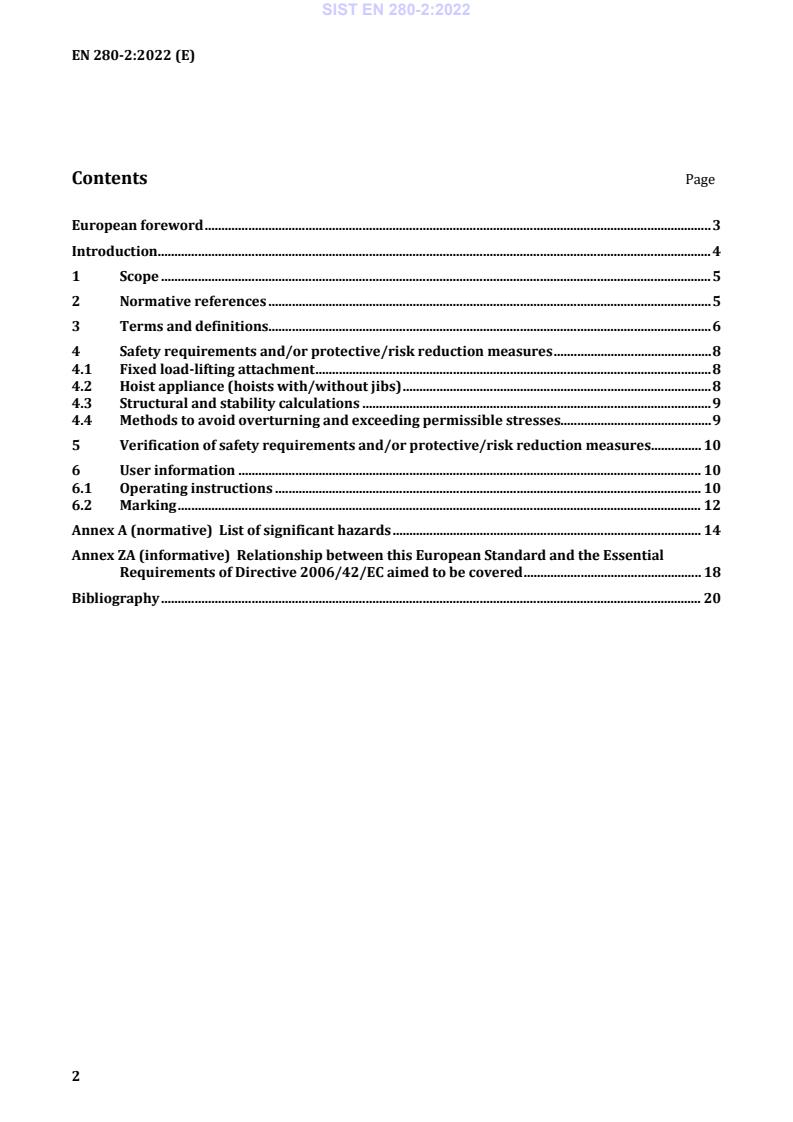
Contents Page
European foreword . 3
Introduction. 4
1 Scope . 5
2 Normative references . 5
3 Terms and definitions. 6
4 Safety requirements and/or protective/risk reduction measures . 8
4.1 Fixed load-lifting attachment . 8
4.2 Hoist appliance (hoists with/without jibs) . 8
4.3 Structural and stability calculations . 9
4.4 Methods to avoid overturning and exceeding permissible stresses. 9
5 Verification of safety requirements and/or protective/risk reduction measures. 10
6 User information . 10
6.1 Operating instructions . 10
6.2 Marking . 12
Annex A (normative) List of significant hazards . 14
Annex ZA (informative) Relationship between this European Standard and the Essential
Requirements of Directive 2006/42/EC aimed to be covered . 18
Bibliography . 20
European foreword
This document (EN 280-2:2022) has been prepared by Technical Committee CEN/TC 98 “Lifting
platforms”, the secretariat of which is held by DIN.
This European Standard shall be given the status of a national standard, either by publication of an
identical text or by endorsement, at the latest by August 2022, and conflicting national standards shall be
withdrawn at the latest by August 2022.
Attention is drawn to the possibility that some of the elements of this document may be the subject of
patent rights. CEN shall not be held responsible for identifying any or all such patent rights.
This document has been prepared under a Standardization Request given to CEN by the European
Commission and the European Free Trade Association, and supports essential requirements of EU
Directive(s).
For relationship with EU Directive(s), see informative Annex ZA, which is an integral part of this
document.
Any feedback and questions on this document should be directed to the users’ national standards body.
A complete listing of these bodies can be found on the CEN website.
According to the CEN-CENELEC Internal Regulations, the national standards organisations of the
following countries are bound to implement this European Standard: Austria, Belgium, Bulgaria, Croatia,
Cyprus, Czech Republic, Denmark, Estonia, Finland, France, Germany, Greece, Hungary, Iceland, Ireland,
Italy, Latvia, Lithuania, Luxembourg, Malta, Netherlands, Norway, Poland, Portugal, Republic of North
Macedonia, Romania, Serbia, Slovakia, Slovenia, Spain, Sweden, Switzerland, Turkey and the United
Kingdom.
Introduction
This document is a harmonized standard to provide one means for Mobile Elevating Work Platforms
(MEWPs) of Type 1, equipped with a load lifting appliance and designed for lifting suspended loads, to
conform to the essential health and safety requirements of the Machinery Directive 2006/42/EC.
This document is a type C standard as stated in EN ISO 12100:2010.
When provisions of this type C standard are different from those which are stated in type A or B
standards, the provisions of this type C standard take precedence over the provisions of the other
standards, for machines that have been designed and built according to the provisions of this type C
standard.
The machinery concerned and the extent to which hazards are covered are indicated in the scope of this
document.
1 Scope
This document, which is to be used in conjunction with EN 280-1:2022, specifies the additional safety
requirements for MEWPs of Type 1 Group B equipped with a load lifting appliance. The load-lifting
appliance is designed for lifting suspended loads only as part of the task being carried out by personnel
from the work platform. This document deals with the additional hazards, hazardous situations and
events relevant to load lifting appliances either on the extending lifting structure or on the work platform,
when the MEWP and load lifting appliance are used as intended and under conditions of misuse which
are reasonably foreseeable by the manufacturer of the MEWP. The significant hazards covered by this
document are listed in Annex A.
This document does not cover the following:
a) the use of a MEWP for lifting persons as a suspended load;
b) the use of a MEWP for lifting suspended loads from a control position other than the work platform;
c) requirements for lifting accessories;
d) lifting or lowering of suspended loads for general materials handling as carried out by a crane;
e) MEWPs compliant with EN 280-1:2022, 4.4.1.5 and/or 4.4.1.6 (enhanced stability and overload
criteria);
f) MEWPS others than Type1 Group B.
Load lifting appliance can be:
g) fixed load attachment points on the work platform or on the extending lifting structure where the
load can be positioned in reach of the personnel on the platform;
h) lifting equipment for lifting or lowering the load with a stationary platform. The equipment is
attached to the work platform or extending structure and may have a load lifting jib.
NOTE The lifting equipment can be either permanently attached or removable.
2 Normative references
The following documents are referred to in the text in such a way that some or all of their content
constitutes requirements of this document. For dated references, only the edition cited applies. For
undated references, the latest edition of the referenced document (including any amendments) applies.
EN 280-1:2022, Mobile elevating work platforms - Part 1: Design calculations - Stability criteria -
Construction - Safety - Examinations and tests
EN 13001-2:2021, Crane safety - General design - Part 2: Load actions
EN 14492-2:2019, Cranes - Power driven winches and hoists - Part 2: Power driven hoists
EN 60204-32:2008, Safety of machinery - Electrical equipment of machines - Part 32: Requirements for
hoisting machines (IEC 60204 32:2008)
EN ISO 12100:2010, Safety of machinery - General principles for design - Risk assessment and risk reduction
(ISO 12100:2010)
EN ISO 13850:2015, Safety of machinery - Emergency stop function - Principles for design (ISO 13850:2015)
EN ISO 13854:2019, Safety of machinery - Minimum gaps to avoid crushing of parts of the human body
(ISO 13854:2017)
EN ISO 13857:2019, Safety of machinery - Safety distances to prevent hazard zones being reached by upper
and lower limbs (ISO 13857:2019)
3 Terms and definitions
For the purposes of this document, the terms and definitions given in EN 280-1:2022,
EN ISO 12100:2010, and the following apply (see also Figure 1 for some illustrations of definitions).
ISO and IEC maintain terminological databases for use in standardization at the following addresses:
— IEC Electropedia: available at https://www.electropedia.org/
— ISO Online browsing platform: available at https://www.iso.org/obp
3.1
load lifting appliance
load attachment point or hoist appliance
3.2
lifting equipment
hoist with or without load lifting jibs, with or without hoist mediums and load holding device, which is
permanently mounted or removable
3.3
lifting accessories
component or equipment not attached to the lifting machinery, allowing the load to be held, which is
placed between the machinery and the load or on the load itself, or which is intended to constitute an
integral part of the load
Note 1 to entry: Slings and their components are also regarded as lifting accessories.
3.4
load lifting jib
part of the lifting equipment which provides the necessary radius and/or height of the load holding device
(definition similar to ISO 4306-1:2007)
a b
Key
a boom structure load attachment point
b work platform lifting equipment
Figure 1 — Example of load lifting appliance
Key
1 work platform
2 lifting equipment
3 hoist
4 load lifting jib
5 hoist medium
6 load holding device
7 lifting accessories
8 payload
a lifting
b lowering
Figure 2 — Example of lifting equipment in the work platform
4 Safety requirements and/or protective/risk reduction measures
4.1 Fixed load-lifting attachment
4.1.1 The load-lifting attachment shall be secured so as to prevent unintentional loosening of the lifting
accessories.
4.1.2 The load shall be suspended freely and guided by the movements of the extending structure of
the MEWP. The hoist medium shall not change length while moving the extending structure.
4.2 Hoist appliance (hoists with/without jibs)
4.2.1 Power-operated hoists shall be designed according to EN 14492-2:2019.
4.2.2 Rope drums, rope pulleys and guides shall be designed according to EN 14492-2:2019.
Trapping and shearing points between moving parts which are within reach of persons (see
EN ISO 13857:2019) on the platform or standing adjacent to the MEWP at ground level shall be avoided
by providing safe clearances in accordance with EN ISO 13854:2019 or guarding.
4.2.3 The hoist lifting speed shall not exceed the work platform lifting speed by boom movement and
not exceed 0,25 m/s. The hoist lowering speed shall not be more than 1,5 times of the hoist lifting speed
and in no case exceed the lowering speed of the work platform.
4.2.4 Manual boom extensions shall have end stops and mechanical locks for the retracted, extended
and working positions.
4.2.5 An interlock shall prevent movements of the MEWP whilst lifting or lowering the load with the
lifting equipment. This interlocking device shall comply with EN 280-1:2022, 4.11 and meet a minimum
Performance Level c. This requirement does not apply for human powered hoists.
4.2.6 Means to reduce the risk of collision between the suspended load and platform occupants due to
the movement of the extending structure and the platform shall be provided.
Aspects to be considered include:
a) a reduced speed of the extending structure and platform;
b) platform position during the lifting, lowering and other movements of the load.
It shall not be possible to position the work platform below the load attachment point. Collisions between
the suspended load and structural parts of the MEWP shall be avoided.
4.2.7 The hydraulic equipment shall comply with EN 280-1:2022, 4.9. Hydraulic hoses in the vicinity of
the operators shall not pose a hazard to them (e.g. due to leakage of hot or pressurized liquids).
4.2.8 Hydraulic cylinders shall comply with EN 280-1:2022, 4.10.
4.2.9 The electrical equipment shall comply with EN 280-1:2022, 4.8 and EN 60204-32:2008.
4.2.10 The control position of the lifting equipment shall comply with EN 280-1:2022, 4.7 and have an
emergency stop according to EN ISO 13850:2015. All emergency stop devices (on the MEWP and on the
load lifting appliance) shall stop all movements of the MEWP and the load lifting appliance.
4.2.11 It shall be possible to activate power-operated lifting equipment from an additional position
easily accessible from the ground as an overriding emergency control function. The additional control
position shall comply with EN 280-1:2022, 4.7.4.
4.2.12 Means shall be provided to control lowering of the load of the hoist even in case of loss of power
supply.
NOTE Use of the boom functions is permissible.
4.3 Structural and stability calculations
The load lifting appliance and its interface with the MEWP shall comply with EN 280-1:2022, 4.2.5.2 and
4.2.5.3. The force from the hoist load shall be considered when designing the MEWP (see EN 280-1:2022,
4.2.3.5). To consider dynamic effect of hoisting, the hoist load shall be multiplied by a dynamic factor in
accordance with EN 13001-2:2021, 4.2.2.2, using hoisting class HC1 (see Table 1).
Wind forces on the hoist load shall be calculated in accordance with EN 13001-2:2021, 4.2.3.1.
Table 1 — Partial safety factors (based on Table 3 of EN 280-1:2022)
Clause Loading Partial safety factors γ
p
Regular loads Occasional loads
4.2.3.1 in Rated load 1,34 1,22
EN 280-1:2022
4.2.3.2 in Dead weights 1,22 1,16
EN 280-1:2022
4.2.3.3 in Wind loads − 1,22
EN 280-1:2022
4.2.3.4 in Manual force − 1,22
EN 280-1:2022
4.3 in EN 280-2:2022 Dynamic hoist load 1,34 1,22
4.4 Methods to avoid overturning and exceeding permissible stresses
4.4.1 The combination of the MEWP with the load lifting appliance shall be equipped with a safety
function according to EN 280-1:2022, 4.4.1.2, 4.4.1.3 and/or 4.4.1.4 which avoids the risk of overturning
and exceeding the permissible stresses. In addition to the requirements in EN 280-1:2022, 4.4.1 the safety
function shall also stop the powered load lifting appliance. The safety function shall comply with
EN 280-1:2022, 4.11.
4.4.2 Where the rated load of the load lifting appliance is greater than the rated load of the work
platform, a safety function according to EN 280-1:2022, 4.11 with at least PL
...
Questions, Comments and Discussion
Ask us and Technical Secretary will try to provide an answer. You can facilitate discussion about the standard in here.
Loading comments...