

oSIST prEN 16230-1:2026
(Main)Leisure karts - Part 1: Safety requirements and test methods for karts
- Abstract
This document is applicable for karts that are not intended to be used on public roads.
This document applies to:
- leisure karts only;
- karts propelled by a combustion engine, including LPG combustion engines;
- karts propelled by an electric powertrain where the working voltage is below 30 V AC rms and 60 V DC. The traction battery is a Li-ion battery or a lead acid battery;
- karts used on indoor and outdoor tracks, permanent or temporary;
- karts used on supervised tracks designed for leisure karting, with a sealed ground (such as asphalt, concrete, ice or snow).
This document does not apply to:
- karts used for competition organized by and under the responsibility of the CIK-FIA and/or ASN, ensuring through the granting of licenses by an ASN or one of its affiliated members as defined in the International Sporting code, compliance with the safety, sporting, disciplinary and technical rules of the CIAK-FIA and/ or ASN;
- karts designed exclusively for competition and toys;
- cross country karts;
- karts with two or more seats;
- karts used on tracks not mentioned above (such as mud, earth);
- karts used in amusement parks (refer to EN 13814-1:2019+A1:2024 [1] for these installations).
The requirements related to the hazards of swappable battery propulsion systems are not covered in this document.
The requirements related to whole-body vibration are not covered in this document.
This document specifies appropriate measures to eliminate or reduce the risks arising from significant hazards, hazardous situations and events (see Clause 6) during operation and maintenance of the karts, when carried out as intended by the manufacturer.
Safety in karting activities is dependent on a correct interaction between leisure karts and the track equipment and facilities. General recommendations for tracks to be used for leisure karting are included in this part of the standard.
This document is not applicable to karts that are manufactured before the date of publication of this document by CEN.
NOTE Specific requirements for tracks design and operation will be included in a future Part 2 of this standard.
- Status
- Not Published
- Public Enquiry End Date
- 04-Sep-2026
- Technical Committee
- I13 - Imaginarni 13
- Current Stage
- 4020 - Public enquire (PE) (Adopted Project)
- Start Date
- 14-Jul-2026
- Due Date
- 01-Dec-2026
- Completion Date
- 07-Sep-2026

oSIST prEN 16230-1:2026 is the Slovenian adoption of the draft European Standard prEN 16230-1 from CEN. It specifies safety requirements and test methods for leisure karts used off public roads, including combustion-engine karts and low-voltage electric karts on supervised indoor and outdoor tracks. Manufacturers, track operators, test laboratories, and buyers use it to design, check, and verify kart safety, marking, and user information.
What does oSIST prEN 16230-1:2026 specify?
oSIST prEN 16230-1:2026 covers leisure karts that are not intended for public roads and are used on sealed, supervised tracks. It applies to combustion-engine karts, including LPG combustion engines, and to electric karts with working voltage below 30 V AC rms and 60 V DC, using a Li-ion battery or a lead acid battery.
The document excludes competition karts under CIK-FIA and/or ASN control, toys, cross country karts, two-seat karts, karts for mud or earth tracks, and karts used in amusement parks. It also leaves out hazards linked to swappable battery propulsion systems and whole-body vibration.
The standard is organized into clauses 1 to 9, followed by five technical annexes and Annex ZA.
| Annex | What it covers |
|---|---|
| Annex A | Measurement methods for kart all around protection |
| Annex B | Crash test protocol |
| Annex C | Brake system performance tests for leisure karts |
| Annex D | Noise test code for karts |
| Annex E | Vibration test methods |
| Annex ZA | Relationship to Regulation (EU) 2023/1230 |
What are the key requirements of oSIST prEN 16230-1:2026?
oSIST prEN 16230-1:2026 combines design rules, protective measures, and verification tests. The main practical message is that a leisure kart must be safe as a machine, but also safe as part of a karting system that includes the track, the driver briefing, and the maintenance process.
Kart type, size, and seating
Clause 4 classifies leisure karts as A1, A2, B, C1, or C2, and links each type to design parameters such as speed, power, and reference driver size. That matters because the class determines which crash, brake, and seating provisions apply.
Clause 7.2 sets limits for kart dimensions and wheelbase-to-track proportions. Clause 7.3.2 then requires the seat to fit the intended driver range, and allows inserts to adapt the seat. In practice, the kart must fit the driver well enough to preserve control and braking posture.
Protection against impact and break-up
Clause 7.3.1 requires all around protection to prevent wheel-to-kart contact, reduce the risk of karts climbing, rolling over, or going under track protection, and reduce impact loads on the driver and the kart. Annex A gives the measurement method, including the 12 checking positions and the tool for shaped protection surfaces.
Clause 7.3.1.6 requires frontal, side, and rear energy absorption systems, verified by Annex B crash testing. The test is repeated four times in each impact direction, and the kart must stay within the acceleration limits set for its type. In practice, this means the kart structure and protection must keep absorbing impacts after repeated low-speed contacts, not just once.
Clause 7.3.1.5 states that the Rechargeable Electrical Energy Storage System (REESS) shall not be part of the all-around protection and shall be encapsuled by it. That matters for electric kart layout and packaging.
Braking, steering, and control
Clause 7.3.3 requires a brake system that can effectively slow the kart and reduce contact, collision, and loss-of-control risks. A1 and A2 karts are checked with a static torque test, while B, C1, and C2 karts use dynamic tests in Annex C. If regenerative braking is used, the mechanical brake remains the primary brake, and regenerative braking must stay predictable and not user-controllable.
Clause 7.4 requires brake-system control arrangements that avoid single-point failures, including independent braking on split rear axles or differentials. Clause 7.4.2 sets steering-wheel dimensions, grip shape, closure of the wheel center, and safe clearances. Clause 7.9 requires the accelerator on the right and the brake on the left, and for electric powertrains it sets the required performance level PLr c for preventing unintentional self-start, movement, and automatic direction reversal.
Access, wheels, tyres, and rotating parts
Clause 7.10 requires safe stepping in and out of the kart, including floor-plate coverage and protection of steering rods and the REESS where relevant. Clause 7.11 requires secure wheel fixing and tyres with wear indicators and suitable pressure guidance in the manual.
Clause 7.7 requires guards or covers on rotating parts to prevent hair, loose clothing, and body parts from being caught. Clause 7.8 requires protection against hot surfaces above 58 °C.
LPG and electric propulsion
Clause 7.12 requires LPG components to stay inside the all-around protection, with secure tank retention, overfill control, shut-off functions, and hose routing that avoids damage in kart-to-kart or kart-to-track contact. Clause 7.13 covers electric powertrains: short-circuit protection, visible drive indication, emergency stop, wiring protection, REESS ingress protection, battery and charger requirements, and EMC testing. Clause 7.13 also ties Li-ion batteries to UN 38.3 and EN IEC 62619, and lead-acid batteries to the battery standards named in the document.
Noise, vibration, emissions, and use information
Clause 7.15 requires noise emission measurement to Annex D. Clause 7.16 addresses hand-transmitted vibration, with Annex E giving the measurement method. Clause 7.17 routes exhaust gases away from the driver, and Clause 7.18 protects starter batteries and batteries for second systems.
Clauses 9.1 to 9.5 require a user manual, spare parts catalogue, safety stickers, pictograms, and indelible marking. The manual must also cover track compatibility, driver age and training, driver briefing, protective equipment, refuelling warnings, and, for electric karts, charging and battery handling.
What terms does oSIST prEN 16230-1:2026 define?
- kart - Motor-driven sports equipment with four wheels not set in a straight line, two powered wheels, and no suspension.
- leisure karting - An organized karting activity offered as a leisure service, including leisure competition.
- leisure kart - A kart intended and designed for leisure karting activities.
- all around protection - A device around the kart that protects the driver and kart from external impacts and helps eliminate wheel-to-kart contact.
- track - A sealed-ground loop-and-straight circuit, separated from the public by a barrier, designed for safe kart driving.
- slow track - A track designed and operated for karts up to 70 km/h.
- fast track - A track designed and operated for karts up to 110 km/h.
- REESS - Rechargeable Electrical Energy Storage System, meaning the rechargeable energy source for electric propulsion.
- working voltage - The highest rms voltage that can occur between conductive parts under open-circuit or normal operating conditions.
Who uses oSIST prEN 16230-1:2026?
oSIST prEN 16230-1:2026 is used by kart manufacturers, chassis and component suppliers, and designers of electric or LPG propulsion systems. It is also used by track operators, rental operators, maintenance staff, and training staff because the document links the kart to the track layout, driver briefing, and operating controls.
Test laboratories and conformity assessment bodies use it for impact, brake, noise, and vibration testing. Buyers and safety managers use it to check whether a kart is suitable for a given type of leisure track and whether the required information, marking, and spare-parts support are in place.
What changed in oSIST prEN 16230-1:2026 from the previous edition?
oSIST prEN 16230-1:2026 will supersede EN 16230-1:2013+A1:2014. The technical changes stated in the document are:
- electric karts are included in the scope;
- requirements for electric powertrain protection against incorrect action on control systems are added;
- requirements for the REESS are added;
- specific requirements for the electrical powertrain are added;
- additional information for use linked to the electric propulsion system is added.
Which standards are used with oSIST prEN 16230-1:2026?
oSIST prEN 16230-1:2026 relies on several referenced standards and related documents:
- EN ISO 12100:2010 - general principles for risk assessment and risk reduction for machinery.
- EN ISO 13849-1:2023 - required performance level for safety-related parts of the electric powertrain control system.
- EN 60204-1:2018 - electrical equipment of machines, including the stop category used for the emergency stop.
- EN 60529:1991 - IP protection ratings for the REESS.
- EN IEC 62619:2022 - safety requirements for industrial lithium secondary cells and batteries.
- UN 38.3 - transport testing for lithium batteries.
- EN 50342-1:2015 and IEC 60095-1:2018 - lead-acid starter battery requirements and test methods.
- EN 60335-2-29:2021 - battery charger safety.
- EN IEC 61000-6-2:2019 and EN IEC 61000-6-4:2019 - EMC immunity and emission for industrial environments.
- EN ISO 3744:2026 - sound power measurement used in the noise test code.
- EN ISO 5349-1:2001, EN ISO 8041-1:2017, and EN ISO 8041-2:2021 - hand-transmitted vibration measurement and instrumentation.
- ISO 3864-1:2011 and ISO 3864-2:2016 - safety sign and label design.
- EN 13814-1:2019+A1:2024 - referenced for amusement park installations outside this document’s scope.
- HD 60364-5-52:2011 - cited as guidance for selecting power cable size.
What does the oSIST prEN 16230-1:2026 document contain?
The document contains type-class tables, hazard identification, and detailed test methods that support design verification and conformity assessment. Table 1 defines kart types, Table 2 lists significant hazards, Table 3 gives dimensional limits, Table 4 gives all-around protection values, Table 5 gives required performance levels, and Table 7 links kart speed to driver age, evaluation, and training.
Annex A gives the measurement setup for all-around protection, including the kart position, tool use, and recorded dimensions. Annex B defines the pendulum crash test and the required data capture. Annex C contains burnishing, dry stop, and heat fade procedures for brake performance. Annex D defines the noise test code and the dual-number noise declaration, while Annex E gives static vibration test methods for the steering wheel.
Relations
- Effective Date
- 17-Jul-2024
Get Certified
Connect with accredited certification bodies for this standard

TÜV Rheinland
TÜV Rheinland is a leading international provider of technical services.

TÜV SÜD
TÜV SÜD is a trusted partner of choice for safety, security and sustainability solutions.

DEKRA Certification Inc.
DEKRA US certification services.
Sponsored listings
Frequently Asked Questions
oSIST prEN 16230-1:2026 is a draft published by the Slovenian Institute for Standardization (SIST). Its full title is "Leisure karts - Part 1: Safety requirements and test methods for karts". This standard covers: This document is applicable for karts that are not intended to be used on public roads. This document applies to: - leisure karts only; - karts propelled by a combustion engine, including LPG combustion engines; - karts propelled by an electric powertrain where the working voltage is below 30 V AC rms and 60 V DC. The traction battery is a Li-ion battery or a lead acid battery; - karts used on indoor and outdoor tracks, permanent or temporary; - karts used on supervised tracks designed for leisure karting, with a sealed ground (such as asphalt, concrete, ice or snow). This document does not apply to: - karts used for competition organized by and under the responsibility of the CIK-FIA and/or ASN, ensuring through the granting of licenses by an ASN or one of its affiliated members as defined in the International Sporting code, compliance with the safety, sporting, disciplinary and technical rules of the CIAK-FIA and/ or ASN; - karts designed exclusively for competition and toys; - cross country karts; - karts with two or more seats; - karts used on tracks not mentioned above (such as mud, earth); - karts used in amusement parks (refer to EN 13814-1:2019+A1:2024 [1] for these installations). The requirements related to the hazards of swappable battery propulsion systems are not covered in this document. The requirements related to whole-body vibration are not covered in this document. This document specifies appropriate measures to eliminate or reduce the risks arising from significant hazards, hazardous situations and events (see Clause 6) during operation and maintenance of the karts, when carried out as intended by the manufacturer. Safety in karting activities is dependent on a correct interaction between leisure karts and the track equipment and facilities. General recommendations for tracks to be used for leisure karting are included in this part of the standard. This document is not applicable to karts that are manufactured before the date of publication of this document by CEN. NOTE Specific requirements for tracks design and operation will be included in a future Part 2 of this standard.
This document is applicable for karts that are not intended to be used on public roads. This document applies to: - leisure karts only; - karts propelled by a combustion engine, including LPG combustion engines; - karts propelled by an electric powertrain where the working voltage is below 30 V AC rms and 60 V DC. The traction battery is a Li-ion battery or a lead acid battery; - karts used on indoor and outdoor tracks, permanent or temporary; - karts used on supervised tracks designed for leisure karting, with a sealed ground (such as asphalt, concrete, ice or snow). This document does not apply to: - karts used for competition organized by and under the responsibility of the CIK-FIA and/or ASN, ensuring through the granting of licenses by an ASN or one of its affiliated members as defined in the International Sporting code, compliance with the safety, sporting, disciplinary and technical rules of the CIAK-FIA and/ or ASN; - karts designed exclusively for competition and toys; - cross country karts; - karts with two or more seats; - karts used on tracks not mentioned above (such as mud, earth); - karts used in amusement parks (refer to EN 13814-1:2019+A1:2024 [1] for these installations). The requirements related to the hazards of swappable battery propulsion systems are not covered in this document. The requirements related to whole-body vibration are not covered in this document. This document specifies appropriate measures to eliminate or reduce the risks arising from significant hazards, hazardous situations and events (see Clause 6) during operation and maintenance of the karts, when carried out as intended by the manufacturer. Safety in karting activities is dependent on a correct interaction between leisure karts and the track equipment and facilities. General recommendations for tracks to be used for leisure karting are included in this part of the standard. This document is not applicable to karts that are manufactured before the date of publication of this document by CEN. NOTE Specific requirements for tracks design and operation will be included in a future Part 2 of this standard.
oSIST prEN 16230-1:2026 is classified under the following ICS (International Classification for Standards) categories: 43.100 - Passenger cars. Caravans and light trailers; 97.220.01 - Sports equipment and facilities in general. The ICS classification helps identify the subject area and facilitates finding related standards.
oSIST prEN 16230-1:2026 has the following relationships with other standards: It is inter standard links to SIST EN 16230-1:2014+A1:2015. Understanding these relationships helps ensure you are using the most current and applicable version of the standard.
oSIST prEN 16230-1:2026 is associated with the following European legislation: EU Directives/Regulations: 2006/42/EC, 2023/1230; Standardization Mandates: M/396, M/605. When a standard is cited in the Official Journal of the European Union, products manufactured in conformity with it benefit from a presumption of conformity with the essential requirements of the corresponding EU directive or regulation.
oSIST prEN 16230-1:2026 is available in PDF format for immediate download after purchase. The document can be added to your cart and obtained through the secure checkout process. Digital delivery ensures instant access to the complete standard document.
Standards Content (Sample)
SLOVENSKI STANDARD
01-september-2026
Gokarti za prosti čas - 1. del: Varnostne zahteve in preskusne metode za gokarte
Leisure karts - Part 1: Safety requirements and test methods for karts
Freizeitkarts - Teil 1: Sicherheitstechnische Anforderungen und Prüfverfahren für Karts
Karts de loisir - Partie 1: Exigences de sécurité et méthodes d'essai relatives aux karts
Ta slovenski standard je istoveten z: prEN 16230-1
ICS:
43.100 Osebni avtomobili. Bivalne Passenger cars. Caravans
prikolice in lahke prikolice and light trailers
97.220.01 Športna oprema in Sports equipment and
pripomočki na splošno facilities in general
2003-01.Slovenski inštitut za standardizacijo. Razmnoževanje celote ali delov tega standarda ni dovoljeno.
DRAFT
EUROPEAN STANDARD
NORME EUROPÉENNE
EUROPÄISCHE NORM
June 2026
ICS 43.100 Will supersede EN 16230-1:2013+A1:2014
English Version
Leisure karts - Part 1: Safety requirements and test
methods for karts
Karts de loisir - Partie 1: Exigences de sécurité et Freizeitkarts - Teil 1: Sicherheitstechnische
méthodes d'essai relatives aux karts Anforderungen und Prüfverfahren für Karts
This draft European Standard is submitted to CEN members for enquiry. It has been drawn up by the Technical Committee
CEN/TC 354.
If this draft becomes a European Standard, CEN members are bound to comply with the CEN/CENELEC Internal Regulations
which stipulate the conditions for giving this European Standard the status of a national standard without any alteration.
This draft European Standard was established by CEN in three official versions (English, French, German). A version in any other
language made by translation under the responsibility of a CEN member into its own language and notified to the CEN-CENELEC
Management Centre has the same status as the official versions.
CEN members are the national standards bodies of Austria, Belgium, Bulgaria, Croatia, Cyprus, Czech Republic, Denmark, Estonia,
Finland, France, Germany, Greece, Hungary, Iceland, Ireland, Italy, Latvia, Lithuania, Luxembourg, Malta, Netherlands, Norway,
Poland, Portugal, Republic of North Macedonia, Romania, Serbia, Slovakia, Slovenia, Spain, Sweden, Switzerland, Türkiye and
United Kingdom.
Recipients of this draft are invited to submit, with their comments, notification of any relevant patent rights of which they are
aware and to provide supporting documentation.
Warning : This document is not a European Standard. It is distributed for review and comments. It is subject to change without
notice and shall not be referred to as a European Standard.
EUROPEAN COMMITTEE FOR STANDARDIZATION
COMITÉ EUROPÉEN DE NORMALISATION
EUROPÄISCHES KOMITEE FÜR NORMUNG
CEN-CENELEC Management Centre: Rue de la Science 23, B-1040 Brussels
© 2026 CEN All rights of exploitation in any form and by any means reserved Ref. No. prEN 16230-1:2026 E
worldwide for CEN national Members.
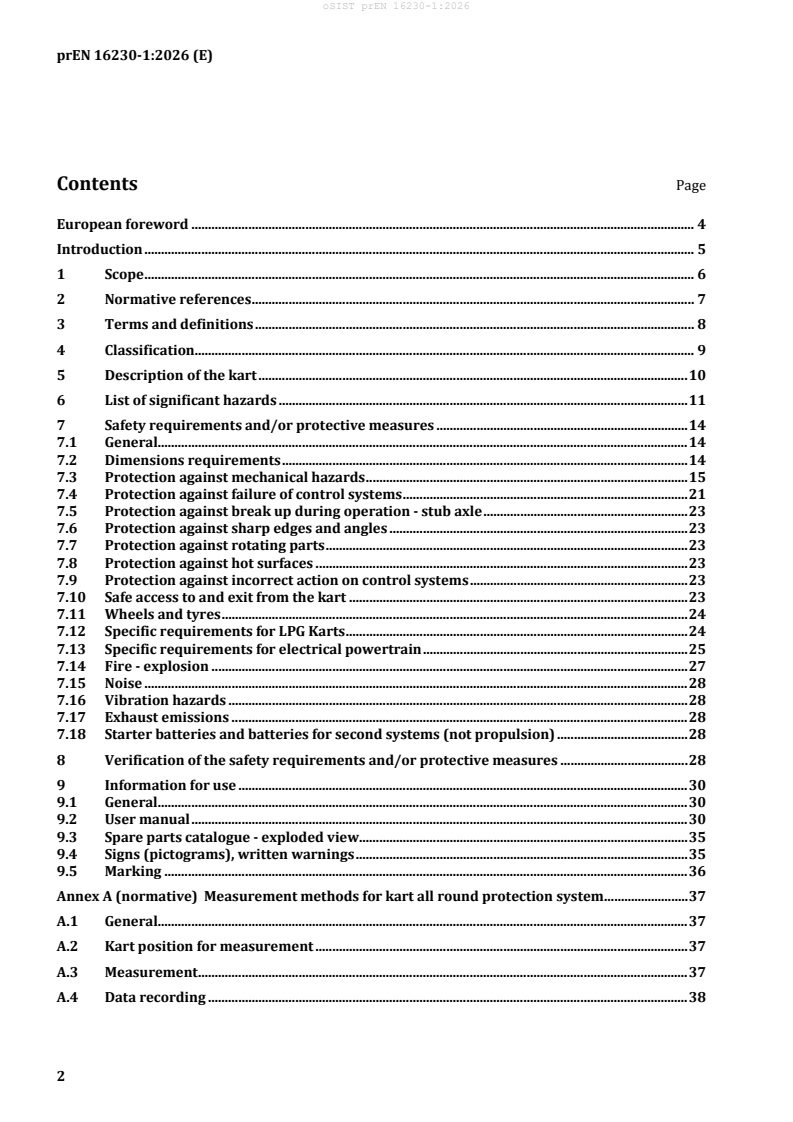
Contents Page
European foreword . 4
Introduction . 5
1 Scope . 6
2 Normative references . 7
3 Terms and definitions . 8
4 Classification. 9
5 Description of the kart . 10
6 List of significant hazards . 11
7 Safety requirements and/or protective measures . 14
7.1 General. 14
7.2 Dimensions requirements . 14
7.3 Protection against mechanical hazards . 15
7.4 Protection against failure of control systems . 21
7.5 Protection against break up during operation - stub axle . 23
7.6 Protection against sharp edges and angles . 23
7.7 Protection against rotating parts . 23
7.8 Protection against hot surfaces . 23
7.9 Protection against incorrect action on control systems . 23
7.10 Safe access to and exit from the kart . 23
7.11 Wheels and tyres . 24
7.12 Specific requirements for LPG Karts . 24
7.13 Specific requirements for electrical powertrain . 25
7.14 Fire - explosion . 27
7.15 Noise . 28
7.16 Vibration hazards . 28
7.17 Exhaust emissions . 28
7.18 Starter batteries and batteries for second systems (not propulsion) . 28
8 Verification of the safety requirements and/or protective measures . 28
9 Information for use . 30
9.1 General. 30
9.2 User manual . 30
9.3 Spare parts catalogue - exploded view . 35
9.4 Signs (pictograms), written warnings . 35
9.5 Marking . 36
Annex A (normative) Measurement methods for kart all round protection system . 37
A.1 General. 37
A.2 Kart position for measurement . 37
A.3 Measurement . 37
A.4 Data recording . 38
A.5 Information to be reported . 38
Annex B (normative) Crash test protocol. 39
B.1 Pendulum impact test . 39
B.2 Instrumentation . 40
B.3 Procedure . 40
B.4 Data acquisition . 42
Annex C (normative) Brake system performance tests – leisure kart. 43
C.1 Dynamic tests . 43
C.2 Information to be reported . 48
Annex D (normative) Noise test code for karts . 49
D.1 General . 49
D.2 Operating and mounting conditions . 49
D.3 Noise measurements . 49
D.4 Test environment . 49
D.5 Determination of A-weighted emission sound pressure level at driver’s ear . 50
D.6 Determining if further measurements are necessary . 50
D.7 Determination of the A-weighted sound power level of the kart . 50
D.8 Information to be recorded . 52
D.9 Information to be reported . 52
D.10 Declaration and verification of noise emission values . 53
Annex E (informative) Vibration test methods . 54
E.1 Background . 54
E.2 Coupling the hand to the vibration source . 55
E.3 Positioning and operating the kart during the test . 55
E.4 Parameters to be measured . 55
E.5 Determination of the vibration levels . 56
E.6 Information to be recorded . 56
E.7 Information to be reported . 57
Annex ZA (informative) Relationship between this European Standard and the essential
requirements of Regulation (EU) 2023/1230 aimed to be covered . 58
Bibliography . 63
European foreword
This document (prEN 16230-1:2026) has been prepared by Technical Committee CEN/TC "354", the
secretariat of which is held by AFNOR.
This document is currently submitted to the CEN Enquiry.
This document will supersede EN 16230-1:2013+A1:2014.
In comparison with the previous edition, the following technical modifications have been made:
— electric karts included in the Scope;
— requirements for electric powertrain for protection against incorrect action on control systems;
— requirements for the Rechargeable Electrical Energy Storage System;
— specific requirements for electrical powertrain;
— additional information for use linked to the electric propulsion system.
This document has been prepared under a standardization request addressed to CEN by the European
Commission. The Standing Committee of the EFTA States subsequently approves these requests for its
Member States.
For the relationship with EU Legislation, see informative Annex ZA, which is an integral part of this
document.
Introduction
This document is a type C standard as stated in EN ISO 12100:2010.
The kart concerned and the extent to which hazards, hazardous situations and hazardous events are
covered are indicated in the scope of this document.
When provisions of this type C standard are different from those which are stated in type A or B
standards, the provisions of this type C standard take precedence over the provisions of the other
standards, for karts that have been designed and built according to the provisions of this type C
standard.
1 Scope
This document is applicable for karts that are not intended to be used on public roads.
This document applies to:
— leisure karts only;
— karts propelled by a combustion engine, including LPG combustion engines;
— karts propelled by an electric powertrain where the working voltage is below 30 V AC rms and 60 V
DC. The traction battery is a Li-ion battery or a lead acid battery;
— karts used on indoor and outdoor tracks, permanent or temporary;
— karts used on supervised tracks designed for leisure karting, with a sealed ground (such as asphalt,
concrete, ice or snow).
This document does not apply to:
— karts used for competition organized by and under the responsibility of the CIK-FIA and/or ASN,
ensuring through the granting of licenses by an ASN or one of its affiliated members as defined in
the International Sporting code, compliance with the safety, sporting, disciplinary and technical
rules of the CIAK-FIA and/ or ASN;
— karts designed exclusively for competition and toys;
— cross country karts;
— karts with two or more seats;
— karts used on tracks not mentioned above (such as mud, earth);
— karts used in amusement parks (refer to EN 13814-1:2019+A1:2024 [1] for these installations).
The requirements related to the hazards of swappable battery propulsion systems are not covered in
this document.
The requirements related to whole-body vibration are not covered in this document.
This document specifies appropriate measures to eliminate or reduce the risks arising from significant
hazards, hazardous situations and events (see Clause 6) during operation and maintenance of the karts,
when carried out as intended by the manufacturer.
Safety in karting activities is dependent on a correct interaction between leisure karts and the track
equipment and facilities. General recommendations for tracks to be used for leisure karting are
included in this part of the standard.
This document is not applicable to karts that are manufactured before the date of publication of this
document by CEN.
NOTE Specific requirements for tracks design and operation will be included in a future Part 2 of this
standard.
2 Normative references
The following documents are referred to in the text in such a way that some or all of their content
constitutes requirements of this document. For dated references, only the edition cited applies. For
undated references, the latest edition of the referenced document (including any amendments) applies.
EN 50342-1:2015, Lead-acid starter batteries - Part 1: General requirements and methods of test
EN 60204-1:2018, Safety of machinery - Electrical equipment of machines - Part 1: General requirements
EN 60335-2-29:2021, Household and similar electrical appliances - Safety - Part 2-29: Particular
requirements for battery chargers
EN 60529:1991, Degrees of protection provided by enclosures (IP Code) (IEC 60529:1989)
EN IEC 61000-6-2:2019, Electromagnetic compatibility (EMC) - Part 6-2: Generic standards - Immunity
standard for industrial environments
EN IEC 61000-6-4:2019, Electromagnetic compatibility (EMC) - Part 6-4: Generic standards - Emission
standard for industrial environments
EN IEC 62619:2022, Secondary cells and batteries containing alkaline or other non-acid electrolytes -
Safety requirements for secondary lithium cells and batteries, for use in industrial applications (IEC
62619:2022)
EN ISO 3744:2026, Acoustics - Determination of sound power levels of noise sources using sound pressure -
Engineering methods for an essentially free field over a reflecting plane (ISO 3744:2025)
EN ISO 5349-1:2001, Mechanical vibration - Measurement and evaluation of human exposure to hand-
transmitted vibration - Part 1: General requirements (ISO 5349-1:2001)
EN ISO 8041-1:2017, Human response to vibration - Measuring instrumentation - Part 1: General purpose
vibration meters (ISO 8041-1:2017)
EN ISO 8041-2:2021, Human response to vibration - Measuring instrumentation - Part 2: Personal
vibration exposure meters (ISO 8041-2:2021)
EN ISO 12100:2010, Safety of machinery - General principles for design - Risk assessment and risk
reduction (ISO 12100:2010)
EN ISO 13849-1:2023, Safety of machinery - Safety-related parts of control systems - Part 1: General
principles for design (ISO 13849-1:2023)
IEC 60095-1:2018, Lead-acid starter batteries - Part 1: General requirements and methods of test
ISO 3864-1:2011, Graphical symbols - Safety colours and safety signs - Part 1: Design principles for safety
signs and safety markings
ISO 3864-2:2016, Graphical symbols - Safety colours and safety signs - Part 2: Design principles for
product safety labels
UN 38.3, Testing for Lithium Batteries
As impacted by EN 60204-1:2018/A1:2025.
As impacted by EN 60335-2-29:2021/A1:2021 and EN 60335-2-29:2021/A11:2024.
As impacted by EN 60529:1991/corrigendum May 1993, EN 60529:1991/A1:2000, EN 60529:1991/A2:2013,
EN 60529:1991/A2:2013/AC:2019-02 and EN 60529:1991/AC:2016-12.
3 Terms and definitions
For the purposes of this document, the following terms and definitions apply.
ISO and IEC maintain terminology databases for use in standardization at the following addresses:
— ISO Online browsing platform: available at https://www.iso.org/obp/
— IEC Electropedia: available at https://www.electropedia.org/
3.1
kart
multilane motor driven sports equipment, with four wheels not set in a straight line, two wheels of
which are powered and the other two serving as control, and without suspension
3.2
leisure karting
organized activity, offering leisure services in karting including leisure competition
3.3
leisure kart
kart intended and designed for leisure karting activities
3.4
all around protection
device made of one or several parts encircling the kart and meant to protect the driver and the kart
from external impacts, so as to eliminate the risk of wheel to kart contact
3.5
evaluation
assessment of the ability of a person to drive
3.6
training
teaching process by which a driver is brought to an appropriate level of driving standard for the session
or event they are participating in
3.7
track
sealed ground consisting of a series of loops and straights that are continuous, designed and operated to
provide safe driving of karts and located in an area of land or building that is separated from the public
by a barrier
3.8
slow track
track designed and operated to provide safe driving of karts up to 70 km/h
3.9
fast track
track designed and operated to provide safe driving of karts up to 110 km/h
3.10
Liquified Petrolum Gas
LPG
mixture of propane and butane which is suitable as power fuel for combustion engines and fluid at
room temperature and overpressure
3.11
Rechargeable Electrical Energy Storage System
REESS
rechargeable energy storage system that provides electric energy for electrical propulsion
Note 1 to entry: This energy storage system can also provide energy to auxiliary unit.
3.12
working voltage
highest value of an electrical circuit voltage root-mean-square (rms), which may occur between any
conductive parts in open circuit conditions or under normal operating condition
4 Classification
Leisure karting covers a wide range of activities on indoor and outdoor tracks, and can be used by
drivers of different age, size, weight and experience.
For the purpose of this document, different types of karts have been defined. Table 1 defines the major
design parameters to be taken as a reference by the kart manufacturer for each kart type.
Table 1 — Type of kart – Manufacturer’s design parameters
c
Kart type Slow track Fast track Maximum Reference parameters for crash test only
a a
kart kart power at the
Reference Reference
crankshaft
Maximum Maximum
d
height of dummy
b
(kW )
speed speed
driver
(km/h) (km/h) Reference
(ergonomy
weight of
minimum
driver (kg)
size ranges
for given
type) (mm)
Kart type A1 30 30 3,5 1 150
e
(baby ) (- 100 / +
f
(- 5 / + 10)
f
100)
th
Kart type A2 45 65 5,15 1 350 32 5 percentile
f female
(mini) (- 150 / + (- 10 / + 18)
f
150)
th
Kart type B 70 80 10,3 1 700 1 700 95
percentile
(adult) (- 250 / + (- 250 / +
male
f g f
250) 250 )
th
Kart type C1 70 90 16,9 1 700 78 95
percentile
g f
(adult) (- 250 / + (- 38 / + 23 )
f male
250)
th
Kart type C2 70 110 22,1 1 700 78 95
g f percentile
(adult) (- 250 / + (- 38 / + 23 )
male
f
250)
NOTE See also Table 7 in 9.2.2.3.
a
Engineering design values; it is assumed that karts are used in conjunction with a track designed for their
maximum speed. In some countries, specific regulations may apply regarding age, speed limitation, intended use
or dedicated areas.
b
Measured according to a generally acknowledged standardized method, e.g. ISO 15550, SAE J1349.
c
These parameters do not indicate maximum or minimum driver height or weight of drivers permitted to use
the karts.
d
Hybrid III type dummies used for the crash test as described in B.3.
e
Smallest category of a kart.
f
Range specified according to the relevant 50th percentile dummy.
g
Upper tolerance specified according to the 95th percentile male dummy.
5 Description of the kart
The main components of the karts are described in Figure 1.
Key
1 all around protection
2 stub axle
3 track rods
4 steering wheel
5 rear train
6 seat
7 wheel
8 steering axle
9 energy absorption device
Figure 1 — Names of the components of the kart
6 List of significant hazards
Table 2 below contains all significant hazards, hazardous situations and events, as they are dealt with in
this document, and identified by risk assessment as significant for the karts within the scope of this
standard and which require action to eliminate or reduce the risk.
Table 2 — List of significant hazards
Subclauses Danger zone or source Type of hazard Relevant clause of the
of hazard standard
6.1 Mechanical hazards
Wheel to wheel, or
plastic/metal to wheel
6.1.1 Protection of the kart contact leading to a 7.3.1 Kart protection
“launching” type of roll
over
Karts “climbing” one on
7.3.1 Kart protection
the other
Crash situations leading to
7.3.1 Kart protection
high forces on the driver
Falling on the side under
centrifugal forces
Non efficient braking due
to bad position of the
driver
6.1.2 Seat 7.3.2 Seat
Lack of control due to bad
driving position
Falling aside under lateral
crash
7.3.3 Brake system
Crash situation resulting
Brake system mechanical performance
6.1.3 from a failure of brake
Brake system hydraulic 7.4.1 Brake system
systems
controls
Crash situation resulting
Steering system from a failure of steering
system
6.1.4
Projection of the driver
against the steering wheel,
Steering wheel 7.4.2 Steering wheel
resulting from a frontal
crash
Crash situation resulting 7.5 Protection against
6.1.5 Stub axle from a failure of a stub break up during operation
axle – stub axle
Injuries due to sharp
edges under:
7.6 Protection against
6.1.6 Sharp edges (whole kart)
— normal situations sharp and edges angles
— crash situations
Hair entanglement in
7.7 Protection against
moving parts, especially in
rotating parts
rear axle
Rotating elements
Loose (floating) clothes
Rear axle
entanglement in rotating
6.1.7
parts
Transmission
Brake disk
Risk of inadvertent
contact of the body of the 9.4 Signs (pictogram),
driver (e.g. hand) with written warnings
rotating parts
Subclauses Danger zone or source Type of hazard Relevant clause of the
of hazard standard
Flip over of the kart
6.1.8 Stability resulting from excessive 7.11 Wheels and tyres
grip
Unattended movement of
6.1.9 Crushing the kart, e.g. while
charging
6.2 Electrical hazards
7.18 Starter batteries and
Fire caused by short
nd
2 systems (not
circuits
Starter batteries and/or
propulsion)
nd
2 systems and/or REESS
7.18 Starter batteries and
batteries, if any
Electrical risks of the
nd
2 systems (not
power source (charger)
propulsion)
6.3 Thermal hazard
All high temperature Burns due to inadvertent 7.8 Protection against hot
components contacts with hot parts surfaces
The REESS shall not be
part of the all-around
protection.
7.3.1.5 Additional
Thermal hazards arising The REESS shall be
requirements for REESS
from the incorrect usage encapsuled by the all-
of the battery: outside of around protection.
7.13.1 Specific
manufacturer’s
requirements for
Components of the
parameters, mechanical
electrical powertrain -
electric powertrain shall
impact, etc.
general
have protection (e.g. fuses,
transistors, etc.) which
shall prevent a short
circuit situation.
6.4 Noise
Risk for the driver, due to
7.15 Noise
close source of noise
Whole kart
Risk for other persons
than the driver due to 7.15 Noise
fleet of karts
6.5 Vibrations hazards
Risk for the driver, due to
Whole kart 7.16 Vibrations hazards
sources of vibration
Material / substance 7.3 Materials and
6.6
hazards products
Fire or explosion due to
Fuel system damage on fuel system 7.14.1 Fuel system
after impacts
6.6.1 Fuel tank
Fuel line
Fire or explosion due to
7.14.2 Fuel lines
filling
Subclauses Danger zone or source Type of hazard Relevant clause of the
of hazard standard
7.12 Specific
Fire or explosion due to
requirements for LPG
LPG system filling
karts
6.6.2 LPG tank
Fire or explosion due to 7.12 Specific
LPG line
damage on fuel system requirements for LPG
after impacts karts
Starter batteries and/or Electrolyte of batteries 7.18 Starter batteries and
nd
6.6.3 2 systems and/or REESS spilled or projected due to batteries for second
batteries, if any battery failure systems (not propulsion)
Risk for the driver when
exposed to gas emissions,
7.17 Exhaust emission
in particular to carbon
monoxide
Indoor facilities.
6.6.4
Requirements on karts is
Risk for the other persons
an open question
than driver when exposed
to gas emissions, in 7.17 Exhaust emission
particular to carbon
monoxide
6.7 Ergonomics hazards
Loss of control due to bad 7.9 Protection against
Pedals means of
ergonomics leading to incorrect action on control
adjustment
crash situations systems
Pedals
6.7.1
Crash situation resulting
7.9 Protection against
Pedal Brake
from incorrect action on
incorrect action on control
pedal / failure of brake
Pedal Throttle
systems
pedal
Crash situation resulting
6.7.2 Steering system from a failure of steering 7.4.2 Steering wheel
system
Injury due to steering
6.7.3 Steering wheel 7.4.2 Steering wheel
wheel bad design
7 Safety requirements and/or protective measures
7.1 General
Karts shall comply with the safety requirements and/or protective measures of this clause. In addition,
the kart shall be designed according to the principles of EN ISO 12100:2010 for relevant but not
significant hazards, which are not dealt with by this document.
7.2 Dimensions requirements
The dimensions of the kart shall meet the requirements of Table 3.
Table 3 — Dimensions of the kart
Maximum Maximum Minimum Minimum Minimum
Total length Total width Wheel base Rear wheel Front wheel
a a
track to track to
L/mm B/mm A/mm
wheel base wheel base
b c
ratio ratio
Kart Type A1 1 700 1 300 700 1 0,8
Kart Type A2 2 000 1 400 800 1 0,8
Others (B, C1, 2 200 1 500 900 1 0,8
C2)
a
The measurement of the track is taken from centre of the wheel to centre of the wheel.
b
The minimum rear wheel track dimension is the actual wheelbase multiplied by the minimum rear wheel
track to wheel base ratio
c
The minimum front wheel track dimension is the actual wheel base multiplied by the minimum front wheel
track to wheel base ratio.
7.3 Protection against mechanical hazards
7.3.1 Kart protection
7.3.1.1 General requirements for all-around protection
All around protection shall be provided that:
— prevents wheel to kart contact and, therefore, the launching effect,
— ensures impact stability, e.g. reduces the risk of karts climbing one on the other, of karts rolling
over, of karts going under track protection,
— reduces the effect of impact loads on the driver,
— reduces the effects of impact loads on the frame and components.
The relevant dimensions of the protection are described in Figure 2 and the requirements are specified
in Table 4.
Key
1 all around protection (see Table 4)
2 upper edge of the all around protection (see Table 4)
3 bottom edge of the all around protection (see Table 4)
a bottom edge height of the all around protection
b upper edge height of the all around protection
c depth of the all around protection
Figure 2 — Dimensions of the all around protection
The dimensions a, b and c of the all-around protection shall be in accordance with the values given at
Table 4 at all positions around the kart.
Compliance with Table 4 shall be verified, as a minimum, by the measurement of the dimensions a, b
and c at the 12 positions defined in Figure 4.
NOTE Table 4 can only be applied directly to all around protection having a flat vertical contact surface.
See 7.3.1.2 for other contact surfaces.
7.3.1.2 Additional requirements for all-around protection having a shaped surface
When the vertical surface of the protection is shaped, the dimensions a, b and c shall be measured using
the tool described in Figure 3. The tool shall be applied until the vertical component of the tool (1)
makes contact with the outermost point of the all-around protection before adjusting the two
measuring arms (3) and (2) until they make contact with the protection; the values of a, b and c shall be
determined with the two measuring arms (3) and (2) in these positions in accordance with Figure 3.
Key
a bottom edge of the all-arount protection (see Table 4)
b upper edge height of the all-around protection (see Table 4)
c depth of the all-around protection (see Table 4)
1 vertical component of the tool
2 upper measuring arm
3 bottom measuring arm
Figure 3 — Tool for measuring the all around protection
The dimensions a, b and c of the all-around protection shall be in accordance with the values given in
Table 4 at all positions around the kart.
Compliance with Table 4 shall be verified, as a minimum, by measurement of the dimensions a, b and c
at the 12 positions defined in Figure 4.
Table 4 — All around protection values
Dimensions in mm
Kart with plastic all around Kart with metallic protection
protection
Minimum Maximum Minimum Maximum
Bottom edge (key a 35 80 60 80
in Figure 2)
Upper edge (key b in 125 350 - 350
Figure 2)
Depth of the all 80 - 80 140
around protection
(key c in Figure 2)
7.3.1.3 Additional requirements for tubular metallic all-around protection
For metallic protection consisting of tubes, the maximum distance between the lower edge of the upper
tube and the upper edge of the lower tube shall not exceed 100 mm.
For tubular system, the upper and lower tubes shall correspond respectively. The vertical distance
between the centre lines of the tubes in contact shall not exceed ± 7 mm.
Additional tubes to protect an air box as part of all around protection is permitted.
7.3.1.4 Additional requirements for plastic all-around protection
In addition to the requirements of 7.3.1.1 and 7.3.1.2, the contact surfaces of plastic all-around
protection systems, regardless of the direction of contact between two karts of the same type, shall
correspond over a minimum vertical distance of 65 mm, the kart being on a level surface with no
steering input. As a minimum, this requirement shall be verified by measurement at the 12 positions on
the all-around protection indicated at Figure 4 for each of the two karts of the same type.
NOTE The checking of the correspondence of the contact areas at the combinations arising from the 12
measurement positions on each kart involves the consideration of 144 combinations of contact between the two
karts. For example, Figure 4 illustrates 1 of the 144 combinations where position 11 of kart A contacts position 2
of kart B.
Key
1 middle of the protection, front
2, 12 front of the protection, facing axle pin
3, 11 middle of front wheels
4, 10 at equal distance between 3 and 5, respectively 9 and 11
5, 9 middle rear wheels
6, 8 rear of the protection, facing rear bearings
7 middle of the protection rear
Figure 4 — Selected points for measurement of all-around protection - Contact between two
karts
The verification shall be in accordance with the following calculation:
ij
— Calculate the value CPF :
ij
CPF = min (b , b ) – max (a , a )
i j i j
where
ij
CPF is contact protection face of point i with point j;
a is bottom edge height of point i;
i
bj is upper edge height of point j;
Min (b , b ) is lowest value of b , b
i j i j;
Max (a , a ) is highest value of a , a
i j i j.
ij
— then calculate the CPF values for:
i = 1 to 12 and j = 1 to 12, and find the minimum value of:
ij
CPF for i = 1 to 12 and j = 1 to 12
ij
The minimum value of CPF shall not be less than the minimum requirement of 65 mm.
7.3.1.5 Additional requirements for REESS
The REESS shall not be part of the all-around protection.
The REESS shall be encapsuled by the all-around protection
7.3.1.6 Energy absorption systems
All karts shall be provided with frontal, side and rear absorption energy systems in accordance with
Annex B.
Energy absorption systems shall be able to maintain their absorption properties under repeated low
speed impacts.
In order to verify that absorption properties are adequate and maintained after recurring impacts, the
crash test according to Annex B shall be repeated four times for each direction of impact. The resultant
acceleration measured on the kart shall not exceed the following upper limits for all the impact events.
a) For Kart type A2, B, C1:
1) Frontal crash maximum acceleration allowed: 15 g
2) Left and right side crash maximum acceleration allowed: 15 g
3) Rear crash maximum acceleration allowed: 20 g
b) For Kart type C2:
1) Frontal crash maximum acceleration allowed: 15 g
2) Left and right side crash maximum acceleration allowed: 20 g
3) Rear crash maximum acceleration allowed: 20 g
The result of the first crash test and the fourth crash test and the state of compliance shall be recorded
for every direction of impact.
There shall be no fractures in the elements constituting the kart protection system.
7.3.2 Seat
Karts shall be designed to accommodate the range of intended drivers in accordance with Table 1. This
can be achieved by supplying inserts to modify the size and shape of the seat.
The dimensions of the seat, if appropriate with a suitable insert fitted, shall provide a distance between
the top of the seat and the position of the bottom of the driver's neck in accordance with the following:
a) Kart Type A1: 100 mm ± 25 mm,
b) Kart Type A2: 100 mm ± 25 mm,
c) Kart Type B, C1 and C2:
1) driver height 1 500 mm to 1 750 mm: 150 mm ± 35 mm,
2) driver height 1 750 mm to 1 950 mm: 200 mm ± 35 mm.
This document only covers low backed seats where the seat back is sufficiently below the driver's neck
(not touching the neck) to allow flexibility of the spine. Higher backed seats are permitted if a risk
assessment has been performed.
7.3.3 Brake system performance
7.3.3.1 General
Karts shall be equipped with a brake system the function of which is to effectively reduce the speed of
the kart when driving in order to minimise the following risks:
— risk of contacts between karts moving at different speeds;
— risk of impacting the track protections at high speeds;
— risk of losing control of the kart speed in general.
The electric kart shall at least fulfil the requirements of 7.3.3.2 and 7.3.3.3 for mechanical brake without
regenerative braking involved.
7.3.3.2 Karts type A1 and A2
When tested in accordance with the static test described in C.1 the brakes of types A1 and A2 karts shall
resist, without any turning of the brake tester, a braking torque of at least 100 Nm with a foot control
force of 300 N applied.
7.3.3.3 Karts type B, C1 and C2
When tested in accordance with the dynamic test described in C.1.6 (dry stop test) karts of types B, C1
and C2 shall reach a mean fully developed deceleration (MFDD) of at least 3 m/s .
When tested in accordance with the dynamic test described in C.1.7 (heat fade test) karts of types B, C1
and C2 shall reach a residual performance (Pr) of at least 60 %.
When a kart manufacturer is fitting the same brake system (at least the control, the transmission
cable(s), the actuator(s) and the brake linings shall not differ) to different kart types and models of an
identified family, it is not necessary to repeat the dynamic tests provided that the following conditions
have been met:
— the dynamic tests have been performed on the heaviest kart type/model;
— the dynamic tests have been performed on the fastest kart type/model.
7.3.3.4 Regenerative breaking
If regenerative breaking is used for the kart, the following requirements are applicable:
— The mechanical braking system shall be the primary brake system and meet the requirements of
this document.
— The level of regenerative braking shall not be controllable by the user.
— The amount of braking force provided by regenerative braking shall not vary for any external
reason, such as but not limited to:
— the state of charge of the battery,
— the temperature of the battery,
— the temperature of the motor,
— the temperature of the controller
so that level of deceleration behaviour of any regenerative braking is constant and predictable.
7.4 Protection against failure of control systems
7.4.1 Brake system control
7.4.1.1 General
Karts shall have, at least, one brake system acting on both wheels of the rear axle. Where the rear axle is
split, or a differential is fitted, the brake system shall provide a separate brake for each rear wheel.
The elements of the brake system shall be protected against self loosening.
All necessary instructions for a proper maintenance of the brake system and of the relevant controls
shall be given in the user maintenance guide described in 9.2.
7.4.1.2 Mechanical components of the brake system
The brake pedal shall be connected at two points to the chassis or any adjustable brake mechanism.
In the case of a mechanical brake, there shall be two brake cables both connected independently. Both
cables shall withstand the braking load individually.
In the case of a hydraulic system, the activation linkage between the brake pedal and the master
cylinder shall have a secondary safety device that ensures brake activation should the primary system
fail.
Control cables shall be fitted to the kart so as to prevent unintentional activation and damage. Cables
shall be installed such that loops, unintended pulling by feet or hands and mechanical damage is
prevented when either driving or getting into and off the kart (e.g. use of conduits, fixing to the
structure to retain in position).
Screw thread ends of brake linkages shall be rolled.
7.4.1.3 Hydraulic components of the brake system
Hydraulic brake
...