

SIST-TS CEN/TS 14237:2022
(Main)Textiles for healthcare and social services facilities
General Information
- Abstract
This document recommends characteristics, test methods and minimum performance specifications for unused textile for the healthcare and social service facilities (hospitals, residential care homes, etc.) to give guidance on the suitability of products intended to be maintained by industrial laundering.
This document is not applicable to surgical textiles under the Medical Devices Directive nor protective clothing under the PPE Directive.
- Status
- Published
- Public Enquiry End Date
- 30-Jun-2021
- Publication Date
- 07-Dec-2021
- Technical Committee
- ITEK - Textile and textile products
- Current Stage
- 6060 - National Implementation/Publication (Adopted Project)
- Start Date
- 01-Dec-2021
- Due Date
- 05-Feb-2022
- Completion Date
- 08-Dec-2021



Overview
CEN/TS 14237:2021 - "Textiles for healthcare and social services facilities" is a CEN Technical Specification that gives recommended characteristics, test methods and minimum performance specifications for unused textiles intended for hospitals, residential care homes and similar facilities. It specifically covers products designed to be maintained by industrial laundering and excludes surgical textiles (Medical Devices Directive) and protective clothing (PPE Directive). The document supersedes the 2015 edition and includes guidance for children’s cot duvets.
Key topics and requirements
This Technical Specification defines properties, test methods and minimum performance levels for product groups (Tables 1–9), including bed textiles, pillows & quilts, blankets, towels, curtains, mattress protectors, patient and staff clothing, and baby clothing.
Important technical topics covered:
- Colour fastness (light, washing, bleach, rubbing, perspiration) - e.g., many items require ≥ 4 for light fastness and washing change.
- Dimensional change after washing and drying (EN ISO 5077, EN ISO 6330 procedures).
- Tensile and bursting strength (EN ISO 13934-1, EN ISO 13938) - example: woven bed textiles commonly list ≥ 400 N warp/weft; knitted fabrics use bursting tests.
- Burning behaviour / flammability (EN ISO 12952-1/2, EN 16779-1) - items where specified “shall not ignite.”
- Pilling resistance, air permeability, liquid absorbency/absorptive capacity, thermal resistance (e.g., quilts/pillows thermal resistance ≥ 0.35 m²·K/W), water penetration and water vapour resistance.
- Making-up and accessories guidance (ISO 4915/4916, EN 12590) and requirements for industrial launderability.
- Special guidance: children’s cot duvets hazard relationships per EN 16779-1.
The document lists specific test standards (EN ISO series) and numeric minimums in its product tables to support procurement and supplier agreements.
Applications and who uses it
Practical uses of CEN/TS 14237:2021:
- Procurement specifications for hospitals, care homes and health services purchasing linens, gowns, towels and curtains.
- Product development and quality control for textile manufacturers targeting healthcare markets.
- Laundry service providers assessing suitability and expected durability of textiles under industrial processing.
- Facility managers, infection control teams and standards committees aligning purchases with industrial laundering and hygiene requirements (EN 14065 referenced for hygienic cleanliness).
Users: purchasing officers, textile suppliers, contract laundries, hospital estates and procurement teams, product designers and test laboratories.
Related standards
Relevant referenced standards include:
- EN 14065 (hygienic cleanliness of textiles in laundries)
- EN 16779-1 (hazard guidance for cot duvets)
- EN ISO 105 series (colour fastness)
- EN ISO 13934-1 (tensile strength), EN ISO 13938 (bursting)
- EN ISO 11092 (thermal resistance), EN ISO 9237 (air permeability), EN ISO 811 (water penetration)
CEN/TS 14237:2021 is a practical procurement and testing guide to help stakeholders select healthcare textiles that withstand industrial laundering while meeting safety and performance expectations.
Relations
- Effective Date
- 01-Dec-2021
- Effective Date
- 01-Jun-2021
Get Certified
Connect with accredited certification bodies for this standard

BSI Group
BSI (British Standards Institution) is the business standards company that helps organizations make excellence a habit.

TÜV Rheinland
TÜV Rheinland is a leading international provider of technical services.

TÜV SÜD
TÜV SÜD is a trusted partner of choice for safety, security and sustainability solutions.
Sponsored listings
Frequently Asked Questions
SIST-TS CEN/TS 14237:2022 is a technical specification published by the Slovenian Institute for Standardization (SIST). Its full title is "Textiles for healthcare and social services facilities". This standard covers: This document recommends characteristics, test methods and minimum performance specifications for unused textile for the healthcare and social service facilities (hospitals, residential care homes, etc.) to give guidance on the suitability of products intended to be maintained by industrial laundering. This document is not applicable to surgical textiles under the Medical Devices Directive nor protective clothing under the PPE Directive.
This document recommends characteristics, test methods and minimum performance specifications for unused textile for the healthcare and social service facilities (hospitals, residential care homes, etc.) to give guidance on the suitability of products intended to be maintained by industrial laundering. This document is not applicable to surgical textiles under the Medical Devices Directive nor protective clothing under the PPE Directive.
SIST-TS CEN/TS 14237:2022 is classified under the following ICS (International Classification for Standards) categories: 11.140 - Hospital equipment; 59.080.30 - Textile fabrics. The ICS classification helps identify the subject area and facilitates finding related standards.
SIST-TS CEN/TS 14237:2022 has the following relationships with other standards: It is inter standard links to SIST-TS CEN/TS 14237:2016, SIST-TS CEN/TS 14237:2016. Understanding these relationships helps ensure you are using the most current and applicable version of the standard.
SIST-TS CEN/TS 14237:2022 is available in PDF format for immediate download after purchase. The document can be added to your cart and obtained through the secure checkout process. Digital delivery ensures instant access to the complete standard document.
Standards Content (Sample)
SLOVENSKI STANDARD
01-januar-2022
Nadomešča:
SIST-TS CEN/TS 14237:2016
Tekstilije za zdravstveno in socialno oskrbo
Textiles for healthcare and social services facilities
Textilien für Einrichtungen des Gesundheitswesens und von sozialen Diensten
Textiles dans les établissements de santé et de services sociaux
Ta slovenski standard je istoveten z: CEN/TS 14237:2021
ICS:
11.140 Oprema bolnišnic Hospital equipment
59.080.30 Tkanine Textile fabrics
2003-01.Slovenski inštitut za standardizacijo. Razmnoževanje celote ali delov tega standarda ni dovoljeno.
CEN/TS 14237
TECHNICAL SPECIFICATION
SPÉCIFICATION TECHNIQUE
November 2021
TECHNISCHE SPEZIFIKATION
ICS 11.140; 59.080.30 Supersedes CEN/TS 14237:2015
English Version
Textiles for healthcare and social services facilities
Textiles dans les établissements de santé et de services Textilien für Einrichtungen des Gesundheitswesens
sociaux und von sozialen Diensten
This Technical Specification (CEN/TS) was approved by CEN on 16 August 2021 for provisional application.
The period of validity of this CEN/TS is limited initially to three years. After two years the members of CEN will be requested to
submit their comments, particularly on the question whether the CEN/TS can be converted into a European Standard.
CEN members are required to announce the existence of this CEN/TS in the same way as for an EN and to make the CEN/TS
available promptly at national level in an appropriate form. It is permissible to keep conflicting national standards in force (in
parallel to the CEN/TS) until the final decision about the possible conversion of the CEN/TS into an EN is reached.
CEN members are the national standards bodies of Austria, Belgium, Bulgaria, Croatia, Cyprus, Czech Republic, Denmark, Estonia,
Finland, France, Germany, Greece, Hungary, Iceland, Ireland, Italy, Latvia, Lithuania, Luxembourg, Malta, Netherlands, Norway,
Poland, Portugal, Republic of North Macedonia, Romania, Serbia, Slovakia, Slovenia, Spain, Sweden, Switzerland, Turkey and
United Kingdom.
EUROPEAN COMMITTEE FOR STANDARDIZATION
COMITÉ EUROPÉEN DE NORMALISATION
EUROPÄISCHES KOMITEE FÜR NORMUNG
CEN-CENELEC Management Centre: Rue de la Science 23, B-1040 Brussels
© 2021 CEN All rights of exploitation in any form and by any means reserved Ref. No. CEN/TS 14237:2021 E
worldwide for CEN national Members.
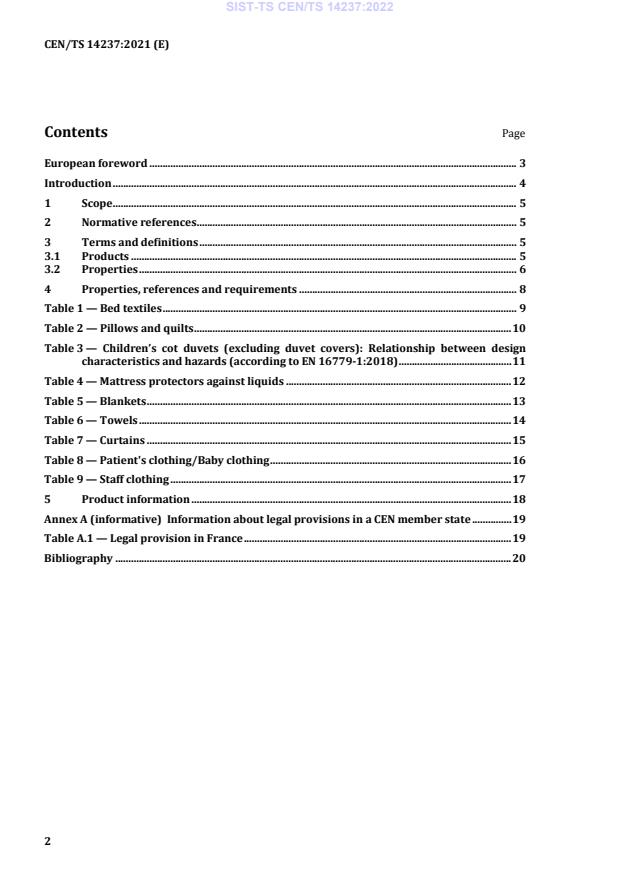
Contents Page
European foreword . 3
Introduction . 4
1 Scope . 5
2 Normative references . 5
3 Terms and definitions . 5
3.1 Products . 5
3.2 Properties . 6
4 Properties, references and requirements . 8
Table 1 — Bed textiles . 9
Table 2 — Pillows and quilts . 10
Table 3 — Children’s cot duvets (excluding duvet covers): Relationship between design
characteristics and hazards (according to EN 16779-1:2018) . 11
Table 4 — Mattress protectors against liquids . 12
Table 5 — Blankets . 13
Table 6 — Towels . 14
Table 7 — Curtains . 15
Table 8 — Patient's clothing/Baby clothing . 16
Table 9 — Staff clothing . 17
5 Product information . 18
Annex A (informative) Information about legal provisions in a CEN member state . 19
Table A.1 — Legal provision in France . 19
Bibliography . 20
European foreword
This document (CEN/TS 14237:2021) has been prepared by Technical Committee CEN/TC 248 “Textiles
and textile products”, the secretariat of which is held by BSI.
Attention is drawn to the possibility that some of the elements of this document may be the subject of
patent rights. CEN shall not be held responsible for identifying any or all such patent rights.
This document supersedes CEN/TS 14237:2015.
In comparison with the previous edition, the following technical modifications have been made:
• The normative references and bibliography were updated.
• Requirements were modified following past experiences with the use of CEN/TS 14237:2015.
• Guidance about children’s cot duvets (excluding duvet covers) was added.
Any feedback and questions on this document should be directed to the users’ national standards body.
A complete listing of these bodies can be found on the CEN website.
According to the CEN-CENELEC Internal Regulations, the national standards organisations of the
following countries are bound to announce this Technical Specification: Austria, Belgium, Bulgaria,
Croatia, Cyprus, Czech Republic, Denmark, Estonia, Finland, France, Germany, Greece, Hungary, Iceland,
Ireland, Italy, Latvia, Lithuania, Luxembourg, Malta, Netherlands, Norway, Poland, Portugal, Republic of
North Macedonia, Romania, Serbia, Slovakia, Slovenia, Spain, Sweden, Switzerland, Turkey and the United
Kingdom.
Introduction
This document provides minimum specifications for the purchase of unused textiles for healthcare and
social service facilities. It is intended to assist healthcare and social services organisations select textiles
products produced from these textiles and which they intend to be maintained by industrial laundering.
It is recognized that textile materials are currently available which outperform these minimum
specifications in this document and it is unable to provide information to correlate these minimum
specifications with textile life and value in typical industrial processing. Furthermore, these minimum
specifications cannot be correlated with textile life as measure by industrial launder-use trials.
Consequently, it is strongly recommended that purchasers discuss the quality of materials and their
expected performance requirement with any prospective laundry company prior to making a purchase.
Moreover, there is a need for safety of patients and clients which needs to be ensured by hygienic
cleanliness according to EN 14065, which is not reachable by domestic washing.
Production technologies in laundries places a requirement for high performance characteristics on the
textile to ensure sufficient durability, and which could increase acquisition costs, It is therefore
encouraged to carry out some trial processing in the prospective laundry, to better assess textile life and
lifecycle costing.
The properties, references and specifications for textiles shown in Tables 1 to 9 provide guidance as a
starting point for products to be industrially laundered. It is possible that National Standards may set a
higher level of characteristics for textile products.
This document only addresses the properties of the materials used, not the constructions.
1 Scope
This document recommends characteristics, test methods and minimum performance specifications for
unused textile for the healthcare and social service facilities (hospitals, residential care homes, etc.) to
give guidance on the suitability of products intended to be maintained by industrial laundering.
This document is not applicable to surgical textiles under the Medical Devices Directive nor protective
clothing under the PPE Directive.
2 Normative references
There are no normative references in this document.
3 Terms and definitions
For the purposes of this document, the following terms and definitions apply.
3.1 Products
NOTE This document classifies the requirements for the fabrics according to its use in the following product
groups.
3.1.1
accessories
components different from the main materials of the product (e.g. cuffs, buttons, sewing thread, press
studs, zippers, etc.)
3.1.2
baby clothing
garment being provided by the hospital that is worn by babies during their stay
3.1.3
bed textiles
two-dimensional textile such as sheets, pillow covers, secondary covers, mattress covers, draw sheets,
bed spreads
3.1.4
blanket
covering used on beds to provide thermal comfort
3.1.5
curtain
piece of hanging cloth that can be drawn to cover a window or to provide a screen
3.1.6
encasing
fully fitting article which covers all faces of the mattress
3.1.7
mattress protector against liquids
mattress cover impermeable to liquids
3.1.8
patient's clothing
garment being provided by the hospital that is worn by a patient during a stay
3.1.9
pillow
cloth bag filled with soft material used for patients support
3.1.10
quilt
cover made of two layers of cloth with soft insulating material in-between to provide thermal comfort
3.1.11
staff
person charged with (part of) medical treatment of a patient or the performance of a medical duty
3.1.12
staff clothing
over-garment without a specific protective function worn by the staff
3.1.13
towels
piece of cloth used for drying a person
3.2 Properties
3.2.1
air permeability
velocity of an air flow passing perpendicularly through a test specimen under specified conditions of test
area, pressure drop and time
[SOURCE: EN ISO 9237:1995, 3.1]
3.2.2
bursting strength
strength at burst
pressure obtained by subtracting the diaphragm pressure from the mean bursting pressure
[SOURCE: EN ISO 13938-1:1999, 3.3]
3.2.3
colour fastness
resistance of the colour of textiles to the different agents to which these materials may be exposed during
manufacture and their subsequent use
Note 1 to entry: The change in colour and staining of undyed adjacent fabrics are assessed as fastness ratings.
Note 2 to entry: See EN ISO 105-A01.
3.2.4
dimensional change
change in length and/or width of fabrics, garments or other textile articles which may occur when
subjected to an appropriate combination of specified washing and drying procedures
Note 1 to entry: See EN ISO 5077.
3.2.5
burning behaviour
property of fabrics whereby flaming combustion is slowed, terminated or prevented
Note 1 to entry: See EN ISO 12952-1, EN ISO 12952-2, EN 13773 and EN 16779-1.
3.2.6
liquid absorbency time
time required for a test specimen of fabric to become completely wetted by the test liquid
and imbibe test liquid into its interior structure
[SOURCE: EN 1644-1:1997, B.1]
3.2.7
liquid absorptive capacity
mass of liquid absorbed per unit mass of the fabric, expressed as a percentage, after either
a standard immersion time or after the time needed to completely wet the fabric and after drainage has
occurred
[SOURCE: EN 1644-1:1997, C.1, modified — The term “fabric” is used instead of the term “nonwoven” in
the present definition.]
3.2.8
pilling
generation of pills over the surface of the fabric
[SOURCE: EN ISO 12945-1:2000, 3.3]
3.2.9
tensile strength
maximum tensile force recorded in extending a test-piece to breaking point, the tensile force recorded at
the moment of rupture
Note 1 to entry: The tensile strength and tensile strength at break may be different if, after yield, the elongation
continues and is accompanied by a drop in force resulting in tensile strength at break being lower than tensile
strength.
3.2.10
thermal resistance
R
ct
ratio of the temperature difference between two faces of a test specimen to the rate of flow of heat per
unit area normal to the faces
Note 1 to entry: It is analogous to electrical resistance in the case of current flow through an electrical conductor.
[SOURCE: EN ISO 11092:2014, 2.1, modified — The definition itself had to be redrafted, the original notes
to the entry were deleted and the present Note 1 to entry was added.]
3.2.11
water penetration
hydrostatic head supported by a fabric
Note 1 to entry: It is measure of the opposition to the passage of water through the fabric.
Note 2 to entry: See EN ISO 811.
3.2.12
water vapour resistance
R
et
water-vapour pressure difference between the two faces of a material divided by the resultant
evaporative heat flux per unit area in the direction of the gradient
Note 1 to entry: The evaporative heat flux may consist of both diffusive and convective components.
[SOURCE: EN ISO 11092:2014, 2.2, modified. The present Note 1 to entry was shortened and Note 2 to
the entry was deleted.]
4 Properties, references and requirements
The following tables for properties, references and requirements of product groups are recommended as
the basis for agreements between the supplier and customer.
Table 1 — Bed textiles
Properties References Requirements
Colour fastness
Light EN ISO 105-B02 ≥ 4
Washing EN ISO 105-C06 E2 S Change ≥ 4 Stain ≥ 3–4
Bleach (peroxide) EN ISO 105-N02 ≥ 4
Bleach (hypochlorite)
(not for FR treated EN 20105-N01 ≥ 4
fabrics)
Rubbing EN ISO 105-X12 Dry ≥ 3–4 Wet ≥ 3
Perspiration EN ISO 105-E04 Change ≥ 4 Stain ≥ 3–4
Dry heat (for printed
EN ISO 105-P01 ≥ 4
polyester)
Dimensional change
Washing + Processing WARP WEFT
EN ISO 5077 (max. %)
Woven fabrics
±5 % ±5 %
Prior treatment:
EN ISO 6330, 3 washing
cycles programme 4N or
Knitted fabrics
LENGTH WIDTH
6N, plus drying process F
for knitted fabrics
+2 % to −5 % +5 % to −8 %
Tensile strength EN ISO 13934-1 WARP WEFT
(for woven fabrics only)
Basic requirements ≥ 400 N ≥ 400 N
Bursting strength (test specimen 7,3 cm ) ≥ 200 kPa
EN ISO 13938-1, or
(for knitted fabrics
EN ISO 13938-2
only)
a
Burning behaviour EN ISO 12952-1, Shall not ignite
(where specified) EN ISO 12952-2,
Pilling Prior treatment: see ≥ 4 (woven fabrics), ≥ 3 (knitted fabrics)
Dimensional Change –
Washing
EN ISO 12945-2
(2 000 rubs)
Additional properties References Recommendations
Health, safety According to European and/or national regulations
properties
Making up + ISO 4915; ISO 4916 Construction, accessories and making up should be appropriate
Accessories to product and its intended use. Coloured threads to be
EN 12590
colourfast to the same level as the basic product. Industrially
EN ISO 13936-1 and
launderable.
EN ISO 13936-2
a
Where burning behaviour properties are not inherent, the producer shall certify the durability in laundering and the test
method used.
Table 2 — Pillows and quilts
Properties References Requirements
Colour fastness
Light EN ISO 105-B02 ≥ 4
Washing EN ISO 105-C06 E2 S Change ≥ 4 Stain ≥ 3–4
Bleach (peroxide) EN ISO 105-N02 ≥ 4
Bleach (hypochlorite) EN 20105-N01 ≥ 4
(not for FR treated
fabrics)
Rubbing EN ISO 105-X12 Dry ≥ 4 Wet ≥ 3
Perspiration EN ISO 105-E04 Change ≥ 4 Stain ≥ 3–4
Dry heat (for printed EN ISO 105-P01 ≥ 4
polyester)
Tensile strength EN ISO 13934-1 WARP WEFT
(for woven fabrics only)
≥ 400 N ≥ 400 N
a
EN ISO 12952-1, Shall not ignite
Burning behaviour
EN ISO 12952-2,
(where specified)
EN 16779-1
Pilling EN ISO 12945-1 (10 h)
EN ISO 12945-2 (2000 rubs)
≥ 4
Prior treatment: EN ISO 6330,
3 washing cycles programme
9N, plus drying process F
b 2
Thermal resistance EN ISO 11092 ≥ 0,35 m K/W
Additional properties References Recommendations
Dimensional stability The manufacturer should state the expected
dimensional change as a percentage of the original
dimension
Health, safety properties According to European and/or national regulations
Making up + Accessories ISO 4915; ISO 4916 Construction, accessories and making up should be
appropriate to product and its intended use. Coloured
EN 12590
threads to be colourfast to the same level as the basic
EN ISO 13936-1 and
product. Industrially launderable.
EN ISO 13936-2
Surface disinfection Applicable disinfecting agents should be identified by
the manufacturer
a
Where burning behaviour properties are not inherent, the producer shall certify the durability in laundering and the test
method used.
b
Entire product.
Table 3 — Children’s cot duvets (excluding duvet covers): Relationship between design
characteristics and hazards (according to EN 16779-1:2018)
Hazards Inherently safe design
Mechanical and physical hazards
Plastic transfer or coated
Suffocation hazards A.3.4 4.1.1.4
fabrics
Cutting, puncture,
4.2.3 Fabrics and filling materials 4.1.6
abrasion hazards
Chemical hazards
Harmful substances A.4.1 Refer to A.4.1
Migration of certain
4.3.1 Refer to 4.3.1
substances
Formaldehyde 4.3.2 Refer to 4.3.2
Flame retardants 4.3.3 Refer to 4.3.
...