


SIST EN 16175-2:2017
(Main)Sludge, treated biowaste and soil - Determination of mercury - Part 2: Cold-vapour atomic fluorescence spectrometry (CV-AFS)
Sludge, treated biowaste and soil - Determination of mercury - Part 2: Cold-vapour atomic fluorescence spectrometry (CV-AFS)
This European Standard specifies a method for the determination of mercury in aqua regia or nitric acid digests of sludge, treated biowaste and soil, obtained according to EN 16173 or EN 16174 using cold-vapour atomic fluorescence spectrometry (CV-AFS). The lower working range limit is 0,003 mg/kg (dry matter basis).
Schlamm, behandelter Bioabfall und Boden - Bestimmung von Quecksilber - Teil 2: Kaltdampf-Atomfluoreszenzspektrometrie (CV-AFS)
Diese Europäische Norm legt ein Verfahren zur Bestimmung von Quecksilber in Königswasser oder Salpetersäureaufschlusslösungen von Schlamm, behandeltem Bioabfall und Boden, hergestellt nach EN 16173 oder EN 16174, durch Kaltdampf Atomfluoreszenzspektrometrie (CV-AFS) fest. Die untere Bestimmungsgrenze liegt bei 0,003 mg/kg (Trockenmasse).
Boues, bio-déchets traités et sols - Détermination du mercure - Partie 2: Spectrométrie de fluorescence atomique en vapeur froide (SFA-VP)
La présente Norme européenne spécifie une méthode de détermination du mercure soluble dans l'eau régale ou l'acide nitrique des boues, des bio-déchets traités et des sols, obtenus conformément à l’EN 16173 ou à l'EN 16174, par spectrométrie de fluorescence atomique en vapeur froide (SFA-VP). La limite inférieure de la gamme de travail est de 0,003 mg/kg (par rapport à la matière sèche).
Blato, obdelani biološki odpadki in tla - Določevanje živega srebra - 2. del: Metoda atomske fluorescenčne spektrometrije s tehniko hladnih par (CV-AFS)
Ta evropski standard določa metodo za določevanje živega srebra v zlatotopki ali izvlečku dušikove kisline blata, obdelanih bioloških odpadkov in tal, pridobljenega v skladu s standardom EN 16173 ali EN 16174, z uporabo metode atomske fluorescenčne spektrometrije s tehniko hladnih par (CV-AFS). Spodnja meja delovnega razpona je 0,003 mg/kg (suha osnova).
General Information
- Status
- Published
- Public Enquiry End Date
- 03-Jan-2016
- Publication Date
- 13-Mar-2017
- Technical Committee
- KAT - Soil quality
- Current Stage
- 6060 - National Implementation/Publication (Adopted Project)
- Start Date
- 02-Feb-2017
- Due Date
- 09-Apr-2017
- Completion Date
- 14-Mar-2017
Relations
- Effective Date
- 01-Apr-2017
Overview
EN 16175-2:2016 specifies a validated analytical method for the determination of mercury in sludge, treated biowaste and soil using cold‑vapour atomic fluorescence spectrometry (CV‑AFS). The method applies to aqua regia or nitric acid digests prepared according to EN 16174 or EN 16173. The standard’s lower working range limit is 0.003 mg/kg (dry matter basis), and it includes requirements for calibration, reagents, apparatus and quality control.
Key topics and technical requirements
- Scope and matrices: Municipal sludge, treated biowaste (e.g. compost) and soil - validated matrices are explicitly listed.
- Analytical principle: Mercury(II/I) is chemically reduced (recommended: tin(II) chloride; alternative: sodium borohydride) to elemental Hg, stripped by an inert gas (argon or nitrogen) and measured by fluorescence at ~254 nm.
- Reagents & water quality: High‑purity reagents and Type 2 water (EN ISO 3696) are required. Prescribed acid solutions, Hg calibration stocks (1 000 mg/l down to µg/l levels), and fresh tin(II) chloride preparations are described.
- Instrumentation: Atomic fluorescence spectrometer with Hg lamp and 254 nm filter, a cold‑vapour generator (batch or automated flow/FIA), and an inert carrier gas supply. Use of automated flow systems improves sensitivity.
- Calibration & range: Calibration with multiple standards covering the test range (e.g. 0–20 µg/l in test solution) and appropriate dilution of samples above the calibration range. Sensitivity can be enhanced by amalgamation techniques.
- Interferences: Guidance on quenching by water vapour, suppression by noble metals (gold, silver) and complexing anions (sulfide, iodide, bromide). Tolerable concentrations for some matrix elements (e.g. Cu, Ni up to 500 mg/l; Ag ~1 mg/l) are specified.
- Quality and performance: Includes repeatability and reproducibility data from a European interlaboratory study; test reporting requirements are given.
Applications and users
This standard is intended for:
- Environmental and commercial analytical laboratories performing trace‑mercury monitoring.
- Wastewater treatment and sludge management facilities assessing contaminant levels.
- Soil testing and remediation projects requiring accurate mercury quantification.
- Regulatory agencies and compliance monitoring for biosolids, composts and soils.
- Research groups studying mercury fate in solid matrices.
Keywords: EN 16175-2:2016, mercury determination, CV-AFS, cold-vapour atomic fluorescence spectrometry, sludge testing, treated biowaste, soil mercury, aqua regia digestion, nitric acid digestion.
Related standards
- EN 16175-1 - Mercury determination by CV‑AAS (related technique).
- EN 16173 / EN 16174 - Digestion procedures for nitric acid and aqua regia extracts.
- EN ISO 3696 - Water for analytical laboratory use.
- EN 15934 - Calculation of dry matter fraction.



Frequently Asked Questions
SIST EN 16175-2:2017 is a standard published by the Slovenian Institute for Standardization (SIST). Its full title is "Sludge, treated biowaste and soil - Determination of mercury - Part 2: Cold-vapour atomic fluorescence spectrometry (CV-AFS)". This standard covers: This European Standard specifies a method for the determination of mercury in aqua regia or nitric acid digests of sludge, treated biowaste and soil, obtained according to EN 16173 or EN 16174 using cold-vapour atomic fluorescence spectrometry (CV-AFS). The lower working range limit is 0,003 mg/kg (dry matter basis).
This European Standard specifies a method for the determination of mercury in aqua regia or nitric acid digests of sludge, treated biowaste and soil, obtained according to EN 16173 or EN 16174 using cold-vapour atomic fluorescence spectrometry (CV-AFS). The lower working range limit is 0,003 mg/kg (dry matter basis).
SIST EN 16175-2:2017 is classified under the following ICS (International Classification for Standards) categories: 13.030.20 - Liquid wastes. Sludge; 13.080.10 - Chemical characteristics of soils; 71.040.50 - Physicochemical methods of analysis. The ICS classification helps identify the subject area and facilitates finding related standards.
SIST EN 16175-2:2017 has the following relationships with other standards: It is inter standard links to SIST-TS CEN/TS 16175-2:2013. Understanding these relationships helps ensure you are using the most current and applicable version of the standard.
SIST EN 16175-2:2017 is associated with the following European legislation: EU Directives/Regulations: TP136. When a standard is cited in the Official Journal of the European Union, products manufactured in conformity with it benefit from a presumption of conformity with the essential requirements of the corresponding EU directive or regulation.
SIST EN 16175-2:2017 is available in PDF format for immediate download after purchase. The document can be added to your cart and obtained through the secure checkout process. Digital delivery ensures instant access to the complete standard document.
Standards Content (Sample)
2003-01.Slovenski inštitut za standardizacijo. Razmnoževanje celote ali delov tega standarda ni dovoljeno.6Schlamm, behandelter Bioabfall und Boden - Bestimmung von Quecksilber - Teil 2: Kaltdampf-Atomfluoreszenzspektrometrie (CV-AFS)Boues, bio-déchets traités et sols - Détermination du mercure - Partie 2: Spectrométrie de fluorescence atomique en vapeur froide (SFA-VP)Sludge, treated biowaste and soil - Determination of mercury - Part 2: Cold-vapour atomic fluorescence spectrometry (CV-AFS)71.040.50Fizikalnokemijske analitske metodePhysicochemical methods of analysis13.080.10Chemical characteristics of soils13.030.20Liquid wastes. SludgeICS:Ta slovenski standard je istoveten z:EN 16175-2:2016SIST EN 16175-2:2017en,fr,de01-april-2017SIST EN 16175-2:2017SLOVENSKI
STANDARDSIST-TS CEN/TS 16175-2:20131DGRPHãþD
EUROPEAN STANDARD NORME EUROPÉENNE EUROPÄISCHE NORM
EN 16175-2
October
t r s x English Version
Sludgeá treated biowaste and soil æ Determination of mercury æ Part
tã Coldævapour atomic fluorescence Bouesá biodéchets traités et sols æ Détermination du mercure æ Partie
tã Spectrométrie de fluorescence
Schlammá behandelter Bioabfall und Boden æ Bestimmung von Quecksilber æ Teil
tã KaltdampfæAtomfluoreszenzspektThis European Standard was approved by CEN on
s { March
t r s xä
egulations which stipulate the conditions for giving this European Standard the status of a national standard without any alterationä Upætoædate lists and bibliographical references concerning such national standards may be obtained on application to the CENæCENELEC Management Centre or to any CEN memberä
translation under the responsibility of a CEN member into its own language and notified to the CENæCENELEC Management Centre has the same status as the official versionsä
CEN members are the national standards bodies of Austriaá Belgiumá Bulgariaá Croatiaá Cyprusá Czech Republicá Denmarká Estoniaá Finlandá Former Yugoslav Republic of Macedoniaá Franceá Germanyá Greeceá Hungaryá Icelandá Irelandá Italyá Latviaá Lithuaniaá Luxembourgá Maltaá Netherlandsá Norwayá Polandá Portugalá Romaniaá Slovakiaá Sloveniaá Spainá Swedená Switzerlandá Turkey andUnited Kingdomä
EUROPEAN COMMITTEE FOR STANDARDIZATION COMITÉ EUROPÉEN DE NORMALISATION EUROPÄISCHES KOMITEE FÜR NORMUNG
CEN-CENELEC Management Centre:
Avenue Marnix 17,
B-1000 Brussels
t r s x CEN All rights of exploitation in any form and by any means reserved worldwide for CEN national Membersä Refä Noä EN
s x s y wæ tã t r s x ESIST EN 16175-2:2017
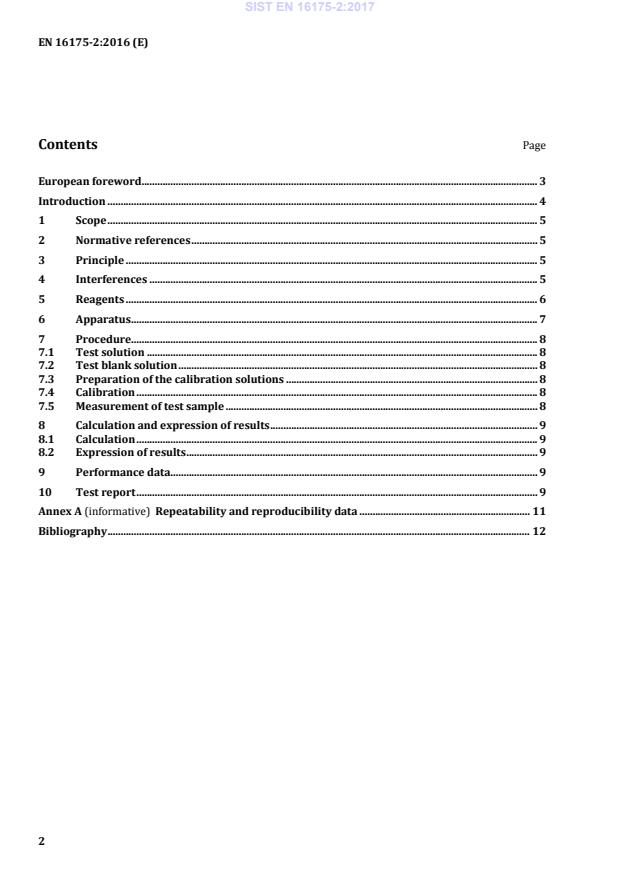
Repeatability and reproducibility data . 11 Bibliography . 12
...
Questions, Comments and Discussion
Ask us and Technical Secretary will try to provide an answer. You can facilitate discussion about the standard in here.
Loading comments...