

kSIST FprEN 50121-4:2026
(Main)Railway applications - Electromagnetic compatibility - Part 4: Emission and immunity of the signalling and telecommunications apparatus
- Abstract
This document applies to signalling and telecommunication apparatus (including power supply system belonging to signalling and telecommunication apparatus) that is installed inside interlocking locations, wayside cabinets and other wayside locations including platforms (including vital equipment such as interlocking, signals, point machines, level crossing, etc.).
This document specifies limits for emission and immunity and provides performance criteria.
The document does not specify basic personal safety requirements for apparatus such as protection against electric shock, unsafe operation, insulation co-ordination and related dielectric tests. The requirements were developed for and are applicable to this set of apparatus when operating under normal conditions. Fault conditions of the apparatus have not been taken into account.
The test frequency range defined in this document is considered to ensure the electromagnetic compatibility of the apparatus in the whole frequency range from 0 Hz (DC) to 400 GHz.
- Status
- Not Published
- Public Enquiry End Date
- 30-Sep-2025
- Technical Committee
- ŽEN - Electrical applications for railways
- Current Stage
- 5020 - Formal vote (FV) (Adopted Project)
- Start Date
- 14-May-2025
- Due Date
- 02-Jul-2025
- Completion Date
- 24-Jun-2026

kSIST FprEN 50121-4:2026 is a CLC draft European standard for railway applications - electromagnetic compatibility, Part 4. It specifies emission and immunity requirements, together with performance criteria, for signalling and telecommunications apparatus installed at interlocking locations, wayside cabinets, and other wayside locations including platforms. Engineers, test labs, quality managers, and buyers use it to check whether railway-side signalling and telecom equipment behaves acceptably in normal operating conditions.
What does kSIST FprEN 50121-4:2026 specify?
kSIST FprEN 50121-4:2026 defines the EMC requirements for signalling and telecommunication apparatus used in railway wayside locations. It sets emission limits, immunity test levels, and the performance criteria used to judge results.
The standard applies to apparatus including its power supply system when that system belongs to the signalling and telecommunication apparatus. Clause 1 also makes clear that it covers vital equipment such as interlocking, signals, point machines, and level crossing equipment.
It does not cover basic personal safety requirements such as protection against electric shock, unsafe operation, insulation co-ordination, or related dielectric tests. It is written for normal operation, not fault conditions. The document structure is straightforward: Clause 4 covers overall aspects, Clause 5 covers emission, and Clause 6 covers immunity. The main test information is collected in Tables 1 to 8.
| Clause | What it covers |
|---|---|
| 4 | Overall application rules, including railway zones and special cases |
| 5 | Emission requirements by port type |
| 6 | Immunity criteria and immunity test requirements |
What are the key requirements of kSIST FprEN 50121-4:2026?
kSIST FprEN 50121-4:2026 is a port-by-port EMC product standard. In practice, that means the test plan must follow the equipment interfaces, not just the product as a whole.
Overall application rules
Clause 4 ties the document to the railway environment described in prEN 50121-1:2025. It also sets the boundary between this part and generic EMC standards: apparatus in the scope of the radio equipment directive (RED) follows this document except in defined exclusion bands, and combined equipment uses ETSI guidance so that non-radio functions are still assessed in those bands. For a test engineer, this means the radio and non-radio functions may need different EMC treatment in the same product.
Clause 4 also says the specific requirements apply when the equipment is inside the 3 m zone or when its ports connect inside the 3 m zone, except fibre optic connections. Equipment outside that area may instead follow EN IEC 61000-6-1/6-3 or EN IEC 61000-6-2/6-4, depending on whether it is inside or outside the 10 m zone. For procurement or design, this zone split is important because it determines which EMC target the equipment must meet.
Emission requirements
Clause 5 divides emission testing by port type. Power ports, wired network ports, and the enclosure port are treated separately, so the product team has to identify every relevant interface early.
- Table 1 covers conducted emissions on AC power ports and DC input power ports.
- Table 2 covers conducted emissions on wired network ports.
- Table 3 covers radiated emissions from the enclosure port.
The table set also shows which measuring arrangements and frequency bands apply, and it refers to the underlying basic standards for the detailed methods and test set-up. In practice, this means the laboratory needs the correct network, antenna, site, and detector arrangement for each port type.
Clause 5 also says no transient emission tests are needed, because their effect is considered to be covered by the transient immunity test levels. That reduces duplicate testing and keeps the focus on the disturbance types that matter for certification.
Immunity requirements
Clause 6 uses the same port-by-port approach for immunity. Table 4 covers enclosure ports, Tables 5 to 8 cover I/O ports, DC power ports, AC power ports, and earth ports.
The enclosure-port tests include radio-frequency fields, power-frequency magnetic fields, and electrostatic discharge. The I/O and power-port tables use immunity methods such as conducted radio-frequency immunity, fast transients, and surge. For a practical test plan, this means each external connection has its own disturbance set and cannot be assumed to behave like the others.
Clause 6.1 requires a functional description and a definition of performance criteria to be included in the test report, using criteria A, B, and C from prEN 50121-1:2025. That matters because the laboratory must report not just pass/fail, but how the equipment behaved during and after each test.
Clause 6.2 says the tests shall be run in a well-defined and reproducible manner and carried out as single tests in sequence, with the sequence itself being optional. For repeatability, this means the test lab must control the setup carefully and record it clearly.
Special testing rules
Clause 4 says that if a product has many identical ports, the tester should select the worst-case port or ports for conducted emission and immunity, and a sufficient number for radiated emission. This avoids unnecessary duplication while still covering the real risk points.
For radiated emission on the enclosure port, Table 3 allows several test facilities, including OATS, SAC, TEM, FAR, and FSOATS, depending on the equipment and frequency range. In practice, the chosen site and measurement distance must match the product size and test method in the table.
What terms does kSIST FprEN 50121-4:2026 define?
- Port - a particular interface through which the equipment couples with the external electromagnetic environment, such as an enclosure, I/O, power, or earth connection.
- 3 m zone - the area along the railway line within 3 m of the centreline of the nearest track on both sides.
- 10 m zone - the area along the railway line within 10 m of the centreline of the nearest track on both sides.
- Apparatus - a device or assembly of devices that can be used as an independent unit for specific functions.
- Electromagnetic compatibility (EMC) - the ability of equipment to operate acceptably in its electromagnetic environment without causing unacceptable disturbance.
- Direct current (DC) - current that flows in one direction only.
- Input / Output (I/O) - ports used to exchange signals or data with external equipment.
Who uses kSIST FprEN 50121-4:2026?
kSIST FprEN 50121-4:2026 is used by manufacturers of railway signalling and telecommunications equipment, EMC test laboratories, railway infrastructure managers, system integrators, and quality or conformity engineers. It is also relevant to buyers who need to state EMC requirements in procurement documents.
Typical tasks include selecting the correct port category, choosing the right emission and immunity tests, defining performance criteria, and writing the EMC test report. It is especially relevant for equipment installed in interlocking locations, wayside cabinets, platforms, and other railway-side locations.
What changed in kSIST FprEN 50121-4:2026 from the previous edition?
kSIST FprEN 50121-4:2026 will supersede EN 50121-4:2016 and EN 50121-4:2016/A1:2019. The foreword lists these significant technical changes:
- updated foreword information
- updated introduction information
- updated scope
- updated normative references
- updated terms, definitions, and abbreviations
- a new clause structure with separate clauses for overall aspects, emission, and immunity
- clarification of the emission clause
- updated emission tables, including new tables for emission
- updated immunity tables
- updated immunity requirements
- deletion of Annex ZZ
Which standards are used with kSIST FprEN 50121-4:2026?
kSIST FprEN 50121-4:2026 relies on prEN 50121-1:2025 for the general railway EMC framework and on the EN IEC 61000 series for the test methods used in immunity and some emission measurements. It also uses CISPR-based measurement standards for emission set-ups.
Key references and what they add:
- prEN 50121-1:2025 - general railway EMC provisions and the performance criteria A, B, and C used in the test report.
- EN 55016 series and EN 55032:2015 - measuring apparatus, coupling devices, antennas, test sites, and disturbance measurement methods for emission testing.
- EN IEC 61000-4-2, -4-3, -4-4, -4-5, -4-6, -4-8, -4-20 - immunity test methods for ESD, radiated RF fields, fast transients, surge, conducted RF, power-frequency magnetic fields, and TEM-based testing.
- EN IEC 61000-6-1, -6-2, -6-3, -6-4 - generic emission and immunity standards used for equipment outside the 3 m zone or 10 m zone as stated in Clause 4.
- IEC 60050-161:1990 - the EMC vocabulary used for the terms and definitions.
- ETSI EN 301 489-1 and ETSI EG 203 367 - rules for RED-related equipment and combined radio/non-radio equipment.
- prEN 50121-3-2:2025 and prEN 50121-5:2025 - related railway EMC parts for signalling/telecommunication apparatus in vehicles and in fixed power supply installations.
What does the kSIST FprEN 50121-4:2026 document contain?
The document contains the scope, normative references, terms and abbreviations, overall application rules, emission requirements, and immunity requirements, followed by a bibliography. Figure 1 explains the equipment ports used in EMC testing.
Tables 1 to 3 define the emission tests for power ports, wired network ports, and the enclosure port. Tables 4 to 8 define the immunity tests for enclosure ports, I/O ports, DC power ports, AC power ports, and earth ports. For a laboratory or product engineer, these tables provide the test arrangements, frequency ranges, limits, detectors, and special restrictions needed to build a compliant test plan.
Relations
- Effective Date
- 09-Apr-2024
- Effective Date
- 09-Apr-2024
Get Certified
Connect with accredited certification bodies for this standard

IMQ S.p.A. (Certification)
Italian electrical product certification.

IRIS Certification (UNIFE)
International Railway Industry Standard certification.

SLG Prüf- und Zertifizierungs GmbH
German testing and certification body.
Sponsored listings
Frequently Asked Questions
kSIST FprEN 50121-4:2026 is a draft published by the Slovenian Institute for Standardization (SIST). Its full title is "Railway applications - Electromagnetic compatibility - Part 4: Emission and immunity of the signalling and telecommunications apparatus". This standard covers: This document applies to signalling and telecommunication apparatus (including power supply system belonging to signalling and telecommunication apparatus) that is installed inside interlocking locations, wayside cabinets and other wayside locations including platforms (including vital equipment such as interlocking, signals, point machines, level crossing, etc.). This document specifies limits for emission and immunity and provides performance criteria. The document does not specify basic personal safety requirements for apparatus such as protection against electric shock, unsafe operation, insulation co-ordination and related dielectric tests. The requirements were developed for and are applicable to this set of apparatus when operating under normal conditions. Fault conditions of the apparatus have not been taken into account. The test frequency range defined in this document is considered to ensure the electromagnetic compatibility of the apparatus in the whole frequency range from 0 Hz (DC) to 400 GHz.
This document applies to signalling and telecommunication apparatus (including power supply system belonging to signalling and telecommunication apparatus) that is installed inside interlocking locations, wayside cabinets and other wayside locations including platforms (including vital equipment such as interlocking, signals, point machines, level crossing, etc.). This document specifies limits for emission and immunity and provides performance criteria. The document does not specify basic personal safety requirements for apparatus such as protection against electric shock, unsafe operation, insulation co-ordination and related dielectric tests. The requirements were developed for and are applicable to this set of apparatus when operating under normal conditions. Fault conditions of the apparatus have not been taken into account. The test frequency range defined in this document is considered to ensure the electromagnetic compatibility of the apparatus in the whole frequency range from 0 Hz (DC) to 400 GHz.
kSIST FprEN 50121-4:2026 is classified under the following ICS (International Classification for Standards) categories: 29.280 - Electric traction equipment; 33.100.01 - Electromagnetic compatibility in general; 45.020 - Railway engineering in general. The ICS classification helps identify the subject area and facilitates finding related standards.
kSIST FprEN 50121-4:2026 has the following relationships with other standards: It is inter standard links to SIST EN 50121-4:2017/A1:2019, SIST EN 50121-4:2017. Understanding these relationships helps ensure you are using the most current and applicable version of the standard.
kSIST FprEN 50121-4:2026 is available in PDF format for immediate download after purchase. The document can be added to your cart and obtained through the secure checkout process. Digital delivery ensures instant access to the complete standard document.
Standards Content (Sample)
SLOVENSKI STANDARD
oSIST prEN 50121-4:2025
01-september-2025
Železniške naprave - Elektromagnetna združljivost - 4. del: Sevanje in odpornost
signalnih in telekomunikacijskih naprav
Railway applications - Electromagnetic compatibility - Part 4: Emission and immunity of
the signalling and telecommunications apparatus
Bahnanwendungen - Elektromagnetische Verträglichkeit - Teil 4: Störaussendungen und
Störfestigkeit von Signalund Telekommunikationseinrichtungen
Applications ferroviaires - Compatibilité électromagnétique - Partie 4: Emission et
immunité des appareils de signalisation et de télécommunication
Ta slovenski standard je istoveten z: prEN 50121-4:2025
ICS:
33.100.01 Elektromagnetna združljivost Electromagnetic compatibility
na splošno in general
45.020 Železniška tehnika na Railway engineering in
splošno general
oSIST prEN 50121-4:2025 en
2003-01.Slovenski inštitut za standardizacijo. Razmnoževanje celote ali delov tega standarda ni dovoljeno.
oSIST prEN 50121-4:2025
oSIST prEN 50121-4:2025
EUROPEAN STANDARD DRAFT
prEN 50121-4
NORME EUROPÉENNE
EUROPÄISCHE NORM
August 2025
ICS 29.280; 33.100.01; 45.020 Will supersede EN 50121-4:2016; EN 50121-
4:2016/A1:2019
English Version
Railway applications - Electromagnetic compatibility - Part 4:
Emission and immunity of the signalling and telecommunications
apparatus
Applications ferroviaires - Compatibilité électromagnétique - Bahnanwendungen - Elektromagnetische Verträglichkeit -
Partie 4: Emission et immunité des appareils de Teil 4: Störaussendungen und Störfestigkeit von Signalund
signalisation et de télécommunication Telekommunikationseinrichtungen
This draft European Standard is submitted to CENELEC members for enquiry.
Deadline for CENELEC: 2025-10-24.
It has been drawn up by CLC/TC 9X.
If this draft becomes a European Standard, CENELEC members are bound to comply with the CEN/CENELEC Internal Regulations which
stipulate the conditions for giving this European Standard the status of a national standard without any alteration.
This draft European Standard was established by CENELEC in three official versions (English, French, German).
A version in any other language made by translation under the responsibility of a CENELEC member into its own language and notified to
the CEN-CENELEC Management Centre has the same status as the official versions.
CENELEC members are the national electrotechnical committees of Austria, Belgium, Bulgaria, Croatia, Cyprus, the Czech Republic,
Denmark, Estonia, Finland, France, Germany, Greece, Hungary, Iceland, Ireland, Italy, Latvia, Lithuania, Luxembourg, Malta, the
Netherlands, Norway, Poland, Portugal, Republic of North Macedonia, Romania, Serbia, Slovakia, Slovenia, Spain, Sweden, Switzerland,
Türkiye and the United Kingdom.
Recipients of this draft are invited to submit, with their comments, notification of any relevant patent rights of which they are aware and to
provide supporting documentation.
Warning : This document is not a European Standard. It is distributed for review and comments. It is subject to change without notice and
shall not be referred to as a European Standard.
European Committee for Electrotechnical Standardization
Comité Européen de Normalisation Electrotechnique
Europäisches Komitee für Elektrotechnische Normung
CEN-CENELEC Management Centre: Rue de la Science 23, B-1040 Brussels
© 2025 CENELEC All rights of exploitation in any form and by any means reserved worldwide for CENELEC Members.
Project: 79750 Ref. No. prEN 50121-4:2025 E
oSIST prEN 50121-4:2025
prEN 50121-4:2025 (E)
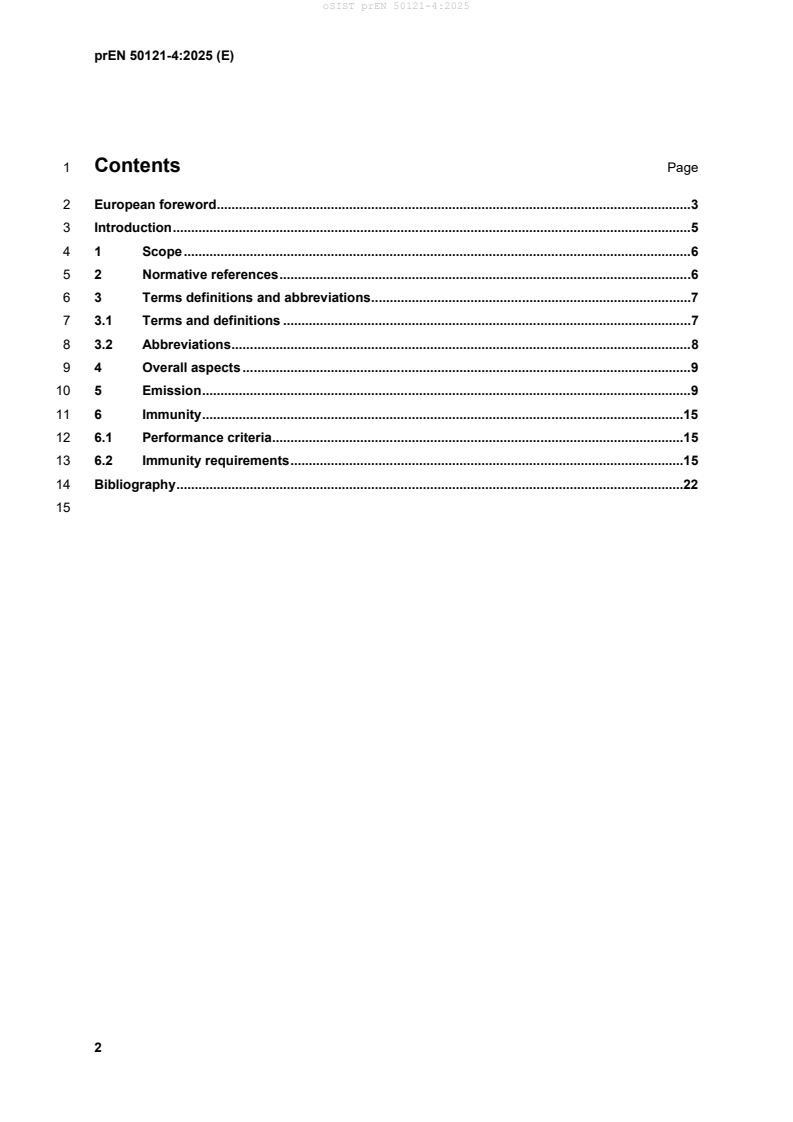
1 Contents Page
2 European foreword . 3
3 Introduction . 5
4 1 Scope . 6
5 2 Normative references . 6
6 3 Terms definitions and abbreviations . 7
7 3.1 Terms and definitions . 7
8 3.2 Abbreviations . 8
9 4 Overall aspects . 9
10 5 Emission . 9
11 6 Immunity .15
12 6.1 Performance criteria.15
13 6.2 Immunity requirements .15
14 Bibliography .22
oSIST prEN 50121-4:2025
prEN 50121-4:2025 (E)
16 European foreword
17 This document (prEN 50121-4:2025) has been prepared by CLC/TC 9X “Electrical and electronic
18 applications for railways”.
19 This document is currently submitted to the Enquiry.
20 The following dates are proposed:
• latest date by which the existence of this (doa) dav + 6 months
document has to be announced at national
level
• latest date by which this document has to be (dop) dav + 12 months
implemented at national level by publication of
an identical national standard or by
endorsement
• latest date by which the national standards (dow) dav + 36 months
conflicting with this document have to be (to be confirmed or
withdrawn modified when voting)
21 This document has been prepared according to Decision 69/09 taken during the TC 9X meeting.
22 This document will supersede EN 50121-4:2016.
23 prEN 50121-4:2025 includes the following significant technical changes with respect to
24 EN 50121-4:2016:
25 — additional information introduced in European foreword, last three paragraphs;
26 — additional information introduced in Introduction, last two paragraphs;
27 — update of scope;
28 — update of normative references;
29 — update of terms and definitions and abbreviations;
30 — new structure with Clause 4: Overall aspects, Clause 5: Emission and Clause 6: Immunity;
31 — clarification of Clause 5, Emission;
32 — update of Table 1, introduction of new Tables 2 and 3 in Clause 5, Emission;
33 — update of Tables 4 to 6 in Clause 6, Immunity;
34 — update of Clause 6.2, immunity requirements;
35 — update of Tables 4 to 8;
36 — deletion of Annex ZZ.
37 This standard forms Part 4 of the European Standard series EN 50121, published under the general title
38 “Railway applications - Electromagnetic compatibility”. The series consists of:
39 — Part 1: General;
40 — Part 2: Emission of the whole railway system to the outside world;
oSIST prEN 50121-4:2025
prEN 50121-4:2025 (E)
41 — Part 3-1: Rolling stock – Train and complete vehicle;
42 — Part 3-2: Rolling stock – Apparatus;
43 — Part 4: Emission and immunity of the signalling and telecommunications apparatus;
44 — Part 5: Emission and immunity of fixed power supply installations and apparatus.
45 The specific provisions of this document are to be used in conjunction with the general provisions in
46 prEN 50121-1:2025.
47 Signalling and telecommunication apparatus mounted in vehicles is covered by prEN 50121-3-2:2025,
48 signalling and telecommunication apparatus installed inside the substation, powered by the fixed power
49 supply or connected to port for process, measurement, control lines, and long bus is covered by
50 prEN 50121-5:2025.
51 For products in the scope of EN IEC 61000-3-2:2019, EN 61000-3-3:2013 +A2:2021 +A2/AC:2022,
52 EN IEC 61000-3-11:2019 or EN 61000-3-12:2011 +A1:2024 the requirements of those standards also
53 apply.
oSIST prEN 50121-4:2025
prEN 50121-4:2025 (E)
54 Introduction
55 This document has been prepared in the form of a Product Standard.
56 It defines the immunity and emission test requirements for apparatus defined in the scope in relation to
57 the electromagnetic disturbances likely to be experienced in the railway. In particular, the test
58 requirements represent the essential electromagnetic immunity requirements and have been selected
59 to ensure an adequate level of immunity for apparatus installed on the railway locations.
60 Test requirements are specified for each port considered.
61 Safety considerations are not covered by this standard.
62 Emission requirements have been selected so as to ensure that disturbances generated by the
63 apparatus operated normally in railway environment do not exceed a level which could prevent other
64 apparatus from operating as intended.
65 Likewise, the immunity requirements have been selected so as to ensure an adequate level of immunity
66 for signalling and telecommunication equipment.
oSIST prEN 50121-4:2025
prEN 50121-4:2025 (E)
67 1 Scope
68 This document applies to signalling and telecommunication apparatus (including power supply system
69 belonging to signalling and telecommunication apparatus) that is installed inside interlocking locations,
70 wayside cabinets and other wayside locations including platforms (including vital equipment such as
71 interlocking, signals, point machines, level crossing, etc.).
72 This document specifies limits for emission and immunity and provides performance criteria.
73 The standard does not specify basic personal safety requirements for apparatus such as protection
74 against electric shock, unsafe operation, insulation co-ordination and related dielectric tests. The
75 requirements were developed for and are applicable to this set of apparatus when operating under
76 normal conditions. Fault conditions of the apparatus have not been taken into account.
77 The test frequency range defined in this document is considered to ensure the electromagnetic
78 compatibility of the apparatus in the whole frequency range from 0 Hz (DC) to 400 GHz.
79 2 Normative references
80 The following documents are referred to in the text in such a way that some or all of their content
81 constitutes requirements of this document. For dated references, only the edition cited applies. For
82 undated references, the latest edition of the referenced document (including any amendments) applies.
83 prEN 50121-1:2025, Railway applications - Electromagnetic compatibility - Part 1: General
84 EN IEC 55014-1:2021, Electromagnetic compatibility - Requirements for household appliances, electric
85 tools and similar apparatus - Part 1: Emission (CISPR 14-1:2020)
86 EN 55016-1-1:2019, Specification for radio disturbance and immunity measuring apparatus and
87 methods - Part 1-1: Radio disturbance and immunity measuring apparatus - Measuring apparatus
88 (CISPR 16-1-1:2019)
89 EN 55016-1-2:2014 , Specification for radio disturbance and immunity measuring apparatus and
90 methods - Part 1-2: Radio disturbance and immunity measuring apparatus - Coupling devices for
91 conducted disturbance measurements (CISPR 16-1-2:2014)
92 EN 55016-1-4:2019, Specification for radio disturbance and immunity measuring apparatus and
93 methods - Part 1-4: Radio disturbance and immunity measuring apparatus - Antennas and test sites for
94 radiated disturbance measurements (CISPR 16-1-4:2019)
95 EN 55016-1-6:2015 , Specification for radio disturbance and immunity measuring apparatus and
96 methods - Part 1-6: Radio disturbance and immunity measuring apparatus - EMC antenna calibration
97 (CISPR 16-1-6:2014)
98 EN 55016-2-1:2014 , Specification for radio disturbance and immunity measuring apparatus and
99 methods - Part 2-1: Methods of measurement of disturbances and immunity - Conducted disturbance
100 measurements (CISPR 16-2-1:2014)
101 EN 55016-2-3:2017 , Specification for radio disturbance and immunity measuring apparatus and
102 methods - Part 2-3: Methods of measurement of disturbances and immunity - Radiated disturbance
103 measurements (CISPR 16-2-3:2016)
As impacted by EN 55016-1-2:2014/A1:2018.
As impacted by EN 55016-1-6:2015/A1:2017 and EN 55016-1-6:2015/A2:2022.
As impacted by EN 55016-2-1:2014/A1:2017 and EN 55016-2-1:2014/AC:2020-09.
As impacted by EN 55016-2-3:2017/A1:2019 and EN 55016-2-3:2017/A2:2023.
oSIST prEN 50121-4:2025
prEN 50121-4:2025 (E)
104 EN 55032:2015 , Electromagnetic compatibility of multimedia equipment - Emission Requirements
105 (CISPR 32:2015)
106 EN IEC 61000-4-2:2025, Electromagnetic compatibility (EMC) - Part 4-2: Testing and measurement
107 techniques - Electrostatic discharge immunity test (IEC 61000-4-2:2025)
108 EN IEC 61000-4-3:2020, Electromagnetic compatibility (EMC) - Part 4-3 : Testing and measurement
109 techniques - Radiated, radio-frequency, electromagnetic field immunity test (IEC 61000-4-3:2020)
110 EN 61000-4-4:2012, Electromagnetic compatibility (EMC) - Part 4-4: Testing and measurement
111 techniques - Electrical fast transient/burst immunity test (IEC 61000-4-4:2012)
112 EN 61000-4-5:2014, Electromagnetic compatibility (EMC) - Part 4-5: Testing and measurement
113 techniques - Surge immunity test (IEC 61000-4-5:2014)
114 EN IEC 61000-4-6:2023, Electromagnetic compatibility (EMC) - Part 4-6: Testing and measurement
115 techniques - Immunity to conducted disturbances, induced by radio-frequency fields (IEC 61000-4-
116 5:2023)
117 EN 61000-4-8:2010, Electromagnetic compatibility (EMC) - Part 4-8: Testing and measurement
118 techniques - Power frequency magnetic field immunity test (IEC 61000-4-8:2009)
119 EN IEC 61000-4-20, Electromagnetic compatibility (EMC) - Part 4-20: Testing and measurement
120 techniques - Emission and immunity testing in transverse electromagnetic (TEM) waveguides (IEC
121 61000-4-20:2022)
122 EN IEC 61000-6-1:2019, Electromagnetic compatibility (EMC) - Part 6-1: Generic standards - Immunity
123 standard for residential, commercial and light-industrial environments (IEC 61000-6-1:2016)
124 EN IEC 61000-6-2:2019, Electromagnetic compatibility (EMC) - Part 6-2: Generic standards - Immunity
125 standard for industrial environments (IEC 61000 6 2:2016)
126 EN IEC 61000-6-3:2021, Electromagnetic compatibility (EMC) - Part 6-3: Generic standards - Emission
127 standard for equipment in residential environments (IEC 61000-6-3:2020)
128 EN IEC 61000-6-4:2019, Electromagnetic compatibility (EMC) - Part 6-4: Generic standards - Emission
129 standard for industrial environments (IEC 61000 6 4:2018)
130 IEC 60050-161:1990, International Electrotechnical Vocabulary. Chapter 161: Electromagnetic
131 compatibility
132 ETSI EN 301-489-1 V2.2.3, (11/2019), ElectroMagnetic Compatibility (EMC) standard for radio
133 equipment and services; Part 1: Common technical requirements; Harmonised Standard for
134 ElectroMagnetic Compatibility
135 ETSI EG 203 367 V1.1.1 (06/2016), Guide to the application of harmonised standards covering articles
136 3.1b and 3.2 of the Directive 2014/53/EU (RED) to multi-radio and combined radio and non-radio
137 equipment
138 3 Terms definitions and abbreviations
139 3.1 Terms and definitions
140 For the purposes of this document, the terms and definitions given in IEC 60050-161:1990 and the
141 following apply.
As impacted by EN 55032:2015/AC:2016-07, EN 55032:2015/A1:2020 and EN 55032:2015/A11:2020.
oSIST prEN 50121-4:2025
prEN 50121-4:2025 (E)
142 ISO and IEC maintain terminology databases for use in standardization at the following addresses:
143 — ISO Online browsing platform: available at https://www.iso.org/obp/
144 — IEC Electropedia: available at https://www.electropedia.org/
145 3.1.1
146 port
147 particular interface of an equipment which couples this equipment with
148 the external electromagnetic environment (161-01-01) and through which the equipment is influenced
149 by this environment
150 EXAMPLE Examples of ports of interest are shown in Figure 1. The enclosure port is the physical boundary
151 of the apparatus (e.g. enclosure). The enclosure port provides for radiated and electrostatic discharge (161-01-22)
152 energy transfer, whereas the other ports provide for conducted energy transfer.
155 Figure 1 — Equipment ports
156 Note 1 to entry: Ports in the subject area of electromagnetic compatibility are specific cases of the port defined
157 in 131-12-60
158 [SOURCE: IEC 60050-161:1990, 161-01-27, modified – in the example Figure Signal/control port was
159 exchanged by I/O port and Functional earth port was exchanged by earth port]
160 3.1.2
161 3 m zone
162 area along the railway line within a distance of 3 m from the centreline of the nearest track at both sides
163 of the track
164 3.1.3
165 10 m zone
166 area along the railway line within a distance of 10 m from the centreline of the nearest track at both sides
167 of the track
168 3.1.4
169 apparatus
170 device or assembly of devices which can be used as an independent unit for specific functions
171 3.2 Abbreviations
172 For the purposes of this document, the following abbreviations apply.
AC Alternating Current
AM Amplitude modulation
DC Direct Current
EMC Electro Magnetic Compatibility
oSIST prEN 50121-4:2025
prEN 50121-4:2025 (E)
EMI Electromagnetic interference
I/O Input / Output
173 4 Overall aspects
174 The railway environment is characterized as described in prEN 50121-1:2025.
175 Apparatus in the scope of the radio equipment directive (RED) shall comply with the EMC-requirements
176 given in this document except in the exclusion frequency bands defined in the relevant ETSI EMC
177 standards (if exist) or otherwise in Clause 4.3 of ETSI EN 301 489-1, V2.2.3 (11/2019).
178 For combined equipment according ETSI EG 203 367 V1.1.1 Emission or immunity tests shall be
179 performed in
...