

oSIST prEN 2883:2026
(Main)Aerospace series - Nuts, hexagonal, self-locking, with counterbore and captive washer, in heat resisting steel, MoS2 lubricated - Classification : 1 100 MPa (at ambient temperature) / 315 °C
- Abstract
This document specifies the characteristics of self-locking hexagonal nuts, with counterbore and captive washer, in heat resisting steel, MoS2 lubricated.
Classification: 1 100 MPa1/315 °C2.
- Status
- Not Published
- Public Enquiry End Date
- 09-Jul-2026
- Technical Committee
- I13 - Imaginarni 13
- Current Stage
- 4020 - Public enquire (PE) (Adopted Project)
- Start Date
- 21-May-2026
- Due Date
- 08-Oct-2026
- Completion Date
- 10-Jul-2026

oSIST prEN 2883:2026 is a CEN draft European Standard for aerospace self-locking hexagonal nuts with a counterbore and captive washer, made in heat resisting steel and lubricated with molybdenum disulphide (MoS2). It specifies the product characteristics, classification, marking, and technical specification for these nuts.
oSIST prEN 2883:2026 is used by aerospace manufacturers, suppliers, and buyers who need a common definition for this nut type. The document classifies the nuts as 1 100 MPa at ambient temperature / 315 °C, so readers can match the fastener to the required strength level and service temperature.
What does oSIST prEN 2883:2026 specify?
oSIST prEN 2883:2026 specifies the characteristics of self-locking hexagonal nuts with counterbore and captive washer in heat resisting steel, MoS2 lubricated. It is organized as scope, normative references, terms and definitions, required characteristics, designation, marking, and technical specification, with Figure 1 and Table 1 giving the product configuration and sizes.
The document focuses on the nut and captive washer assembly used in aerospace applications. In practice, that means it tells you how the part is shaped, what materials and surface treatment are acceptable, how it is identified, and what has to be shown before supply.
What are the key requirements of oSIST prEN 2883:2026?
oSIST prEN 2883:2026 ties the product to the classification 1 100 MPa at ambient temperature / 315 °C. In practical terms, this is the strength and temperature class the nut is designed to meet, and the maximum temperature depends on the surface treatment.
Geometry, dimensions, and fit
oSIST prEN 2883:2026 requires the configuration, dimensions, and mass to follow Figure 1 and Table 1. Dimensions and tolerances are given in millimetres, apply before MoS lubrication, and follow ISO 8538; any form details not stated are left to the manufacturer’s option.
This matters because inspection and procurement have to use the stated geometry and the MJ thread limits from ISO 5855-2. Table 1 also covers the diameter codes, so buyers can specify the right size directly on the order.
Form, position, and materials
oSIST prEN 2883:2026 requires tolerances of form and position to follow ISO 8788. The nut material has to be heat resisting steel in accordance with EN 2399, EN 3638, EN 3639, or TR 3791, and for MJ3 and MJ4 sizes the manufacturer may use SAE AMS5525; the washer material has to follow EN 3638 or TR 3791.
This matters in practice because the document allows only defined material families for the fastener parts. For sourcing and quality control, the material certificate has to match one of the accepted standards.
Surface treatment, designation, and marking
oSIST prEN 2883:2026 requires the nut to use the EN 2491 MoS2 dry lubricant coating method, with no coating thickness specified, and the washer to follow EN 2516 with the process class appropriate to the material. The document also states that the stated dimensional values apply before surface treatment and do not apply to threads and sheared edges, and it calls for sharp edges to be removed.
For identification, oSIST prEN 2883:2026 uses the designation format shown by the example NUT EN2883-050, where 050 is the diameter code. Marking has to follow EN 2424, style N.
Technical specification, approval, and qualification
oSIST prEN 2883:2026 says the technical specification follows ISO 5858 with modifications in Clause 7. Manufacturers have to be approved production organizations for aerospace products and show that they operate a quality management system such as EN 9100 or an equivalent aerospace accepted and established system.
The nuts also have to go through an aerospace qualification procedure such as EN 9133 or an equivalent procedure, and the tests have to be documented unless customer and supplier agree otherwise. This is the part the buyer or quality manager uses to verify that the product is not only defined, but also controlled and qualified for aerospace supply.
Who uses oSIST prEN 2883:2026?
oSIST prEN 2883:2026 is used by aerospace fastener manufacturers, captive-washer nut suppliers, procurement teams, quality managers, and approval or qualification laboratories. It is relevant anywhere a self-locking hexagonal nut has to be specified, manufactured, marked, inspected, and qualified for aerospace use.
What changed in oSIST prEN 2883:2026 from the previous edition?
oSIST prEN 2883:2026 will supersede EN 2883:2009. Compared with that edition, it adds Clause 3, expands Clause 4.3 with EN 2399, EN 3638, EN 3639, and SAE AMS5525, and revises Clause 7 editorially.
Which standards are used with oSIST prEN 2883:2026?
oSIST prEN 2883:2026 relies on dated and undated references. For dated references, the cited edition applies; for undated references, the latest edition applies.
| Reference | What it contributes |
|---|---|
| EN 2399 | One accepted heat resisting steel material standard for the nut |
| EN 2424 | Marking of aerospace products |
| EN 2491 | MoS2 dry lubricant coating methods |
| EN 2516 | Passivation and decontamination process for the washer |
| EN 3638 | Accepted heat-resisting alloy material standard |
| EN 3639 | Accepted wire material standard for forged fasteners |
| ISO 5855-2 | MJ thread limit dimensions for bolts and nuts |
| ISO 5858 | Procurement specification for self-locking nuts up to 425 °C |
| ISO 8538 | Dimensions for self-locking hexagonal nuts with counterbore and captive washer |
| ISO 8788 | Tolerances of form and position |
| TR 3791 | Material guidance for self-locking nuts and related inserts |
| SAE AMS5525 | Alternative material standard for MJ3 and MJ4 sizes |
| EN 9100 | Example of an acceptable aerospace quality management system |
| EN 9133 | Example of an aerospace qualification procedure |
What does the oSIST prEN 2883:2026 document contain?
oSIST prEN 2883:2026 contains Figure 1 for the nut-and-washer configuration and Table 1 for size, thread, and mass information. It also contains the designation rule, the marking requirement, and the technical specification rules for manufacturer approval and product qualification.
For practical use, the document gives the information needed for design selection, purchasing descriptions, inspection of dimensions and form, marking checks, and qualification planning.
Relations
- Effective Date
- 20-Jan-2026
Get Certified
Connect with accredited certification bodies for this standard

BUREAU VERITAS Certification Germany
Bureau Veritas certification in Germany.

Element Materials Technology
Materials testing and product certification.

AQMS Ltd.
AQMS provides ISO certification to SMEs across the UK.
Sponsored listings
Frequently Asked Questions
oSIST prEN 2883:2026 is a draft published by the Slovenian Institute for Standardization (SIST). Its full title is "Aerospace series - Nuts, hexagonal, self-locking, with counterbore and captive washer, in heat resisting steel, MoS2 lubricated - Classification : 1 100 MPa (at ambient temperature) / 315 °C". This standard covers: This document specifies the characteristics of self-locking hexagonal nuts, with counterbore and captive washer, in heat resisting steel, MoS2 lubricated. Classification: 1 100 MPa1/315 °C2.
This document specifies the characteristics of self-locking hexagonal nuts, with counterbore and captive washer, in heat resisting steel, MoS2 lubricated. Classification: 1 100 MPa1/315 °C2.
oSIST prEN 2883:2026 is classified under the following ICS (International Classification for Standards) categories: 49.025.10 - Steels; 49.030.20 - Bolts, screws, studs; 49.030.30 - Nuts. The ICS classification helps identify the subject area and facilitates finding related standards.
oSIST prEN 2883:2026 has the following relationships with other standards: It is inter standard links to SIST EN 2883:2009. Understanding these relationships helps ensure you are using the most current and applicable version of the standard.
oSIST prEN 2883:2026 is available in PDF format for immediate download after purchase. The document can be added to your cart and obtained through the secure checkout process. Digital delivery ensures instant access to the complete standard document.
Standards Content (Sample)
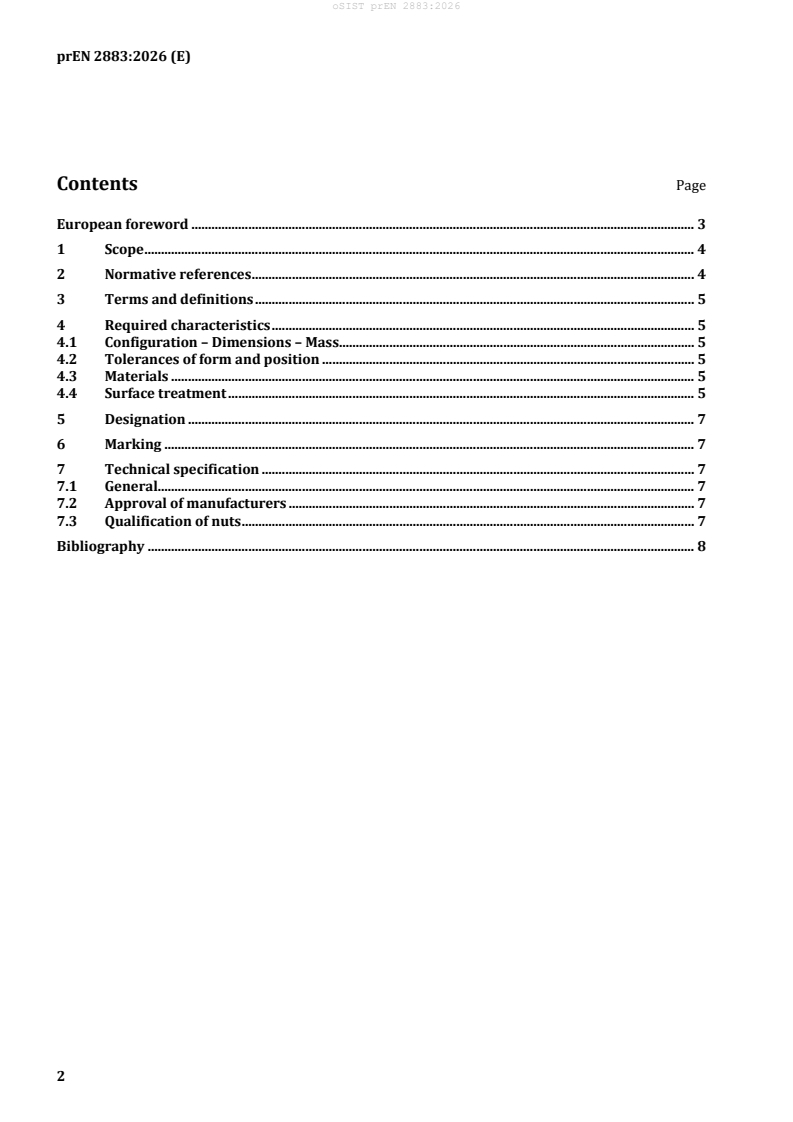
Contents
- 1 Scope
- 2 Normative references
- 3 Terms and definitions
- 4 Required characteristics
- 4.1 Configuration – Dimensions – Mass
- 4.2 Tolerances of form and position
- 4.3 Materials
- 4.4 Surface treatment
- 5 Designation
- 6 Marking
- 7 Technical specification
- 7.1 General
- 7.2 Approval of manufacturers
- 7.3 Qualification of nuts
- Bibliography
1 Scope
This document specifies the characteristics of self-locking hexagonal nuts, with counterbore and captive washer, in heat resisting steel, MoS lubricated.
1 2 Classification: 1 100 MPa /315 °C .
2 Normative references
The following documents are referred to in the text in such a way that some or all of their content constitutes requirements of this document. For dated references, only the edition cited applies. For undated references, the latest edition of the referenced document (including any amendments) applies. EN 2399, Aerospace series — Heat resisting steel FE-PA2601 (X4NiCrTiMoV26-15) — R ≥ 900 MPa — m Bars for forged bolts — D ≤ 25 mm EN 2424, Aerospace series — Marking of aerospace products EN 2491, Aerospace series — Molybdenum disulphide dry lubricants — Coating methods EN 2516, Aerospace series — Passivation of corrosion resisting steels and decontamination of nickel or cobalt base alloys EN 3638, Aerospace series — Heat-resisting alloy X6NiCrTiMoV26-15 (1.4980) — Consumable electrode remelted — Solution treated and precipitation treated — Sheets, strips and plates — 0,5 ≤ a ≤ 10 mm EN 3639, Aerospace series — Heat-resisting alloy X6NiCrTiMoV26-15 (1.4980) — Softened and cold worked — Wires for forged fasteners — D ≤ 15 mm — 900 MPa ≤ R ≤ 1 100 MPa m ISO 5855-2, Aerospace — MJ threads — Part 2: Limit dimensions for bolts and nuts ISO 5858, Aerospace — Nuts, self-locking, with maximum operating temperature less than or equal to 425 °C — Procurement specification ISO 8538, Aerospace — Nuts, hexagonal, self-locking, with counterbore and captive washer, with MJ threads, classifications: 1 100 MPa (at ambient temperature)/235 °C, 1 100 MPa (at ambient temperature)/315 °C and 1 100 MPa (at ambient temperature)/425 °C — Dimensions ISO 8788, Aerospace — Nuts, metric — Tolerances of form and position
TR 3791, Aerospace series — Materials for self-locking nuts, threaded inserts and screw thread inserts of temperature classes ≤ 425 °C
SAE AMS5525, Steel, Corrosion and Heat-Resistant, Sheet, Strip, and Plate 15Cr – 25.5Ni – 1.2Mo – 2.1Ti – 0.006B – 0.30V 1 800 °F (982 °C) Solution Heat Treated
Corresponds to the minimum tensile stress which the nut is able to withstand at ambient temperature without breaking or cracking when tested with a bolt of a higher strength class.
...