

SIST EN 18205:2027
(Main)Qualification of Welding Procedures for Plastic Materials
- Abstract
This document specifies a procedure to qualify a preliminary welding procedure specification (pWPS) by welding procedure tests to produce a qualified welding procedure specification (WPS).
NOTE 1 The application of this document ensures that the qualification of the pWPS is carried out according to a uniform test procedure.
NOTE 2 The primary purpose of a welding procedure qualification is to demonstrate that the joining process proposed for construction is capable of producing joints having the required mechanical properties for the intended application.
This document applies to the following thermoplastic welding processes:
- hot gas welding: round nozzle, speed, wedge;
- extrusion welding;
- heated tool welding: butt, socket, wedge.
This document applies to the welding of the following products:
- sheet;
- pipe (unreinforced, solid wall only);
- fittings (unreinforced only);
- lining membrane/
This document covers the welding of the following groups of materials:
a) for sheets, pipes and fittings:
- PVC (PVC-U, PVC-C);
- PP (PP-B, PP-H, PP-R);
- PE;
- PVDF;
- ECTFE, PFA and FEP;
b) for lining membranes:
- PVC-P;
- PE;
- ECB;
- PP;
c) for pipes and fittings only:
- PA-U (PA-U 11, PA-U 12).
- Status
- Published
- Public Enquiry End Date
- 17-Sep-2025
- Publication Date
- 22-Nov-2026
- Technical Committee
- IPMA - Polimer materials and products
- Current Stage
- 6060 - National Implementation/Publication (Adopted Project)
- Start Date
- 23-Nov-2026
- Due Date
- 28-Jan-2027
- Completion Date
- 23-Nov-2026

SIST EN 18205:2027 is a Slovenian standard for qualification of welding procedures for plastic materials, aligned with the European document prEN 18205. It specifies how to qualify a preliminary welding procedure specification (pWPS) by welding procedure tests so that a qualified welding procedure specification (WPS) can be issued. The standard is aimed at organizations that prepare, test, and approve thermoplastic welding procedures for sheets, pipes, fittings, and lining membranes.
What does SIST EN 18205:2027 specify?
SIST EN 18205:2027 specifies a procedure for qualifying a pWPS through welding procedure tests. It sets out the test pieces, examinations, acceptance criteria, and qualification ranges needed to turn a proposed procedure into an approved WPS.
The document applies to these thermoplastic welding processes:
- hot gas welding: round nozzle, speed, wedge
- extrusion welding
- heated tool welding: butt, socket, wedge
It applies to welding of:
- sheet
- pipe, for unreinforced solid wall only
- fittings, for unreinforced only
- lining membrane
The document is organized into:
- Clause 1 - Scope
- Clause 2 - Normative references
- Clause 3 - Terms and definitions
- Clause 4 - Preliminary welding procedure specification
- Clause 5 - Welding procedure test
- Clause 6 - Test piece
- Clause 7 - Examination and testing
- Clause 8 - Range of qualification
- Annex A - Example WPQR for hot gas welding
| Annex | What it covers |
|---|---|
| Annex A | Informative example of a welding procedure qualification record (WPQR) for hot gas welding |
What are the key requirements of SIST EN 18205:2027?
SIST EN 18205:2027 requires the pWPS to be prepared in accordance with CEN/TS 16892. In practice, the qualification starts from a documented procedure, not from ad hoc welding trials.
Test pieces and specimens
SIST EN 18205:2027 requires the test pieces to be welded according to the pWPS, and the specimen shapes and cutting locations are given in Figures 1 to 7. Cutting must not damage the weld or the heat affected zone, because the test is meant to measure the joint, not cutting damage.
Clause 6 links each welded test piece to a defined test layout. For example, the figures cover butt welds on sheet and pipe, socket welds, and lining membrane lap seams, so the reader knows how to prepare the sample before testing starts.
Examination, testing, and acceptance
SIST EN 18205:2027 requires visual examination during all stages of welding and mechanical testing. Visual inspection follows EN 13100-1, imperfections are classified with EN 14728, and acceptance levels come from EN 16296.
The destructive tests are selected by joint type and material. Clause 7 and Table 1 link the test piece to bend, tensile, crush, or T-peel testing, so the procedure qualification is matched to the joint being made. The standard also distinguishes which materials use bend testing and which use tensile testing for the butt-welded sheet and pipe specimens.
WPQR and re-testing
SIST EN 18205:2027 requires the welding procedure qualification record (WPQR) to capture the WPS items together with visual and destructive test results. The WPQR is the formal record used to present the qualification data in a uniform way.
If a test piece fails visual acceptance or a specimen fails a destructive criterion, the standard allows re-testing under defined conditions. If failure is shown to be due to insufficient welder skill rather than the procedure itself, the evidence can be recorded without repeating the full test sequence.
Range of qualification
SIST EN 18205:2027 limits qualification to the organization responsible for the welding, the parent material or material combination, the thickness range, the welding process, the welding position, the joint type, and the quality level chosen. In practice, a successful test does not automatically cover every plastic, joint, or thickness.
The standard also treats a standard welding procedure specification (sWPS) differently: an sWPS may be used in workshops or on site without further qualification. That matters when a company wants to rely on an already standardized procedure instead of running a new qualification test.
Process-specific changes that trigger re-qualification
SIST EN 18205:2027 lists specific changes that require re-qualification for each welding process. These include changes in key variables such as temperature, speed, gas type, backing, pressure, force, shoe design, wedge type, and nip roller type.
For example:
- hot gas welding - changes in gas type, backing, gas flow rate, gas temperature, welding speed, or nozzle-to-workpiece distance can trigger re-qualification
- extrusion welding - changes in shoe design, gas type, backing, extrudate temperature, screw speed, welding speed, or filler material can trigger re-qualification
- heated tool butt welding - changes in heater plate temperature, alignment pressure, heating time, change-over time, joining pressure, or cooling time can trigger re-qualification
- heated tool socket welding - changes in tool temperature, chamfer depth, insertion depth, heating time, change-over time, cooling time, or insertion method can trigger re-qualification
- heated tool wedge welding and hot gas wedge welding - changes in overlap length, wedge temperature or gas temperature, speed, force, wedge type, or nip roller type can trigger re-qualification
These limits matter because they define when a procedure remains covered and when a new test is needed.
What terms does SIST EN 18205:2027 define?
SIST EN 18205:2027 uses the following key terms and abbreviations:
- preliminary welding procedure specification (pWPS) - the initial welding procedure document that is tested and qualified.
- welding procedure specification (WPS) - the qualified welding procedure document issued after successful testing.
- standard welding procedure specification (sWPS) - a WPS with acceptable welding variables based on standard industry practice and specified in standards or specifications.
- welding procedure qualification record (WPQR) - the record of the test piece assessment, including visual and destructive test results and any re-tests.
- parent material - the base material that is welded and used to define the qualification range.
- quality level - the imperfection acceptance level used to judge the welded test piece.
- test piece - the welded sample made for qualification testing.
- heat affected zone - the area of material affected by welding heat and protected from damage during specimen cutting.
Who uses SIST EN 18205:2027?
SIST EN 18205:2027 is used by welding organizations that qualify procedures for plastic fabrication. It is relevant to engineers, welding coordinators, quality managers, and laboratories that prepare, witness, or assess procedure qualification tests.
It also matters to buyers and specifiers who need to compare or approve welding procedures for plastic sheets, pipes, fittings, and lining membranes. In practice, they use it to decide whether a proposed welding method is sufficiently qualified for a defined material, joint type, thickness, and quality level.
Which standards are used with SIST EN 18205:2027?
SIST EN 18205:2027 relies on these referenced documents:
- EN 12814-1 - bend test method for welded thermoplastic joints.
- EN 12814-2 - tensile test method for welded thermoplastic joints.
- EN 12814-4 - peel test method, used here for crush and T-peel testing.
- EN 12814-7 - tensile test with waisted test specimens.
- EN 12814-8 - acceptance requirements for the relevant mechanical tests.
- EN 13100-1 - visual examination of welded thermoplastic joints.
- EN 14728 - classification of imperfections in thermoplastic welds.
- EN 16296 - quality levels for imperfections in thermoplastic welded joints.
- EN 13067 - qualification of welders for thermoplastics welded assemblies.
- CEN/TS 16892 - specification for preparing welding procedures, including the pWPS.
- EN ISO 23936-1 - thermoplastics in oil and gas related media, used for terms and definitions.
- ISO/TR 20118 - fire characteristics and fire performance guidance for PVC materials in building applications.
- ISO/TR 25901-1 - general welding vocabulary.
- ISO 13953 - tensile strength and failure mode of PE butt-fused joints, used for brittle failure assessment.
What does the SIST EN 18205:2027 document contain?
SIST EN 18205:2027 contains the procedure for qualifying a pWPS, the preparation and welding of test pieces, and the examination and testing rules used to judge the welded joint. It also contains qualification rules for thickness, process, position, joint type, material, and quality level.
The figures show the required test-piece layouts for butt welds on sheet and pipe, socket welds, and lining membrane lap seams, including discard areas and specimen-cutting zones. Table 1 links each test piece to the relevant mechanical test and specimen count, and Table 2 gives the thickness qualification ranges. Annex A provides an example WPQR format for hot gas welding, which is useful when documenting procedure qualification results.
Get Certified
Connect with accredited certification bodies for this standard

DIN CERTCO
DIN Group product certification.

DVS-ZERT GmbH
German welding certification society.
CARES (UK Certification Authority for Reinforcing Steels)
UK certification for reinforcing steels and construction.
Sponsored listings
Frequently Asked Questions
SIST EN 18205:2027 is a standard published by the Slovenian Institute for Standardization (SIST). Its full title is "Qualification of Welding Procedures for Plastic Materials". This standard covers: This document specifies a procedure to qualify a preliminary welding procedure specification (pWPS) by welding procedure tests to produce a qualified welding procedure specification (WPS). NOTE 1 The application of this document ensures that the qualification of the pWPS is carried out according to a uniform test procedure. NOTE 2 The primary purpose of a welding procedure qualification is to demonstrate that the joining process proposed for construction is capable of producing joints having the required mechanical properties for the intended application. This document applies to the following thermoplastic welding processes: - hot gas welding: round nozzle, speed, wedge; - extrusion welding; - heated tool welding: butt, socket, wedge. This document applies to the welding of the following products: - sheet; - pipe (unreinforced, solid wall only); - fittings (unreinforced only); - lining membrane/ This document covers the welding of the following groups of materials: a) for sheets, pipes and fittings: - PVC (PVC-U, PVC-C); - PP (PP-B, PP-H, PP-R); - PE; - PVDF; - ECTFE, PFA and FEP; b) for lining membranes: - PVC-P; - PE; - ECB; - PP; c) for pipes and fittings only: - PA-U (PA-U 11, PA-U 12).
This document specifies a procedure to qualify a preliminary welding procedure specification (pWPS) by welding procedure tests to produce a qualified welding procedure specification (WPS). NOTE 1 The application of this document ensures that the qualification of the pWPS is carried out according to a uniform test procedure. NOTE 2 The primary purpose of a welding procedure qualification is to demonstrate that the joining process proposed for construction is capable of producing joints having the required mechanical properties for the intended application. This document applies to the following thermoplastic welding processes: - hot gas welding: round nozzle, speed, wedge; - extrusion welding; - heated tool welding: butt, socket, wedge. This document applies to the welding of the following products: - sheet; - pipe (unreinforced, solid wall only); - fittings (unreinforced only); - lining membrane/ This document covers the welding of the following groups of materials: a) for sheets, pipes and fittings: - PVC (PVC-U, PVC-C); - PP (PP-B, PP-H, PP-R); - PE; - PVDF; - ECTFE, PFA and FEP; b) for lining membranes: - PVC-P; - PE; - ECB; - PP; c) for pipes and fittings only: - PA-U (PA-U 11, PA-U 12).
SIST EN 18205:2027 is classified under the following ICS (International Classification for Standards) categories: 25.160.10 - Welding processes; 83.080.01 - Plastics in general. The ICS classification helps identify the subject area and facilitates finding related standards.
SIST EN 18205:2027 is available in PDF format for immediate download after purchase. The document can be added to your cart and obtained through the secure checkout process. Digital delivery ensures instant access to the complete standard document.
Standards Content (Sample)
SLOVENSKI STANDARD
01-januar-2027
Kvalifikacija postopkov varjenja za polimerne materiale
Qualification of Welding Procedures for Plastic Materials
Qualifizierung von Schweißverfahren für Kunststoffe
Qualification des modes opératoires de soudage des matières plastiques
Ta slovenski standard je istoveten z: EN 18205:2026
ICS:
25.160.10 Varilni postopki in varjenje Welding processes
83.080.01 Polimerni materiali na Plastics in general
splošno
2003-01.Slovenski inštitut za standardizacijo. Razmnoževanje celote ali delov tega standarda ni dovoljeno.
EN 18205
EUROPEAN STANDARD
NORME EUROPÉENNE
November 2026
EUROPÄISCHE NORM
ICS 25.160.10
English Version
Qualification of welding procedures for plastic materials
Qualification des modes opératoires de soudage des Qualifizierung von Schweißverfahren für Kunststoffe
matières plastiques
This European Standard was approved by CEN on 11 October 2026.
CEN members are bound to comply with the CEN/CENELEC Internal Regulations which stipulate the conditions for giving this
European Standard the status of a national standard without any alteration. Up-to-date lists and bibliographical references
concerning such national standards may be obtained on application to the CEN-CENELEC Management Centre or to any CEN
member.
This European Standard exists in three official versions (English, French, German). A version in any other language made by
translation under the responsibility of a CEN member into its own language and notified to the CEN-CENELEC Management
Centre has the same status as the official versions.
CEN members are the national standards bodies of Austria, Belgium, Bulgaria, Croatia, Cyprus, Czech Republic, Denmark, Estonia,
Finland, France, Germany, Greece, Hungary, Iceland, Ireland, Italy, Latvia, Lithuania, Luxembourg, Malta, Netherlands, Norway,
Poland, Portugal, Republic of North Macedonia, Romania, Serbia, Slovakia, Slovenia, Spain, Sweden, Switzerland, Türkiye and
United Kingdom.
EUROPEAN COMMITTEE FOR STANDARDIZATION
COMITÉ EUROPÉEN DE NORMALISATION
EUROPÄISCHES KOMITEE FÜR NORMUNG
CEN-CENELEC Management Centre: Rue de la Science 23, B-1040 Brussels
© 2026 CEN All rights of exploitation in any form and by any means reserved Ref. No. EN 18205:2026 E
worldwide for CEN national Members.
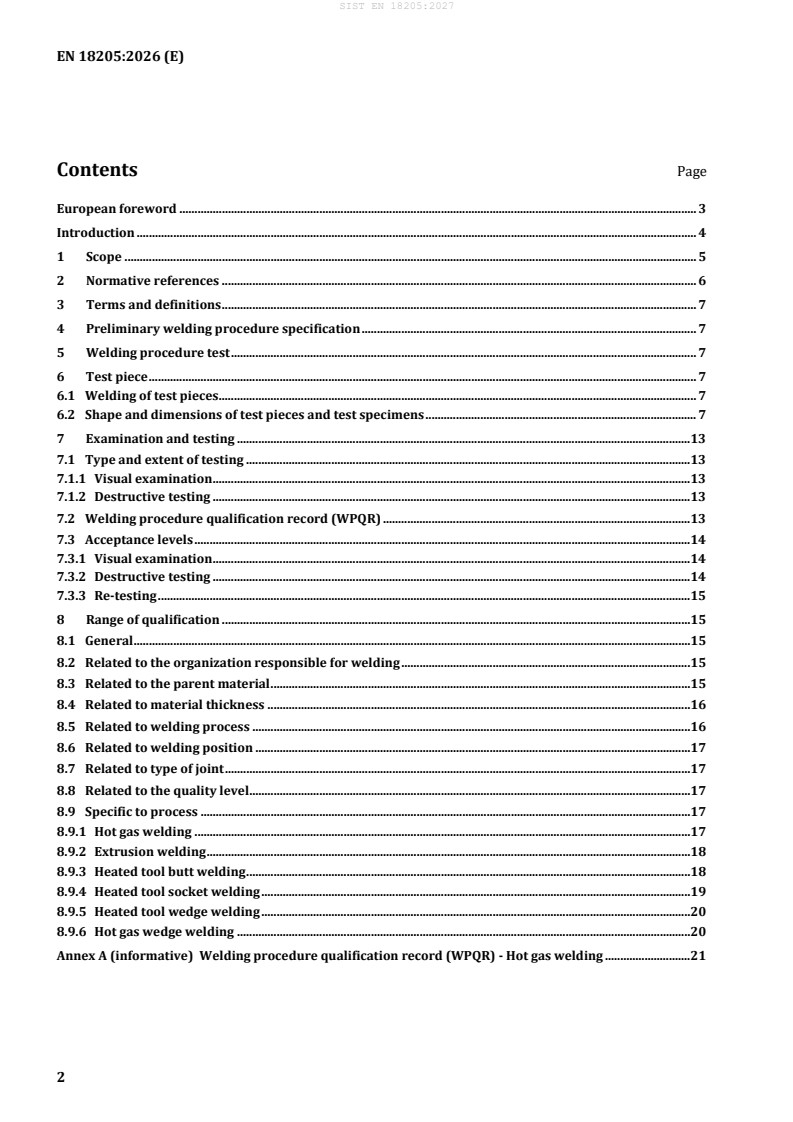
Contents Page
European foreword . 3
Introduction . 4
1 Scope . 5
2 Normative references . 6
3 Terms and definitions . 7
4 Preliminary welding procedure specification . 7
5 Welding procedure test . 7
6 Test piece . 7
6.1 Welding of test pieces . 7
6.2 Shape and dimensions of test pieces and test specimens . 7
7 Examination and testing . 13
7.1 Type and extent of testing . 13
7.1.1 Visual examination . 13
7.1.2 Destructive testing . 13
7.2 Welding procedure qualification record (WPQR) . 13
7.3 Acceptance levels . 14
7.3.1 Visual examination . 14
7.3.2 Destructive testing . 14
7.3.3 Re-testing . 15
8 Range of qualification . 15
8.1 General . 15
8.2 Related to the organization responsible for welding . 15
8.3 Related to the parent material . 15
8.4 Related to material thickness . 16
8.5 Related to welding process . 16
8.6 Related to welding position . 17
8.7 Related to type of joint . 17
8.8 Related to the quality level . 17
8.9 Specific to process . 17
8.9.1 Hot gas welding . 17
8.9.2 Extrusion welding . 18
8.9.3 Heated tool butt welding . 18
8.9.4 Heated tool socket welding . 19
8.9.5 Heated tool wedge welding . 20
8.9.6 Hot gas wedge welding . 20
Annex A (informative) Welding procedure qualification record (WPQR) - Hot gas welding . 21
European foreword
This document (EN 18205:2026) has been prepared by Technical Committee CEN/TC 249 “Plastics”, the
secretariat of which is held by SIS.
This European Standard shall be given the status of a national standard, either by publication of an
identical text or by endorsement, at the latest by May 2027 and conflicting national standards shall be
withdrawn at the latest by May 2027.
Attention is drawn to the possibility that some of the elements of this document may be the subject of
patent rights. CEN shall not be held responsible for identifying any or all such patent rights.
Any feedback and questions on this document should be directed to the users’ national standards body.
A complete listing of these bodies can be found on the CEN website.
According to the CEN-CENELEC Internal Regulations, the national standards organizations of the
following countries are bound to implement this European Standard: Austria, Belgium, Bulgaria, Croatia,
Cyprus, Czech Republic, Denmark, Estonia, Finland, France, Germany, Greece, Hungary, Iceland, Ireland,
Italy, Latvia, Lithuania, Luxembourg, Malta, Netherlands, Norway, Poland, Portugal, Republic of North
Macedonia, Romania, Serbia, Slovakia, Slovenia, Spain, Sweden, Switzerland, Türkiye and the United
Kingdom.
Introduction
This document covers the principles to be observed in the qualification testing of welding procedures for
thermoplastic materials.
1 Scope
This document specifies a procedure to qualify a preliminary welding procedure specification (pWPS) by
welding procedure tests to produce a qualified welding procedure specification (WPS).
NOTE 1 The application of this document ensures that the qualification of the pWPS is carried out according to
a uniform test procedure.
NOTE 2 The primary purpose of a welding procedure qualification is to demonstrate that the joining process
proposed for construction is capable of producing joints having the required mechanical properties for the intended
application.
This document applies to the following thermoplastic welding processes:
— hot gas welding: round nozzle, speed, wedge;
— extrusion welding;
— heated tool welding: butt, socket, wedge.
This document applies to the welding of the following products:
— sheet;
— pipe (unreinforced, solid wall only);
— fittings (unreinforced only);
— lining membrane/
This document covers the welding of the following groups of materials:
a) for sheets, pipes and fittings:
— PVC (PVC-U, PVC-C);
— PP (PP-B, PP-H, PP-R);
— PE;
— PVDF;
— ECTFE, PFA and FEP;
b) for lining membranes:
— PVC-P;
— PE;
— ECB;
— PP;
c) for pipes and fittings only:
— PA-U (PA-U 11, PA-U 12).
2 Normative references
The following documents are referred to in the text in such a way that some or all of their content
constitutes requirements of this document. For dated references, only the edition cited applies. For
undated references, the latest edition of the referenced document (including any amendments) applies.
CEN/TS 16892, Plastics - Welding of thermoplastics - Specification of welding procedures
EN 12814-1, Testing of welded joints of thermoplastics semi-finished products - Part 1: Bend test
EN 12814-2, Testing of welded joints of thermoplastics semi-finished products - Part 2: Tensile test
EN 12814-4, Testing of welded joints of thermoplastics semi-finished products - Part 4: Peel test
EN 12814-7, Testing of welded joints of thermoplastics semi-finished products - Part 7: Tensile test with
waisted test specimens
EN 12814-8, Testing of welded joints of thermoplastics semi-finished products - Part 8: Requirements
EN 13100-1, Non destructive testing of welded joints of thermoplastics semi-finished products - Part 1:
Visual examination
EN 14728, Imperfections in thermoplastic welds - Classification
EN 16296, Imperfections in thermoplastics welded joints - Quality levels
EN 13067, Plastics welding personnel - Qualification of welders - Thermoplastics welded assemblies
EN ISO 23936-1, Oil and gas industries including lower carbon energy - Non-metallic materials in contact
with media related to oil and gas production - Part 1: Thermoplastics (ISO 23936-1)
ISO/TR 20118, Plastics - Guidance on fire characteristics and fire performance of PVC materials used in
building applications
ISO/TR 25901-1, Welding and allied processes - Vocabulary - Part 1: General terms
ISO 13953, Polyethylene (PE) pipes and fittings - Determination of the tensile strength and failure mode of
test pieces from a butt-fused joint
3 Terms and definitions
For the purposes of this document, the terms and definitions given in EN 13067, EN ISO 23936-1,
ISO/TR 20118, ISO/TR 25901-1 and the following apply.
ISO and IEC maintain terminology databases for use in standardization at the following addresses:
— ISO Online browsing platform: available at http://www.iso.org/obp
— IEC Electropedia: available at http://www.electropedia.org/
3.1
standard welding procedure specification
sWPS
welding procedure specification that contains acceptable welding variables based on standard industry
practice and is specified in national or international standards or industry specifications
4 Preliminary welding procedure specification
The preliminary welding procedure specification (pWPS) shall be prepared in accordance with
CEN/TS 16892.
5 Welding procedure test
The welding and testing of test pieces shall be in accordance with Clauses 6 and 7.
6 Test piece
6.1 Welding of test pieces
Preparation and welding of the test pieces shall be carried out in accordance with the pWPS. All welding
parameters shall be recorded in a welding procedure qualification record (see 7.2).
6.2 Shape and dimensions of test pieces and test specimens
The dimensions of the test piece and the number of test specimens to be cut from the test piece are
specified in Figures 1 to 7.
The shapes, dimensions and conditioning of the test specimens are specified in the relevant test
standards.
Cutting the test specimens shall be carried out without significant damage to the welds and their heat
affected zones.
Minimum dimensions in millimetres
Key
1 discard
2 6 bend test specimens cut from within this area
3 weld
Figure 1 — Test piece for a butt weld on sheet (for bend test specimens)
Key
1 4 test specimens, 1 in each location (x1, x2, y1, y2)
2 weld
l ≥ 350 or 2 dn, whichever is longer
Figure 2 — Test piece for a butt weld on pipe (for bend or tensile test specimens)
Minimum dimensions in millimetres
Key
1 discard
2 5 tensile test specimens cut from within this area
3 tensile test specimens (for reference)
4 weld
Figure 3 —Test piece for a butt weld on sheet (for tensile test specimens)
Key
1 socket
2 pipe
l ≥ 5 dn
Figure 4 — Test piece for a socket weld
Minimum dimensions in millimetres
a) Test piece
...