

oSIST prEN 10219-1:2026
(Main)Cold formed welded steel structural hollow sections - Part 1: Technical delivery conditions
General Information
- Abstract
This document specifies the technical delivery conditions for electric welded and submerged arc welded cold formed structural steel hollow sections of circular, square, rectangular or elliptical forms and applies to structural hollow sections formed cold without subsequent heat treatment other than the heat treatment of the weld line.
NOTE 1 The requirements for tolerances, dimensions and sectional properties in EN 10219-2.
NOTE 2 The provisions that apply under the Construction Products Regulations (CPR) are specified in EN 10380.
NOTE 3 The attention of users is drawn to the fact that whilst cold formed grades in this document can have equivalent mechanical properties to hot-finished grades in EN 10210-1 the sectional properties of square and rectangular hollow sections in EN 10219-2 and EN 10210-2 are not equivalent.
NOTE 4 A range of steel grades is specified in this document and the user should select the grade most appropriate to the intended use and service conditions. The grades and mechanical properties, but not the final supply condition of cold formed hollow sections are generally comparable with those in EN 10025-2, EN 10025-3, EN 10025-4, EN 10025-5, EN 10025-6, EN 10149-2 and EN 10149-3.
- Status
- Not Published
- Public Enquiry End Date
- 30-May-2026
- Technical Committee
- IFEK - Ferrous metals
- Current Stage
- 4020 - Public enquire (PE) (Adopted Project)
- Start Date
- 02-Apr-2026
- Due Date
- 20-Aug-2026
- Completion Date
- 01-Jun-2026

Overview
oSIST prEN 10219-1:2026:2026, issued by CEN, defines the technical delivery conditions for cold formed welded steel structural hollow sections. This standard applies to hollow sections produced by electric welding or submerged arc welding and shaped cold, without any subsequent heat treatment except for the weld seam. The specification addresses various hollow section forms-including circular, square, rectangular, and elliptical-commonly used in construction and engineering industries.
This European Standard is a key document for manufacturers, specifiers, and purchasers seeking consistent product quality, mechanical properties, and chemical composition requirements for structural hollow sections used in steel frameworks and load-bearing applications.
Key Topics
Scope of Application
- Covers cold formed welded structural steel hollow sections without post-formation heat treatment, except for the weld.
- Applicable to hollow sections used in structural and load-bearing applications.
Product Forms
- Circular, square, rectangular, and elliptical hollow sections.
- Multiple steel grades available to suit different service requirements.
Technical Delivery Conditions
- Criteria for material ordering, manufacturer responsibilities, and product identification.
- Classification and designation of steel grades and qualities for impact resistance, mechanical strength, and specific service conditions.
Manufacturing and Inspection
- Delivered in cold formed state; only the weld seam may receive heat treatment.
- Requirements for surface condition, weld bead trimming, and optional hot-dip zinc coating.
- Specifies mandatory and optional inspection and testing processes for chemical composition and mechanical properties.
Reference for Tolerances
- Tolerances, sectional properties, and dimensions are defined in EN 10219-2.
Regulatory Considerations
- Provisions relating to the Construction Products Regulation (CPR) are specified in EN 10380.
Applications
Structural hollow sections conforming to oSIST prEN 10219-1:2026 provide critical components for a wide range of construction and structural engineering applications, including but not limited to:
- Steel building frameworks (columns, beams, trusses)
- Infrastructure (bridges, towers, and masts)
- Mechanical engineering (frames for machinery and industrial supports)
- Transport and storage systems
These hollow sections are valued for their strength-to-weight ratio, design flexibility, and suitability for welded construction. Their availability in different shapes and grades allows designers to optimize material usage based on structural requirements and environmental conditions.
Related Standards
- EN 10219-2 - Details tolerances, dimensions, and sectional properties for cold formed welded steel hollow sections.
- EN 10380 - Specifies provisions under the Construction Products Regulation (CPR).
- EN 10210-1/EN 10210-2 - Standards for hot-finished structural hollow sections, referenced for comparison of mechanical and sectional properties.
- EN 10025 series - General mechanical property standards for structural steel (including sections referenced for comparative grades).
- EN ISO 1461 - Conditions for hot dip galvanized coatings.
- EN ISO 9712, ISO 11484, SNT TC-1A - Guidelines for non-destructive testing personnel qualification.
Practical Value
Conformance to oSIST prEN 10219-1:2026:2026 assures the quality, consistency, and fitness-for-purpose of cold formed welded structural hollow sections. By adhering to the defined technical delivery and inspection conditions, manufacturers and users benefit from:
- Reliable mechanical performance and safety
- Clear guidelines for material ordering and specification
- Consistent chemical and mechanical properties for critical structural applications
- Compatibility with European regulatory requirements and market expectations
This standard facilitates efficient structural design, manufacture, and quality assurance, supporting the needs of construction professionals across Europe and worldwide.
Relations
- Effective Date
- 17-Jan-2024
Get Certified
Connect with accredited certification bodies for this standard

Element Materials Technology
Materials testing and product certification.

Inštitut za kovinske materiale in tehnologije
Institute of Metals and Technology. Materials testing, metallurgical analysis, NDT.
Sponsored listings
Frequently Asked Questions
oSIST prEN 10219-1:2026 is a draft published by the Slovenian Institute for Standardization (SIST). Its full title is "Cold formed welded steel structural hollow sections - Part 1: Technical delivery conditions". This standard covers: This document specifies the technical delivery conditions for electric welded and submerged arc welded cold formed structural steel hollow sections of circular, square, rectangular or elliptical forms and applies to structural hollow sections formed cold without subsequent heat treatment other than the heat treatment of the weld line. NOTE 1 The requirements for tolerances, dimensions and sectional properties in EN 10219-2. NOTE 2 The provisions that apply under the Construction Products Regulations (CPR) are specified in EN 10380. NOTE 3 The attention of users is drawn to the fact that whilst cold formed grades in this document can have equivalent mechanical properties to hot-finished grades in EN 10210-1 the sectional properties of square and rectangular hollow sections in EN 10219-2 and EN 10210-2 are not equivalent. NOTE 4 A range of steel grades is specified in this document and the user should select the grade most appropriate to the intended use and service conditions. The grades and mechanical properties, but not the final supply condition of cold formed hollow sections are generally comparable with those in EN 10025-2, EN 10025-3, EN 10025-4, EN 10025-5, EN 10025-6, EN 10149-2 and EN 10149-3.
This document specifies the technical delivery conditions for electric welded and submerged arc welded cold formed structural steel hollow sections of circular, square, rectangular or elliptical forms and applies to structural hollow sections formed cold without subsequent heat treatment other than the heat treatment of the weld line. NOTE 1 The requirements for tolerances, dimensions and sectional properties in EN 10219-2. NOTE 2 The provisions that apply under the Construction Products Regulations (CPR) are specified in EN 10380. NOTE 3 The attention of users is drawn to the fact that whilst cold formed grades in this document can have equivalent mechanical properties to hot-finished grades in EN 10210-1 the sectional properties of square and rectangular hollow sections in EN 10219-2 and EN 10210-2 are not equivalent. NOTE 4 A range of steel grades is specified in this document and the user should select the grade most appropriate to the intended use and service conditions. The grades and mechanical properties, but not the final supply condition of cold formed hollow sections are generally comparable with those in EN 10025-2, EN 10025-3, EN 10025-4, EN 10025-5, EN 10025-6, EN 10149-2 and EN 10149-3.
oSIST prEN 10219-1:2026 is classified under the following ICS (International Classification for Standards) categories: 77.140.70 - Steel profiles; 77.140.75 - Steel pipes and tubes for specific use. The ICS classification helps identify the subject area and facilitates finding related standards.
oSIST prEN 10219-1:2026 has the following relationships with other standards: It is inter standard links to SIST EN 10219-1:2006. Understanding these relationships helps ensure you are using the most current and applicable version of the standard.
oSIST prEN 10219-1:2026 is available in PDF format for immediate download after purchase. The document can be added to your cart and obtained through the secure checkout process. Digital delivery ensures instant access to the complete standard document.
Standards Content (Sample)
SLOVENSKI STANDARD
01-maj-2026
Hladno oblikovani varjeni votli profili iz jekla - 1. del: Tehnični dobavni pogoji
Cold formed welded steel structural hollow sections - Part 1: Technical delivery
conditions
Kaltgeformte geschweißte Hohlprofile für den Stahlbau - Teil 1: Technische
Lieferbedingungen
Profils creux de construction en aciers soudés formés à froid - Partie 1 : Conditions
techniques de livraison
Ta slovenski standard je istoveten z: prEN 10219-1
ICS:
77.140.70 Jekleni profili Steel profiles
77.140.75 Jeklene cevi in cevni profili Steel pipes and tubes for
za posebne namene specific use
2003-01.Slovenski inštitut za standardizacijo. Razmnoževanje celote ali delov tega standarda ni dovoljeno.
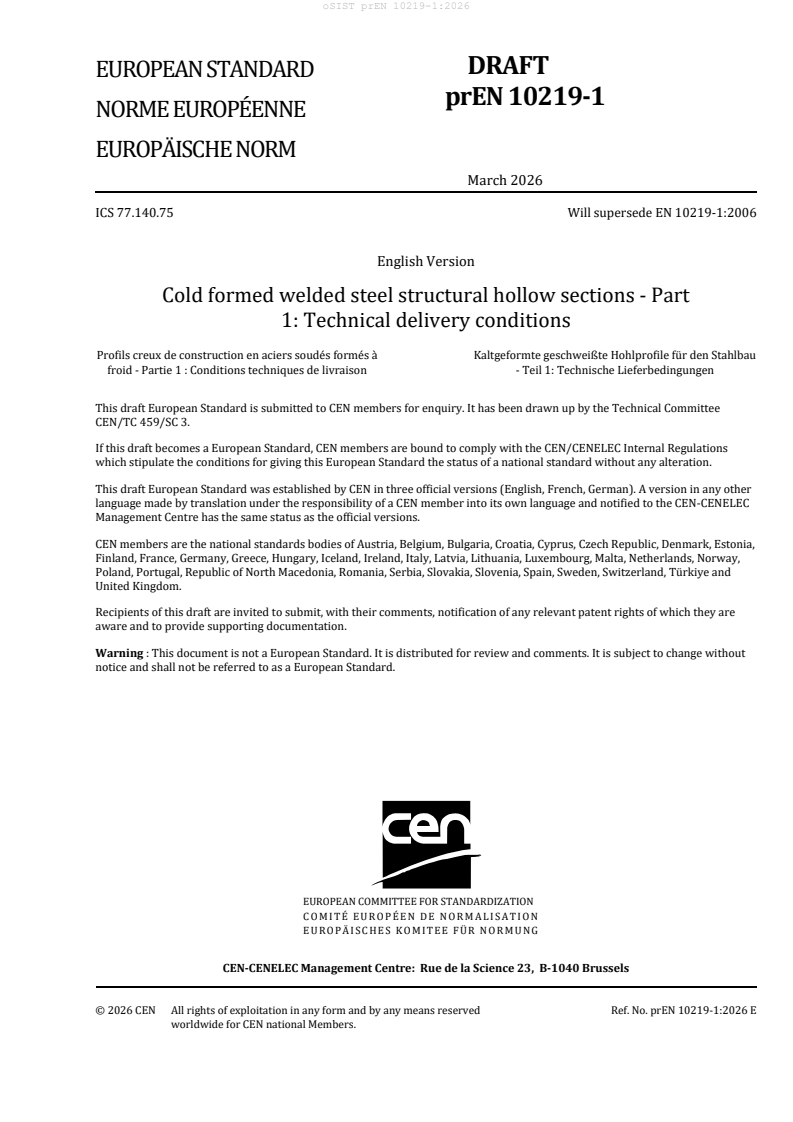
DRAFT
EUROPEAN STANDARD
NORME EUROPÉENNE
EUROPÄISCHE NORM
March 2026
ICS 77.140.75 Will supersede EN 10219-1:2006
English Version
Cold formed welded steel structural hollow sections - Part
1: Technical delivery conditions
Profils creux de construction en aciers soudés formés à Kaltgeformte geschweißte Hohlprofile für den Stahlbau
froid - Partie 1 : Conditions techniques de livraison - Teil 1: Technische Lieferbedingungen
This draft European Standard is submitted to CEN members for enquiry. It has been drawn up by the Technical Committee
CEN/TC 459/SC 3.
If this draft becomes a European Standard, CEN members are bound to comply with the CEN/CENELEC Internal Regulations
which stipulate the conditions for giving this European Standard the status of a national standard without any alteration.
This draft European Standard was established by CEN in three official versions (English, French, German). A version in any other
language made by translation under the responsibility of a CEN member into its own language and notified to the CEN-CENELEC
Management Centre has the same status as the official versions.
CEN members are the national standards bodies of Austria, Belgium, Bulgaria, Croatia, Cyprus, Czech Republic, Denmark, Estonia,
Finland, France, Germany, Greece, Hungary, Iceland, Ireland, Italy, Latvia, Lithuania, Luxembourg, Malta, Netherlands, Norway,
Poland, Portugal, Republic of North Macedonia, Romania, Serbia, Slovakia, Slovenia, Spain, Sweden, Switzerland, Türkiye and
United Kingdom.
Recipients of this draft are invited to submit, with their comments, notification of any relevant patent rights of which they are
aware and to provide supporting documentation.
Warning : This document is not a European Standard. It is distributed for review and comments. It is subject to change without
notice and shall not be referred to as a European Standard.
EUROPEAN COMMITTEE FOR STANDARDIZATION
COMITÉ EUROPÉEN DE NORMALISATION
EUROPÄISCHES KOMITEE FÜR NORMUNG
CEN-CENELEC Management Centre: Rue de la Science 23, B-1040 Brussels
© 2026 CEN All rights of exploitation in any form and by any means reserved Ref. No. prEN 10219-1:2026 E
worldwide for CEN national Members.
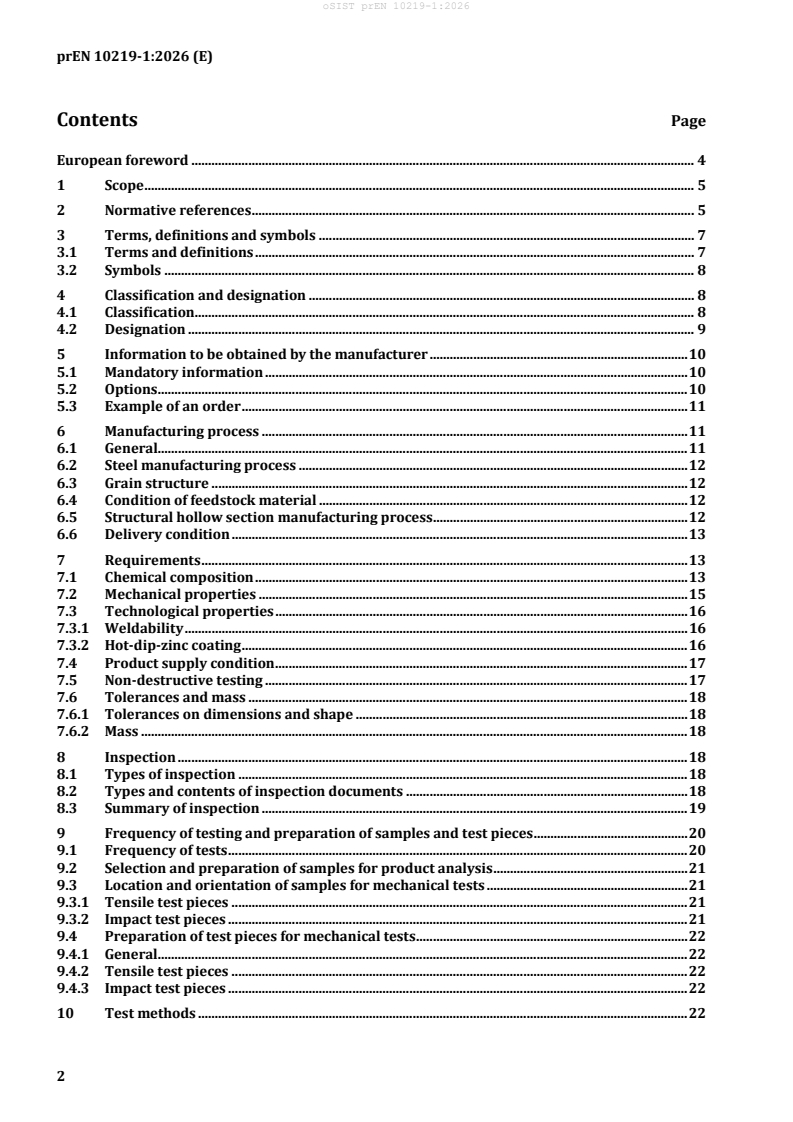
Contents Page
European foreword . 4
1 Scope . 5
2 Normative references . 5
3 Terms, definitions and symbols . 7
3.1 Terms and definitions . 7
3.2 Symbols . 8
4 Classification and designation . 8
4.1 Classification. 8
4.2 Designation . 9
5 Information to be obtained by the manufacturer . 10
5.1 Mandatory information . 10
5.2 Options . 10
5.3 Example of an order . 11
6 Manufacturing process . 11
6.1 General. 11
6.2 Steel manufacturing process . 12
6.3 Grain structure . 12
6.4 Condition of feedstock material . 12
6.5 Structural hollow section manufacturing process . 12
6.6 Delivery condition . 13
7 Requirements . 13
7.1 Chemical composition . 13
7.2 Mechanical properties . 15
7.3 Technological properties . 16
7.3.1 Weldability . 16
7.3.2 Hot-dip-zinc coating . 16
7.4 Product supply condition . 17
7.5 Non-destructive testing . 17
7.6 Tolerances and mass . 18
7.6.1 Tolerances on dimensions and shape . 18
7.6.2 Mass . 18
8 Inspection . 18
8.1 Types of inspection . 18
8.2 Types and contents of inspection documents . 18
8.3 Summary of inspection . 19
9 Frequency of testing and preparation of samples and test pieces . 20
9.1 Frequency of tests . 20
9.2 Selection and preparation of samples for product analysis . 21
9.3 Location and orientation of samples for mechanical tests . 21
9.3.1 Tensile test pieces . 21
9.3.2 Impact test pieces . 21
9.4 Preparation of test pieces for mechanical tests . 22
9.4.1 General. 22
9.4.2 Tensile test pieces . 22
9.4.3 Impact test pieces . 22
10 Test methods . 22
10.1 Chemical analysis . 22
10.2 Mechanical tests . 23
10.2.1 Test temperature . 23
10.2.2 Tensile test . 23
10.2.3 Impact test . 23
10.3 Visual inspection and dimensional check . 23
10.4 Non-destructive testing . 24
10.4.1 General . 24
10.4.2 Weld seams of electric welded sections . 24
10.4.3 Weld seams of submerged arc welded sections . 24
10.4.4 Full peripheral NDT . 24
10.4.5 Ultrasonic testing for laminar imperfections . 24
10.5 Retests, sorting and reprocessing . 24
11 Marking . 25
Annex A (normative) Structural hollow sections of non-alloy quality steels - Chemical composition
and mechanical properties . 26
Annex B (normative) Structural hollow sections of normalized/normalized rolled steels - Chemical
composition and mechanical properties . 28
Annex C (normative) Structural hollow sections of thermomechanical formed steels - Chemical
composition and mechanical properties . 31
Annex D (normative) Structural hollow sections of quenched and tempered steels — Chemical
composition and mechanical properties . 37
Annex E (normative) Structural hollow sections of steels with improved atmospheric corrosion
resistance — Chemical composition and mechanical properties . 43
Annex F (normative) Location of samples and test pieces . 47
Bibliography . 49
European foreword
This document (prEN 10219-1:2026) has been prepared by Technical Committee CEN/TC 459/SC 3
“Structural steels other than reinforcements”, the secretariat of which is held by DIN.
This document is currently submitted to the CEN Enquiry.
This document will supersede EN 10219-1:2006 and EN 10219-3:2020.
This document includes the following significant technical changes with respect to the previous version:
— part 1 and part 3 were merged;
— the chemical compositions of some grades were slightly changed;
— Annex ZA and provisions that apply under the Construction Products Regulation were moved to
EN 10380;
— editorial revised.
This standard consists of the following parts:
— EN 10380, Finished non-alloy and alloy steel products for structural use
— EN 10219-1, Cold formed welded steel structural hollow sections - Part 1: Technical delivery conditions
— EN 10219-2, Cold formed welded steel structural hollow sections - Part 2: Tolerances, dimensions and
sectional properties
It forms part of a series of standards on hollow sections together with EN 10210-1 and EN 10210-2.
1 Scope
This document specifies the technical delivery conditions for electric welded and submerged arc welded
cold formed structural steel hollow sections of circular, square, rectangular or elliptical forms and applies
to structural hollow sections formed cold without subsequent heat treatment other than the heat
treatment of the weld line.
NOTE 1 The requirements for tolerances, dimensions and sectional properties in EN 10219-2.
NOTE 2 The provisions that apply under the Construction Products Regulations (CPR) are specified in EN 10380.
NOTE 3 The attention of users is drawn to the fact that whilst cold formed grades in this document can have
equivalent mechanical properties to hot-finished grades in EN 10210-1 the sectional properties of square and
rectangular hollow sections in EN 10219-2 and EN 10210-2 are not equivalent.
NOTE 4 A range of steel grades is specified in this document and the user selects the grade most appropriate to
the intended use and service conditions. The grades and mechanical properties, but not the final supply condition
of cold formed hollow sections are generally comparable with those in EN 10025-2, EN 10025-3, EN 10025-4,
EN 10025-5, EN 10025-6, EN 10149-2 and EN 10149-3.
2 Normative references
The following documents are referred to in the text in such a way that some or all of their content
constitutes requirements of this document. For dated references, only the edition cited applies. For
undated references, the latest edition of the referenced document (including any amendments) applies.
EN 1011-1, Welding — Recommendations for welding of metallic materials - Part 1: General guidance for
arc welding
EN 1011-2, Welding — Recommendations for welding of metallic materials — Part 2: Arc welding of ferritic
steels
EN 10020, Definition and classification of grades of steel
EN 10021, General technical delivery conditions for steel products
EN 10027-1, Designation systems for steels — Part 1: Steel names
EN 10027-2, Designation systems for steels — Part 2: Numerical system
EN 10160, Ultrasonic testing of steel flat product of thickness equal or greater than 6 mm (reflection
method)
EN 10168, Steel products — Inspection documents — List of information and description
EN 10204, Metallic products — Types of inspection documents
EN 10219-2, Cold formed welded steel structural hollow sections — Part 2: Tolerances, dimensions and
sectional properties
CEN/TR 10261, Iron and steel — European standards for the determination of chemical composition
EN 10266, Steel tubes, fittings and structural hollow sections — Symbols and definitions of terms for use in
product standards
EN ISO 148-1, Metallic materials — Charpy pendulum impact test — Part 1: Test method (ISO 148-1)
EN ISO 377, Steel and steel products — Location and preparation of samples and test pieces for mechanical
testing (ISO 377)
EN ISO 643, Steels — Micrographic determination of the apparent grain size (ISO 643)
EN ISO 1461, Hot dip galvanized coatings on fabricated iron and steel articles — Specifications and test
methods (ISO 1461)
EN ISO 2566-1, Steel - Conversion of elongation values — Part 1: Carbon and low alloy steels (ISO 2566-1)
EN ISO 4885, Ferrous materials — Heat treatments — Vocabulary (ISO 4885)
EN ISO 6892-1, Metallic materials — Tensile testing — Part 1: Method of test at room temperature
(ISO 6892-1)
EN ISO 9606-1, Qualification testing of welders — Fusion welding - Part 1: Steels (ISO 9606-1)
EN ISO 9712, Non-destructive testing — Qualification and certification of NDT personnel (ISO 9712)
EN ISO 10893-2, Non-destructive testing of steel tubes — Part 2: Automated eddy current testing of
seamless and welded (except submerged arc-welded) steel tubes for the detection of imperfections
(ISO 10893-2)
EN ISO 10893-3, Non-destructive testing of steel tubes — Part 3: Automated full peripheral flux leakage
testing of seamless and welded (except submerged arc-welded) ferromagnetic steel tubes for the detection
of longitudinal and/or transverse imperfections (ISO 10893-3)
EN ISO 10893-6, Non-destructive testing of steel tubes — Part 6: Radiographic testing of the weld seam of
welded steel tubes for the detection of imperfections (ISO 10893-6)
EN ISO 10893-7, Non-destructive testing of steel tubes — Part 7: Digital radiographic testing of the weld
seam of welded steel tubes for the detection of imperfections (ISO 10893-7)
EN ISO 10893-8, Non-destructive testing of steel tubes — Part 8: Automated ultrasonic testing of seamless
and welded steel tubes for the detection of laminar imperfections (ISO 10893-8)
EN ISO 10893-9, Non-destructive testing of steel tubes — Part 9: Automated ultrasonic testing for the
detection of laminar imperfections in strip/plate used for the manufacture of welded steel tubes
(ISO 10893-9)
EN ISO 10893-10, Non-destructive testing of steel tubes — Part 10: Automated full peripheral ultrasonic
testing of seamless and welded (except submerged arc-welded) steel tubes for the detection of longitudinal
and/or transverse imperfections (ISO 10893-10)
EN ISO 10893-11, Non-destructive testing of steel tubes — Part 11: Automated ultrasonic testing of the weld
seam of welded steel tubes for the detection of longitudinal and/or transverse imperfections (ISO 10893-11)
EN ISO 14284, Steel and iron — Sampling and preparation of samples for the determination of chemical
composition (ISO 14284)
EN ISO 14713-2:2020, Zinc coatings — Guidelines and recommendations for the protection against
corrosion of iron and steel in structures — Part 2: Hot dip galvanizing (ISO 14713-2:2019)
EN ISO 15607, Specification and qualification of welding procedures for metallic materials — General rules
(ISO 15607)
EN ISO 15609-1, Specification and qualification of welding procedures for metallic materials — Welding
procedure specification — Part 1: Arc welding (ISO 15609-1)
EN ISO 15614-1, Specification and qualification of welding procedures for metallic materials — Welding
procedure test — Part 1: Arc and gas welding of steels and arc welding of nickel and nickel alloys
(ISO 15614-1)
ISO 11484, Steel products — Employer’s qualification system for non-destructive testing (NDT) personnel
SNT TC-1A, Personnel Qualification and Certification in non-destructive Testing
3 Terms, definitions and symbols
3.1 Terms and definitions
For the purposes of this document, the following terms and definitions apply in addition to or where
different from those in EN 10020, EN 10021, EN 10266 and EN ISO 4885.
ISO and IEC maintain terminology databases for use in standardization at the following addresses:
— ISO Online browsing platform: available at https://www.iso.org/obp/
— IEC Electropedia: available at https://www.electropedia.org/
3.1.1
cold forming
process where the forming to final shape of the welded hollow section is carried out at ambient
temperature
Note 1 to entry: Circular hollow sections produced from normalized strip with a normalized weld seam and with a
cold forming ratio of D/T ≥ 20 may be classified as hot-finished hollow sections.
3.1.2
normalizing rolling for feedstock material
rolling process in which the final deformation is carried out in a certain temperature range leading to a
material condition equivalent to that obtained after normalizing so that the specified values of the
mechanical properties are retained even after subsequent normalizing
3.1.3
thermomechanical rolling for feedstock material
rolling process in which the final deformation is carried out in a certain temperature range leading to a
material condition with certain properties which cannot be achieved or repeated by heat treatment alone
Note 1 to entry: Thermomechanical rolling can include processes with an increased cooling rate with or without
tempering including self-tempering but excluding direct quenching and quenching and tempering.
Note 2 to entry: In some publications the word TMCP (Thermomechanical Control Process) is also used.
3.1.4
steel with improved atmospheric corrosion resistance for feedstock material
steel in which a certain number of alloying elements has been added in order to increase its resistance to
atmospheric corrosion, by forming an auto-protective oxide layer on the base metal under the influence
of weather conditions
Note 1 to entry: Steel with improved atmospheric corrosion resistance is often called weathering steel.
Note 2 to entry: Additional information for the use of steel with improved atmospheric corrosion resistance is
given in Annex E.
3.1.5
quenching and tempering for feedstock material
process which consists of the following two steps:
— first quenching, where the steel is heated up above Ac temperature and then rapidly cooled down
in liquids to create a process specific grain structure;
— afterwards tempering, during which the steel is heated up to a certain temperature to adjust the
desired properties and cooled down in air afterwards
3.1.6
fine grain steel
steel with fine grain structure with an equivalent index of ferritic grain size ≥ 6
Note 1 to entry: For the determination of grain sizes, see EN ISO 643.
3.1.7
hot-dip zinc coating
application of a zinc coating by immersing the prepared strip or hollow section in a molten bath
containing a zinc content of at least 98 %
3.2 Symbols
For the purposes of this document, the symbols defined in EN 10266 apply.
4 Classification and designation
4.1 Classification
4.1.1 Within the grades of the non-alloy steels given in Annex A, four qualities JR, J0, J2 and K2 are
specified. These differ in respect of specified impact requirements, limits on values of various elements,
with particular reference to sulphur and phosphorus, and the inspection and testing requirements.
In accordance with the classification system in EN 10020, all steel grades in Annex A are non-alloy quality
steels.
4.1.2 Within the grades of steels given in Annex B, C and D seven qualities N, NL, M, ML, Q, QL and QL1
are specified. These differ in respect of the carbon, sulphur and phosphorus content, low temperature
impact properties, production process, heat treatment and grain size.
In accordance with the classification system in EN 10020, steel grades S275NH, S275NLH, S355NH and
S355NLH are non-alloy quality steels and all other steel grades are alloy special steels.
4.1.3 Within the grades of steels given in Annex E, three qualities J0, J2 and K2 are specified. These
differ in respect of specified impact requirements and limits on values of various elements.
In accordance with the classification system in EN 10020, all steel grades in Annex E are alloy special
steels.
4.2 Designation
4.2.1 For the products covered by this document the steel names are allocated in accordance with
EN 10027-1; the steel numbers are allocated in accordance with EN 10027-2.
4.2.2 The designation of steel hollow sections consists of:
a) the number of this document (EN 10219-1);
b) the capital letter S for structural steel;
c) the indication of the minimum specified yield strength for thicknesses ≤ 16 mm expressed in MPa;
d) further designations for either:
1) non-alloy structural steels:
i. the capital letters JR for the qualities with specified impact properties at room temperature;
ii. the characters J0 for the qualities with specified impact properties at 0 °C;
iii. the characters J2 or K2 for the qualities with specified impact properties at −20 °C; or
2) normalized/normalized rolled structural steels:
i. capital letter N to indicate normalized or normalized rolled with specified impact properties
at −20 °C (see 6.4);
ii. capital letters NL for qualities with specified impact properties at –50 °C; or
3) thermomechanical rolled structural steels:
i. capital letter M to indicate thermomechanical rolled with specified impact properties at
−20 °C (see 6.4);
ii. capital letters ML for qualities with specified impact properties at –50 °C; or
4) structural steels in the quenched and tempered condition:
i. capital letter Q to indicate the quenched and tempered condition with specified impact
properties at −20 °C (see 6.4);
ii. capital letters QL or QL1 for qualities with specified impact properties at –40 or –50 °C; or
5) steels with improved atmospheric corrosion resistance:
i. the characters J0 for the qualities with specified impact properties at 0 °C;
ii. the characters J2 or K2 for the qualities with specified impact properties at −20 °C; and
iii. the letter W (weather) for improved atmospheric corrosion resistance; and
e) the capital letter H to indicate hollow sections.
EXAMPLE 1 Hollow section made of structural steel (S) with a specified minimum yield strength for thickness
not greater than 16 mm of 355 MPa, with a minimum impact energy value of 27 J at −20 °C (J2), hollow section (H):
EN 10219-1 — S355J2H
or
EN 10219-1 — 1.0576
EXAMPLE 2 Hollow section made of structural steel (S) with a specified minimum yield strength for thickness
not greater than 16 mm of 420 MPa, thermomechanically rolled steel (M), with a minimum impact energy value of
27 J at −50 °C (L), hollow section (H):
EN 10219-1 — S420MLH
or
EN 10219-1 — 1.8848
5 Information to be obtained by the manufacturer
5.1 Mandatory information
The following information shall be contained in the order document at the time of enquiry and order:
a) the quantity (mass or total length);
b) details of the product form:
1) CFCHS = cold formed circular hollow section;
2) CFRHS = cold formed square or rectangular hollow section;
3) CFEHS = cold formed elliptical hollow section;
c) the name of the standard for dimensions and tolerances (EN 10219-2);
d) the dimensions and the type of length, length range or length (see EN 10219-2);
e) the steel designation (see 4.2).
5.2 Options
A number of options are specified in this document. These are listed below with appropriate clause
references. In the event that the purchaser does not indicate a wish to implement any of these options at
the time of enquiry and order, the hollow sections shall at least be supplied in accordance with the basic
specification.
1.1 Internal weld bead trimmed (see 6.5.2);
1.2 Other surface condition than as rolled (see 6.6);
1.3 Product analysis (see 7.1.1);
1.4 Cr, Cu, Mo, Ni, Ti and V cast analysis contents to be reported for non-alloy quality steels
(see 7.1.2);
1.5 Tensile test in corner region (see 7.2.1);
1.6 Impact test in corner region (see 7.2.2);
1.7 Verification of impact properties for qualities J0 and JR (see 7.2.3);
1.8 The product shall have a chemical composition suitable for hot-dip-zinc coating (see
7.3.2);
1.9 Weld repairs to the body of structural steel hollow sections are permitted (see 7.4.4);
1.10 Full peripheral NDT (non-destructive testing) of the circular tube for imperfections –
not possible for elliptical, rectangular, square and SAW (submerged arc welded) hollow
sections (see 7.5);
1.11 Ultrasonic testing for laminar imperfections (see 7.5);
1.12 Inspection certificate 3.1 for steel grades S235JRH, S275J0H, S355J0H of Annex A and
S355J0WH of Annex E instead of a test report 2.2 (see 8.1);
1.13 Inspection certificate 3.2.
5.3 Example of an order
10 t cold formed welded square hollow sections in accordance with EN 10219-2 with specified outside
dimensions 100 mm × 100 mm and wall thickness of 8 mm of 12 m approximate lengths, grade S355MH
according to EN 10219-1 including product analysis (Option 1.3) and chemical composition for hot dip
zinc coating (Option 1.8), supplied with inspection certificate 3.1 and with regulatory marking according
to EN 10380:
10 t – CFRHS – EN 10219-2 — 100 × 100 × 8 – approximate length 12 m
EN 10219-1 — S355MH – Options 1.3 and 1.8
6 Manufacturing process
6.1 General
Structural welded cold formed hollow sections of non-alloy steels shall conform to the requirements of
Annex A. Structural welded cold formed hollow sections of normalized/normalized rolled,
thermomechanical rolled and quenched and tempered steels shall conform to Annexes B to D and steels
with improved atmospheric corrosion resistance shall conform to the requirements of Annex E.
In addition, the general technical delivery requirements specified in EN 10021 shall apply.
6.2 Steel manufacturing process
6.2.1 The steel manufacturing process shall be at the discretion of the hollow section manufacturer
with the exception that the open hearth (Siemens-Martin) process shall not be employed.
6.2.2 The method of deoxidation shall be as specified in Tables A.1, B.1, C.1, D.1 and E.1.
6.3 Grain structure
The steel grades given in Annexes B to D shall have a ferritic grain size equal to or finer than 6 when
measured in accordance with EN ISO 643 (see 7.2.4).
6.4 Condition of feedstock material
According to the designation given in the order the following delivery conditions apply for the feedstock
material used for the manufacture of cold formed hollow sections:
— as rolled or normalized/normalized rolled or thermomechanically rolled for steels according to
Annex A;
— normalized/normalized rolled for steels of qualities N and NL according to Annex B;
— thermomechanical rolled for steels of quality M and ML according to Annex C;
— quenched and tempered for steels of qualities Q, QL and QL1 according to Annex D;
— as rolled or normalized/normalized rolled or thermomechanical formed for steels with improved
atmospheric corrosion resistance W according to Annex E.
6.5 Structural hollow section manufacturing process
6.5.1 Structural hollow sections shall be manufactured by electric welding or submerged arc welding
without subsequent heat treatment (see 6.6). Hollow sections manufactured by a continuous process
shall not include the welds used to join the lengths of strip prior to forming the hollow section, except
that for helically welded submerged arc-welded (SAW) hollow sections, such welds shall be permitted
when tested in accordance with 10.4.3.
6.5.2 Electric welded hollow sections shall be supplied with the external weld bead trimmed to an
essentially flush condition. Trimming of the internal weld bead is at the discretion of the manufacturer
unless Option 1.1 is specified.
Option 1.1 Electric welded hollow sections shall be supplied with the internal weld bead trimmed,
the maximum height of the internal weld bead after trimming shall be agreed at the time of enquiry and
order.
6.5.3 All NDT activities shall be carried out by qualified and competent level 1, 2 and/or 3 personnel
authorized to operate by the employer.
The qualification shall be in accordance with ISO 11484 or ASNT TC-1A or EN ISO 9712.
It is recommended that the level 3 personnel be certified in accordance with EN ISO 9712 or ASNT.
The operating authorisation issued by the employer shall be in accordance with a written procedure.
NDT operations shall be authorised by a level 3 NDT individual approved by the employer.
NOTE The definition of levels 1, 2 and 3 can be found in the appropriate standards, e.g. EN ISO 9712 and
ISO 11484.
6.6 Delivery condition
The hollow sections shall be delivered cold formed without subsequent heat treatment except that the
weld seam may be in the as welded or heat treated condition.
NOTE For SAW hollow sections, it can be necessary to perform a warm shaping operation, which does not affect
the mechanical properties, in order to meet the out-of-roundness tolerance requirements.
The surface of the hollow sections shall be typical of the feedstock employed and manufacturing method
used.
Option 1.2 Other possible surface conditions are:
a) S2 pickled feedstock;
b) S3 pickled hollow section;
c) S4 hot-dip-zinc coated feedstock;
d) S5 hot-dip-zinc coated hollow section (There shall also be an agreement on the coating of the weld
seam.)
7 Requirements
7.1 Chemical composition
7.1.1 The chemical composition determined by the cast analysis and reported by the steel producer
shall comply to the requirements given in Tables A.1, B.1, C.1, D.1 or E.1.
The maximum carbon equivalent value (CEV) for all grades, based on the cast analyses, given in Tables
A.2, B.2, C.2, D.2 or E.2 shall apply.
When determining the CEV the following formula of the International Institute of Welding (IIW) shall be
used:
Mn Cr++Mo V Ni+ Cu
CEV=C+ + +
6 5 15
In addition to the cast analysis the following option can be specified by the purchaser at the time of
enquiry and order:
Option 1.3 For products supplied with specific inspection and testing, a product analysis shall be
reported.
Deviations of the product analysis from the specified limits of the cast analysis shall be in accordance with
Table 1.
7.1.2 For non-alloy steel products with specific inspection (3.1 or 3.2) the following option may be
specified:
Option 1.4 The recording on the inspection certificate of the Cr, Cu, Mo, Ni, Ti and V content (cast
analysis).
Table 1 — Permissible deviations of the product analysis from the specified limits of the cast
analysis given in Tables A.1, B.1, C.1, D.1 and E.1
Permissible deviation of
Permissible maximum content in the the product analysis from
Element
cast analysis specified limits for the cast
analysis
% by mass % by mass
≤ 0,20 + 0,02
C
> 0,20 + 0,03
≤ 0,60 + 0,05
Si
> 0,60 + 0,06
non-alloy ≤ 1,60 + 0,10
normalized ≤ 1,70 – 0,05 / + 0,10
Mn thermomechanical rolled ≤ 2,20 + 0,10
quenched and tempered ≤ 1,70 + 0,10
weather ≤ 1,50 – 0,05 / + 0,10
non-alloy ≤ 0,040 + 0,010
normalized/thermomechanical
P rolled ≤ 0,030, + 0,005
quenched and tempered ≤ 0,025
weather ≤ 0,035 + 0,010
non-alloy ≤ 0,040 + 0,010
normalized/ thermomechanical rolled
+ 0,005
≤ 0,025
S
quenched and tempered ≤ 0,015 + 0,002
weather ≤ 0,035 + 0,010
Nb ≤ 0,060 + 0,010
V ≤ 0,20 + 0,02
≤ 0,03 + 0,01
Ti
> 0,03 + 0,02
≤ 0,30 + 0,05
Cr
> 0,30 + 0,10
≤ 0,80 + 0,05
Ni
> 0,80 + 0,10
≤ 0,10 + 0,03
Mo
> 0,10 + 0,04
non-alloy,
normalized/thermomechanical rolled, ±0,04
weather ≤ 0,35
Cu non-alloy,
normalized/thermomechanical rolled, + 0,07
weather 0,35 < Cu ≤ 0,55
quenched and tempered ≤ 0,50 + 0,05
non-alloy,
N normalized/thermomechanical rolled, + 0,002
weather ≤ 0,025
Permissible deviation of
Permissible maximum content in the the product analysis from
Element
cast analysis specified limits for the cast
analysis
% by mass % by mass
quenched and tempered ≤ 0,020 + 0,001
Al
≥ 0,020 – 0,005
total
B ≤ 0,005 0 + 0,000 5
Zr ≤ 0,15 + 0,02
7.1.3 When products are supplied with a control on Si e.g. for hot-dip zinc-coating there could be a
need, for certain grades and thicknesses, to increase the content of other elements such as C and Mn, to
achieve the required mechanical properties. In such cases the maximum carbon equivalent values of
Tables A.2 to E.2 may be increased as follows:
— for Si ≤ 0,04 %, increase the value of the CEV by 0,02;
— for Si ≤ 0,25 %, increase the value of the CEV by 0,01.
7.2 Mechanical properties
7.2.1 Under the inspection and testing conditions as specified in Clause 8 and in the delivery condition
as specified in 6.5 the mechanical properties of the finished hollow section shall conform to the relevant
requirements of Tables A.3, B.3, B.4, C.3, C.4, D.3, D.4 und E.3.
Any heat treatment at more than 580 °C and any heat treatment not processed in the normalizing
temperature range may result to a reduction in the mechanical properties and is therefore not
recommended.
NOTE Flame straightening can be applied in accordance with CEN/TR 10347.
The following option can be specified by the purchaser at the time of enquiry and order:
Option 1.5 longitudinal test pieces for the tensile test shall be taken from the centre of the corner,
but remote from the weld in welded section (see Annex F).
7.2.2 Another temperature as given in the Tables A.3, B.4, C.4, D.4 and E.3 may be agreed at the time of
the order.
If a Charpy test is performed at a lower temperature than specified in the standard and the impact energy
values obtained meet the requirements at the higher temperature, then the material is deemed to
conform to the standard.
The following option can be specified by the purchaser at the time of enquiry and order:
Option 1.6 longitudinal test pieces for the impact test shall be taken from the centre of the corner
with the notch orientated through the material thickness.
7.2.3 Subject to limitations to 7.2.2:
a) the impact properties of structural hollow sections of steel qualities J2, K2, N, NL, M, ML, Q, QL and
QL1 shall be verified;
b) the impact properties of structural hollow sections of steel qualities JR and J0 need not be verified
unless Option 1.7 is specified by the purchaser at the time of enquiry and order.
Option 1.7 For products in qualities JR and J0 supplied with specific inspection and testing (see Options
1.12 and 1.13) the verification of the impact properties is specified.
7.2.4 The following requirement for fine grain steel hollow sections can be specified.
For fine grain steel hollow sections in thicknesses which do not permit impact test pieces of width ≥ 5 mm
to be taken, the ferritic grain size (see 6.3) shall be verified by the method as described in EN ISO 643.
When aluminium is used as the grain refining element, the grain size requirement shall be deemed to be
fulfilled if the cast analysis shows the aluminium content to be ≥ 0,020 % total aluminium or alternatively
≥ 0,015 % soluble aluminium. In these cases, verification of the grain size is not required.
7.3 Technological properties
7.3.1 Weldability
The steels specified in this document are weldable as given in Annexes A to E. The general requirements
for welding of the products in accordance with this document shall comply with EN 1011-1 and
EN 1011-2.
NOTE 1 When welding hollow sections, as product thickness, strength level and CEV increase, the occurrence of
cold cracking in the welded zone forms the main risk. Cold cracking is caused by a combination of the following
factors:
— high levels of diffusible hydrogen in the weld metal;
— a brittle structure in the heat affected zone;
— significant tensile stress concentrations in the welded joint.
NOTE 2 By using guidelines, specified for example in EN 1011-1, EN 1011-2 or any other relevant welding
standard, the welding conditions and the various welding ranges for the steel grades can be determined. These will
vary depending on the product thickness, the applied welding energy, the design requirements, the electrode
efficiency, the welding process and the weld metal properties.
Care should be taken when welding in corner regions of cold formed hollow sections. Eurocode 3
(EN 1993-1-8:2024, Table 4.2) includes conditions and restrictions for welding within 5t of the corner of
cold formed square and rectangular hollow sections. For steel qualities J2H, K2H, MH, MLH, NH, NLH,
where these limits are not satisfied, welding within 5t of the corner is permitted, for products of nominal
thickness not exceeding 12,5 mm, subject to their meeting specific analysis of C ≤ 0,18 %, P ≤ 0,020 % and
S ≤ 0,012 %. For more information, refer to EN 1993-1-8:2024, Table 4.2 and see below.
7.3.2 Hot-dip-zinc coating
EN ISO 1461 shall be used to specify coating requirements. EN ISO 14713-2 provides further guidance,
including information on the influence of various factors, including steel chemical composition, on the
coating formation.
Option 1.8 can be used to order steels with a chemical composition required for hot-dip-zinc coating.
When Option 1.8 is implemented, the purchaser and manufacturer shall agree a steel composition (cast
analysis) of silicon and phosphorous according to either
— Category A (see also EN ISO 14713-2:2020, Table 1, Note 1); or
— Category B; or
— Category D (limited to 0,25 % < Si ≤ 0,35 %)
with required values as cited by the ranges given in EN ISO 14713-2:2020, Ta
...