


SIST EN 4400-1:2019
(Main)Aerospace series - Aluminium and aluminium- and magnesium- alloys - Technical specification - Part 1: Aluminium and aluminium alloy plate
Aerospace series - Aluminium and aluminium- and magnesium- alloys - Technical specification - Part 1: Aluminium and aluminium alloy plate
This European Standard defines the requirements for the ordering, manufacture, testing, inspection and
delivery of aluminium and aluminium alloy plate, clad or unclad, supplied in the as-rolled or machined
condition. It shall be applied when referred to and in conjunction with the EN material standard unless
otherwise specified on the drawing, order or inspection schedule.
Luft- und Raumfahrt - Aluminium und Aluminium- und Magnesiumlegierungen - Technische Lieferbedingungen - Teil 1: Platten aus Aluminium und Aluminiumlegierungen
Diese Europäische Norm legt die Anforderungen für die Bestellung, Herstellung, Prüfung, Inspektion und Lieferung von plattierten und von unplattierten Platten aus Aluminium und Aluminiumlegierungen fest, die im Walzzustand oder in spanend bearbeiteter Form bereitgestellt werden. Sie ist anzuwenden, sofern auf sie verwiesen wird, sowie in Verbindung mit der EN-Werkstoffnorm, sofern in der Zeichnung, Bestellung oder Prüfanweisung nicht anders festgelegt.
Série aérospatiale - Aluminium et alliages d'aluminium et magnésium - Spécification technique - Partie 1 : Tôles épaisses en aluminium et alliages d’aluminium
Aeronavtika - Aluminij in aluminijeve in magnezijeve zlitine - Tehnične specifikacije - 1. del: Aluminij in aluminijeve zlitine
Ta evropski standard določa zahteve za naročanje, proizvodnjo, preskušanje, pregled ter
dobavo aluminija in aluminijevih zlitin, prevlečenih ali neprevlečenih, v valjanem ali obdelanem stanju. Uporablja se, kadar se nanj sklicuje, in v povezavi s standardom za materiale EN, razen če je na skici, naročilu ali razporedu pregledov navedeno drugače.
General Information
- Status
- Published
- Publication Date
- 09-Apr-2019
- Technical Committee
- I13 - Imaginarni 13
- Current Stage
- 6060 - National Implementation/Publication (Adopted Project)
- Start Date
- 05-Apr-2019
- Due Date
- 10-Jun-2019
- Completion Date
- 10-Apr-2019
Relations
- Effective Date
- 03-Apr-2019
- Effective Date
- 03-Apr-2019
- Effective Date
- 03-Apr-2019
- Effective Date
- 07-Jun-2017
- Effective Date
- 07-Jun-2017
- Effective Date
- 07-Jun-2017
Overview
EN 4400-1:2019 - part of the CEN Aerospace series - defines the technical specification for aluminium and aluminium alloy plate (clad or unclad) supplied in the as-rolled or machined condition. Prepared by ASD‑STAN and adopted by CEN, this standard sets requirements for ordering, manufacture, testing, inspection and delivery of plate used in aerospace applications. It supersedes earlier EN 2070 parts and forms part of the EN metallic material standards organized under EN 4258.
Key topics and technical requirements
- Scope and application: Applies when referenced on the drawing, order or inspection schedule and is to be used with the applicable EN material standard.
- Wording of order: Orders must specify quantities, delivery dates, material standard number, delivery condition, dimensions and tolerances (or dimensional standard reference), packing, surface protection and any special tests.
- Manufacture and inspection: A manufacturing schedule shall be established in accordance with EN 2078. Products must be free from irregularities that would prejudice manufacture or use.
- Heat treatment and forming: Definitions and provisions for solution heat treatment, controlled stretching and machined/parent plate are included (e.g., continuous furnace runs).
- Qualification and release testing: Defines qualification phases, manufacturer responsibility for release tests, purchaser’s right to witness tests, and procedures for replacement/retests and rejection.
- Special test regimes: Capability clause, statistical process control and purchaser‑requested special tests are addressed.
- Traceability and documentation: Each delivery must include an inspection and test report per EN 2078 with manufacturer ID, order number, statement of compliance, material and delivery condition, dimensions, batch/cast numbers, heat treatment and test results.
- Health & safety: Products must comply with applicable laws and a product safety data sheet must be available.
- Patent caution: The foreword notes possible patent rights and places responsibility on users to identify these.
Practical applications and users
- Who uses it: Aerospace material suppliers, plate manufacturers, procurement officers, QA/QC managers, testing laboratories, design and stress engineers, and certification bodies.
- Typical uses: Specification and acceptance of aluminium plate for airframe structures, structural components, skin panels and other aerospace parts where consistent metallurgical condition, mechanical properties and documented traceability are required.
- Value: Ensures uniform ordering language, agreed test methods and clear release criteria to support reliable supply chains and regulatory compliance in aerospace manufacturing.
Related standards (examples to consult)
- EN 2078 (manufacturing/inspection schedule), EN 4258 / EN 4259 (series organization and terms), EN 515 (temper designations), and test method series (EN 2002, EN 2004, EN 2716, EN 2720, EN 4050-4, EN 6018, EN 9100). These referenced documents define the test methods and supporting rules to be used with EN 4400-1:2019.
Keywords: EN 4400-1:2019, aluminium alloy plate, aerospace standard, CEN, manufacturing schedule, inspection and test report, traceability, aerospace materials.



Frequently Asked Questions
SIST EN 4400-1:2019 is a standard published by the Slovenian Institute for Standardization (SIST). Its full title is "Aerospace series - Aluminium and aluminium- and magnesium- alloys - Technical specification - Part 1: Aluminium and aluminium alloy plate". This standard covers: This European Standard defines the requirements for the ordering, manufacture, testing, inspection and delivery of aluminium and aluminium alloy plate, clad or unclad, supplied in the as-rolled or machined condition. It shall be applied when referred to and in conjunction with the EN material standard unless otherwise specified on the drawing, order or inspection schedule.
This European Standard defines the requirements for the ordering, manufacture, testing, inspection and delivery of aluminium and aluminium alloy plate, clad or unclad, supplied in the as-rolled or machined condition. It shall be applied when referred to and in conjunction with the EN material standard unless otherwise specified on the drawing, order or inspection schedule.
SIST EN 4400-1:2019 is classified under the following ICS (International Classification for Standards) categories: 49.025.20 - Aluminium; 77.120.10 - Aluminium and aluminium alloys. The ICS classification helps identify the subject area and facilitates finding related standards.
SIST EN 4400-1:2019 has the following relationships with other standards: It is inter standard links to SIST EN 2070-1:2001, SIST EN 2070-2:2001, SIST EN 2070-1:2001/A1:2001, SIST EN 2070-1:2001, SIST EN 2070-1:2001/A1:2001, SIST EN 2070-2:2001. Understanding these relationships helps ensure you are using the most current and applicable version of the standard.
SIST EN 4400-1:2019 is available in PDF format for immediate download after purchase. The document can be added to your cart and obtained through the secure checkout process. Digital delivery ensures instant access to the complete standard document.
Standards Content (Sample)
2003-01.Slovenski inštitut za standardizacijo. Razmnoževanje celote ali delov tega standarda ni dovoljeno.KQLþQHLuft- und Raumfahrt - Aluminium und Aluminium- und Magnesiumlegierungen - Technische Lieferbedingungen - Teil 1: Platten aus Aluminium und AluminiumlegierungenSérie aérospatiale - Aluminium et alliages d'aluminium et magnésium - Spécification technique - Partie 1 : Tôles épaisses en aluminium et alliages d’aluminiumAerospace series - Aluminium and aluminium- and magnesium- alloys - Technical specification - Part 1: Aluminium and aluminium alloy plate77.120.10Aluminij in aluminijeve zlitineAluminium and aluminium alloys49.025.20AluminijAluminiumICS:Ta slovenski standard je istoveten z:EN 4400-1:2019SIST EN 4400-1:2019en,fr,de01-junij-2019SIST EN 4400-1:2019SLOVENSKI
STANDARDSIST EN 2070-2:2001SIST EN 2070-1:2001/A1:2001SIST EN 2070-1:20011DGRPHãþD
EUROPEAN STANDARD NORME EUROPÉENNE EUROPÄISCHE NORM
EN 4400-1
March
t r s { ICS
Supersedes EN
t r y ræ sã s { z {á EN
t r y ræ tã s { z {English Version
Aerospace series æ Aluminium and aluminiumæ and magnesiumæ alloys æ Technical specification æ Part
sã Aluminium and aluminium alloy plate Série aérospatiale æ Aluminium et alliages d 5aluminium et magnésium æ Spécification technique æ Partie
s ã Tôles épaisses en aluminium et alliages d 5aluminium
Luftæ und Raumfahrt æ Aluminium und Aluminiumæ und Magnesiumlegierungen æ Technische Lieferbedingungen æ Teil
sã Platten aus Aluminium und Aluminiumlegierungen This European Standard was approved by CEN on
t z August
t r s yä
egulations which stipulate the conditions for giving this European Standard the status of a national standard without any alterationä Upætoædate lists and bibliographical references concerning such national standards may be obtained on application to the CENæCENELEC Management Centre or to any CEN memberä
translation under the responsibility of a CEN member into its own language and notified to the CENæCENELEC Management Centre has the same status as the official versionsä
CEN members are the national standards bodies of Austriaá Belgiumá Bulgariaá Croatiaá Cyprusá Czech Republicá Denmarká Estoniaá Finlandá Former Yugoslav Republic of Macedoniaá Franceá Germanyá Greeceá Hungaryá Icelandá Irelandá Italyá Latviaá Lithuaniaá Luxembourgá Maltaá Netherlandsá Norwayá Polandá Portugalá Romaniaá Serbiaá Slovakiaá Sloveniaá Spainá Swedená Switzerlandá Turkey and United Kingdomä
EUROPEAN COMMITTEE FOR STANDARDIZATION COMITÉ EUROPÉEN DE NORMALISATION EUROPÄISCHES KOMITEE FÜR NORMUNG
CEN-CENELEC Management Centre:
Rue de la Science 23,
B-1040 Brussels
t r s { CEN All rights of exploitation in any form and by any means reserved worldwide for CEN national Membersä Refä Noä EN
v v r ræ sã t r s { ESIST EN 4400-1:2019
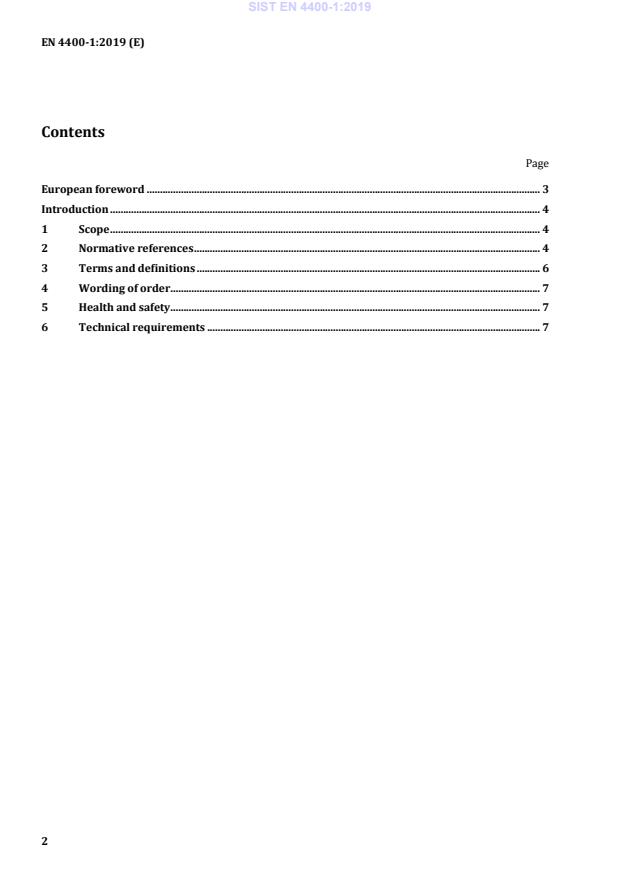
Page European foreword . 3 Introduction . 4 1 Scope . 4 2 Normative references . 4 3 Terms and definitions . 6 4 Wording of order . 7 5 Health and safety . 7 6 Technical requirements . 7
1) Published as ASD-STAN Prestandard at the date of publication of this standard by AeroSpace and Defence industries Association of Europe - Standardization (ASD-STAN), http://www.asd-stan.org 2) In preparation at the date of publication of this standard. SIST EN 4400-1:2019
3) Published as ASD-STAN Technical Report at the date of publication of this standard by AeroSpace and Defence industries Association of Europe - Standardization (ASD-STAN), http://www.asd-stan.org SIST EN 4400-1:2019
Table 1 — Technical requirements for lines 1 to 29, where appropriate (1 of 8) Material standard line reference Requirements Frequency of testing Qualification phase Release No. Title Starting Intermediate 1 Material designation See EN 2032-001. −
2 Chemical composition The test samples used for chemical analysis shall be representative of the product and shall be taken from the molten metal. Any subsequent analytical checks taken from the solid product shall take into consideration the heterogeneity normal to the alloy. The method of chemical analysis shall be at the discretion of the manufacturer unless otherwise stated in the material standard or order. In cases of dispute, the method of chemical analysis shall be agreed between the manufacturer and purchaser.
The measured chemical composition shall meet the requirements of the material standard and shall be stated in the inspection and test report. 1 (one) per cast 1 (one) per cast 1 (one) per cast 3 Method of melting At the discretion of the manufacturer or unless otherwise stated in the material standard. −
4.1 Form Plate
4.2 Method of production Rolling The product shall satisfy the requirements of the relevant order, material standard and this technical specification. The manufacturer shall define the raw materials, processes and inspection requirements in a manufacturing schedule in accordance with EN 2078 and EN 9133. The manufacturer shall make this available to the purchaser upon request. Changes to any manufacturing schedule agreed during qualification and which may adversely affect the quality of the product shall be advised by the manufacturer and shall be subject to written approval of the purchaser. Each product shall be traceable to the cast, production batch and/or heat treatment batch at all stages of manufacture, testing and delivery. For machined plate, the minimum depth of metal removal shall correspond to the ultrasonic dead zones, unless otherwise agreed between the purchaser and manufacturer. Witness of the removed metal shall be given by the following method or 1 (one) agreed upon between the manufacturer and purchaser: • 10 mm diameter circles shall be hard stamped on the four edges of the product, tangential to the face(s) to be machined. On each edge, at least 3 (three) circles shall be stamped, 1 (one) at each end and at the middle of the length. • After machining, the remainder of the circles give witness of the metal removed. −
4.3 Limit dimension(s) Minimum and/or maximum size of the product expressed as nominal thickness, a. See also line 96. −
5 Technical specification Reference to this technical specification EN 4400-1. In cases of conflict, the requirements of the material standard shall take precedence over those of this technical specification. See also EN 4258.
Table 1 — Technical requirements for lines 1 to 29, where appropriate (2 of 8) Material standard line reference Requirements Frequency of testing Qualification phase Release No. Title Starting Intermediate 6.1 Delivery condition (1 of 2) The product shall be supplied in the delivery condition specified in this line in the material standard and/or as stated on the order. When required, semi-finished product designations shall conform to the requirements of the order. Marking: The method of marking used shall not cause corrosion, crack initiation, contamination or unacceptable deformation. The marking shall remain permanently visible after handling and contact with protective products. Unless otherwise specified, the nature and colour of marking ink and type of marking characters shall be left to the discretion of the manufacturer. The marking inks shall be removable with cleaning products which do not leave a residue which could affect further processing. The cleaning products shall not give rise to corrosion. All products shall be marked legibly as indicated in the following table: −
Continuous marking a, b (Ink or similar product) End marking c (Ink or similar product or hard stamping)
Material standard. Dimensional standard. Delivery condition and code. Manufacturer and plant identification. Nominal product thickness (mm) a < 12 mm: On the face in a corner or on the edge Batch number or product number. Inspection stamp.
a ≥ 12 mm: On the edge Product number. Inspection stamp.
a All indications shall be visible on any seperate piece of 300 mm u 300 mm. b Continuous marking shall be in the rolling direction on 1 (one) major face. c If required by the purchaser and specified on the order.
Table 1 — Technical requirements for lines 1 to 29, where appropriate (3 of 8) Material standard line reference Requirements Frequency of testing Qualification phase Release No. Title Starting Intermediate 6.1 Delivery condition (2 of 2) Preservation: Unless otherwise agreed and stated on the order, the product shall be delivered with corrosion protection. The type of corrosion protection shall be agreed between the manufacturer and purchaser. Packing: All necessary precautions shall be taken to prevent damage to, or corrosion of the product, especially where the delivered surface finish shall be maintained, that is, not subsequently machined. The packing shall be suitable for the type of transportation used. The exterior of the packing shall bear the following information: • name and address of recipient, • mass, • order number and sufficient information to enable the contents to be related to the relevant documentation. Shipment: The responsibility for shipping shall be detailed in a transport contract. −
Heat treatment (1 of 2) Thermal and/or thermomechanical operations shall be applied to the product as specified in the material standard and are listed in the same order as they are to be applied. Abbreviations and symbols used in the material standard are shown in the following table: all other terms are written in full. −
Term Abbreviation/Symbol Term Abbreviation/Symbol
temperature θ minute min
time t second s
day d water quench WQ
hour h air cool AC
Unless otherwise specified, heat treatment facilities shall conform to EN 4268. If a specific temperature (value and tolerance) and time are stated in the material standard or order, these parameters shall be mandatory. If a temperature range is stated, a temperature within that range, reduced by the tolerances of the furnace, shall be selected. The charge shall be maintained at the temperature selected, subject to the furnace tolerances in the following table, for the period stated in the material standard:
Table 1 — Technical requirements for lines 1 to 29, where appropriate (4 of 8) Material standard line reference Requirements Frequency of testing Qualification phase Release No. Title Starting Intermediate 6.1 Heat treatment (2 of 2)
– – –
Heat treatment Temperature range specified in material standard Maximum tolerance (°C)
Solution heat treatment ≥ 10 °C r 5
Artificial ageing t 10 °C r 5
10 °C r 3
When the duration of the treatment stage is stated as a range, a time within that range shall be selected. When the duration is not specified, it shall be at the discretion of the manufacturer. Where "ramping" to the heat treatment temperature is allowed in the material standard and is used, this shall be stated in the inspection and test report. Where controlled stretching after solution heat treatment is required, this is defined as a stage in the heat treatment. A permanent elongation within the range stated in the material standard shall be selected.
6.2 Delivery condition code See EN 2032-2. −
7 Use condition The use condition temper of the product is stated in the material standard.
Heat treatment (1 of 2)
• If the delivery condition is the use condition, no further heat treatment shall be applied to the product. • If the delivery condition is not the use condition, the product shall be subject to heat treatment(s) in the same order as those specified in the material standard. Abbreviations and symbols used in the material standard are shown in the following table: all other terms are written in full. −
Term Abbreviation/Symbol Term Abbreviation/Symbol
temperature θ minute min
time t second s
day d water quench WQ
hour h air cool AC
Unless otherwise specified, heat treatment facilities and procedures shall conform to EN 4268. If a specific temperature (value and tolerance) and time are stated in the material standard or order, these parameters shall be mandatory. If a temperature range is stated, a temperature within that range, reduced by the tolerances of the furnace, shall be selected. The charge shall be maintained at the temperature selected, subject to the furnace tolerances in the following table, for the period stated in the material standard:
Table 1 — Technical requirements for lines 1 to 29, where appropriate (5 of 8) Material standard line reference Requirements Frequency of testing Qualification phase Release No. Title Starting Intermediate 7 Heat treatment (2 of 2)
– – –
Heat treatment Temperature range specified in material standard Maximum tolerance (°C)
Solution heat treatment ≥ 10 °C r 5
Artificial ageing t 10 °C r 5
10 °C r 3
When the duration of the treatment stage is stated as a range, a time within that range shall be selected. When the duration is not specified, it shall be at the discretion of the manufacturer. Where "ramping" to the heat treatment temperature is allowed in the material standard and is used, this shall be stated in the inspection and test report. Where the use condition is not the delivery condition the inspection and test report shall detail the heat treatment applied to the test samples representing the use condition: see line 8.3.
8.1 Test sample(s) (1 of 2) • For machined plate, the thickness before machining shall govern the requirements of sampling, testing and determination of acceptance limits. • Test samples shall be selected such that they are clear of any stretcher jaw marks. • Test samples shall not be worked after removal from the product they represent. • Test samples and associated test pieces shall be identified in such a manner that their orientation with respect to the product and batch is maintained. Where the product is supplied in the use condition and hardness and / or electrical conductivity testing is used for batch uniformity assessment, see line 82, then such testing shall be carried out prior to selection of the tensile test sample(s). In such cases the product(s) showing the lowest hardness / highest electrical conductivity values shall be selected for the requisite tensile testing as stated in the table below. The number of parent plates to be tested per batch shall be as shown in the following table, although this number may be reduced by written agreement between manufacturer and purchaser if the manufacturer can demonstrate that the requirements of the relevant material standard are consistently met. −
Table 1 — Technical requirements for lines 1 to 29, where appropriate (6 of 8) Material standard line reference Requirements Frequency of testing Qualification phase Release No. Title Starting Intermediate 8.1 Test sample(s) (2 of 2)
– – –
Product dimensions mm No. of parent plates in a batch No. of parent plates to be tested
6 < a ≤ 12 1 or 2 1
3 or 4 2
5 or 6 3
> 6 4
a > 12 1 parent plate shall constitute a batch 1
Where electrical conductivity measurements (line 32) are used as an indirect assessment of resistance to stress corrosion cracking and / or exfoliation corrosion, such measurements shall be made on the test sample(s) selected for tensile testing or at corresponding locations if a tensile test piece is not taken.
8.2 Test piece(s) This line relates to test pieces for the tests defined in lines 12 to 16. For product of 6 mm
a ≤ 12,5 mm, test pieces shall be flat specimens of full product thickness. For product of a > 12,5 mm, proportional round test pieces of the form and 1 (one) of the sizes in EN 2002-001 shall be used. • Test pieces shall be machined from the test samples taken in accordance with the requirements of line 8.1 of this technical specification. • Test pieces shall be in the heat treatment condition of the test samples from which they are taken, that is, no further heat treatment shall be carried out. • Test piece type and dimensions shall be as specified for the appropriate test/line number in the material standard and/or this technical specification and/or test method. −
8.3 Heat treatment If the delivery condition is not the use condition, the test samples shall be subject to heat treatment as specified in line 7 of the material standard. If the delivery condition is the use condition, no further heat treatment shall be applied to the test samples.
Table 1 — Technical requirements for lines 1 to 29, where appropriate (7 of 8) Material standard line reference Requirements Frequency of testing Qualification phase Release No. Title Starting Intermediate 9 Dimensions concerned Nominal thickness, a, of the prod
...
Questions, Comments and Discussion
Ask us and Technical Secretary will try to provide an answer. You can facilitate discussion about the standard in here.
Loading comments...