

SIST ISO 11540:2022
(Main)Writing and marking instruments - Specification for caps to reduce the risk of asphyxiation
General Information
- Abstract
This document specifies requirements to reduce the risk of asphyxiation from caps for writing and marking instruments. It relates to such instruments which in normal or foreseeable circumstances are likely to be used by children up to the age of 14 years.
This document is not applicable to the following:
— writing and marking instruments which are designed or only intended for use by adults, e.g. jewellery pens, expensive fountain pens, professional technical pens;
— transit caps for refills.
- Status
- Published
- Publication Date
- 30-Mar-2022
- Technical Committee
- TRS - Technical drawings, quantities, units, symbols and graphical symbols
- Current Stage
- 6060 - National Implementation/Publication (Adopted Project)
- Start Date
- 09-Mar-2022
- Due Date
- 14-May-2022
- Completion Date
- 31-Mar-2022
Buy Documents



ISO 11540:2021 - Writing and marking instruments -- Specification for caps to reduce the risk of asphyxiation

ISO 11540:2021 - Writing and marking instruments — Specification for caps to reduce the risk of asphyxiation/3/2021
Overview
SIST ISO 11540:2022 sets out important requirements for the design and safety of caps on writing and marking instruments, focusing specifically on reducing the risk of asphyxiation. This standard applies to pens, markers, and similar instruments that are likely to be used by children up to 14 years old, addressing the hazards associated with inhalation of small parts such as pen caps. It provides practical measures for manufacturers to ensure ventilated or appropriately sized caps, which can play a crucial role in preventing airway obstruction and increasing child safety.
Key Topics
Scope of Application
- The standard applies to writing and marking instruments-such as pens and markers-with detachable caps that could foreseeably be used by children up to age 14.
- It explicitly excludes instruments intended solely for adult use (e.g., high-value fountain pens, technical pens, jewelry pens) and transit caps for refills.
Safety Requirements
- Size Requirements: Caps must be designed to a size that minimizes the risk of inhalation, using a specific ring gauge test to determine if the cap is too large to enter a child's airway.
- Ventilation Requirements: If a cap is small enough to pose a choking risk, it must include a ventilated design that allows for a minimum airflow of 8 liters per minute under an applied pressure of 1.33 kPa.
- Testing Procedures: The standard describes precise laboratory methods for air flow testing using elastomeric tubing and measurement equipment to verify compliance.
Identification and Labelling
- Products or their packaging must be legibly marked with the manufacturer's or supplier's identifying details, ensuring traceability and accountability.
Applications
SIST ISO 11540:2022 is essential for manufacturers, designers, and importers of writing and marking instruments intended for school, office, or home use by children. Practical applications include:
- Product Development: Guiding the design and engineering teams in creating safer pen and marker caps that meet internationally recognized asphyxiation hazard standards.
- Quality Assurance: Implementing standardized testing procedures as part of quality management systems to verify compliance before products reach the market.
- Safety Labeling: Ensuring proper labeling on writing instruments and their packaging, which helps distributors and end-users easily identify compliant products.
- Regulatory Compliance: Assisting companies in meeting legal requirements regarding children’s product safety in international markets, especially in education and retail sectors.
Related Standards
When working with SIST ISO 11540:2022, consider also referencing other pertinent international standards that support comprehensive safety and quality management:
- ISO 1938-1 - Geometrical product specifications (GPS) for dimensional measuring equipment, relevant for accurate size and fit testing of components.
- ISO/IEC Directives - Guidance for the drafting, adoption, and maintenance of standards, ensuring alignment with the latest best practices in product standardization.
For additional support and harmonization, organizations may also consult national or international safety directives related to toys, children’s products, and general product safety.
By adhering to SIST ISO 11540:2022, manufacturers and suppliers can improve product safety, minimize the risk of asphyxiation, and meet consumer and regulatory expectations in global markets for writing and marking instruments.
Relations
- Effective Date
- 01-May-2022
Buy Documents
ISO 11540:2021 - Writing and marking instruments -- Specification for caps to reduce the risk of asphyxiation
ISO 11540:2021 - Writing and marking instruments — Specification for caps to reduce the risk of asphyxiation/3/2021
Frequently Asked Questions
SIST ISO 11540:2022 is a standard published by the Slovenian Institute for Standardization (SIST). Its full title is "Writing and marking instruments - Specification for caps to reduce the risk of asphyxiation". This standard covers: This document specifies requirements to reduce the risk of asphyxiation from caps for writing and marking instruments. It relates to such instruments which in normal or foreseeable circumstances are likely to be used by children up to the age of 14 years. This document is not applicable to the following: — writing and marking instruments which are designed or only intended for use by adults, e.g. jewellery pens, expensive fountain pens, professional technical pens; — transit caps for refills.
This document specifies requirements to reduce the risk of asphyxiation from caps for writing and marking instruments. It relates to such instruments which in normal or foreseeable circumstances are likely to be used by children up to the age of 14 years. This document is not applicable to the following: — writing and marking instruments which are designed or only intended for use by adults, e.g. jewellery pens, expensive fountain pens, professional technical pens; — transit caps for refills.
SIST ISO 11540:2022 is classified under the following ICS (International Classification for Standards) categories: 97.180 - Miscellaneous domestic and commercial equipment; 97.190 - Equipment for children. The ICS classification helps identify the subject area and facilitates finding related standards.
SIST ISO 11540:2022 has the following relationships with other standards: It is inter standard links to SIST ISO 11540:2015. Understanding these relationships helps ensure you are using the most current and applicable version of the standard.
SIST ISO 11540:2022 is available in PDF format for immediate download after purchase. The document can be added to your cart and obtained through the secure checkout process. Digital delivery ensures instant access to the complete standard document.
Standards Content (Sample)
SLOVENSKI STANDARD
01-maj-2022
Nadomešča:
SIST ISO 11540:2015
Pisala in označevalna sredstva - Specifikacija zaščitnih pokrovčkov za zmanjšanje
tveganja zadušitve
Writing and marking instruments - Specification for caps to reduce the risk of
asphyxiation
Instruments pour l'écriture et le marquage - Spécifications pour les capuchons afin de
réduire le risque d'asphyxie
Ta slovenski standard je istoveten z: ISO 11540:2021
ICS:
97.180 Razna oprema za dom in Miscellaneous domestic and
trgovino commercial equipment
97.190 Otroška oprema Equipment for children
2003-01.Slovenski inštitut za standardizacijo. Razmnoževanje celote ali delov tega standarda ni dovoljeno.
INTERNATIONAL ISO
STANDARD 11540
Third edition
2021-08
Writing and marking instruments —
Specification for caps to reduce the
risk of asphyxiation
Instruments pour l'écriture et le marquage — Spécifications pour les
capuchons afin de réduire le risque d'asphyxie
Reference number
©
ISO 2021
© ISO 2021
All rights reserved. Unless otherwise specified, or required in the context of its implementation, no part of this publication may
be reproduced or utilized otherwise in any form or by any means, electronic or mechanical, including photocopying, or posting
on the internet or an intranet, without prior written permission. Permission can be requested from either ISO at the address
below or ISO’s member body in the country of the requester.
ISO copyright office
CP 401 • Ch. de Blandonnet 8
CH-1214 Vernier, Geneva
Phone: +41 22 749 01 11
Email: copyright@iso.org
Website: www.iso.org
Published in Switzerland
ii © ISO 2021 – All rights reserved
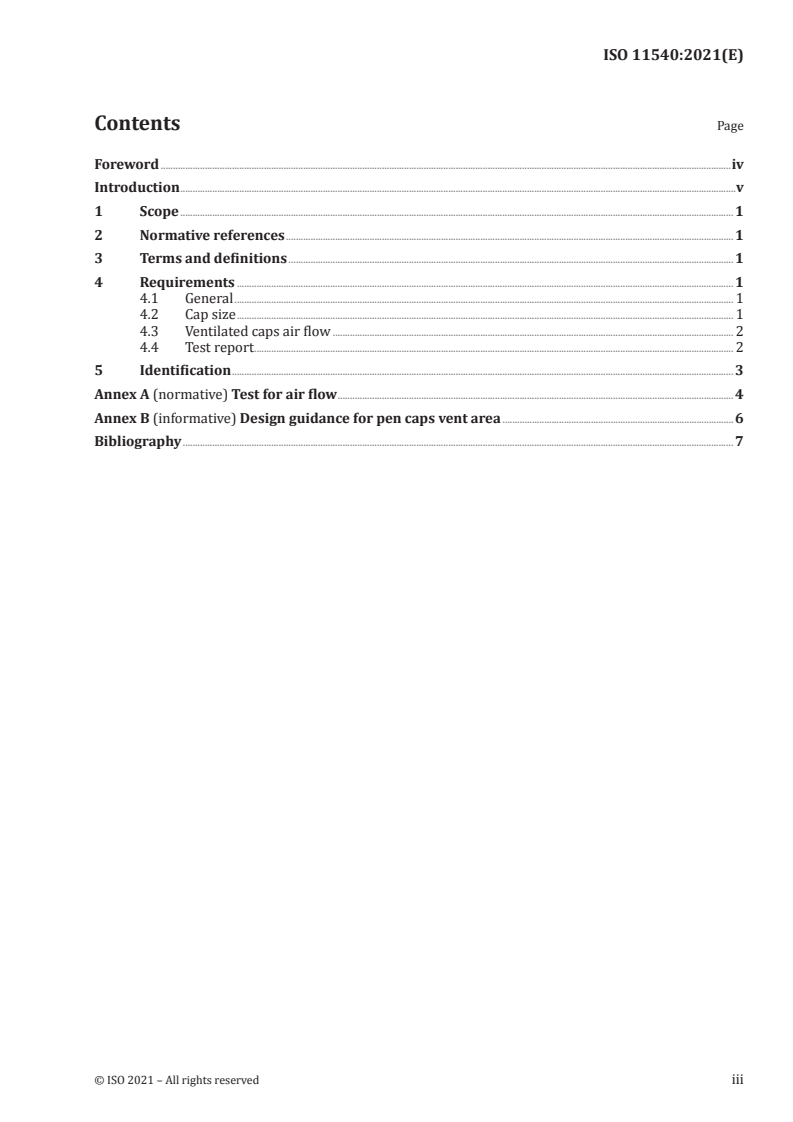
Contents Page
Foreword .iv
Introduction .v
1 Scope . 1
2 Normative references . 1
3 Terms and definitions . 1
4 Requirements . 1
4.1 General . 1
4.2 Cap size . 1
4.3 Ventilated caps air flow . 2
4.4 Test report . 2
5 Identification . 3
Annex A (normative) Test for air flow . 4
Annex B (informative) Design guidance for pen caps vent area . 6
Bibliography . 7
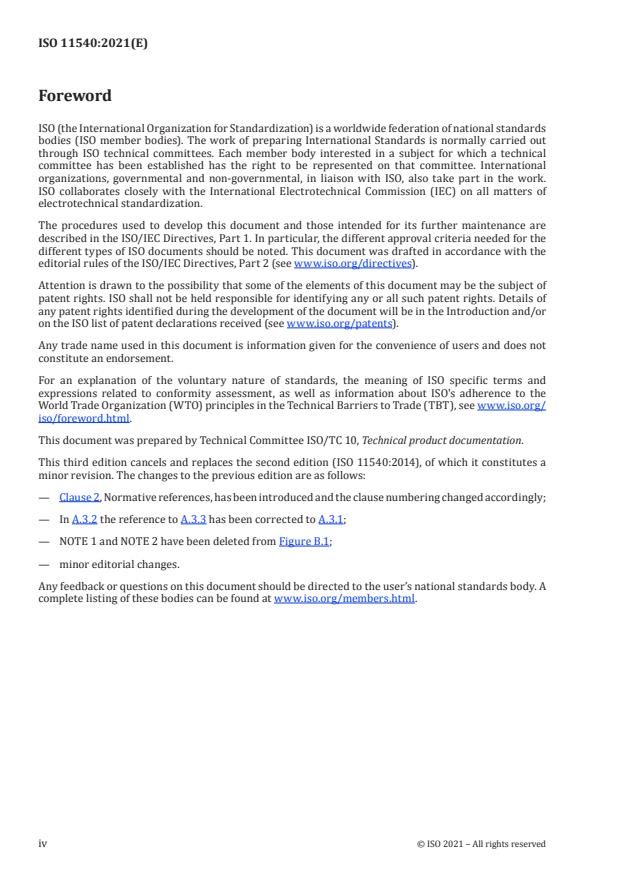
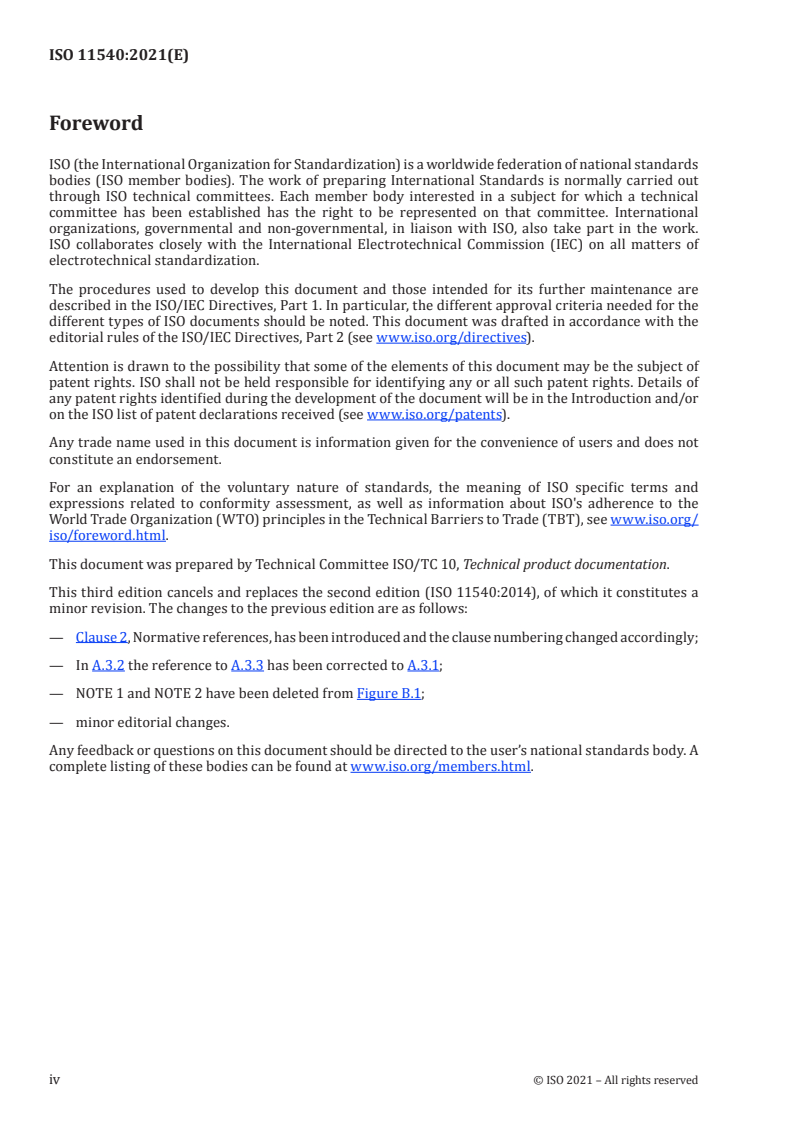
Foreword
ISO (the International Organization for Standardization) is a worldwide federation of national standards
bodies (ISO member bodies). The work of preparing International Standards is normally carried out
through ISO technical committees. Each member body interested in a subject for which a technical
committee has been established has the right to be represented on that committee. International
organizations, governmental and non-governmental, in liaison with ISO, also take part in the work.
ISO collaborates closely with the International Electrotechnical Commission (IEC) on all matters of
electrotechnical standardization.
The procedures used to develop this document and those intended for its further maintenance are
described in the ISO/IEC Directives, Part 1. In particular, the different approval criteria needed for the
different types of ISO documents should be noted. This document was drafted in accordance with the
editorial rules of the ISO/IEC Directives, Part 2 (see www .iso .org/ directives).
Attention is drawn to the possibility that some of the elements of this document may be the subject of
patent rights. ISO shall not be held responsible for identifying any or all such patent rights. Details of
any patent rights identified during the development of the document will be in the Introduction and/or
on the ISO list of patent declarations received (see www .iso .org/ patents).
Any trade name used in this document is information given for the convenience of users and does not
constitute an endorsement.
For an explanation of the voluntary nature of standards, the meaning of ISO specific terms and
expressions related to conformity assessment, as well as information about ISO's adherence to the
World Trade Organization (WTO) principles in the Technical Barriers to Trade (TBT), see www .iso .org/
iso/ foreword .html.
This document was prepared by Technical Committee ISO/TC 10, Technical product documentation.
This third edition cancels and replaces the second edition (ISO 11540:2014), of which it constitutes a
minor revision. The changes to the previous edition are as follows:
— Clause 2, Normative references, has been introduced and the clause numbering changed accordingly;
— In A.3.2 the reference to A.3.3 has been corrected to A.3.1;
— NOTE 1 and NOTE 2 have been deleted from Figure B.1;
— minor editorial changes.
Any feedback or questions on this document should be directed to the user’s national standards body. A
complete listing of these bodies can be found at www .iso .org/ members .html.
iv © ISO 2021 – All rights reserved
Introduction
If a child inhales a pen cap it might become lodged below the larynx and block the trachea. The risk of
asphyxiation can be reduced if the pen cap is ventilated or too large to enter the airway. Children must
be actively discouraged from sucking, chewing or putting pen caps in their mouths. A way of avoiding
the risk of inhalation of caps of writing and marking instruments is to manufacture products without
caps whenever possible. However, if caps are essential, the provisions of this document minimize risk
by specifying the design and performance of ventilated caps, which reduce the likelihood of inhalation
and delay asphyxiation pending medical intervention.
ISO/TC 10 recognizes that while it is possible to i
...
INTERNATIONAL ISO
STANDARD 11540
Third edition
2021-08
Writing and marking instruments —
Specification for caps to reduce the
risk of asphyxiation
Instruments pour l'écriture et le marquage — Spécifications pour les
capuchons afin de réduire le risque d'asphyxie
Reference number
©
ISO 2021
© ISO 2021
All rights reserved. Unless otherwise specified, or required in the context of its implementation, no part of this publication may
be reproduced or utilized otherwise in any form or by any means, electronic or mechanical, including photocopying, or posting
on the internet or an intranet, without prior written permission. Permission can be requested from either ISO at the address
below or ISO’s member body in the country of the requester.
ISO copyright office
CP 401 • Ch. de Blandonnet 8
CH-1214 Vernier, Geneva
Phone: +41 22 749 01 11
Email: copyright@iso.org
Website: www.iso.org
Published in Switzerland
ii © ISO 2021 – All rights reserved
Contents Page
Foreword .iv
Introduction .v
1 Scope . 1
2 Normative references . 1
3 Terms and definitions . 1
4 Requirements . 1
4.1 General . 1
4.2 Cap size . 1
4.3 Ventilated caps air flow . 2
4.4 Test report . 2
5 Identification . 3
Annex A (normative) Test for air flow . 4
Annex B (informative) Design guidance for pen caps vent area . 6
Bibliography . 7
Foreword
ISO (the International Organization for Standardization) is a worldwide federation of national standards
bodies (ISO member bodies). The work of preparing International Standards is normally carried out
through ISO technical committees. Each member body interested in a subject for which a technical
committee has been established has the right to be represented on that committee. International
organizations, governmental and non-governmental, in liaison with ISO, also take part in the work.
ISO collaborates closely with the International Electrotechnical Commission (IEC) on all matters of
electrotechnical standardization.
The procedures used to develop this document and those intended for its further maintenance are
described in the ISO/IEC Directives, Part 1. In particular, the different approval criteria needed for the
different types of ISO documents should be noted. This document was drafted in accordance with the
editorial rules of the ISO/IEC Directives, Part 2 (see www .iso .org/ directives).
Attention is drawn to the possibility that some of the elements of this document may be the subject of
patent rights. ISO shall not be held responsible for identifying any or all such patent rights. Details of
any patent rights identified during the development of the document will be in the Introduction and/or
on the ISO list of patent declarations received (see www .iso .org/ patents).
Any trade name used in this document is information given for the convenience of users and does not
constitute an endorsement.
For an explanation of the voluntary nature of standards, the meaning of ISO specific terms and
expressions related to conformity assessment, as well as information about ISO's adherence to the
World Trade Organization (WTO) principles in the Technical Barriers to Trade (TBT), see www .iso .org/
iso/ foreword .html.
This document was prepared by Technical Committee ISO/TC 10, Technical product documentation.
This third edition cancels and replaces the second edition (ISO 11540:2014), of which it constitutes a
minor revision. The changes to the previous edition are as follows:
— Clause 2, Normative references, has been introduced and the clause numbering changed accordingly;
— In A.3.2 the reference to A.3.3 has been corrected to A.3.1;
— NOTE 1 and NOTE 2 have been deleted from Figure B.1;
— minor editorial changes.
Any feedback or questions on this document should be directed to the user’s national standards body. A
complete listing of these bodies can be found at www .iso .org/ members .html.
iv © ISO 2021 – All rights reserved
Introduction
If a child inhales a pen cap it might become lodged below the larynx and block the trachea. The risk of
asphyxiation can be reduced if the pen cap is ventilated or too large to enter the airway. Children must
be actively discouraged from sucking, chewing or putting pen caps in their mouths. A way of avoiding
the risk of inhalation of caps of writing and marking instruments is to manufacture products without
caps whenever possible. However, if caps are essential, the provisions of this document minimize risk
by specifying the design and performance of ventilated caps, which reduce the likelihood of inhalation
and delay asphyxiation pending medical intervention.
ISO/TC 10 recognizes that while it is possible to identify the age range of the children who are most
at risk, it is not possible to identify with certainty any writing instruments with detachable caps that
would never be accessible to children and hence never pose a risk. It is, however, acknowledged that
certain products (i.e. writing and marking instruments which are designed or only intended for use by
adults, e.g. jewellery pens, expensive fountain pens, professional technical pens)
...
INTERNATIONAL ISO
STANDARD 11540
Third edition
2021-08
Writing and marking instruments —
Specification for caps to reduce the
risk of asphyxiation
Instruments pour l'écriture et le marquage — Spécifications pour les
capuchons afin de réduire le risque d'asphyxie
Reference number
©
ISO 2021
© ISO 2021
All rights reserved. Unless otherwise specified, or required in the context of its implementation, no part of this publication may
be reproduced or utilized otherwise in any form or by any means, electronic or mechanical, including photocopying, or posting
on the internet or an intranet, without prior written permission. Permission can be requested from either ISO at the address
below or ISO’s member body in the country of the requester.
ISO copyright office
CP 401 • Ch. de Blandonnet 8
CH-1214 Vernier, Geneva
Phone: +41 22 749 01 11
Email: copyright@iso.org
Website: www.iso.org
Published in Switzerland
ii © ISO 2021 – All rights reserved
Contents Page
Foreword .iv
Introduction .v
1 Scope . 1
2 Normative references . 1
3 Terms and definitions . 1
4 Requirements . 1
4.1 General . 1
4.2 Cap size . 1
4.3 Ventilated caps air flow . 2
4.4 Test report . 2
5 Identification . 3
Annex A (normative) Test for air flow . 4
Annex B (informative) Design guidance for pen caps vent area . 6
Bibliography . 7
Foreword
ISO (the International Organization for Standardization) is a worldwide federation of national standards
bodies (ISO member bodies). The work of preparing International Standards is normally carried out
through ISO technical committees. Each member body interested in a subject for which a technical
committee has been established has the right to be represented on that committee. International
organizations, governmental and non-governmental, in liaison with ISO, also take part in the work.
ISO collaborates closely with the International Electrotechnical Commission (IEC) on all matters of
electrotechnical standardization.
The procedures used to develop this document and those intended for its further maintenance are
described in the ISO/IEC Directives, Part 1. In particular, the different approval criteria needed for the
different types of ISO documents should be noted. This document was drafted in accordance with the
editorial rules of the ISO/IEC Directives, Part 2 (see www .iso .org/ directives).
Attention is drawn to the possibility that some of the elements of this document may be the subject of
patent rights. ISO shall not be held responsible for identifying any or all such patent rights. Details of
any patent rights identified during the development of the document will be in the Introduction and/or
on the ISO list of patent declarations received (see www .iso .org/ patents).
Any trade name used in this document is information given for the convenience of users and does not
constitute an endorsement.
For an explanation of the voluntary nature of standards, the meaning of ISO specific terms and
expressions related to conformity assessment, as well as information about ISO's adherence to the
World Trade Organization (WTO) principles in the Technical Barriers to Trade (TBT), see www .iso .org/
iso/ foreword .html.
This document was prepared by Technical Committee ISO/TC 10, Technical product documentation.
This third edition cancels and replaces the second edition (ISO 11540:2014), of which it constitutes a
minor revision. The changes to the previous edition are as follows:
— Clause 2, Normative references, has been introduced and the clause numbering changed accordingly;
— In A.3.2 the reference to A.3.3 has been corrected to A.3.1;
— NOTE 1 and NOTE 2 have been deleted from Figure B.1;
— minor editorial changes.
Any feedback or questions on this document should be directed to the user’s national standards body. A
complete listing of these bodies can be found at www .iso .org/ members .html.
iv © ISO 2021 – All rights reserved
Introduction
If a child inhales a pen cap it might become lodged below the larynx and block the trachea. The risk of
asphyxiation can be reduced if the pen cap is ventilated or too large to enter the airway. Children must
be actively discouraged from sucking, chewing or putting pen caps in their mouths. A way of avoiding
the risk of inhalation of caps of writing and marking instruments is to manufacture products without
caps whenever possible. However, if caps are essential, the provisions of this document minimize risk
by specifying the design and performance of ventilated caps, which reduce the likelihood of inhalation
and delay asphyxiation pending medical intervention.
ISO/TC 10 recognizes that while it is possible to identify the age range of the children who are most
at risk, it is not possible to identify with certainty any writing instruments with detachable caps that
would never be accessible to children and hence never pose a risk. It is, however, acknowledged that
certain products (i.e. writing and marking instruments which are designed or only intended for use by
adults, e.g. jewellery pens, expensive fountain pens, professional technical pens)
...