

oSIST prEN 4876:2021
(Main)Aerospace series - Environmental testing - Durability of the displays by general usage
General Information
- Abstract
This document provides a series of testing methods to determine the resistance of the digital display during general usage in an aircraft cabin. The document applies to any passive and interactive displays. It includes also dirt affinity and cleanability.
The testing methods include the determination of the durability of touchscreen surfaces, signing pads and general displays against human fingertip and hand abrasion, fingerprint and dirt affinity under the usage by humans as can occur during everyday operation inside an aircraft cabin. Additionally, the resistance against general abrasion, scratch and mar on the displays as well as the resistance study against the routine cleaning procedure conducted inside the aircraft is defined.
The test methods are also suitable to test the durability of a display surface against all low and high dynamic strains.
- Status
- Not Published
- Public Enquiry End Date
- 23-Jun-2021
- Technical Committee
- I13 - Imaginarni 13
- Current Stage
- 4020 - Public enquire (PE) (Adopted Project)
- Start Date
- 08-Apr-2021
- Due Date
- 26-Aug-2021
- Completion Date
- 22-Jun-2021


Overview
oSIST prEN 4876:2021 is a draft European standard developed by SIST for the aerospace industry. It focuses on environmental testing to determine the durability of digital displays under general usage in aircraft cabins. With increasing reliance on digital and interactive displays, especially in passenger compartments, ensuring their durability and resistance to common forms of wear is crucial for both safety and customer experience. This standard outlines comprehensive test methods for evaluating display surface resistance to abrasion, fingerprint and dirt affinity, scratch, mar, and cleanability, making it essential for manufacturers, suppliers, and operators in the aerospace sector.
Key Topics
- Durability Testing for Aircraft Displays
The standard details procedures to assess how well both passive and interactive digital displays withstand physical strains during regular use in the aircraft cabin environment. - Fingertip and Hand Abrasion
Methods are provided for simulating fingertip and palm contact, reflecting real user actions such as tapping, swiping, and zooming on touchscreens and signing pads. - Fingerprint and Dirt Affinity
Tests focus on how easily fingerprints and other contaminants adhere to display surfaces, as well as the repeatability and intensity of fingerprint deposition. - Scratch and Mar Resistance
The scratching and marring protocols evaluate how the display surface holds up against repeated contact with various materials, including writing instruments, plastics, leather, and textiles. - Cleanability Assessment
The standard specifies evaluating how effectively display surfaces can be cleaned after exposure to dirt, soil, and common cabin contaminants. - Dynamic Strains
Test methods account for both low and high-level dynamic strains, covering a comprehensive range of in-service scenarios. - Reporting and Analysis
The document prescribes detailed reporting requirements, including damage documentation, optical topography, water drop angle, and fast abrasion testing.
Applications
- Aircraft Cabin Display Quality Assurance
Ensuring that in-flight entertainment systems, seatback displays, and cabin control panels remain functional and visually acceptable throughout their service life. - Touchscreen and Surface Coating Development
Guiding the design and material selection for touchscreens and coatings to enhance abrasion resistance and ease of cleaning. - Supplier and Manufacturer Testing Framework
Providing a standardized basis for supplier qualification, product comparison, and contractual compliance testing. - Routine Maintenance Procedures
Informing cabin cleaning and maintenance practices with evidence-based recommendations on acceptable cleaning methods and materials. - Regulatory Compliance and Certification
Assisting stakeholders in meeting industry regulations and quality standards for electronic passenger equipment and cabin devices.
Related Standards
- prEN 4860: Environmental Testing - Abrasion of Markings, Letterings, Surfaces, and Materials
Referenced for standardized abrasion test apparatus and procedures, particularly relevant to human-induced surface wear. - ISO and IEC Terminology Standards
For consistent definitions and terms in electronic display and testing processes. - SID Methodologies
Industry guidelines for real-life simulation and evaluation of interactive displays, supporting broader context and best practices.
Keywords: aircraft cabin displays, aerospace display durability, touchscreen abrasion, fingerprint affinity, scratch resistance, display cleanability, environmental testing, passenger equipment standards, SIST, prEN 4876
Get Certified
Connect with accredited certification bodies for this standard

BUREAU VERITAS Certification Germany
Bureau Veritas certification in Germany.

Element Materials Technology
Materials testing and product certification.

AQMS Ltd.
AQMS provides ISO certification to SMEs across the UK.
Sponsored listings
Frequently Asked Questions
oSIST prEN 4876:2021 is a draft published by the Slovenian Institute for Standardization (SIST). Its full title is "Aerospace series - Environmental testing - Durability of the displays by general usage". This standard covers: This document provides a series of testing methods to determine the resistance of the digital display during general usage in an aircraft cabin. The document applies to any passive and interactive displays. It includes also dirt affinity and cleanability. The testing methods include the determination of the durability of touchscreen surfaces, signing pads and general displays against human fingertip and hand abrasion, fingerprint and dirt affinity under the usage by humans as can occur during everyday operation inside an aircraft cabin. Additionally, the resistance against general abrasion, scratch and mar on the displays as well as the resistance study against the routine cleaning procedure conducted inside the aircraft is defined. The test methods are also suitable to test the durability of a display surface against all low and high dynamic strains.
This document provides a series of testing methods to determine the resistance of the digital display during general usage in an aircraft cabin. The document applies to any passive and interactive displays. It includes also dirt affinity and cleanability. The testing methods include the determination of the durability of touchscreen surfaces, signing pads and general displays against human fingertip and hand abrasion, fingerprint and dirt affinity under the usage by humans as can occur during everyday operation inside an aircraft cabin. Additionally, the resistance against general abrasion, scratch and mar on the displays as well as the resistance study against the routine cleaning procedure conducted inside the aircraft is defined. The test methods are also suitable to test the durability of a display surface against all low and high dynamic strains.
oSIST prEN 4876:2021 is classified under the following ICS (International Classification for Standards) categories: 31.120 - Electronic display devices; 49.095 - Passenger and cabin equipment. The ICS classification helps identify the subject area and facilitates finding related standards.
oSIST prEN 4876:2021 is available in PDF format for immediate download after purchase. The document can be added to your cart and obtained through the secure checkout process. Digital delivery ensures instant access to the complete standard document.
Standards Content (Sample)
SLOVENSKI STANDARD
01-junij-2021
Aeronavtika - Okoljski preskusi - Trajnost zaslonov za splošno uporabo
Aerospace series - Environmental testing - Durability of the displays by general usage
Luft- und Raumfahrt - Umweltprüfung - Beständigkeit der Displays bei allgemeiner
Nutzung
Série aérospatiale - Essais d'environnement - Durabilité des affichages d'utilisation
générale
Ta slovenski standard je istoveten z: prEN 4876
ICS:
31.120 Elektronske prikazovalne Electronic display devices
naprave
49.095 Oprema za potnike in Passenger and cabin
oprema kabin equipment
2003-01.Slovenski inštitut za standardizacijo. Razmnoževanje celote ali delov tega standarda ni dovoljeno.
DRAFT
EUROPEAN STANDARD
NORME EUROPÉENNE
EUROPÄISCHE NORM
April 2021
ICS 31.120; 49.095
English Version
Aerospace series - Environmental testing - Durability of
the displays by general usage
Série aérospatiale - Essais d'environnement - Luft- und Raumfahrt - Umweltprüfung - Beständigkeit
Durabilité des affichages d'utilisation générale der Displays bei allgemeiner Nutzung
This draft European Standard is submitted to CEN members for enquiry. It has been drawn up by the Technical Committee ASD-
STAN.
If this draft becomes a European Standard, CEN members are bound to comply with the CEN/CENELEC Internal Regulations
which stipulate the conditions for giving this European Standard the status of a national standard without any alteration.
This draft European Standard was established by CEN in three official versions (English, French, German). A version in any other
language made by translation under the responsibility of a CEN member into its own language and notified to the CEN-CENELEC
Management Centre has the same status as the official versions.
CEN members are the national standards bodies of Austria, Belgium, Bulgaria, Croatia, Cyprus, Czech Republic, Denmark, Estonia,
Finland, France, Germany, Greece, Hungary, Iceland, Ireland, Italy, Latvia, Lithuania, Luxembourg, Malta, Netherlands, Norway,
Poland, Portugal, Republic of North Macedonia, Romania, Serbia, Slovakia, Slovenia, Spain, Sweden, Switzerland, Turkey and
United Kingdom.
Recipients of this draft are invited to submit, with their comments, notification of any relevant patent rights of which they are
aware and to provide supporting documentation.
Warning : This document is not a European Standard. It is distributed for review and comments. It is subject to change without
notice and shall not be referred to as a European Standard.
EUROPEAN COMMITTEE FOR STANDARDIZATION
COMITÉ EUROPÉEN DE NORMALISATION
EUROPÄISCHES KOMITEE FÜR NORMUNG
CEN-CENELEC Management Centre: Rue de la Science 23, B-1040 Brussels
© 2021 CEN All rights of exploitation in any form and by any means reserved Ref. No. prEN 4876:2021 E
worldwide for CEN national Members.
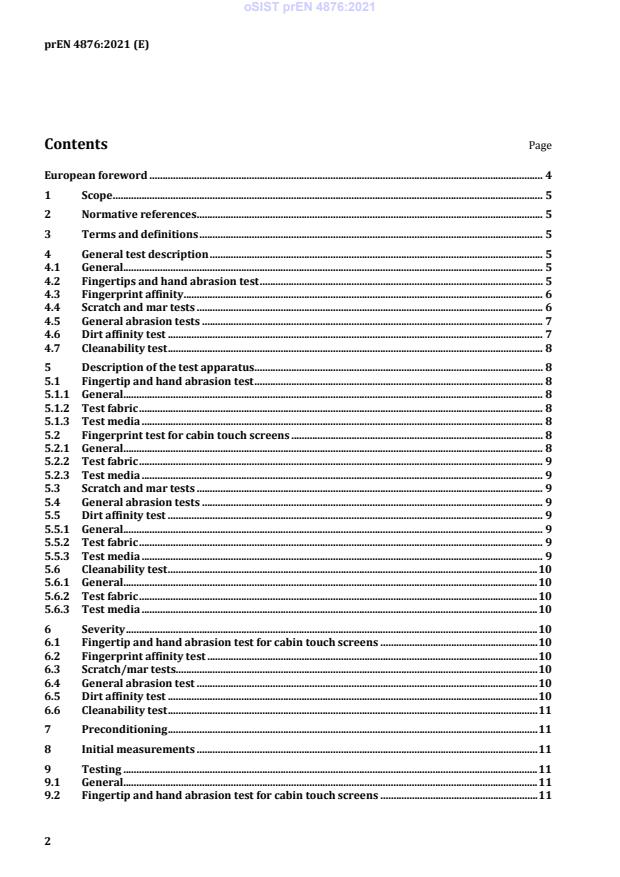
Contents Page
European foreword . 4
1 Scope . 5
2 Normative references . 5
3 Terms and definitions . 5
4 General test description . 5
4.1 General. 5
4.2 Fingertips and hand abrasion test . 5
4.3 Fingerprint affinity . 6
4.4 Scratch and mar tests . 6
4.5 General abrasion tests . 7
4.6 Dirt affinity test . 7
4.7 Cleanability test . 8
5 Description of the test apparatus . 8
5.1 Fingertip and hand abrasion test . 8
5.1.1 General. 8
5.1.2 Test fabric . 8
5.1.3 Test media . 8
5.2 Fingerprint test for cabin touch screens . 8
5.2.1 General. 8
5.2.2 Test fabric . 9
5.2.3 Test media . 9
5.3 Scratch and mar tests . 9
5.4 General abrasion tests . 9
5.5 Dirt affinity test . 9
5.5.1 General. 9
5.5.2 Test fabric . 9
5.5.3 Test media . 9
5.6 Cleanability test . 10
5.6.1 General. 10
5.6.2 Test fabric . 10
5.6.3 Test media . 10
6 Severity . 10
6.1 Fingertip and hand abrasion test for cabin touch screens . 10
6.2 Fingerprint affinity test . 10
6.3 Scratch/mar tests. 10
6.4 General abrasion test . 10
6.5 Dirt affinity test . 10
6.6 Cleanability test . 11
7 Preconditioning . 11
8 Initial measurements . 11
9 Testing . 11
9.1 General. 11
9.2 Fingertip and hand abrasion test for cabin touch screens . 11
9.3 Fingerprint affinity test . 11
9.4 Scratch/mar tests . 11
9.5 General abrasion tests . 11
9.6 Dirt affinity test . 11
9.7 Cleanability test . 12
10 Intermediate measurements . 12
11 Recovery . 12
12 Damage documentation and analysis . 12
12.1 Visual evaluation . 12
12.2 Water drop angle test . 12
12.3 Documentation and topographical analysis on damaged area . 13
12.4 Fast abrasion evaluation with Micro-Calotest . 13
13 Relevant information to be given in the test report . 15
Annex A (informative) Schematic drawing of a test apparatus for generating the fingerprint . 17
Annex B (informative) Schematic drawing of a test apparatus for pencil abrasion test . 18
Annex C (informative) Additional textiles for testing . 19
Bibliography . 20
European foreword
This document (prEN 4876:2021) has been prepared by the Aerospace and Defence Industries
Association of Europe — Standardization (ASD-STAN).
After enquiries and votes carried out in accordance with the rules of this Association, this document has
received the approval of the National Associations and the Official Services of the member countries of
ASD-STAN, prior to its presentation to CEN.
This document is currently submitted to the CEN Enquiry.
1 Scope
This document provides a series of testing methods to determine the resistance of the digital display
during general usage in an aircraft cabin. The document applies to any passive and interactive displays.
It includes also dirt affinity and cleanability.
The testing methods include the determination of the durability of touchscreen surfaces, signing pads
and general displays against human fingertip and hand abrasion, fingerprint and dirt affinity under the
usage by humans as can occur during everyday operation inside an aircraft cabin. Additionally, the
resistance against general abrasion, scratch and mar on the displays as well as the resistance study
against the routine cleaning procedure conducted inside the aircraft is defined.
The test methods are also suitable to test the durability of a display surface against all low and high
dynamic strains.
2 Normative references
The following documents are referred to in the text in such a way that some or all of their content
constitutes requirements of this document. For dated references, only the edition cited applies. For
undated references, the latest edition of the referenced document (including any amendments) applies.
prEN 4860, Aerospace series — Environmental testing — Test Xb: Abrasion of markings, letterings,
surfaces and materials caused by rubbing of fingertips and hands
3 Terms and definitions
No terms and definitions are listed in this document.
ISO and IEC maintain terminological databases for use in standardization at the following addresses:
• ISO Online browsing platform: available at https://www.iso.org/obp
• IEC Electropedia: available at http://www.electropedia.org/
4 General test description
4.1 General
The six tests scenarios for testing the durability of the displays in cabin interior are defined in 4.2 to 4.7.
4.2 Fingertips and hand abrasion test
The surface under test shall be repeatedly stressed by the impact and rubbing movement of a test
piston. The tip of the test piston due to its elasticity shall be deformed in such a way as to fit the surface
under test. The material, hardness, roughness and shape of the piston, the movement and the angle of
action shall be chosen in such a way that the pressure and friction executed by a human fingertip or by
the ball of a thumb are simulated.
To obtain reproducible conditions of friction and wear, a piece of fabric shall be placed between the
piston and the surface under test either as a cover of the piston or as a curtain, hanging between piston
and surface. The testing fabric, depending on its specified property, can contain additional ingredients
as a lubricant. Therefore, depending on the relevant specification, this fabric can either be used in a dry
condition (dry test and semi dry test) or additionally wetted with a specified test liquid by means of an
Published as ASD-STAN Standard at the date of publication of this document by AeroSpace and Defence
industries Association of Europe — Standardization (ASD-STAN), http://www.asd-stan.org/.
automatic feedthrough if the test is intended to cover the influence of fluid contamination as may occur
in normal use (wet test).
Depending on the three different motions of human fingertips on the display, namely touch, swipe and
zoom motions, the abrasion patterns are described in Figure 1, see [1].
Key
1 Impact on the sample surface = Putting on the fingertip when using display = short tap or touch motion
2 Friction path with defined force and speed/transition between static and sliding friction = Swipe movement
3 Reaching the end point of the friction movement; then the test cylinder moves back to the starting
position = Finger stops the swipe movement
4 Short area where the test piston moves bidirectionally on the surface = Retraction of the piston
Figure 1 — Fingertip abrasion zone and movement pattern
The complete test procedure for testing the resistance against fingertip and hand abrasion for cabin
touch screens shall be done according to prEN 4860. The complete test fabric options and test media
options are described in Annex C and in prEN 4860.
Additional speed options, differing from the 60 mm/s ± 5 mm/s specified in prEN 4860, such as
200 mm/s shall be used to simulate realistic stress conditions.
4.3 Fingerprint affinity
This test method serves as securing of a consistent implementation for the attachment of a fingerprint
on surfaces of displays.
The test medium shall be attached on the surface of a display surface fitting by the help of a silicon
stamp, using a reproducible amount and
...