


oSIST prEN 14973:2024
(Main)Conveyor belts for use in underground installations - Electrical and flammability safety requirements
Conveyor belts for use in underground installations - Electrical and flammability safety requirements
This document specifies electrical and flammability safety requirements for conveyor belts intended for use in underground installations, in the presence of flammable or non-flammable atmospheres.
Conveyor belts covered by this document and intended for use in flammable atmospheres are intended for use on conveyor belt installations (machinery in mines). The belt is a component or part of equipment, which can be incorporated into the conveyor, which is an equipment of Group I, Category M2, as defined in 3.2.2 of EN ISO 80079-36:2016.
This document is not applicable to light conveyor belts as described in EN ISO 21183-1:2006 nor is it applicable to conveyor belts which are manufactured before the date of publication of this document by CEN.
This document deals with those significant hazards detailed in A.1.
Attention is drawn to Annexes ZA and ZB.
NOTE A summary of the requirements of this document is given in Table 2. This is intended for quick reference only.
Fördergurte für die Verwendung unter Tage - Elektrische und brandtechnische Sicherheitsanforderungen
Dieses Dokument legt elektrische und brandtechnische Sicherheitsanforderungen an Fördergurte für den Einsatz unter Tage bei entflammbarer und nicht entflammbarer Atmosphäre fest.
Fördergurte, die unter dieses Dokument fallen und vorgesehen sind für den für den Einsatz in entflammbaren Atmosphären, sind vorgesehen für den Gebrauch in Förderanlagen (Maschinen in Bergwerken). Der Fördergurt ist ein Teil der Fördereinrichtung, die eine Ausrüstung nach Gruppe I, Kategorie M2, darstellt, wie in EN ISO 80079-36:2016, 3.2.2, definiert.
Dieses Dokument gilt nicht für die in EN ISO 21183-1:2006 beschriebenen leichten Fördergurte und auch nicht für Fördergurte, die vor dem Datum der Veröffentlichung dieses Dokuments durch CEN hergestellt wurden.
Dieses Dokument behandelt die in Abschnitt A.1 aufgeführten signifikanten Gefährdungen.
Es wird auf Anhang ZA und Anhang ZB hingewiesen.
ANMERKUNG Tabelle 2 gibt eine Zusammenfassung der Anforderungen dieses Dokuments. Diese dient lediglich einem schnellen Überblick.
Courroies transporteuses pour usage dans les installations souterraines - Exigences de sécurité électrique et de protection contre l’inflammabilité
Le présent document spécifie des prescriptions de sécurité électrique et de protection contre l’inflammabilité pour les courroies transporteuses destinées à être utilisées dans des installations souterraines, en présence d’atmosphères inflammables ou non inflammables.
Les courroies transporteuses couvertes par le présent document et destinées à être utilisées en atmosphères inflammables sont destinées aux installations de transport par bande (machines dans les mines). La courroie est un composant ou une partie d’un appareil qui peut être incorporé(e) dans le convoyeur, qui est lui-même un appareil du Groupe I, Catégorie M2, tel que défini en 3.2.2 de l’EN ISO 80079-36:2016.
Le présent document n’est pas applicable aux courroies transporteuses légères telles que décrites dans l’EN ISO 21183-1:2006, ni aux courroies transporteuses qui ont été fabriquées avant la date de publication du présent document par le CEN.
Le présent document traite des phénomènes dangereux significatifs détaillés en A.1.
L’attention est attirée sur les Annexes ZA et ZB.
NOTE Un résumé des prescriptions de la présente Norme européenne est donné dans le Tableau 2. Il est destiné à une consultation rapide uniquement.
Naprave za kontinuirni transport - Trakovi tračnih transporterjev za podzemno vgradnjo - Električne in požarnovarnostne zahteve
General Information
- Status
- Not Published
- Public Enquiry End Date
- 30-Jul-2024
- Technical Committee
- DTN - Lift and transport appliances
- Current Stage
- 4020 - Public enquire (PE) (Adopted Project)
- Start Date
- 04-Jun-2024
- Due Date
- 22-Oct-2024
- Completion Date
- 22-Aug-2024
Relations
- Effective Date
- 06-Mar-2023
Overview
The oSIST prEN 14973:2024:2024 standard, developed by CEN, sets forth critical electrical and flammability safety requirements for conveyor belts used in underground installations. These conveyor belts are specifically designed for environments where flammable or non-flammable atmospheres may be present, such as mines and other underground facilities. The standard aims to mitigate fire and ignition risks inherent in such hazardous environments by defining safety classifications, testing methodologies, and performance thresholds for conveyor belts.
This updated document supersedes EN 14973:2015 and incorporates recent technical enhancements, including revised test methods and new clauses on test reporting. The standard applies to conveyor belts serving as integral components within underground conveyor systems categorized as Group I, Category M2, in compliance with EN ISO 80079-36:2016. It excludes light conveyor belts and those manufactured prior to its publication.
Key Topics
Safety Classes and Hazard Assessment
- Conveyor belts are classified into Class A, B, and C, addressing differing underground conditions:
- Class A: General use with limited hazard.
- Class B: Use in potentially explosive atmospheres, subdivided based on the presence of secondary safety devices (B1 without, B2 with).
- Class C: For environments with additional combustible dust or materials, also subdivided by secondary device presence (C1 without, C2 with).
- An ignition hazard assessment is mandatory to determine appropriate belt classification for specific underground conditions (Annex A & B provide guidance).
Electrical Safety
- Conveyor belts must comply with electrical resistance requirements, maintaining a surface resistance under 300 MΩ per EN ISO 284:2012 to prevent electrostatic discharge and potential ignition.
Flammability and Fire Propagation
- The standard mandates rigorous testing for ignition resistance and flame propagation under underground conditions:
- Tests include propane burner tests, double burner tests, and mid-scale high energy tests for various belt classes.
- Testing addresses flame persistence, afterglow, and the ability of the belt to self-extinguish.
- Specific attention is given to belts used in dusty conditions or with additional fuel sources, with stringent fire propagation controls to reduce underground fire risk.
Frictional Heating Resistance
- Frictional heating tests per EN ISO 20238:2019 method B2.1 ensure belts do not produce flames during normal operation, though glowing is permissible under controlled parameters.
- Alternative test methods are specified for certain belt constructions, such as steel cord and textile belts.
Marking and Compliance
- Conveyor belts must be properly marked to indicate compliance with the relevant safety class.
- Detailed test reports are required to document adherence to the standard’s requirements (new Clause 10).
Applications
oSIST prEN 14973:2024:2024 is essential for manufacturers, operators, and safety engineers involved with conveyor belts in:
- Underground mining operations where flammable gases, dust, or coal are present.
- Tunnels and subterranean transport systems requiring reliable fire-safe conveyor belts.
- Environments where electrical and fire safety risks must be minimized to protect personnel and infrastructure.
- Equipment design and selection for conveyors categorized under Group I, Category M2 machinery.
By following the standard, industries can ensure safer underground conveyor operations, reducing the risk of fire-related incidents and enhancing the operational longevity of conveyor systems.
Related Standards
This standard interrelates with several key international and European standards including:
- EN ISO 80079-36:2016 – Explosive atmospheres, outlining equipment categorization and safety principles.
- EN ISO 284:2012 – Electrical conductivity tests for conveyor belts.
- EN ISO 20238:2019 – Drum friction testing to evaluate frictional heating.
- EN 12881-1:2014 and EN 12881-2:2005+A1:2008 – Fire simulation and flammability testing methods.
- EN ISO 22721:2023 – Specification for rubber- or plastics-covered textile belts for underground mining.
- EN IEC 31010:2019 – Risk management techniques, supporting ignition hazard assessments.
- EN ISO 12100:2010 – General principles for machinery safety design and risk assessment.
These complementary standards provide the foundation for comprehensive safety management in underground conveyor applications, supporting compliance with European directives such as 2014/34/EU, 2006/42/EC, and Regulation (EU) 2023/1230 as outlined in Annexes ZA, ZB, and ZC of oSIST prEN 14973:2024.
Keywords: oSIST prEN 14973:2024, conveyor belts, underground installations, electrical safety, flammability requirements, fire propagation, ignition hazard, mining safety, safety classification, risk assessment, CEN standard, hazardous atmospheres, combustible dust, secondary safety devices.

Frequently Asked Questions
oSIST prEN 14973:2024 is a draft published by the Slovenian Institute for Standardization (SIST). Its full title is "Conveyor belts for use in underground installations - Electrical and flammability safety requirements". This standard covers: This document specifies electrical and flammability safety requirements for conveyor belts intended for use in underground installations, in the presence of flammable or non-flammable atmospheres. Conveyor belts covered by this document and intended for use in flammable atmospheres are intended for use on conveyor belt installations (machinery in mines). The belt is a component or part of equipment, which can be incorporated into the conveyor, which is an equipment of Group I, Category M2, as defined in 3.2.2 of EN ISO 80079-36:2016. This document is not applicable to light conveyor belts as described in EN ISO 21183-1:2006 nor is it applicable to conveyor belts which are manufactured before the date of publication of this document by CEN. This document deals with those significant hazards detailed in A.1. Attention is drawn to Annexes ZA and ZB. NOTE A summary of the requirements of this document is given in Table 2. This is intended for quick reference only.
This document specifies electrical and flammability safety requirements for conveyor belts intended for use in underground installations, in the presence of flammable or non-flammable atmospheres. Conveyor belts covered by this document and intended for use in flammable atmospheres are intended for use on conveyor belt installations (machinery in mines). The belt is a component or part of equipment, which can be incorporated into the conveyor, which is an equipment of Group I, Category M2, as defined in 3.2.2 of EN ISO 80079-36:2016. This document is not applicable to light conveyor belts as described in EN ISO 21183-1:2006 nor is it applicable to conveyor belts which are manufactured before the date of publication of this document by CEN. This document deals with those significant hazards detailed in A.1. Attention is drawn to Annexes ZA and ZB. NOTE A summary of the requirements of this document is given in Table 2. This is intended for quick reference only.
oSIST prEN 14973:2024 is classified under the following ICS (International Classification for Standards) categories: 13.220.40 - Ignitability and burning behaviour of materials and products; 53.040.10 - Conveyors; 53.040.20 - Components for conveyors. The ICS classification helps identify the subject area and facilitates finding related standards.
oSIST prEN 14973:2024 has the following relationships with other standards: It is inter standard links to SIST EN 14973:2016. Understanding these relationships helps ensure you are using the most current and applicable version of the standard.
oSIST prEN 14973:2024 is associated with the following European legislation: EU Directives/Regulations: 2006/42/EC, 2014/34/EU, 2023/1230; Standardization Mandates: M/396, M/596, M/605, M/BC/CEN/92/46. When a standard is cited in the Official Journal of the European Union, products manufactured in conformity with it benefit from a presumption of conformity with the essential requirements of the corresponding EU directive or regulation.
oSIST prEN 14973:2024 is available in PDF format for immediate download after purchase. The document can be added to your cart and obtained through the secure checkout process. Digital delivery ensures instant access to the complete standard document.
Standards Content (Sample)
SLOVENSKI STANDARD
01-julij-2024
Naprave za kontinuirni transport - Trakovi tračnih transporterjev za podzemno
vgradnjo - Električne in požarnovarnostne zahteve
Conveyor belts for use in underground installations - Electrical and flammability safety
requirements
Fördergurte für die Verwendung unter Tage - Elektrische und brandtechnische
Sicherheitsanforderungen
Courroies transporteuses pour usage dans les installations souterraines - Exigences de
sécurité électrique et de protection contre l’inflammabilité
Ta slovenski standard je istoveten z: prEN 14973
ICS:
13.220.40 Sposobnost vžiga in Ignitability and burning
obnašanje materialov in behaviour of materials and
proizvodov pri gorenju products
53.040.20 Deli za transporterje Components for conveyors
2003-01.Slovenski inštitut za standardizacijo. Razmnoževanje celote ali delov tega standarda ni dovoljeno.
DRAFT
EUROPEAN STANDARD
NORME EUROPÉENNE
EUROPÄISCHE NORM
May 2024
ICS 53.040.10; 13.220.40 Will supersede EN 14973:2015
English Version
Conveyor belts for use in underground installations -
Electrical and flammability safety requirements
Courroies transporteuses pour usage dans les Fördergurte für die Verwendung unter Tage -
installations souterraines - Prescriptions de sécurité Elektrische und brandtechnische
électrique et protection contre l'inflammation Sicherheitsanforderungen
This draft European Standard is submitted to CEN members for enquiry. It has been drawn up by the Technical Committee
CEN/TC 188.
If this draft becomes a European Standard, CEN members are bound to comply with the CEN/CENELEC Internal Regulations
which stipulate the conditions for giving this European Standard the status of a national standard without any alteration.
This draft European Standard was established by CEN in three official versions (English, French, German). A version in any other
language made by translation under the responsibility of a CEN member into its own language and notified to the CEN-CENELEC
Management Centre has the same status as the official versions.
CEN members are the national standards bodies of Austria, Belgium, Bulgaria, Croatia, Cyprus, Czech Republic, Denmark, Estonia,
Finland, France, Germany, Greece, Hungary, Iceland, Ireland, Italy, Latvia, Lithuania, Luxembourg, Malta, Netherlands, Norway,
Poland, Portugal, Republic of North Macedonia, Romania, Serbia, Slovakia, Slovenia, Spain, Sweden, Switzerland, Türkiye and
United Kingdom.
Recipients of this draft are invited to submit, with their comments, notification of any relevant patent rights of which they are
aware and to provide supporting documentation.
Warning : This document is not a European Standard. It is distributed for review and comments. It is subject to change without
notice and shall not be referred to as a European Standard.
EUROPEAN COMMITTEE FOR STANDARDIZATION
COMITÉ EUROPÉEN DE NORMALISATION
EUROPÄISCHES KOMITEE FÜR NORMUNG
CEN-CENELEC Management Centre: Rue de la Science 23, B-1040 Brussels
© 2024 CEN All rights of exploitation in any form and by any means reserved Ref. No. prEN 14973:2024 E
worldwide for CEN national Members.
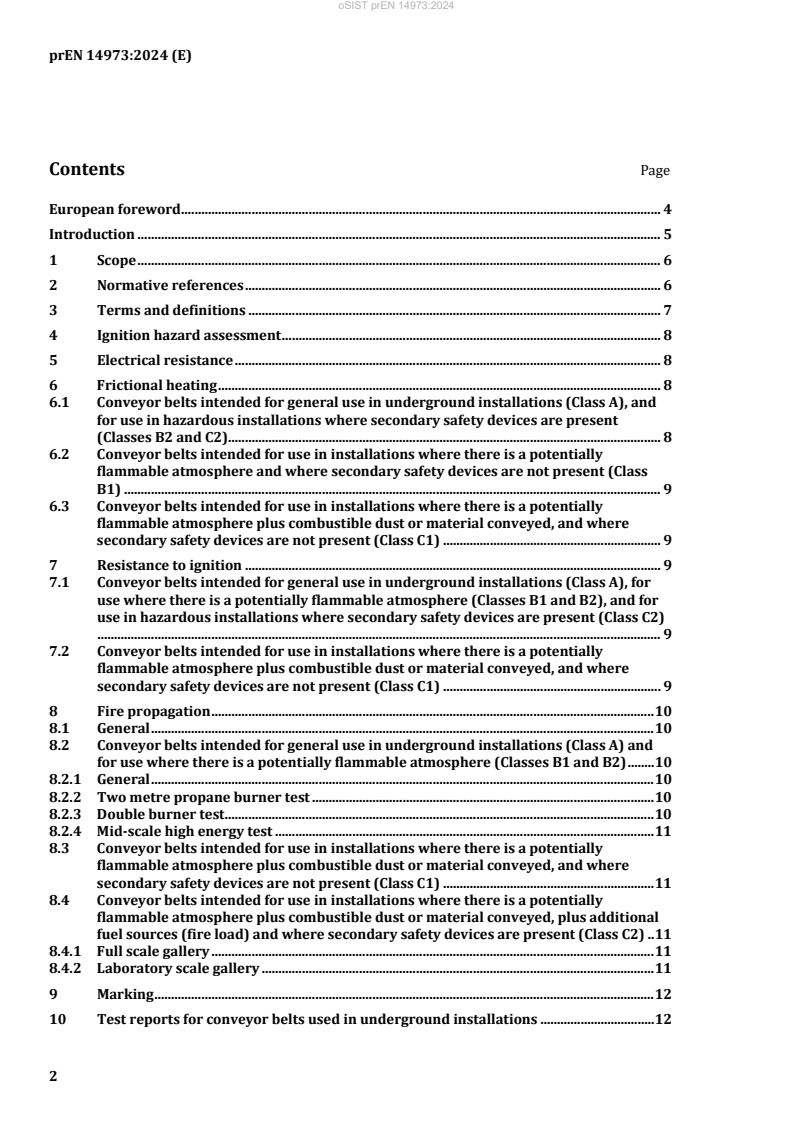
Contents Page
European foreword . 4
Introduction . 5
1 Scope . 6
2 Normative references . 6
3 Terms and definitions . 7
4 Ignition hazard assessment . 8
5 Electrical resistance . 8
6 Frictional heating . 8
6.1 Conveyor belts intended for general use in underground installations (Class A), and
for use in hazardous installations where secondary safety devices are present
(Classes B2 and C2) . 8
6.2 Conveyor belts intended for use in installations where there is a potentially
flammable atmosphere and where secondary safety devices are not present (Class
B1) . 9
6.3 Conveyor belts intended for use in installations where there is a potentially
flammable atmosphere plus combustible dust or material conveyed, and where
secondary safety devices are not present (Class C1) . 9
7 Resistance to ignition . 9
7.1 Conveyor belts intended for general use in underground installations (Class A), for
use where there is a potentially flammable atmosphere (Classes B1 and B2), and for
use in hazardous installations where secondary safety devices are present (Class C2)
........................................................................................................................................................................ 9
7.2 Conveyor belts intended for use in installations where there is a potentially
flammable atmosphere plus combustible dust or material conveyed, and where
secondary safety devices are not present (Class C1) . 9
8 Fire propagation . 10
8.1 General . 10
8.2 Conveyor belts intended for general use in underground installations (Class A) and
for use where there is a potentially flammable atmosphere (Classes B1 and B2) . 10
8.2.1 General . 10
8.2.2 Two metre propane burner test . 10
8.2.3 Double burner test . 10
8.2.4 Mid-scale high energy test . 11
8.3 Conveyor belts intended for use in installations where there is a potentially
flammable atmosphere plus combustible dust or material conveyed, and where
secondary safety devices are not present (Class C1) . 11
8.4 Conveyor belts intended for use in installations where there is a potentially
flammable atmosphere plus combustible dust or material conveyed, plus additional
fuel sources (fire load) and where secondary safety devices are present (Class C2) . 11
8.4.1 Full scale gallery . 11
8.4.2 Laboratory scale gallery . 11
9 Marking . 12
10 Test reports for conveyor belts used in underground installations . 12
Annex A (informative) Hazards and risk assessment .14
A.1 Identification of hazards.14
A.2 Risk assessment .14
A.3 Methods for addressing hazards .15
Annex B (informative) Example of an ignition hazard assessment for a conveyor belt
intended for use in a potentially explosive atmosphere .16
Annex C (informative) Suggested conveyor belt approval/compliance options .17
Annex ZA (informative) Relationship between this European Standard and the essential
Health and Safety Requirements of Directive 2014/34/EU aimed to be covered .20
Annex ZB (informative) Relationship between this European Standard and the essential
requirements of Directive 2006/42/EC aimed to be covered .22
Annex ZC (informative) Relationship between this European Standard and the essential
requirements of Regulation (EU) 2023/1230 aimed to be covered .23
Bibliography .24
European foreword
This document (prEN 14973:2024) has been prepared by Technical Committee CEN/TC 188
“Conveyor belts”, the secretariat of which is held by SNV.
This document is currently submitted to the CEN Enquiry.
This document will supersede EN 14973:2015.
Significant technical changes between this document and the previous edition of this European
Standard:
— The EN 1554 standard has been replaced by EN ISO 20238:2019. The corresponding technical
revisions have been made.
— A new Clause 10 “ 10 Test reports for conveyor belts used in underground installations” has
been added. The definition of the construction series has been revised and described in details.
This document has been prepared under a standardization request addressed to CEN by the
European Commission. The Standing Committee of the EFTA States subsequently approves these
requests for its Member States.
For the relationship with EU Legislation, see informative Annex ZA, Annex ZB and Annex ZC, which
are an integral part of this document.
Introduction
This document is a type C standard as stated in EN ISO 12100:2010.
The machinery concerned and the extent to which hazards, hazardous situations and events are
covered are indicated in the scope of this document.
When provisions of this type C standard are different from those which are stated in type A or B
standards, the provisions of this type C standard take precedence over the provisions of the other
standards, for machines that have been designed and built according to the provisions of this type C
standard.
The approach taken in this European Standard is to identify the main hazards encountered in
underground conveying applications and to specify requirements for conveyor belts that will
provide the necessary operational safety. Three Classes are specified, A, B and C, as defined in 3.9 to
3.11.
NOTE According to national authorities Class C (C1/C2) conveyor belts are requested for use in EU coal
mining.
1 Scope
This document specifies electrical and flammability safety requirements for conveyor belts intended
for use in underground installations, in the presence of flammable or non-flammable atmospheres.
Conveyor belts covered by this document and intended for use in flammable atmospheres are
intended for use on conveyor belt installations (machinery in mines). The belt is a component or part
of equipment, which can be incorporated into the conveyor, which is an equipment of Group I,
Category M2, as defined in 3.2.2 of EN ISO 80079-36:2016.
This document is not applicable to light conveyor belts as described in EN ISO 21183-1:2006 nor is
it applicable to conveyor belts which are manufactured before the date of publication of this
document by CEN.
This document deals with those significant hazards detailed in A.1.
Attention is drawn to Annexes ZA and ZB.
NOTE A summary of the requirements of this document is given in Table 2. This is intended for quick
reference only.
2 Normative references
The following documents are referred to in the text in such a way that some or all of their content
constitutes requirements of this document. For dated references, only the edition cited applies. For
undated references, the latest edition of the referenced document (including any amendments)
applies.
EN 12881-1:2014, Conveyor belts — Fire simulation flammability testing — Part 1: Propane burner
tests
EN 12881-2:2005+A1:2008, Conveyor belts — Fire simulation flammability testing — Part 2: Large
scale fire test
EN ISO 284:2012, Conveyor belts — Electrical conductivity — Specification and test method
(ISO 284:2012)
EN ISO 340:2022, Conveyor belts — Laboratory scale flammability characteristics — Requirements
and test method (ISO 340:2022)
EN ISO 12100:2010, Safety of machinery — General principles for design — Risk assessment and risk
reduction (ISO 12100:2010)
EN ISO 15236-3:2017, Steel cord conveyor belts — Part 3: Special safety requirements for belts for use
in underground installations (ISO 15236-3:2017)
EN ISO 20238:2019, Conveyor belts — Drum friction testing (ISO 20238:2018)
EN ISO 22721:2023, Conveyor belts — Specification for rubber- or plastics-covered conveyor belts of
textile construction for underground mining (ISO 22721:2023)
EN ISO 80079-36:2016, Explosive atmospheres — Part 36: Non-electrical equipment for explosive
atmospheres — Basic method and requirements (ISO 80079-36:2016)
EN IEC 31010:2019, Risk management — Risk assessment techniques (IEC 31010:2019)
ISO/IEC 17025:2017, General requirements for the competence of testing and calibration laboratories
(ISO/IEC 17025:2017)
3 Terms and definitions
For the purposes of this document, the following terms and definitions apply.
ISO and IEC maintain terminology databases for use in standardization at the following addresses:
• ISO Online browsing platform: available at https://www.iso.org/obp
• IEC Electropedia: available at https://www.electropedia.org/
3.1
afterflame
flame which persists after the ignition source has been removed
[SOURCE: EN ISO 13943:2023, definition 3.12]
3.2
afterglow
persistence of glowing, after cessation of flaming or, if no flaming occurs, after the ignition source
has been removed
3.3
flame (noun)
zone of combustion in the gaseous phase usually with emission of light
3.4
flame (verb)
undergo combustion in the gaseous phase with emission of light
3.5
glowing, noun
made luminous by heat (without flame)
3.6
undamaged
that part of a conveyor belt remaining after the termination of the fire tests described in
EN 12881-1:2014 and which shows no evidence of embrittlement, cracking, blistering or other
blemishes not originally present
3.7
secondary safety device
equipment or apparatus provided for the purpose of assisting in the provision of a safe working
environment, e.g. slip detectors, heat detectors, water fire extinguishing systems
3.8
incomplete ignition
situation in which the part of the conveyor belt above the burner burns only on the bottom side and
not on the top side when the burner is removed
3.9
class A belt
conveyor belt intended for general use where the only hazard is limited access and means of escape
3.10
class B belt
conveyor belt intended for use where there is limited access and means of escape, where a
potentially explosive atmosphere is present and where secondary safety devices are either not
present (Class B1) or present (Class B2)
3.11
class C belt
conveyor belt intended for use where there is limited access and means of escape, where a
potentially explosive atmosphere is present, where other combustible material or dust is either
being conveyed or is a potential source of additional fuel (fire load) and where secondary safety
devices are either not present (Class C1) or present (Class C2)
3.12
additional fuel source (fire load)
material, e.g. wooden linings or plastic pipes, significantly additional to the conveyor belt and
conveyed material which it is considered likely would contribute to the ignition source of the
conveyor belt in a fire situation
3.13
potentially explosive atmosphere
atmosphere which could become explosive due to local and operational conditions
4 Ignition hazard assessment
In order to determine which class of conveyor belt has to be used in an underground installation, the
operating company shall carry out an ignition hazard assessment. The result of such an assessment
shall lead to a class of conveyor belt according to this document. Annex A of this document and
Annex A of EN ISO/IEC 80079-38:2016 serve as aids for preparing such an ignition hazard
assessment.
NOTE An example of an ignition hazard assessment for a conveyor belt intended for use in a potentially
explosive atmosphere is given in Annex B.
5 Electrical resistance
When tested in accordance with EN ISO 284:2012, conveyor belts intended for use in underground
installations shall have an electrical surface resistance not greater than 300 MΩ.
6 Frictional heating
6.1 Conveyor belts intended for general use in underground installations (Class A),
and for use in hazardous installations where secondary safety devices are present
(Classes B2 and C2)
When tested according to EN ISO 20238:2019, method B2.1, conveyor belts intended for general
underground use shall not show any flames, while glowing is permitted. No requirements are given
for the maximum temperature of the drum.
If, due to the design of the conveyor belt (for example, textile conveyor belts or steel cord conveyor
belts with a large thickness), the test according to procedure B2.1 cannot be performed, the test
according to procedure B2.2 is performed with a reduced wrap angle;
6.2 Conveyor belts intended for use in installations where there is a potentially
flammable atmosphere and where secondary safety devices are not present (Class
B1)
When tested in accordance with EN ISO 20238:2019, method B2.1, conveyor belts intended for use
in flammable atmospheres shall not exhibit flames or glow, and at no time shall the drum
temperature exceed 450 °C.
If, due to the design of the conveyor belt (for example, textile conveyor belts or steel cord conveyor
belts with a large thickness), the test according to procedure B2.1 cannot be performed, the test
according to procedure B2.2 shall be performed with a reduced wrap angle;
NOTE If the intrinsic properties of the conveyor belt alone are to be used to give a safe situation in the
presence of flammable atmospheres, it is important to limit the temperature of the drum and not to allow glow.
The temperature of 450 °C was chosen as being adequately below the ignition temperature of methane-air
mixtures when in the presence of a hot drum surface.
6.3 Conveyor belts intended for use in installations where there is a potentially
flammable atmosphere plus combustible dust or material conveyed, and where
secondary safety devices are not present (Class C1)
When tested in accordance with EN ISO 20238:2019, method B2.1, conveyor belts intended for use
in the presence of coal dust shall not exhibit flames or glow, and at no time shall the temperature of
the drum exceed 325°C.
If, due to the design of the conveyor belt (for example, textile conveyor belts or steel cord conveyor
belts with a large thickness), the test according to procedure B2.1 cannot be performed, the test
according to procedure B2.2 shall be performed with a reduced wrap angle;
NOTE If the intrinsic properties of the conveyor belt alone are to be used to give a safe situation in the
presence of combustible dusts or material conveyed, it is important to limit the temperature of the drum and
not to allow glow to avoid the possibility of combustion of dust on the belt. The drum temperature of 325 °C
was chosen as being adequately below the ignition temperature of coal dust on the belt when in the presence
of a hot drum surface. However, if the conveyor belt is to be used in the presence of other dusts, the
purchaser/user and manufacturer can agree to alternative requirements on the basis of experience, e.g. a
different maximum drum temperature that will give an adequate margin of safety over the ignition
temperature of the dust in question.
7 Resistance to ignition
7.1 Conveyor belts intended for general use in underground installations (Class A),
for use where there is a potentially flammable atmosphere (Classes B1 and B2), and
for use in hazardous installations where secondary safety devices are present (Class
C2)
When tested in accordance with EN ISO 340:2022, the sum of the afterflame times for each group of
six tests (i.e. six tests with covers intact and six tests with covers removed) shall be less than 45 s
and no individual result shall be greater than 15 s.
7.2 Conveyor belts intended for use in installations where there is a potentially
flammable atmosphere plus combustible dust or material conveyed, and where
secondary safety devices are not present (Class C1)
When tested in accordance with EN ISO 340:2022, the sum of the afterflame and afterglow times for
six test pieces with covers intact shall be no more than 18 s and no individual result shall be greater
than 10 s. When tested with covers removed, the sum of the afterflame and afterglow times for the
six test pieces shall be no more than 30 s and no individual result shall be more than 15 s.
8 Fire propagation
8.1 General
8.1.1 The requirements in 8.2 to 8.4 are based on resistance to the propagation of fire from a
localized heat source. However, experience has shown that the two metre propane burner test given
in EN 12881-1:2014, Method A (8.2.2) might not measure propagation if the conveyor belt is not
fully ignited in the 10 min period of flame application. In these circumstances, the mid-scale high
energy test given in EN 12881-1:2014, Method C (see 8.2.3 and 8.3) has been found to ignite all but
the heaviest steel cord conveyor belts and to provide an adequate level of safety. The inability to
ignite fully a belt in the 50 min period of the mid-scale high energy test implies a high level of
resistance to fire propagation.
8.1.2 If, in the mid-scale high energy test, the conveyor belt is not fully ignited in the 50 min period
of flame application, the double burner test given in EN 12881-1:2014, Method B (see 8.2.4 and 8.3)
shall be used to achieve full ignition. Although the double burner test ignites a wider range of
conveyor belts, experience with conveyor belts other than those containing steel cord or aramid
yarns is limited.
8.1.3 If there is the possibility of a major roadway fire due to the presence of fuel sources (fire
load) additional to and greater than the conveyor belt and conveyed material alone, the full-scale
gallery test described in EN 12881-2:2005+A1:2008 (see 8.4.1) is used to provide adequate
operational safety levels. Alternatively, the laboratory scale test described in EN 12881-1:2014
Method D, may be used for a restricted range of conveyor belts (see 8.4.2)
8.1.4 The satisfactory performance of a conveyor belt in one of the propagation tests should not
be taken to indicate that performance will necessarily be satisfactory in any of the other tests. Care
is particularly needed in respect of the comparison of performance in the tests simulating resistance
to propagation from a localized source and the test for propagation in a major roadway fire.
Satisfactory performance in one test cannot be taken to indicate satisfactory performance in the
other. The substitution of one of these tests, if previously specified for an installation, for another
may result in a reduction in previously accepted standards of safety for that installation.
8.2 Conveyor belts intended for general use in underground installations (Class A)
and for use where there is a potentially flammable atmosphere (Classes B1 and B2)
8.2.1 General
The conveyor belt shall comply with the requirement given in 8.2.2, except that, if incomplete
ignition is achieved, the conveyor belt shall comply with the requirement given in 8.2.3 or 8.2.4.
The requirements in 8.2.3 and 8.2.4 are more severe than that in 8.2.2. Therefore, if the requirements
in 8.2.3 or 8.2.4 are met, the requirement in 8.2.2 shall be met without further testing being required.
8.2.2 Two metre propane burner test
When tested in accordance with EN 12881-1:2014, Method A, the length of the test piece that
remains undamaged shall be not less than 100 mm across the whole width of the conveyor belt.
8.2.3 Double burner test
When tested in accordance with EN 12881-1:2014, Method B, there shall be some of the test piece
remaining undamaged across the whole width of the conveyor belt.
8.2.4 Mid-scale high energy test
When tested in accordance with EN 12881-1:2014, Method C, either
a) the length of the test piece that remains undamaged shall be not less than 600 mm across the
whole width of the conveyor belt; or
b) the maximum average temperature rise shall not exceed 140 °C, the calculated length of
conveyor belt consumed by mass shall not exceed 1 250 mm and the length of the test piece that
remains undamaged shall be not less than 50 mm across the whole width of the conveyor belt.
8.3 Conveyor belts intended for use in installations where there is a potentially
flammable atmosphere plus combustible dust or material conveyed, and where
secondary safety devices are not present (Class C1)
When tested in accordance with EN 12881-1:2014, Method B or Method C, the conveyor belt s
...
Questions, Comments and Discussion
Ask us and Technical Secretary will try to provide an answer. You can facilitate discussion about the standard in here.
Loading comments...