

ASTM A488/A488M-24
(Practice)Standard Practice for Steel Castings, Welding, Qualifications of Procedures and Personnel
General Information
- Abstract
ABSTRACT
This practice covers the qualification of procedures, welders, and operators for the fabrication and repair of steel castings by electric arc welding. The materials are categorized as carbon steel, carbon and carbon-manganese steel, low alloy steel, ferritic stainless steel, martensitic stainless steel, low carbon austenitic stainless steel, unstabilized austenitic stainless steel, austenitic stainless steel, duplex austenitic-ferritic stainless steel, precipitation-hardened austenitic stainless steel, nickel base alloy, steel castings, austenitic manganese. The orientation of the welds with respect to the horizontal and vertical planes of reference is classified into four positions, namely, flat, horizontal, vertical, and overhead. Four types of test shall be conducted in the qualification procedures such as tension test, bend test, Charpy impact test and radiographic test. Guided bend test specimens shall be prepared by cutting the test plate or pipe to form specimens of approximately rectangular cross section. Guided bend test specimens are of three types depending on which surface -side bend, face bend, or root bend is on the convex (outer) side of the bent specimen. A welding procedure must be set up as a new procedure and must be requalified when any of the changes in essential variables, inclusive, are made. Changes other than those listed may be made without requalification, provided the procedure is revised to show these changes. All welders and operators welding castings under this practice shall pass the welder qualification test. The welder or operator successfully performing the procedure qualification test is automatically qualified for performance.
SCOPE
1.1 This practice covers the qualification of procedures, welders, and operators for the fabrication and repair of steel castings by electric arc welding.
1.1.1 Qualifications of a procedure and either or both the operator or welder under Section IX of the ASME Boiler and Pressure Vessel Code shall automatically qualify the procedure and either or both the operator or welder under this practice. P-number designations in the ASME grouping of base metals for qualification may be different than the category numbers listed in Table 1. Refer to Appendix X1 for a comparison of ASTM category numbers with the corresponding ASME P-number designations.
1.2 Each manufacturer or contractor is responsible for the welding done by his organization and shall conduct the tests required to qualify his welding procedures, welders, and operators.
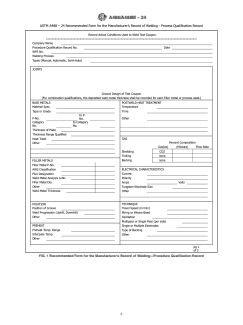
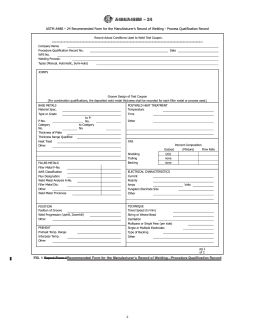
1.3 Each manufacturer or contractor shall maintain a record of welding procedure qualification tests (Fig. 1), welder or operator performance qualification tests (Fig. 2), and welding procedure specification (Fig. 3), which shall be made available to the purchaser's representative on request.
1.4 The values stated in either SI units or inch-pound units are to be regarded separately as standard. The values stated in each system may not be exact equivalents; therefore, each system shall be used independently of the other. Combining values from the two systems may result in nonconformance with the standard.
1.4.1 SI Units—Within the text, the SI units are shown in brackets.
1.5 This standard does not purport to address all of the safety concerns, if any, associated with its use. It is the responsibility of the user of this standard to establish appropriate safety, health, and environmental practices and determine the applicability of regulatory limitations prior to use.
1.6 This international standard was developed in accordance with internationally recognized principles on standardization established in the Decision on Principles for the Development of International Standards, Guides and Recommendations issued by the World Trade Organization Technical Barriers to Trade (TBT) Committee.
- Status
- Published
- Publication Date
- 29-Feb-2024
- Technical Committee
- A01 - Steel, Stainless Steel and Related Alloys
- Drafting Committee
- A01.18 - Castings
Buy Documents
ASTM A488/A488M-24 - Standard Practice for Steel Castings, Welding, Qualifications of Procedures and Personnel
REDLINE ASTM A488/A488M-24 - Standard Practice for Steel Castings, Welding, Qualifications of Procedures and Personnel
Overview
ASTM A488/A488M-24 provides standard practices for qualifying welding procedures, welders, and operators involved in the fabrication and repair of steel castings using electric arc welding. This ASTM standard is essential for ensuring reliable, high-quality welds in steel castings, which are widely used in construction, manufacturing, oil & gas, and power generation. The practice applies to a broad range of material groups, including carbon steels, low alloy steels, various grades of stainless steel, nickel-base alloys, and austenitic manganese steels. The document outlines specific testing requirements for procedure and personnel qualification, helping manufacturers and contractors demonstrate compliance, improve safety, and ensure product performance.
Key Topics
- Material Categories: The standard classifies steel castings into multiple categories based on their composition and mechanical properties, covering everything from carbon steel to duplex stainless steel and nickel alloys.
- Welding Positions: Weld orientation and qualification are defined for four main positions: flat, horizontal, vertical, and overhead. These positions help ensure personnel are competent to weld in all required orientations.
- Qualification Testing: Detailed requirements for:
- Tension Tests: Assess the strength of the welded joint.
- Guided Bend Tests: Evaluate ductility and soundness of the weld via side, face, or root bend specimens.
- Charpy Impact Test: Determines the toughness of welds and heat-affected zones, especially important for critical service applications.
- Radiographic Test: Used for detecting internal flaws and ensuring soundness of the welding process.
- Documentation and Records: Each manufacturer or contractor must maintain records of welding procedure qualifications, welder performance tests, and welding procedure specifications. These records must be available for inspection by the purchaser’s representative upon request.
- Requalification Requirements: Any changes in essential welding variables-such as base material category, welding process, or test conditions-require requalification of the welding procedure.
Applications
ASTM A488/A488M-24 is widely used in industries where steel castings are integral components and weld quality is critical. Its main applications include:
- Manufacturing and Fabrication: Ensures weld integrity in the assembly and repair of steel cast components in heavy equipment, machinery, and infrastructure projects.
- Pressure Vessels and Boilers: Aligns with ASME Boiler and Pressure Vessel Code requirements, making it suitable for use in highly regulated fields involving pressurized systems.
- Power Generation and Petrochemical Facilities: Facilitates compliance and enhances safety in power plants and processing facilities where steel castings are subjected to high stress and extreme environments.
- Construction: Supports the development of safe and durable welded structures made from cast steel materials.
Related Standards
For a holistic approach to steel casting welding quality, ASTM A488/A488M-24 should be referenced alongside the following standards:
- ASTM A27/A27M: Carbon steel castings for general applications
- ASTM A148/A148M: High-strength steel castings for structural purposes
- ASTM A216/A216M: Carbon steel castings suitable for fusion welding
- ASTM A352/A352M, A351/A351M: Specifications for various types of alloy and stainless steel castings
- ASME Boiler and Pressure Vessel Code, Section IX: Rules for welding procedure and personnel qualifications
- ANSI/AWS A3.0: Definitions for welding and cutting terminology
- ASTM A370: Mechanical testing of steel products
Value to Industry
By following ASTM A488/A488M-24, organizations can:
- Ensure Weld Quality and Safety: Standardized qualification procedures reduce welding defects and help maintain high safety and performance standards.
- Demonstrate Compliance: Satisfy industry, regulatory, and customer requirements, particularly in sensitive and regulated sectors.
- Streamline Quality Audits: Comprehensive documentation facilitates quality audits and inspections.
- Facilitate International Trade: Adherence to internationally recognized standards supports global business and procurement.
For further assurance of steel casting weld quality and consistency, integrating this standard into your quality assurance program is considered best practice in the steel fabrication and manufacturing industry.
Relations
- Effective Date
- 01-Mar-2024
- Effective Date
- 01-Mar-2024
- Effective Date
- 01-Mar-2024
- Effective Date
- 01-Mar-2024
- Effective Date
- 01-Mar-2024
- Effective Date
- 01-Mar-2024
- Effective Date
- 01-Mar-2024
- Effective Date
- 01-Mar-2024
- Effective Date
- 01-Mar-2024
- Effective Date
- 01-Mar-2024
- Effective Date
- 01-Mar-2024
- Effective Date
- 01-Mar-2024
- Effective Date
- 01-Mar-2024
- Effective Date
- 01-Mar-2024
- Effective Date
- 01-Mar-2024
Buy Documents
ASTM A488/A488M-24 - Standard Practice for Steel Castings, Welding, Qualifications of Procedures and Personnel
REDLINE ASTM A488/A488M-24 - Standard Practice for Steel Castings, Welding, Qualifications of Procedures and Personnel
Get Certified
Connect with accredited certification bodies for this standard

DVS-ZERT GmbH
German welding certification society.
CARES (UK Certification Authority for Reinforcing Steels)
UK certification for reinforcing steels and construction.
EWF/IIW (European/International Welding Federation)
International welding personnel certification.
Sponsored listings
Frequently Asked Questions
ASTM A488/A488M-24 is a standard published by ASTM International. Its full title is "Standard Practice for Steel Castings, Welding, Qualifications of Procedures and Personnel". This standard covers: ABSTRACT This practice covers the qualification of procedures, welders, and operators for the fabrication and repair of steel castings by electric arc welding. The materials are categorized as carbon steel, carbon and carbon-manganese steel, low alloy steel, ferritic stainless steel, martensitic stainless steel, low carbon austenitic stainless steel, unstabilized austenitic stainless steel, austenitic stainless steel, duplex austenitic-ferritic stainless steel, precipitation-hardened austenitic stainless steel, nickel base alloy, steel castings, austenitic manganese. The orientation of the welds with respect to the horizontal and vertical planes of reference is classified into four positions, namely, flat, horizontal, vertical, and overhead. Four types of test shall be conducted in the qualification procedures such as tension test, bend test, Charpy impact test and radiographic test. Guided bend test specimens shall be prepared by cutting the test plate or pipe to form specimens of approximately rectangular cross section. Guided bend test specimens are of three types depending on which surface -side bend, face bend, or root bend is on the convex (outer) side of the bent specimen. A welding procedure must be set up as a new procedure and must be requalified when any of the changes in essential variables, inclusive, are made. Changes other than those listed may be made without requalification, provided the procedure is revised to show these changes. All welders and operators welding castings under this practice shall pass the welder qualification test. The welder or operator successfully performing the procedure qualification test is automatically qualified for performance. SCOPE 1.1 This practice covers the qualification of procedures, welders, and operators for the fabrication and repair of steel castings by electric arc welding. 1.1.1 Qualifications of a procedure and either or both the operator or welder under Section IX of the ASME Boiler and Pressure Vessel Code shall automatically qualify the procedure and either or both the operator or welder under this practice. P-number designations in the ASME grouping of base metals for qualification may be different than the category numbers listed in Table 1. Refer to Appendix X1 for a comparison of ASTM category numbers with the corresponding ASME P-number designations. 1.2 Each manufacturer or contractor is responsible for the welding done by his organization and shall conduct the tests required to qualify his welding procedures, welders, and operators. 1.3 Each manufacturer or contractor shall maintain a record of welding procedure qualification tests (Fig. 1), welder or operator performance qualification tests (Fig. 2), and welding procedure specification (Fig. 3), which shall be made available to the purchaser's representative on request. 1.4 The values stated in either SI units or inch-pound units are to be regarded separately as standard. The values stated in each system may not be exact equivalents; therefore, each system shall be used independently of the other. Combining values from the two systems may result in nonconformance with the standard. 1.4.1 SI Units—Within the text, the SI units are shown in brackets. 1.5 This standard does not purport to address all of the safety concerns, if any, associated with its use. It is the responsibility of the user of this standard to establish appropriate safety, health, and environmental practices and determine the applicability of regulatory limitations prior to use. 1.6 This international standard was developed in accordance with internationally recognized principles on standardization established in the Decision on Principles for the Development of International Standards, Guides and Recommendations issued by the World Trade Organization Technical Barriers to Trade (TBT) Committee.
ABSTRACT This practice covers the qualification of procedures, welders, and operators for the fabrication and repair of steel castings by electric arc welding. The materials are categorized as carbon steel, carbon and carbon-manganese steel, low alloy steel, ferritic stainless steel, martensitic stainless steel, low carbon austenitic stainless steel, unstabilized austenitic stainless steel, austenitic stainless steel, duplex austenitic-ferritic stainless steel, precipitation-hardened austenitic stainless steel, nickel base alloy, steel castings, austenitic manganese. The orientation of the welds with respect to the horizontal and vertical planes of reference is classified into four positions, namely, flat, horizontal, vertical, and overhead. Four types of test shall be conducted in the qualification procedures such as tension test, bend test, Charpy impact test and radiographic test. Guided bend test specimens shall be prepared by cutting the test plate or pipe to form specimens of approximately rectangular cross section. Guided bend test specimens are of three types depending on which surface -side bend, face bend, or root bend is on the convex (outer) side of the bent specimen. A welding procedure must be set up as a new procedure and must be requalified when any of the changes in essential variables, inclusive, are made. Changes other than those listed may be made without requalification, provided the procedure is revised to show these changes. All welders and operators welding castings under this practice shall pass the welder qualification test. The welder or operator successfully performing the procedure qualification test is automatically qualified for performance. SCOPE 1.1 This practice covers the qualification of procedures, welders, and operators for the fabrication and repair of steel castings by electric arc welding. 1.1.1 Qualifications of a procedure and either or both the operator or welder under Section IX of the ASME Boiler and Pressure Vessel Code shall automatically qualify the procedure and either or both the operator or welder under this practice. P-number designations in the ASME grouping of base metals for qualification may be different than the category numbers listed in Table 1. Refer to Appendix X1 for a comparison of ASTM category numbers with the corresponding ASME P-number designations. 1.2 Each manufacturer or contractor is responsible for the welding done by his organization and shall conduct the tests required to qualify his welding procedures, welders, and operators. 1.3 Each manufacturer or contractor shall maintain a record of welding procedure qualification tests (Fig. 1), welder or operator performance qualification tests (Fig. 2), and welding procedure specification (Fig. 3), which shall be made available to the purchaser's representative on request. 1.4 The values stated in either SI units or inch-pound units are to be regarded separately as standard. The values stated in each system may not be exact equivalents; therefore, each system shall be used independently of the other. Combining values from the two systems may result in nonconformance with the standard. 1.4.1 SI Units—Within the text, the SI units are shown in brackets. 1.5 This standard does not purport to address all of the safety concerns, if any, associated with its use. It is the responsibility of the user of this standard to establish appropriate safety, health, and environmental practices and determine the applicability of regulatory limitations prior to use. 1.6 This international standard was developed in accordance with internationally recognized principles on standardization established in the Decision on Principles for the Development of International Standards, Guides and Recommendations issued by the World Trade Organization Technical Barriers to Trade (TBT) Committee.
ASTM A488/A488M-24 is classified under the following ICS (International Classification for Standards) categories: 25.160.01 - Welding, brazing and soldering in general; 25.160.10 - Welding processes. The ICS classification helps identify the subject area and facilitates finding related standards.
ASTM A488/A488M-24 has the following relationships with other standards: It is inter standard links to ASTM A488/A488M-18e2, ASTM A957/A957M-21, ASTM A757/A757M-22, ASTM A872/A872M-21, ASTM A352/A352M-21, ASTM A781/A781M-21, ASTM A216/A216M-21, ASTM A608/A608M-20, ASTM A494/A494M-22, ASTM A985/A985M-21, ASTM A356/A356M-21, ASTM A990/A990M-23, ASTM A994-23a, ASTM B1015-20, ASTM A958/A958M-24. Understanding these relationships helps ensure you are using the most current and applicable version of the standard.
ASTM A488/A488M-24 is available in PDF format for immediate download after purchase. The document can be added to your cart and obtained through the secure checkout process. Digital delivery ensures instant access to the complete standard document.
Standards Content (Sample)
This international standard was developed in accordance with internationally recognized principles on standardization established in the Decision on Principles for the
Development of International Standards, Guides and Recommendations issued by the World Trade Organization Technical Barriers to Trade (TBT) Committee.
Designation: A488/A488M − 24
Standard Practice for
Steel Castings, Welding, Qualifications of Procedures and
Personnel
This standard is issued under the fixed designation A488/A488M; the number immediately following the designation indicates the year
of original adoption or, in the case of revision, the year of last revision. A number in parentheses indicates the year of last reapproval.
A superscript epsilon (´) indicates an editorial change since the last revision or reapproval.
This standard has been approved for use by agencies of the U.S. Department of Defense.
1. Scope* priate safety, health, and environmental practices and deter-
mine the applicability of regulatory limitations prior to use.
1.1 This practice covers the qualification of procedures,
1.6 This international standard was developed in accor-
welders, and operators for the fabrication and repair of steel
dance with internationally recognized principles on standard-
castings by electric arc welding.
ization established in the Decision on Principles for the
1.1.1 Qualifications of a procedure and either or both the
Development of International Standards, Guides and Recom-
operator or welder under Section IX of the ASME Boiler and
mendations issued by the World Trade Organization Technical
Pressure Vessel Code shall automatically qualify the procedure
Barriers to Trade (TBT) Committee.
and either or both the operator or welder under this practice.
P-number designations in the ASME grouping of base metals
for qualification may be different than the category numbers 2. Referenced Documents
listed in Table 1. Refer to Appendix X1 for a comparison of
2.1 ASTM Standards:
ASTM category numbers with the corresponding ASME
A27/A27M Specification for Steel Castings, Carbon, for
P-number designations.
General Application
1.2 Each manufacturer or contractor is responsible for the
A128/A128M Specification for Steel Castings, Austenitic
welding done by his organization and shall conduct the tests
Manganese
required to qualify his welding procedures, welders, and
A148/A148M Specification for Steel Castings, High
operators.
Strength, for Structural Purposes
A216/A216M Specification for Steel Castings, Carbon, Suit-
1.3 Each manufacturer or contractor shall maintain a record
able for Fusion Welding, for High-Temperature Service
of welding procedure qualification tests (Fig. 1), welder or
A217/A217M Specification for Steel Castings, Martensitic
operator performance qualification tests (Fig. 2), and welding
Stainless and Alloy, for Pressure-Containing Parts, Suit-
procedure specification (Fig. 3), which shall be made available
able for High-Temperature Service
to the purchaser’s representative on request.
A297/A297M Specification for Steel Castings, Iron-
1.4 The values stated in either SI units or inch-pound units
Chromium and Iron-Chromium-Nickel, Heat Resistant,
are to be regarded separately as standard. The values stated in
for General Application
each system may not be exact equivalents; therefore, each
A351/A351M Specification for Castings, Austenitic, for
system shall be used independently of the other. Combining
Pressure-Containing Parts
values from the two systems may result in nonconformance
A352/A352M Specification for Steel Castings, Ferritic and
with the standard.
Martensitic, for Pressure-Containing Parts, Suitable for
1.4.1 SI Units—Within the text, the SI units are shown in
Low-Temperature Service
brackets.
A356/A356M Specification for Steel Castings, Carbon, Low
1.5 This standard does not purport to address all of the
Alloy, and Stainless Steel, Heavy-Walled for Steam Tur-
safety concerns, if any, associated with its use. It is the
bines
responsibility of the user of this standard to establish appro-
A370 Test Methods and Definitions for Mechanical Testing
of Steel Products
This practice is under the jurisdiction of ASTM Committee A01 on Steel,
Stainless Steel and Related Alloys and is the direct responsibility of Subcommittee
A01.18 on Castings. For referenced ASTM standards, visit the ASTM website, www.astm.org, or
Current edition approved March 1, 2024. Published April 2024. Originally contact ASTM Customer Service at service@astm.org. For Annual Book of ASTM
approved in 1963. Last previous edition approved in 2018 as A488/A488M – 18. Standards volume information, refer to the standard’s Document Summary page on
DOI: 10.1520/A0488_A0488M-24. the ASTM website.
*A Summary of Changes section appears at the end of this standard
Copyright © ASTM International, 100 Barr Harbor Drive, PO Box C700, West Conshohocken, PA 19428-2959. United States
A488/A488M − 24
TABLE 1 Categories of Base Materials
Category ASTM
Material Description Grades
Number Specification
1 Carbon steel (carbon less than A27/A27M All grades
0.35 %, tensile strength less than
or equal to 70 ksi [485 MPa])
A216/A216M WCA, WCB
A352/A352M LCB, LCA
A356/A356M 1
A732/A732M 1A, 2A
A757/A757M A1Q
A958/A958M SC 1020, SC 1025, SC 1030, CLASSES 65/35,
70/36
2 Carbon steel (tensile strength A148/A148M 80-40
greater than 70 ksi [485 MPa])
Carbon-manganese steel (tensile A216/A216M WCC
strength equal to or greater than
70 ksi [485 MPa]) but less than 90
ksi [620 MPa])
A352/A352M LCC
A732/A732M 2Q, 3A
A757/A757M A2Q
A958/A958M SC 1030, SC 1040, SC 1045, CLASSES 80/40,
80/50
3 Carbon and carbon-manganese A732/A732M 3Q, 4A, 4Q, 5N
steel (tensile strength equal to or
greater than 90 ksi [620 MPa])
A958/A958M SC 1045, CLASSES 90/60, 105/85, 115/95
4 Low-alloy steel (annealed, A148/A148M 80-50
normalized, or normalized and
tempered
Tensile strength less than 85 ksi A217/A217M WC1, WC4, WC5, WC6, WC9
[585 MPa])
A352/A352M LC1, LC2, LC3, LC4
A356/A356M 2, 5, 6, 8
A389/A389M C23, C24
A487/A487M 11A, 12A, 16A
A757/A757M B2N, B3N, B4N
A958/A958M SC 4130, SC 4140, SC 8620, SC 8625, SC 8630,
CLASSES 65/35, 70/36, 80/40, 80/50
5 Low-alloy steel (annealed, A148/A148M 90-60, 105-85
normalized, or normalized and
tempered
Tensile strength equal to or greater A217/A217M C5, C12, C12A, WC11
than 85 ksi [585 MPa])
A356/A356M 9, 10, 12
A487/A487M 1A, 1C, 2A, 2C, 4A, 4C, 6A, 8A, 9A, 9C, 10A,
13A
A732/A732M 6N, 15A
A757/A757M D1N1, D1N2, D1N3, E2N1, E2N2, E2N3
A958/A958M SC 4340, CLASSES 90/60, 105/85
6 Low-alloy steel (quenched and A148/A148M 90-60, 105-85, 115-95, 130-115, 135-125,
tempered) 150-135, 160-145, 165-150, 165-150L, 210-180,
210-180L, 260-210, 260-210L
A352/A352M LC2-1, LC1, LC2, LC3, LC4, LC9
A487/A487M 1B, 1C, 2B, 2C, 4B, 4C, 4D, 4E, 6B, 7A, 8B, 8C,
9A, 9B, 9C, 9D, 9E, 10B, 11B, 12B, 13B, 14A
A732/A732M 7Q, 8Q, 9Q, 10Q, 11Q, 12Q, 13Q, 14Q
A757/A757M B2Q, B3Q, B4Q, C1Q, D1Q1, D1Q2, D1Q3, E1Q,
E2Q1, E2Q2, E2Q3
A958/A958M SC 4140, SC 4130, SC 4340, SC 8620, SC 8625,
SC 8630, CLASSES 115/95, 130/115, 135/125,
150/135, 160/145, 165/150, 210/180
7 Ferritic stainless steel A743/A743M CB30, CC50
8 Martensitic stainless steel A217/A217M CA15
A352/A352M CA6NM
A356/A356M CA6NM
A488/A488M − 24
TABLE 1 Continued
Category ASTM
Material Description Grades
Number Specification
A487/A487M CA15-A, CA15-B, CA15-C, CA15-D, CA15M-A,
CA6NM-A, CA6NM-B
A743/A743M CA15, CA15M, CA6NM, CA40, CA6N, CB6
A757/A757M E3N
9 Low-carbon austenitic stainless A351/A351M CF3, CF3A, CF3M, CF3MA, CF3MN,
steel (carbon equal to or less than CK3MCUN, CG3M, CN3MN
0.03 %)
A743/A743M CF3, CF3M, CF3MN, CK3MCUN, CN3M, CG3M,
CN3MN
A744/A744M CF3, CF3M, CK3MCUN, CG3M, CN3MN
10 Unstabilized austenitic stainless A351/A351M CF8, CF8A, CF8M, CF10, CF10M, CG8M, CH8,
steel (carbon greater than 0.03 %) CH10, CH20, CG6MMN, CF10SMNN, CE20N
A447/A447M Type I
A743/A743M CF8, CG12, CF20, CF8M, CF16F, CF10SMNN,
CH20, CG8M, CE30, CG6MMN, CH10, CF16Fa
A744/A744M CF8, CF8M, CG8M
11 Stabilized austenitic stainless steel A297/A297M HG10MNN
A351/A351M CF8C, CF10MC, CK20, HK30, HK40, HT30,
CN7M, CT15C
A447/A447M Type II
A743/A743M CF8C, CN7M, CN7MS, CK20
A744/A744M CF8C, CN7M, CN7MS
12 Duplex (austenitic-ferritic) stainless A872/A872M J93183, J93550
steel
A890/A890M 1A, 1B, 2A, 3A, 4A, 5A, 6A
A995/A995M 1B, 2A, 3A, 4A, 5A, 6A
13 Precipitation-hardened austenitic A747/A747M CB7CU-1, CB7CU-2
stainless steel
14 Nickel-base alloys A494/A494M CW12MW, CY40 Class 1, CY40 Class 2,
CZ100, M35-1, M35-2, M30C, N12MV, N7M,
CW6M, CW2M, CW6MC, CX2MW, CU5MCUC
A990/A990M CW2M
15 Steel castings, austenitic manga- A128/A128M A, B-1, B-2, B-3, B-4, C, D, E-1, E-2, F
nese
A389/A389M Specification for Steel Castings, Alloy, Spe- A747/A747M Specification for Steel Castings, Stainless,
cially Heat Treated, for Pressure-Containing Parts, Suit- Precipitation Hardening
able for High-Temperature Service A757/A757M Specification for Steel Castings, Ferritic and
A447/A447M Specification for Steel Castings, Chromium- Martensitic, for Pressure-Containing and Other
Nickel-Iron Alloy (25-12 Class), for High-Temperature Applications, for Low-Temperature Service
Service A872/A872M Specification for Centrifugally Cast Ferritic/
A487/A487M Specification for Steel Castings Suitable for Austenitic Stainless Steel Pipe for Corrosive Environ-
Pressure Service ments
A494/A494M Specification for Castings, Nickel and Nickel A890/A890M Specification for Castings, Iron-Chromium-
Alloy Nickel-Molybdenum Corrosion-Resistant, Duplex
A732/A732M Specification for Castings, Investment, Car- (Austenitic/Ferritic) for General Application
bon and Low-Alloy Steel for General Application, and A958/A958M Specification for Steel Castings, Carbon and
Cobalt Alloy for High Strength at Elevated Temperatures Alloy, with Tensile Requirements, Chemical Require-
A743/A743M Specification for Castings, Iron-Chromium, ments Similar to Standard Wrought Grades
Iron-Chromium-Nickel, Corrosion Resistant, for General A990/A990M Specification for Castings, Iron-Nickel-
Application Chromium and Nickel Alloys, Specially Controlled for
A744/A744M Specification for Castings, Iron-Chromium- Pressure-Retaining Parts for Corrosive Service
Nickel, Corrosion Resistant, for Severe Service A995/A995M Specification for Castings, Austenitic-Ferritic
A488/A488M − 24
FIG. 1 Recommended Form for the Manufacturer’s Record of Welding—Procedure Qualification Record
A488/A488M − 24
FIG. 1 Recommended Form for the Manufacturer’s Record of Welding—Procedure Qualification Record (continued)
A488/A488M − 24
FIG. 2 Report Form 2
A488/A488M − 24
REPORT FORM 3
RECOMMENDED FORM FOR WELDING PROCEDURE SPECIFICATION
1. Title 7. Preheat
A
Welding of steel castings. 7.1 Preheat and interpass temperature shall be maintained in the range
A A B C
Indicate general material description, such as carbon, Cr-Mo, 12 Cr, etc. from to during .
A
2. Specification No. Rev. Indicate minimum temperature.
B
Date Indicate maximum temperature.
C
3. Scope Indicate if preheat maintenance is during welding or until postweld heat
A
3.1 Procedure Specification No. covers the welding of treatment is performed.
B
steel castings using the welding process. 7.2 Preheat for tack welding of backing plates is the same as required
A
Indicate general material description in the Title. for welding.
B A
Indicate specific welding process, such as shielded metal arc, etc. 7.3 Minimum temperature before applying heat shall be .
A
4. Base Material Indicate temperature.
A
4.1 The base material shall conform to the specification for 7.4 Local preheating to the temperatures indicated may be performed
B
which is found in materials category number . so that the heated area completely surrounds the weld preparation for a
A A
Insert reference to ASTM designation or indicate chemical analysis and minimum distance of in any direction.
A
physical properties. Indicate minimum distance for local preheating.
B
Indicate category number from Table 1. 8. Welding Position
A A
4.2 Base material shall be in the heat treated condition before 8.1 Welds shall be made in the position.
A
welding. Indicate position or positions in which the welding will be performed. See
A
Indicate heat treatment before welding. Fig. 4.
5. Filler Metal 9. Electrical Characteristics
A A
5.1 The filler metal shall conform to ANSI/AWS Specification 9.1 The current used shall be . The base material shall be attached
B B
which is found in weld metal analysis group A . to the welding electrode lead.
A A
Indicate appropriate American Welding Society specification number and Indicate whether direct or alternating current. If direct, state whether
filler metal classification (e.g., A5.1 E7018). non-pulsed or pulsed. If pulsed, state frequency.
B B
Indicate A Number from Table 4. Indicate whether electrode positive (EP) or electrode negative (EN) output
5.2 Flux for submerged arc welding shall conform to the following nominal terminal of power supply is used.
A
composition: . Electrode
A
Indicate chemical composition or trade designation. Wire
A A A A
5.3 Shielding gas for gas shielded arc welding shall conform to the Diameter Amperage Range Voltage
A
following nominal composition: .
A
Indicate the single gas or proportional parts of mixed gases and flow rates.
6. Preparation of Base Material
A A
6.1 Metal removal shall be performed by . Indicate for each diameter of electrode, the amperage, the range of
A
Indicate method of metal removal, such as chipping, grinding, carbon arc amperage permitted, and the voltage requirements. For welding processes
cutting, frame cutting, etc. Also indicate whether preheat is required during using wire, indicate wire diameter, wire feed speed, and current requirements.
metal removal. 9.2 Electrodes subject to moisture absorption must be stored and handled
A
6.2 Configuration of the weld preparation for partial penetration welds to maintain dryness according to the following: .
A A
shall conform to the following geometry: . Where applicable, indicate electrode care instructions.
A
Indicate minimum root radius and minimum side wall angle. 10. Welding Details
A
6.3 Configuration of the weld preparation for full penetration welds shall 10.1 The width of any pass of welding shall not exceed times
A
conform to the following geometry: . the size of the filler metal used.
A A
Indicate minimum side wall angle. Indicate the number for controlling the maximum width.
6.4 Backing plates shall be used for welding full penetration welds. 10.2 Craters shall be properly filled before each interruption of the arc.
A
Backing plates shall be made from steel and shall fit the back of 10.3 Slag or flux shall be removed on any bead before depositing the
B
the cavity with a minimum gap of . next successive bead.
A A
Indicate material of backing plate. 10.4 Interpass inspection shall be performed according to the following:
B
Indicate dimension of maximum gap. .
A
6.5 Surfaces of the weld preparation shall be cleaned of all oil, grease, Indicate degree of interpass inspection required.
A
dirt, scale, slag, shot blasting grit, or any foreign material which may 10.5 Peening shall be performed according to the following: .
A
be harmful to the quality of the weld. Surfaces of backing plates Indicate the degree of peening required. Indicate any limits on peening
when used shall also meet the same cleanliness requirements. first and last layers.
6.6 All surfaces of the weld preparation shall be inspected as 11. Post-Weld Heat Treatment
A A
follows: . 11.1 Post-weld heat treatment shall consist of the following: .
A A
Indicate type of inspection. Indicate the heating and cooking rates, holding temperatures and times.
12. Inspection
12.1 Inspection of the completed weld shall be performed according to
A
the following: .
A
Indicate degree of inspection.
FIG. 3 Report Form 3
A488/A488M − 24
(Duplex) Stainless Steel, for Pressure-Containing Parts 5. Preparation of Test Plate
2.2 American Society of Mechanical Engineers:
5.1 Procedure qualification testing shall be performed on
ASME Boiler and Pressure Vessel Code, Section IX
cast or wrought material having the same category number as
the casting being welded. Test material shall be subjected to the
2.3 American Welding Society:
same heat treatment before and after welding as will be applied
ANSI/AWS 3.0 Definitions for Welding and Cutting
to the casting. If the castings are not to be post-weld heat
treated, then the test material is not to be post-weld heat
3. Terminology
treated. Test plate material for performance qualification test-
3.1 Definitions—Definitions of terms relating to welding
ing is covered in 12.2.
shall be in agreement with the definitions of the American
5.2 The dimensions of the test plate shall be such as to
Welding Society, ANSI/AWS A3.0. Any casting definitions not
provide the required number of test specimens.
referenced in AWS are listed herein.
3.2 production welding—any welding carried out during 5.3 The test joint shall be welded using the type of welding
groove proposed in the welding procedure. The dimensions of
manufacturing before final delivery to the customer. Produc-
the welding groove are not essential variables of the welding
tion welding is part of the casting production process. Most
procedure.
castings will receive some welding as part of the process of
producing a casting to customer requirements.
5.4 The thickness of the test plate shall depend on the range
of thickness to be qualified as shown in Tables 2 and 3.
4. Weld Orientation
5.5 The joint preparation shown in Fig. 5 shall qualify the
4.1 Orientation—The orientation of welds with respect to
supplier for all welding on steel castings.
horizontal and vertical planes of reference are classified into
5.6 Where pipe or a cylindrical casting is used for
four positions, namely: flat, horizontal, vertical, and overhead
qualification, it is recommended that a minimum nominal
as shown in Fig. 4. Test material shall be oriented as shown in
diameter of 5 in. [125 mm] and a minimum thickness of ⁄8 in.
Fig. 4; however, an angular deviation of 615° from the
[10 mm] be used.
specified horizontal and vertical planes is permitted during
welding.
6. Types of Tests
4.2 Flat Position (Fig. 4(a))—This position covers plate in
6.1 Four types of tests are used in the qualification proce-
a horizontal plane with the weld metal deposited from above,
dure as follows:
or pipe or a cylindrical casting with its axis horizontal and
6.1.1 Tension Test—Tests in direct tension are used in the
rolled during welding so that the weld metal is deposited from
procedure qualification to measure the strength of groove-weld
above.
joints.
4.3 Horizontal Position (Fig. 4(b))—This position covers
6.1.2 Bend Test—Guided bend tests are used in the proce-
plate in a vertical plane with the axis of the weld horizontal, or
dure and performance qualification tests to check the degree of
pipe or a cylindrical casting with its axis vertical and the axis
soundness and ductility of groove-weld joints.
of the weld horizontal.
6.1.3 Charpy Impact Test—Charpy V-notch impact test
4.4 Vertical Position (Fig. 4(c))—In this position, the plate specimens are used in the procedure qualification to determine
the impact strength of weld metal deposited in groove-type
is in a vertical plane with the axis of the weld vertical.
joints.
4.5 Overhead Position (Fig. 4(d))—In this position, the
6.1.4 Radiographic Test—Radiographic examination in ac-
plate is in a horizontal plane with the weld metal deposited
cordance with 12.6 of a length of weld may be used to prove
from underneath.
the ability of operators and welders to make sound welds.
4.6 Horizontal Fixed Position (Fig. 4(e))—In this position,
the pipe or cylindrical casting has its axis horizontal and the
7. Tension Test
welding groove in a vertical plane. Welding shall be done
7.1 Specimens—Tension tests shall be in accordance with
without rotating the pipe or casting so that the weld metal is
the requirements of 7.1.1 or 7.1.2.
deposited from the flat, vertical, and overhead positions.
7.1.1 All thicknesses of plate may be tested using reduced-
4.7 Qualification—Qualification in the horizontal, vertical,
section specimens in accordance with the requirements of Fig.
or overhead position shall qualify also for the flat position.
6. All thicknesses of pipe or cylindrical castings having an
Qualification in the horizontal fixed position, or in the hori-
outside diameter greater than 3 in. [75 mm] may be tested
zontal and vertical and overhead positions, shall qualify for all
using reduced-section specimens in accordance with the re-
positions.
quirements of Fig. 7.
7.1.1.1 A single specimen of full-plate or full-pipe thickness
shall be used for thicknesses up to and including 1 in. [25 mm].
Available from American Society of Mechanical Engineers (ASME), ASME
7.1.1.2 For plate or pipe thicknesses greater than 1 in.
International Headquarters, Three Park Ave., New York, NY 10016-5990, http://
[25 mm], single or multiple specimens may be used.
www.asme.org.
7.1.1.3 When multiple specimens are used, each set shall
Available from American Welding Society (AWS), 550 NW LeJeune Rd.,
Miami, FL 33126, http://www.aws.org. represent a single required tension test. Collectively, all of the
A488/A488M − 24
Tabulation of Positions of Groove Welds
Diagram Inclination of
Position Rotation of Face,°
Reference Axis, °
Flat A 0 to 15 150 to 210
Horizontal B 0 to 15 80 to 150
210 to 280
Overhead C 0 to 80 0 to 80
280 to 360
Vertical D 15 to 80 80 to 280
E 80 to 90 0 to 360
NOTE 1—(a) Flat Position; (b) Horizontal Position; (c) Vertical Position; (d) Overhead Position; (e) Horizontal Fixed Position.
FIG. 4 Orientation of Welds
A488/A488M − 24
TABLE 2 Type and Number of Test Specimens and Range of Thicknesses Qualified – (Procedure)
Range of Thicknesses
B
Type and Number of Tests Required
A
Qualified
Thickness, t, of Test Plate or Pipe as
Welded, in. [mm]
Reduced Section
min, in. [mm] max Side Bend Face Bend Root Bend
Tension
C
1 3 1
⁄16 to ⁄8 [1.6 to 9.5], incl ⁄16 [1.6] 2t 2 . . . 2 2
3 3 3
Over ⁄8 [9.5], under ⁄4 [19.0] ⁄16 [4.8] 2t 2 . . . 2 2
3 1 3
⁄4 [19.0] to under 1 ⁄2 [38.1] ⁄16 [4.8] 2t 2 4 . . . . . .
1 3
1 ⁄2 [38.1] and over ⁄16 [4.8] 8 [203] 2 4 . . . . . .
A
For repair welding, the minimum thickness requirements do not apply.
B
3 3
Either the face- and root-bend tests or the side-bend tests may be used for thicknesses from ⁄8 to ⁄4 in. [9.5 to 19.0 mm].
C 3
The maximum thickness qualified with pipe smaller than 5 in. [127 mm] is two times the thickness of the pipe but not more than ⁄4 in. [19.0 mm].
TABLE 3 Type and Number of Test Specimens and Thickness Limits Qualified – (Performance)
A
Type and Number of Tests Required
Thickness, t, of Test Plate or Pipe as
Thickness Qualified
Welded, in. [mm]
Side Bend Face Bend Root Bend
Up to ⁄8 [9.5], incl 2t . . . 1 1
B
3 3
Over ⁄8 [9.5], under ⁄4 [19.0] 2t . . . 1 1
B
3 3
Over ⁄8 [9.5], under ⁄4 [19.0] 2t 2 . . . . . .
⁄4 [19.0], and over max to be welded 2 . . . . . .
A
A total of four specimens are required to qualify for Position 1(e) of Fig. 4. Refer to Fig. 17 and Fig. 18.
B
3 3
Either the face- and root-bend tests or the side-bend tests may be used for thicknesses from ⁄8 to ⁄4 in. [9.5 to 19.0 mm].
FIG. 5 Joint Preparation
Metric Equivalents Metric Equivalents
1 3
in. ⁄4 10
in. ⁄4 ⁄4 2 10
[mm] [6] [255] [mm] [6] [20] [50] [255]
FIG. 6 Reduced-Section Tension Specimen for Plate FIG. 7 Reduced-Section Tension Specimen for Pipe
specimens required to represent the full thickness of the weld with their centers parallel to the metal surface and not over
at one location shall comprise a set. 1 in. [25 mm] apart. The centers of the specimens adjacent to
7.1.1.4 When multiple specimens are necessary, the entire the metal surfaces shall not exceed ⁄8 in. [16 mm] from the
thickness shall be mechanically cut into a minimum number of surface.
approximately equal strips of a size that can be tested in the 7.1.2.3 When multiple specimens are used, each set shall
available equipment. Each specimen shall be tested and meet represent a single required tension test. Col
...
This document is not an ASTM standard and is intended only to provide the user of an ASTM standard an indication of what changes have been made to the previous version. Because
it may not be technically possible to adequately depict all changes accurately, ASTM recommends that users consult prior editions as appropriate. In all cases only the current version
of the standard as published by ASTM is to be considered the official document.
´2
Designation: A488/A488M − 18 A488/A488M − 24
Standard Practice for
Steel Castings, Welding, Qualifications of Procedures and
Personnel
This standard is issued under the fixed designation A488/A488M; the number immediately following the designation indicates the year
of original adoption or, in the case of revision, the year of last revision. A number in parentheses indicates the year of last reapproval.
A superscript epsilon (´) indicates an editorial change since the last revision or reapproval.
This standard has been approved for use by agencies of the U.S. Department of Defense.
ε NOTE—Grade designations in Table 1 and Table X1.1 were corrected editorially in January 2020.
ε NOTE—Grade designation HG10MNN in Table 1 was corrected editorially in February 2020.
1. Scope*
1.1 This practice covers the qualification of procedures, welders, and operators for the fabrication and repair of steel castings by
electric arc welding.
1.1.1 Qualifications of a procedure and either or both the operator or welder under Section IX of the ASME Boiler and Pressure
Vessel Code shall automatically qualify the procedure and either or both the operator or welder under this practice. P-number
designations in the ASME grouping of base metals for qualification may be different than the category numbers listed in Table 1.
Refer to Appendix X1 for a comparison of ASTM category numbers with the corresponding ASME P-number designations.
1.2 Each manufacturer or contractor is responsible for the welding done by his organization and shall conduct the tests required
to qualify his welding procedures, welders, and operators.
1.3 Each manufacturer or contractor shall maintain a record of welding procedure qualification tests (Fig. 1), welder or operator
performance qualification tests (Fig. 2), and welding procedure specification (Fig. 3), which shall be made available to the
purchaser’s representative on request.
1.4 The values stated in either SI units or inch-pound units are to be regarded separately as standard. The values stated in each
system may not be exact equivalents; therefore, each system shall be used independently of the other. Combining values from the
two systems may result in nonconformance with the standard.
1.4.1 SI Units—Within the text, the SI units are shown in brackets.
1.5 This standard does not purport to address all of the safety concerns, if any, associated with its use. It is the responsibility
of the user of this standard to establish appropriate safety, health, and environmental practices and determine the applicability of
regulatory limitations prior to use.
1.6 This international standard was developed in accordance with internationally recognized principles on standardization
established in the Decision on Principles for the Development of International Standards, Guides and Recommendations issued
by the World Trade Organization Technical Barriers to Trade (TBT) Committee.
This practice is under the jurisdiction of ASTM Committee A01 on Steel, Stainless Steel and Related Alloys and is the direct responsibility of Subcommittee A01.18
on Castings.
Current edition approved July 1, 2018March 1, 2024. Published July 2018April 2024. Originally approved in 1963. Last previous edition approved in 20172018 as
A488/A488M – 17.A488/A488M – 18. DOI: 10.1520/A0488_A0488M-18E02.10.1520/A0488_A0488M-24.
*A Summary of Changes section appears at the end of this standard
Copyright © ASTM International, 100 Barr Harbor Drive, PO Box C700, West Conshohocken, PA 19428-2959. United States
A488/A488M − 24
TABLE 1 Categories of Base Materials
Category ASTM
Material Description Grades
Number Specification
1 Carbon steel (carbon less than A27/A27M All grades
0.35 %, tensile strength less than
or equal to 70 ksi [485 MPa])
A216/A216M WCA, WCB
A352/A352M LCB, LCA
A356/A356M 1
A732/A732M 1A, 2A
A757/A757M A1Q
A958/A958M SC 1020, SC 1025, SC 1030, CLASSES 65/35,
70/36
2 Carbon steel (tensile strength A148/A148M 80-40
greater than 70 ksi [485 MPa])
Carbon-manganese steel (tensile A216/A216M WCC
strength equal to or greater than
70 ksi [485 MPa]) but less than 90
ksi [620 MPa])
A352/A352M LCC
A732/A732M 2Q, 3A
A757/A757M A2Q
A958/A958M SC 1030, SC 1040, SC 1045, CLASSES 80/40,
80/50
3 Carbon and carbon-manganese A732/A732M 3Q, 4A, 4Q, 5N
steel (tensile strength equal to or
greater than 90 ksi [620 MPa])
A958/A958M SC 1045, CLASSES 90/60, 105/85, 115/95
4 Low-alloy steel (annealed, A148/A148M 80-50
normalized, or normalized and
tempered
Tensile strength less than 85 ksi A217/A217M WC1, WC4, WC5, WC6, WC9
[585 MPa])
A352/A352M LC1, LC2, LC3, LC4
A356/A356M 2, 5, 6, 8
A389/A389M C23, C24
A487/A487M 11A, 12A, 16A
A757/A757M B2N, B3N, B4N
A958/A958M SC 4130, SC 4140, SC 8620, SC 8625, SC 8630,
CLASSES 65/35, 70/36, 80/40, 80/50
5 Low-alloy steel (annealed, A148/A148M 90-60, 105-85
normalized, or normalized and
tempered
Tensile strength equal to or greater A217/A217M C5, C12, C12A, WC11
than 85 ksi [585 MPa])
A356/A356M 9, 10, 12
A487/A487M 1A, 1C, 2A, 2C, 4A, 4C, 6A, 8A, 9A, 9C, 10A,
13A
A732/A732M 6N, 15A
A757/A757M D1N1, D1N2, D1N3, E2N1, E2N2, E2N3
A958/A958M SC 4340, CLASSES 90/60, 105/85
6 Low-alloy steel (quenched and A148/A148M 90-60, 105-85, 115-95, 130-115, 135-125,
tempered) 150-135, 160-145, 165-150, 165-150L, 210-180,
210-180L, 260-210, 260-210L
A352/A352M LC2-1, LC1, LC2, LC3, LC4, LC9
A487/A487M 1B, 1C, 2B, 2C, 4B, 4C, 4D, 4E, 6B, 7A, 8B, 8C,
9A, 9B, 9C, 9D, 9E, 10B, 11B, 12B, 13B, 14A
A732/A732M 7Q, 8Q, 9Q, 10Q, 11Q, 12Q, 13Q, 14Q
A757/A757M B2Q, B3Q, B4Q, C1Q, D1Q1, D1Q2, D1Q3, E1Q,
E2Q1, E2Q2, E2Q3
A958/A958M SC 4140, SC 4130, SC 4340, SC 8620, SC 8625,
SC 8630, CLASSES 115/95, 130/115, 135/125,
150/135, 160/145, 165/150, 210/180
7 Ferritic stainless steel A743/A743M CB30†, CC50†
7 Ferritic stainless steel A743/A743M CB30, CC50
8 Martensitic stainless steel A217/A217M CA15†
8 Martensitic stainless steel A217/A217M CA15
A488/A488M − 24
TABLE 1 Continued
Category ASTM
Material Description Grades
Number Specification
A352/A352M CA6NM
A356/A356M CA6NM
A487/A487M CA15-A, CA15-B, CA15-C, CA15-D, CA15M-A,
CA6NM-A, CA6NM-B
A743/A743M CA15†, CA15M†, CA6NM, CA40†, CA6N, CB6
A743/A743M CA15, CA15M, CA6NM, CA40, CA6N, CB6
A757/A757M E3N
9 Low-carbon austenitic stainless A351/A351M CF3†, CF3A†, CF3M†, CF3MA†, CF3MN†,
steel (carbon equal to or less than CK3MCUN†, CG3M, CN3MN
0.03 %)
9 Low-carbon austenitic stainless A351/A351M CF3, CF3A, CF3M, CF3MA, CF3MN,
steel (carbon equal to or less than CK3MCUN, CG3M, CN3MN
0.03 %)
A743/A743M CF3†, CF3M†, CF3MN†, CK3MCUN†, CN3M†,
CG3M, CN3MN
A743/A743M CF3, CF3M, CF3MN, CK3MCUN, CN3M, CG3M,
CN3MN
A744/A744M CF3†, CF3M†, CK3MCUN†, CG3M, CN3MN
A744/A744M CF3, CF3M, CK3MCUN, CG3M, CN3MN
10 Unstabilized austenitic stainless A351/A351M CF8†, CF8A†, CF8M†, CF10†, CF10M†, CG8M†,
steel (carbon greater than 0.03 %) CH8†, CH10†, CH20†, CG6MMN, CF10SMNN,
CE20N
10 Unstabilized austenitic stainless A351/A351M CF8, CF8A, CF8M, CF10, CF10M, CG8M, CH8,
steel (carbon greater than 0.03 %) CH10, CH20, CG6MMN, CF10SMNN, CE20N
A447/A447M Type I
A743/A743M CF8†, CG12†, CF20†, CF8M†, CF16F†,
CF10SMNN, CH20†, CG8M†, CE30†, CG6MMN,
CH10, CF16Fa
A743/A743M CF8, CG12, CF20, CF8M, CF16F, CF10SMNN,
CH20, CG8M, CE30, CG6MMN, CH10, CF16Fa
A744/A744M CF8†, CF8M†, CG8M†
A744/A744M CF8, CF8M, CG8M
11 Stabilized austenitic stainless steel A297/A297M HG10MNN†
11 Stabilized austenitic stainless steel A297/A297M HG10MNN
A351/A351M CF8C†, CF10MC†, CK20†, HK30†, HK40†,
HT30†, CN7M†, CT15C†
A351/A351M CF8C, CF10MC, CK20, HK30, HK40, HT30,
CN7M, CT15C
A447/A447M Type II
A743/A743M CF8C†, CN7M†, CN7MS†, CK20†
A743/A743M CF8C, CN7M, CN7MS, CK20
A744/A744M CF8C†, CN7M†, CN7MS†
A744/A744M CF8C, CN7M, CN7MS
12 Duplex (austenitic-ferritic) stainless A872/A872M J93183, J93550
steel
A890/A890M 1A, 1B, 2A, 3A, 4A, 5A, 6A
A995/A995M 1B, 2A, 3A, 4A, 5A, 6A
13 Precipitation-hardened austenitic A747/A747M CB7CU-1, CB7CU-2
stainless steel
14 Nickel-base alloys A494/A494M CW12MW†, CY40† Class 1, CY40† Class 2,
CZ100†, M35-1†, M35-2†, M30C†, N12MV†,
N7M†, CW6M†, CW2M†, CW6MC† CX2MW†,
CU5MCUC
14 Nickel-base alloys A494/A494M CW12MW, CY40 Class 1, CY40 Class 2,
CZ100, M35-1, M35-2, M30C, N12MV, N7M,
CW6M, CW2M, CW6MC, CX2MW, CU5MCUC
A990/A990M CW2M
15 Steel castings, austenitic manga- A128/A128M A, B-1, B-2, B-3, B-4, C, D, E-1, E-2, F
nese
†Editorially corrected.
A488/A488M − 24
FIG. 1 Report Form 1Recommended Form for the Manufacturer’s Record of Welding—Procedure Qualification Record
A488/A488M − 24
FIG. 1 Recommended Form for the Manufacturer’s Record of Welding—Procedure Qualification Record (continued)
A488/A488M − 24
FIG. 2 Report Form 2
A488/A488M − 24
REPORT FORM 3
RECOMMENDED FORM FOR WELDING PROCEDURE SPECIFICATION
1. Title 7. Preheat
A
Welding of steel castings. 7.1 Preheat and interpass temperature shall be maintained in the range
A A B C
Indicate general material description, such as carbon, Cr-Mo, 12 Cr, etc. from to during .
A
2. Specification No. Rev. Indicate minimum temperature.
B
Date Indicate maximum temperature.
C
3. Scope Indicate if preheat maintenance is during welding or until postweld heat
A
3.1 Procedure Specification No. covers the welding of treatment is performed.
B
steel castings using the welding process. 7.2 Preheat for tack welding of backing plates is the same as required
A
Indicate general material description in the Title. for welding.
B A
Indicate specific welding process, such as shielded metal arc, etc. 7.3 Minimum temperature before applying heat shall be .
A
4. Base Material Indicate temperature.
A
4.1 The base material shall conform to the specification for 7.4 Local preheating to the temperatures indicated may be performed
B
which is found in materials category number . so that the heated area completely surrounds the weld preparation for a
A A
Insert reference to ASTM designation or indicate chemical analysis and minimum distance of in any direction.
A
physical properties. Indicate minimum distance for local preheating.
B
Indicate category number from Table 1. 8. Welding Position
A A
4.2 Base material shall be in the heat treated condition before 8.1 Welds shall be made in the position.
A
welding. Indicate position or positions in which the welding will be performed. See
A
Indicate heat treatment before welding. Fig. 4.
5. Filler Metal 9. Electrical Characteristics
A A
5.1 The filler metal shall conform to ANSI/AWS Specification 9.1 The current used shall be . The base material shall be attached
B B
which is found in weld metal analysis group A . to the welding electrode lead.
A A
Indicate appropriate American Welding Society specification number and Indicate whether direct or alternating current. If direct, state whether
filler metal classification (e.g., A5.1 E7018). non-pulsed or pulsed. If pulsed, state frequency.
B B
Indicate A Number from Table 4. Indicate whether electrode positive (EP) or electrode negative (EN) output
5.2 Flux for submerged arc welding shall conform to the following nominal terminal of power supply is used.
A
composition: . Electrode
A
Indicate chemical composition or trade designation. Wire
A A A A
5.3 Shielding gas for gas shielded arc welding shall conform to the Diameter Amperage Range Voltage
A
following nominal composition: .
A
Indicate the single gas or proportional parts of mixed gases and flow rates.
6. Preparation of Base Material
A A
6.1 Metal removal shall be performed by . Indicate for each diameter of electrode, the amperage, the range of
A
Indicate method of metal removal, such as chipping, grinding, carbon arc amperage permitted, and the voltage requirements. For welding processes
cutting, frame cutting, etc. Also indicate whether preheat is required during using wire, indicate wire diameter, wire feed speed, and current requirements.
metal removal. 9.2 Electrodes subject to moisture absorption must be stored and handled
A
6.2 Configuration of the weld preparation for partial penetration welds to maintain dryness according to the following: .
A A
shall conform to the following geometry: . Where applicable, indicate electrode care instructions.
A
Indicate minimum root radius and minimum side wall angle. 10. Welding Details
A
6.3 Configuration of the weld preparation for full penetration welds shall 10.1 The width of any pass of welding shall not exceed times
A
conform to the following geometry: . the size of the filler metal used.
A A
Indicate minimum side wall angle. Indicate the number for controlling the maximum width.
6.4 Backing plates shall be used for welding full penetration welds. 10.2 Craters shall be properly filled before each interruption of the arc.
A
Backing plates shall be made from steel and shall fit the back of 10.3 Slag or flux shall be removed on any bead before depositing the
B
the cavity with a minimum gap of . next successive bead.
A A
Indicate material of backing plate. 10.4 Interpass inspection shall be performed according to the following:
B
Indicate dimension of maximum gap. .
A
6.5 Surfaces of the weld preparation shall be cleaned of all oil, grease, Indicate degree of interpass inspection required.
A
dirt, scale, slag, shot blasting grit, or any foreign material which may 10.5 Peening shall be performed according to the following: .
A
be harmful to the quality of the weld. Surfaces of backing plates Indicate the degree of peening required. Indicate any limits on peening
when used shall also meet the same cleanliness requirements. first and last layers.
6.6 All surfaces of the weld preparation shall be inspected as 11. Post-Weld Heat Treatment
A A
follows: . 11.1 Post-weld heat treatment shall consist of the following: .
A A
Indicate type of inspection. Indicate the heating and cooking rates, holding temperatures and times.
12. Inspection
12.1 Inspection of the completed weld shall be performed according to
A
the following: .
A
Indicate degree of inspection.
FIG. 3 Report Form 3
A488/A488M − 24
2. Referenced Documents
2.1 ASTM Standards:
A27/A27M Specification for Steel Castings, Carbon, for General Application
A128/A128M Specification for Steel Castings, Austenitic Manganese
A148/A148M Specification for Steel Castings, High Strength, for Structural Purposes
A216/A216M Specification for Steel Castings, Carbon, Suitable for Fusion Welding, for High-Temperature Service
A217/A217M Specification for Steel Castings, Martensitic Stainless and Alloy, for Pressure-Containing Parts, Suitable for
High-Temperature Service
A297/A297M Specification for Steel Castings, Iron-Chromium and Iron-Chromium-Nickel, Heat Resistant, for General
Application
A351/A351M Specification for Castings, Austenitic, for Pressure-Containing Parts
A352/A352M Specification for Steel Castings, Ferritic and Martensitic, for Pressure-Containing Parts, Suitable for Low-
Temperature Service
A356/A356M Specification for Steel Castings, Carbon, Low Alloy, and Stainless Steel, Heavy-Walled for Steam Turbines
A370 Test Methods and Definitions for Mechanical Testing of Steel Products
A389/A389M Specification for Steel Castings, Alloy, Specially Heat Treated, for Pressure-Containing Parts, Suitable for
High-Temperature Service
A447/A447M Specification for Steel Castings, Chromium-Nickel-Iron Alloy (25-12 Class), for High-Temperature Service
A487/A487M Specification for Steel Castings Suitable for Pressure Service
A494/A494M Specification for Castings, Nickel and Nickel Alloy
A732/A732M Specification for Castings, Investment, Carbon and Low-Alloy Steel for General Application, and Cobalt Alloy
for High Strength at Elevated Temperatures
A743/A743M Specification for Castings, Iron-Chromium, Iron-Chromium-Nickel, Corrosion Resistant, for General Application
A744/A744M Specification for Castings, Iron-Chromium-Nickel, Corrosion Resistant, for Severe Service
A747/A747M Specification for Steel Castings, Stainless, Precipitation Hardening
A757/A757M Specification for Steel Castings, Ferritic and Martensitic, for Pressure-Containing and Other Applications, for
Low-Temperature Service
A872/A872M Specification for Centrifugally Cast Ferritic/Austenitic Stainless Steel Pipe for Corrosive Environments
A890/A890M Specification for Castings, Iron-Chromium-Nickel-Molybdenum Corrosion-Resistant, Duplex (Austenitic/
Ferritic) for General Application
A958/A958M Specification for Steel Castings, Carbon and Alloy, with Tensile Requirements, Chemical Requirements Similar
to Standard Wrought Grades
A990/A990M Specification for Castings, Iron-Nickel-Chromium and Nickel Alloys, Specially Controlled for Pressure-Retaining
Parts for Corrosive Service
A995/A995M Specification for Castings, Austenitic-Ferritic (Duplex) Stainless Steel, for Pressure-Containing Parts
2.2 American Society of Mechanical Engineers:
ASME Boiler and Pressure Vessel Code, Section IX
2.3 American Welding Society:
ANSI/AWS 3.0 Definitions for Welding and Cutting
3. Terminology
3.1 Definitions—Definitions of terms relating to welding shall be in agreement with the definitions of the American Welding
Society, ANSI/AWS A3.0. Any casting definitions not referenced in AWS are listed herein.
3.2 production welding—any welding carried out during manufacturing before final delivery to the customer. Production welding
is part of the casting production process. Most castings will receive some welding as part of the process of producing a casting
to customer requirements.
4. Weld Orientation
4.1 Orientation—The orientation of welds with respect to horizontal and vertical planes of reference are classified into four
For referenced ASTM standards, visit the ASTM website, www.astm.org, or contact ASTM Customer Service at service@astm.org. For Annual Book of ASTM Standards
volume information, refer to the standard’s Document Summary page on the ASTM website.
Available from American Society of Mechanical Engineers (ASME), ASME International Headquarters, Three Park Ave., New York, NY 10016-5990, http://
www.asme.org.
Available from American Welding Society (AWS), 550 NW LeJeune Rd., Miami, FL 33126, http://www.aws.org.
A488/A488M − 24
positions, namely: flat, horizontal, vertical, and overhead as shown in Fig. 4. Test material shall be oriented as shown in Fig. 4;
however, an angular deviation of 615° from the specified horizontal and vertical planes is permitted during welding.
4.2 Flat Position (Fig. 4(a))—This position covers plate in a horizontal plane with the weld metal deposited from above, or pipe
or a cylindrical casting with its axis horizontal and rolled during welding so that the weld metal is deposited from above.
4.3 Horizontal Position (Fig. 4(b))—This position covers plate in a vertical plane with the axis of the weld horizontal, or pipe or
a cylindrical casting with its axis vertical and the axis of the weld horizontal.
4.4 Vertical Position (Fig. 4(c))—In this position, the plate is in a vertical plane with the axis of the weld vertical.
4.5 Overhead Position (Fig. 4(d))—In this position, the plate is in a horizontal plane with the weld metal deposited from
underneath.
4.6 Horizontal Fixed Position (Fig. 4(e))—In this position, the pipe or cylindrical casting has its axis horizontal and the welding
groove in a vertical plane. Welding shall be done without rotating the pipe or casting so that the weld metal is deposited from the
flat, vertical, and overhead positions.
4.7 Qualification—Qualification in the horizontal, vertical, or overhead position shall qualify also for the flat position.
Qualification in the horizontal fixed position, or in the horizontal and vertical and overhead positions, shall qualify for all positions.
5. Preparation of Test Plate
5.1 Procedure qualification testing shall be performed on cast or wrought material having the same category number as the casting
being welded. Test material shall be subjected to the same heat treatment before and after welding as will be applied to the casting.
If the castings are not to be postweldpost-weld heat treated, then the test material is not to be postweldpost-weld heat treated. Test
plate material for performance qualification testing is covered in 12.2.
5.2 The dimensions of the test plate shall be such as to provide the required number of test specimens.
5.3 The test joint shall be welded using the type of welding groove proposed in the welding procedure. The dimensions of the
welding groove are not essential variables of the welding procedure.
5.4 The thickness of the test plate shall depend on the range of thickness to be qualified as shown in Tables 2 and 3.
5.5 The joint preparation shown in Fig. 5 shall qualify the supplier for all welding on steel castings.
5.6 Where pipe or a cylindrical casting is used for qualification, it is recommended that a minimum nominal diameter of 5 in. [125
mm] and a minimum thickness of ⁄8 in. [10 mm] be used.
6. Types of Tests
6.1 Four types of tests are used in the qualification procedure as follows:
6.1.1 Tension Test—Tests in direct tension are used in the procedure qualification to measure the strength of groove-weld joints.
6.1.2 Bend Test—Guided bend tests are used in the procedure and performance qualification tests to check the degree of soundness
and ductility of groove-weld joints.
6.1.3 Charpy Impact Test—Charpy V-notch impact test specimens are used in the procedure qualification to determine the impact
strength of weld metal deposited in groove-type joints.
6.1.4 Radiographic Test—Radiographic examination in accordance with 12.6 of a length of weld may be used to prove the ability
of operators and welders to make sound welds.
A488/A488M − 24
Tabulation of Positions of Groove Welds
Diagram Inclination of
Position Rotation of Face,°
Reference Axis, °
Flat A 0 to 15 150 to 210
Horizontal B 0 to 15 80 to 150
210 to 280
Overhead C 0 to 80 0 to 80
280 to 360
Vertical D 15 to 80 80 to 280
E 80 to 90 0 to 360
NOTE 1—(a) Flat Position; (b) Horizontal Position; (c) Vertical Position; (d) Overhead Position; (e) Horizontal Fixed Position.
FIG. 4 Orientation of Welds
A488/A488M − 24
TABLE 2 Type and Number of Test Specimens and Range of Thicknesses Qualified – (Procedure)
Range of Thicknesses
B
Type and Number of Tests Required
A
Qualified
Thickness, t, of Test Plate or Pipe as
Welded, in. [mm]
Reduced Section
min, in. [mm] max Side Bend Face Bend Root Bend
Tension
C
1 3 1
⁄16 to ⁄8 [1.6 to 9.5], incl ⁄16 [1.6] 2t 2 . . . 2 2
3 3 3
Over ⁄8 [9.5], under ⁄4 [19.0] ⁄16 [4.8] 2t 2 . . . 2 2
3 1 3
⁄4 [19.0] to under 1 ⁄2 [38.1] ⁄16 [4.8] 2t 2 4 . . . . . .
1 3
1 ⁄2 [38.1] and over ⁄16 [4.8] 8 [203] 2 4 . . . . . .
A
For repair welding, the minimum thickness requirements do not apply.
B
3 3
Either the face- and root-bend tests or the side-bend tests may be used for thicknesses from ⁄8 to ⁄4 in. [9.5 to 19.0 mm].
C
The maximum thickness qualified with pipe smaller than 5 in. [127 mm] is two times the thickness of the pipe but not more than ⁄4 in. [19.0 mm].
TABLE 3 Type and Number of Test Specimens and Thickness Limits Qualified – (Performance)
A
Type and Number of Tests Required
Thickness, t, of Test Plate or Pipe as
Thickness Qualified
Welded, in. [mm]
Side Bend Face Bend Root Bend
Up to ⁄8 [9.5], incl 2t . . . 1 1
B
3 3
Over ⁄8 [9.5], under ⁄4 [19.0] 2t . . . 1 1
3 3 B
Over ⁄8 [9.5], under ⁄4 [19.0] 2t 2 . . . . . .
⁄4 [19.0], and over max to be welded 2 . . . . . .
A
A total of four specimens are required to qualify for Position 1(e) of Fig. 4. Refer to Fig. 17 and Fig. 18.
B
3 3
Either the face- and root-bend tests or the side-bend tests may be used for thicknesses from ⁄8 to ⁄4 in. [9.5 to 19.0 mm].
FIG. 5 Joint Preparation
7. Tension Test
7.1 Specimens—Tension tests shall be in accordance with the requirements of 7.1.1 or 7.1.2.
7.1.1 All thicknesses of plate may be tested using reduced-section specimens in accordance with the requirements of Fig. 6. All
thicknesses of pipe or cylindrical castings having an outside diameter greater than 3 in. [75 mm] may be tested using
reduced-section specimens in accordance with the requirements of Fig. 7.
7.1.1.1 A single specimen of full-plate or full-pipe thickness shall be used for thicknesses up to and including 1 in. [25 mm].
7.1.1.2 For plate or pipe thicknesses greater than 1 in. [25 mm], single or multiple specimens may be used.
7.1.1.3 When multiple specimens are used, each set shall represent a single required tension test. Collectively, all of the specimens
required to represent the full thickness of the weld at one location shall comprise a set.
7.1.1.4 When multiple specimens are necessary, the entire thickness shall be mechanically cut into a minimum number of
approximately equal strips of a size that can be tested in the available equipment. Each specimen shall be tested and meet the
requirements of 7.1.4.
7.1.2 Turned specimens, in accordance with the requirements of Fig. 8, may be used for tension tests.
7.1.
...