

EN ISO 23783-1:2023
(Main)Automated liquid handling systems - Part 1: Vocabulary and general requirements (ISO 23783-1:2022)
- Abstract
This document defines terms relating to automated liquid handling systems (ALHS). This document also specifies general requirements for the use of ALHS. It describes types of ALHS and specific use requirements, settings, and adjustments for each ALHS type. It also specifies environmental requirements for the use of ALHS.
This document is applicable to all ALHS with complete, installed liquid handling devices, including tips and other essential parts needed for delivering a specified volume, which perform liquid handling tasks without human intervention into labware.
NOTE Measurement procedures for the determination of volumetric performance are given in ISO 23783-2. The determination, specification, and reporting of volumetric performance of automated liquid handling systems are described in ISO 23783-3.
- Status
- Published
- Publication Date
- 03-Oct-2023
- Technical Committee
- CEN/TC 332 - Laboratory equipment
- Current Stage
- 6060 - Definitive text made available (DAV) - Publishing
- Start Date
- 04-Oct-2023
- Due Date
- 16-Jul-2025
- Completion Date
- 04-Oct-2023


Overview
EN ISO 23783-1:2023 defines essential terminology and general requirements for automated liquid handling systems (ALHS). Applicable across all laboratory ALHS that are fully assembled and equipped to deliver precise liquid volumes without human intervention, this standard is foundational for ensuring consistency and quality in automated laboratory processes. It supports manufacturers, users, and certification bodies in establishing a common language and understanding, enhancing calibration, validation, and operational reliability in chemical, clinical, and research laboratories.
Key Topics
- Standardized Vocabulary: Establishes clear terms and definitions specific to ALHS, covering concepts like accuracy, precision, calibration, air displacement, liquid classes, and system components.
- Types of ALHS: Describes main categories, including piston-operated, pump-operated, inkjet-type, and acoustic droplet ejection systems. Also provides guidance on pipette tips (air-displacement, positive displacement, fixed tips).
- General Requirements: Outlines specifications for installation, operation, adjustment, and maintenance of ALHS. Provides guidance on cleaning reusable components and managing exchangeable system parts.
- Environmental Conditions: Sets environmental requirements and site-specific considerations to ensure the correct functioning and performance of ALHS.
- Testing and Calibration: Details required practices for calibration, routine testing, metrological confirmation, and performance reporting, emphasizing the importance of adherence to defined procedures for result consistency.
Applications
The standard has broad applications across industries that rely on high-throughput, precise, and reproducible liquid handling, such as:
- Clinical Diagnostics: Supports automation in sample preparation, reagent dispensing, and assay setup, critical for high-volume and regulated laboratory environments.
- Pharmaceutical Research: Facilitates drug discovery workflows by standardizing liquid handling for compound dispensing, dilution, and mixing.
- Molecular Biology and Genomics: Ensures reliability in pipetting small volumes for PCR, NGS library preparation, and qPCR assays.
- Chemical Analysis: Enhances consistency and traceability in chemical laboratories performing routine testing or complex analyses.
- Quality Control: Offers a benchmark for manufacturers and testing organizations, aiding in acceptance testing, routine maintenance, and calibration protocols.
By adhering to EN ISO 23783-1:2023, laboratories and manufacturers benefit from improved data integrity, reduced variability, and harmonized adoption of automated technology.
Related Standards
- ISO 23783-2: Provides detailed measurement procedures for the determination of volumetric performance in ALHS.
- ISO 23783-3: Outlines the specification, determination, and reporting of volumetric performance, building upon the definitions and processes introduced in Part 1.
- ANSI/SLAS Microplate Standards: Establishes dimensions and tolerances for microplates used with many ALHS.
- ISO/IEC Guide 99: Reference for standardized measurement and calibration terminology.
- ISO/IEC Guide 98-3: Guidance on the estimation of measurement uncertainty relevant to ALHS performance.
Practical Value
- Improved Communication: Enables consistent terminology for users, manufacturers, and test bodies, facilitating clear communication and efficient technology transfer.
- Regulatory Compliance: Aids in meeting national and international laboratory accreditation and quality assurance requirements.
- Operational Efficiency: Promotes best practices for installation, operation, and maintenance, boosting reliability and uptime for automated systems.
- Benchmarking and Interoperability: Establishes a reference framework for comparing ALHS capabilities, supporting the integration of equipment from different suppliers.
By implementing EN ISO 23783-1:2023, organizations enhance the robustness and consistency of automated liquid handling processes, leading to better results and streamlined laboratory operations.
Relations
- Effective Date
- 25-Aug-2026
- Effective Date
- 25-Aug-2026
- Effective Date
- 28-Jan-2026
- Effective Date
- 28-Jan-2026
Get Certified
Connect with accredited certification bodies for this standard

ECOCERT
Organic and sustainability certification.

Eurofins Food Testing Global
Global leader in food, environment, and pharmaceutical product testing.

Intertek Bangladesh
Intertek certification and testing services in Bangladesh.
Sponsored listings
Frequently Asked Questions
EN ISO 23783-1:2023 is a standard published by the European Committee for Standardization (CEN). Its full title is "Automated liquid handling systems - Part 1: Vocabulary and general requirements (ISO 23783-1:2022)". This standard covers: This document defines terms relating to automated liquid handling systems (ALHS). This document also specifies general requirements for the use of ALHS. It describes types of ALHS and specific use requirements, settings, and adjustments for each ALHS type. It also specifies environmental requirements for the use of ALHS. This document is applicable to all ALHS with complete, installed liquid handling devices, including tips and other essential parts needed for delivering a specified volume, which perform liquid handling tasks without human intervention into labware. NOTE Measurement procedures for the determination of volumetric performance are given in ISO 23783-2. The determination, specification, and reporting of volumetric performance of automated liquid handling systems are described in ISO 23783-3.
This document defines terms relating to automated liquid handling systems (ALHS). This document also specifies general requirements for the use of ALHS. It describes types of ALHS and specific use requirements, settings, and adjustments for each ALHS type. It also specifies environmental requirements for the use of ALHS. This document is applicable to all ALHS with complete, installed liquid handling devices, including tips and other essential parts needed for delivering a specified volume, which perform liquid handling tasks without human intervention into labware. NOTE Measurement procedures for the determination of volumetric performance are given in ISO 23783-2. The determination, specification, and reporting of volumetric performance of automated liquid handling systems are described in ISO 23783-3.
EN ISO 23783-1:2023 is classified under the following ICS (International Classification for Standards) categories: 01.040.71 - Chemical technology (Vocabularies); 71.040.20 - Laboratory ware and related apparatus. The ICS classification helps identify the subject area and facilitates finding related standards.
EN ISO 23783-1:2023 has the following relationships with other standards: It is inter standard links to ISO 23783-2:2022, ISO 23783-3:2022, EN ISO 24805:2022, EN ISO 24808:2024. Understanding these relationships helps ensure you are using the most current and applicable version of the standard.
EN ISO 23783-1:2023 is available in PDF format for immediate download after purchase. The document can be added to your cart and obtained through the secure checkout process. Digital delivery ensures instant access to the complete standard document.
Standards Content (Sample)
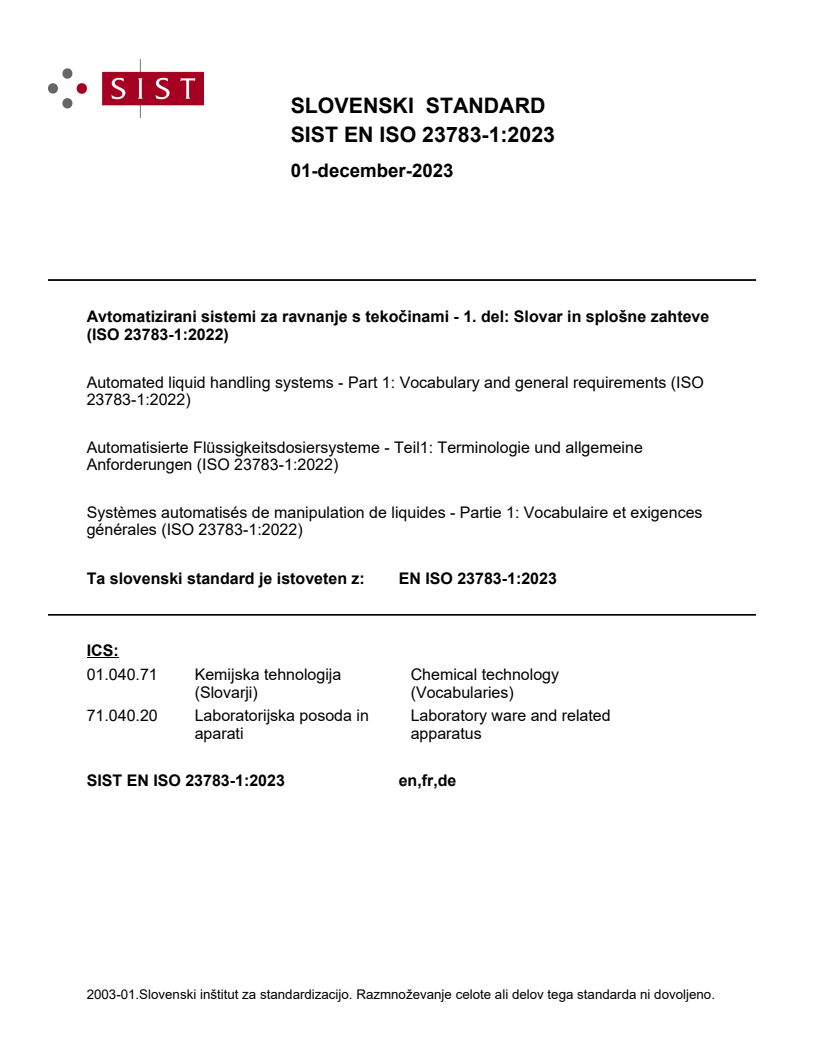
SLOVENSKI STANDARD
01-december-2023
Avtomatizirani sistemi za ravnanje s tekočinami - 1. del: Slovar in splošne zahteve
(ISO 23783-1:2022)
Automated liquid handling systems - Part 1: Vocabulary and general requirements (ISO
23783-1:2022)
Automatisierte Flüssigkeitsdosiersysteme - Teil1: Terminologie und allgemeine
Anforderungen (ISO 23783-1:2022)
Systèmes automatisés de manipulation de liquides - Partie 1: Vocabulaire et exigences
générales (ISO 23783-1:2022)
Ta slovenski standard je istoveten z: EN ISO 23783-1:2023
ICS:
01.040.71 Kemijska tehnologija Chemical technology
(Slovarji) (Vocabularies)
71.040.20 Laboratorijska posoda in Laboratory ware and related
aparati apparatus
2003-01.Slovenski inštitut za standardizacijo. Razmnoževanje celote ali delov tega standarda ni dovoljeno.
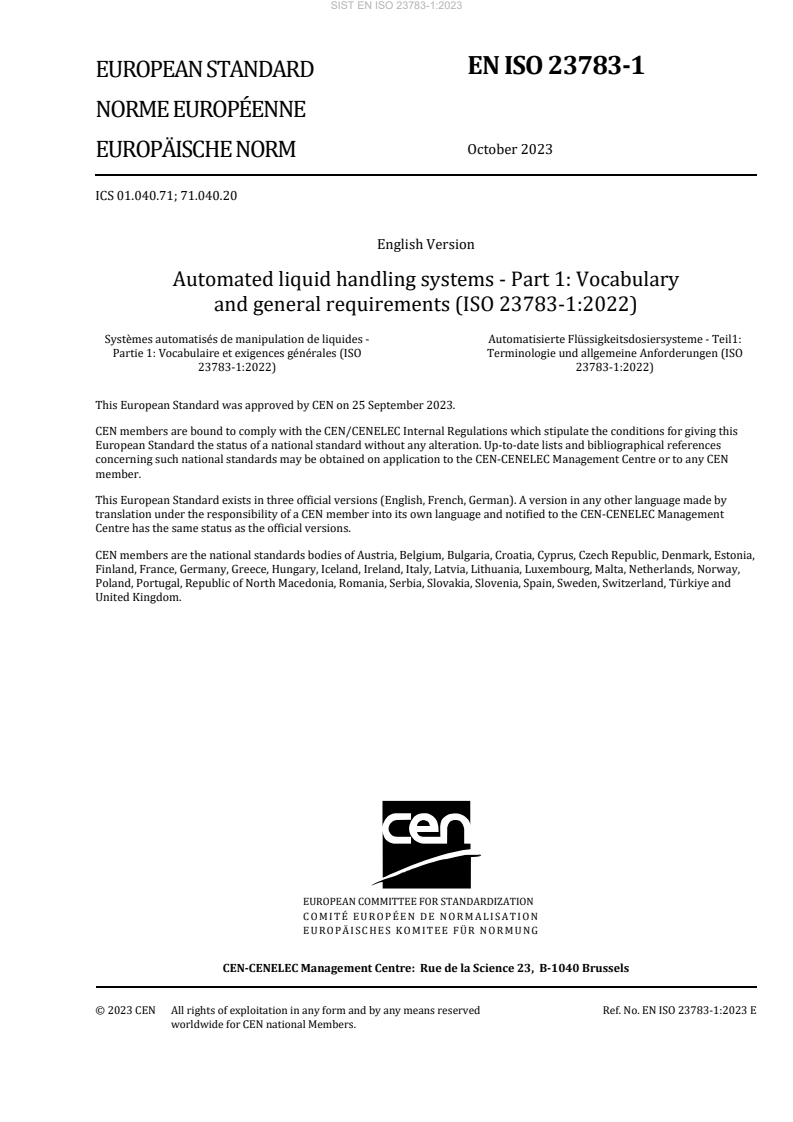
EN ISO 23783-1
EUROPEAN STANDARD
NORME EUROPÉENNE
October 2023
EUROPÄISCHE NORM
ICS 01.040.71; 71.040.20
English Version
Automated liquid handling systems - Part 1: Vocabulary
and general requirements (ISO 23783-1:2022)
Systèmes automatisés de manipulation de liquides - Automatisierte Flüssigkeitsdosiersysteme - Teil1:
Partie 1: Vocabulaire et exigences générales (ISO Terminologie und allgemeine Anforderungen (ISO
23783-1:2022) 23783-1:2022)
This European Standard was approved by CEN on 25 September 2023.
CEN members are bound to comply with the CEN/CENELEC Internal Regulations which stipulate the conditions for giving this
European Standard the status of a national standard without any alteration. Up-to-date lists and bibliographical references
concerning such national standards may be obtained on application to the CEN-CENELEC Management Centre or to any CEN
member.
This European Standard exists in three official versions (English, French, German). A version in any other language made by
translation under the responsibility of a CEN member into its own language and notified to the CEN-CENELEC Management
Centre has the same status as the official versions.
CEN members are the national standards bodies of Austria, Belgium, Bulgaria, Croatia, Cyprus, Czech Republic, Denmark, Estonia,
Finland, France, Germany, Greece, Hungary, Iceland, Ireland, Italy, Latvia, Lithuania, Luxembourg, Malta, Netherlands, Norway,
Poland, Portugal, Republic of North Macedonia, Romania, Serbia, Slovakia, Slovenia, Spain, Sweden, Switzerland, Türkiye and
United Kingdom.
EUROPEAN COMMITTEE FOR STANDARDIZATION
COMITÉ EUROPÉEN DE NORMALISATION
EUROPÄISCHES KOMITEE FÜR NORMUNG
CEN-CENELEC Management Centre: Rue de la Science 23, B-1040 Brussels
© 2023 CEN All rights of exploitation in any form and by any means reserved Ref. No. EN ISO 23783-1:2023 E
worldwide for CEN national Members.
Contents Page
European foreword . 3
European foreword
The text of ISO 23783-1:2022 has been prepared by Technical Committee ISO/TC 48 "Laboratory
equipment” of the International Organization for Standardization (ISO) and has been taken over as
which is held by DIN.
This European Standard shall be given the status of a national standard, either by publication of an
identical text or by endorsement, at the latest by April 2024, and conflicting national standards shall be
withdrawn at the latest by April 2024.
Attention is drawn to the possibility that some of the elements of this document may be the subject of
patent rights. CEN shall not be held responsible for identifying any or all such patent rights.
Any feedback and questions on this document should be directed to the users’ national standards body.
A complete listing of these bodies can be found on the CEN website.
According to the CEN-CENELEC Internal Regulations, the national standards organizations of the
following countries are bound to implement this European Standard: Austria, Belgium, Bulgaria,
Croatia, Cyprus, Czech Republic, Denmark, Estonia, Finland, France, Germany, Greece, Hungary, Iceland,
Ireland, Italy, Latvia, Lithuania, Luxembourg, Malta, Netherlands, Norway, Poland, Portugal, Republic of
North Macedonia, Romania, Serbia, Slovakia, Slovenia, Spain, Sweden, Switzerland, Türkiye and the
United Kingdom.
Endorsement notice
The text of ISO 23783-1:2022 has been approved by CEN as EN ISO 23783-1:2023 without any
modification.
INTERNATIONAL ISO
STANDARD 23783-1
First edition
2022-08
Automated liquid handling systems —
Part 1:
Vocabulary and general requirements
Systèmes automatisés de manipulation de liquides —
Partie 1: Vocabulaire et exigences générales
Reference number
ISO 23783-1:2022(E)
ISO 23783-1:2022(E)
© ISO 2022
All rights reserved. Unless otherwise specified, or required in the context of its implementation, no part of this publication may
be reproduced or utilized otherwise in any form or by any means, electronic or mechanical, including photocopying, or posting on
the internet or an intranet, without prior written permission. Permission can be requested from either ISO at the address below
or ISO’s member body in the country of the requester.
ISO copyright office
CP 401 • Ch. de Blandonnet 8
CH-1214 Vernier, Geneva
Phone: +41 22 749 01 11
Email: copyright@iso.org
Website: www.iso.org
Published in Switzerland
ii
ISO 23783-1:2022(E)
Contents Page
Foreword .iv
Introduction .v
1 Scope . 1
2 Normative references . 1
3 Terms and definitions . 1
4 Abbreviated terms . 9
5 Operation of automated liquid handling systems .10
5.1 Types of automated liquid handling systems . 10
5.1.1 General . 10
5.1.2 Piston-operated automated liquid handling systems . 10
5.1.3 Pump operated automated liquid handling systems . 11
5.1.4 Automated liquid handling systems using inkjet-type dispensing
technologies . 11
5.1.5 Automated liquid handling systems using acoustic droplet ejection
technology . 11
5.1.6 Pin tools .12
5.2 Types of pipette tips for ALHS .12
5.2.1 General .12
5.2.2 Air-displacement tips .12
5.2.3 Positive displacement tips .12
5.2.4 Fixed tips .13
5.3 Cleaning of re-usable components and confirmation of metrological characteristics .13
6 Testing and calibration of ALHS .13
6.1 Metrological confirmation .13
6.1.1 General .13
6.1.2 Calibration . . .13
6.1.3 Routine tests . 14
6.2 Channels to test . 14
6.3 Test volumes . 14
6.4 Test liquids . 14
6.5 Replicate measurements . 14
6.6 Test frequency . 14
6.7 Test methods . 15
6.8 Exchangeable components .15
6.8.1 Automatically exchangeable components . 15
6.8.2 Manually exchangeable components . 15
6.8.3 Other exchangeable components . 15
6.9 Firmware and software updates . 15
6.10 Environmental conditions . 16
6.10.1 General . 16
6.10.2 Factory acceptance testing. 16
6.10.3 Site acceptance testing . . 16
6.11 Adjustments . 17
6.11.1 General . 17
6.11.2 Liquid classes . 17
6.11.3 Adjustment of ALHS settings . . 17
6.12 Correction . 17
6.13 Reporting of results . 18
7 Specification of ALHS volumetric performance.18
7.1 Information to be supplied with the ALHS . 18
7.2 Optional information . 18
Bibliography .19
iii
ISO 23783-1:2022(E)
Foreword
ISO (the International Organization for Standardization) is a worldwide federation of national standards
bodies (ISO member bodies). The work of preparing International Standards is normally carried out
through ISO technical committees. Each member body interested in a subject for which a technical
committee has been established has the right to be represented on that committee. International
organizations, governmental and non-governmental, in liaison with ISO, also take part in the work.
ISO collaborates closely with the International Electrotechnical Commission (IEC) on all matters of
electrotechnical standardization.
The procedures used to develop this document and those intended for its further maintenance are
described in the ISO/IEC Directives, Part 1. In particular, the different approval criteria needed for the
different types of ISO documents should be noted. This document was drafted in accordance with the
editorial rules of the ISO/IEC Directives, Part 2 (see www.iso.org/directives).
Attention is drawn to the possibility that some of the elements of this document may be the subject of
patent rights. ISO shall not be held responsible for identifying any or all such patent rights. Details of
any patent rights identified during the development of the document will be in the Introduction and/or
on the ISO list of patent declarations received (see www.iso.org/patents).
Any trade name used in this document is information given for the convenience of users and does not
constitute an endorsement.
For an explanation of the voluntary nature of standards, the meaning of ISO specific terms and
expressions related to conformity assessment, as well as information about ISO's adherence to the
World Trade Organization (WTO) principles in the Technical Barriers to Trade (TBT), see www.iso.org/
iso/foreword.html.
This document was prepared by Technical Committee ISO/TC 48, Laboratory equipment.
This first edition of ISO 23783-1, together with ISO 23783-2 and ISO 23783-3, cancels and replaces
IWA 15:2015.
A list of all parts in the ISO 23783 series can be found on the ISO website.
Any feedback or questions on this document should be directed to the user’s national standards body. A
complete listing of these bodies can be found at www.iso.org/members.html.
iv
ISO 23783-1:2022(E)
Introduction
Globalization of laboratory operations requires standardized practices for operating automated
liquid handling systems (ALHS), communicating test protocols, as well as analysing and reporting
of performance parameters. IWA 15:2015 was developed to provide standardized terminology, test
protocols, and analytical methods for reporting test results. The concepts developed for, and described
in, IWA 15 form the foundation of the ISO 23783 series.
Specifically, this document addresses the needs of:
— users of ALHS, as a basis for calibration, verification, validation, optimization, and routine testing of
trueness and precision;
— manufacturers of ALHS, as a basis for quality control, communication of acceptance test specifications
and conditions, and issuance of manufacturer’s declarations (where appropriate);
— test houses and other bodies, as a basis for certification, calibration, and testing.
The tests established in this document should be carried out by trained personnel.
v
INTERNATIONAL STANDARD ISO 23783-1:2022(E)
Automated liquid handling systems —
Part 1:
Vocabulary and general requirements
1 Scope
This document defines terms relating to automated liquid handling systems (ALHS). This document
also specifies general requirements for the use of ALHS. It describes types of ALHS and specific
use requirements, settings, and adjustments for each ALHS type. It also specifies environmental
requirements for the use of ALHS.
This document is applicable to all ALHS with complete, installed liquid handling devices, including tips
and other essential parts needed for delivering a specified volume, which perform liquid handling tasks
without human intervention into labware.
NOTE Measurement procedures for the determination of volumetric performance are given in ISO 23783-2.
The determination, specification, and reporting of volumetric performance of automated liquid handling systems
are described in ISO 23783-3.
2 Normative references
The following documents are referred to in the text in such a way that some or all of their content
constitutes requirements of this document. For dated references, only the edition cited applies. For
undated references, the latest edition of the referenced document (including any amendments) applies.
ISO 23783-2, Automated liquid handling systems — Part 2: Measurement procedures for the determination
of volumetric performance
ISO 23783-3:2022, Automated liquid handling systems — Part 3: Determination, specification, and
reporting of volumetric performance
3 Terms and definitions
For the purposes of this document, the following terms and definitions apply.
ISO and IEC maintain terminology databases for use in standardization at the following addresses:
— ISO Online browsing platform: available at https:// www .iso .org/ obp
— IEC Electropedia: available at https:// www .electropedia .org/
3.1
accuracy
accuracy of liquid delivery
closeness of agreement between the delivered volume and the target volume
Note 1 to entry: The concept "accuracy" is not given a numerical value. A liquid delivery is said to be more
accurate when it is made with a smaller error.
Note 2 to entry: The term "accuracy" shall not be used for "trueness" and the term "precision" should not be used
for ‘accuracy,’ which, however, is related to both of these concepts.
Note 3 to entry: The relationship between accuracy, systematic error, and random error of an automated liquid
handling system is explained further in ISO 23783-3:2022, 5.1.
ISO 23783-1:2022(E)
[SOURCE: ISO/IEC Guide 99:2007, 2.13, modified — definition and Notes 1 and 2 were modified for the
context of automated liquid handling and Note 3 was replaced.]
3.2
air displacement
liquid handling principle in which a body of air is contained between the
piston and the test liquid
Note 1 to entry: It is possible to have a large air gap (piston systems), or a smaller air gap between the test liquid
and the system liquid (liquid filled systems).
3.3
air gap
captive air volume
dead air volume
air volume between the lower part of the piston and the surface of the
aspirated liquid
Note 1 to entry: It is possible to have a large air gap (piston systems), or a smaller air gap for liquid filled systems.
3.4
automated liquid handling system
ALHS
system with a complete, installed liquid handling device, including tips and other essential components
needed for delivering a specified volume without human intervention into labware
Note 1 to entry: Examples of automated liquid handling systems include automated pipetting systems (APS), and
automated dispensing systems (ADS).
3.5
calibration
operation that, under specified conditions, establishes a relation between the target volume of
the ALHS and the delivered volume
Note 1 to entry: A calibration may be expressed by a statement, a calibration curve or a calibration table. It may
include a correction, but correction or adjustment is not a required element of a calibration.
[SOURCE: ISO/IEC Guide 99:2007, 2.39, modified — definition was simplified and modified for the
context of automated liquid handling; Note 1 was simplified and Notes 2 and 3 were deleted.]
3.6
correction
mathematical compensation for a systematic effect
Note 1 to entry: The mathematical compensation can take different forms, such as an addend or a factor, or can
be deducted from a table.
[SOURCE: ISO/IEC Guide 99:2007, 2.53, modified – added mathematical to the definition and Note 2,
deleted estimated from the definition, and Note 1 was deleted.]
3.7
delivered volume
quantity delivered by a liquid handling system
Note 1 to entry: Delivered volume is a conceptual term and cannot be known with complete certainty due to
measurement error.
3.8
dispense height
initial distance at which the test liquid is dispensed relative to a stated reference
Note 1 to entry: Dispensing from an initial fixed distance relative to the liquid surface will decrease the dispense
height as the liquid level rises.
ISO 23783-1:2022(E)
Note 2 to entry: Dispensing from a fixed distance relative to the well bottom will not change the dispense height
over the course of the dispense.
Note 3 to entry: Dispensing and adjusting the distance relative to the liquid surface will not change the dispense
height over the course of the dispense. This is an operational mode possible with some ALHS liquid level detection
systems.
Note 4 to entry: Dispensing and adjusting the distance relative to the well bottom will increase the dispense
height over the course of the dispense. This is an operational mode possible with some ALHS liquid level detection
systems.
3.9
dispensing system
device for delivering liquids from a pre-filled liquid reservoir
3.10
disposable tip
component to transfer liquid, which is attached once and after use, as defined by the manufacturer,
detached and intended to be discarded
Note 1 to entry: Disposable tips are usually made of plastic.
Note 2 to entry: Disposable tips are in contrast to fixed tips (3.13).
3.11
dry contact dispensing
transferring of liquid while the tip is in contact with a dry surface
3.12
factory acceptance testing
internal testing at the site of ALHS production to ensure ALHS performance to manufacturer’s
specifications
3.13
fixed tip
component to transfer liquid, which remains attached to the dispense head after use and is cleaned
prior to its next use
Note 1 to entry: Fixed tips are in contrast to disposable tips (3.10).
3.14
forward mode pipetting
direct mode pipetting
process of liquid transfer where the entire aspirated volume is delivered
3.15
immersion depth
depth of the tip orifice below the liquid surface
Note 1 to entry: Immersion depth can be applied to both aspiration and dispensing (wet contact).
3.16
individually controlled channel
liquid handling channel that can be operated independently of other channels
3.17
inkjet type dispenser
dispensing system which uses technologies that deliver liquid volume as individual, free-flying droplets
or jets (e.g. inkjet technology)
Note 1 to entry: For example, multiple volume increments as small as a few picolitres can be added up to dispense
volumes of several microlitres.
ISO 23783-1:2022(E)
3.18
labware
materials used in conjunction with liquid handling operations
Note 1 to entry: Labware includes, but is not limited to, disposable tips, reservoirs, receiving vessels, adapters
and microplates.
3.19
liquid class
specific liquid or liquid type, which is defined by specific liquid characteristics that require specific
settings of the liquid handler to achieve a desired volume delivery
3.20
maximum permissible error
upper or lower permitted extreme value for the deviation of the dispensed volume from the target
volume
3.21
maximum specified volume
largest volume for which specifications are provided
3.22
measured volume
quantity reported by a volume measuring system
Note 1 to entry: In practice, all measurements contain some measurement error. The measured volume is a
quantity value and serves as an estimate of the delivered volume which is not known with complete certainty.
3.23
minimum specified volume
smallest volume for which specifications are provided
3.24
measurement method
measurement procedure
detailed description of a measurement according to one or more measurement principles
Note 1 to entry: Sometimes, a distinction is drawn between a "‘measurement method" and a "measurement
procedure". In this document, the terms are used interchangeably.
Note 2 to entry: The measurement method descriptions in this document detail the steps needed to make a
volume measurement and calculate certain descriptive statistics. Additional details needed to operate the ALHS
are part of the test process (3.51). In this document, the measurement method is one of the components of a test
process.
3.25
measurement uncertainty
non-negative parameter characterizing the statistical dispersion of the delivered
volumes
Note 1 to entry: The measurement uncertainty of the mean delivered volume and the measurement uncertainty
of a single delivered volume are two distinct applications of this concept.
Note 2 to entry: The measurement uncertainty of the mean delivered volume and the measurement uncertainty
of a single delivered volume include contributions from the random errors and uncorrected systematic errors of
the ALHS.
Note 3 to entry: The measurement uncertainty includes contributions from the measuring system uncertainty,
as well as the ALHS under test.
Note 4 to entry: These measurement uncertainties can be estimated according to ISO/IEC Guide 98-3.
ISO 23783-1:2022(E)
3.26
measuring system uncertainty
non-negative parameter characterizing the statistical dispersion of the volume results of the
measurement procedure, which does not include the uncertainty of the ALHS under test
Note 1 to entry: The measuring system uncertainty can be estimated according to ISO/IEC Guide 98-3.
3.27
metrological confirmation
set of operations required to ensure that the ALHS conforms to the requirements for its intended use
Note 1 to entry: Metrological confirmation generally includes calibration or verification, any necessary
adjustment or repair, and subsequent recalibration, comparison with the metrological requirements for the
intended use of the ALHS, as well as any required sealing and labelling.
Note 2 to entry: Metrological confirmation is not achieved until and unless the fitness of the ALHS for the
intended use has been demonstrated and documented.
Note 3 to entry: The requirements for intended use include such considerations as range, resolution and
maximum permissible errors.
Note 4 to entry: Metrological requirements are usually distinct from, and are not specified in, product
requirements.
[SOURCE: ISO 9000:2015, 3.5.6, modified — the terms ‘measurement equipment’ and ‘equipment’ were
replaced by ‘ALHS.’]
3.28
metrological traceability
traceability
property of a measurement result whereby the result can be related to a reference through a
documented unbroken chain of calibrations, each contributing to the measurement uncertainty
Note 1 to entry: Additional information can be found in the notes to definition (ISO/IEC Guide 99:2007, 2.41) and
the related term ‘metrological traceability chain’ (ISO/IEC Guide 99:2007, 2.42).
[SOURCE: ISO/IEC Guide 99:2007, 2.41, modified — Notes 1 to 4 were deleted and a new Note 1 to entry
was added.]
3.29
microplate
flat plate with an array of wells
[5–9]
Note 1 to entry: Some dimensions of microplates are defined in ANSI/SLAS standards .
3.30
multichannel head
group of liquid handling channels operated in common
Note 1 to entry: Common arrangements of multichannel heads include 8-, 96-, 384-, and 1 536-channel heads.
Other arrangements are possible, e.g. 2-channel to 1 536-channel configurations.
3.31
multi-dispense
repeat dispense
sequential dispense
collection of dispenses without intervening aspiration
Note 1 to entry: First dispense can be different and is frequently wasted.
Note 2 to entry: Repeat dispenses usually dispense repeatedly the same volume, while sequential dispenses
usually dispense different volumes.
ISO 23783-1:2022(E)
3.32
non-contact dispensing
contact-free dispensing
free-jet dispensing
dispensing of the liquid without contacting the target or the liquid contained in the target
3.33
outlier
member of a set of values which is inconsistent with the other members of that set
3.34
pipetting system
system for aspirating and dispensing a specified volume of liquid
3.35
positive displacement
direct displacement
liquid handling principle in which a piston is in direct contact with the liquid
3.36
precision
closeness of agreement between replicate delivered volumes under specified conditions
Note 1 to entry: Precision is conceptual and not a quantity value.
Note 2 to entry: Measurement precision is usually expressed numerically by measures of random error, such as
standard deviation, variance, or coefficient of variation under the specified conditions of measurement.
Note 3 to entry: The "specified conditions" can be, for example, repeatability conditions, intermediate precision,
or reproducibility conditions (see ISO 5725-1:1994).
Note 4 to entry: The relationship between accuracy, trueness, precision, systematic error, and random error of an
automated liquid handling system is explained further in ISO 23783-3:2022, 5.1.
3.37
random error
component of liquid handling error that in replicate liquid deliveries varies in an unpredictable
manner
Note 1 to entry: The relationship between accuracy, systematic error, and random error of an automated liquid
handling system is explained further in ISO 23783-3: 2022, 5.1.
[SOURCE: ISO/IEC Guide 99:2007, 2.19, modified — definition was modified for the context of automated
liquid handling; Note 1 was replaced and Notes 2 and 3 were deleted.]
3.38
repeatability
liquid delivery repeatability
precision of liquid deliveries under a set of repeatability conditions
Note 1 to entry: Repeatability refers to the variability among liquid deliveries made on the same automated
liquid handling system under nearly identical circumstances. It is recognized that, because of unknown or
uncontrollable factors which influence the liquid handling process, repeated measurements will usually not
agree. The extent of this variability can be expressed by a standard deviation, called the repeatability standard
deviation.
[SOURCE: ISO/IEC Guide 99:2007, 2.21, modified — definition was modified for the context of automated
liquid handling and Note 1 was added.]
ISO 23783-1:2022(E)
3.39
repeatability condition
repeatability condition of liquid delivery
condition of liquid delivery, out of a set of conditions that includes the same liquid delivery
procedure, same operators, same measuring system, same operating conditions and same location, and
replicate measurements on the same automated liquid handling system over a short period of time
[SOURCE: ISO/IEC Guide 99:2007, 2.20, modified — definition was modified for the context of automated
liquid handling and Notes 1 and 2 were deleted.]
3.40
reproducibility
precision of liquid deliveries under reproducibility conditions
Note 1 to entry: Reproducibility refers to the variability of replicate volume deliveries by identical ALHS under
differing conditions. It includes effects caused by differences among the ALHS and measurement instruments,
reagents, operators, laboratories, and environmental conditions. The variability of results under these conditions
may be described by a standard deviation, called the reproducibility standard deviation.
[SOURCE: ISO/IEC Guide 99:2007, 2.25, modified — definition was modified for the context of automated
liquid handling and Note 1 was replaced.]
3.41
reproducibility condition
reproducibility condition of liquid delivery
condition of liquid delivery that includes different locations, environmental conditions,
operators, or automated liquid handling systems
3.42
reservoir
liquid container
vessel that contains the liquid
3.43
reverse mode pipetting
pipetting mode where a volume larger than the target volume is aspirated into the tip and only the
target volume is delivered
3.44
single dispense
individual dispense
one liquid delivery per aspiration
3.45
site acceptance testing
in-situ testing at the location where the ALHS will be used, typically a part of the installation process
3.46
supplier’s declaration
document by which a supplier gives written assurance that an ALHS conforms to the
requirements of one or more commonly accepted industry standards
3.47
systematic error
component of liquid handling error that in replicate liquid deliveries remains constant or
varies in a predictable manner
Note 1 to entry: Systematic error is estimated by calculating the average volume of a series of deliveries and
comparing it to the target volume of the automated liquid handling system. Frequently, this result is expressed as
a percentage of the target volume.
ISO 23783-1:2022(E)
Note 2 to entry: Systematic liquid handling error, and its causes, can be known or unknown. A correction can be
applied to compensate for a known systematic error.
Note 3 to entry: Some ALHS can be adjusted to compensate for a known systematic error.
Note 4 to entry: The relationship between accuracy, systematic error, and random error of an automated liquid
handling system is explained further in ISO 23783-3: 2022, 5.1.
[SOURCE: ISO/IEC Guide 99:2007, 2.17, modified — definition was modified for the context of automated
liquid handling; Notes 1 and 3 were replaced and Note 4 was added.]
3.48
system liquid
liquid used to transmit energy between a mechanical actuator and the liquid to be transferred
Note 1 to entry: System liquids can reduce or completely eliminate system dead air volume.
Note 2 to entry: System liquid is usually deionized water. For special applications, organic solvents such as DMSO
or aqueous solutions such as saline (e.g. 0,9 % NaCl) can be used.
Note 3 to entry: System liquid can be used for flushing and rinsing tips to minimize cross contamination.
Note 4 to entry: System liquid can be used as a diluent in some applications (e.g. for diluting samples).
3.49
target volume
indicated volume
selected volume
volume which is intended to be delivered
3.50
test liquid
liquid used for the volume measurement
3.51
test process
detailed description of an ALHS testing procedure including system operation and
measurement method
Note 1 to entry: The test process includes all details needed to reproduce the test or interpret the results. The
measurement method (3.24) is only a part of the test process.
3.52
test report
document reporting the result of the testing
Note 1 to entry: Details regarding information to be contained in test reports are specified in ISO 23783-3: 2022,
Clause 6.
3.53
test result
value of a characteristic obtained by carrying out a specified test method
Note 1 to entry: Test result is a broader concept than measured volume. The test result can be a single measured
volume, a set of measured volumes, or descriptive statistics such as the mean or standard deviation of multiple
measurements.
[SOURCE: ISO 5725-1:1994, 3.2, modified — Note 1 was replaced.]
ISO 23783-1:2022(E)
3.54
trueness
closeness of agreement between the average volume delivered in a large series of deliveries
and the target volume
Note 1 to entry: Measurement trueness is not a quantity and thus cannot be expressed numerically, but measures
for closeness of agreement are given in ISO 5725-1.
Note 2 to entry: Trueness is inversely related to systematic error but is not related to random error.
Note 3 to entry: The term "accuracy" shall not be used for "trueness".
Note 4 to entry: The relationship between accuracy, precision, trueness, systematic error, and random error of an
automated liquid handling system is explained further in ISO 23783-3:2022, 5.1.
[SOURCE: ISO/IEC Guide 99:2007, 2.14, modified — definition was modified for the context of automated
liquid handling and Note 4 was added.]
3.55
verification
confirmation, through the provision of objective evidence, that volumetric performance
specifications have been fulfilled
Note 1 to entry: The term “verified” is used to designate the corresponding status.
3.56
volume increment
discreetly dispensed volumes which are usually added up to achieve larger delivered volumes
Note 1 to entry: Volume increments can be as small as 11 pl in the case of inkjet-type dispensers.
Note 2 to entry: If it is possible to dispense just one increment, the volume increment equals the lowest possible
dispense volume.
3.57
wet contact dispensing
dispensing of the test liquid while the tip is in contact with the liquid present in the target
4 Abbreviated terms
See Table 1 for abbreviations used throughout the ISO 23783 series.
Table 1 — Abbreviated terms used in the ISO 23783 series
Abbreviated term Explanation
AC Alternating current
ADS Automated dispensing system
ALHS Automated liquid handling system
APS Automated pipetting system
AU Absorbance unit
BCV Between class variant
BSA Bovine serum albumin
CAS Chemical abstracts service, a division of the American Chemical Society
C2C Channel-to-channel
CV Coefficient of variation
DI De-ionized
DMSO Dimethylsulfoxide
ISO 23783-1:2022(E)
Table 1 (continued)
Abbreviated term Explanation
DOF Depth of focus
DUT Device under test
GA Grand average
HVAC Heating, ventilation, and air conditioning
LED Light-emitting diode
MSU Measuring system uncertainty
MU Measurement uncertainty
MW Molecular weight
ND Neutral density
4-NP 4-Nitrophenol
OA Over all
POVA Piston-operated volumetric apparatus
r/min Revolutions per minute
rcf Relative centrifugal force (g-force)
RH Relative humidity [%]
RSE Relative systematic error
ROI Region of interest
SD Standard deviation
SI International System of Units
5 Operation of automated liquid handling systems
5.1 Types of automated liquid handling systems
5.1.1 General
Examples of some types of ALHS are provided in 5.1.2 to 5.1.6. This list is not intended to be a
comprehensive list as technologies continue to be developed.
Manipulation of the labware on the deck of the ALHS may be achieved automatically, semi-automatically,
or manually.
5.1.2 Piston-operated automated liquid handling systems
Piston-operated ALHS can operate as follows:
— variable volume; designed to aspirate and dispense selectable volumes within the specified useable
volume range of the dispense head and selected tips (for example, between 10 µl and 100 µl).
— a larger volume can be aspirated into the tips, followed by a series of subsequent dispenses of liquid
sub-deliveries.
The dispense head can be:
— permanently attached to the instrument; or
— exchangeable, e.g. to change the usable volume range or number of channels.
ISO 23783-1:2022(E)
The piston can:
— either have a body of air (air gap) contained between the piston and the surface of the liquid (air-
displacement); or
— be in direct contact with the surface of the liquid (positive or direct displacement); or
— be in contact with a system liquid (liquid-filled systems are a variation of air-displacement systems).
The system can have:
— a single tip; or
— multiple tips, operated by individual pistons; or
— multiple tips, operated by a single, common drive or moving plate with multiple pistons
simultaneously driven by a common drive.
The tip can be:
— permanently attached to the dispense channel of the ALHS; or
— disposable, and used for one or more aspirate and dispense sequences.
5.1.3 Pump operated automated liquid handling systems
Pump-operated ALHS can operate as follows:
— variable volume; designed to dispense selectable volumes within the specified usable volume range
of the dispense head.
The dispense head can be:
— permanently attached to the instrument; or
— exchangeable, e.g. to change the usable vol
...