

EN 13059:2002+A1:2008
(Main + Amendment)Safety of industrial trucks - Test methods for measuring vibration
- Abstract
This European Standard is a type test procedure for establishing the values of vibration emission
transmitted to the whole body of operators of industrial trucks under specified conditions. It is not
applicable to hand-arm vibration.
This standard is applicable to powered industrial trucks listed in ISO 5053:1987. The annex A is
applicable for "all-terrain" trucks. It also applies to other powered industrial trucks not covered by
ISO 5053:1987, e.g. variable-reach trucks and "low-lift" "order picking" trucks, etc.
NOTE The standard may however be useful also for existing trucks.
This standard is not applicable to non-stacking "low-lift" straddle carriers (as specified in 3.1.3.2.3 of
ISO 5053:1987) and stacking "high-lift" straddle carriers (as specified in 3.1.3.1.11 of ISO 5053:1987).
The test results, however, are not applicable to the determination of whole-body vibration exposure.
- Status
- Published
- Publication Date
- 22-Jul-2008
- Withdrawal Date
- 27-Dec-2009
- Technical Committee
- CEN/TC 150 - Industrial trucks - Safety
- Drafting Committee
- CEN/TC 150/WG 8 - Vibration
- Current Stage
- 9093 - Decision to confirm - Review Enquiry
- Start Date
- 17-Apr-2024
- Completion Date
- 21-Oct-2026
- Directive
- 2006/42/EC - Directive 2006/42/EC of the European Parliament and of the Council of 17 May 2006 on machinery, and amending Directive 95/16/EC (recast)OJ Ref: C, C 214 OJ Date: 08-Sep-2009
98/37/EC - MachineryOJ Ref: C, C 22 OJ Date: 28-Jan-2009


Overview
EN 13059:2002+A1:2008 (CEN) is a European type‑test standard that defines test methods for measuring vibration transmitted to the whole body of operators of industrial trucks. It gives a reproducible procedure for establishing vibration emission values for powered industrial trucks (see ISO 5053:1987 categories) and includes informative guidance for “all‑terrain” trucks (Annex A). The standard is a harmonized means to support compliance with the EU Machinery Directive (e.g., requirement to include vibration values in instruction books when whole‑body vibration > 0.5 m/s2).
Key topics and technical requirements
- Scope and applicability: Type tests for whole‑body vibration of powered industrial trucks; not applicable to hand‑arm vibration or to certain straddle carriers. Results are not for assessing daily operator exposure in the field.
- Quantities to measure: Whole‑body vibration metrics with defined frequency weighting and integration time principles.
- Instrumentation: Requirements for transducers and measurement equipment to ensure accuracy and reproducibility.
- Measurement direction & location: Defined axes and measurement points for seated and standing operators.
- Test setup: Specifications for test track surface and obstacles, truck condition (load, tyres, seats), operator posture, environmental parameters.
- Procedure validation: Test speeds, repeatability checks, coefficient of variation limits, and rules for reporting vibration values.
- Reporting & declaration: Mandatory items for test reports and declaration of vibration emission values; verification uncertainty guidance (referenced to EN 12096).
- Informative annexes: Guidance for all‑terrain trucks, reporting formats, measurement method development, and related references.
Practical applications and users
Who benefits from EN 13059:
- Manufacturers - to determine and declare vibration emission values for product datasheets and CE documentation.
- Test laboratories - to carry out comparable type tests and produce compliant test reports.
- Design & R&D teams - to compare effects of seats, tyres, suspension and to optimize operator comfort and safety.
- Procurement & fleet managers - to compare truck families by vibration emission values when selecting equipment.
- Safety/occupational health professionals - for understanding machine emission characteristics (note: this standard is not a substitute for workplace exposure assessment).
Practical value: enables consistent comparison of industrial trucks, supports compliance with EU directives, and helps reduce whole‑body vibration risks through design choices (seats, tyres, suspension).
Related standards
- EN 1032 (mobile machinery whole‑body vibration testing principles)
- EN 12096 (declaration and verification of vibration emission values)
- ISO 5053 (powered industrial truck terminology)
- ISO 2041 / ISO 5805 (vibration vocabularies)
Keywords: EN 13059, vibration measurement, industrial trucks, whole‑body vibration, CEN, type test, Machinery Directive.
Relations
- Effective Date
- 22-Dec-2008
- Effective Date
- 25-Aug-2026
- Effective Date
- 25-Aug-2026
- Effective Date
- 25-Aug-2026
- Refers
EN 12096:2026 - Mechanical vibration - Declaration and verification of vibration emission values - Effective Date
- 29-Jul-2026
- Effective Date
- 28-Jan-2026
- Effective Date
- 28-Jan-2026
- Effective Date
- 28-Jan-2026
- Effective Date
- 28-Jan-2026
- Refers
EN 12096:1997 - Mechanical vibration - Declaration and verification of vibration emission values - Effective Date
- 28-Jan-2026
- Effective Date
- 28-Jan-2026
- Effective Date
- 09-Feb-2026
- Effective Date
- 09-Feb-2026
- Effective Date
- 28-Jan-2026
- Effective Date
- 28-Jan-2026
Get Certified
Connect with accredited certification bodies for this standard

CIS Institut d.o.o.
Personal Protective Equipment (PPE) certification body. Notified Body NB-2890 for EU Regulation 2016/425 PPE.

Kiwa BDA Testing
Building and construction product certification.
Kmetijski inštitut Slovenije
Agricultural Institute of Slovenia. Soil testing, plant health, agricultural product analysis.
Sponsored listings
Frequently Asked Questions
EN 13059:2002+A1:2008 is a standard published by the European Committee for Standardization (CEN). Its full title is "Safety of industrial trucks - Test methods for measuring vibration". This standard covers: This European Standard is a type test procedure for establishing the values of vibration emission transmitted to the whole body of operators of industrial trucks under specified conditions. It is not applicable to hand-arm vibration. This standard is applicable to powered industrial trucks listed in ISO 5053:1987. The annex A is applicable for "all-terrain" trucks. It also applies to other powered industrial trucks not covered by ISO 5053:1987, e.g. variable-reach trucks and "low-lift" "order picking" trucks, etc. NOTE The standard may however be useful also for existing trucks. This standard is not applicable to non-stacking "low-lift" straddle carriers (as specified in 3.1.3.2.3 of ISO 5053:1987) and stacking "high-lift" straddle carriers (as specified in 3.1.3.1.11 of ISO 5053:1987). The test results, however, are not applicable to the determination of whole-body vibration exposure.
This European Standard is a type test procedure for establishing the values of vibration emission transmitted to the whole body of operators of industrial trucks under specified conditions. It is not applicable to hand-arm vibration. This standard is applicable to powered industrial trucks listed in ISO 5053:1987. The annex A is applicable for "all-terrain" trucks. It also applies to other powered industrial trucks not covered by ISO 5053:1987, e.g. variable-reach trucks and "low-lift" "order picking" trucks, etc. NOTE The standard may however be useful also for existing trucks. This standard is not applicable to non-stacking "low-lift" straddle carriers (as specified in 3.1.3.2.3 of ISO 5053:1987) and stacking "high-lift" straddle carriers (as specified in 3.1.3.1.11 of ISO 5053:1987). The test results, however, are not applicable to the determination of whole-body vibration exposure.
EN 13059:2002+A1:2008 is classified under the following ICS (International Classification for Standards) categories: 13.160 - Vibration and shock with respect to human beings; 53.060 - Industrial trucks. The ICS classification helps identify the subject area and facilitates finding related standards.
EN 13059:2002+A1:2008 has the following relationships with other standards: It is inter standard links to EN 13059:2002, ISO 5053:1987, ISO 5805:1997, ISO 2041:1990, EN 12096:2026, EN ISO 12100:2010, EN 13138-3:2003, EN 1032:1996, EN ISO 176:1999, EN 12096:1997, EN ISO 7027:1999, EN 60811-4-1:2004, EN 60811-607:2012, EN 1459-1:2017+A1:2020, EN 1555-1:2010. Understanding these relationships helps ensure you are using the most current and applicable version of the standard.
EN 13059:2002+A1:2008 is associated with the following European legislation: EU Directives/Regulations: 2006/42/EC, 98/37/EC; Standardization Mandates: M/396. When a standard is cited in the Official Journal of the European Union, products manufactured in conformity with it benefit from a presumption of conformity with the essential requirements of the corresponding EU directive or regulation.
EN 13059:2002+A1:2008 is available in PDF format for immediate download after purchase. The document can be added to your cart and obtained through the secure checkout process. Digital delivery ensures instant access to the complete standard document.
Standards Content (Sample)
2003-01.Slovenski inštitut za standardizacijo. Razmnoževanje celote ali delov tega standarda ni dovoljeno.Varnost vozil za talni transport - Preskusne metode za merjenje vibracijSicherheit von Flurförderzeuge - SchwingungsmessungSécurité des chariots de manutention - Méthodes d'essai pour mesurer les vibrationsSafety of industrial trucks - Test methods for measuring vibration53.060Industrijski tovornjakiIndustrial trucks13.160Vpliv vibracij in udarcev na ljudiVibration and shock with respect to human beingsICS:Ta slovenski standard je istoveten z:EN 13059:2002+A1:2008SIST EN 13059:2003+A1:2008en,fr01-december-2008SIST EN 13059:2003+A1:2008SLOVENSKI
STANDARD
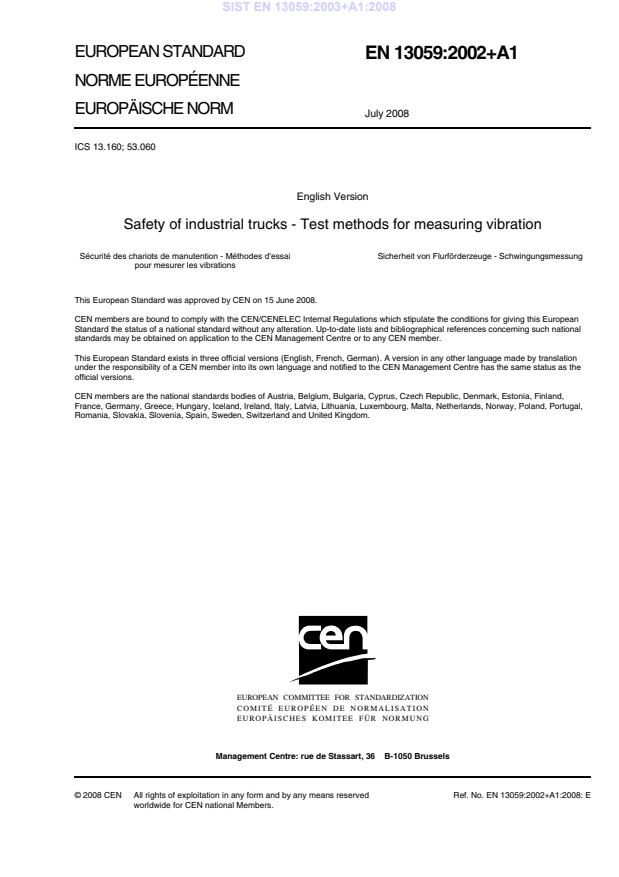
EUROPEAN STANDARDNORME EUROPÉENNEEUROPÄISCHE NORMEN 13059:2002+A1July 2008ICS 13.160; 53.060 English VersionSafety of industrial trucks - Test methods for measuring vibrationSécurité des chariots de manutention - Méthodes d'essaipour mesurer les vibrationsSicherheit von Flurförderzeuge - SchwingungsmessungThis European Standard was approved by CEN on 15 June 2008.CEN members are bound to comply with the CEN/CENELEC Internal Regulations which stipulate the conditions for giving this EuropeanStandard the status of a national standard without any alteration. Up-to-date lists and bibliographical references concerning such nationalstandards may be obtained on application to the CEN Management Centre or to any CEN member.This European Standard exists in three official versions (English, French, German). A version in any other language made by translationunder the responsibility of a CEN member into its own language and notified to the CEN Management Centre has the same status as theofficial versions.CEN members are the national standards bodies of Austria, Belgium, Bulgaria, Cyprus, Czech Republic, Denmark, Estonia, Finland,France, Germany, Greece, Hungary, Iceland, Ireland, Italy, Latvia, Lithuania, Luxembourg, Malta, Netherlands, Norway, Poland, Portugal,Romania, Slovakia, Slovenia, Spain, Sweden, Switzerland and United Kingdom.EUROPEAN COMMITTEE FOR STANDARDIZATIONCOMITÉ EUROPÉEN DE NORMALISATIONEUROPÄISCHES KOMITEE FÜR NORMUNGManagement Centre: rue de Stassart, 36
B-1050 Brussels© 2008 CENAll rights of exploitation in any form and by any means reservedworldwide for CEN national Members.Ref. No. EN 13059:2002+A1:2008: ESIST EN 13059:2003+A1:2008
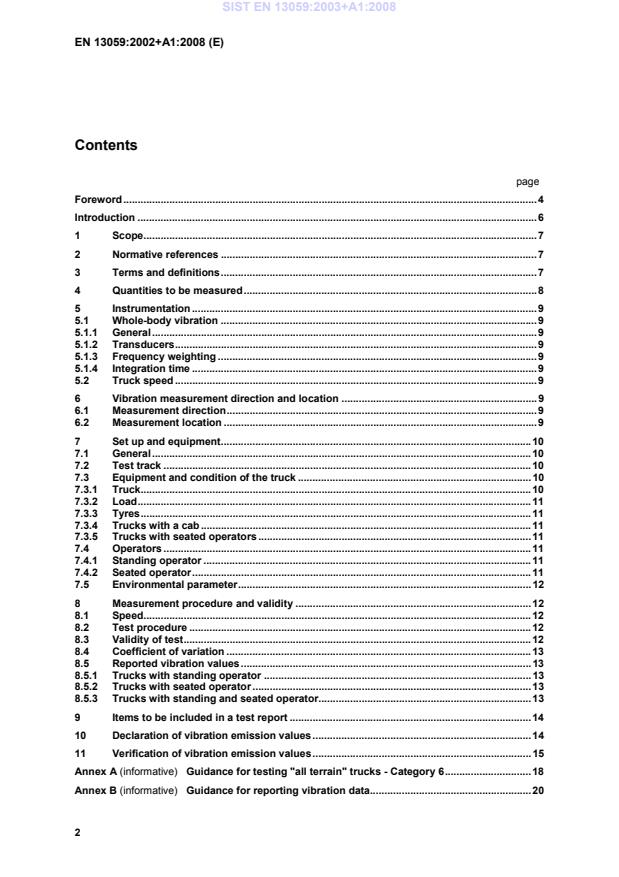
Guidance for testing "all terrain" trucks - Category 6.18 Annex B (informative)
Guidance for reporting vibration data.20 SIST EN 13059:2003+A1:2008
Procedure for developing a measurement method for a specific category of industrial truck.22 Annex D (informative)
Reference of ETRTO publication.23 Annex ZA (informative)
!Relationship between this European Standard and the Essential Requirements of EU Directive 98/37/EC".24 Annex ZB (informative)
!Relationship between this European Standard and the Essential Requirements of EU Directive 2006/42/EC".25 Bibliography.26
1 Under preparation, using the Vienna agreement with ISO lead. SIST EN 13059:2003+A1:2008
The aim of this standard is to provide a method for the measurement of vibration emission transmitted to the whole body of operators of industrial trucks which will enable the information requirements of the Machinery Directive to be satisfied. It is intended that the results obtained also can be used to compare industrial trucks of the same category or a given truck when equipped with different seats or tyres, etc. This standard cannot be used for field measurements to determine the daily exposure of the operator to vibration. For the measurements trucks shall be fitted with equipment corresponding to that offered by the manufacturers on the standard truck data sheet (lifting devices, batteries, etc.). Type test measurements require accurate and reproducible results. It is essential that different establishments obtain comparable results within specified limits. This requires that the process or way in which the machinery is used during the measurement is precisely defined. This process will reproduce the whole-body vibration values typical of the machinery when in normal travelling use. In the case of industrial trucks, there may be three predominant operating modes: travelling, lifting and engine idling; of these, only travelling exposes the driver to significant whole-body vibration. Therefore, in accordance with EN 1032, the test for whole-body vibration is based on the travelling operating mode. Research has shown that the magnitude of hand-arm vibration on the steering wheel or control levers of trucks will normally be lower than 2,5 m/s2. Therefore no test method has been developed for its measurement. In practice, exposure over a working day is a mixture of the three modes and the average vibration values will generally be lower than the values given by this standard. Fitting the industrial trucks with different seats, changing the tyres, etc. can lead to different vibration values. Due to the specific operation of industrial trucks however, the existing EN 1032 standard cannot be applied directly, so that preparation of this standard for industrial trucks became necessary. Although studies showed that it is possible to obtain repeatable and representative results with all-terrain trucks tested on an artificial test track, this family of trucks is covered by Informative annex A. The reason is that an inexplicable difference of about 20 % was found in the emission from one truck when it was tested at two different times of the year. Further consideration should be given to including all-terrain trucks in the normative section of the standard when more data is available for these trucks. For the verification of the measurements the uncertainty is fixed at 0,3 times the vibration emission value reported in accordance with EN 12096. Further consideration should be given to revise this range of uncertainty when emission vibration data obtained from different places is available.
NOTE The standard may however be useful also for existing trucks. This standard is not applicable to non-stacking "low-lift" straddle carriers (as specified in 3.1.3.2.3 of ISO 5053:1987) and stacking "high-lift" straddle carriers (as specified in 3.1.3.1.11 of ISO 5053:1987). The test results, however, are not applicable to the determination of whole-body vibration exposure. 2 Normative references This European Standard incorporates by dated or undated reference, provisions from other publications. These normative references are cited at the appropriate places in the text, and the publications are listed hereafter. For dated references, subsequent amendments to or revisions of any of these publications apply to this European Standard only when incorporated in it by amendment or revision. For undated references the latest edition of the publication referred to applies (including amendments). EN 292-1, Safety of machinery – Basic concepts, general principles for design - Part 1: Basic terminology, methodology.
EN 292-2, Safety of machinery – Basic concepts, general principles for design - Part 2:Technical principals and specifications.
EN 1032:1996, Mechanical vibration — Testing of mobile machinery in order to determine the whole-body vibration emission value — General. EN 1070, Safety of machinery – Terminology. EN 12096, Mechanical vibration — Declaration and verification of vibration emission values. ISO 2041, Vibration and shock — Vocabulary. ISO 5053:1987, Powered industrial trucks — Terminology. ISO 5805, Mechanical vibration and shock — Human exposure — Vocabulary. 3 Terms and definitions For the purposes of this European Standard, the terms and definitions given in EN 1070, ISO 2041, ISO 5053 and ISO 5805, and the following apply. 3.1 truck family
trucks sharing the same major components that influence vibration emission SIST EN 13059:2003+A1:2008
...