

EN 17558:2023
(Main)Ergonomics - Ergonomics of PPE ensembles
General Information
- Abstract
This document contains test methods for comparing the performance of different ensembles as part of any PPE selection process.
This document does not replace the product standards for the certification of individual items of PPE. It specifies the testing of individual items of PPE as an ensemble, so that the interactions between the individual items of PPE can be evaluated and any adverse interactions between the individual items of PPE, the user and the environment can be identified.
It specifies requirements for testing by either assessing the performance of a PPE ensemble against a benchmark condition (i.e. benchmark testing) or assessing the performance of two or more PPE ensembles against each other (i.e. comparative testing).
This document incorporates examples of laboratory and field tests. It can also be used to assess the performance regarding the ergonomics of an ensemble that incorporates an item of PPE that has never before been incorporated into an ensemble, and the listed methods can be combined into dedicated test batteries for evaluating that ensemble.
- Status
- Published
- Publication Date
- 27-Jun-2023
- Technical Committee
- CEN/TC 122 - Ergonomics
- Current Stage
- 6060 - Definitive text made available (DAV) - Publishing
- Start Date
- 28-Jun-2023
- Due Date
- 27-Jun-2022
- Completion Date
- 28-Jun-2023

Overview
EN 17558:2023 (CEN) - "Ergonomics - Ergonomics of PPE ensembles" defines standardized test methods to evaluate the ergonomic performance of complete personal protective equipment (PPE) ensembles. It is intended for use in PPE selection and evaluation processes and focuses on testing interactions between individual PPE items, the wearer and the environment. This standard complements - but does not replace - product standards for individual PPE certification.
Key topics and requirements
- Scope and purpose
- Compares whole PPE ensembles rather than single items to identify adverse interactions and ergonomic impacts.
- Supports both benchmark testing (against a minimal-clothing reference condition) and comparative testing (ensemble vs ensemble).
- Test methods
- Includes laboratory and field test examples; methods can be combined into bespoke test batteries for specific ensembles.
- Tests use human test persons (selection criteria, withdrawal rules) and recommend balanced repeated-measures designs and statistical analysis (see Annex A).
- Functional performance areas
- Mobility - restriction of movement and task performance.
- Vision - normal and total field of view.
- Manual dexterity - ability to perform fine manipulations while wearing ensemble.
- Hearing ability - speech and auditory perception with hearing PPE/ESE.
- Thermal impact - physiological and comfort effects of thermal strain.
- Overall preference - subjective comparative ratings in usability testing.
- Practical performance tests
- Simulated or real work tasks under expected use conditions (lighting, noise, temperature).
- Reporting and expertise
- Test reports must document ensemble composition and results (Clause 10).
- Ergonomic interpretation by trained ergonomists or qualified safety professionals is recommended.
- Annexes
- Provide experimental design, test preparations, movement/vision/manual dexterity/hearing/thermal protocols, use of manikins or virtual models, and example test batteries.
Applications and who uses it
- Manufacturers - design and validate PPE ensembles, identify adverse interactions between components (including smart PPE/ESE).
- Procurement and purchasing teams - compare ensembles for purchase decisions and tender specifications.
- Employers and safety managers - select ergonomic PPE to improve worker compliance and reduce performance hindrance, and demonstrate due diligence under legislation (e.g., EU Regulation 2016/425).
- Test laboratories and ergonomists - implement standardized protocols for ensemble testing and reporting.
- Emergency services and industrial users - evaluate ensembles for police, firefighters, rescue teams, and specialized industrial teams.
Related standards
- EN 13921 (principles of PPE ergonomics)
- Normative references cited in EN 17558: EN 352 (hearing protectors), EN ISO 7731, EN ISO 9886, EN ISO 9921, EN ISO 11904-1, EN ISO 12894, EN 13819-2
EN 17558:2023 is a practical, modular standard enabling consistent ergonomics evaluation of PPE ensembles to support safer, more usable protective systems.
Relations
- Effective Date
- 28-Jan-2026
- Effective Date
- 28-Jan-2026
- Effective Date
- 28-Jan-2026
- Effective Date
- 28-Jan-2026
- Effective Date
- 28-Jan-2026
- Effective Date
- 28-Jan-2026
- Effective Date
- 28-Jan-2026
- Effective Date
- 28-Jan-2026
- Effective Date
- 28-Jan-2026
- Effective Date
- 28-Jan-2026
- Effective Date
- 28-Jan-2026
- Effective Date
- 28-Jan-2026
- Effective Date
- 28-Jan-2026
- Effective Date
- 28-Jan-2026
- Effective Date
- 28-Jan-2026
Get Certified
Connect with accredited certification bodies for this standard

CIS Institut d.o.o.
Personal Protective Equipment (PPE) certification body. Notified Body NB-2890 for EU Regulation 2016/425 PPE.

Kiwa BDA Testing
Building and construction product certification.
Kmetijski inštitut Slovenije
Agricultural Institute of Slovenia. Soil testing, plant health, agricultural product analysis.
Sponsored listings
Frequently Asked Questions
EN 17558:2023 is a standard published by the European Committee for Standardization (CEN). Its full title is "Ergonomics - Ergonomics of PPE ensembles". This standard covers: This document contains test methods for comparing the performance of different ensembles as part of any PPE selection process. This document does not replace the product standards for the certification of individual items of PPE. It specifies the testing of individual items of PPE as an ensemble, so that the interactions between the individual items of PPE can be evaluated and any adverse interactions between the individual items of PPE, the user and the environment can be identified. It specifies requirements for testing by either assessing the performance of a PPE ensemble against a benchmark condition (i.e. benchmark testing) or assessing the performance of two or more PPE ensembles against each other (i.e. comparative testing). This document incorporates examples of laboratory and field tests. It can also be used to assess the performance regarding the ergonomics of an ensemble that incorporates an item of PPE that has never before been incorporated into an ensemble, and the listed methods can be combined into dedicated test batteries for evaluating that ensemble.
This document contains test methods for comparing the performance of different ensembles as part of any PPE selection process. This document does not replace the product standards for the certification of individual items of PPE. It specifies the testing of individual items of PPE as an ensemble, so that the interactions between the individual items of PPE can be evaluated and any adverse interactions between the individual items of PPE, the user and the environment can be identified. It specifies requirements for testing by either assessing the performance of a PPE ensemble against a benchmark condition (i.e. benchmark testing) or assessing the performance of two or more PPE ensembles against each other (i.e. comparative testing). This document incorporates examples of laboratory and field tests. It can also be used to assess the performance regarding the ergonomics of an ensemble that incorporates an item of PPE that has never before been incorporated into an ensemble, and the listed methods can be combined into dedicated test batteries for evaluating that ensemble.
EN 17558:2023 is classified under the following ICS (International Classification for Standards) categories: 13.180 - Ergonomics; 13.340.01 - Protective equipment in general. The ICS classification helps identify the subject area and facilitates finding related standards.
EN 17558:2023 has the following relationships with other standards: It is inter standard links to EN 352-2:2020+A1:2024, EN 13819-2:2020, EN 352-4:2020, EN 458:2025, EN ISO 7731:2008, EN 352-7:2020, EN 352-6:2020+A1:2024, EN 352-10:2020+A1:2024, EN 352-1:2020, EN ISO 9921:2003, EN 352-9:2020+A1:2024, EN ISO 12894:2001, EN 352-8:2020+A1:2024, EN ISO 9886:2004, EN 352-3:2020. Understanding these relationships helps ensure you are using the most current and applicable version of the standard.
EN 17558:2023 is available in PDF format for immediate download after purchase. The document can be added to your cart and obtained through the secure checkout process. Digital delivery ensures instant access to the complete standard document.
Standards Content (Sample)
SLOVENSKI STANDARD
01-januar-2024
Ergonomija - Ergonomija kompletov osebne varovalne opreme (OVO)
Ergonomics - Ergonomics of PPE ensembles
Ergonomie - Ergonomie von PSA-Ensembles
Ergonomie - Ergonomie des ensembles d’EPI
Ta slovenski standard je istoveten z: EN 17558:2023
ICS:
13.180 Ergonomija Ergonomics
13.340.01 Varovalna oprema na Protective equipment in
splošno general
2003-01.Slovenski inštitut za standardizacijo. Razmnoževanje celote ali delov tega standarda ni dovoljeno.
EN 17558
EUROPEAN STANDARD
NORME EUROPÉENNE
June 2023
EUROPÄISCHE NORM
ICS 13.180; 13.340.01
English Version
Ergonomics - Ergonomics of PPE ensembles
Ergonomie - Ergonomie des ensembles d'EPI Ergonomie - Ergonomie von PSA-Ensembles
This European Standard was approved by CEN on 21 May 2023.
CEN members are bound to comply with the CEN/CENELEC Internal Regulations which stipulate the conditions for giving this
European Standard the status of a national standard without any alteration. Up-to-date lists and bibliographical references
concerning such national standards may be obtained on application to the CEN-CENELEC Management Centre or to any CEN
member.
This European Standard exists in three official versions (English, French, German). A version in any other language made by
translation under the responsibility of a CEN member into its own language and notified to the CEN-CENELEC Management
Centre has the same status as the official versions.
CEN members are the national standards bodies of Austria, Belgium, Bulgaria, Croatia, Cyprus, Czech Republic, Denmark, Estonia,
Finland, France, Germany, Greece, Hungary, Iceland, Ireland, Italy, Latvia, Lithuania, Luxembourg, Malta, Netherlands, Norway,
Poland, Portugal, Republic of North Macedonia, Romania, Serbia, Slovakia, Slovenia, Spain, Sweden, Switzerland, Türkiye and
United Kingdom.
EUROPEAN COMMITTEE FOR STANDARDIZATION
COMITÉ EUROPÉEN DE NORMALISATION
EUROPÄISCHES KOMITEE FÜR NORMUNG
CEN-CENELEC Management Centre: Rue de la Science 23, B-1040 Brussels
© 2023 CEN All rights of exploitation in any form and by any means reserved Ref. No. EN 17558:2023 E
worldwide for CEN national Members.
Contents Page
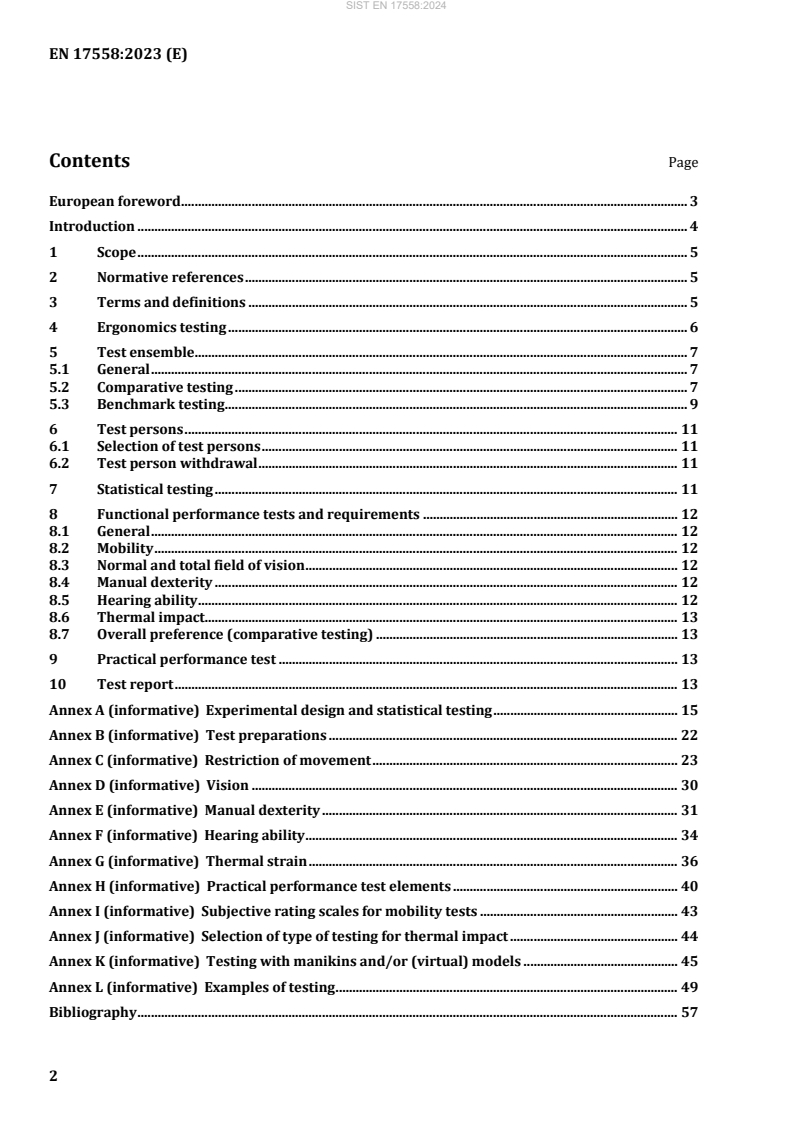
European foreword . 3
Introduction . 4
1 Scope . 5
2 Normative references . 5
3 Terms and definitions . 5
4 Ergonomics testing . 6
5 Test ensemble . 7
5.1 General . 7
5.2 Comparative testing . 7
5.3 Benchmark testing . 9
6 Test persons . 11
6.1 Selection of test persons . 11
6.2 Test person withdrawal . 11
7 Statistical testing . 11
8 Functional performance tests and requirements . 12
8.1 General . 12
8.2 Mobility . 12
8.3 Normal and total field of vision . 12
8.4 Manual dexterity . 12
8.5 Hearing ability . 12
8.6 Thermal impact. 13
8.7 Overall preference (comparative testing) . 13
9 Practical performance test . 13
10 Test report . 13
Annex A (informative) Experimental design and statistical testing . 15
Annex B (informative) Test preparations . 22
Annex C (informative) Restriction of movement . 23
Annex D (informative) Vision . 30
Annex E (informative) Manual dexterity . 31
Annex F (informative) Hearing ability . 34
Annex G (informative) Thermal strain . 36
Annex H (informative) Practical performance test elements . 40
Annex I (informative) Subjective rating scales for mobility tests . 43
Annex J (informative) Selection of type of testing for thermal impact . 44
Annex K (informative) Testing with manikins and/or (virtual) models . 45
Annex L (informative) Examples of testing . 49
Bibliography . 57
European foreword
This document (EN 17558:2023) has been prepared by Technical Committee CEN/TC 122 “Ergonomics”,
the secretariat of which is held by DIN.
This European Standard shall be given the status of a national standard, either by publication of an
identical text or by endorsement, at the latest by December 2023, and conflicting national standards shall
be withdrawn at the latest by December 2023.
Attention is drawn to the possibility that some of the elements of this document may be the subject of
patent rights. CEN shall not be held responsible for identifying any or all such patent rights.
Any feedback and questions on this document should be directed to the users’ national standards body.
A complete listing of these bodies can be found on the CEN website.
According to the CEN-CENELEC Internal Regulations, the national standards organisations of the
following countries are bound to implement this European Standard: Austria, Belgium, Bulgaria, Croatia,
Cyprus, Czech Republic, Denmark, Estonia, Finland, France, Germany, Greece, Hungary, Iceland, Ireland,
Italy, Latvia, Lithuania, Luxembourg, Malta, Netherlands, Norway, Poland, Portugal, Republic of North
Macedonia, Romania, Serbia, Slovakia, Slovenia, Spain, Sweden, Switzerland, Türkiye and the United
Kingdom.
Introduction
It has long been recognized that personal protective equipment (PPE) can have unwanted side-effects on
the wearer in terms of imposing additional physical workload, hindering movement, impairing sensory
perception or in some cases causing considerable discomfort. Such side effects can reduce the efficiency
of task performance and/or encourage the user not to wear the PPE or use the PPE incorrectly thereby
impairing the level of protection afforded. This problem has been recognized in legislation. The
Regulation (EU) 2016/425 of the European Parliament and of the Council of 9 March 2016 on personal
protective equipment [18] places duties on PPE manufacturers to take account of ergonomic
requirements and assists employers in demonstrating compliance with national legislation, whilst the
associated EC Directive on the use by workers of personal protective equipment at the workplace
(89/656/EEC) [19] places similar duties on employers providing PPE for use. These latter requirements
have been transposed into national legislation in all Member States.
This document can be used to compare the performance of different ensembles as part of any PPE
selection process, thereby again assisting employers in evaluating PPE Ensembles in standardized
conditions.
To facilitate compliance with legislation, European technical product standards for individual items of
PPE are gradually introducing tests for ergonomic characteristics. However, these standards are mainly
for testing individual products and seldom include the assessment of interactions with other items of PPE
except in isolated cases (e.g. helmet-mounted ear-muffs conforming to EN 352-3) where they are an
essential element of their use. An exception as an example is ISO/TS 11999-2, which details a series of
tests aimed at evaluating the compatibility of the different components of the PPE ensembles used by
firefighters.
Some PPE items or ensembles incorporate Electronic Safety Equipment forming a smart system designed
to enhance the protection provided. Such systems are included if they form a discrete wearable item or
their integration is considered to possibly have an influence on the ergonomic impact of the ensemble on
the wearer. For example, interconnections or integrated elements might have an adverse effect on the
mobility of a wearer.
This document has therefore been prepared to enable PPE ensembles, such as those worn by police,
firefighters and other emergency services, as well as some industrial users; to be evaluated and
objectively assessed for ergonomic performance as complete ensembles, rather than in their component
parts. As such it will provide a valuable tool to aid manufacturers and purchasers of PPE to make informed
decisions in selecting and designing those ensembles and creating awareness of interaction issues
between PPE items. Test and evaluation of PPE ensembles and systems (efficiency and ergonomics)
should be carried out by those who create the ensemble. The wide range of methods described in the
annexes may be used as specific test packages or handpicked and combined into dedicated test batteries
to match the intended purpose of a particular PPE ensemble.
Some of the tests can also be suitable for adoption as part of product standards for individual items of
PPE or they can refer to this document, although that is not their main purpose.
The principles relating to the ergonomics of PPE are presented in EN 13921. This document builds on
those principles and provides appropriate tests to verify that an ensemble meets those principles.
1 Scope
This document contains test methods for comparing the performance of different ensembles as part of
any PPE selection process.
This document does not replace the product standards for the certification of individual items of PPE. It
specifies the testing of individual items of PPE as an ensemble, so that the interactions between the
individual items of PPE can be evaluated and any adverse interactions between the individual items of
PPE, the user and the environment can be identified.
It specifies requirements for testing by either assessing the performance of a PPE ensemble against a
benchmark condition (i.e. benchmark testing) or assessing the performance of two or more PPE
ensembles against each other (i.e. comparative testing).
This document incorporates examples of laboratory and field tests. It can also be used to assess the
performance regarding the ergonomics of an ensemble that incorporates an item of PPE that has never
before been incorporated into an ensemble, and the listed methods can be combined into dedicated test
batteries for evaluating that ensemble.
2 Normative references
The following documents are referred to in the text in such a way that some or all of their content
constitutes requirements of this document. For dated references, only the edition cited applies. For
undated references, the latest edition of the referenced document (including any amendments) applies.
EN 352 (all parts), Hearing protectors
EN 458, Hearing protectors - Recommendations for selection, use, care and maintenance - Guidance
document
EN 13819-2, Hearing protectors - Testing - Part 2: Acoustic test methods
EN ISO 7731, Ergonomics - Danger signals for public and work areas - Auditory danger signals (ISO 7731)
EN ISO 9886, Ergonomics - Evaluation of thermal strain by physiological measurements (ISO 9886)
EN ISO 9921, Ergonomics - Assessment of speech communication (ISO 9921)
EN ISO 11904-1, Acoustics - Determination of sound immission from sound sources placed close to the ear -
Part 1: Technique using a microphone in a real ear (MIRE technique) (ISO 11904-1)
EN ISO 12894, Ergonomics of the thermal environment - Medical supervision of individuals exposed to
extreme hot or cold environments (ISO 12894)
3 Terms and definitions
For the purposes of this document, the following terms and definitions apply.
ISO and IEC maintain terminology databases for use in standardization at the following addresses:
— IEC Electropedia: available at https://www.electropedia.org/
— ISO Online browsing platform: available at https://www.iso.org/obp
3.1
benchmark condition
condition at which a test person is wearing non-restrictive, minimal, light clothing such as shorts and a
cotton t-shirt and light, flexible footwear such as trainers or plimsolls
Note 1 to entry: Benchmark testing for thermal impact in accordance with Annex G might require the use of an
alternative benchmark condition.
3.2
benchmark testing
testing for assessing the performance of an ensemble against the benchmark condition
3.3
comparative testing
testing for assessing the performance of two or more ensembles against each other
3.4
electronic safety equipment
ESE
products that contain electronics embedded in or associated with the product for use by wearers that
provides enhanced safety functions for wearers during operations in a use environment
3.5
functional performance test
procedure testing specified functionalities with wearers of PPE ensembles under specified conditions
3.6
PPE ensemble
collection of items of personal protective equipment worn by an individual
3.7
practical performance test
test procedure with wearers of PPE ensembles under simulated or real work tasks and if relevant then
also under expected use conditions
3.8
use conditions
conditions under which different items of PPE normally are used by the wearer
3.9
smart PPE
PPE that uses ESE (electronic safety equipment) or material solutions that interact actively, by
responding or adapting to environmental changes or react according to external signal input
4 Ergonomics testing
Ergonomics of PPE can be tested by use of either test persons, use of manikins and/or use of (computer)
models. This document is dealing only with testing of the ergonomics of PPE with test persons.
NOTE The General Data Protection Regulation, Directive 95/46/EC and ethical aspects of human testing and
the Helsinki Declaration are applicable to any tests with test persons.
Information about alternative testing, e.g. with a manikin and/or (virtual) models, is available in Annex K.
A representative sample of target users shall be selected for relevant ergonomics evaluation (see Annex A
for details). A balanced repeated measurement design shall be used for both the benchmark and
comparative testing of ensembles to ensure that the order of experimentation does not influence the test
results (Annex A).
Depending on the required level of complexity the tasks may consist of individual postures. Ergonomic
analysis of tasks under use conditions is recommended before selecting specific tests in order to
guarantee that all major potential constraints are covered. Testing may be done in either controlled
laboratory conditions or field settings resembling expected use conditions, e.g. environmental
parameters, such as heat, cold, poor lighting, noise, etc.
It is strongly recommended that a person who has been trained in ergonomics, e.g. health and safety
expert, ergonomist, work hygienist, should interpret the test results. It is often a person who has been
certified for that qualification, but may also be a person who has a long (documented) experience in the
field of ergonomics, e.g. publications, documented earlier evaluations, etc.
5 Test ensemble
5.1 General
All the items of a test ensemble shall be worn by the test person during testing in accordance with the
instructions of the manufacturer. A complete description of a test ensemble shall be recorded in a test
report conforming to Clause 10.
Although items of clothing being worn with the ensemble might not be classified as PPE, they may
influence ensemble performance. For example, clothing worn beneath protective clothing may influence
heat exchange and consequently thermal comfort or safety. Similarly, tight fitting or bulky garments may
influence mobility. Any description of a test ensemble shall therefore include all clothing layers, footwear,
hand wear and headwear (including helmets, hearing protection, communications systems and
respiratory protection) including the non-PPE items.
All testing shall either be conducted:
a) to compare two or more PPE ensembles (with comparable protective functions), i.e. comparative
testing in accordance with 5.2; or
b) in an absolute comparison against an unrestricted benchmark condition, i.e. benchmark testing in
accordance with 5.3.
5.2 Comparative testing
Where some items of an ensemble are being replaced, and undergoing assessment by comparative
testing, other components of the existing ensemble need not be new. The status (new or used) of all items
forming the ensemble shall be documented in the test report conforming to Clause 10.
Where all the items of an ensemble are undergoing assessment by comparative testing, each ensemble
shall be subjected to the relevant tests specified in Clause 8.
Where only a selection of items of an ensemble is being tested, each ensemble shall be subjected to testing
specified in Clause 8, however, if it may be reasonably assumed that the items of PPE undergoing testing
have no influence on a particular test parameter specified in Clause 8, then it is not necessary to conduct
the test for that parameter. Table 1 shows which tests from Clause 8 shall be conducted for a particular
item undergoing assessment.
Table 1 — Parameters from Clause 8 recommended to be assessed for a particular item of PPE undergoing assessment
Item of PPE being Parameters from Clause 8 recommended to be assessed
assessed (part of body
Shoulder/ arm Trunk Hip/knee Clarity Normal Total Manual Hearing Thermal
protected)
mobility 8.2 flexion flexion 8.2 within field field of range of
dexterity 8.5 impact 8.6
8.2 of vision 8.3 vision 8.3 vision 8.3 8.4
Head protection x x x x x x x
Eye protection x x x x x
Respiratory protection x x x x x x x
b
Hearing protection x x x
Clothing x x x x x x x x x
Gloves x x x x
Footwear x x
Fall protection x x x x
Auxiliary heating or x x x x x x
cooling device
a
Smart PPE x x x x x x x x x
NOTE x indicates which parameters from Clause 8 should be assessed for a particular item undergoing assessment.
a
Smart PPE, for example ESE, may be very different and cover various body areas including intra- and intersystem communication means, thus, the assessment parameters
depend on the specific application and need to be chosen individually (see CEN ISO/TR 23383 for reference).
b
Hearing protection may interact with other items (e.g. bulky collar of lifejacket, or a hood) to restrict head movement and therefore total range of vision.
5.3 Benchmark testing
Where all the items of an ensemble are undergoing assessment by benchmark testing, all the items of the
ensemble shall be new and each ensemble shall be subjected to the relevant tests specified in Clause 8.
NOTE For possible pre-treatment options see Annex B.
Where only a selection of the items of an ensemble are undergoing assessment by benchmark testing,
those items being tested and all of those items which potentially impact upon the items being tested shall
be new. Table 2 shows which items shall be new for a particular item undergoing assessment by
benchmark testing. Where used ensembles shall be tested, e.g. for sustainability purposes, the
requirements on items being new in this subclause and Table 2 do not apply.
Where only a selection of items of an ensemble is being tested, each ensemble shall be subjected to testing
specified in Clause 8, however, if it may be reasonably assumed that the items of PPE undergoing
benchmark testing have no influence on a particular test parameter specified in Clause 8, then it is not
necessary to conduct the test for that parameter. Table 1 shows which tests from Clause 8 shall be
conducted for a particular item undergoing assessment by benchmark testing.
Table 2 — Items of PPE required to be new for a particular item undergoing assessment
Item of PPE being Items of PPE required to be new during assessment
assessed
Head Eye Respiratory Hearing Clothing Gloves Footwear Fall Auxiliary Smart
a
protection protection protection protection protection heating or PPE
cooling
Head protection x x x x x x x
Eye protection x x x x x x x
Respiratory x x x x x x x x
protection
Hearing protection x x x x x
Clothing x x x x x x x x
Gloves x x x x x x
Footwear x x x x
Fall protection x x x x x
Auxiliary heating or x x x x x x x x x
cooling device
a
Smart PPE x x x x x x x x x x
NOTE x indicates which items of an ensemble shall be new.
a
Smart PPE may be very different and cover various body areas including intra- and intersystem communication means, thus, the assessment parameters depend on the specific
application and need to be chosen individually (see CEN ISO/TR 23383 for reference).
6 Test persons
6.1 Selection of test persons
The sample of test persons to be used should be established by statistical evaluation taking into account
inter and intra-test person variability and the estimated magnitude of the effect of the combination of
items of PPE on the user. It is recommended that a power analysis is used for this as described in Annex A.
As a practical guideline in any case a minimum of six test persons shall be used to assess an ensemble
against one or more others.
The test persons shall represent the total group of expected wearers reflecting the diversity among this
group. Each test person shall be experienced or appropriately trained in the use of the PPE items’
combinations and shall have passed medical examination (guidance on this is available in EN ISO 12894).
The items of PPE to be evaluated shall be of the appropriate size and correctly fitted for the wearer (see
EN ISO 15537 for support).
If it is not possible to use a representative sample from the user population then the sample used shall
match as closely as possible to the user population (see also A.5 and A.6). For the individual test persons
the most important characteristics are:
— age;
— height;
— body mass;
— gender;
— (self) reported physical fitness;
— skill at the task being simulated.
6.2 Test person withdrawal
Where test persons voluntarily withdraw or are withdrawn from the test battery, results from any
completed activities undertaken shall be included in any assessment of ensemble performance. Where
that withdrawal is for reasons unrelated to the ensembles tested and remaining test persons are still
sufficient to complete the analysis of test results and ensure the required level of statistical significance,
then testing may continue. If not, a new test person shall be recruited as replacement. See also B.5.
If the withdrawal is related to the design of the ensemble it is an important indicator for terminating the
testing and not approving the ensemble. Pass/fail criteria, including the permitted number of ensemble
related drop outs, shall be specified clearly before starting the test (see Clause 8 for ergonomic test
requirements). If a certain number of test persons drop out due to ensemble design factors, then testing
shall be terminated and the ensemble failed. Reasons for withdrawal shall be reported (for reporting
details see Clause 10).
7 Statistical testing
In order to compare ensembles with each other or to a reference ensemble it is essential to look at the
differences in the results (means) in relation to their standard deviation. Differences between the test
ensembles and the benchmark condition or between two or more test ensembles undergoing
comparative testing, shall be compared using statistical tests in order to determine the likelihood of
observed differences being due to chance (see more in Annex A).
The statistical test used shall be stated in the test report conforming to Clause 10.
8 Functional performance tests and requirements
8.1 General
The preparations for the testing specified in 8.2 to 8.7 should conform to Annex B.
Every outcome shall be reported and taken into account in the evaluation.
The criteria to be adopted will be related to the ensemble, the user (population), and the use conditions.
For this, ergonomic relevant critical limits are needed to substantiate ‘appreciable’ effects and shall be
specified. The factors included in this document may need to be combined with other factors depending
on the specific application.
8.2 Mobility
Test mobility in accordance with Annex C.
No visible loss of primary protective function during any of the test movements shall be permitted. If any
separation of protective elements is observed for an ensemble then that ensemble shall be deemed to
have failed.
8.3 Normal and total field of vision
Test field of vision in accordance with Annex D.
For any class of ensemble requiring a reduction in field of vision to achieve satisfactory protective
performance, appropriate evaluative criteria shall be devised and published in the report.
For benchmark testing, unless specific criteria have been identified for any of the individual items of PPE
forming the ensemble, the normal and total field of vision shall be not less than 85 % of that in either axis
in the benchmark condition.
8.4 Manual dexterity
Test manual dexterity in accordance with Annex E.
For benchmark testing, the test ensemble shall not reduce performance in any of the tests by more than
20 % compared to the unencumbered benchmark.
8.5 Hearing ability
Measurement of hearing ability of a PPE ensemble is not required where the ensemble includes a hearing
protector. Where hearing protection is claimed, the sound attenuation methods of EN 13819-2, and
requirements of the product standards (EN 352 series) shall be applicable to the assessment of the
ensemble protective performance. Selection and use of hearing protectors are covered by EN 458.
Test hearing ability in accordance with Annex F.
For benchmark testing, the equivalent continuous sound pressure level (L ) at any octave frequency
eq
band shall differ from the benchmark readings by less than 6 dB.
As described in Annex F, differences in insertion loss at low and high frequencies might reduce speech
intelligibility, particularly if consonants are lost. For applications where speech communication is
regarded as essential, the difference between the sum of low frequency insertion losses (A ) and the
LOW
sum of high frequency insertion losses (A ) shall be minimized and A shall be as low as possible
HIGH HIGH
(Annex F). Where speech intelligibility and/or perception of warning signals are considered critical, the
assessment methods for speech communication (EN ISO 9921) and/or signal recognition (EN ISO 7731)
shall also be applied.
8.6 Thermal impact
Test thermal impact in accordance with Annex G.
For thermal testing the following objective measures shall limit the exposure:
— The heat storage in the body shall be less than 8 J/g body weight.
— Raise or drop in the core temperature shall not be more than 1 °C while the core temperature shall
not increase above 38,5 °C or drop below 35,5 °C.
— Mean skin temperature shall not increase above 40 °C or drop below 25 °C.
— Local skin temperatures shall not raise above 43 or drop below 15 °C.
For benchmark tests at ambient or elevated temperatures test time shall not differ from that wearing the
standard ensemble by more than 10 %.
8.7 Overall preference (comparative testing)
After the test person has performed all tests in 8.2 to 8.6, the person shall be asked to indicate an order
of overall preference for the ensembles tested.
The order of preference and any reasons given for this order shall be recorded in a test report conforming
to Clause 10.
9 Practical performance test
The test shall be carried out in accordance with Annex H.
For benchmark testing all test persons shall successfully complete the proposed elements of a battery of
tests without refusing or being unable to continue. No visible loss of primary protective function during
any of the test movements shall be permitted. If any separation of protective elements is observed for an
ensemble then that ensemble shall be deemed to have failed.
10 Test report
The test report shall provide all information relevant to the selected procedures, the ensemble items
tested and the results obtained. It may be recommended to take photos of the items and how the items
are worn in order to document the test settings and how the PPE ensemble was worn.
The report shall include the following:
a) reference to this test method, i.e. EN 17558:2023, and the specific clauses selected for use.
b) name and address of the test authority, the date of the test, and where the testing was carried out.
c) full details of the ensembles worn, including model numbers and manufacturers, such that the entire
ensemble could be re-assembled if necessary.
d) the number of test persons employed and their gender and other selection characteristics (as
mentioned in 6.1), including the number of test persons withdrawn from the tests.
e) whether the testing was benchmark or comparative.
f) for comparative testing, which items (if any) of the ensembles were not new.
g) for each tested ensemble, any observations and measurements recorded during the tests as specified
in Annex C to Annex F for functional performance testing, and in Annex H for practical performance
testing.
h) for each tested ensemble, any comments from test persons recorded during the tests as required in
Annex C to Annex F for functional performance testing, and in Annex H for practical performance
testing.
i) for each tested ensemble, any apparent failures in protective function or other observations made by
the test administrator as required in Annex C to Annex F for functional performance testing, and in
Annex H for practical performance testing.
j) for benchmark testing, whether or not the ensemble has passed or failed in accordance with the
criteria detailed in Clause 8 or Clause 9, respectively, including the type of statistical test employed
in reaching that conclusion.
k) for any testing, all test results and the type of statistical tests employed.
l) interpretation of the thermal strain testing.
Annex A
(informative)
Experimental design and statistical testing
A.1 General
Basic information on experimental design and statistical testing is given in this Annex. If more advanced
information and support is needed, then the reader is referred to ISO 3494 [33].
A.2 Use of test persons as controls (repeated testing)
To accommodate the effects of variability between individuals, tests involving test persons frequently
make use of experimental designs in which the test persons each undertake the test with each of the
different “treatments” or conditions, thereby serving as their own control group (intra-individual
comparison).
In the present context, different PPE ensembles would form the various conditions. In this way, any effect
on test outcome of differences between test persons is reduced, increasing the chances that any
differences identified between conditions are due to genuine variations between those conditions rather
than being attributable to the test persons taking part.
This convention is adopted in this document.
A.3 Balanced experimental design
In circumstances where there might be some form of sequential or “learning” effect associated with the
performance of any test, experimental designs should be selected which balance out any such effects by
the order in which the test conditions are carried out.
Again, this convention is adopted in this document with a balanced order of any person wearing different
PPE ensembles. It should be noted that this does not remove any learning effect but balances the effect
across the different conditions.
Where two ensembles are to be tested by comparative or benchmark testing a crossover design should
be used, e.g. test persons shall be allocated ensembles so that each ensemble is worn first by half of the
test persons and the test order is randomly selected (balanced experimental design).
In the event of there being three or more ensembles to be compared, a study design may be adopted using
a Latin square [27] with individual test persons being allocated to a wearing order according to the rows
of such squares.
Table A.1 shows the combination of two such squares for six wearers of three ensembles. It will be noted
that this requires each person to carry out the test three times, wearing each of the test ensembles once
and that two test persons will wear each ensemble on any one test occasion. For details on the relevant
procedures also covering larger squares, the user should refer to corresponding textbooks on
experimental design and statistics.
Table A.1 — Latin square design for three ensembles and six test persons
Test person Order of wearing ensembles
1 Ensemble A Ensemble B Ensemble C
2 Ensemble B Ensemble C Ensemble A
3 Ensemble C Ensemble A Ensemble B
4 Ensemble B Ensemble A Ensemble C
5 Ensemble A Ensemble C Ensemble B
6 Ensemble C Ensemble B Ensemble A
A.4 Statistical testing — Number of test persons
At its simplest, two test persons undertaking each of two conditions, with one wearing ensemble A first
and the other wearing ensemble B, would provide a balanced design.
However, one assumption behind any such testing is that the test results do not apply only to those
participating test persons but also to others from the same group or “population” from which the test
persons are drawn. With only two test persons the possibility of a “chance” difference is considerable. To
increase the validity of the assumption, a larger number of test persons are frequently employed, often
with statistical tests of the results.
Statistical testing of the results of any tests under different conditions allows the determination of the
likelihood of a particular outcome being just due to chance variation between those conditions; or
whether there is a genuine difference in their effects. This provides for a greater validity to any findings.
For both comparative (3.3) and benchmark testing (3.2), the user might be interested to show that the
means of ensemble A (μA) and B (μB) are different, i.e. to perform the conventional statistical hypothesis
test (SHT1) for differences with null hypothesis H and alternative hypothesis H :
0 A
H : μ = μ vs. H : μ ≠ μ (SHT1)
0 A B A A B
Alternatively, non-inferiority testing might be preferable in benchmark testing to show that PPE
ensemble A does not perform appreciably worse than benchmark B. For this, an ergonomic relevant non-
inferiority margin (δ), needs to be specified [5] to substantiate ‘appreciable’ effects, as shown in (SHT2):
H : μ ≤ μ – δ vs. H : μ > μ – δ (SHT2)
0 A B A A B
In general, the use of a larger number of test persons increases the likelihood of identifying any genuine
difference between test conditions and reduces the size of any difference which statistical tests are able
to “detect” against background variation. However, the use of large numbers of test persons increases the
complexity of the test process and increases the number of tests required (particularly with each person
carrying out each test condition). Inevitably, this increases the time and cost involved in carrying out the
tests and some form of trade-off or compromise is often necessary.
There are procedures for so-called power calculations to estimate the required sample size for both SHT1
[8] and SHT2 [5] types of hypothesis testing using the paired t-test for the within-subject crossover
design (A.3).
SHT outcomes do not only depend on sample size, but also on many other parameters, such as:
— experimental design (one, two or multiple samples, one or more factors [i.e. influential variables],
ANOVA, regression, survival analysis, …);
— the applied statistical model and test (parametric vs. non-parametric, two- vs one-tailed [cf. SHT1 vs.
SHT2]);
— the type-I-error α (the probability to erroneously accept H when H is true) [with typical values for
A 0
α = 0,05, 0,01, …];
— the type-II-error β (the probability to erroneously accept H when H is true), i.e. power = 1-β
0 A
(probability of rejecting H when it is false, i.e. probability of detecting a ‘significant’ effect) [with
typical values for β = 0,2, 0,05, i.e. power = 0,8, 0,95];
— the surmised effects and variability (often expressed as effect size = mean difference / SD, i.e. in SD
units);
— within-subject correlations; and
— in case of SHT2, on the non-inferiority margin (δ).
When solving for sample size, the user shall supply all those parameters. Relevant input can be found in
specific ergonomics handbooks and standards (e.g. [36]), or deduced from studies providing
experimental or normative data for the test procedures under consideration [4, 24], e.g. for functional
testing of manual dexterity [40, 42, 46].
Key
X effect size Y sample size
trivial effect r = 0,2
small r = 0,4
moderate r = 0,6
large r = 0,8
very large
Figure A.1 — Sample size in relation to effect size and within-subject correlation (r) estimated
for paired t-Tests testing for difference (SHT1, left panel) and non-inferiority (SHT2, right panel)
applying standard assumptions for type-I-error (α = 0,05), type-II-error (β = 0,2, i.e. power = 1-
β = 0,8) and non-inferiority margin (δ = 0,2)
Figure A.1 shows the sample size estimates obtained with specified standard values for the type-I-error
(α = 0,05) and the type-II-error (β = 0,2, i.e. power = 1-β = 0,8), respectively. Within-subject correlation
(r) varied between 0,2 and 0,8 and the mean difference, expressed as effect size ([μA-μB]/SD) with SD
denoting the common or pooled standard deviation, varied between 0 and 4, thus describing trivial to
very large effects according to conventions applied in sports medicine and exercise physiology [25]. The
non-inferiority margin for SHT2 was set to δ = 0,2 in SD units indicating the upper limit to a trivial effect
[25]. The resulting sample size requirements are comparable between SHT1 and SHT2 with slightly lower
numbers for non-inferiority testing, but decreased considerably with increasing effect size and also with
increasing within-subject correlations [3].
Key
X effect size Y type-II-error probability (β)
trivial effect N = 3
small N = 6
moderate N = 8
large β = 20 %
very large β = 5 %
Figure A.2 — Type-II-error β, i.e. the probability to erroneously accept H when H is true, in
0 A
relation to effect size estimated for paired t-Tests with varying sample size (N) and moderate
within-subject correlation (r = 0,6) testing for difference (SHT1, left panel) and non-inferiority
(SHT2, right panel) applying standard assumptions for type-I-error (α = 0,05), and non-
inferiority margin (δ = 0,2)
Plots of the type-II-error β in Figure A.2 suggest that with moderate correlation (r = 0,6) there would be
sufficient power to detect moderate to large effect sizes with N = 8, or large to very large effects with N =
6 when requiring 95 % power (i.e. β = 5 %). They also indicate that the user should avoid ‘pragmatic
approaches’ considering two ensembles as equivalent, if they are not significantly different, as these are
prone to type-II-error (probability of erroneously accepting H ) above 5 % in the presence of modera
...