


FprEN 1994-2
(Main)Eurocode 4 - Design of composite steel and concrete structures - Part 2: Bridges
Eurocode 4 - Design of composite steel and concrete structures - Part 2: Bridges
EN 1994-2 gives design rules for steel-concrete composite bridges or members of bridges, supplementary to the general rules given in EN 1994-1-1.
Eurocode 4 - Bemessung und Konstruktion von Verbundtragwerken aus Stahl und Beton - Teil 2: Brücken
Eurocode 4 - Calcul des structures mixtes acier-béton - Partie 2: Ponts
Evrokod 4 - Projektiranje sovprežnih konstrukcij iz jekla in betona - 2. del: Mostovi
General Information
- Status
- Not Published
- Publication Date
- 17-Mar-2026
- Technical Committee
- CEN/TC 250 - Structural Eurocodes
- Current Stage
- 6055 - CEN Ratification completed (DOR) - Publishing
- Start Date
- 28-Dec-2025
- Due Date
- 14-Aug-2024
- Completion Date
- 28-Dec-2025
Relations
- Effective Date
- 24-Jan-2018
Overview
Eurocode 4 - Design of Composite Steel and Concrete Structures - Part 2: Bridges (FprEN 1994-2) is a comprehensive European standard developed by CEN (European Committee for Standardization) that provides detailed design rules for steel-concrete composite bridges or bridge members. This part of Eurocode 4 complements the general rules defined in EN 1994-1-1, focusing specifically on the unique structural demands and behavior associated with composite bridge construction. The latest draft version, prEN 1994-2:2024, supersedes the 2005 edition and is intended for adoption as a national standard within CEN member countries.
The standard encompasses all aspects vital for safe, durable, and efficient design of composite bridges, including material specifications, structural analysis, ultimate and serviceability limit states, durability considerations, and detailing of connections.
Key Topics
Scope and Assumptions
Addresses design rules exclusively for composite steel and concrete structures in bridges, specifying assumptions related to materials, structural behavior, and loadings.Basis of Design
Implements the limit states design methodology including partial factor methods, combination of actions, and verification principles aligned with Eurocode frameworks.Materials
Specifies requirements for concrete, reinforcing steel, structural steel, prestressing components, and connecting devices to ensure compatibility and performance in composite bridge elements.Durability
Covers crucial aspects such as corrosion protection at steel-concrete interfaces to enhance longevity and minimize maintenance.Structural Analysis
Details structural modelling techniques, including joint modelling, ground-structure interaction, and stability analyses. Includes linear elastic, nonlinear, and combined analysis methods to accurately assess action effects.Ultimate Limit States (ULS)
Establishes resistance requirements for bending, vertical shear, lateral-torsional buckling, shear connection, and fatigue. Covers specific considerations for filler beam decks, composite columns, and tension members.Serviceability Limit States (SLS)
Focuses on stress limitations, deflections, vibrations, cracking control, and durability under operational conditions ensuring performance and safety throughout bridge life.Precast Concrete Slabs and Composite Plates
Addresses design and detailing specifics for precast slabs, slab-to-steel interface, bedding tolerances, shear connection, and local effect design of composite plates.
Applications
Eurocode 4 Part 2 is essential for structural engineers, bridge designers, and contractors involved in the design, construction, and maintenance of composite bridges across Europe and beyond. Its practical applications include:
- Designing steel-concrete composite bridges with enhanced load-bearing capacity and optimized structural performance.
- Ensuring safety and durability of bridge components subjected to variable and dynamic traffic loads.
- Facilitating the integration of prestressed elements and advanced connection devices to improve structural efficiency.
- Guiding repair, strengthening, and retrofitting efforts of existing composite bridges by providing updated material and analysis criteria.
- Enhancing bridge serviceability through controlled deflections, cracking, and fatigue management tailored to composite structures.
- Supporting standard compliance for national and international bridge projects to ensure harmonized and recognized construction quality.
Related Standards
Eurocode 4 Part 2 interacts with and supplements several other key standards, including:
- EN 1994-1-1: General rules for the design of composite steel and concrete structures.
- EN 1990: Basis of structural design, underpinning the principles across Eurocodes.
- EN 1993: Design of steel structures, providing steel-specific criteria also relevant for composite construction.
- EN 1992: Design of concrete structures, covering concrete and reinforcement aspects in composite members.
- EN 1991: Actions on structures, defining traffic loads, environmental effects, and other forces critical for bridge safety.
Utilizing these interconnected standards ensures holistic and compliant bridge design aligned with European best practices.
Keywords: Eurocode 4, FprEN 1994-2, composite steel and concrete bridges, steel-concrete composite design, bridge construction standard, structural analysis for bridges, ultimate limit state design, serviceability limit state, durability of composite structures, European standards for bridges.


Frequently Asked Questions
FprEN 1994-2 is a draft published by the European Committee for Standardization (CEN). Its full title is "Eurocode 4 - Design of composite steel and concrete structures - Part 2: Bridges". This standard covers: EN 1994-2 gives design rules for steel-concrete composite bridges or members of bridges, supplementary to the general rules given in EN 1994-1-1.
EN 1994-2 gives design rules for steel-concrete composite bridges or members of bridges, supplementary to the general rules given in EN 1994-1-1.
FprEN 1994-2 is classified under the following ICS (International Classification for Standards) categories: 91.010.30 - Technical aspects; 91.080.13 - Steel structures; 91.080.40 - Concrete structures; 93.040 - Bridge construction. The ICS classification helps identify the subject area and facilitates finding related standards.
FprEN 1994-2 has the following relationships with other standards: It is inter standard links to EN 1994-2:2005. Understanding these relationships helps ensure you are using the most current and applicable version of the standard.
FprEN 1994-2 is associated with the following European legislation: EU Directives/Regulations: 305/2011; Standardization Mandates: M/515. When a standard is cited in the Official Journal of the European Union, products manufactured in conformity with it benefit from a presumption of conformity with the essential requirements of the corresponding EU directive or regulation.
FprEN 1994-2 is available in PDF format for immediate download after purchase. The document can be added to your cart and obtained through the secure checkout process. Digital delivery ensures instant access to the complete standard document.
Standards Content (Sample)
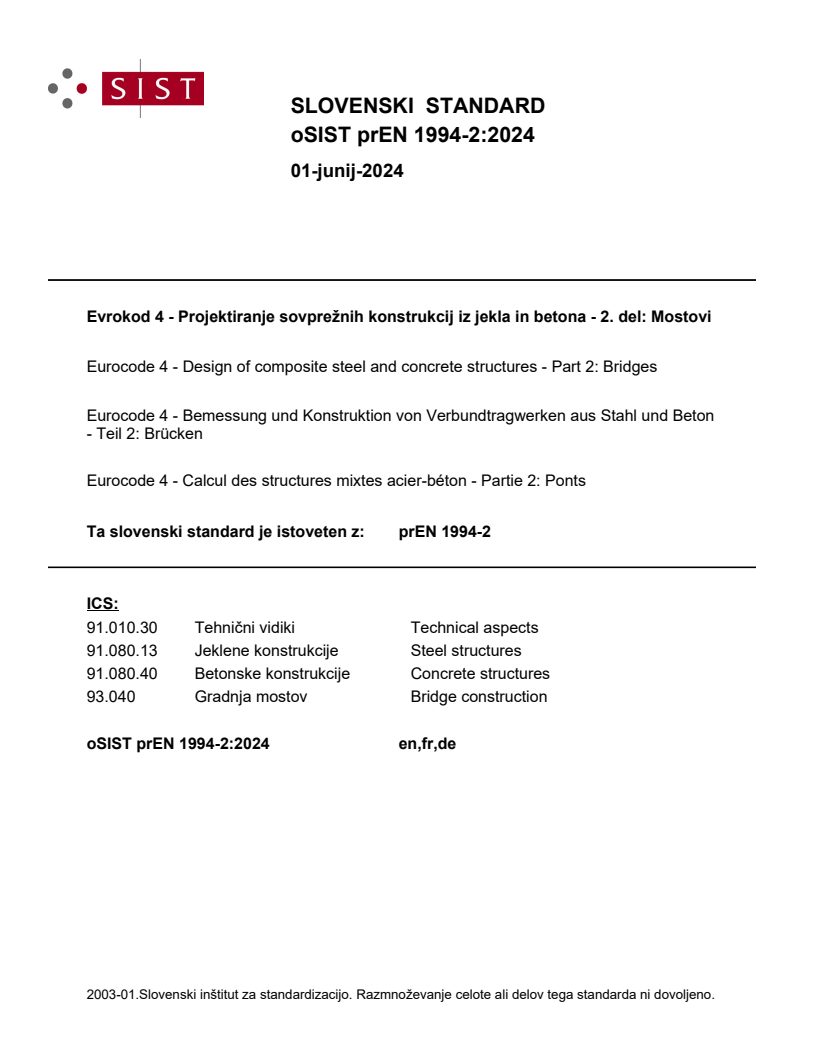
SLOVENSKI STANDARD
oSIST prEN 1994-2:2024
01-junij-2024
Evrokod 4 - Projektiranje sovprežnih konstrukcij iz jekla in betona - 2. del: Mostovi
Eurocode 4 - Design of composite steel and concrete structures - Part 2: Bridges
Eurocode 4 - Bemessung und Konstruktion von Verbundtragwerken aus Stahl und Beton
- Teil 2: Brücken
Eurocode 4 - Calcul des structures mixtes acier-béton - Partie 2: Ponts
Ta slovenski standard je istoveten z: prEN 1994-2
ICS:
91.010.30 Tehnični vidiki Technical aspects
91.080.13 Jeklene konstrukcije Steel structures
91.080.40 Betonske konstrukcije Concrete structures
93.040 Gradnja mostov Bridge construction
oSIST prEN 1994-2:2024 en,fr,de
2003-01.Slovenski inštitut za standardizacijo. Razmnoževanje celote ali delov tega standarda ni dovoljeno.
oSIST prEN 1994-2:2024
oSIST prEN 1994-2:2024
DRAFT
EUROPEAN STANDARD
prEN 1994-2
NORME EUROPÉENNE
EUROPÄISCHE NORM
March 2024
ICS 91.010.30; 91.080.13; 91.080.40; 93.040 Will supersede EN 1994-2:2005
English Version
Eurocode 4 - Design of composite steel and concrete
structures - Part 2: Bridges
Eurocode 4 - Calcul des structures mixtes acier-béton - Eurocode 4 - Bemessung und Konstruktion von
Partie 2: Ponts Verbundtragwerken aus Stahl und Beton - Teil 2:
Brücken
This draft European Standard is submitted to CEN members for enquiry. It has been drawn up by the Technical Committee
CEN/TC 250.
If this draft becomes a European Standard, CEN members are bound to comply with the CEN/CENELEC Internal Regulations
which stipulate the conditions for giving this European Standard the status of a national standard without any alteration.
This draft European Standard was established by CEN in three official versions (English, French, German). A version in any other
language made by translation under the responsibility of a CEN member into its own language and notified to the CEN-CENELEC
Management Centre has the same status as the official versions.
CEN members are the national standards bodies of Austria, Belgium, Bulgaria, Croatia, Cyprus, Czech Republic, Denmark, Estonia,
Finland, France, Germany, Greece, Hungary, Iceland, Ireland, Italy, Latvia, Lithuania, Luxembourg, Malta, Netherlands, Norway,
Poland, Portugal, Republic of North Macedonia, Romania, Serbia, Slovakia, Slovenia, Spain, Sweden, Switzerland, Türkiye and
United Kingdom.
Recipients of this draft are invited to submit, with their comments, notification of any relevant patent rights of which they are
aware and to provide supporting documentation.
Warning : This document is not a European Standard. It is distributed for review and comments. It is subject to change without
notice and shall not be referred to as a European Standard.
EUROPEAN COMMITTEE FOR STANDARDIZATION
COMITÉ EUROPÉEN DE NORMALISATION
EUROPÄISCHES KOMITEE FÜR NORMUNG
CEN-CENELEC Management Centre: Rue de la Science 23, B-1040 Brussels
© 2024 CEN All rights of exploitation in any form and by any means reserved Ref. No. prEN 1994-2:2024 E
worldwide for CEN national Members.
oSIST prEN 1994-2:2024
prEN 1994-2:2024 (E)
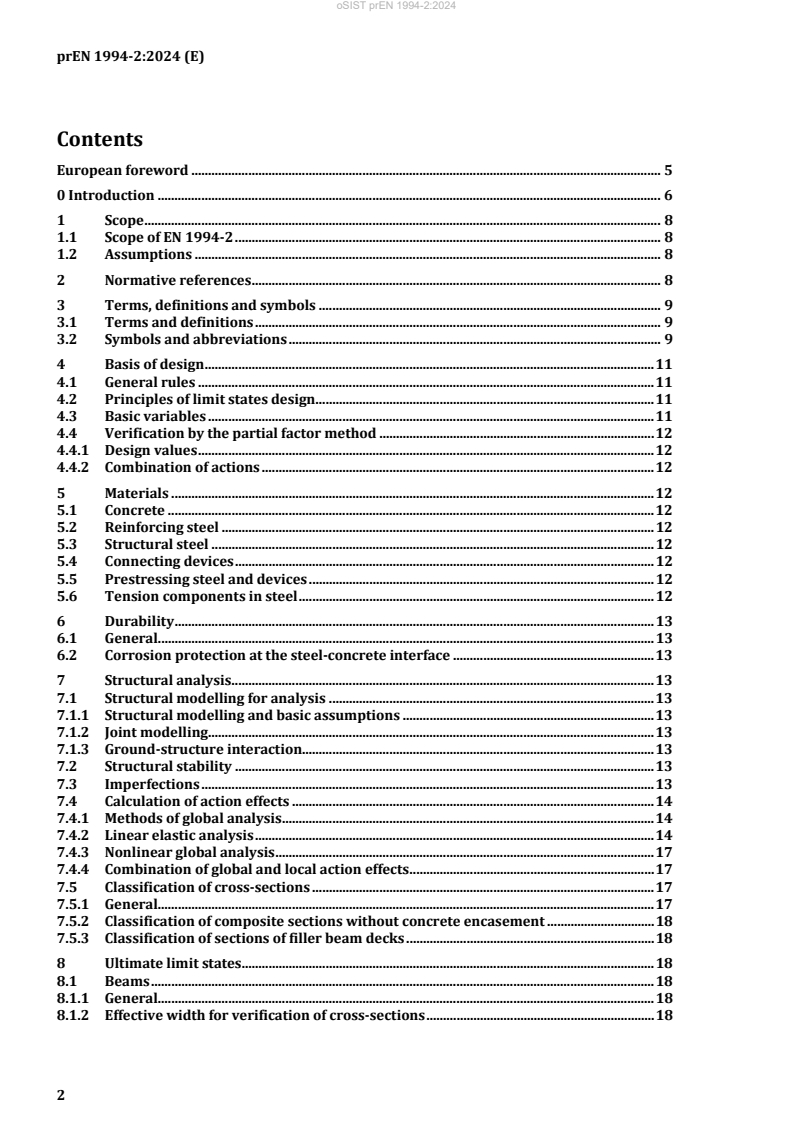
Contents
European foreword . 5
0 Introduction . 6
1 Scope . 8
1.1 Scope of EN 1994-2 . 8
1.2 Assumptions . 8
2 Normative references . 8
3 Terms, definitions and symbols . 9
3.1 Terms and definitions . 9
3.2 Symbols and abbreviations . 9
4 Basis of design . 11
4.1 General rules . 11
4.2 Principles of limit states design . 11
4.3 Basic variables . 11
4.4 Verification by the partial factor method . 12
4.4.1 Design values . 12
4.4.2 Combination of actions . 12
5 Materials . 12
5.1 Concrete . 12
5.2 Reinforcing steel . 12
5.3 Structural steel . 12
5.4 Connecting devices . 12
5.5 Prestressing steel and devices . 12
5.6 Tension components in steel . 12
6 Durability . 13
6.1 General. 13
6.2 Corrosion protection at the steel-concrete interface . 13
7 Structural analysis . 13
7.1 Structural modelling for analysis . 13
7.1.1 Structural modelling and basic assumptions . 13
7.1.2 Joint modelling. 13
7.1.3 Ground-structure interaction. 13
7.2 Structural stability . 13
7.3 Imperfections . 13
7.4 Calculation of action effects . 14
7.4.1 Methods of global analysis. 14
7.4.2 Linear elastic analysis . 14
7.4.3 Nonlinear global analysis . 17
7.4.4 Combination of global and local action effects . 17
7.5 Classification of cross-sections . 17
7.5.1 General. 17
7.5.2 Classification of composite sections without concrete encasement . 18
7.5.3 Classification of sections of filler beam decks . 18
8 Ultimate limit states . 18
8.1 Beams . 18
8.1.1 General. 18
8.1.2 Effective width for verification of cross-sections . 18
oSIST prEN 1994-2:2024
prEN 1994-2:2024 (E)
8.2 Resistances of cross-sections of beams . 18
8.2.1 Bending resistance . 18
8.2.2 Resistance to vertical shear . 19
8.3 Filler beam decks . 19
8.3.1 Scope . 19
8.3.2 General . 21
8.3.3 Bending moments . 21
8.3.4 Vertical shear . 22
8.3.5 Resistance and stability of steel beams during execution . 22
8.4 Lateral-torsional buckling of composite beams . 22
8.4.1 General . 22
8.4.2 Verification of lateral-torsional buckling of continuous composite beams with
uniform cross-sections in Class 1, 2 and 3 . 22
8.4.3 General methods for buckling of members and frames . 22
8.5 Transverse forces on webs . 23
8.6 Shear connection . 23
8.6.1 Basis of design . 23
8.6.2 General method using nonlinear analysis . 23
8.6.3 Longitudinal shear force in beams . 23
8.6.4 Other beams where plastic theory is used for the resistance of the cross-section. 24
8.6.5 Beams in which elastic theory is used for the resistance of the cross-section . 24
8.6.6 Beams in which nonlinear theory is used for the resistance of the cross-section . 24
8.6.7 Local effects of concentrated longitudinal shear force . 24
8.6.8 Headed stud connectors in solid slabs and concrete encasement . 24
8.6.9 Design resistance of headed studs used with profiled steel sheeting . 24
8.6.10 Detailing of the shear connection and influence of execution . 24
8.6.11 Longitudinal shear in concrete slabs . 25
8.7 Fatigue . 25
8.7.1 General . 25
8.7.2 Partial factors for fatigue verification. 25
8.7.3 Fatigue strength . 26
8.7.4 Internal forces and fatigue loadings . 27
8.7.5 Stresses . 27
8.7.6 Stress ranges . 28
8.7.7 Fatigue assessment based on nominal stress ranges . 29
8.8 Composite columns and composite compression members . 31
8.9 Composite tension members . 31
9 Serviceability limit states . 32
9.1 General . 32
9.2 Stresses . 32
9.2.1 General . 32
9.2.2 Stress limitation . 32
9.2.3 Web breathing . 33
9.2.4 Longitudinal shear force in beams . 33
9.3 Deformations . 33
9.3.1 Deflections . 33
9.3.2 Vibrations . 33
9.4 Cracking of concrete . 33
9.4.1 General . 33
9.4.2 Minimum reinforcement . 34
9.4.3 Control of cracking due to direct loading . 34
9.5 Filler beam decks . 34
oSIST prEN 1994-2:2024
prEN 1994-2:2024 (E)
9.5.1 General. 34
9.5.2 Cracking of concrete . 34
9.5.3 Minimum reinforcement . 34
9.5.4 Control of cracking due to direct loading . 34
10 Precast concrete slabs . 34
10.1 General. 34
10.2 Actions . 35
10.3 Design, analysis and detailing of the bridge slab . 35
10.4 Interface between steel beam and concrete slab . 35
10.4.1 Bedding and tolerances . 35
10.4.2 Corrosion . 35
10.4.3 Shear connection and transverse reinforcement. 35
11 Composite plates . 36
11.1 General. 36
11.2 Design for local effects . 36
11.3 Design for global effects . 36
11.4 Design of shear connectors . 37
Bibliography . 39
oSIST prEN 1994-2:2024
prEN 1994-2:2024 (E)
European foreword
This document (prEN 1994-2:2024) has been prepared by Technical Committee CEN/TC 250 “Structural
Eurocodes”, the secretariat of which is held by BSI. CEN/TC 250 is responsible for all Structural
Eurocodes and has been assigned responsibility for structural and geotechnical design matters by CEN.
This document is currently submitted to the CEN Enquiry.
This document will supersede EN 1994-2:2005.
The first generation of EN Eurocodes was published between 2002 and 2007. This document forms part
of the second generation of the Eurocodes, which have been prepared under Mandate M/515 issued to
CEN by the European Commission and the European Free Trade Association.
The Eurocodes have been drafted to be used in conjunction with relevant execution, material, product
and test standards, and to identify requirements for execution, materials, products and testing that are
relied upon by the Eurocodes.
The Eurocodes recognize the responsibility of each Member State and have safeguarded their right to
determine values related to regulatory safety matters at national level through the use of National
Annexes.
The main changes compared to the previous edition are listed below:
• This document does not repeat rules that are already contained in EN 1994-1-1. Instead, reference is
made to EN 1994-1-1.
• New rules for shear connectors under tension and under combined tension and shear in the case of
fatigue have been added.
oSIST prEN 1994-2:2024
prEN 1994-2:2024 (E)
0 Introduction
0.1 Introduction to the Eurocodes
The Structural Eurocodes comprise of the following standards generally consisting of a number of Parts:
• EN 1990, Eurocode — Basis of structural and geotechnical design
• EN 1991, Eurocode 1 — Actions on structures
• EN 1992, Eurocode 2 — Design of concrete structures
• EN 1993, Eurocode 3 — Design of steel structures
• EN 1994, Eurocode 4 — Design of composite steel and concrete structures
• EN 1995, Eurocode 5 — Design of timber structures
• EN 1996, Eurocode 6 — Design of masonry structures
• EN 1997, Eurocode 7 — Geotechnical design
• EN 1998, Eurocode 8 — Design of structures for earthquake resistance
• EN 1999, Eurocode 9 — Design of aluminium structures
• New parts are under development, e.g. Eurocode for design of structural glass
The Eurocodes are intended for use by designers, clients, manufacturers, constructors, relevant
authorities (in exercising their duties in accordance with national or international regulations),
educators, software developers, and committees drafting standards for related product, testing and
execution standards.
NOTE Some aspects of design are most appropriately specified by relevant authorities or, where not specified, can
be agreed on a project-specific basis between relevant parties such as designers and clients. The Eurocodes identify
such aspects making explicit reference to relevant authorities and relevant parties.
0.2 Introduction to EN 1994 (all parts)
EN 1994 (all parts) applies to the design of steel-concrete composite structures and members for
buildings and civil engineering works. It complies with the rules for the safety and serviceability of
structures, the basis of their design and verification that are given in EN 1990.
EN 1994 (all parts) is concerned only with requirements for resistance, serviceability, durability and fire
resistance of steel-concrete composite structures. Other requirements, e.g. concerning thermal or sound
insulation, are not considered.
EN 1994 is subdivided in various parts:
EN 1994-1-1, Eurocode 4 — Design of composite steel and concrete structures — Part 1 1: General rules
and rules for buildings;
EN 1994-1-2, Eurocode 4 — Design of composite steel and concrete structures — Part 1 2: Structural fire
design;
EN 1994-2, Eurocode 4 — Design of composite steel and concrete structures — Part 2: Bridges.
oSIST prEN 1994-2:2024
prEN 1994-2:2024 (E)
0.3 Introduction to EN 1994-2
EN 1994-2 refers to the rules for safety, serviceability and durability of composite steel and concrete
structures, as described in EN 1994-1-1, and provides specific provisions for the design of steel-concrete
composite bridges and composite members of bridges. It is based on the limit state concept used in
conjunction with a partial factor method.
Numerical values for partial factors and other reliability parameters are provided as basic values that
provide an acceptable level of reliability. They have been selected assuming that an appropriate level of
workmanship and of quality management applies.
0.4 Verbal forms used in the Eurocodes
The verb “shall” expresses a requirement strictly to be followed and from which no deviation is permitted
in order to comply with the Eurocodes.
The verb “should” expresses a highly recommended choice or course of action. Subject to national
regulation and/or any relevant contractual provisions, alternative approaches could be used/adopted
where technically justified.
The verb “may” expresses a course of action permissible within the limits of the Eurocodes.
The verb “can” expresses possibility and capability; it is used for statements of fact and clarification of
concepts.
0.5 National Annex for EN 1994-2
National choice is allowed in this standard where explicitly stated within notes. National choice includes
the selection of values for Nationally Determined Parameters (NDPs).
The national standard implementing EN 1994-2 can have a National Annex containing all national choices
to be used for the design of bridges to be constructed in the relevant country.
When no national choice is given, the default choice given in this standard is to be used.
When no national choice is made and no default is given in this standard, the choice can be specified by a
relevant authority or, where not specified, agreed for a specific project by appropriate parties.
National choice is allowed in EN 1994-2 through notes to the following clauses:
4.4.1.2(1) 4.4.1.2(2) 7.4.4(2) 8.2.2(2)
8.6.1(1) 8.7.1(3) 8.7.7.2(1) 8.7.7.2(3)
9.4.1(4)
National choice is allowed in EN 1994-2 on the application of the following informative annexes:
None.
The National Annex can contain, directly or by reference, non-contradictory complementary information
for ease of implementation, provided it does not alter any provisions of the Eurocodes.
oSIST prEN 1994-2:2024
prEN 1994-2:2024 (E)
1 Scope
1.1 Scope of EN 1994-2
EN 1994-2 gives design rules for steel-concrete composite bridges or members of bridges,
supplementary to the general rules given in EN 1994-1-1.
1.2 Assumptions
(1) The assumptions of EN 1990 apply to this document.
(2) In addition to the general assumptions of EN 1990, the assumptions given in 1.2 to EN 1992-1-1,
EN 1993-1-1 and EN 1994-1-1 apply to this document.
(3) EN 1994-2 is intended to be used in conjunction with EN 1990, EN 1991 (all parts), EN 1992 (all
parts), EN 1993 (all parts), EN 1994-1-1, EN 1997 (all parts), EN 1998 (all parts) when steel-concrete
composite structures are built in seismic regions), EN 1090-1, EN 1090-2 and EN 13670.
2 Normative references
The following documents are referred to in the text in such a way that some or all of their content
constitutes requirements of this document. For dated references, only the edition cited applies. For
undated references, the latest edition of the referenced document (including any amendments) applies.
NOTE See the Bibliography for a list of other documents cited that are not normative references, including
those referenced as recommendations (i.e. through ‘should’ clauses) and permissions (i.e. through ‘may’ clauses).
EN 1990:2023, Eurocode — Basis of structural and geotechnical design
EN 1991-1-6, Eurocode 1 — Actions on structures — Part 1-6: Actions during execution
EN 1991-2:2023, Eurocode 1 — Actions on structures — Part 2: Traffic loads on bridges and other civil
engineering works
EN 1992 (all parts), Eurocode 2 — Design of concrete structures
EN 1992-1-1:2023, Eurocode 2 — Design of concrete structures — Part 1-1: General rules and rules for
buildings, bridges and civil engineering structures
EN 1993 (all parts), Eurocode 3 — Design of steel structures
EN 1993-1-1:2022, Eurocode 3 — Design of steel structures — Part 1-1: General rules and rules for
buildings
prEN 1993-1-11:2024, Eurocode 3 — Design of steel structures — Part 1-11: Tension components
prEN 1993-2:2024, Eurocode 3 — Design of steel structures — Part 2: Bridges
prEN 1994-1-1:2024, Eurocode 4 — Design of composite steel and concrete structures — Part 1-1: General
rules and rules for buildings
As impacted by EN 1990:2023/prA1:2024.
oSIST prEN 1994-2:2024
prEN 1994-2:2024 (E)
3 Terms, definitions and symbols
3.1 Terms and definitions
For the purposes of this document, the terms and definitions given in EN 1990, EN 1992-1-1,
EN 1993-1-1, EN 1994-1-1 and the following apply.
3.1.1
filler beam deck
deck consisting of a reinforced concrete slab and partially concrete-encased hot-rolled or welded steel
beams, having their bottom flange on the level of the slab bottom
3.1.2
composite plate
composite member consisting of a flat bottom steel plate connected to a concrete slab, in which both the
length and width are much larger than the thickness of the composite plate
3.2 Symbols and abbreviations
For the purposes of this document, the symbols given in EN 1990, EN 1992-1-1, EN 1993-1-1, EN 1993-2
and EN 1994-1-1 and the following apply.
Latin upper-case letters
A effective area of concrete
c,eff
A minimum longitudinal top reinforcement per filler beam
s,min
(EA ) effective longitudinal stiffness of the cracked concrete tension member
s eff
F component in the direction of the steel beam of the design force of a bonded or unbonded
d
tendon applied after the shear connection has become effective
I effective second moment of area of filler beams
eff
L length of inelastic region, between points A and B, corresponding to M and M ,
A-B el,Rd Ed,max
respectively
L length of shear connection
v
MEd,max total design bending moment applied to the steel and composite member
M maximum bending moment or internal force due to fatigue loading
Ed,max,f
M minimum bending moment due to fatigue loading
Ed,min,f
M design plastic moment of resistance of the reinforcement
s,Rd
N design compressive force in concrete slab corresponding to M
cd Ed,max
N normal force of concrete tension member for SLS
Ed,serv
N normal force of concrete tension member for ULS
Ed,ult
N design value of the plastic resistance of the structural steel section to normal force
pl,a
N number of stress-range cycles
R
N tensile force in cracked concrete slab corresponding to M taking into account the effects
s,el el,Rd
of tension stiffening
P longitudinal force on a connector at distance x from the nearest web
Ed
V longitudinal shear force, acting along the steel-concrete flange interface
L
oSIST prEN 1994-2:2024
prEN 1994-2:2024 (E)
V longitudinal shear force acting on length L of the inelastic region
L,Ed A-B
Latin lower-case letters
a steel flange projection outside the web of the beam
w
c concrete cover above the steel beams of filler beam decks
st
d effective thickness of concrete
eff
e either of 2e or 2e
d h v
e lateral distance from the point of application of force F to the relevant steel web, if F is
h d d
applied to the concrete slab
e vertical distance from the point of application of force F to the plane of shear connection
v d
concerned, if F is applied to the steel element
d
f limiting stress of prestressing tendons according to EN 1992-1-1:2023, 3.2.2
pd
f characteristic value of yield strength of prestressing tendons
pk
n modular ratio (shear moduli) for short-term loading
0G
n reference should be made to 11.4
tot
n modular ratio (shear moduli) for long term loading
LG
n reference should be made to 11.4
w
calibration factor for validity of Miner’s rule in case of headed studs
kM,s
s clear distance between the upper flanges of the steel beams of filler beam decks
f
s spacing of webs of steel beams of filler beam decks
w
v design longitudinal shear force per unit length at the interface between steel and concrete
L,Ed
v , maximum design longitudinal shear force per unit length at the interface between steel
L Ed,max
and concrete
x distance of a shear connector from the nearest web
z lever arm of the reinforcement
s
Greek upper-case letters
∆σ stress range
reference value of the fatigue strength at 2 million cycles
∆σc
∆σ reference value of the fatigue strength at 2 million cycles for headed studs subjected to
c,ten
tensile forces
∆σ equivalent constant amplitude stress range
E
∆σ equivalent constant amplitude stress range due to global effects
E,glob
∆σ equivalent constant amplitude stress range due to local effects
E,loc
∆σ equivalent constant amplitude stress range related to 2 million cycles
E,2
∆σ equivalent constant amplitude tensile stress range related to 2 million cycles
E,2,ten
∆σ increase of stress in steel reinforcement due to tension stiffening of concrete
s
∆σs,equ damage equivalent stress range
nominal stress range caused by the tension force
∆σten
oSIST prEN 1994-2:2024
prEN 1994-2:2024 (E)
∆τ range of shear stress for fatigue loading
∆τ reference value of the fatigue strength at 2 million cycles
c
∆τ equivalent constant amplitude stress range
E
∆τ equivalent constant amplitude range of shear stress related to 2 million cycles
E,2
∆τ fatigue shear strength
R
Greek lower-case letters
η coefficient related to f in lightweight aggregate concrete
lw,fc c
η degree of utilization for the fatigue assessment of headed studs exposed to shear and
st
tension force
λ, λ damage equivalent factors
v
λ factor to be used for the determination of the damage equivalent factor λ for headed studs
v,1 v
in shear
λ , λ damage equivalent factors for global effects and local effects, respectively
glob loc
σ maximum stress due to fatigue loading
max,f
σ minimum stress due to fatigue loading
min,f
σ stress in the reinforcement due to the bending moment M
s,max,f Ed,max,f
σ , stress in the reinforcement due to the bending moment M
s,min,f Ed,min,f
σ normal stress in the concrete
cp
σcp,0 recommended value for normal stress in the concrete (– 1,85 N/mm )
φ diameter of the longitudinal reinforcement
s
φ dynamic amplification factor
ψ reduction factor to account for unequally distributed tensile forces of headed studs
N
4 Basis of design
4.1 General rules
(1) The design of steel-concrete composite bridges shall be in accordance with the general rules given in
EN 1990, EN 1991-2 and prEN 1994-1-1:2024, 4.1.1 if not otherwise stated.
(2) Rules in EN 1994-1-1, which are specific to buildings only, shall not be applied.
4.2 Principles of limit states design
(1) The principles of limit states design given in EN 1990 and EN 1994-1-1 shall be used.
4.3 Basic variables
(1) The rules given in EN 1994-1-1 shall be used.
oSIST prEN 1994-2:2024
prEN 1994-2:2024 (E)
4.4 Verification by the partial factor method
4.4.1 Design values
4.4.1.1 Design values of actions
(1) Partial factor for prestressing made by methods other than usual prestressing tendons such as
prestressing arisen from imposed deformations at supports, pre-strain applied by tension components,
etc. shall be as defined in prEN 1993-1-11:2024, 4.4 and Table 4.1.
4.4.1.2 Design values of material or product properties
(1) In addition to prEN 1994-1-1:2024, 4.4.1.2, for structural steel, steel sheeting and steel connecting
devices, partial factors γ in accordance with EN 1993-2 shall be applied. Unless otherwise stated, the
M
partial factor for structural steel shall be taken as γ .
M0
(2) For fatigue verification of headed studs, partial factors γMf and γMf,s in accordance with EN 1993-2 shall
be applied.
NOTE The value for γ is 1,25 unless the National Annex gives a different value.
Mf,s
4.4.1.3 Design values of geometrical data
(1) The rules given in EN 1994-1-1 shall be used.
4.4.1.4 Design resistances
(1) The rules given in EN 1994-1-1 shall be used.
4.4.2 Combination of actions
(1) The combinations of actions given in EN 1990 shall be used.
5 Materials
5.1 Concrete
(1) The rules given in EN 1994-1-1 shall be used.
5.2 Reinforcing steel
(1) The rules given in EN 1994-1-1 shall be used.
5.3 Structural steel
(1) Structural steel properties should be derived from EN 1993-2.
(2) The nominal yield strength shall be lower than 460 N/mm .
5.4 Connecting devices
(1) The rules given in EN 1994-1-1 shall be used.
5.5 Prestressing steel and devices
(1) Prestressing steel and devices shall be in accordance with EN 1992-1-1:2023, 5.3 and 5.4.
5.6 Tension components in steel
(1) Tension components in steel shall be in accordance with EN 1993-1-11.
oSIST prEN 1994-2:2024
prEN 1994-2:2024 (E)
6 Durability
6.1 General
(1) The provisions on durability given in EN 1990, EN 1992 (all parts) and EN 1993 (all parts) shall be
followed.
(2) Detailing of the shear connection should be in accordance with 8.6.10.
6.2 Corrosion protection at the steel-concrete interface
(1) The corrosion protection of the steel element should extend into the steel-concrete interface at least
50 mm from any edge.
NOTE For additional rules for bridges with pre-cast deck slabs, see Clause 10.
7 Structural analysis
7.1 Structural modelling for analysis
7.1.1 Structural modelling and basic assumptions
(1) The rules given in EN 1994-1-1 shall be used.
7.1.2 Joint modelling
(1) In addition to prEN 1994-1-1:2024, 7.1.2, semi-continuous composite joints should not be used.
7.1.3 Ground-structure interaction
(1) Effects due to settlements may be neglected in ultimate limit states other than fatigue for composite
members where all cross sections are in class 1 or 2 and bending resistance is not reduced by lateral
torsional buckling.
(2) Effects due to settlement should be considered where accurate determination of stress is required,
where structural displacements are not small or the structure is not ductile.
7.2 Structural stability
(1) prEN 1994-1-1:2024, 7.2.2(1) shall not be applied.
7.3 Imperfections
(1) prEN 1994-1-1:2024, 7.3.2 shall not be applied.
(2) In addition to prEN 1994-1-1:2024, 7.3, equivalent geometric imperfections should be used with
values that reflect the possible effects of system imperfections and also member imperfections unless
these effects are included in the resistance formulae.
(3) The imperfections and design transverse forces for stabilizing transverse frames should be calculated
in accordance with prEN 1993-2:2024, 7.3 and Annex D where applicable.
(4) Imperfections within steel compression members should be considered in accordance with
prEN 1993-2:2024, 7.3.
oSIST prEN 1994-2:2024
prEN 1994-2:2024 (E)
7.4 Calculation of action effects
7.4.1 Methods of global analysis
(1) In addition to prEN 1994-1-1:2024, 7.4.1, for transient design situations during erection stages,
uncracked global analysis and the distribution of effective width according to prEN 1994-1-1:2024,
7.4.1.2 may be used.
7.4.2 Linear elastic analysis
7.4.2.1 General
(1) The rules given in EN 1994-1-1 shall be used.
7.4.2.2 Creep and shrinkage
(1) In addition to prEN 1994-1-1:2024, 7.4.2.2, the St. Venant torsional stiffness of box girders should be
calculated for a transformed cross-section in which the concrete slab thickness is reduced by the modular
ratio n = G /G where G and G are the elastic shear moduli of structural steel and concrete respectively.
0G a c a c
(2) The effects of creep should be taken into account in accordance with prEN 1994-1-1:2024, 7.4.2.2(2)
with the modular ratio n = n (1+ψφ ).
LG 0G L t
7.4.2.3 Effects of cracking of concrete
(1) In addition to prEN 1994-1-1:2024, 7.4.2.3, unless a more precise method is used, in multiple beam
decks where transverse composite members are not subjected to tensile forces, it may be assumed that
the transverse members are uncracked throughout.
(2) The torsional stiffness of box girders should be calculated for a transformed cross-section. In areas
where the concrete slab is assumed to be cracked due to bending, the calculation may be performed
considering a slab thickness reduced to one half, unless the effect of cracking is considered in a more
precise way.
(3) For ultimate limit states, the effect of cracking on the longitudinal shear forces at the interface
between the steel and concrete section should be taken into account according to 8.6.3.
(4) For serviceability limit states, the longitudinal shear forces at the interface between the steel and
concrete section should be calculated by uncracked analysis or cracked analysis.
(5) If the effects of cracking are taken into account, tension stiffening and over-strength of concrete in
tension should be considered.
7.4.2.4 Stages and sequence of construction
(1) The rules given in EN 1994-1-1 shall be used.
(2) The dissipation of the hydration heat of the concrete results in constraint stresses in composite
structures in construction stages, which may be taken into account in the design of the structure and the
bearings as well as in the design of construction aids in case of unfavourable effects.
7.4.2.5 Temperature effects
(1) In addition to prEN 1994-1-1:2024, 7.4.2.5, for simplification in global analysis and for the
determination of stresses for composite structures, the value of the coefficient of linear thermal
−6
expansion for structural steel may be taken as 10 × 10 per °C.
(2) For calculation of change in length of the bridge, the coefficient of thermal expansion should be taken
−6
as 10 × 10 per °C for all structural materials.
oSIST prEN 1994-2:2024
prEN 1994-2:2024 (E)
7.4.2.6 Pre-stressing by controlled imposed deformations
(1) The rules given in EN 1994-1-1 shall be used.
7.4.2.7 Prestressing by tendons
(1) Internal forces and moments due to prestressing by bonded tendons should be determined in
accordance with EN 1992-1-1:2023, 7.6.1 and 7.6.5, taking into account the effects of creep and shrinkage
of concrete and cracking of concrete where relevant.
(2) In global analysis, forces in unbonded tendons should be treated as external forces.
(3) For the determination of forces in permanently unbonded tendons, deformations of the whole
structure should be taken into account.
7.4.2.8 Composite tension members
7.4.2.8.1 General
(1) In this clause, concrete tension member means either:
a) an isolated reinforced concrete tension member acting together with a tension member of structural
steel, with shear connection only at the ends of the member, which causes a global tensile force in
the concrete tension member; or
b) the reinforced concrete part of a composite member with shear connection over the member length
(a composite tension member) subjected to longitudinal tension.
NOTE Typical examples occur in bowstring arches and trusses where the concrete or composite members act
as tension members in the main composite system.
7.4.2.8.2 Internal forces and moments in a concrete tension member: simplified approach
(1) The effects of tension stiffening of concrete may be neglected, if in the global analysis the internal
forces and moments of the concrete tension member are determined by uncracked analysis and the
internal forces of structural steel members are determined by cracked analysis.
(2) In that case, the free shrinkage strain of the uncracked member should be used for the
...
Questions, Comments and Discussion
Ask us and Technical Secretary will try to provide an answer. You can facilitate discussion about the standard in here.
Loading comments...