


prEN ISO 1938-1
(Main)Geometrical product specifications (GPS) - Dimensional measuring equipment - Part 1: Plain limit gauges of linear size (ISO/DIS 1938-1:2025)
Geometrical product specifications (GPS) - Dimensional measuring equipment - Part 1: Plain limit gauges of linear size (ISO/DIS 1938-1:2025)
ISO 1938-1:2015 specifies the most important metrological and design characteristics of plain limit gauges of linear size.
ISO 1938-1:2015 defines the different types of plain limit gauges used to verify linear dimensional specifications associated with linear size.
ISO 1938-1:2015 also defines the design characteristics and the metrological characteristics for these limit gauges as well as the new or wear limits state Maximum Permissible Limits (MPLs) for the new state or wear limits state for these metrological characteristics.
In addition, ISO 1938-1:2015 describes the use of limit gauges. It covers linear sizes up to 500 mm.
Geometrische Produktspezifikation (GPS) - Längenprüftechnik - Teil 1: Grenzlehren und Lehrung der Längenmaße (ISO/DIS 1938-1:2025)
Spécification géométrique des produits (GPS) - Équipement de mesure dimensionnel - Partie 1: Calibres lisses à limite de taille linéaire (ISO/DIS 1938-1:2025)
ISO 1938-1:2015 spécifie les caractéristiques métrologiques et de conception les plus importantes des calibres lisses à limites de taille linéaire.
ISO 1938-1:2015 définit les différents types de calibres lisses à limites utilisés pour vérifier les spécifications dimensionnelles linéaires associées à la taille linéaire.
ISO 1938-1:2015 définit également les caractéristiques de conception et les caractéristiques métrologiques de ces calibres à limites, ainsi que l'état neuf ou l'état limite d'usure des limites maximales tolérées (Maximum Permissible Limits, MPL) de l'état neuf ou de l'état limite d'usure de ces caractéristiques métrologiques.
ISO 1938-1:2015 décrit également l'utilisation des calibres à limites. Elle couvre les tailles linéaires jusqu'à 500 mm.
Specifikacija geometrijskih veličin izdelka (GPS) - Oprema za merjenje dimenzij - 1. del: Ploščati mejni merilniki linearne velikosti (ISO/DIS 1938-1:2025)
General Information
- Status
- Not Published
- Publication Date
- 14-Sep-2026
- Current Stage
- 4060 - Closure of enquiry - Enquiry
- Start Date
- 12-May-2025
- Completion Date
- 12-May-2025
Relations
- Effective Date
- 04-Oct-2023
Overview
The prEN ISO 1938-1:2025 standard, titled "Geometrical product specifications (GPS) - Dimensional measuring equipment - Part 1: Plain limit gauges of linear size", is published by CEN and based on the ISO/DIS 1938-1:2025 draft. This international standard specifies the essential metrological and design characteristics of plain limit gauges used for verifying linear dimensions in manufacturing and quality control.
Plain limit gauges are critical tools in dimensional measurement and verification workflows for linear sizes up to 500 mm. This standard updates and supersedes ISO 1938-1:2015, enhancing definitions, design parameters, and metrological requirements, including maximum permissible limits (MPLs) for gauge wear and new gauge states.
The document aligns with the broader Geometrical Product Specifications (GPS) system, ensuring consistency and traceability within dimensional metrology standards.
Key Topics
Types of Plain Limit Gauges
The standard defines various plain limit gauge types to assess internal and external linear sizes, including:- GO gauges (acceptance gauges)
- NO GO gauges (rejection gauges)
- Types such as full form cylindrical plug gauges and segmental cylindrical bar gauges
Design Characteristics
Specifications cover the construction and functional requirements, including:- Gauge elements that simulate perfect features of size derived from upper or lower specification limits
- Physical attributes for durability and accuracy
Metrological Characteristics
Focus on ensuring measurement reliability through:- Calibration and verification procedures
- Specifications of measurement uncertainty and allowable deviations
- Establishment of Maximum Permissible Limits (MPLs) for both new and wear states of gauges
Usage Guidelines
Practical instructions included in the annexes describe:- Application principles for limit gauging in inspection
- Uncertainty estimation related to gauge types
- Relationship to the GPS matrix model ensuring conformity with ISO GPS rules
Terminology and Reference Standards
Terms such as maximum material limit of size (MMLS), upper specification limit (USL), and lower limit of size (LLS) are clearly defined in conjunction with related ISO GPS standards (ISO 286-1, ISO 14405-1, ISO 1101).
Applications
prEN ISO 1938-1:2025 is vital for industries utilizing precision metrology and quality assurance where dimensional compliance is critical, including:
Manufacturing
Verifying machined parts, shafts, holes, and other features to ensure adherence to design tolerances and fit requirements.Quality Control
Routine inspection of components where GO/NO GO limit gauging techniques simplify pass/fail decisions without complex measurement equipment.Calibration Laboratories
Establishing traceability and ensuring measuring equipment meets the stated design and metrological standards.Automotive and Aerospace
Enforcing strict dimensional tolerances on critical safety and performance-related components.Tooling and Gauge Design
Guiding the creation and maintenance of plain limit gauges with defined wear limits to optimize gauge life and reliability.
Related Standards
This standard functions within the ISO GPS system and references several key standards to maintain harmony and interoperability:
- ISO 286-1:2010 – Basis for tolerances, deviations, and fits of linear sizes
- ISO 1101 – Geometrical tolerancing for form, orientation, location, and run-out specifications
- ISO 14405-1 – Dimensional tolerancing for linear sizes
- ISO 14253-2 – Guidance on uncertainty estimation in GPS measurement and verification
- ISO 17450-2 – GPS general concepts addressing uncertainties and measurement ambiguities
- ISO/IEC Guide 98-3 (GUM) – Guide to the expression of uncertainty in measurement
These related standards establish a comprehensive framework for dimensional metrology, supporting the accurate and reliable use of plain limit gauges under ISO 1938-1:2025.
Keywords: plain limit gauges, geometrical product specifications, GPS, linear size measurement, dimensional measuring equipment, metrological characteristics, design characteristics, maximum permissible limits, GO gauge, NO GO gauge, ISO 1938-1, dimensional inspection, quality control, manufacturing metrology.

Frequently Asked Questions
prEN ISO 1938-1 is a draft published by the European Committee for Standardization (CEN). Its full title is "Geometrical product specifications (GPS) - Dimensional measuring equipment - Part 1: Plain limit gauges of linear size (ISO/DIS 1938-1:2025)". This standard covers: ISO 1938-1:2015 specifies the most important metrological and design characteristics of plain limit gauges of linear size. ISO 1938-1:2015 defines the different types of plain limit gauges used to verify linear dimensional specifications associated with linear size. ISO 1938-1:2015 also defines the design characteristics and the metrological characteristics for these limit gauges as well as the new or wear limits state Maximum Permissible Limits (MPLs) for the new state or wear limits state for these metrological characteristics. In addition, ISO 1938-1:2015 describes the use of limit gauges. It covers linear sizes up to 500 mm.
ISO 1938-1:2015 specifies the most important metrological and design characteristics of plain limit gauges of linear size. ISO 1938-1:2015 defines the different types of plain limit gauges used to verify linear dimensional specifications associated with linear size. ISO 1938-1:2015 also defines the design characteristics and the metrological characteristics for these limit gauges as well as the new or wear limits state Maximum Permissible Limits (MPLs) for the new state or wear limits state for these metrological characteristics. In addition, ISO 1938-1:2015 describes the use of limit gauges. It covers linear sizes up to 500 mm.
prEN ISO 1938-1 is classified under the following ICS (International Classification for Standards) categories: 17.040.10 - Limits and fits; 17.040.40 - Geometrical Product Specification (GPS). The ICS classification helps identify the subject area and facilitates finding related standards.
prEN ISO 1938-1 has the following relationships with other standards: It is inter standard links to EN ISO 1938-1:2015. Understanding these relationships helps ensure you are using the most current and applicable version of the standard.
You can purchase prEN ISO 1938-1 directly from iTeh Standards. The document is available in PDF format and is delivered instantly after payment. Add the standard to your cart and complete the secure checkout process. iTeh Standards is an authorized distributor of CEN standards.
Standards Content (Sample)
SLOVENSKI STANDARD
01-april-2025
Specifikacija geometrijskih veličin izdelka (GPS) - Oprema za merjenje dimenzij - 1.
del: Ploščati mejni merilniki linearne velikosti (ISO/DIS 1938-1:2025)
Geometrical product specifications (GPS) - Dimensional measuring equipment - Part 1:
Plain limit gauges of linear size (ISO/DIS 1938-1:2025)
Geometrische Produktspezifikation (GPS) - Längenprüftechnik - Teil 1: Grenzlehren und
Lehrung der Längenmaße (ISO/DIS 1938-1:2025)
Spécification géométrique des produits (GPS) - Équipement de mesure dimensionnel -
Partie 1: Calibres lisses à limite de taille linéaire (ISO/DIS 1938-1:2025)
Ta slovenski standard je istoveten z: prEN ISO 1938-1
ICS:
17.040.30 Merila Measuring instruments
17.040.40 Specifikacija geometrijskih Geometrical Product
veličin izdelka (GPS) Specification (GPS)
2003-01.Slovenski inštitut za standardizacijo. Razmnoževanje celote ali delov tega standarda ni dovoljeno.
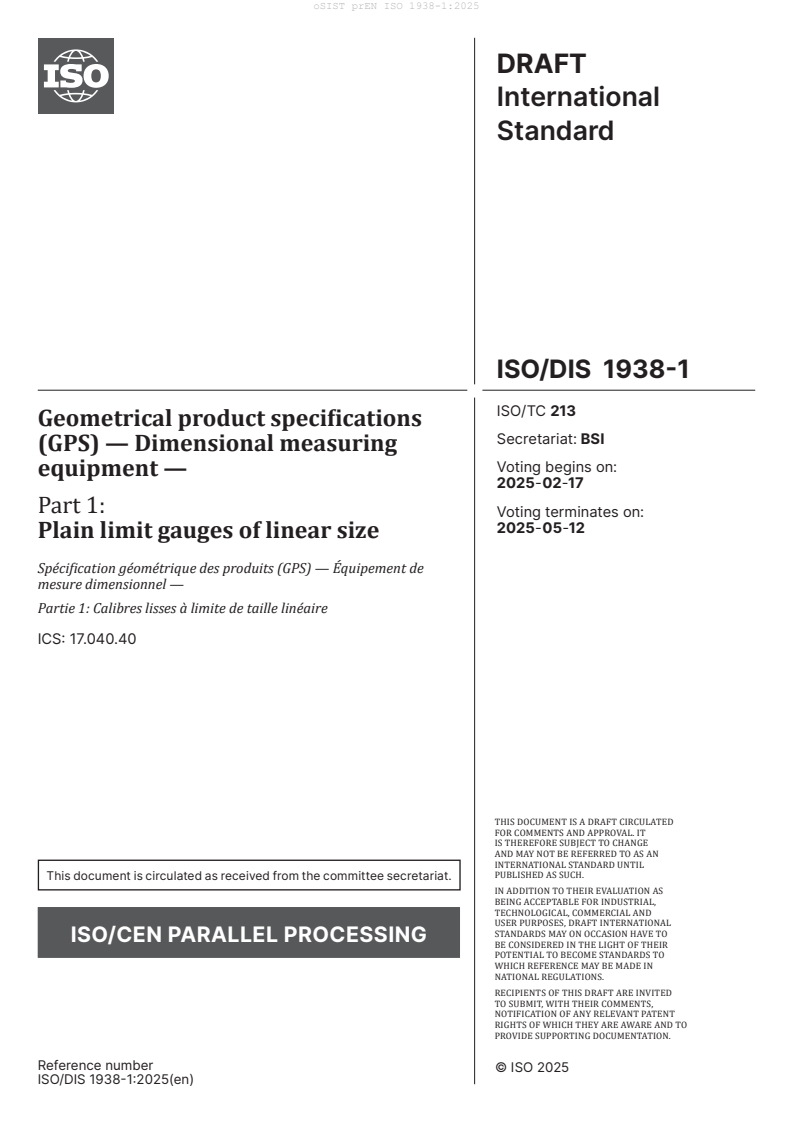
DRAFT
International
Standard
ISO/DIS 1938-1
ISO/TC 213
Geometrical product specifications
Secretariat: BSI
(GPS) — Dimensional measuring
Voting begins on:
equipment —
2025-02-17
Part 1:
Voting terminates on:
2025-05-12
Plain limit gauges of linear size
Spécification géométrique des produits (GPS) — Équipement de
mesure dimensionnel —
Partie 1: Calibres lisses à limite de taille linéaire
ICS: 17.040.40
THIS DOCUMENT IS A DRAFT CIRCULATED
FOR COMMENTS AND APPROVAL. IT
IS THEREFORE SUBJECT TO CHANGE
AND MAY NOT BE REFERRED TO AS AN
INTERNATIONAL STANDARD UNTIL
PUBLISHED AS SUCH.
This document is circulated as received from the committee secretariat.
IN ADDITION TO THEIR EVALUATION AS
BEING ACCEPTABLE FOR INDUSTRIAL,
TECHNOLOGICAL, COMMERCIAL AND
USER PURPOSES, DRAFT INTERNATIONAL
STANDARDS MAY ON OCCASION HAVE TO
ISO/CEN PARALLEL PROCESSING
BE CONSIDERED IN THE LIGHT OF THEIR
POTENTIAL TO BECOME STANDARDS TO
WHICH REFERENCE MAY BE MADE IN
NATIONAL REGULATIONS.
RECIPIENTS OF THIS DRAFT ARE INVITED
TO SUBMIT, WITH THEIR COMMENTS,
NOTIFICATION OF ANY RELEVANT PATENT
RIGHTS OF WHICH THEY ARE AWARE AND TO
PROVIDE SUPPORTING DOCUMENTATION.
Reference number
ISO/DIS 1938-1:2025(en)
DRAFT
ISO/DIS 1938-1:2025(en)
International
Standard
ISO/DIS 1938-1
ISO/TC 213
Geometrical product specifications
Secretariat: BSI
(GPS) — Dimensional measuring
Voting begins on:
equipment —
Part 1:
Voting terminates on:
Plain limit gauges of linear size
Spécification géométrique des produits (GPS) — Équipement de
mesure dimensionnel —
Partie 1: Calibres lisses à limite de taille linéaire
ICS: 17.040.40
THIS DOCUMENT IS A DRAFT CIRCULATED
FOR COMMENTS AND APPROVAL. IT
IS THEREFORE SUBJECT TO CHANGE
AND MAY NOT BE REFERRED TO AS AN
INTERNATIONAL STANDARD UNTIL
PUBLISHED AS SUCH.
This document is circulated as received from the committee secretariat.
IN ADDITION TO THEIR EVALUATION AS
BEING ACCEPTABLE FOR INDUSTRIAL,
© ISO 2025
TECHNOLOGICAL, COMMERCIAL AND
USER PURPOSES, DRAFT INTERNATIONAL
All rights reserved. Unless otherwise specified, or required in the context of its implementation, no part of this publication may
STANDARDS MAY ON OCCASION HAVE TO
ISO/CEN PARALLEL PROCESSING
be reproduced or utilized otherwise in any form or by any means, electronic or mechanical, including photocopying, or posting on
BE CONSIDERED IN THE LIGHT OF THEIR
the internet or an intranet, without prior written permission. Permission can be requested from either ISO at the address below
POTENTIAL TO BECOME STANDARDS TO
WHICH REFERENCE MAY BE MADE IN
or ISO’s member body in the country of the requester.
NATIONAL REGULATIONS.
ISO copyright office
RECIPIENTS OF THIS DRAFT ARE INVITED
CP 401 • Ch. de Blandonnet 8
TO SUBMIT, WITH THEIR COMMENTS,
CH-1214 Vernier, Geneva
NOTIFICATION OF ANY RELEVANT PATENT
Phone: +41 22 749 01 11
RIGHTS OF WHICH THEY ARE AWARE AND TO
PROVIDE SUPPORTING DOCUMENTATION.
Email: copyright@iso.org
Website: www.iso.org
Published in Switzerland Reference number
ISO/DIS 1938-1:2025(en)
ii
ISO/DIS 1938-1:2025(en)
Contents Page
Foreword .iv
Introduction .v
1 Scope . 1
2 Normative references . 1
3 Terms and definitions . 1
3.1 Limits .2
3.2 Gauge types .2
3.3 Characteristics and function of gauges .6
4 Abbreviated terms and symbols . 7
5 Design characteristics for gauges . 8
6 Metrological characteristics . 10
6.1 General .10
6.2 Metrological characteristic relative to the type of limit gauge (GO gauge or NO GO
gauge) .10
7 Maximum permissible limits (MPL) on metrological characteristics . 14
7.1 General .14
7.2 Values for calculation of MPL for limit gauges for internal features of size.14
7.3 Values for calculation of MPL of limit gauges for external features of size .16
7.4 Values for calculation of MPL of limit gauges .17
8 Proving conformance with specification for limit gauges .20
9 Verification of dimensional specification of a workpiece with limit gauges .20
10 Marking . .22
Annex A (informative) General principles and application of limit gauging .23
Annex B (informative) Description of the specific use of the various gauge types and the
associated uncertainty .25
Annex C (informative) Relation to the GPS matrix model .28
Bibliography .30
iii
ISO/DIS 1938-1:2025(en)
Foreword
ISO (the International Organization for Standardization) is a worldwide federation of national standards
bodies (ISO member bodies). The work of preparing International Standards is normally carried out through
ISO technical committees. Each member body interested in a subject for which a technical committee
has been established has the right to be represented on that committee. International organizations,
governmental and non-governmental, in liaison with ISO, also take part in the work. ISO collaborates closely
with the International Electrotechnical Commission (IEC) on all matters of electrotechnical standardization.
The procedures used to develop this document and those intended for its further maintenance are described
in the ISO/IEC Directives, Part 1. In particular, the different approval criteria needed for the different types
of ISO documents should be noted. This document was drafted in accordance with the editorial rules of the
ISO/IEC Directives, Part 2 (see www.iso.org/directives).
ISO draws attention to the possibility that the implementation of this document may involve the use of (a)
patent(s). ISO takes no position concerning the evidence, validity or applicability of any claimed patent
rights in respect thereof. As of the date of publication of this document, ISO had not received notice of (a)
patent(s) which may be required to implement this document. However, implementers are cautioned that
this may not represent the latest information, which may be obtained from the patent database available at
www.iso.org/patents. ISO shall not be held responsible for identifying any or all such patent rights.
Any trade name used in this document is information given for the convenience of users and does not
constitute an endorsement.
For an explanation of the voluntary nature of standards, the meaning of ISO specific terms and expressions
related to conformity assessment, as well as information about ISO's adherence to the World Trade
Organization (WTO) principles in the Technical Barriers to Trade (TBT), see www.iso.org/iso/foreword.html.
This document was prepared by Technical Committee ISO/TC 213, Dimensional and geometrical product
specifications and verification.
This second edition cancels and replaces the first edition (ISO 1938-1:2015), which has been technically
revised.
The main changes are as follows:
— update of the definitions 3.1.3, 3.1.4, 3.2.1;
— in Clause 5 and in Tables 4 and 5, update of design and metrological characteristics of GO gauge type B to K;
— in Table B.1, inclusion of full form cylindrical ring, full form notch gauge and gap gauge.
A list of all parts in the ISO 1938 series can be found on the ISO website.
Any feedback or questions on this document should be directed to the user’s national standards body. A
complete listing of these bodies can be found at www.iso.org/members.html.
iv
ISO/DIS 1938-1:2025(en)
Introduction
This document is a geometrical product specification (GPS) standard and is to be regarded as a general GPS
standard (see ISO 14638). It influences chain links E, F and G of the size chain of standards in the general
GPS matrix. For more detailed information of the relation of this document to other standards and the GPS
matrix model, see Annex C.
The ISO GPS matrix model given in ISO 14638 gives an overview of the ISO GPS system of which this
document is a part. The fundamental rules of ISO GPS given in ISO 8015 apply to this document and the
default decision rules given in ISO 14253-1 apply to specifications made in accordance with this document,
unless otherwise indicated.
This document deals with verification, using plain limit gauges, of linear sizes for features of size when the
dimensional specifications are required (see ISO 14405-1), for rigid workpieces.
NOTE Tables 4 and 5 use the modifiers given in ISO 14405-1 and ISO 1101.
v
DRAFT International Standard ISO/DIS 1938-1:2025(en)
Geometrical product specifications (GPS) — Dimensional
measuring equipment —
Part 1:
Plain limit gauges of linear size
1 Scope
This document specifies the most important metrological and design characteristics of plain limit gauges of
linear size.
This document defines the different types of plain limit gauges used to verify linear dimensional
specifications associated with linear size.
This document also defines the design characteristics and the metrological characteristics for these limit
gauges as well as the new or wear limits state maximum permissible limits (MPLs) for the new state or wear
limits state for these metrological characteristics.
In addition, this document describes the use of limit gauges. It covers linear sizes up to 500 mm.
2 Normative references
The following documents are referred to in the text in such a way that some or all of their content constitutes
requirements of this document. For dated references, only the edition cited applies. For undated references,
the latest edition of the referenced document (including any amendments) applies.
ISO 286-1:2010, Geometrical product specifications (GPS) — ISO code system for tolerances on linear sizes —
Part 1: Basis of tolerances, deviations and fits
ISO 1101, Geometrical product specifications (GPS) — Geometrical tolerancing — Tolerances of form,
orientation, location and run-out
ISO 14405-1, Geometrical product specifications (GPS) — Dimensional tolerancing — Part 1: Linear sizes
ISO 14253-2, Geometrical product specifications (GPS) — Inspection by measurement of workpieces and
measuring equipment — Part 2: Guidance for the estimation of uncertainty in GPS measurement, in calibration
of measuring equipment and in product verification
ISO 17450-2, Geometrical product specifications (GPS) — General concepts — Part 2: Basic tenets, specifications,
operators, uncertainties and ambiguities
ISO/IEC Guide 98-3, Uncertainty of measurement — Part 3: Guide to the expression of uncertainty in
measurement (GUM:1995)
3 Terms and definitions
For the purpose of this document, the terms and definitions given in ISO 286-1, ISO 14405-1, ISO 17450-2,
ISO/IEC Guide 98-3 and ISO/IEC Guide 99 and the following definitions apply.
ISO and IEC maintain terminology databases for use in standardization at the following addresses:
— ISO Online browsing platform: available at https:// www .iso .org/ obp
ISO/DIS 1938-1:2025(en)
— IEC Electropedia: available at https:// www .electropedia .org/
3.1 Limits
3.1.1
maximum material limit of size
MMLS
limit of size corresponding to the maximum material condition of feature of size
Note 1 to entry: MMLS includes the numerical value for the size and the specified association criteria.
Note 2 to entry: A number of different association criteria for size are given in ISO 14405-1 and ISO 17450-3.
3.1.2
least material limit of size
LMLS
limit of size corresponding to the least material condition of feature of size
Note 1 to entry: LMLS includes the numerical value for the size and the specified association criteria.
Note 2 to entry: A number of different association criteria for size are given in ISO 14405-1 and ISO 17450-3.
3.1.3
upper limit of size
ULS
largest permissible size of a feature of size
Note 1 to entry: ULS is a numerical value.
[SOURCE: ISO 286-1:2010, 3.2.3.1]
3.1.4
lower limit of size
LLS
smallest permissible size of a feature of size
Note 1 to entry: LLS is a numerical value.
[SOURCE: ISO 286-1:2010, 3.2.3.2]
3.1.5
upper specification limit
USL
limit of a specification for a metrological characteristic of a gauge having the largest value
3.1.6
lower specification limit
LSL
limit of a specification for a metrological characteristic of a gauge having the smallest value
3.2 Gauge types
3.2.1
limit gauge
gauge designed and intended to verify only if workpiece characteristics are lower or upper at one of its
tolerance limits
Note 1 to entry: When a limit gauge is designed to verify an internal feature of size (a hole for example), then it can be
called internal limit gauge.
Note 2 to entry: When a limit gauge is designed to verify an external feature of size (a shaft for example), then it can be
called external limit gauge.
ISO/DIS 1938-1:2025(en)
Note 3 to entry: General application of limit gauge is given in Annex A.
Note 4 to entry: A limit gauge may be physical or a virtual object (simulated by a geometrical model to be compared to
the extracted integral feature of size of the workpiece).
3.2.2
plain limit gauge
physical limit gauge with only one or two gauge elements, each one simulating a perfect feature of size,
whose size is derived from upper or lower specification limits of the size of a feature of size
Note 1 to entry: When a plain limit gauge consists of only one element, it is qualified as simple (simple plain limit
gauge: GO plain limit gauge or NO GO plain limit gauge).
Note 2 to entry: When a plain limit gauge consists of two elements, it is qualified as double (double plain limit gauge:
GO and NO GO).
3.2.3
full form cylindrical plug gauge
gauge type A
plain limit gauge designed to simulate a cylinder as a contacting feature with an internal cylinder
Note 1 to entry: See Table 1.
Note 2 to entry: The GO gauge type A simulates a dimensional specification defining the maximum material limit of
size with the envelope requirement when the gauge length is greater or at least equal to the length of the feature of
size of the workpiece.
3.2.4
segmental cylindrical bar gauge
gauge type B
plain limit gauge designed to simulate two opposite angular portions of a cylinder as a contacting feature
with an internal cylinder
Note 1 to entry: See Table 1.
3.2.5
segmental cylindrical bar gauge with reduced gauging surfaces
gauge type C
segmental cylindrical bar gauge designed to simulate two reduced opposite angular portions of a cylinder as
a contacting surface with an internal cylinder
Note 1 to entry: See Table 1.
3.2.6
full form spherical plug gauge
gauge type D
plain limit gauge designed to simulate a circle as a contacting feature with an internal cylinder
Note 1 to entry: See Table 1.
Note 2 to entry: The shape of this gauge type is not spherical, but a torus - per tradition the name is “spherical plug gauge”.
3.2.7
segmental spherical plug gauge
gauge type E
plain limit gauge designed to simulate two opposite angular portions of a circle as a contacting feature with
an internal cylinder
Note 1 to entry: See Table 1.
Note 2 to entry: The shape of this gauge type is not spherical but a torus - per tradition the name is “segmental
spherical plug gauge”.
ISO/DIS 1938-1:2025(en)
3.2.8
bar gauge
gauge type F
full form bar gauge
plain limit gauge designed to simulate two opposite planes as a contacting feature with an internal feature
of size consisting of two opposite planes
Note 1 to entry: See Table 1.
3.2.9
rod gauge with spherical ends
gauge type G
plain limit gauge designed to simulate two opposite points as a contacting feature with an internal feature
of size consisting of two opposite planes or of a cylinder
Note 1 to entry: See Table 1.
Note 2 to entry: The active part of a rod gauge with spherical ends consists only of two points: the two points at the
largest distance between the two spheres.
ISO/DIS 1938-1:2025(en)
Table 1 — Types of limit gauge for internal feature of size
Nominal contacting feature with
feature of size of type
Limit gauge Type Illustration
“two opposite
“Cylinder”
parallel planes”
Two opposite
Full form cylindrical plug gauge Gauge type A Cylinder parallel straight
lines
Two opposite Two opposite
Segmental cylindrical bar gauge Gauge type B angular portions parallel straight
of cylinder lines
Two opposite
Segmental cylindrical bar gauge with angular reduced Two opposite par-
Gauge type C
reduced gauging surfaces portions of cyl- allel line segments
inder
Full form spherical plug gauge Gauge type D Circle Two points
Two opposite
Segmental spherical plug gauge Gauge type E angular portions Two points
of circle
Two opposite
Bar gauge Gauge type F Not applicable
parallel planes
Rod gauge with spherical ends Gauge type G Two points Two points
3.2.10
full form cylindrical ring gauge
gauge type H
plain limit gauge designed to simulate a cylinder as contacting feature with an external cylinder
Note 1 to entry: See Table 2.
ISO/DIS 1938-1:2025(en)
3.2.11
full form notch gauge
gauge type J
plain limit gauge designed to simulate straight lines or flat surfaces on two opposite parallel planes as
contacting features with an external feature of size consisting of a cylinder or two opposite planes
Note 1 to entry: See Table 2.
3.2.12
gap gauge
gauge type K
plain limit gauge designed to simulate portions (straight lines or flat surfaces) on two opposite planes as
contacting feature with an external feature of size consisting of a cylinder or two opposite planes
Note 1 to entry: See Table 2.
Table 2 — Types of limit gauge for external feature of size
Nominal contacting feature with feature
of size of type:
Limit gauge Type Illustration
“two opposite paral-
“cylinder”
lel planes”
Full form cylindrical ring gauge Gauge type H Cylinder Not applicable
Two opposite par- Two opposite parallel
Full form notch gauge Gauge type J
allel straight lines planes
Two opposite par-
Two opposite parallel
Gap gauge Gauge type K allel straight line
portions of planes
segments
3.3 Characteristics and function of gauges
3.3.1
non-adjustable gauge
gauge with an inherent, stable and not changeable nominal metrological characteristic
Note 1 to entry: The metrological characteristics of a non-adjustable gauge may change with, for example, temperature
and wear.
EXAMPLE A full form cylindrical plug gauge and a full form cylindrical ring gauge are non-adjustable gauges.
3.3.2
adjustable gauge
gauge designed in a way that the inherent nominal metrological characteristic can be intentionally changed
by the user
Note 1 to entry: The metrological characteristics of an adjustable gauge may also change with, for example,
temperature and wear.
EXAMPLE A variable gap gauge and a variable rod gauge with spherical ends are adjustable gauges.
ISO/DIS 1938-1:2025(en)
3.3.3
GO gauge
gauge designed to verify the size of the workpiece relative to maximum material size according to
dimensional specification
Note 1 to entry: Usually relative to the maximum material limit of size (MMLS) of the dimensional specification, the
GO gauge passing over the actual feature of size of the workpiece, defines an acceptance and the GO gauge, not passing
over the actual feature of size of the workpiece defines a non-acceptance.
3.3.4
NO GO gauge
gauge designed to verify the size of the workpiece relative to least material size according to dimensional
specification
Note 1 to entry: Usually relative to the least material limit of size (LMLS) of the dimensional specification, the NO GO
gauge not passing over the actual feature of size of the workpiece defines an acceptance and the NO GO gauge passing
over the actual feature of size of the workpiece defines a non-acceptance.
3.3.5
length of gauge element
active length of a gauge in the direction perpendicular to a cross section of the gauged feature of size
Note 1 to entry: For a cylindrical gauge element, it is the length of the cylinder (see Table 4). For a gauge element of
type “two parallel opposite surfaces”, it is the length of the bar or notch (see Table 4). For a gap gauge, it is the width of
the anvils (see Table 4).
3.3.6
height of gauge element
active height of a gauge in the direction parallel to a cross section of the gauged feature of size
Note 1 to entry: For a gauge element of type two parallel opposite surfaces, it is the height of the bar or notch (see
Table 4). For a gap gauge, it is the height of the anvils (see Table 4).
3.3.7
new state specification
specification for metrological characteristics of a new gauge to be used by a manufacturer
or supplier
3.3.8
wear limits state specification
specification for metrological characteristics of a used gauge
Note 1 to entry: The user may use standardized wear limits state specifications, e.g. as given in this document.
Note 2 to entry: The wear limits state specifications consider the gauge as used, and can include wear limits.
3.3.9
new state permissible limits of a metrological characteristic
permissible limits of a metrological characteristic in a new state specification
3.3.10
wear limits state permissible limits of a metrological characteristic
permissible limits of a metrological characteristic in a wear limits state specification
4 Abbreviated terms and symbols
For the purpose of this document, the abbreviated terms and symbols given in Table 3 apply.
ISO/DIS 1938-1:2025(en)
Table 3 — Abbreviated terms and symbols
Description
Abbreviated term
B width of segmental gauge element
F tolerance value of form specification on limit gauge
GO GO gauge
H interval tolerance on the size characteristic, S, for a limit gauge in the new state
LT length of gauge element
HG height of gauge element
USL upper specification limit (of a gauge)
LG length of gauge element
LSL lower specification limit (of a gauge)
LMLS least material limit of size
M new state gauge
MMLS maximum material limit of size
MPL maximum permissible limits of a metrological characteristic
NO GO NO GO gauge
S size
SR spherical radius of the gauge
T tolerance
U wear limits state gauge
W workpiece
Symbol
y amount outside of workpiece tolerance limit taking into account a margin of wear limit for
internal feature of size
y amount outside of workpiece tolerance limit taking into account a margin of wear limit for
external feature of size
z distance between centre of tolerance for GO new state gauge and the lower specification
limit of an internal feature of size of a workpiece
z distance between centre of tolerance for GO new state gauge and the upper specification
limit of an external feature of size of a workpiece
α safety allowance for measurement uncertainty for internal feature of size
α safety allowance for measurement uncertainty for external feature of size
5 Design characteristics for gauges
The length of the GO gauge type A, B and H shall be greater or at least equal to the length of the feature
of size of the workpiece with the envelope requirement, unless the agreement between the user and the
manufacturer.
The height and length of the GO gauge type F and J shall greater or at least equal to the length of the feature
of size of the workpiece with the envelope requirement, unless the agreement between the user and the
manufacturer.
For rod gauges with spherical ends the contact radius of each gauging surface shall be not greater than
50 percent of the nominal size of the workpiece to be verified.
The material used for gauges shall be suitably selected with due consideration to its size stability, durability
and stiffness.
ISO/DIS 1938-1:2025(en)
Gauging elements shall normally be manufactured from a high quality steel suitably selected to provide a
high degree of wear resistance after heat treatment. Other wear-resistant materials, e.g. tungsten carbide,
may be used provided that their wear qualities are not less than those of the steel specified above.
NOTE The temperature expansion coefficient of the material used is to be considered together with the wear
resistance.
Hard plating or other surface treatments in order to improve the wear resistance of the surface may also be
applied to gauging surfaces, but the thickness of deposit shall at least be of an amount, that an acceptable
gauge always has a fully intact layer of wear resistant material.
The hardness of the gauging surface shall not be less than 670 HV 30 (approximately 58 HRC), irrespective
of the type of material.
There may be specific applications where the use of special materials (e.g. aluminium and glass) is required
by the nature of the workpiece or the manufacturing environment. In such cases it may not be possible to
have the required hardness or wear resistance.
The gauging surface shall be finished by fine grinding or lapping or a process which results in a smooth type
of surface. The surface roughness of gauging surface shall be specified and the R value shall not exceed
a
10 % of the new state gauge MPL for size (see Example and Table 6) with an upper tolerance limit value of
0,2 µm, and nesting index (cut-off) value of 0,8 mm (see ISO 21920-1).
EXAMPLE Surface texture specification related to R parameter on gauging surface:
a
Additional surface texture parameters can be specified.
All sharp edges shall be removed unless functionally required.
The design of grip handle of the plain limit gauge shall take into account ergonomic considerations (e.g.
knurling, hexagon shape) and the associated characteristics to the grip handle are also design characteristics.
Design options on some gauges are possible; these are given below.
— Air slot: for a GO gauge- full form cylindrical plug gauge: this option is intended to verify a blind hole, to
avoid phenomena of compression and suction. This option requires defining the air slot dimensions.
— Precentering/pilot (see Figure 1): for a GO gauge or a NO GO gauge - full form cylindrical plug gauge and
segmental cylindrical bar gauge; this option is intended to facilitate the introduction of the gauge in the
workpiece. This option requires defining the precentering or pilot dimensions.
When a gauge with precentering option is used for a blind hole, an air slot option may be used.
Figure 1 — Illustration of precentering option (example)
Other specific design characteristics, attached to a type of gauge, are described in Tables 4 and 5.
ISO/DIS 1938-1:2025(en)
6 Metrological characteristics
6.1 General
A plain limit gauge has one or two gauge elements (GO gauge or NO GO gauge, or GO and NO GO gauge).
Metrological characteristics are defined for these gauge elements. These metrological characteristics
influence the quality of the evaluation made using the gauge.
The most important metrological characteristics for the gauge elements are the size characteristic and form
characteristic. The modifiers defined in ISO 14405-1 and the symbols defined in ISO 1101 can be used to
define these metrological characteristics.
The size characteristic can be seen metrologically by different ways. For example, on a cylinder, it is possible
to evaluate the maximum inscribed diameter, the minimum circumscribed diameter, the minimum local
diameter, the maximum local diameter or the least square diameter. Each of them can yield different result
of measurement. For this reason, the metrological characteristic includes this information (by adding after
the size one or more modifiers as defined in ISO 14405-1).
Depending on the use of the plain gauge and its type, the metrological characteristic impacting the
uncertainty of verification can be different, for the same plain gauge.
NOTE When a slot without envelope requirement is checked for its lower tolerance limit with a gauge type A, two
parallel lines will be checked which do not exactly correspond to the definition for two-point size. The gauge type G is
the gauge type that follows the definition for two-point size.
This document describes potential metrological characteristics available on plain limit gauge. The final
decision to select one or several metrological characteristics is left to the user.
6.2 Metrological characteristic relative to the type of limit gauge (GO gauge or NO GO gauge)
Tables 4 and 5 give potential metrological characteristics associated to a gauge type, but also complementary
design characteristics as defined in Clause 5. Depending on the need of the user, a set of these metrological
characteristics shall be defined; by default, the two point size is required for the size characteristic, S, of the
gauge limit and the form deviation also.
Table 4 — List of potential design and metrological characteristics for external gauge type
Description Complementary Metrological characteristics for
design charac-
GO gauge NO GO gauge
teristics
Full form cylindrical plug gauge — Gauge
type A
LG
Segmental cylindrical bar gauge — Gauge
type B
ISO/DIS 1938-1:2025(en)
TTabablele 4 4 ((ccoonnttiinnueuedd))
Description Complementary Metrological characteristics for
design charac-
GO gauge NO GO gauge
teristics
LG
B
Segmental cylindrical bar gauge with re-
duced gauging surfaces — Gauge type C
LG
B
LT
Full form spherical plug gauge — Gauge type
D
R
LT
Segmental spherical plug gauge — Gauge type
E
ISO/DIS 1938-1:2025(en)
TTabablele 4 4 ((ccoonnttiinnueuedd))
Description Complementary Metrological characteristics for
design charac-
GO gauge NO GO gauge
teristics
B
LT
R
Bar gauge — Gauge type F
LG
HG
Rod gauge with spherical ends — Gauge type
G
SR
a
default metrological characteristics to be considered
minimum circumscribed (see ISO 14405 1)
two-point size (see ISO 14405 1)
ACS any cross section (see ISO 14405 1)
UF united feature (see ISO 14405 1)
ISO/DIS 1938-1:2025(en)
Table 5 — List of potential design and metrological characteristics for internal gauge type
Description Complementa- Metrological characteristics for
ry design char-
GO gauge NO GO gauge
acteristics
Full form cylindrical ring gauge — Gauge type H
Dy
LG
Full form notch gauge — Gauge type J LG
HG
Gap gauge — Gauge type K LG
HG
ISO 10579-NR – Restrained condition:
a) normally the dimension HG is vertical compared to the
gravity direction
b) gap gauges shall only be used for rigid workpieces
a
default metrological characteristics to be considered
maximum inscribed (see ISO 14405-1)
two-point size (see ISO 14405 1)
ACS any cross section (see ISO 14405-1)
ISO/DIS 1938-1:2025(en)
7 Maximum permissible limits (MPL) on metrological characteristics
7.1 General
The maximum permissible limits, MPL, for a gauge are completely equivalent to the specification limits on a
characteristic.
a) The maximum permissible limits on form and orientation characteristics are asymmetrical.
1) The upper tolerance limit of MPL on these characteristics is equal to the value of F given in Table 6
and depending to the type of the gauge.
2) The lower tolerance limit of MPL on these characteristics is equal to 0.
3) The evaluation of these characteristics shall be in accordance with ISO 1101 and shall fulfil MPLs.
EXAMPLE 1 A metrological characteristic of cylindricity with its MPLs is equivalent to the following
requirement: . Its meaning is given in ISO 1101.
b) Specifications for metrological characteristics associated to the size characteristic to a limit gauge of
the same type used as a GO gauge and as a NO GO gauge are different (see 7.2 and 7.3) and applicable by
default to the two point size, S Lp.
Specifications of the gauges for new or wear limits state attached to the size metrological characteristics
associated to these tolerance limits are always different for GO gauges and may be equal for NO GO gauges.
The new state specification limits of GO gauges are always positioned inside the workpiece tolerance limits.
Tables 6 to 11 can be used directly when the tolerance of the dimension of feature of size of workpiece is given
as a code according to ISO 286-1. When the size tolerance is not given as an ISO code, the standard tolerance
grade shall be defined as the standard tolerance grade corresponding to the first tolerance interval, T, given
in Tables 7 to 11, lower than the tolerance interval of the workpiece in the same range of nominal sizes.
EXAMPLE 2 For a dimensional specification given on the workpiece, by 20 ± 0,02 , the tolerance interval on the
workpiece is equal to 40 µm. In Table 8, in the nominal range in which 20 is included, the lower standardized tolerance
interval is equal to 33 µm, corresponding to the standard tolerance grade equal to 8, which is to be used to define the
metrological characteristic for a plain limit gauge to verify this dimensional specification.
NOTE For GO gauges, the specification limits are positioned by z and z1 relative to the tolerance limit of the
workpiece (see Figures 2 and 3) in order to allow a certain wear and therefore a certain time in use before the size and
form is worn outside the specification for the limit gauge.
7.2 Values for calculation of MPL for limit gauges for internal features of size
The tolerances limits, defining the MPL for the size characteristic, of a GO gauge and NO GO gauge in a new
state, and in wear state for internal features of size in relation to workpiece tolerance limits are shown in
Figure 2.
The NO GO gauge specification is positioned relative to the LMLS of the workpiece tolerance limits.
The GO gauge specification is positioned relative to the MMLS of the workpiece tolerance limits.
ISO/DIS 1938-1:2025(en)
Figure 2 — MPL size position for GO and NO GO gauges for workpieces of internal feature of size
The value for H (see Figure 2) is specific for each type of limit gauge, workpiece tolerance grade and
workpiece feature size and shall be taken from Table 6.
The values of z, α and y (see Figure 2) is specific for each workpiece tolerance grade and workpiece feature
size, and shall be taken from Tables 7 to 11.
When a plug gauge is used as a NO GO limit gauge (for LMLS) of a workpiece feature (LMLS ) the requirement
W
on the size, S, of the gauge element shall be in accordance with the following gauge tolerances for new and
wear limits state (see Figure 2):
H
— for the upper specification limit:
USLU==SL USL −+α
U,NOGO M,NOGO W
H
— for the lower specification limit: LSLL==SL USL −−α
U,NOGO M,NOGO W
where α is equal to zero when the nominal value is up to or equal to 180 mm.
When a plug gauge is used as a GO gauge (for MMLS) of a workpiece feature (MMLS ), the requirement on
w
the size, S, of the gauge element shall be in accordance with the following gauge tolerances:
a) for the new state (see Figure 2):
H
1) for the upper specification limit:
USLL=+SL z+
M, GOW
H
2) for the lower specification limit:
LSLL=+SL z−
M, GOW
b) for the wear limits state (see Figure 2):
H
1) for the upper specification limit:
USLL=+SL z+
U, GOW
LSLL=+SL α− y
2) for the lower specification limit:
U, GOW
ISO/DIS 1938-1:2025(en)
where
y represents an amount outside of workpiece tolerance limits taking into account a margin of wear
limits of GO gauge;
α represents a safety allowance for measurement uncertainty.
7.3 Values for calculation of MPL of limit gauges for external features of size
The tolerances limits, defining the MPL for the size characteristic, of a GO gauge and NO GO gauge in a new
state, and in wear state for external features of size in relation to workpiece tolerance limits are shown in
Figure 3.
The GO gauge specification is positioned relative to the MMLS of the workpiece tolerance.
The NO GO gauge specification is positioned relative to the LMLS of the workpiece tolerance.
Figure 3 — MPL size position for GO and NO GO gauges for workpieces for an external feature of size
The value for H (see Figure 3) is specific for each type of limit gauge, for workpiece tolerance grade and size
and shall be taken from Table 6.
The value of z , α and y (see Figure 3) is specific for each workpiece feature size and tolerance grade.
1 1 1
Values for z , α and y shall be taken from Tables 7 to 11.
1 1 1
When a gauge (type ring) is used as a GO gauge for an external feature of size of a workpiece (MMLS ), the
W
requirement on size, S, of the gauge element shall be in accordance with the following gauge tolerances:
a) for the new state (see Figure 3):
H
1) for the upper specification limit:
USLU=−SL z +
M, GOW 1
H
2) for the lower specification limit:
LSLU=−SL z −
M, GOW 1
b) for the wear limits state (see Figure 3):
ISO/DIS 1938-1:2025(en)
USLU=+SL y −α
1) for the upper specification limit:
U, GOW 11
H
2) for the lower specification limit: LSLU=−SL z −
U, GOW 1
where
y represents an amount outside of workpiece tolerance limits taking into account a margin of wear
limits of GO gauge;
α represents a safety zone for compensation of measurement uncertainty.
When a gauge (type ring) is to be used as a NO GO gauge of an external feature of size of a workpiece
(LMLS ), the requirement on size, S, of the gauge element shall be in accordance with the following gauge
W
tolerances:
H
— for the upper specification limit (see Figure 3):
USLU==SL LSL ++α
M,NO GOU,NOGOW 1
H
— for the lower specification limit (see Figure 3): LSLL==SL LSL +−α
M,NO GOU,NOGOW 1
where α is equal to zero when the nominal value is up to or equal to 180 mm.
7.4 Values for calculation of MPL of limit gauges
When the size tolerance limits of the workpiece are given as a code according to ISO 286-1, use Tables 6 to
11 directly.
When the size to
...
Questions, Comments and Discussion
Ask us and Technical Secretary will try to provide an answer. You can facilitate discussion about the standard in here.
Loading comments...