

EN 1240:2011
(Main)Adhesives - Determination of hydroxyl value and/or hydroxyl content
- Abstract
This European Standard specifies a method to determine the hydroxyl value and/or the hydroxyl content of adhesives, adhesive components, their basic constituents and related products. This method can also be used to determine the hydroxyl value and/or the hydroxyl content of surface protection systems of concrete.
- Status
- Published
- Publication Date
- 19-Apr-2011
- Withdrawal Date
- 30-Oct-2011
- Technical Committee
- CEN/TC 193 - Adhesives
- Current Stage
- 9093 - Decision to confirm - Review Enquiry
- Start Date
- 08-Jan-2026
- Completion Date
- 07-Oct-2026

Overview
EN 1240:2011 is a European Standard developed by CEN that specifies the analytical method for determining the hydroxyl value and/or hydroxyl content in adhesives, adhesive components, their basic constituents, and related products. This standard also extends to surface protection systems for concrete, providing a reliable and consistent laboratory procedure to measure hydroxyl groups (-OH) in materials critical to adhesive formulation and quality control.
Hydroxyl value and hydroxyl content testing play a pivotal role in characterizing adhesives, influencing factors such as reactivity, performance, and durability. By following EN 1240:2011, laboratories ensure accurate and harmonized results compliant with European regulatory frameworks.
Key Topics
Scope and Applicability
The standard covers methods for adhesives and their components, as well as surface protection systems of concrete, ensuring broad applicability across construction, manufacturing, and materials science sectors.Principles of Determination
Hydroxyl groups are acetylated using acetic anhydride in pyridine solution. After reaction and hydrolysis, the generated acetic acid is titrated with potassium hydroxide, allowing quantitative calculation of hydroxyl content.Reagents and Apparatus
Laboratories use analytical grade acetic anhydride, pyridine, phenolphthalein, and standardized potassium hydroxide solutions. Apparatus includes volumetric glassware (Class A), analytical balances, reflux condensers, water baths, burettes, and optional potentiometric titration devices.Procedure Overview
The sample is prepared according to specified EN standards (EN ISO 15605 for sampling, EN 1067 for preparation), weighed precisely, reacted under reflux at 100°C, hydrolyzed with water, then titrated. Results require multiple replicates to ensure reliability.Calculations and Interpretation
Hydroxyl value (in mg KOH/g) and percentage hydroxyl content are calculated from titration volumes corrected for blank tests and acid value (per EN 1241). This dual expression enables flexible reporting according to user requirements.Safety and Environmental Considerations
The standard emphasizes adherence to laboratory safety protocols when handling reagents. It also encourages responsible waste disposal aligned with local regulations to minimize environmental impact.
Applications
Adhesives Quality Control
EN 1240:2011 facilitates precise measurement of hydroxyl groups in adhesives, ensuring consistent chemical properties necessary for bonding performance, curing behavior, and formulation control.Surface Protection Systems
The method applies to concrete coatings and protective layers, aiding in assessing polymer crosslinking potential and durability characteristics.Raw Material Characterization
The hydroxyl value measurement assists manufacturers in verifying purity and functionality of polymer precursors, polyols, and other constituents critical for high-performance adhesives.Regulatory Compliance
Compliance with EN 1240:2011 enables manufacturers and testing laboratories to meet European standards harmonized across member countries, streamlining product acceptance and market access.Research and Development
Researchers use this standardized method to develop novel adhesive formulations and optimize processing by understanding hydroxyl group concentrations and behavior.
Related Standards
EN 923:2005+A1:2008 – Terms and definitions related to adhesives, ensuring terminology consistency for EN 1240:2011 users.
EN 1241 – Determination of acid value in adhesives, crucial for correction in hydroxyl value calculation.
EN ISO 15605 – Sampling methods for adhesive products, standardizing sample preparation.
EN 1067 – Guidelines for examination and preparation of adhesive samples prior to testing.
EN ISO 15528 – Sampling of paints, varnishes, and related materials, applicable when testing surface protection systems.
EN ISO 3696 and EN ISO 385 – Specifications for laboratory water and volumetric glassware to ensure accuracy and reproducibility.
Conclusion
EN 1240:2011 provides a robust and practical methodology for determining hydroxyl value and content in adhesives and related materials. The standard ensures harmonization across European laboratories, enabling manufacturers and researchers to produce and verify high-quality adhesive products with reliable data. Its applicability to concrete surface protection systems further broadens its industrial relevance. Laboratories adhering to EN 1240:2011 benefit from improved accuracy, repeatability, and compliance with environmental and safety best practices.
By integrating this standard into quality control and R&D processes, companies enhance product performance, support regulatory requirements, and foster innovation in adhesive technology.
Relations
- Effective Date
- 23-Apr-2011
- Effective Date
- 09-Feb-2026
- Effective Date
- 28-Jan-2026
- Effective Date
- 28-Jan-2026
- Effective Date
- 28-Jan-2026
- Effective Date
- 28-Jan-2026
- Effective Date
- 28-Jan-2026
- Effective Date
- 28-Jan-2026
- Effective Date
- 28-Jan-2026
- Effective Date
- 28-Jan-2026
- Effective Date
- 28-Jan-2026
- Effective Date
- 28-Jan-2026
- Effective Date
- 28-Jan-2026
Get Certified
Connect with accredited certification bodies for this standard

DIN CERTCO
DIN Group product certification.

Smithers Quality Assessments
US management systems and product certification.
Sponsored listings
Frequently Asked Questions
EN 1240:2011 is a standard published by the European Committee for Standardization (CEN). Its full title is "Adhesives - Determination of hydroxyl value and/or hydroxyl content". This standard covers: This European Standard specifies a method to determine the hydroxyl value and/or the hydroxyl content of adhesives, adhesive components, their basic constituents and related products. This method can also be used to determine the hydroxyl value and/or the hydroxyl content of surface protection systems of concrete.
This European Standard specifies a method to determine the hydroxyl value and/or the hydroxyl content of adhesives, adhesive components, their basic constituents and related products. This method can also be used to determine the hydroxyl value and/or the hydroxyl content of surface protection systems of concrete.
EN 1240:2011 is classified under the following ICS (International Classification for Standards) categories: 83.180 - Adhesives. The ICS classification helps identify the subject area and facilitates finding related standards.
EN 1240:2011 has the following relationships with other standards: It is inter standard links to EN 1240:1998, ISO 648:2008, EN ISO 3696:1995, EN 1067:2005, EN 923:2005+A1:2008, EN ISO 385:2005, EN ISO 1042:1999, EN ISO 15528:2020, EN ISO 15605:2004, EN 1241:1998, EN 1504-5:2004, EN 1504-5:2013, EN 1504-2:2004. Understanding these relationships helps ensure you are using the most current and applicable version of the standard.
EN 1240:2011 is available in PDF format for immediate download after purchase. The document can be added to your cart and obtained through the secure checkout process. Digital delivery ensures instant access to the complete standard document.
Standards Content (Sample)
2003-01.Slovenski inštitut za standardizacijo. Razmnoževanje celote ali delov tega standarda ni dovoljeno.XSLQKlebstoffe - Bestimmung der Hydroxylzahl und/oder des HydroxylgehaltesAdhésifs - Détermination de la valeur hydroxyle et/ou de la teneur en hydroxyleAdhesives - Determination of hydroxyl value and/or hydroxyl content83.180LepilaAdhesivesICS:Ta slovenski standard je istoveten z:EN 1240:2011SIST EN 1240:2011en,fr,de01-november-2011SIST EN 1240:2011SLOVENSKI
STANDARDSIST EN 1240:19991DGRPHãþD
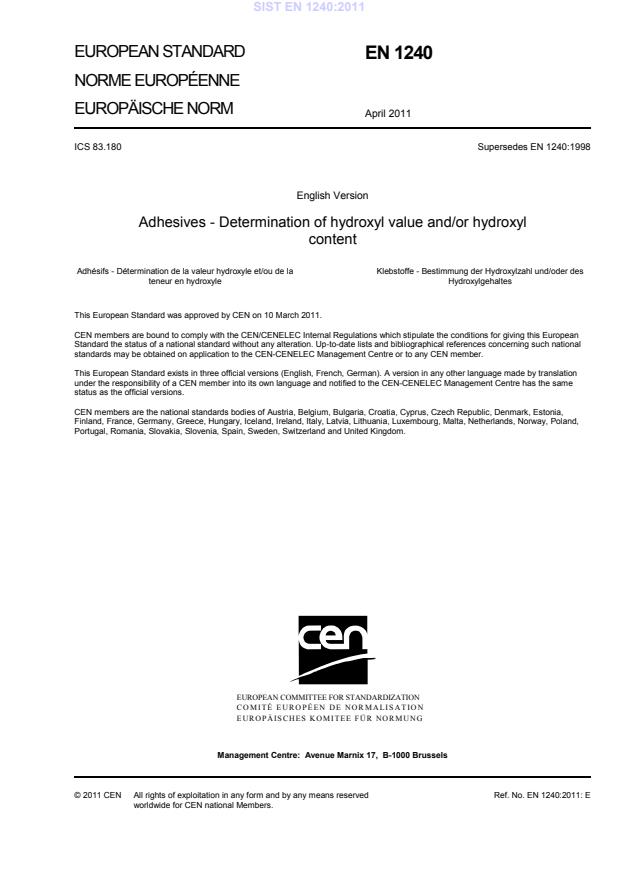
EUROPEAN STANDARD NORME EUROPÉENNE EUROPÄISCHE NORM
EN 1240
April 2011 ICS 83.180 Supersedes EN 1240:1998English Version
Adhesives - Determination of hydroxyl value and/or hydroxyl content
Adhésifs - Détermination de la valeur hydroxyle et/ou de la teneur en hydroxyle
Klebstoffe - Bestimmung der Hydroxylzahl und/oder des Hydroxylgehaltes This European Standard was approved by CEN on 10 March 2011.
CEN members are bound to comply with the CEN/CENELEC Internal Regulations which stipulate the conditions for giving this European Standard the status of a national standard without any alteration. Up-to-date lists and bibliographical references concerning such national standards may be obtained on application to the CEN-CENELEC Management Centre or to any CEN member.
This European Standard exists in three official versions (English, French, German). A version in any other language made by translation under the responsibility of a CEN member into its own language and notified to the CEN-CENELEC Management Centre has the same status as the official versions.
CEN members are the national standards bodies of Austria, Belgium, Bulgaria, Croatia, Cyprus, Czech Republic, Denmark, Estonia, Finland, France, Germany, Greece, Hungary, Iceland, Ireland, Italy, Latvia, Lithuania, Luxembourg, Malta, Netherlands, Norway, Poland, Portugal, Romania, Slovakia, Slovenia, Spain, Sweden, Switzerland and United Kingdom.
EUROPEAN COMMITTEE FOR STANDARDIZATION
COMITÉ EUROPÉEN DE NORMALISATION EUROPÄISCHES KOMITEE FÜR NORMUNG
Management Centre:
Avenue Marnix 17,
B-1000 Brussels © 2011 CEN All rights of exploitation in any form and by any means reserved worldwide for CEN national Members. Ref. No. EN 1240:2011: ESIST EN 1240:2011
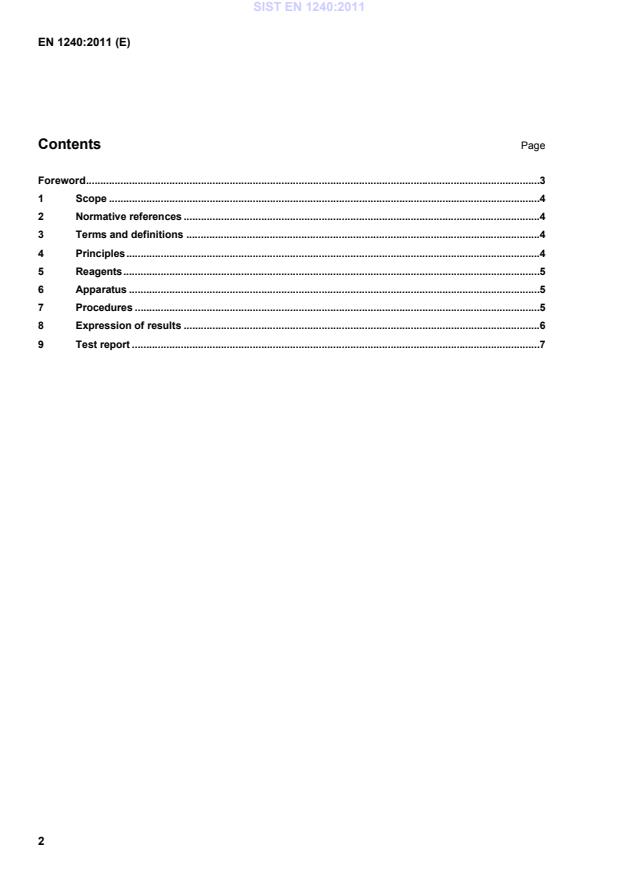
2 Contents Page Foreword .31Scope .42Normative references .43Terms and definitions .44Principles .45Reagents .56Apparatus .57Procedures .58Expression of results .69Test report .7 SIST EN 1240:2011
3 Foreword This document (EN 1240:2011) has been prepared by Technical Committee CEN/TC 193 “Adhesives”, the secretariat of which is held by AENOR. This European Standard shall be given the status of a national standard, either by publication of an identical text or by endorsement, at the latest by October 2011, and conflicting national standards shall be withdrawn at the latest by October 2011. Attention is drawn to the possibility that some of the elements of this document may be the subject of patent rights. CEN [and/or CENELEC] shall not be held responsible for identifying any or all such patent rights. This document supersedes EN 1240:1998. The main modifications regarding the previous version are in the Foreword, Normative References and 6.5. SAFETY STATEMENT— Persons using this document should be familiar with the normal laboratory practice, if applicable. This document does not purport to address all of the safety problems, if any, associated with its use. It is the responsibility of the user to establish appropriate safety and health practices and to ensure compliance with any regulatory conditions. ENVIRONMENTAL STATEMENT — It is understood that some of the material permitted in this standard may have negative environmental impact. As technological advantages lead to acceptable alternatives for these materials, they will be eliminated from this standard to the extent possible. At the end of the test, the user of the standard should take care to carry out an appropriate disposal of the wastes, according to local regulation. According to the CEN/CENELEC Internal Regulations, the national standards organizations of the following countries are bound to implement this European Standard: Austria, Belgium, Bulgaria, Croatia, Cyprus, Czech Republic, Denmark, Estonia, Finland, France, Germany, Greece, Hungary, Iceland, Ireland, Italy, Latvia, Lithuania, Luxembourg, Malta, Netherlands, Norway, Poland, Portugal, Romania, Slovakia, Slovenia, Spain, Sweden, Switzerland and the United Kingdom.
4 1 Scope This European Standard specifies a method to determine the hydroxyl value and/or the hydroxyl content of adhesives, adhesive components, their basic constituents and related products. This method can also be used to determine the hydroxyl value and/or the hydroxyl content of surface protection systems of concrete. 2 Normative references The following referenced documents are indispensable for the application of this document. For dated references, only the edition cited applies. For undated references, the latest edition of the referenced document (including any amendments) applies. EN 923:2005+A1:2008, Adhesives
Terms and definitions EN 1067, Adhesives
Examination and preparation of samples for testing EN 1241, Adhesives
Determination of acid value EN ISO 15528, Paints, varnishes and raw materials for paints and varnishes
Sampling (
...