


prEN 15014
(Main)Plastics piping systems - Buried and above ground piping components for water under pressure - Requirements and test/assessment methods for pipes and fittings
Plastics piping systems - Buried and above ground piping components for water under pressure - Requirements and test/assessment methods for pipes and fittings
This European Standard specifies product characteristics for plastics pipes and fittings for pressure applications for water supply, drainage, sewerage and irrigation with the exception of water intended for human consumption.
Pipes and fittings covered by this standard are intended to be used for buried or above-ground conveyance of water, waste water, water for general purposes, vacuum-operated soil and waste conveyance, for both outside and inside buildings.
It gives the associated test/assessment methods.
This standard does not cover valves, adhesives, joint sealings and gaskets.
NOTE Products complying with this document may be used for the transport of water intended for human consumption and raw water prior to treatment if they comply with the relevant national, regional or local regulatory provisions applicable in the place of use. Compliance of a product with this document does not confer a presumption of fitness of the product for the transport of water intended for human consumption within the meaning of the Regulation (EU) No. 305/2011 (CPR).
Kunststoff-Rohrleitungssysteme - Bauteile für den Einsatz in erdverlegten und nicht erdverlegten Druckrohrleitungen für Wasser - Anforderungen und Prüf-/Bewertungsverfahren für Rohre und Formstücke
Diese Europäische Norm legt Produkteigenschaften für Rohre und Formstücke aus Kunststoff für Druck-rohrleitungssysteme für Wasserversorgung, Entwässerung, Abwasser und Bewässerung mit Ausnahme von Wasser für den menschlichen Gebrauch fest.
Rohre und Formstücke nach dieser Norm sind vorgesehen für die Anwendung für den Transport von Wasser, Abwasser, Brauchwasser, das Ableiten von Abwasser bei Unterdruck in erdverlegten oder nicht erdverlegten Rohrleitungen sowohl außerhalb als auch innerhalb von Gebäuden.
Sie enthält die zugehörigen Prüf-/Bewertungsverfahren.
Diese Norm gilt nicht für Armaturen, Klebstoffe, Abdichtungen von Rohrverbindungen und Dichtungen.
ANMERKUNG Produkte dürfen bei Übereinstimmung mit diesem Dokument für den Transport von Wasser für den menschlichen Gebrauch und Rohwasser vor der Aufbereitung verwendet werden, sofern sie den maßgebenden am Einsatzort geltenden nationalen, regionalen oder örtlichen gesetzlichen Bestimmungen entsprechen. Die Überein-stimmung eines Produkts mit diesem Dokument stellt keine Annahme der Gebrauchstauglichkeit des Produkts für den Transport von Wasser für den menschlichen Gebrauch im Sinne der Verordnung (EU) Nr. 305/2011 (BauPVO) dar.
Systèmes de canalisations en plastique - Composants de canalisation enterrés et aériens pour eau avec pression - Exigences et méthodes d’essais/d’évaluation pour tubes et raccords
La présente Norme européenne spécifie les caractéristiques de produit relatives aux tubes et raccords en plastique destinés aux applications avec pression pour l’alimentation en eau, les branchements, les collecteurs d’assainissement et l’irrigation, à l’exception de l’eau destinée à la consommation humaine.
Les tubes et raccords couverts par la présente norme sont destinés à être utilisés pour le transport enterré ou aérien d’eau, d’eaux usées, d’eau pour usages généraux, d’eaux-vannes et d’eaux usées sous dépression, à l’extérieur et à l’intérieur des bâtiments.
Elle indique les méthodes d’essais/d’évaluation associées.
La présente norme ne couvre pas les robinets, les adhésifs, les joints d’étanchéité et les garnitures de joints.
NOTE Les produits conformes au présent document peuvent être utilisés pour le transport de l’eau destinée à la consommation humaine et l’eau brute avant traitement à condition d’être conformes aux réglementations nationales, régionales ou locales applicables sur le lieu d’utilisation. La conformité d’un produit au présent document ne confère pas une présomption d’aptitude du produit pour le transport de l’eau destinée à la consommation humaine au sens du Règlement (UE) no 305/2011 (RPC).
Cevni sistemi iz polimernih materialov - Podzemne in nadzemne cevne komponente za vodo pod tlakom - Zahteve in preskusi/metode ocenjevanja za cevi in fitinge
General Information
- Status
- Not Published
- Publication Date
- 02-Feb-2016
- Withdrawal Date
- 02-Aug-2016
- Technical Committee
- CEN/TC 155 - Plastics piping systems and ducting systems
- Drafting Committee
- CEN/TC 155/WG 30 - Pressure hENs
- Current Stage
- 3098 - Decision to reject - Consensus building
- Start Date
- 10-Jun-2016
- Completion Date
- 14-Apr-2025
Relations
- Effective Date
- 18-Jan-2023
Overview
prEN 15014 is a European Standard developed by CEN that sets out specifications for plastics piping systems designed for buried and above-ground pressure applications. It focuses on pipes and fittings used for water supply, drainage, sewerage, and irrigation systems, excluding water intended for human consumption. This standard provides detailed requirements and test/assessment methods for product characteristics such as pressure resistance, dimensional tolerances, tightness, durability, and release of substances.
This standard complements other relevant regulations and standards and excludes components like valves, adhesives, joint sealings, and gaskets. While products that comply with prEN 15014 may be used for transporting potable or raw water under specific national or regional regulatory provisions, this compliance alone does not guarantee fitness for potable water transport per Regulation (EU) No. 305/2011 (CPR).
Key Topics
Product Characteristics
- Internal and external pressure strength of pipes and fittings
- Dimensional tolerances
- Liquid tightness of pipes, fittings, and connections
- Durability of pressure strength and tightness
- Fire reaction performance for above-ground applications
- Release of dangerous substances
Testing and Assessment Methods
- Procedures for evaluating internal and external pressure resistance
- Methods for assessing dimensional accuracy and joint tightness
- Durability testing over the service life
- Fire resistance tests for surface and reaction to fire (above ground only)
- Sampling and factory production control requirements
Scope and Application
- Applies to plastic pipes and fittings for water supply, sewerage, and irrigation under pressure
- Covers both underground and above-ground installations
- Excludes valves and sealing accessories
- Products may be used for potable water when compliant with additional local regulations
References and Harmonization
- Aligns with related EN and ISO standards covering materials, testing of joints, fire reaction, and system conformity
- Supports EU directives and mandates, including Construction Products Regulation (CPR) compliance protocols
Applications
Water Supply Systems
Suitable for pressure piping in municipal, industrial, and agricultural water delivery systems excluding direct potable water unless local regulations permit.Drainage and Sewerage Networks
Designed for vacuum-operated and pressure-operated conveyance of waste water inside and outside buildings.Irrigation Systems
Used in agricultural irrigation requiring durable and pressure-resistant plastic piping solutions.Above and Below Ground Installations
Appropriate for both buried infrastructure and surface-mounted piping in commercial or residential buildings.Infrastructure Compliance
Ensures that plastic piping systems meet stringent European norms, supporting product quality, safety, and longevity in water management infrastructure.
Related Standards
- EN 12201 Series – Plastic piping systems for water supply and drainage using polyethylene (PE), including pipes and fittings.
- EN ISO 1167 – Testing resistance of thermoplastic pipes to internal pressure.
- EN 681-1 and EN 681-4 – Material requirements for elastomeric seals used in pipe joints.
- EN 13501-1 – Fire classification of construction products, relevant for above-ground piping components.
- EN 14364 – Specifications for glass-reinforced thermosetting plastics pipes and fittings for drainage and sewerage.
- EN 911 – Testing methods for elastomeric sealing ring type joints under external pressure.
- CEN/TS 1452-7 – Guidance for assessment of conformity of unplasticized polyvinyl chloride piping systems.
Compliance with prEN 15014 ensures that plastics piping components meet European performance, safety, and durability standards necessary for effective and reliable water infrastructure systems under pressure. This standard serves as a fundamental reference for manufacturers, engineers, and regulatory bodies involved in the production and installation of plastic piping solutions.

Frequently Asked Questions
prEN 15014 is a draft published by the European Committee for Standardization (CEN). Its full title is "Plastics piping systems - Buried and above ground piping components for water under pressure - Requirements and test/assessment methods for pipes and fittings". This standard covers: This European Standard specifies product characteristics for plastics pipes and fittings for pressure applications for water supply, drainage, sewerage and irrigation with the exception of water intended for human consumption. Pipes and fittings covered by this standard are intended to be used for buried or above-ground conveyance of water, waste water, water for general purposes, vacuum-operated soil and waste conveyance, for both outside and inside buildings. It gives the associated test/assessment methods. This standard does not cover valves, adhesives, joint sealings and gaskets. NOTE Products complying with this document may be used for the transport of water intended for human consumption and raw water prior to treatment if they comply with the relevant national, regional or local regulatory provisions applicable in the place of use. Compliance of a product with this document does not confer a presumption of fitness of the product for the transport of water intended for human consumption within the meaning of the Regulation (EU) No. 305/2011 (CPR).
This European Standard specifies product characteristics for plastics pipes and fittings for pressure applications for water supply, drainage, sewerage and irrigation with the exception of water intended for human consumption. Pipes and fittings covered by this standard are intended to be used for buried or above-ground conveyance of water, waste water, water for general purposes, vacuum-operated soil and waste conveyance, for both outside and inside buildings. It gives the associated test/assessment methods. This standard does not cover valves, adhesives, joint sealings and gaskets. NOTE Products complying with this document may be used for the transport of water intended for human consumption and raw water prior to treatment if they comply with the relevant national, regional or local regulatory provisions applicable in the place of use. Compliance of a product with this document does not confer a presumption of fitness of the product for the transport of water intended for human consumption within the meaning of the Regulation (EU) No. 305/2011 (CPR).
prEN 15014 is classified under the following ICS (International Classification for Standards) categories: 23.040.03 - Pipeline and its parts for external water conveyance systems; 23.040.20 - Plastics pipes; 23.040.45 - Plastics fittings. The ICS classification helps identify the subject area and facilitates finding related standards.
prEN 15014 has the following relationships with other standards: It is inter standard links to EN 15014:2007. Understanding these relationships helps ensure you are using the most current and applicable version of the standard.
prEN 15014 is associated with the following European legislation: EU Directives/Regulations: 305/2011; Standardization Mandates: M/131. When a standard is cited in the Official Journal of the European Union, products manufactured in conformity with it benefit from a presumption of conformity with the essential requirements of the corresponding EU directive or regulation.
You can purchase prEN 15014 directly from iTeh Standards. The document is available in PDF format and is delivered instantly after payment. Add the standard to your cart and complete the secure checkout process. iTeh Standards is an authorized distributor of CEN standards.
Standards Content (Sample)
SLOVENSKI STANDARD
01-julij-2014
Cevni sistemi iz polimernih materialov - Podzemne in nadzemne cevne
komponente za vodo pod tlakom - Zahteve in preskusi/metode ocenjevanja za cevi
in fitinge
Plastics piping systems - Buried and above ground piping components for water under
pressure - Requirements and test/assessment methods for pipes and fittings
Kunststoff-Rohrleitungssysteme - Erdverlegte und oberirdische Rohrleitungsteile für
Wasser unter Druck - Anforderungen und Prüf-/Beurteilungsmethoden für Rohre und
Formstücke
Systèmes de canalisations en plastique - Composants de canalisation enterrés et
aériens pour eau avec pression - Exigences et méthodes d’essais/d’évaluation pour
tubes et raccords
Ta slovenski standard je istoveten z: prEN 15014
ICS:
23.040.20 Cevi iz polimernih materialov Plastics pipes
23.040.45 Fitingi iz polimernih Plastics fittings
materialov
91.140.80 Drenažni sistemi Drainage systems
2003-01.Slovenski inštitut za standardizacijo. Razmnoževanje celote ali delov tega standarda ni dovoljeno.
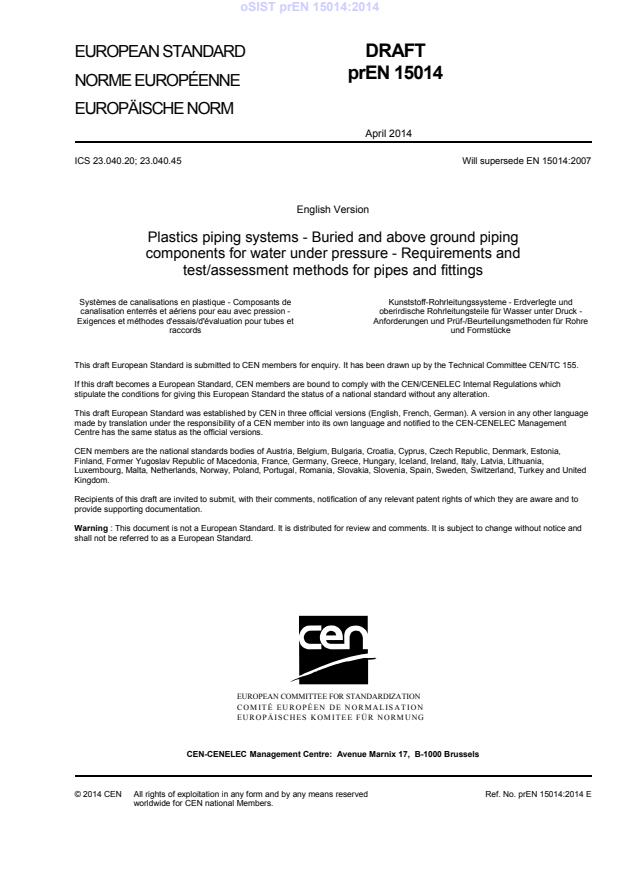
EUROPEAN STANDARD
DRAFT
NORME EUROPÉENNE
EUROPÄISCHE NORM
April 2014
ICS 23.040.20; 23.040.45 Will supersede EN 15014:2007
English Version
Plastics piping systems - Buried and above ground piping
components for water under pressure - Requirements and
test/assessment methods for pipes and fittings
Systèmes de canalisations en plastique - Composants de Kunststoff-Rohrleitungssysteme - Erdverlegte und
canalisation enterrés et aériens pour eau avec pression - oberirdische Rohrleitungsteile für Wasser unter Druck -
Exigences et méthodes d'essais/d'évaluation pour tubes et Anforderungen und Prüf-/Beurteilungsmethoden für Rohre
raccords und Formstücke
This draft European Standard is submitted to CEN members for enquiry. It has been drawn up by the Technical Committee CEN/TC 155.
If this draft becomes a European Standard, CEN members are bound to comply with the CEN/CENELEC Internal Regulations which
stipulate the conditions for giving this European Standard the status of a national standard without any alteration.
This draft European Standard was established by CEN in three official versions (English, French, German). A version in any other language
made by translation under the responsibility of a CEN member into its own language and notified to the CEN-CENELEC Management
Centre has the same status as the official versions.
CEN members are the national standards bodies of Austria, Belgium, Bulgaria, Croatia, Cyprus, Czech Republic, Denmark, Estonia,
Finland, Former Yugoslav Republic of Macedonia, France, Germany, Greece, Hungary, Iceland, Ireland, Italy, Latvia, Lithuania,
Luxembourg, Malta, Netherlands, Norway, Poland, Portugal, Romania, Slovakia, Slovenia, Spain, Sweden, Switzerland, Turkey and United
Kingdom.
Recipients of this draft are invited to submit, with their comments, notification of any relevant patent rights of which they are aware and to
provide supporting documentation.
Warning : This document is not a European Standard. It is distributed for review and comments. It is subject to change without notice and
shall not be referred to as a European Standard.
EUROPEAN COMMITTEE FOR STANDARDIZATION
COMITÉ EUROPÉEN DE NORMALISATION
EUROPÄISCHES KOMITEE FÜR NORMUNG
CEN-CENELEC Management Centre: Avenue Marnix 17, B-1000 Brussels
© 2014 CEN All rights of exploitation in any form and by any means reserved Ref. No. prEN 15014:2014 E
worldwide for CEN national Members.
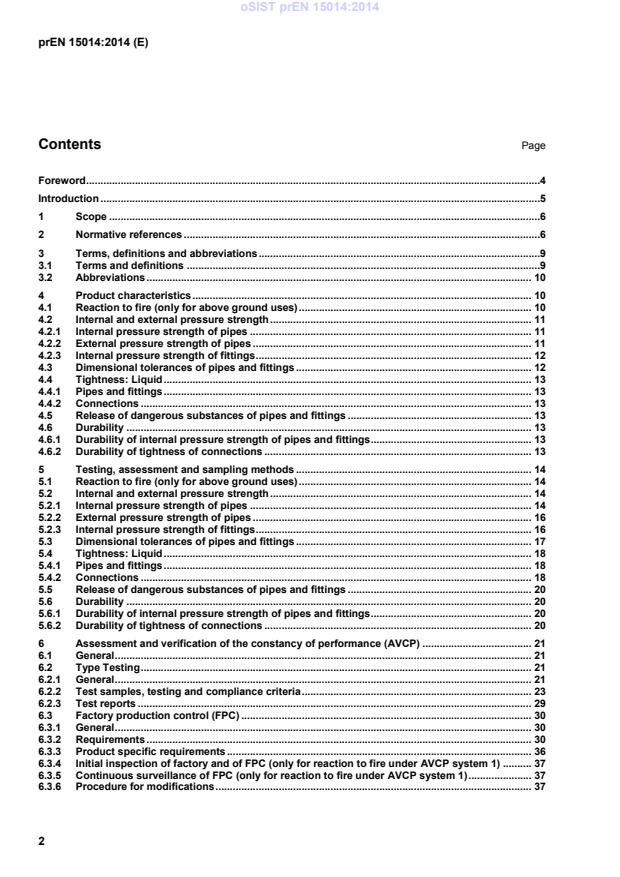
Contents Page
Foreword .4
Introduction .5
1 Scope .6
2 Normative references .6
3 Terms, definitions and abbreviations .9
3.1 Terms and definitions .9
3.2 Abbreviations . 10
4 Product characteristics . 10
4.1 Reaction to fire (only for above ground uses) . 10
4.2 Internal and external pressure strength . 11
4.2.1 Internal pressure strength of pipes . 11
4.2.2 External pressure strength of pipes . 11
4.2.3 Internal pressure strength of fittings . 12
4.3 Dimensional tolerances of pipes and fittings . 12
4.4 Tightness: Liquid . 13
4.4.1 Pipes and fittings . 13
4.4.2 Connections . 13
4.5 Release of dangerous substances of pipes and fittings . 13
4.6 Durability . 13
4.6.1 Durability of internal pressure strength of pipes and fittings . 13
4.6.2 Durability of tightness of connections . 13
5 Testing, assessment and sampling methods . 14
5.1 Reaction to fire (only for above ground uses) . 14
5.2 Internal and external pressure strength . 14
5.2.1 Internal pressure strength of pipes . 14
5.2.2 External pressure strength of pipes . 16
5.2.3 Internal pressure strength of fittings . 16
5.3 Dimensional tolerances of pipes and fittings . 17
5.4 Tightness: Liquid . 18
5.4.1 Pipes and fittings . 18
5.4.2 Connections . 18
5.5 Release of dangerous substances of pipes and fittings . 20
5.6 Durability . 20
5.6.1 Durability of internal pressure strength of pipes and fittings . 20
5.6.2 Durability of tightness of connections . 20
6 Assessment and verification of the constancy of performance (AVCP) . 21
6.1 General . 21
6.2 Type Testing . 21
6.2.1 General . 21
6.2.2 Test samples, testing and compliance criteria . 23
6.2.3 Test reports . 29
6.3 Factory production control (FPC) . 30
6.3.1 General . 30
6.3.2 Requirements . 30
6.3.3 Product specific requirements . 36
6.3.4 Initial inspection of factory and of FPC (only for reaction to fire under AVCP system 1) . 37
6.3.5 Continuous surveillance of FPC (only for reaction to fire under AVCP system 1) . 37
6.3.6 Procedure for modifications . 37
6.3.7 One-off products, pre-production products (e.g. prototypes) and products produced in
very low quantity . 38
Annex ZA (informative) Clauses of this European Standard addressing the provisions of EU
Construction Products Regulation . 39
ZA.1 Scope and relevant characteristics . 39
ZA.2 Procedure for AVCP of plastics pipes and fittings . 42
ZA.2.1 System(s) of AVCP . 42
ZA.2.2 Declaration of performance (DoP) . 44
ZA.3 CE marking and labelling. 47
Bibliography . 53
Foreword
This document (prEN 15014:2014) has been prepared by Technical Committee CEN/TC 155 “Plastics piping
systems and ducting systems”, the secretariat of which is held by NEN.
This document is currently submitted to the CEN Enquiry.
This document will supersede EN 15014:2007.
This document has been prepared under a mandate given to CEN by the European Commission and the
European Free Trade Association, and supports essential requirements of EU Directive(s).
For relationship with EU Directive(s), see informative Annex ZA, which is an integral part of this document.
Introduction
This European Standard specifies only those characteristics of pipes and fittings for pressure applications for
water supply, drainage, sewerage and irrigation with the exception of water intended for human consumption
that need to be known to determine if the works in which these are to be installed can satisfy the essential
requirements of the EU Directive(s). Additional characteristics are specified in the documents listed in clause 2
or in other appropriate product specifications.
This harmonised European Standard covers plastics pipes and fittings under pressure. Valves are covered by
CEN/TC 69.
1 Scope
This European Standard specifies product characteristics for plastics pipes and fittings for pressure
applications for water supply, drainage, sewerage and irrigation with the exception of water intended for
human consumption.
Pipes and fittings covered by this standard are intended to be used for buried or above-ground conveyance of
water, waste water, water for general purposes, vacuum-operated soil and waste conveyance, for both
outside and inside buildings.
It gives the associated test/assessment methods.
This standard does not cover valves, adhesives, joint sealings and gaskets.
NOTE Products complying with this document may be used for the transport of water intended for human
consumption and raw water prior to treatment if they comply with the relevant national, regional or local regulatory
provisions applicable in the place of use. Compliance of a product with this document does not confer a presumption of
fitness of the product for the transport of water intended for human consumption within the meaning of the Regulation (EU)
No. 305/2011 (CPR).
2 Normative references
The following documents, in whole or in part, are normatively referenced in this document and are
indispensable for its application. For dated references, only the edition cited applies. For undated references,
the latest edition of the referenced document (including any amendments) applies.
EN 681-1, Elastomeric seals — Materials requirements for pipe joint seals used in water and drainage
applications — Part 1: Vulcanized rubber
EN 681-4, Elastomeric seals — Materials requirements for pipe joint seals used in water and drainage
applications — Part 4: Cast polyurethane sealing elements
EN 713, Plastics piping systems — Mechanical joints between fittings and polyolefin pressure pipes — Test
method for leaktightness under internal pressure of assemblies subjected to bending
EN 911, Plastics piping systems — Elastomeric sealing ring type joints and mechanical joints for
thermoplastics pressure piping — Test method for leaktightness under external hydrostatic pressure
EN 1119, Plastics piping systems — Joints for glass-reinforced thermosetting plastics (GRP) pipes and
fittings — Test methods for leaktightness and resistance to damage of non-thrust resistant flexible joints with
elastomeric sealing elements
EN 1447:2009+A1:2010, Plastics piping systems — Glass-reinforced thermosetting plastics (GRP) pipes —
Determination of long-term resistance to internal pressure
FprCEN/TS 1452-7:2013, Plastics piping systems for water supply — Unplasticized poly(vinyl chloride) (PVC-
U) — Part 7: Guidance for the assessment of conformity
EN 1796:2013, Plastics piping systems for water supply with or without pressure — Glass-reinforced
thermosetting plastics (GRP) based on unsaturated polyester resin (UP)
EN 12201-1, Plastics piping systems for water supply, and for drainage and sewerage under pressure —
Polyethylene (PE) — Part 1: General
EN 12201-2:2011+A1:2013, Plastics piping systems for water supply, and for drainage and sewerage under
pressure — Polyethylene (PE) — Part 2: Pipes
EN 12201-3:2011+A1:2012, Plastics piping systems for water supply, and for drainage and sewerage under
pressure — Polyethylene (PE) — Part 3: Fittings
EN 12201-5:2011, Plastics piping systems for water supply, and for drainage and sewerage under pressure
— Polyethylene (PE) — Part 5: Fitness for purpose of the system
CEN/TS 12201-7:2013, Plastics piping systems for water supply — Polyethylene (PE) — Part 7: Guidance for
the assessment of conformity
EN 13501-1, Fire classification of construction products and building elements — Part 1: Classification using
test data from reaction to fire tests
EN 13823, Reaction to fire tests for building products — Building products excluding floorings exposed to the
thermal attack by a single burning item
EN 14364:2013, Plastics piping systems for drainage and sewerage with or without pressure — Glass-
reinforced thermosetting plastics (GRP) based on unsaturated polyester resin (UP) — Specifications for pipes,
fittings and joints
CEN/TS 14632:2012, Plastics piping systems for drainage, sewerage and water supply, pressure and non-
pressure — Glass-reinforced thermosetting plastics (GRP) based on polyester resin (UP) — Guidance for the
assessment of conformity
EN 16000, Plastics piping systems — Systems within the building structure — Mounting and fixing of
components in the test apparatus to thermal attack by a single burning item
EN ISO 580, Plastics piping and ducting systems — Injection-moulded thermoplastics fittings — Methods for
visually assessing the effects of heating (ISO 580:2005)
EN ISO 1167-1, Thermoplastics pipes, fittings and assemblies for the conveyance of fluids — Determination
of the resistance to internal pressure — Part 1: General method (ISO 1167-1:2006)
EN ISO 1167-2, Thermoplastics pipes, fittings and assemblies for the conveyance of fluids — Determination
of the resistance to internal pressure — Part 2: Preparation of pipe test pieces (ISO 1167-2:2006)
EN ISO 1167-3, Thermoplastics pipes, fittings and assemblies for the conveyance of fluids — Determination
of the resistance to internal pressure — Part 3: Preparation of components (ISO 1167-3:2007)
EN ISO 1167-4, Thermoplastics pipes, fittings and assemblies for the conveyance of fluids — Determination
of the resistance to internal pressure — Part 4: Preparation of assemblies (ISO 1167-4:2007)
EN ISO 1452-2:2009, Plastics piping systems for water supply and for buried and above-ground drainage and
sewerage under pressure — Unplasticized poly(vinyl chloride) (PVC-U) — Part 2: Pipes (ISO 1452-2:2009)
EN ISO 1452-3:2010, Plastics piping systems for water supply and for buried and above-ground drainage and
sewerage under pressure — Unplasticized poly(vinyl chloride) (PVC-U) — Part 3: Fittings (ISO 1452-3:2009)
EN ISO 1452-5:2010, Plastics piping systems for water supply and for buried and above-ground drainage and
sewerage under pressure — Unplasticized poly(vinyl chloride) (PVC-U) — Part 5: Fitness for purpose of the
system (ISO 1452-5:2009)
EN ISO 3126, Plastics piping systems — Plastics components — Determination of dimensions
(ISO 3126:2005)
EN ISO 9080, Plastics piping and ducting systems — Determination of the long-term hydrostatic strength of
thermoplastics materials in pipe form by extrapolation (ISO 9080:2003)
EN ISO 12162, Thermoplastics materials for pipes and fittings for pressure applications — Classification and
designation — Overall service (design) coefficient (ISO 12162:2009)
EN ISO 13783, Plastics piping systems — Unplasticized poly(vinyl chloride) (PVC-U) end-load-bearing
double socket joints — Test method for leaktightness and strength while subjected to bending and internal
pressure (ISO 13783:1997)
EN ISO 13844, Plastics piping systems — Elastomeric-sealing-ring-type socket joints of unplasticized
poly(vinyl chloride) (PVC-U) for use with PVC-U pipes — Test method for leaktightness under negative
pressure (ISO 13844:2000)
EN ISO 13845, Plastics piping systems — Elastomeric-sealing-ring-type socket joints for use with
unplasticized poly(vinyl chloride) (PVC-U) pipes — Test method for leaktightness under internal pressure and
with angular deflection (ISO 13845:2000)
EN ISO 13846, Plastics piping systems — End-load-bearing and non-end-load-bearing assemblies and joints
for thermoplastics pressure piping — Test method for long-term leaktightness under internal water pressure
(ISO 13846:2000)
EN ISO 13968, Plastics piping and ducting systems — Thermoplastics pipes — Determination of ring
flexibility (ISO 13968:2008)
ISO 161-1, Thermoplastics pipes for the conveyance of fluids — Nominal outside diameters and nominal
pressures — Part 1: Metric series
ISO 3459, Plastic piping systems — Mechanical joints between fittings and pressure pipes — Test method for
leaktightness under external hydrostatic pressure
ISO 3501, Plastics piping systems — Mechanical joints between fittings and pressure pipes — Test method
for resistance to pull-out under constant longitudinal force
ISO 3503, Plastics piping systems — Mechanical joints between fittings and pressure pipes — Test method
for leaktightness under internal pressure of assemblies subjected to bending
ISO 7432, Glass-reinforced thermosetting plastics (GRP) pipes and fittings — Test methods to prove the
design of locked socket-and-spigot joints, including double-socket joints, with elastomeric seals
ISO 7685, Plastics piping systems — Glass-reinforced thermosetting plastics (GRP) pipes — Determination
of initial specific ring stiffness
ISO 8483, Plastics piping systems for pressure and non-pressure drainage and sewerage — Glass-reinforced
thermosetting plastics (GRP) pipes and fittings — Test methods to prove the design of bolted flange joints
ISO 8513, Plastics piping systems — Glass-reinforced thermosetting plastics (GRP) pipes — Test methods
for the determination of the apparent initial longitudinal tensile strength
ISO 8521, Plastics piping systems — Glass-reinforced thermosetting plastics (GRP) pipes — Test methods
for the determination of the apparent initial circumferential tensile strength
ISO 8533, Plastics piping systems for pressure and non-pressure drainage and sewerage — Glass-reinforced
thermosetting plastics (GRP) systems based on unsaturated polyester (UP) resin — Test methods to prove
the design of cemented or wrapped joints
ISO 9852, Unplasticized poly(vinyl chloride) (PVC-U) pipes — Dichloromethane resistance at specified
temperature (DCMT) — Test method
ISO 10466, Plastics piping systems — Glass-reinforced thermosetting plastics (GRP) pipes — Test method
to prove the resistance to initial ring deflection
ISO 10468, Glass-reinforced thermosetting plastics (GRP) pipes — Determination of the long-term specific
ring creep stiffness under wet conditions and calculation of the wet creep factor
ISO 10471, Glass-reinforced thermosetting plastics (GRP) pipes — Determination of the long-term ultimate
bending strain and the long-term ultimate relative ring deflection under wet conditions
ISO 11357-6, Plastics — Differential scanning calorimetry (DSC) — Part 6: Determination of oxidation
induction time (isothermal OIT) and oxidation induction temperature (dynamic OIT)
ISO 13761, Plastics pipes and fittings — Pressure reduction factors for polyethylene pipeline systems for use
at temperature above 20 °C
ISO 13954, Plastics pipes and fittings — Peel decohesion test for polyethylene (PE) electrofusion assemblies
of nominal outside diameter greater than or equal to 90 mm
ISO 13955, Plastics pipes and fittings — Crushing decohesion test for polyethylene (PE) electrofusion
assemblies
ISO 13956, Plastics pipes and fittings — Decohesion test of polyethylene (PE) saddle fusion joints —
Evaluation of ductility of fusion joint interface by tear test
ISO 14236:2000, Plastics pipes and fittings — Mechanical-joint compression fittings for use with polyethylene
pressure pipes in water supply systems
ISO/DIS 16422:2013, Pipes and joints made of oriented unplasticized poly(vinyl chloride) (PVC-O) for the
conveyance of water under pressure — Specifications
ISO 17454, Plastics piping systems — Multilayer pipes — Test method for the adhesion of the different layers
using a pulling rig
ISO 17456, Plastics piping systems — Multilayer pipes — Determination of long-term strength
ISO/DIS 17885:2013, Plastics piping systems — Mechanical fittings for pressure piping systems —
Specifications
ISO 21004:2006, Plastics piping systems — Multilayer pipes and their joints, based on thermoplastics, for
water supply
ISO 21751, Plastics pipes and fittings — Decohesion test of electrofusion assemblies — Strip-bend test
3 Terms, definitions and abbreviations
3.1 Terms and definitions
For the purposes of this document, the following terms and definitions apply.
3.1.1
nominal size
DN
numerical designation of the size of a component, other than a component designated by thread size, which is
a convenient round number approximately equal to the manufacturing dimension
Note 1 to entry: This can apply to either the internal diameter (DN/ID) or external diameter (DN/OD).
Note 2 to entry: The nominal size is expressed in millimetres (mm).
3.1.2
nominal outside diameter
d
n
specified diameter, in millimetres, assigned to a nominal size (for thermoplastics pipes and fittings only)
3.1.3
nominal wall thickness
e
n
numerical designation of the wall thickness of a component, which is a convenient round number,
approximately equal to the manufacturing dimension in millimetres (for thermoplastics pipes and fittings only)
3.1.4
standard dimension ratio
SDR
numerical designation of a pipe series, which is a convenient round number, approximately equal to the
dimension ratio of the nominal outside diameter, d , and the nominal wall thickness, e
n n
3.1.5
nominal pressure
PN
numerical designation used for reference purposes related to the mechanical characteristics of the component
of a piping system
Note 1 to entry: For plastic piping systems conveying water it corresponds to the maximum continuous operating
pressure in bar, which can be sustained with water at 20 °C for thermoplastics and 35 °C for glass-reinforced
thermosetting materials, based on the minimum design coefficient.
3.1.6
connection
assembly of pipe(s) and fitting(s)
Note 1 to entry: For this standard the term fitting includes the term joint.
3.2 Abbreviations
For the purposes of this document, the following abbreviations apply.
GRP: glass-reinforced thermosetting plastics
GRP UP: glass-reinforced thermosetting plastics based on unsaturated polyester resin
PE: polyethylene
PVC: poly(vinyl chloride)
PVC-O: oriented poly(vinyl chloride)
PVC-U: unplasticized poly(vinyl chloride)
4 Product characteristics
4.1 Reaction to fire (only for above ground uses)
The contribution to fire development of products falling under the scope of this European standard is verified
according to the provisions of 5.1.
The test result shall be expressed by the classification.
4.2 Internal and external pressure strength
4.2.1 Internal pressure strength of pipes
The pipe must have mechanical properties able to assure the resistance to internal pressure of the liquid
conveyed.
4.2.1.1 For thermoplastics materials the internal pressure strength of the pipe shall be determined in
accordance with 5.2.1.1 and shall be declared by the manufacturer as nominal pressure PN in accordance
with ISO 161-1.
The design coefficient shall not be less than that specified in EN ISO 12162 for the relevant material.
Depending on the intended use, standards as referred to in clause 2 define the design coefficient to be
applied.
The design coefficient may also be enhanced by derating the PN.
The verification of the PN by the internal pressure strength of pipes shall be performed in accordance with
5.2.1.1
The test results shall be expressed as a PN value.
4.2.1.2 For multilayer pipes the internal pressure strength shall be determined in accordance with 5.2.1.2 and
shall be declared by the manufacturer as nominal pressure PN in accordance with ISO 161-1.
The verification of the PN by the internal pressure strength of pipes shall be performed in accordance with
5.2.1.2.
The test results shall be expressed as a PN value.
4.2.1.3 For glass-reinforced thermosetting materials the internal pressure strength of the pipe shall be
determined in accordance with 5.2.1.3 and shall be declared by the manufacturer as nominal pressure PN in
accordance with EN 1796 or EN 14364, depending on the intended use.
The verification of the PN by the internal pressure strength of pipes shall be performed in accordance with
5.2.1.3.
The test results shall be expressed as a PN value.
4.2.2 External pressure strength of pipes
The pipe, when buried in the ground, must have mechanical properties able to assure the resistance to
external pressure from the embedding.
4.2.2.1 The external pressure strength of thermoplastics and multilayer pipes is deemed to be satisfied by the
internal pressure strength.
NOTE Instructions on limitations for the use in vacuum-operated soil and waste pipes may be found in the
manufacturers technical file.
4.2.2.2 The external pressure strength of glass-reinforced thermosetting pipes shall be determined in
accordance with 5.2.2.2 and shall be declared as the initial specific ring stiffness SN.
The SN shall be verified by the initial specific ring stiffness and resistance to initial ring deflection in
accordance with 5.2.2.2.The test results shall be expressed as an SN value.
4.2.3 Internal pressure strength of fittings
The fitting must have mechanical properties able to assure the resistance to internal pressure of the liquid
conveyed.
4.2.3.1 For thermoplastics materials the internal pressure strength of the fitting shall be determined in
accordance with 5.2.3.1 and shall be declared by the manufacturer as nominal pressure PN in accordance
with ISO 161-1.
The design coefficient shall not be less than that specified in EN ISO 12162 for the relevant material.
Depending on the intended use, standards as referred to in clause 2 define the design coefficient to be
applied.
The design coefficient may also be enhanced by derating the PN.
The verification of the PN by the internal pressure strength of fittings shall be performed in accordance with
5.2.3.1.
The test results shall be expressed as a PN value.
4.2.3.2 For glass-reinforced thermosetting materials the internal pressure strength of the fitting shall be
determined in accordance with 5.2.3.2 and shall be declared by the manufacturer as nominal pressure PN in
accordance with EN 1796 or EN 14364, depending on the intended use.
The verification of the PN by the internal pressure strength of fittings shall be performed in accordance with
5.2.3.2.The test results shall be expressed as a PN value.
4.3 Dimensional tolerances of pipes and fittings
Dimensions including the dimensional tolerances are assuring the proper functioning of the connections when
installing the pipes and fittings.
a) Dimensions shall be measured in accordance with 5.3. The dimensions and the dimensional tolerances
shall comply with what is declared by the manufacturer. This shall be done by using the values given in
one of the documents listed hereafter: a specific European standard as given in Clause 2, as applicable,
b) only in the absence of a), a specific publicly available product specification,
c) only in the absence of a) and b), an International Standard,
d) only in the absence of a), b), and c), by stating the values of his own specification and associated
connecting method.
For thermoplastics pipes and fittings, the test results shall be expressed as a d value with the appropriate
n
SDR series, respectively for small dimensions as a d value with the appropriate e value.
n n
For thermosetting pipes and fittings, the test result shall be expressed as a DN value with the appropriate
diameter series.
4.4 Tightness: Liquid
4.4.1 Pipes and fittings
Pipes and fittings shall be tight to confirm the PN.
Pipes fulfilling the requirements of 5.2.1 and fittings fulfilling the requirements of 5.2.3 are deemed to be tight.
This shall be verified.
4.4.2 Connections
Connections between pipes and/or fittings shall be tight to confirm the PN.
Connections between pipes and/or fittings shall be tested in accordance with 5.4.2 by using the conditions and
meeting the requirements as given in the applicable standard as referenced in clause 2.
No leakage shall occur during the test period.
4.5 Release of dangerous substances of pipes and fittings
National regulations on dangerous substances may require verification and declaration on release, and
sometimes content, when construction products covered by this standard are placed on those markets. In the
absence of European harmonized test methods, verification and declaration on release/content should be
done taking into account national provisions in the place of use.
NOTE An informative database covering European and national provisions on dangerous substances is available at
the Construction web site on EUROPA accessed through: http://ec.europa.eu/enterprise/construction/cpd-ds/.
4.6 Durability
4.6.1 Durability of internal pressure strength of pipes and fittings
The durability of internal pressure strength shall be assessed by testing the relevant material characteristics in
accordance with 5.6.1 with the conditions and requirements as given in the relevant standard referenced in
clause 2, as applicable.
The requirement shall be met.
If the nature of the liquid is different from water or this liquid or water has a higher temperature than 20 °C
(35 °C for glass-reinforced thermosetting materials), guidance for de-rating the pressure shall be in
accordance with the appropriate following standards: EN ISO 1452-2 for PVC-U, ISO 16422 for PVC-O,
ISO 13761 and/or EN 12201-1 for PE, EN 1796 and/or EN 14364 for glass-reinforced thermosetting materials
and ISO 17456 and/or ISO 21004 for multilayer piping systems.
Instead of de-rating the pressure, a shorter working life may be declared.
4.6.2 Durability of tightness of connections
The durability of tightness of connections shall be assessed by testing the relevant characteristics in
accordance with 5.6.2 with the conditions and requirements as given in the relevant standard referenced in
clause 2, as applicable.
The requirement shall be met.
5 Testing, assessment and sampling methods
5.1 Reaction to fire (only for above ground uses)
The reaction to fire is tested according to the test method relevant for the claimed class.
When tested in accordance with EN 13823 (SBI test), the mounting and fixing conditions of the samples to be
tested shall be in accordance with EN 16000.
Test results shall be classified according to EN 13501-1.
5.2 Internal and external pressure strength
5.2.1 Internal pressure strength of pipes
5.2.1.1 For checking the internal pressure strength of thermoplastics pipes, first the nominal pressure PN shall
be determined as follows:
a) determine the σ value in accordance with EN ISO 9080. Data shall be provided either by the
LPL
compound manufacturer or the product manufacturer;
b) classify the material (MRS) and calculate the design stress in accordance with EN ISO 12162.
Classification shall be provided either by the compound manufacturer or the product manufacturer;
c) calculate the PN for a chosen pipe series (SDR series) in accordance with ISO 161-1.
The PN declared by the manufacturer shall be verified by the internal pressure strength using the test
methods referenced in the following table.
Table 1 — Internal pressure strength of thermoplastics pipes
Materials Test parameters Compliance criteria Test methods
PE Clause 7.2, Table 3 of Clause 4.2.1.1 EN ISO 1167-1 and
EN 12201-2:2011+A1:2013 EN ISO 1167-2
Hydrostatic strength at:
20 °C / 100 h
80 °C / 165 h
80 °C / 1000 h
PVC-U Clause 8.2, Table 7 Clause 4.2.1.1 EN ISO 1167-1 and
of EN ISO 1452-2:2009 EN ISO 1167-2
20 °C / 1 h
60 °C / 1000 h
PVC-O Clause 11.1.1 Clause 4.2.1.1 EN ISO 1167-1 and
of ISO/DIS 16422:2013 EN ISO 1167-2
20 °C / 10 h
20 °C / 1000 h
60 °C / 1000 h
5.2.1.2 For checking the internal pressure strength of multilayer pipes, first the nominal pressure PN shall be
determined as given in the following table.
Table 2 — Determination of the PN of multilayer pipes
Materials Test parameters Compliance criteria Test methods
Procedure I: Clause 6.2 of Clause 4.2.1.2 EN ISO 9080
ISO 21004:2006 ISO 17456
Multilayer P pipes
or
Procedure II: Clause 6.3 of Clause 4.2.1.2 EN ISO 9080
ISO 21004:2006
Multilayer P pipes or
multilayer M pipes
The PN declared by the manufacturer shall be verified by the internal pressure strength using the test
methods referenced in the following table.
Table 3 — Internal pressure strength of multilayer pipes
Materials Test parameters Compliance criteria Test methods
95 % of LPL Clause 8.1 of Clause 4.2.1.2 EN ISO 1167-1 and
ISO 21004:2006 EN ISO 1167-2
22 h
165 h
1000 h
5.2.1.3 For checking the internal pressure strength of glass-reinforced thermosetting (GRP-UP) pipes, first the
nominal pressure PN shall be determined as given in the following table.
Table 4 — Determination of the PN of glass-reinforced thermosetting pipes
Materials Test parameters Compliance criteria Test methods
GRP-UP for pressure Clause 5.2.7 of Clause 4.2.1.3 EN 1447:2009+A1:2010
water EN 1796:2013
GRP-UP for pressure Clause 5.2.7 of Clause 4.2.1.3 EN 1447:2009+A1:2010
drainage and sewerage EN 14364:2013
The PN declared by the manufacturer shall be verified by the internal pressure strength using the test
methods referenced in the following table.
Table 5 — Internal pressure strength of glass-reinforced thermosetting pipes
Materials Test parameters Compliance criteria Test methods
GRP-UP for pressure Clause 5.2.6 of Clause 4.2.1.3 ISO 8521
water EN 1796:2013
GRP-UP for pressure Clause 5.2.6 of Clause 4.2.1.3 ISO 8521
drainage and sewerage EN 14364:2013
5.2.2 External pressure strength of pipes
5.2.2.1 The external pressure strength for thermoplastics pipes is dealt with according to 5.2.1.1 and for
multilayer pipes according to 5.2.1.2.
5.2.2.2 For checking the external pressure strength of glass-reinforced thermosetting (GRP-UP) pipes, first
the ring stiffness SN shall be determined using the results from the tests as given in the following table.
Table 6 — Determination of the SN of glass-reinforced thermosetting pipes
Materials Test parameters Compliance criteria Test methods
GRP-UP for pressure Clause 5.2.4 of Clause 4.2.2.2 ISO 10471
water EN 1796:2013
and
Clause 5.2.2 of ISO 10468
EN 1796:2013
GRP-UP for pressure Clause 5.2.4 of Clause 4.2.2.2 ISO 10471
drainage and sewerage EN 14364:2013
and
ISO 10468
Clause 5.2.2 of
EN 14364:2013
The SN declared by the manufacturer shall be verified by the initial specific ring stiffness and resistance to
initial ring deflection using the test methods referenced in the following table.
Table 7 — Verification of the SN of glass-reinforced thermosetting pipes
Materials Test parameters Compliance criteria Test methods
GRP-UP for pressure Clause 5.2.1 of Clause 4.2.2.2 ISO 7685
water EN 1796:2013
and
Clause 5.2.3 of ISO 10466
EN 1796:2013
GRP-UP for pressure Clause 5.2.3 of Clause 4.2.2.2 ISO 7685
drainage and sewerage EN 14364:2013
and
Clause 5.2.3 of ISO 10466
EN 14364:2013
5.2.3 Internal pressure strength of fittings
5.2.3.1 For checking the internal pressure strength of thermoplastics fittings, first the nominal pressure PN
shall be determined as follows:
a) determine the σ value in accordance with EN ISO 9080. Data shall be provided either by the
LPL
compound manufacturer or the product manufacturer;
b) classify the material (MRS) and calculate the design stress in accordance with EN ISO 12162.
Classification shall be provided either by the compound manufacturer or the product manufacturer;
c) calculate the PN for a chosen pipe series (SDR series) in accordance with ISO 161-1.
The PN declared by the manufacturer shall be verified by the internal pressure strength using the test
methods referenced in the following table.
Table 8 — Internal pressure strength of thermoplastics fittings
Materials Test parameters Compliance criteria Test methods
PE Clause 7.3, Table 4 of Clause 4.2.3.1 EN ISO 1167-1 and
EN 12201-3:2011+A1:2012 EN ISO 1167-4
Hydrostatic strength at:
20 °C / 100 h
80 °C / 165 h
80 °C / 1000 h
PVC-U Clause 8.1, Table 22 Clause 4.2.3.1 EN ISO 1167-1 and
of EN ISO 1452-3:2010 EN ISO 1167-3
20 °C / 1 h
20 °C / 1000 h
5.2.3.2 The internal pressure strength for glass-reinforced thermosetting (GRP-UP) fittings is dealt with
according to 5.2.1.3.
5.3 Dimensional tolerances of pipes and fittings
The dimensions and the dimensional tolerances declared by the manufacturer shall be verified by the test
method given in following table.
Table 9 — Dimensional tolerances of pipes and fittings
Materials Test parameters Compliance criteria Test methods
PE pipes Clause 6, Table 1 and 2 of Clause 4.3 EN ISO 3126
EN 12201-2:2011+A1:2013
PE fittings Clause 6, Table 1 to 3 of Clause 4.3 EN ISO 3126
EN 12201-3:2011+A1:2012
PVC-U pipes Clause 6, Table 1 to 5 Clause 4.3 EN ISO 3126
of EN ISO 1452-2:2009
PVC-U fittings Clause 6 Clause 4.3 EN ISO 3126
of EN ISO 1452-3:2010
PVC-O pipes Clause 8, Table 2 and Clause 4.3 EN ISO 3126
Clause 10 of
ISO/DIS 16422:2013
Multilayer pipes Clause 7 of Clause 4.3 EN ISO 3126
ISO 21004:2006
GRP-UP pipes for Clause 5.1 of Clause 4.3 EN ISO 3126
pressure water EN 1796:2013
GRP-UP pipes for Clause 5.1 of Clause 4.3 EN ISO 3126
pressure drainage and EN 14364:2013
sewerage
5.4 Tightness: Liquid
5.4.1 Pipes and fittings
The tightness of pipes and fittings is dealt with according to 5.2.1 and 5.2.3.
5.4.2 Connections
5.4.2.1 Non-end-load-bearing connections
Table 10 — Tightness of non-end-load-bearing connections
Materials Test parameters Compliance criteria Test methods
PVC-U sockets for Clause 4.3, 4.4 and 4.5, Clause 4.4.2 EN ISO 13844
elastomeric ring seal Table 1 of EN ISO 13845
connections EN ISO 1452-5:2010 EN ISO 13846
PVC-O sockets for Clause 13.2, 13.3 and 13.4, Clause 4.4.2 EN ISO 13844
elastomeric ring seal Table 5, 6 and 7 of EN ISO 13845
connections ISO/DIS 16422:2013 EN ISO 13846
Multilayer sockets f
...
Questions, Comments and Discussion
Ask us and Technical Secretary will try to provide an answer. You can facilitate discussion about the standard in here.
Loading comments...