


EN 10257-1:2011
(Main)Zinc or zinc alloy coated non-alloy steel wire for armouring either power cables or telecommunication cables - Part 1: Land cables
Zinc or zinc alloy coated non-alloy steel wire for armouring either power cables or telecommunication cables - Part 1: Land cables
This European Standard specifies requirements for the properties of non-alloy carbon zinc or zinc alloy coated steel wire used primarily for the armouring of either subterranean land power or telecommunication cables.
Mit Zink oder Zinklegierung überzogener unlegierter Stahldraht zur Bewehrung von Strom- und Fernmeldekabeln - Teil 1: Erdverlegte Kabel
Diese Europäische Norm legt Anforderungen an die Eigenschaften von mit Zink oder Zinklegierung überzogenem, unlegiertem Stahldraht fest, der hauptsächlich zur Bewehrung von erdverlegten Strom- oder Fernmeldekabeln verwendet wird.
Fils en acier non allié revêtus de zinc ou d'alliage de zinc pour l'armure des câbles destinés au transport d'énergie ou aux télécommunications - Partie 1 : Câbles terrestres
La présente Norme européenne spécifie les prescriptions relatives aux caractéristiques des fils en acier non allié revêtus de zinc ou d’alliage de zinc, utilisés principalement pour l’armure des câbles terrestres enterrés destinés au transport d’énergie ou aux télécommunications.
S cinkom ali cinkovimi zlitinami prevlečena žica iz nelegiranega jekla za armiranje močnostnih in telekomunikacijskih kablov - 1. del: Zemeljski kabli
Ta evropski standard določa zahteve za lastnosti s cinkom ali cinkovimi zlitinami prevlečene žice iz nelegiranega jekla, ki se uporablja predvsem za armiranje podzemnih zemeljskih močnostnih ali telekomunikacijskih kablov.
General Information
- Status
- Published
- Publication Date
- 25-Oct-2011
- Withdrawal Date
- 29-Apr-2012
- Technical Committee
- ECISS/TC 106 - Wire rod and wires
- Drafting Committee
- ECISS/TC 106 - Wire rod and wires
- Current Stage
- 9093 - Decision to confirm - Review Enquiry
- Start Date
- 03-Dec-2021
- Completion Date
- 14-Apr-2025
Relations
- Effective Date
- 22-Dec-2008
Overview
EN 10257-1:2011 is a European standard developed by the European Committee for Standardization (CEN) that specifies requirements for zinc or zinc alloy coated non-alloy steel wire. This wire is primarily intended for use in the armouring of subterranean land power and telecommunication cables. The standard defines the material properties, manufacturing criteria, testing methods, and quality control processes necessary to ensure the wire meets stringent performance standards for durability, mechanical strength, and electrical characteristics.
This standard applies specifically to land cables, providing key specifications on coating, dimensions, mechanical properties, and testing methods for zinc or zinc alloy coated steel wires used in armored cable applications. It serves as a critical guideline for manufacturers and purchasers aiming for high-quality protective armouring in underground cable installations.
Key Topics
Scope and Application
Defines the use of zinc or zinc alloy coated non-alloy carbon steel wire for armouring power and telecommunication cables laid underground.Material and Manufacture
- Wire is cold drawn from non-alloy carbon steel rods to achieve required tensile and physical properties.
- Only properly dressed welds are permitted in wire coils to maintain wire integrity.
Mechanical Properties
- Tensile strength ranges from 320 to 500 N/mm² depending on wire diameter.
- Minimum elongation after fracture requirements ensure necessary ductility.
- Torsion resistance specified to guarantee wire flexibility during cable manufacture and service.
Dimensions and Tolerances
- Preferred nominal wire diameters range from 0.30 mm up to 4.00 mm with precise tolerance limits.
- Diameter tolerances align with related steel wire standards ensuring compatibility in cable design.
Coating and Surface Finish
- Zinc or zinc alloy coatings applied via hot dip or electrolytic processes complying with EN 10244-2 Class A requirements.
- Coating must adhere firmly and resist surface defects that can affect cable performance.
- Optional additional coatings (e.g., wax) can be specified if compatible with cable design.
Electrical Resistance
- Maximum permissible DC electrical resistance values defined per wire diameter.
- Resistance measurement accounts for temperature variations and ensures wire conductivity is maintained for protective and functional roles.
Testing and Quality Control
- Sampling methods and required tests for tensile strength, torsion, coating adherence, diameter, and electrical resistance.
- Standardized test methods per EN 10218-1, EN 10244 series, and IEC 60468.
- Inspection documents per EN 10204 and EN 10021 are used to verify compliance.
Packing and Identification
- Manufacturer must label each coil with product and batch information for traceability.
- Proper packaging ensures protection during transport and storage.
Applications
EN 10257-1:2011 wire is critical in the construction of armored cables used for:
Power Distribution Cables
Provides mechanical protection to medium and high-voltage subterranean cables, ensuring structural robustness against soil pressure, water ingress, and rodent damage.Telecommunication Cables
Armouring protects delicate fiber optic or copper lines against mechanical stresses in underground installations.Subterranean Land Cable Systems
Suitable for harsh environmental conditions requiring corrosion resistance and long-term durability afforded by zinc or zinc alloy coatings.
This standard supports cable manufacturers, utility companies, and engineering contractors in selecting wires that ensure cable longevity, efficient installation, and compliance with European regulatory requirements.
Related Standards
- EN 10244-1 and EN 10244-2 – Coating requirements and tests for non-ferrous metallic coatings on steel wire, including zinc and zinc alloy coatings.
- EN 10218-1 – Test methods for steel wire and wire products including mechanical tests relevant to EN 10257-1.
- EN 10021 – General delivery conditions for steel products applied to wire rod production.
- IEC 60468 – Method for measuring electrical resistivity of metallic materials, used for verifying wire resistance.
- IEC 60502 series – Power cables with extruded insulation used in conjunction with armored steel armouring wires as per EN 10257-1 requirements.
- EN ISO 16120 series – Specifications for non-alloy steel wire rods used in wire manufacturing, relevant for raw material compliance.
By aligning with these standards, EN 10257-1:2011 ensures interoperability and consistent quality across the cable manufacturing industry in Europe and beyond.
Keywords: EN 10257-1:2011, zinc coated steel wire, zinc alloy coated wire, armored cable wire, land cable armouring wire, non-alloy steel wire, subterranean cables, power cable armouring, telecommunication cable wire, cable protection wire, European standards, CEN standards, steel wire specifications.

Frequently Asked Questions
EN 10257-1:2011 is a standard published by the European Committee for Standardization (CEN). Its full title is "Zinc or zinc alloy coated non-alloy steel wire for armouring either power cables or telecommunication cables - Part 1: Land cables". This standard covers: This European Standard specifies requirements for the properties of non-alloy carbon zinc or zinc alloy coated steel wire used primarily for the armouring of either subterranean land power or telecommunication cables.
This European Standard specifies requirements for the properties of non-alloy carbon zinc or zinc alloy coated steel wire used primarily for the armouring of either subterranean land power or telecommunication cables.
EN 10257-1:2011 is classified under the following ICS (International Classification for Standards) categories: 77.140.65 - Steel wire, wire ropes and link chains; 77.140.70 - Steel profiles. The ICS classification helps identify the subject area and facilitates finding related standards.
EN 10257-1:2011 has the following relationships with other standards: It is inter standard links to EN 10257-1:1998. Understanding these relationships helps ensure you are using the most current and applicable version of the standard.
EN 10257-1:2011 is associated with the following European legislation: Standardization Mandates: M/005. When a standard is cited in the Official Journal of the European Union, products manufactured in conformity with it benefit from a presumption of conformity with the essential requirements of the corresponding EU directive or regulation.
You can purchase EN 10257-1:2011 directly from iTeh Standards. The document is available in PDF format and is delivered instantly after payment. Add the standard to your cart and complete the secure checkout process. iTeh Standards is an authorized distributor of CEN standards.
Standards Content (Sample)
2003-01.Slovenski inštitut za standardizacijo. Razmnoževanje celote ali delov tega standarda ni dovoljeno.LMit Zink oder Zinklegierung überzogener unlegierter Stahldraht zur Bewehrung von Strom- und Fernmeldekabeln- - Teil 1: Erdverlegte KabelFils en acier non allié, revêtu de zinc ou d'alliage de zinc, pour armure de câbles destinés au transport d'énergie ou aux télécommunications - Partie 1: Câbles terrestresZinc or zinc alloy coated non-alloy steel wire for armouring either power cables or telecommunication cables - Part 1: Land cables77.140.65Jeklene žice, jeklene vrvi in verigeSteel wire, wire ropes and link chains29.060.20KabliCablesICS:Ta slovenski standard je istoveten z:EN 10257-1:2011SIST EN 10257-1:2012en01-januar-2012SIST EN 10257-1:2012SLOVENSKI
STANDARDSIST EN 10257-1:20001DGRPHãþD
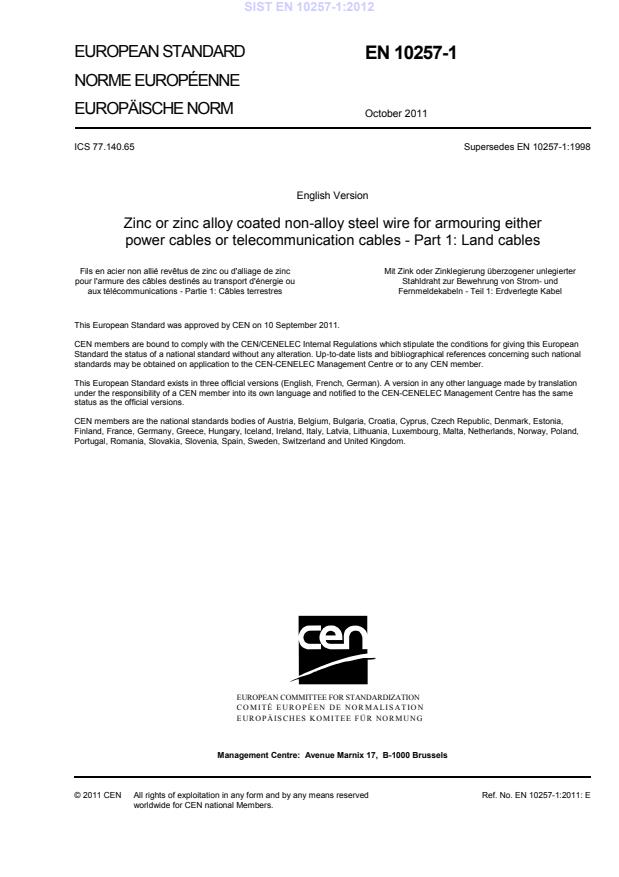
EUROPEAN STANDARD NORME EUROPÉENNE EUROPÄISCHE NORM
EN 10257-1
October 2011 ICS 77.140.65 Supersedes EN 10257-1:1998English Version
Zinc or zinc alloy coated non-alloy steel wire for armouring either power cables or telecommunication cables - Part 1: Land cables Fils en acier non allié revêtus de zinc ou d'alliage de zinc pour l'armure des câbles destinés au transport d'énergie ou aux télécommunications - Partie 1: Câbles terrestres
Mit Zink oder Zinklegierung überzogener unlegierter Stahldraht zur Bewehrung von Strom- und Fernmeldekabeln - Teil 1: Erdverlegte Kabel This European Standard was approved by CEN on 10 September 2011.
CEN members are bound to comply with the CEN/CENELEC Internal Regulations which stipulate the conditions for giving this European Standard the status of a national standard without any alteration. Up-to-date lists and bibliographical references concerning such national standards may be obtained on application to the CEN-CENELEC Management Centre or to any CEN member.
This European Standard exists in three official versions (English, French, German). A version in any other language made by translation under the responsibility of a CEN member into its own language and notified to the CEN-CENELEC Management Centre has the same status as the official versions.
CEN members are the national standards bodies of Austria, Belgium, Bulgaria, Croatia, Cyprus, Czech Republic, Denmark, Estonia, Finland, France, Germany, Greece, Hungary, Iceland, Ireland, Italy, Latvia, Lithuania, Luxembourg, Malta, Netherlands, Norway, Poland, Portugal, Romania, Slovakia, Slovenia, Spain, Sweden, Switzerland and United Kingdom.
EUROPEAN COMMITTEE FOR STANDARDIZATION
COMITÉ EUROPÉEN DE NORMALISATION EUROPÄISCHES KOMITEE FÜR NORMUNG
Management Centre:
Avenue Marnix 17,
B-1000 Brussels © 2011 CEN All rights of exploitation in any form and by any means reserved worldwide for CEN national Members. Ref. No. EN 10257-1:2011: ESIST EN 10257-1:2012
...
EN 10257-1:2011は、地下の電力ケーブルや通信ケーブルのアーマリングに使用される非合金炭素亜鉛または亜鉛合金コーティング鋼線に関するヨーロッパ標準であり、その要求事項を明確に定めています。この標準は、非合金鋼材としての特性に焦点を当てており、様々な産業分野での応用が期待されます。 まず、標準の範囲は明確で、特に陸上ケーブル用に設定されています。このため、地下の電力供給や通信インフラの確立において重要な役割を果たします。標準は、信頼性の高い電力供給や通信の維持に必要な強度と耐久性を提供する鋼線の特性を規定しています。 この標準の強みは、製品が耐腐食性を持ち、厳しい環境条件でも優れた性能を発揮することを求めている点です。亜鉛または亜鉛合金のコーティングは、さまざまな気象条件下での劣化を防ぎ、長寿命を実現します。さらに、EN 10257-1:2011は、国際的な品質基準に準拠しているため、製造業者が輸出を考える際にも非常に重要な標準です。 また、この標準は、品質管理や製品トレーサビリティの向上に寄与します。製品の一貫性と信頼性も強調されており、ユーザーは高い安全性を確保することができます。特に、重要なインフラストラクチャにおいては、このような標準の遵守が求められます。 全体として、EN 10257-1:2011は、地下の電力ケーブルや通信ケーブルのアーマリングにおいて、非常に関連性の高い標準であり、業界における製品の品質と安全性を向上させるための重要なガイドラインを提供しています。この標準に従うことで、製品は市場での競争力を高めることができるでしょう。
La norme EN 10257-1:2011 définit des exigences essentielles concernant les propriétés des fils en acier non allié revêtus de zinc ou d'alliage de zinc, spécifiquement destinés à l'armement de câbles électriques ou de télécommunications souterrains. Le champ d'application de cette norme est particulièrement pertinent pour les acteurs du secteur, car elle couvre des matériaux utilisés dans des conditions d'installation variées, garantissant ainsi leur fiabilité et leur durabilité. Parmi les points forts de la norme, on peut mentionner la précision des spécifications techniques qu'elle impose. En établissant des critères clairs sur les méthodes d'essai et les propriétés mécaniques, EN 10257-1:2011 assure que les produits répondent à des normes de qualité élevées. Cela est crucial pour le niveau de sécurité requis dans les installations électriques et de télécommunications. De plus, la norme aborde des aspects liés à la résistance à la corrosion du matériau, favorisant ainsi la longévité des infrastructures souterraines. En intégrant des recommandations sur le traitement de surface et les performances en milieu agressif, elle souligne l'importance de la durabilité dans les applications modernes. La pertinence de cette norme s'étend également à sa conformité avec les directives européennes, ce qui en fait un document d'une grande valeur pour les fabricants et les utilisateurs. Cela permet de garantir que les produits respectent des exigences harmonisées au sein de l'Union européenne, facilitant ainsi le commerce international tout en préservant des standards élevés de qualité et de sécurité. En résumé, la norme SIST EN 10257-1:2012, issue de la norme EN 10257-1:2011, se positionne comme un outil indispensable pour les industriels du secteur des câbles, reliant innovation et conformité, et contribuant à l'amélioration des standards de sécurité et de performance dans les applications électriques et de télécommunication.
The EN 10257-1:2011 standard serves as a critical guideline within the cable industry, particularly focusing on non-alloy carbon zinc or zinc alloy coated steel wire utilized for the armouring of subterranean land power and telecommunication cables. Its scope is particularly relevant, as it addresses the specifications necessary for ensuring the durability and performance of steel wire used in demanding environments. One of the strengths of this standard is its comprehensive approach to defining the essential properties of the coated wire. It covers aspects such as corrosion resistance, mechanical properties, and tensile strength, which are pivotal for armouring materials that will be subjected to various environmental challenges. The precise requirements outlined in EN 10257-1:2011 enable manufacturers to produce cables that meet stringent safety and performance criteria, thereby enhancing the reliability of power and telecommunication networks. Additionally, this standard is highly relevant in today's context, where the demand for robust and efficient infrastructure continues to rise. By establishing a uniform benchmark across Europe, it encourages quality consistency in the production of armouring materials, facilitating trade and ensuring that cables can perform effectively under different conditions. Furthermore, the standard supports innovation in cable technology, urging manufacturers to adopt advanced materials and processes that align with the outlined specifications. Overall, EN 10257-1:2011 represents a vital resource within the industry, providing essential guidelines that underscore the importance of quality and reliability in the production of zinc or zinc alloy coated non-alloy steel wire for cable armouring, benefiting both manufacturers and end-users alike.
SIST EN 10257-1:2012 문서는 비합금 탄소 아연 또는 아연 합금 도금 강철 선재의 특성에 대한 요구 사항을 명확하게 제시하고 있습니다. 이 표준은 주로 지하 전력 케이블 또는 통신 케이블의 보호를 위해 사용되며, 비합금 강철 소재의 적합성을 보장합니다. 이 표준의 강점 중 하나는 구체적인 기계적 및 화학적 특성을 요구하며, 이는 케이블의 안정성과 내구성을 높이는 데 기여합니다. 또한, 지하에서 사용되는 전력 및 통신 케이블의 특정 환경에서의 성능을 고려하고 있어 실용성이 뛰어납니다. SIST EN 10257-1:2012는 아연 또는 아연 합금으로 도금된 비합금 강철 선재의 사용을 표준화함으로써, 다양한 산업 분야에서의 적용 가능성을 높이고, 제품의 품질 관리에 도움을 줍니다. 이러한 표준은 비합금 강철 선재의 성능을 유지하고, 케이블 구조의 안전성을 확보하는 데 필수적이라고 할 수 있습니다. 결론적으로, 이 문서는 전력 및 통신 산업에서의 케이블 보호를 위한 비합금 강철 선재의 사용에 있어 중요한 기준을 제공하며, 관련 업계에서 큰 의미를 갖고 있습니다.
Die EN 10257-1:2011 ist ein bedeutendes Dokument, das spezifische Anforderungen an die Eigenschaften von unlegiertem Kohlenstoffstahl beschreibt, der mit Zink oder Zinklegierungen beschichtet ist. Diese Norm richtet sich vor allem auf den Einsatz des beschichteten Stahldrahts für die Armierung von unterirdischen Landstrom- und Telekommunikationskabeln. Dies hebt die Relevanz der Norm im Bereich der Kabeltechnologie hervor, insbesondere im Hinblick auf die Sicherstellung der Langlebigkeit und Sicherheit von kritischen Infrastrukturen. Eine der Stärken der EN 10257-1:2011 liegt in ihrer detaillierten Spezifikation der mechanischen und chemischen Eigenschaften des Zink beschichteten Drahts. Diese Anforderungen garantieren, dass der verwendete Draht den Umwelteinflüssen, Korrosion und physikalischen Belastungen, die bei der Nutzung in Landkabeln auftreten können, standhält. Dies erhöht die Zuverlässigkeit der Armierungsstrukturen erheblich. Darüber hinaus trägt die Norm zur Standardisierung der Herstellung und Qualitätssicherung von Zink oder Zinklegierung beschichtetem Draht bei, was den Herstellern hilft, konsistente Produkte zu produzieren, die den industriellen Anforderungen entsprechen. Die klare Definition von Prüfmethoden und Qualitätskriterien fördert eine einheitliche Qualität beim Einsatz in verschiedenen Projekten, was entscheidend für die Wettbewerbsfähigkeit in der Branche ist. In der heutigen Zeit, wo die Anforderungen an die Sicherheit und Effizienz von Kabelsystemen stetig steigen, erweist sich die EN 10257-1:2011 als besonders relevant. Durch die Norm werden nicht nur die Rahmenbedingungen für die Produktentwicklung und -anwendung definiert, sondern auch der Weg für Innovationen im Bereich der Kabeltechnologie geebnet. Das Verständnis und die Anwendung dieser Norm sind somit für Unternehmen, die in der Kabelindustrie tätig sind, von wesentlicher Bedeutung, um wettbewerbsfähig zu bleiben und höchste Qualitätsstandards zu erfüllen.
Questions, Comments and Discussion
Ask us and Technical Secretary will try to provide an answer. You can facilitate discussion about the standard in here.
Loading comments...