


EN 14960-1:2019
(Main)Inflatable play equipment - Part 1: Safety requirements and test methods
General Information
- Abstract
This document is applicable to inflatable play equipment intended for use by children fourteen years and under both individually and collectively.
This document specifies safety requirements for inflatable play equipment for which the primary activities are bouncing and sliding. It sets measures to address risks and also to minimize accidents to users for those involved in the design, manufacture and supply of inflatable play equipment. It specifies information to be supplied with the equipment. The requirements have been laid down bearing in mind the risk factor based on available data.
This document specifies the requirements that will protect a child from hazards that he or she may be unable to foresee when using the equipment as intended, or in a manner that can be reasonably anticipated.
This document is not applicable to inflatable water-borne play and leisure equipment, domestic inflatable toys, air-supported buildings, inflatables used solely for protection, inflatables used for rescue, or other types of inflatable toys where the primary activity is not bouncing or sliding.
- Status
- Published
- Publication Date
- 14-May-2019
- Withdrawal Date
- 29-Nov-2019
- Technical Committee
- CEN/TC 136 - Sports, playground and other recreational equipment
- Drafting Committee
- CEN/TC 136/SC 1/WG 9 - Inflatable play equipment
- Current Stage
- 9092 - Decision on results of review/2YR ENQ - revise - Review Enquiry
- Start Date
- 12-Jan-2026
- Completion Date
- 23-Sep-2026



Overview
EN 14960-1:2019 - Inflatable play equipment: Part 1 - Safety requirements and test methods (CEN, May 2019) sets safety and testing expectations for inflatable play equipment intended for children up to 14 years. The standard covers commercial and permanent inflatables whose primary activities are bouncing and sliding (for example: bounce houses, inflatable slides and play frames). It replaces EN 14960:2013 and focuses on design, materials, testing, documentation and maintenance to reduce foreseeable risks for users.
Key topics and technical requirements
The standard specifies practical safety requirements and test methods including:
- Materials: requirements for fabrics, thread, netting, ropes and zips; limits on dangerous substances and decorative finishes.
- Design and structural integrity: anchorage, calculation of anchor points, load and stability considerations (including guidance for inflatables sited on hard standing).
- Access/egress and containment: safe entry/exit, run-out zones and appropriate wall heights for slopes.
- Entrapment and impact hazards: test methods for head/neck, clothing (toggle) and finger entrapment (Annex D).
- Mechanical tests: tear strength and tensile tests (Annex E), grounding tests (Annex C).
- Blowers and ventilation: requirements for blower installation, ventilation and electrical installations.
- Siting and environmental factors: wind considerations (Beaufort scale guidance in Annex B) and placement rules.
- Operational limits: number of users, supervision recommendations, marking and required information supplied by the manufacturer.
- Inspection, maintenance and alteration: routine and annual inspection procedures, maintenance actions, and documentation requirements.
- Testing competence: reference to accredited laboratory competence (EN ISO/IEC 17025).
Applications and who uses this standard
EN 14960-1:2019 is used by:
- Designers and manufacturers of inflatable play equipment
- Test laboratories and conformity assessment bodies
- Event operators, hire companies and playground owners who deploy inflatables
- Safety inspectors and procurement teams specifying compliant equipment
- Installers and maintenance personnel following inspection and maintenance regimes
This standard helps reduce accidents and ensures inflatables sold or used in Europe meet harmonized safety requirements for bouncing and sliding equipment.
Related standards
Relevant referenced standards include:
- EN 71-3 (toy safety - migration of elements)
- EN 1177 (impact-attenuating surfacing)
- EN 60529 (IP code)
- EN ISO 1421 / 2411 / 2307 / 9554 (material and rope tests)
- EN ISO/IEC 17025 (laboratory competence)
For manufacturers, operators and safety professionals, EN 14960-1:2019 is the authoritative guide for safe design, testing and operation of inflatable play equipment.
Relations
- Effective Date
- 08-Jun-2022
- Effective Date
- 12-Feb-2026
- Effective Date
- 09-Feb-2026
- Effective Date
- 28-Jan-2026
- Effective Date
- 28-Jan-2026
- Effective Date
- 28-Jan-2026
- Effective Date
- 28-Jan-2026
- Effective Date
- 28-Jan-2026
- Effective Date
- 28-Jan-2026
- Effective Date
- 28-Jan-2026
- Effective Date
- 28-Jan-2026
- Effective Date
- 28-Jan-2026
- Effective Date
- 28-Jan-2026
- Effective Date
- 28-Jan-2026
Frequently Asked Questions
EN 14960-1:2019 is a standard published by the European Committee for Standardization (CEN). Its full title is "Inflatable play equipment - Part 1: Safety requirements and test methods". This standard covers: This document is applicable to inflatable play equipment intended for use by children fourteen years and under both individually and collectively. This document specifies safety requirements for inflatable play equipment for which the primary activities are bouncing and sliding. It sets measures to address risks and also to minimize accidents to users for those involved in the design, manufacture and supply of inflatable play equipment. It specifies information to be supplied with the equipment. The requirements have been laid down bearing in mind the risk factor based on available data. This document specifies the requirements that will protect a child from hazards that he or she may be unable to foresee when using the equipment as intended, or in a manner that can be reasonably anticipated. This document is not applicable to inflatable water-borne play and leisure equipment, domestic inflatable toys, air-supported buildings, inflatables used solely for protection, inflatables used for rescue, or other types of inflatable toys where the primary activity is not bouncing or sliding.
This document is applicable to inflatable play equipment intended for use by children fourteen years and under both individually and collectively. This document specifies safety requirements for inflatable play equipment for which the primary activities are bouncing and sliding. It sets measures to address risks and also to minimize accidents to users for those involved in the design, manufacture and supply of inflatable play equipment. It specifies information to be supplied with the equipment. The requirements have been laid down bearing in mind the risk factor based on available data. This document specifies the requirements that will protect a child from hazards that he or she may be unable to foresee when using the equipment as intended, or in a manner that can be reasonably anticipated. This document is not applicable to inflatable water-borne play and leisure equipment, domestic inflatable toys, air-supported buildings, inflatables used solely for protection, inflatables used for rescue, or other types of inflatable toys where the primary activity is not bouncing or sliding.
EN 14960-1:2019 is classified under the following ICS (International Classification for Standards) categories: 97.190 - Equipment for children; 97.200.50 - Toys. The ICS classification helps identify the subject area and facilitates finding related standards.
EN 14960-1:2019 has the following relationships with other standards: It is inter standard links to EN 14960:2013, ISO 20187-1:2022, EN 60529:1991, EN 1177:2018+A1:2023, EN ISO 1421:2016, EN ISO/IEC 17025:2017, EN ISO 2307:2019, EN 71-3:2019+A2:2024, EN ISO 2411:2024, EN ISO 9554:2019, EN 14960-4:2025, EN 14960-2:2019, EN ISO 23659:2022, EN 14960-3:2020. Understanding these relationships helps ensure you are using the most current and applicable version of the standard.
EN 14960-1:2019 is available in PDF format for immediate download after purchase. The document can be added to your cart and obtained through the secure checkout process. Digital delivery ensures instant access to the complete standard document.
Standards Content (Sample)
SLOVENSKI STANDARD
01-julij-2019
Nadomešča:
SIST EN 14960:2013
Napihljiva igralna oprema - 1. del: Varnostne zahteve in preskusne metode
Inflatable play equipment - Part 1: Safety requirements and test methods
Aufblasbare Spielgeräte - Teil 1: Sicherheitstechnische Anforderungen und
Prüfverfahren
Équipements de jeu gonflables - Partie 1 : Exigences de sécurité et méthodes d'essai
Ta slovenski standard je istoveten z: EN 14960-1:2019
ICS:
97.190 Otroška oprema Equipment for children
97.200.50 Igrače Toys
2003-01.Slovenski inštitut za standardizacijo. Razmnoževanje celote ali delov tega standarda ni dovoljeno.
EN 14960-1
EUROPEAN STANDARD
NORME EUROPÉENNE
May 2019
EUROPÄISCHE NORM
ICS 97.190; 97.200.50 Supersedes EN 14960:2013
English Version
Inflatable play equipment - Part 1: Safety requirements
and test methods
Équipements de jeu gonflables - Partie 1 : Exigences de Aufblasbare Spielgeräte - Teil 1: Sicherheitstechnische
sécurité et méthodes d'essai Anforderungen und Prüfverfahren
This European Standard was approved by CEN on 15 April 2019.
CEN members are bound to comply with the CEN/CENELEC Internal Regulations which stipulate the conditions for giving this
European Standard the status of a national standard without any alteration. Up-to-date lists and bibliographical references
concerning such national standards may be obtained on application to the CEN-CENELEC Management Centre or to any CEN
member.
This European Standard exists in three official versions (English, French, German). A version in any other language made by
translation under the responsibility of a CEN member into its own language and notified to the CEN-CENELEC Management
Centre has the same status as the official versions.
CEN members are the national standards bodies of Austria, Belgium, Bulgaria, Croatia, Cyprus, Czech Republic, Denmark, Estonia,
Finland, Former Yugoslav Republic of Macedonia, France, Germany, Greece, Hungary, Iceland, Ireland, Italy, Latvia, Lithuania,
Luxembourg, Malta, Netherlands, Norway, Poland, Portugal, Romania, Serbia, Slovakia, Slovenia, Spain, Sweden, Switzerland,
Turkey and United Kingdom.
EUROPEAN COMMITTEE FOR STANDARDIZATION
COMITÉ EUROPÉEN DE NORMALISATION
EUROPÄISCHES KOMITEE FÜR NORMUNG
CEN-CENELEC Management Centre: Rue de la Science 23, B-1040 Brussels
© 2019 CEN All rights of exploitation in any form and by any means reserved Ref. No. EN 14960-1:2019 E
worldwide for CEN national Members.
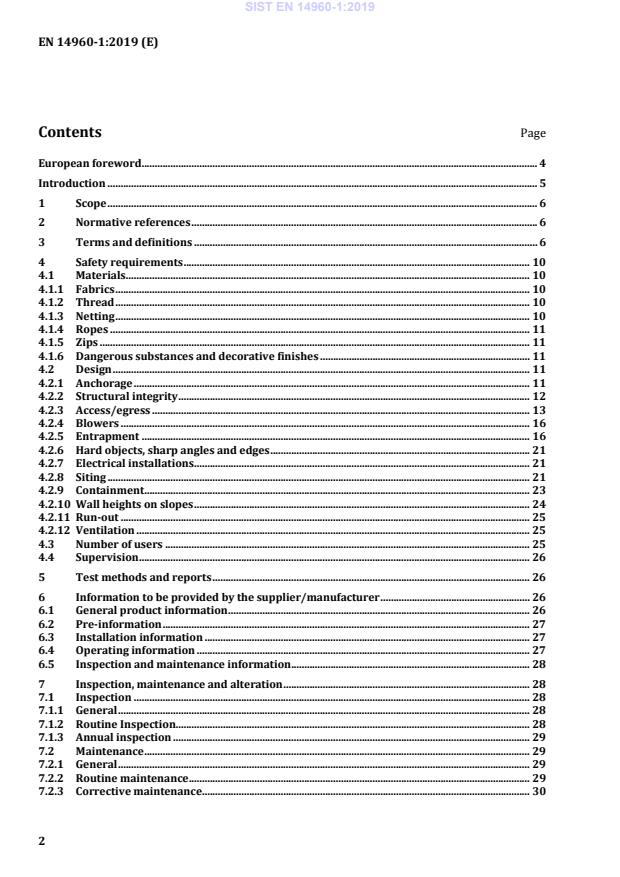
Contents Page
European foreword . 4
Introduction . 5
1 Scope . 6
2 Normative references . 6
3 Terms and definitions . 6
4 Safety requirements . 10
4.1 Materials . 10
4.1.1 Fabrics . 10
4.1.2 Thread . 10
4.1.3 Netting . 10
4.1.4 Ropes . 11
4.1.5 Zips . 11
4.1.6 Dangerous substances and decorative finishes . 11
4.2 Design . 11
4.2.1 Anchorage . 11
4.2.2 Structural integrity . 12
4.2.3 Access/egress . 13
4.2.4 Blowers . 16
4.2.5 Entrapment . 16
4.2.6 Hard objects, sharp angles and edges . 21
4.2.7 Electrical installations . 21
4.2.8 Siting . 21
4.2.9 Containment . 23
4.2.10 Wall heights on slopes . 24
4.2.11 Run-out . 25
4.2.12 Ventilation . 25
4.3 Number of users . 25
4.4 Supervision . 26
5 Test methods and reports . 26
6 Information to be provided by the supplier/manufacturer . 26
6.1 General product information . 26
6.2 Pre-information . 27
6.3 Installation information . 27
6.4 Operating information . 27
6.5 Inspection and maintenance information . 28
7 Inspection, maintenance and alteration . 28
7.1 Inspection . 28
7.1.1 General . 28
7.1.2 Routine Inspection. 28
7.1.3 Annual inspection . 29
7.2 Maintenance . 29
7.2.1 General . 29
7.2.2 Routine maintenance . 29
7.2.3 Corrective maintenance . 30
7.3 Alteration . 30
8 Marking . 30
9 Documentation . 31
Annex A (normative) Calculation of number of anchor-points . 32
Annex B (informative) The Beaufort Scale of wind force . 33
Annex C (normative) Test method for grounding . 34
Annex D (normative) Test methods for entrapment . 35
D.1 General . 35
D.2 Head and neck entrapment . 35
D.3 Entrapment of clothing (Toggle test) . 42
D.4 Finger entrapment . 44
Annex E (normative) Test method for tear strength . 46
E.1 Maximum value tongue tear, apparatus . 46
E.2 Preparation of test specimens . 46
E.3 Conditioning . 46
E.4 Preconditioning . 47
E.5 Characteristics of test atmospheres. 47
E.6 Methods of conditioning . 47
E.7 Procedure . 47
E.8 Calculation and expression of results . 48
E.9 Test report . 50
Bibliography . 51
European foreword
This document (EN 14960-1:2019) has been prepared by Technical Committee CEN/TC 136 “Sports,
playground and other recreational facilities and equipment”, the secretariat of which is held by DIN.
This European Standard shall be given the status of a national standard, either by publication of an
identical text or by endorsement, at the latest by November 2019, and conflicting national standards
shall be withdrawn at the latest by November 2019.
Attention is drawn to the possibility that some of the elements of this document may be the subject of
patent rights. CEN shall not be held responsible for identifying any or all such patent rights.
1 1
This document supersedes – together with EN 14960-2:— and EN 14960-3:— – EN 14960:2013.
In relation to EN 14960:2013, the following main changes have been made:
a) changes with regard to inflatables sited on hard standing;
b) minor editing to improve the content accuracy of the document;
c) splitting this standard into the following three parts:
1) EN 14960-1, Inflatable play equipment — Part 1: Safety requirements and test methods;
2) EN 14960-2, Inflatable play equipment — Part 2: Additional safety requirements for Inflatable
Bouncing Pillows for permanent installation (in preparation);
3) EN 14960-3, Inflatable play equipment — Part 3: Specific safety requirements and test methods
for inflatable snappies (in preparation).
According to the CEN-CENELEC Internal Regulations, the national standards organisations of the
following countries are bound to implement this European Standard: Austria, Belgium, Bulgaria,
Croatia, Cyprus, Czech Republic, Denmark, Estonia, Finland, Former Yugoslav Republic of Macedonia,
France, Germany, Greece, Hungary, Iceland, Ireland, Italy, Latvia, Lithuania, Luxembourg, Malta,
Netherlands, Norway, Poland, Portugal, Romania, Serbia, Slovakia, Slovenia, Spain, Sweden, Switzerland,
Turkey and the United Kingdom.
Both standards are under development at the time of publication.
Introduction
Play is the means by which children discover and understand the world in which they live and is an
essential element in a child’s physical and mental growth.
It is important for children’s rounded development that, through play, they arrive at an understanding
of danger, which provides a basis for assessing safety in a variety of situations. The balance between
challenge and safety is an important consideration.
The inflatable play equipment referred to in this standard can provide different levels of challenge and
excitement. This European Standard aims to minimize the level of risk and the possibility of serious
injury while allowing children to enjoy themselves when playing in or on inflatable equipment.
This standard acknowledges the difficulties of addressing safety issues by age criteria alone because the
ability to handle risk is based on the individual user’s level of skill and not age. Moreover, users other
than the intended age range will make use of the inflatable equipment, in which case, the provisions of
this standard still apply.
It is not the purpose of the requirements of this standard to affect a child’s need to play nor to lessen the
contribution that inflatable play equipment makes either to the child’s development or meaningful play
from an educational point of view.
Where inflatable play equipment is combined with other items of children’s playground equipment, the
relevant standards applying to the other items of equipment should also be consulted.
1 Scope
This document is applicable to inflatable play equipment intended for use by children fourteen years
and under both individually and collectively.
This document specifies safety requirements for inflatable play equipment for which the primary
activities are bouncing and sliding. It sets measures to address risks and also to minimize accidents to
users for those involved in the design, manufacture and supply of inflatable play equipment. It specifies
information to be supplied with the equipment. The requirements have been laid down bearing in mind
the risk factor based on available data.
This document specifies the requirements that will protect a child from hazards that he or she may be
unable to foresee when using the equipment as intended, or in a manner that can be reasonably
anticipated.
This document is not applicable to inflatable water-borne play and leisure equipment, domestic
inflatable toys, air-supported buildings, inflatables used solely for protection, inflatables used for
rescue, or other types of inflatable toys where the primary activity is not bouncing or sliding.
2 Normative references
The following documents are referred to in the text in such a way that some or all of their content
constitutes requirements of this document. For dated references, only the edition cited applies. For
undated references, the latest edition of the referenced document (including any amendments) applies.
EN 71-3, Safety of toys — Part 3: Migration of certain elements
EN 1177, Impact attenuating playground surfacing — Determination of critical fall height
EN 60529, Degrees of protection provided by enclosures (IP code) (IEC 60529)
EN ISO 1421, Rubber- or plastics-coated fabrics — Determination of tensile strength and elongation at
break (ISO 1421)
EN ISO 2307, Fibre ropes — Determination of certain physical and mechanical properties (ISO 2307)
EN ISO 2411, Rubber- or plastics-coated fabrics — Determination of coating adhesion (ISO 2411)
EN ISO 9554, Fibre ropes — General specifications (ISO 9554)
EN ISO/IEC 17025:2017, General requirements for the competence of testing and calibration laboratories
(ISO/IEC 17025:2017)
3 Terms and definitions
For the purposes of this document, the following terms and definitions apply.
NOTE In order not to confine the application of this European Standard to those items of equipment currently
in use and hence allow freedom of design for the manufacture of new equipment, only the fundamental forms of
equipment and motion are listed.
ISO and IEC maintain terminological databases for use in standardization at the following addresses:
— IEC Electropedia: available at http://www.electropedia.org/
— ISO Online browsing platform: available at http://www.iso.org/obp
3.1
inflatable play equipment
structure relying on a continuous supply of air to maintain its shape, on or in which users may play,
bounce and/or slide
Note 1 to entry: Also referred to as an/the inflatable.
a) Flat-bed b) Castle c) A-Frame inflatable
(4 open sides) (3 walled sides, 1 open side) (3 walled sides, 1 open side)
d) Bounce/Slide combination e) Multi-Play Centre f) Obstacle course
g) Inflatable slide h) Enclosed inflatable i) Soft mountain
Figure 1 — Examples of inflatable play equipment
3.2
blower
powered machine used to continuously inflate the structure
3.3
connection tube
part of the inflatable structure to which the blower is connected
3.4
controller
person, company or hirer (those who hire to others), having responsibility for the overall control,
inspection and maintenance of the equipment
3.5
operator
person appointed by a controller to be in charge of the operation of the equipment at any time when it
is available for use by the public
3.6
attendant
person working under the control and direction of an operator to assist in the operation of the
equipment
3.7
inspection body
organisation, part of an organisation or individual with the appropriate competence to carry out one or
more of the following inspections:
— design review;
— assessment of conformity to design;
— initial testing;
— annual main inspection
3.8
free height of fall
greatest vertical distance from the clearly intended body support to the impact area below
[SOURCE: EN 1176-1:2008, 3.6]
3.9
critical fall height
maximum free heights of fall, for which a surface will provide an acceptable level of impact attenuation
3.10
open side
any external side of an inflatable with no containing wall
3.11
step
step to aid the access/egress of users into and out of the playing area of the inflatable, making the
transition between the height of the playing area and the ground
3.12
ramp
ramp to aid the access/egress of users into and out of the playing area of the inflatable, making the
transition between the height of the playing area and the ground
3.13
platform
any surface on which a user may stand
3.14
squeeze
play item which is often attached to and forms part of inflatable play equipment, the purpose of which is
to squeeze the user whilst not entrapping them while allowing the user to pass through a gap with a
degree of difficulty
3.15
entrapment
hazard in which a body, or part of a body, or clothing, can become trapped
3.16
impact area
area surrounding the open side(s) of an inflatable
3.17
run-out
intended deceleration zone at the bottom of a slide
3.18
anchorage system
method of fixing an inflatable to the ground using stakes
3.19
ballast system
method of fixing an inflatable to the ground using weights
3.20
user height
maximum height of persons allowed to use the inflatable
3.21
free space
space in, on or around the inflatable that can be occupied by a user undergoing a movement forced by
the equipment (for example sliding, bouncing)
3.22
playing area
space in or on the inflatable, intended for play
3.23
falling space
space in, or around the inflatable that can be passed through by a user falling from an elevated part of
the equipment
Note 1 to entry: The falling space commences at the free height of fall.
4 Safety requirements
4.1 Materials
4.1.1 Fabrics
Fabrics shall be flame retardant.
Fabrics, and joins in fabrics, shall be of adequate tear and tensile strength for the weight of the intended
user and have sufficient air retention to enable the inflatable, when pressurized to the level specified in
the operations manual, to resume its shape after distortion under load.
Fabrics of:
a) minimum tear strength 350 N (see test method Annex E),
b) minimum tensile strength 1 850 N (see EN ISO 1421),
c) minimum coating adhesion 100 N (see EN ISO 2411),
shall be used in those structural parts of the inflatable where force or stress is applied by the user.
4.1.2 Thread
Threads shall be non-rotting yarn and at least 88 N tensile strength. Stitching shall be lock-stitch. The
length of individual stitches shall be a minimum of 3 mm and a maximum of 8 mm.
4.1.3 Netting
Retention netting is commonly used to define the playing area, to contain the users and to retain items
of mobile play equipment such as balls. Retention netting shall not significantly impair visibility.
Retention netting shall be strong enough to contain the largest/heaviest user for whom the inflatable is
designed.
In order to prevent users from climbing retention netting the mesh size, where the netting is more than
1 m vertical height and accessible to the user, shall be 30 mm or less to exclude users’ feet.
Where netting is used for roofs and is accessible to the user, the mesh size shall be small enough to
prevent the 8 mm finger rod from passing through (see Figure 2).
Dimensions in millimetres
Figure 2 — 8 mm finger rod
Clamber netting (commonly laid on slopes to form foot and hand holds) shall be securely fixed to
prevent lifting by the user. The rope from which it is made shall be at least 12 mm in diameter and shall
be securely knotted. Strand ends shall be treated to prevent fraying. Care shall be taken when heat
sealing so as not to form hard or sharp edges.
4.1.4 Ropes
Ropes shall be fixed at both ends and the total amplitude of swing shall not exceed 20 % of the distance
between the fixing points such that it shall not be possible to make a loop in the rope of large enough
diameter to allow probe E to pass through (see Figure D.1).
NOTE This requirement is intended to remove the risk of strangulation.
The rope diameter shall be between 18 mm and 45 mm.
Fibre ropes (textile type) shall conform to EN ISO 9554 or EN ISO 2307. Alternatively, a works
certificate shall be supplied stating the material used and the safe working load. Monofilament plastics
ropes shall not be used.
4.1.5 Zips
Zips shall withstand air pressures and tension generated within the structure. Zips used for entrances
and exits shall be reliable, easy to use, able to open from both sides and shall allow access and egress by
adults. Zips used for deflation purposes shall have the puller hidden from view (e.g. by a flap or pocket).
4.1.6 Dangerous substances and decorative finishes
Dangerous substances shall not be used for inflatable play equipment in such a way that they can cause
adverse health affects to the user. Paints and other decorative finishes shall conform to EN 71-3.
NOTE Attention is drawn to the provisions of European Regulation (EC) No. 1907/2006 [2]. Such materials
include, for example, asbestos, lead, formaldehyde, coal tar oils, carbolineums and polychlorinated biphenyls
(PCBs).
4.2 Design
4.2.1 Anchorage
The inflatable shall be provided with an anchorage and/or ballast system and any necessary accessories
enabling the inflatable to be securely fixed to the ground. Each inflatable shall have at least six
anchorage points.
The number of anchorage points shall be calculated in accordance with Annex A. They shall be
distributed around the perimeter of the inflatable (see also 4.2.3) and shall be fitted with metal ends.
The maximum wind- speed in which inflatables shall be used outdoors is 38 km/h (Force 5 on the
Beaufort Scale); see Annex B.
When used outdoors, the inflatable shall be secured to the ground, preferably with ground stakes where
the ground is suitable. Each anchorage point on the inflatable and all of the components of the
anchorage and/or ballast system, e.g. ropes, webbings, metal attachments, stakes, weights, shall
withstand a force of 1 600 N. The direction of the exerted force shall be at an angle to the ground of 30°
to 45°. Ground stakes shall incline away from the direction of the exerted force. Ground stakes shall be a
minimum of 380 mm in length and a minimum of 16 mm in diameter and their tops shall be rounded.
The system shall expose no more than 25 mm of the stake above ground level (see Figure 3).
When the inflatable is used indoors, the anchorage and/or ballast system should be used, when
necessary, to maintain stability.
Dimensions in millimetres
Key
1 direction of force
2 rounded tops
3 ground level
Figure 3 — Examples of ground stakes
On hard standing where ground stakes cannot be used, the inflatable shall be secured to the ground by
equally effective method, e.g. attaching each of the anchorage points to fittings already in the ground, or
to sandbags or other weights, if these are capable of supporting the 1 600 N load. If the inflatable is
secured to a vehicle or other movable machinery, such vehicles or machinery shall be immobilised and
be under the control of an operator.
4.2.2 Structural integrity
The minimum air pressure inside the structural parts of the inflatable shall be 1 kPa (100 mm water
gauge). Inflated chambers that are entered by the user are not considered to be structural parts of the
inflatable, e.g. enclosed dome type inflatables. Pressure in the playing area of soft mountains shall be no
greater than 0,25 kPa (25 mm water gauge), but shall maintain a pressure sufficient to prevent
grounding. Pressure in the surrounding safety apron of soft mountains shall be at least 1 kPa (100 mm
water gauge); see Figure 4.
The depth of the trough on the surface of any platform shall be a maximum of 33 % of the width of the
adjacent panel, measured when inflated (see Figure 5).
Containing walls shall be vertical (90 ± 5)°. Towers that support containing walls shall be in the same
plane. Containing walls and towers shall be strong enough to contain the largest and/or heaviest user
for whom the inflatable is designed.
Playing areas, surrounding safety aprons, steps and/or ramps shall support the weight of the largest
and/or heaviest user for whom the inflatable is designed, without grounding. See Annex C for the test
method.
Key
1 surrounding safety apron
2 tread depth
3 playing area
Figure 4 — Section through a soft mountain
Key
a depth of trough — measured when inflated
b width of adjacent panel
Figure 5 — Trough depth
4.2.3 Access/egress
A step or ramp shall be wide enough to cover the entire access/egress aperture with overlap, according
to Figure 6.
A step or ramp shall have a tread depth of a minimum of 1,5 times the height of the adjacent playing
area platform to which it is attached (see Figure 6).
The playing area of soft mountains shall be completely surrounded by an inflated safety apron. This
safety apron shall have a minimum tread depth of 1,6 m or 0,5 times the height of the playing area
measured from the ground when inflated and in the unloaded condition, whichever is greater.
In the event of air supply failure, the deflation time shall be sufficient to allow users of the inflatable to
be evacuated safely.
NOTE Deflation time can be considerably lengthened by inserting a non-return flap in the outlet nozzle of the
blower or at the joint of the connection tube and structure.
Inflatables shall be designed to ensure that adults are able to gain access in order to assist users.
On any open side, the free height of fall shall be no greater than 630 mm from the ground in the
unloaded condition, (600 mm in the loaded condition).
On any open side, the extent of the impact area shall be at least 1,2 m. The surface in the impact area
shall meet the requirements for impact attenuation so that the critical fall height of the surfacing,
according to EN 1177, is at least 630 mm. The impact areas of adjacent inflatables and/or other play
equipment shall not overlap.
Materials such as soil, turf and sand have some impact attenuating properties. Impact absorbing mats
may be used (see Figure 7).
See also 4.2.8. Siting
a) step detail
b) ramp detail
Key
1 overlap 4 tread depth
2 open side 5 step
3 height of adjacent playing area platform 6 ramp
Figure 6 — Step or ramp detail
a) Castle type b) Flat-bed
c) Up and over slide d) Open top inflatable on hard standing
Key
1 walled side 5 exit
2 at least 1,2 m 6 entrance
3 open side 7 at least 1,5 m
4 impact area
Figure 7 — Impact areas
Anchorage points in impact areas shall be avoided if possible but, where necessary, anchorage points
shall be connected to the bottom perimeter edge or seam of the inflatable and shall extend as short a
distance as practicable from the inflatable (see Figure 8).
Key
1 side of inflatable
2 impact area
3 anchorage stake as close as practicable to the side of the inflatable
4 ground level
Figure 8 — Anchorage in an impact area
Totally enclosed inflatables shall have signs indicating exits, which shall be visible in all circumstances.
When designed for more than 15 users, there shall be more than one exit, and users shall never be more
than 5 m from an exit.
4.2.4 Blowers
Blowers shall be protected to a minimum of IP23B as defined in EN 60529, except that the 8mm finger
rod, as illustrated in Figure 2, shall be used instead of the jointed 12 mm test finger.
The 8 mm finger rod may pass through the guard mesh but shall not, in any position, come into contact
with any moving part, hot surface or exposed electrical connections.
The blower shall be positioned at least 1,2 m from a walled side and 2,5 m from an open side. The
connection tube shall be long enough to allow this.
If a blower is sited inside the inflatable structure, it shall be at least 2,5 m from the playing area, safety
apron, step and/or ramp.
The blower, including cabling and controls, shall not be readily accessible to the public.
NOTE See also 4.2.7 Electrical installations.
4.2.5 Entrapment
4.2.5.1 General
Test probes shall be applied with a force of 222 N unless otherwise stated in the text.
4.2.5.2 Entrapment of the head and neck
Inflatables shall be constructed so that any openings do not create head and neck entrapment hazards
by either head first or feet first passage.
Hazardous situations in which this type of entrapment can be encountered include the following:
— completely bound openings through which a user may slide feet first or head first;
— partially bound or V-shaped openings;
— other openings (e.g. shearing or moving openings).
a) Completely bound openings
Accessible completely bound openings with a lower edge more than 600 mm above a platform shall be
tested in accordance with D.2.1.
Probes C or E shall not pass through any opening unless it also allows the passage of the large head
probe D.
b) Partially bound and V-shaped openings
Partially bound and V-shaped openings with an entrance at 600 mm or more above a platform shall be
constructed so that either:
1) the opening is not accessible when tested in accordance with D.2.2, or
2) if accessible at a position of 600 mm or more above a platform when tested in accordance with
D.2.2,
depending on the angular orientation range of the opening (see Figure D.4), shall conform to the
following:
Range 1: (template centre line ± 45° from vertical); when the template apex contacts the base of the
opening, the depth of the opening shall be less than the length of the template to the underside of the
shoulder section.
Range 2: (template centre line from horizontal to + 45°); when the template apex contacts the base of
the opening, the depth of the opening shall be less than the ‘A’ portion of the template. If the depth of
the opening is greater than the ‘A’ portion of the template, all parts of the opening above the ‘A’ portion
shall also allow insertion of the shoulder section of the template or probe D.
Range 3: No template test requirements.
c) Other openings (e.g. shearing or moving openings)
Non-rigid members (for example ropes) shall not overlap if, by doing so, they create openings that do
not conform to the requirements for completely bound openings.
4.2.5.3 Entrapment of clothing/hair
Inflatables shall be constructed so that hazardous situations including:
a) gaps or V-shaped openings in which a part of clothing can become trapped while or immediately
before the user is undergoing a forced movement,
b) protrusions, in which clothing entrapment can be encountered are not created.
Slides shall be constructed so that openings located within the free space (see Figure 9) do not trap the
toggle when tested in accordance with D.3.
The cylindrical space is shown in Figure 9 and its dimensions are given in Table 1. In determining the
free space, the possible movements of the equipment and the user shall be taken into account.
NOTE 1 The toggle test (see D.3) is restricted to the free space as practical experience has shown that natural
materials and connections between different parts can vary over time. The definition of free space (see 3.22) does
not include the three-dimensional area in which the falling movement takes place.
Special consideration should be given when using elements of circular cross-section, e.g. round tubes or
poles, to avoid clothing entanglement within the falling space.
Roofs shall be constructed so that they do not trap the toggle when tested in accordance with D.3.
Spindles and rotating parts shall be constructed so as to prevent entanglement of clothing or hair.
NOTE 2 This can be achieved by use of suitable covering or shields.
a) Standing user
b) Example of a slide
Figure 9 — Free space
Table 1 — Dimensions of the cylinder for the determination of the free space
Dimensions in millimetres
Type of use Radius α Height h
Standing 1 000 1 800
Sitting 1 000 1 500
300 above and 1 800 below hanging
Hanging 500
position
NOTE In case of hanging, h = 300 because of the possibility that the user pulls himself or herself up.
NOTE In certain cases, the dimensions of the free space can be altered. In some cases, these will be given in
the parts of this standard covering individual types of equipment.
4.2.5.4 Fingers entrapment
Inflatables shall be constructed so that there are no hazardous gaps in which fingers can be trapped
while the rest of the body is moving or continuing in motion involuntarily, e.g. sliding, bouncing.
Openings within the free space, where the user is subjected to forced movement, and holes which have
a lower edge more than 1,0 m above the platform when tested in accordance with Annex D (D.4), shall
conform to one of the following requirements:
a) 8 mm finger rod (see Figure 2), when applied with a force of 30 N, shall not pass through the
minimum cross section of the opening and the profile of the opening shall be such that the rod
cannot be locked in any position when set in motion as given in Figure D.10; or
b) if the 8 mm finger rod passes through the opening, the 25 mm finger rod (see Figure 10), when
applied with a force of 30 N shall also pass though the opening provided that the opening does not
permit access to another finger entrapment site.
Dimensions in millimetres
Figure 10 — 25 mm finger rod
4.2.5.5 Body entrapment
Adjacent inflated surfaces shall be more than 120 mm apart if the aperture formed is more than
200 mm deep (see Figure 11).
a) Wall to tower attachment at A forms an entrapment point. Wall to tower attachment at B
does not form an entrapment point
b) Large slide at B forms an entrapment point. The ball fixed at A does not form an entrapment
point
Key
1 walled castle viewed from above 5 less than 120 mm
2 section across playing area 6 wall to tower attachment point
3 wall to tower attachment point 7 less than 200 mm
4 more than 200 mm 8 more than 120 mm
Figure 11 — Entrapment
Inflatable tunnels:
— An inflatable tunnel of 75 cm length or less shall, for the purposes of this standard, be regarded as a
squeeze.
— A tunnel of between 75 cm and 2,0 m length shall be of at least 50 cm internal diameter.
— A tunnel of more than 2,0 m length shall be of at least 75 cm internal diameter.
Inflatable squeeze:
— A squeeze shall not be longer than 75 cm.
— The diameter of the initial opening shall be at least 40 cm.
— The smallest aperture of the squeeze shall allow the large head probe to pass through with the
application of a force of 222 N.
— The entire length of the inner squeeze panel shall be capable of being expanded to at least 40 cm
diameter.
4.2.6 Hard objects, sharp angles and edges
There shall be no hard and/or sharp angles or edges in any part of the inflatable accessible to the users
(e.g. outside seams with a raw edge, square inflated corners, sharp-pointed cones).
Users shall not be able to come into contact with any hard object placed inside or adjacent to the
inflated structure while it is in use or during accidental deflation.
Any hard object positioned over the playing area and supported by air pressure shall have an additional
independent support system.
4.2.7 Electrical installations
Electrical installations shall conform to applicable national standards/regulations.
Controls of electrical installations shall not be readily accessible to the public.
Electrical cables shall be secured away from users and the public.
4.2.8 Siting
The inflatable shall be sited well away from possible hazards such as overhead power lines or other
obstacles with hazardous projections (e.g. fences and/or trees).
The inflatable shall not be erected on a site with more than a 5 % slope in any direction.
The site shall be cleared of debris and/or sharp objects on, or embedded in, the surface.
If, for crowd-control purposes, a perimeter fence is used, it shall be at least 1,8 m from walled sides and
at least 3,5 m from open sides. A gateway shall be 1,0 m wide (see Figure 12).
When inflatables are sited on hard standing and operated with fewer than one supervisor per inflatable,
the impact area shall be extended to a width of 1,5 m so that any hard standing onto which a user might
be liable to fall from a height greater than 630 mm in the unloaded condition shall be covered with
impact attenuating material commensurate with the critical fall height measured from the ground to the
relevant fall height, e.g. top of the wall. This requirement shall not be necessary if all such places from
which a user might be liable to fall onto hard standing are securely and permanently covered so as to
contain the user (see Figure 7 d)).
Key
1 at least 1,8 m
2 walled side
3 at least 3,5 m
4 open side
5 1 m gateway
Figure 12 — Positioning of perimeter fence
A clear area, free of any obstacle that could cause injury, shall be maintained around the inflatable. The
extent of this clear area shall be established by dividing the height of the highest platform by two. The
minimum clear area shall be 1,8 m on walled sides and 3,5 m on open sides (see Figure 13).
An exception to this rule is when an inflatable with inflated walls is sited directly against a solid wall or
walls, for example the walls of a buildin
...