


EN 18274:2026
(Main)Competence requirements for professional AI ethicists
General Information
- Abstract
This document establishes a systematized framework for the competences of AI ethicists, categorizing them into knowledge, skills and attitudes related to the specific activities and tasks of the role. It specifies requirements and recommendations necessary for individuals to effectively perform as AI ethicists. These competences encompass a strong understanding of European values and fundamental rights, further enhancing the knowledge, skills and attitudes required for this profession.
This document defines the essential concepts and principles inherent to the AI ethicist role. It illustrates a clear, uniform approach to the integral components of this profession.
Moreover, the document outlines how the role of AI ethicists can be seamlessly integrated into a wide variety of organizations. These include, but are not limited to, commercial enterprises, governmental agencies and non-profit organizations.
- Status
- Published
- Publication Date
- 04-Aug-2026
- Technical Committee
- CEN/CLC/JTC 21 - Artificial Intelligence
- Drafting Committee
- CEN/CLC/JTC 21/WG 4 - Foundational and societal aspects
- Current Stage
- 6060 - Definitive text made available (DAV) - Publishing
- Start Date
- 05-Aug-2026
- Due Date
- 30-Sep-2026
- Completion Date
- 05-Aug-2026

Overview
EN 18274:2026 – Competence requirements for professional AI ethicists is a European standard developed by CEN to establish a unified framework for the knowledge, skills, and attitudes required of AI ethicists. The document provides structured guidance for individuals and organizations, helping to ensure AI ethicists can effectively address the ethical and societal implications of AI systems within various organizational settings.
This standard outlines the core responsibilities and professional qualities expected of AI ethicists, emphasizing the alignment of AI practices with European values and fundamental rights. It addresses the integration of AI ethicists not only within commercial enterprises but also in governmental and non-profit organizations, fostering consistent application of ethical principles throughout the AI lifecycle.
Key Topics
- Competency Framework: EN 18274:2026 categorizes competencies into three domains: knowledge, skills, and attitudes. The standard defines the essential abilities and behaviors for responsibly guiding AI initiatives.
- Role of AI Ethicists:
- Serve as advisors on ethical issues related to AI.
- Support the implementation, maintenance, and improvement of AI ethics frameworks.
- Guide organizations through complex decisions involving ethical risk and societal impact.
- AI Governance and Life Cycle:
- Governance-related competencies include stakeholder management, communication, and the distinction between legal and ethical concerns.
- Life cycle competencies focus on integrating ethics throughout design, deployment, auditing, and impact assessment stages of AI systems.
- Tasks and Responsibilities:
- Ethical trade-off management
- Policy analysis and mediation in complex dilemmas
- Raising awareness and delivering training on AI ethics
- Developing ethical frameworks and guidelines
- Conducting societal and ethical impact assessments
Applications
EN 18274:2026 serves as a foundational tool in several practical contexts:
- Integration into Organizational Processes: The standard assists organizations in formalizing the AI ethicist role, ensuring independence and confidentiality while safeguarding mechanisms for whistle-blowing and transparency.
- Certification and Professional Development: Establishes a benchmark for AI ethics certification schemes and professional training programs.
- AI Project Governance: Facilitates ethical decision-making across all stages of the AI system life cycle, from conceptualization and design to deployment, auditing, and review.
- Cross-Sector Adaptability: The competence framework can be tailored for use across various sectors, including technology companies, public administration, and civil society organizations.
Organizations benefit from adopting this standard by fostering responsible AI innovation, supporting compliance with ethical and legal obligations, and building stakeholder trust in AI-driven services and products.
Related Standards
EN 18274:2026 references and complements several other key standards in the domain of AI and ethics:
- CEN/TS 17834:2022 – European Professional Ethics Framework for the ICT Profession
- CEN/TR 16234-2:2021 – e-Competence Framework (e-CF)
- ISO/IEC TR 24368:2022 – Information technology - Artificial intelligence - Overview of ethical and societal concerns
- ISO/IEC/IEEE 24748-7000:2022 – Systems and software engineering - Standard model process for addressing ethical concerns during system design
- ISO/IEC 42005:2025 – Artificial intelligence - AI system impact assessment
- ISO 37002:2021 – Whistleblowing management systems - Guidelines
By aligning with these related standards, EN 18274:2026 promotes a harmonized, actionable approach to embedding ethical considerations in the development and governance of AI technologies.
Keywords: AI ethics, AI ethicist competencies, ethical AI, AI governance, societal impact, European standard, organizational AI ethics integration, certification, stakeholder management, ethical guidelines for AI, EN 18274, CEN.
Get Certified
Connect with accredited certification bodies for this standard

BSI Group
BSI (British Standards Institution) is the business standards company that helps organizations make excellence a habit.

Bureau Veritas
Bureau Veritas is a world leader in laboratory testing, inspection and certification services.

DNV
DNV is an independent assurance and risk management provider.
Sponsored listings
Frequently Asked Questions
EN 18274:2026 is a standard published by the European Committee for Standardization (CEN). Its full title is "Competence requirements for professional AI ethicists". This standard covers: This document establishes a systematized framework for the competences of AI ethicists, categorizing them into knowledge, skills and attitudes related to the specific activities and tasks of the role. It specifies requirements and recommendations necessary for individuals to effectively perform as AI ethicists. These competences encompass a strong understanding of European values and fundamental rights, further enhancing the knowledge, skills and attitudes required for this profession. This document defines the essential concepts and principles inherent to the AI ethicist role. It illustrates a clear, uniform approach to the integral components of this profession. Moreover, the document outlines how the role of AI ethicists can be seamlessly integrated into a wide variety of organizations. These include, but are not limited to, commercial enterprises, governmental agencies and non-profit organizations.
This document establishes a systematized framework for the competences of AI ethicists, categorizing them into knowledge, skills and attitudes related to the specific activities and tasks of the role. It specifies requirements and recommendations necessary for individuals to effectively perform as AI ethicists. These competences encompass a strong understanding of European values and fundamental rights, further enhancing the knowledge, skills and attitudes required for this profession. This document defines the essential concepts and principles inherent to the AI ethicist role. It illustrates a clear, uniform approach to the integral components of this profession. Moreover, the document outlines how the role of AI ethicists can be seamlessly integrated into a wide variety of organizations. These include, but are not limited to, commercial enterprises, governmental agencies and non-profit organizations.
EN 18274:2026 is classified under the following ICS (International Classification for Standards) categories: 03.100.02 - Governance and ethics; 03.100.30 - Management of human resources; 35.240.01 - Application of information technology in general. The ICS classification helps identify the subject area and facilitates finding related standards.
EN 18274:2026 is associated with the following European legislation: Standardization Mandates: M/593. When a standard is cited in the Official Journal of the European Union, products manufactured in conformity with it benefit from a presumption of conformity with the essential requirements of the corresponding EU directive or regulation.
EN 18274:2026 is available in PDF format for immediate download after purchase. The document can be added to your cart and obtained through the secure checkout process. Digital delivery ensures instant access to the complete standard document.
Standards Content (Sample)
SLOVENSKI STANDARD
01-oktober-2026
Zahteve glede usposobljenosti za poklicne strokovnjake za etiko umetne
inteligence
Competence requirements for professional AI ethicists
Kompetenzanforderungen für KI-Ethiker
Exigences en matière de compétences pour les spécialistes en éthique de l'IA
Ta slovenski standard je istoveten z: EN 18274:2026
ICS:
03.100.02 Upravljanje in etika Governance and ethics
03.100.30 Vodenje ljudi Management of human
resources
35.240.01 Uporabniške rešitve Application of information
informacijske tehnike in technology in general
tehnologije na splošno
2003-01.Slovenski inštitut za standardizacijo. Razmnoževanje celote ali delov tega standarda ni dovoljeno.
EUROPEAN STANDARD EN 18274
NORME EUROPÉENNE
EUROPÄISCHE NORM
August 2026
ICS 03.100.02
English version
Competence requirements for professional AI ethicists
Exigences en matière de compétences pour les Kompetenzanforderungen für KI-Ethiker
spécialistes en éthique de l'IA
This European Standard was approved by CEN on 22 June 2026.
CEN and CENELEC members are bound to comply with the CEN/CENELEC Internal Regulations which stipulate the conditions for
giving this European Standard the status of a national standard without any alteration. Up-to-date lists and bibliographical
references concerning such national standards may be obtained on application to the CEN-CENELEC Management Centre or to
any CEN and CENELEC member.
This European Standard exists in three official versions (English, French, German). A version in any other language made by
translation under the responsibility of a CEN and CENELEC member into its own language and notified to the CEN-CENELEC
Management Centre has the same status as the official versions.
CEN and CENELEC members are the national standards bodies and national electrotechnical committees of Austria, Belgium,
Bulgaria, Croatia, Cyprus, Czech Republic, Denmark, Estonia, Finland, France, Germany, Greece, Hungary, Iceland, Ireland, Italy,
Latvia, Lithuania, Luxembourg, Malta, Netherlands, Norway, Poland, Portugal, Republic of North Macedonia, Romania, Serbia,
Slovakia, Slovenia, Spain, Sweden, Switzerland, Türkiye and United Kingdom.
CEN-CENELEC Management Centre:
Rue de la Science 23, B-1040 Brussels
© 2026 CEN/CENELEC All rights of exploitation in any form and by any means
Ref. No. EN 18274:2026 E
reserved worldwide for CEN national Members and for
CENELEC Members.
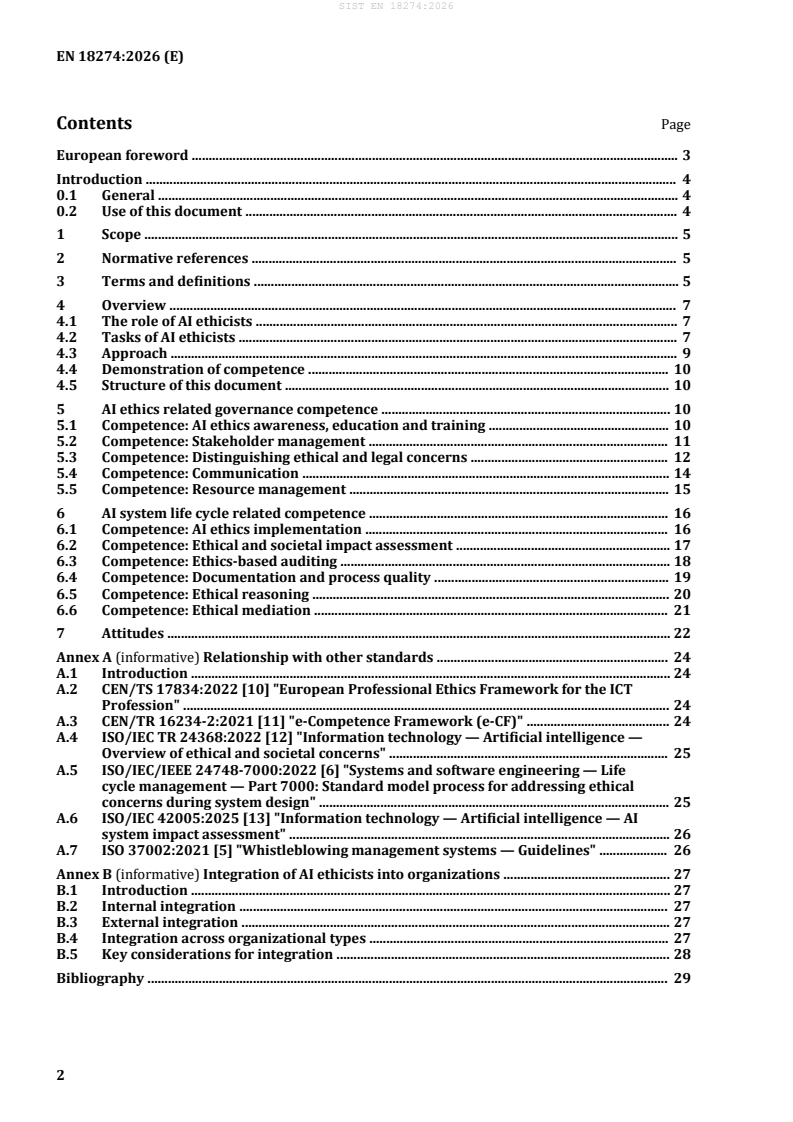
Contents Page
European foreword . 3
Introduction . 4
0.1 General . 4
0.2 Use of this document . 4
1 Scope . 5
2 Normative references . 5
3 Terms and definitions . 5
4 Overview . 7
4.1 The role of AI ethicists . 7
4.2 Tasks of AI ethicists . 7
4.3 Approach . 9
4.4 Demonstration of competence . 10
4.5 Structure of this document . 10
5 AI ethics related governance competence . 10
5.1 Competence: AI ethics awareness, education and training . 10
5.2 Competence: Stakeholder management . 11
5.3 Competence: Distinguishing ethical and legal concerns . 12
5.4 Competence: Communication . 14
5.5 Competence: Resource management . 15
6 AI system life cycle related competence . 16
6.1 Competence: AI ethics implementation . 16
6.2 Competence: Ethical and societal impact assessment . 17
6.3 Competence: Ethics-based auditing . 18
6.4 Competence: Documentation and process quality . 19
6.5 Competence: Ethical reasoning . 20
6.6 Competence: Ethical mediation . 21
7 Attitudes . 22
Annex A (informative) Relationship with other standards . 24
A.1 Introduction . 24
A.2 CEN/TS 17834:2022 [10] "European Professional Ethics Framework for the ICT
Profession" . 24
A.3 CEN/TR 16234-2:2021 [11] "e-Competence Framework (e-CF)" . 24
A.4 ISO/IEC TR 24368:2022 [12] "Information technology — Artificial intelligence —
Overview of ethical and societal concerns" . 25
A.5 ISO/IEC/IEEE 24748-7000:2022 [6] "Systems and software engineering — Life
cycle management — Part 7000: Standard model process for addressing ethical
concerns during system design" . 25
A.6 ISO/IEC 42005:2025 [13] "Information technology — Artificial intelligence — AI
system impact assessment" . 26
A.7 ISO 37002:2021 [5] "Whistleblowing management systems — Guidelines" . 26
Annex B (informative) Integration of AI ethicists into organizations . 27
B.1 Introduction . 27
B.2 Internal integration . 27
B.3 External integration . 27
B.4 Integration across organizational types . 27
B.5 Key considerations for integration . 28
Bibliography . 29
European foreword
This document (EN 18274:2026) has been prepared by Technical Committee CEN-CENELEC/JTC 21
"Artificial Intelligence", the secretariat of which is held by DS.
This European Standard shall be given the status of a national standard, either by publication of an
identical text or by endorsement, at the latest by February 2027, and conflicting national standards
shall be withdrawn at the latest by February 2027.
Attention is drawn to the possibility that some of the elements of this document may be the subject of
patent rights. CEN shall not be held responsible for identifying any or all such patent rights.
Any feedback and questions on this document should be directed to the users’ national standards body.
A complete listing of these bodies can be found on the CEN website.
According to the CEN-CENELEC Internal Regulations, the national standards organisations of the
following countries are bound to implement this European Standard: Austria, Belgium, Bulgaria, Croatia,
Cyprus, Czech Republic, Denmark, Estonia, Finland, France, Germany, Greece, Hungary, Iceland, Ireland,
Italy, Latvia, Lithuania, Luxembourg, Malta, Netherlands, Norway, Poland, Portugal, Republic of North
Macedonia, Romania, Serbia, Slovakia, Slovenia, Spain, Sweden, Switzerland, Tu� rkiyè and the United
Kingdom.
Introduction
0.1 General
The design, deployment and governance of Artificial Intelligence (AI) technologies rest on a thorough
consideration of ethical and societal issues. Prior to the integration of AI systems into various domains,
addressing potential ethical challenges and societal concerns is essential.
Growing awareness of these concerns has generated increasing demand for integrating AI ethics into
AI projects and into the processes of deploying and using AI applications in business, education,
healthcare and high-risk environments. Among other things, this can be achieved by integrating a
spècific professional role, here named AI ethicist, to contribute to the organization's AI governance and
throughout the entire AI system life cycle. This role delivers essential expertise in addressing complex
ethical and societal challenges of AI, supporting proactive ethics safeguards alongside ongoing
monitoring, oversight and appropriate corrective measures.
As the demand for the integration of AI ethics continues to grow, it becomes increasingly important to
establish a common understanding of the competences required to fulfil this role. Without a
standardized set of criteria, organizations risk inconsistent and inadequate attention and
implementation to AI ethics, which can lead to unintended consequences and harm to individuals and
society.
This document provides requirements and recommendations for the competences of AI ethicists, which
influèncès the responsible AI system life cycle and governance of AI and creates value that helps to achieve
the organization’s objectives and promote a positive impact on society. This document is intended to
serve as a basis for the development and deployment of a cèrtification scheme.
0.2 Use of this document
Clause 4 provides an overview of this document, including its objectives, the methodology used in its
development and a review of the main tasks associated with the role of AI ethicists.
Clause 5 provides AI ethics related governance competence for AI ethicists, outlining knowledge and skill
requirements for each competence.
Clause 6 provides AI system related life cycle competence for AI ethicists, outlining knowledge and skill
requirements for each competence.
Annex A discusses the relationship between this document and other relevant standards in the fièld of
ethics and AI.
Annex B provides information on the integration of AI ethicists into various organizational structures.
1 Scope
This document establishes a systematized framework for the competences of AI ethicists, categorizing
them into knowledge, skills and attitudes related to the spècific activities and tasks of the role. It spècifiès
requirements and recommendations necessary for individuals to effectively perform as AI ethicists.
These competences encompass a strong understanding of European values and fundamental rights,
further enhancing the knowledge, skills and attitudes required for this profession.
This document dèfinès the essential concepts and principles inherent to the AI ethicist role. It illustrates
a clear, uniform approach to the integral components of this profession.
Moreover, the document outlines how the role of AI ethicists can be seamlessly integrated into a wide
variety of organizations. These include, but are not limited to, commercial enterprises, governmental
agencies and non-profit organizations.
2 Normative references
There are no normative references in this document.
3 Terms and definitions
For the purposes of this document, the following terms and dèfinitions apply.
ISO and IEC maintain terminology databases for use in standardization at the following addresses:
— IEC Electropedia: available at http://www.electropedia.org/
— ISO Online browsing platform: available at http://www.iso.org/obp
3.1
competence
demonstrated ability to apply knowledge (3.2), skill (3.3) and attitudes for achieving observable results
Note 1 to entry: Especially for AI ethicists, the ability to identify whether or not a given situation is morally laden.
[SOURCE: EN 16234-1:2019 [1], 3.4]
3.2
knowledge
outcome of the assimilation of information through learning
Note 1 to entry: Knowledge is the body of facts, principles, theories and practices that is related to a fièld of work
or study.
Note 2 to entry: In the context of the European Qualifications Framework, knowledge is described as theoretical
and/or factual.
Note 3 to entry: In addition to learning, knowledge can be acquired through any other reliable process (e.g.
testimony, perception, inference).
[SOURCE: European Qualifications Framework, Annex I, f]
3.3
skill
ability to apply knowledge (3.2) and use know-how to complete tasks and solve problems
Note 1 to entry: In the context of the European Qualifications Framework, skills are described as cognitive
(involving the use of logical, intuitive and creative thinking) or practical (involving manual dexterity and the use
of methods, materials, tools and instruments).
[SOURCE: European Qualifications Framework, Annex I, g]
3.4
ethics
branch of philosophy concerning the normative principles of right and wrong conduct
3.5
AI ethics
branch of applied ethics (3.4), focusing on ethical issues raised by the design, development and use of AI
3.6
AI ethicist
professional with competence (3.1) in studying, analysing, supervising, monitoring and providing
guidance on the ethical considerations, implications and practices related to artificial intelligence
3.7
code of ethics
set of principles and rules concerning moral obligations and regard for the rights of humans and nature,
which can be spècifièd by a given profession, group or organization
3.8
attitude
consistent and demonstrable approach to work that rèflècts the values and behaviours expected from
a professional in a spècific context
3.9
ethical infrastructure
formal and informal systems, which communicate, monitor and reward ethical behaviour or sanction
unethical behaviour within an organization
3.10
AI system
engineered system that generates outputs such as content, forecasts, recommendations or decisions
for a given set of human-dèfinèd objectives
Note 1 to entry: The engineered system can use various techniques and approaches related to artificial intelligence
to develop a model to represent data, knowledge (3.2), processes which can be used to conduct tasks.
Note 2 to entry: AI systems are designed to operate with varying levels of automation.
[SOURCE: ISO/IEC 22989:2022 [2], 3.1.4]
3.11
life cycle
lifecycle
evolution of a system, product, service, project or other human-made entity, from conception through
retirement
[SOURCE: ISO/IEC/IEEE 15288:2023 [3], 3.21]
3.12
governance
human-based system comprising directing, overseeing and accountability
[SOURCE: ISO/IEC 38500:2024 [4], 3.3]
3.13
moral deliberation
process of structured and reasoned evaluation by which an agent idèntifiès, compares and justifiès
possible courses of action in light of moral values, principles and the expected effects on affected
stakeholders, in order to determine a course of action that is ethically acceptable or preferable
4 Overview
4.1 The role of AI ethicists
AI ethicists are professionals whose role is to contribute to the establishment, implementation,
maintenance and continual improvement of AI ethics (3.5) frameworks, guidelines and practices within
organizations. They should have and maintain knowledge (3.2), skills and attitudes required to identify,
evaluate and mitigate the ethical and societal risks and implications of AI systems and to support their
alignment with human values, principles and societal norms. They should also stay up-to-date with the
latest developments in AI research, technology, policy and applied ethics (3.4) best practices to fulfil
their role successfully.
Integrating ethicists into teams represents a strategic advantage for organizations designing,
developing and using AI. AI ethicists help mitigate ethical and societal risks while promoting a proactive
approach to responsible innovation which can translate into a competitive advantage in today's
marketplace. The adoption of solid ethical principles can facilitate international cooperation, potentially
opening doors to new markets and partnerships.
Clarifying that AI ethicists serve primarily as advisors rather than judges of what is ethically correct is
relevant. Their role is to identify ethical considerations, facilitate informed discussions, provide
guidance on ethical frameworks and support decision-making processes. While they contribute
expertise on ethical matters, final ethical decisions remain the responsibility of organizational
leadership and relevant stakeholders. AI ethicists help organizations navigate the complex ethical
terrain of AI development and implementation, ensuring that technological innovation proceeds in an
ethically informed and responsible manner.
While a moral deliberation (3.13) can be the outcome of an internal committee and never entrusted
solely to a single AI ethicist (3.6) or even a group of AI ethicists, the role of the AI ethicists shall be
formalized through a contract and organizational setup that ensures the necessary independence and
impartiality to perform their duties effectively. Moreover, AI ethicists should maintain strict
confidèntiality regarding the information they handle on behalf of the organization. However, AI
ethicists should also implement all necessary mechanisms to safeguard whistle-blowers, in line with
ISO 37002:2021 [5] and promote the relevance of system experts, value leads, risk leads, user advocates,
moderators and transparency managers as outlined in ISO/IEC/IEEE 24748-7000:2022 [6]. In addition,
there is frequent interlacing of ethics (3.4) and fundamental rights in practical development,
implementation and control of ethical impacts in organizations. Whereas ethics (3.4) covers the whole
scope of this dimension, fundamental rights refer to the spècific ethical aspects embedded in concrete
normative documents (e.g. rights charts or declarations). AI ethicists should be able to identify, evaluate
and help prevent or justify, where necessary, relations with fundamental rights throughout the AI system
(3.10) life cycle (3.11), in line with a potential structured fundamental rights impact assessment
approach.
The role of AI ethicists may be known by various titles across different organizations and industries.
Alternative names for this role include, but are not limited to: AI Ethics Officèr, AI Ethics Consultant,
Ethical AI Strategist, AI Ethics Researcher or AI Ethics and Compliance Manager, Responsible AI
Specialist. Other names, such as AI Risk Management Specialist and AI Governance Expert, may share
some of the competences of this role, though their primary focus may differ. Roles involving the term
responsible AI fall under the umbrella of AI ethics (3.5), as responsibility is inherently an ethical concept.
4.2 Tasks of AI ethicists
Within an organization, an AI ethicist (3.6) should be capable of carrying out the following tasks listed
in Table 1, each of which inherently involves an ethical dimension.
Table 1 — List of tasks
Task Description
Ethical trade-off management advising on the prioritization and weighing of the pros
and cons of different options given the relevant
circumstances (e.g. organizational policy, impact on
affected persons)
Ethical evaluation identifying potential ethical and societal concerns and
risks associated with AI technologies, applications and
practices (a priori evaluation) and analysing their
realised ethical, psychological and social impact (a
posteriori evaluation)
Ethical dimensions of policy analysis reviewing, evaluating and providing recommendations
on AI-related guidelines and standards
NOTE Attention is drawn to regulations that can
apply.
Ethical mediation providing advice, facilitating discussions and resolve
conflicts on ethical matters in AI development,
deployment and usage
AI ethics implementation implementing guiding principles and practices that
govern the ethical design, development, deployment,
testing, use, monitoring and mitigation of AI
technologies, aligned with the organization's code of
ethics (3.7)
Ethical frameworks development developing ethical guidelines together with or with the
endorsement of the upper management for the design,
development and implementation of AI technologies to
steer corporate decisions and practices towards ethical
and responsible solutions
Research on AI ethics engaging in research by participating in research
projects, publishing peer-reviewed papers or
attending/presenting at conferences to stay updated on
AI ethics-related topics
AI ethics training designing, developing and delivering educational
programs, workshops, training or courses to improve
understanding of ethical and societal issues in AI among
organization’s employees
AI ethics awareness building awareness among employees, users and
consumers on ethical issues through workshops,
seminars and training programs to create a conscious
and responsible organizational culture
Ethical communication communicating AI ethics-related information, insights
and recommendations to internal and external
stakeholders
Ethical oversight and monitoring promoting continuous ethical rèflèction, enabling
organizations to learn from incidents, stakeholder
feedback and societal developments to improve the
moral quality of the AI system (3.10) over time
The responsibilities outlined in Table 1 are examples and do not encompass the full range of activities
undertaken by AI ethicists in all organizations. The spècific roles and tasks of AI ethicists can vary
significantly depending on the organization’s size, industry, context and the nature of its AI models.
Organizations retain complete discretion in determining the responsibilities and scope of work for their
AI ethics (3.5) function. However, whichever scope and responsibilities are included, the AI ethicist (3.6)
function requires adequate support and means to effectively operate within the organization.
4.3 Approach
This document is based on a competence-based approach. Each competence (3.1) is broken down into
its constituent knowledge (3.2), skills and attitudes. Attitudes, while not separately listed for each
competence (3.1), are considered longitudinal and integral to all competences. Although this approach
is aligned with the European Qualifications Framework, this document does not specify any levels of
proficièncy for each spècific competence (3.1).
This document is designed as an enabler, aiming to empower AI ethicists rather than impose restrictions.
It provides a flèxiblè framework that can be adapted to various contexts and needs. It provides a
competence (3.1) framework that can be applied by a wide range of users, including organizations of all
sizes in the private and public sector, AI companies, educational institutions and individuals.
The competences described in this document are suggested as essential and designed to be durable, i.e.
they remain valid over time and can be transferred to other related fièlds, even as AI technology, job
roles and marketing terminology evolve rapidly.
These competences can be aggregated to represent the essential content of a job role or profilè (as in
the present document), but they can also be applied to multiple job profilès. Competences are not the
same as particular tasks. Rather, competences are the crucial elements that enable the successful
performance of tasks across various scenarios.
This document does not aim to exhaustively cover all possible competences of an AI ethicist (3.6), nor
are all included competences unique to AI ethics (3.5). The selection of competences for inclusion in this
document was based on engagement with stakeholders such as commercial enterprises, government
agencies, NGOs and Consumer Associations, who prioritized competence (3.1) inclusion based on
industry knowledge (3.2) and experience. While focusing on AI èthics-spècific competences, this
document acknowledges the importance of more generic competences that are already well-articulated
in other professional frameworks.
Figure 1 shows the approach to competence (3.1) adopted in this document.
Figure 1 — Approach to competence
The subsequent clauses are structured around a table of competences of AI ethicists, as follows:
— intended outcomes: These describe the anticipated results when AI ethicists possess the
necessary competence (3.1) and apply it in practice.
— knowledge (3.2) requirements: This row lists the knowledge (3.2) elements essential for
effectively applying the competence (3.1) and achieving the intended outcomes.
— skill requirements: This row lists the skill (3.3) sets required to apply the competence (3.1) and
achieve the intended outcomes.
4.4 Demonstration of competence
For each competence (3.1), professional AI ethicists shall be able to demonstrate the following:
a) the knowledge (3.2) requirements in the corresponding Table 2, Table 3, Table 4, Table 5, Table
6, Table 7, Table 8, Table 9, Table 10, Table 11 demonstrated by the possession of educational
and/or professional qualifications and experience;
b) the skill (3.3) requirements in the corresponding Table 2, Table 3, Table 4, Table 5, Table 6, Table
7, Table 8, Table 9, Table 10, Table 11 demonstrated by the ability to carry out the managerial or
technical tasks.
4.5 Structure of this document
This document outlines the competences required for professional AI ethicists structured into two
categories: AI governance (3.12) related competences and life cycle (3.11) related competences.
AI related governance competences (Clause 5) refer to the knowledge (3.2), skills and attitudes required
to successfully carry out AI governance related activities, including developing policies, procedures and
standards for responsible AI development, deployment, customization and use.
Life cycle (3.11) related competences (Clause 6) refer to the knowledge (3.2), skills (3.3) and attitudes
(3.8) required to integrate ethical and societal considerations into the entire AI system (3.10) life cycle
(3.11), from design, development, deployment, testing, use, monitoring and mitigation. Note that there
are significant differences between life cycle (3.11) stages (e.g. utilization, support, retirement) and
processes (e.g. operation, maintenance, disposal), as supported by ISO/IEC/IEEE 15288:2023 [3].
Clause 7 presents a list of attitudes recommended for professional AI ethicists.
Annex A and Annex B provide additional information. Annex A analyses the relationship between this
document and other standards related to AI ethics (3.5). Annex B explains how AI ethicists can be
integrated in different organizational contexts.
5 AI ethics related governance competence
5.1 Competence: AI ethics awareness, education and training
To accomplish their roles in an organization, professional AI ethicists shall acquire, keep up-to-date
and demonstrate competence (3.1) with respect to AI ethics (3.5) and governance (3.12).
The intended outcomes, knowledge (3.2) requirements and skill (3.3) requirements associated with the
AI ethics (3.5) awareness, education and training competence (3.1) are presented in Table 2.
Table 2 — Competences on AI ethics awareness, education and training
Intended outcomes cultivating an environment where ethical reasoning can
flourish, promoting a strong ethical culture within the
organization and ensuring that employees have the
necessary knowledge (3.2) and skills to identify,
evaluate and address ethical challenges related to AI
Knowledge requirements — ethical frameworks and principles applicable to AI
— learning theories and principles
— instructional design and development
— evaluation methods and evaluation techniques
— organizational learning and development
practices
— normative ethics (3.4) and ethical theories that
underlay discussions about AI
— ethical and societal implications of AI and how it
affects different groups of people within society
— awareness of the pros and cons of each ethical
theory and framework
— fundamental rights norms and principles
— risk areas relevant to AI systems
Skill requirements — design and develop curricula
— communication and presentation skills
— analysis and evaluation skills
— identify, evaluate and help prevent or justify
relations between ethics (3.4) and fundamental
rights aspects
— contribute to fundamental rights and risk impact
assessment
5.2 Competence: Stakeholder management
The intended outcomes, knowledge (3.2) requirements and skill (3.3) requirements associated with the
stakeholder management competence (3.1) are presented in Table 3.
Table 3 — Competences on stakeholder management
Intended outcomes identifying, engaging and managing relationships with
key stakeholders (internal and external) to align
interests, address concerns and build trust in AI models,
promoting ethical and responsible AI design,
development, deployment, testing, use, monitoring
and mitigation
Knowledge requirements — stakeholder analysis and mapping techniques
— stakeholder engagement strategies
— associations and organized stakeholders (for
consumers, workers, children, gender)
— conflict management strategies
— an understanding of transparency and
accountability obligations and procedures
between internal stakeholder and between
internal and external stakeholders
Skill requirements — analyse and evaluate organizational culture
— advise on the resolution of conflicts among
stakeholders with differing interests
— negotiate to achieve ethical objectives
— establish and maintain strong relationships with
stakeholders based on trust and mutual respect
— identify and address stakeholder needs and
challenges
— enable, advocate for and practice appropriate
transparency procedures and standards in
support of accountability obligations, up to and
including escalation to top level management and
pub
...