


EN 15221-6:2011
(Main)Facility Management - Part 6: Area and Space Measurement in Facility Management
Facility Management - Part 6: Area and Space Measurement in Facility Management
This European Standard establishes a common basis for planning and design, area and space management, financial assessment, as well as a tool for benchmarking in the field of Facility Management.
This standard covers area and space measurement for existing owned or leased buildings as well as buildings in state of planning or development.
This standard presents a framework for measuring floor areas within buildings and areas outside of buildings. In addition, it contains clear terms and definitions as well as methods for measuring horizontal areas and volumes in buildings and/or parts of buildings, independent of their function.
Facility Management - Teil 6: Flächenbemessung im Facility Management
Diese Europäische Norm schafft eine gemeinsame Grundlage für die Planung und Auslegung für Flächenmanagement und Finanzbewertung und bietet ein Werkzeug für Benchmarking im Bereich des Facility Managements.
Diese Norm behandelt die Flächenmessung für bestehende im Eigentum befindliche oder gemietete Gebäude sowie die Bemessung für Gebäude in der Planungs oder Entwicklungsphase.
Diese Norm bietet einen Rahmen für die Messung von Grundflächen in Gebäuden und Flächen außerhalb von Gebäuden. Darüber hinaus enthält sie eindeutige Begriffe und Definitionen sowie Verfahren zur Messung von horizontalen Grundflächen und Rauminhalten (Volumen) in Gebäuden und/oder Gebäudeteilen unabhängig von ihrer Funktion.
Facilities management - Partie 6 : Mesure des surfaces et de l'espace en Facilities Management
La présente Norme européenne établit une base commune applicable à la planification et à la conception, à la gestion des surfaces et de l’espace, à l’évaluation financière et constitue également un outil d’étalonnage comparatif dans le domaine du Facilities Management.
La présente norme concerne la mesure des surfaces et de l’espace de bâtiments existants possédés ou loués, ainsi que de bâtiments au stade de planification ou de développement.
La présente norme spécifie un cadre de mesure des surfaces de plancher dans des bâtiments et des surfaces à l’extérieur des bâtiments. Elle comprend par ailleurs des termes et définitions clairs, ainsi que des méthodes de mesure des surfaces horizontales et des volumes dans des bâtiments et/ou des parties de bâtiments, indépendamment de leur fonction.
Upravljanje objektov in storitev - 6. del: Merjenje površin in prostorov pri upravljanju objektov in storitev
Ta evropski standard vzpostavlja splošno osnovo za načrtovanje in projektiranje, upravljanje površin in prostorov, finančno oceno in za orodje za primerjavo na področju upravljanja objektov in storitev.
Ta standard zajema merjenje površin in prostorov za obstoječe zgradbe v lasti ali v najemu in za zgradbe, ki se načrtujejo in razvijajo.
Ta standard predstavlja okvir za merjenje talnih površin znotraj zgradb in površin zunaj zgradb.
Poleg tega vsebuje jasne izraze in definicije ter metode za merjenje vodoravnih površin in volumnov v zgradbah in/ali delih zgradb, neodvisno od njihovih funkcij.
General Information
- Status
- Published
- Publication Date
- 18-Oct-2011
- Withdrawal Date
- 29-Apr-2012
- Technical Committee
- CEN/TC 348 - Facility management
- Drafting Committee
- CEN/TC 348/WG 6 - Space measurement in Facility Management
- Current Stage
- 9092 - Decision on results of review/2YR ENQ - revise - Review Enquiry
- Start Date
- 08-Feb-2022
- Completion Date
- 14-Apr-2025
Relations
- Revised
prEN 15221-6 - Facility Management - Part 6: Area and Space Measurement in Facility Management - Effective Date
- 18-Jan-2023
Overview
EN 15221-6:2011 - Facility Management: Part 6 - Area and Space Measurement in Facility Management (CEN) defines a harmonised European framework for measuring areas and spaces in buildings. It applies to existing, leased or owned buildings and to properties in planning or development. The standard provides clear terms and definitions, measurement methods for horizontal areas and volumes, and a common language to support planning, design, space management, financial assessment and benchmarking across the facility management (FM) value chain.
Key Topics
- Scope and purpose: Establishes a common basis for area and space measurement to enable comparable data across countries and stakeholders.
- Units and methods: Standard measurement units - metres (m), square metres (m2) and cubic metres (m3) - and distinctions between length/width/height and gross vs. net distances.
- Defined area types: Framework includes many floor- and space-related categories such as:
- Level Area (LA), Gross Floor Area (GFA), Net Floor Area (NFA), Net Room Area (NRA)
- Internal Floor Area (IFA), Interior Construction Area (ICA), Exterior Construction Area (ECA)
- Non-functional Level Area (NLA), Partition Wall Area (PWA)
- Functional subcategories: Technical Area (TA), Circulation Area (CA), Amenity Area (AA), Primary Area (PA)
- Outside areas: Classification and terminology for areas outside buildings (parking, covered/uncovered spaces).
- Supporting material: Normative annexes (Area Matrix), illustrations (atria, stairwells, walls) and informative examples for subcategories.
- Normative reference: EN 15221-1 (Terms and definitions) is required for consistent interpretation.
Applications
Who uses EN 15221-6 and why:
- Facility managers - for consistent space inventories, utilisation analysis and operational planning.
- Architects & planners - to align design measurements with FM and leasing needs.
- Property owners & asset managers - for accurate area-based financial assessments, rent calculations and life-cycle cost planning.
- Tenants & occupiers - to compare offers, verify leased area and benchmark space efficiency.
- Investors, valuers & economists - to enable comparable metrics for valuation and benchmarking across regions.
- Benchmarking & reporting - provides a consistent basis for cross-country comparisons of floor area and space utilisation, reducing discrepancies from differing national practices.
Related Standards
- EN 15221-1:2006 - Facility Management - Part 1: Terms and definitions (normative reference)
- Other parts of the EN 15221 series: Part 2 (FM agreements), Part 3 (Quality), Part 4 (Taxonomy), Part 5 (Processes), Part 7 (Performance Benchmarking)
EN 15221-6 is essential where accurate, comparable floor area measurement, space management and benchmarking are needed to support FM decision-making, contracts and financial transparency.



Frequently Asked Questions
EN 15221-6:2011 is a standard published by the European Committee for Standardization (CEN). Its full title is "Facility Management - Part 6: Area and Space Measurement in Facility Management". This standard covers: This European Standard establishes a common basis for planning and design, area and space management, financial assessment, as well as a tool for benchmarking in the field of Facility Management. This standard covers area and space measurement for existing owned or leased buildings as well as buildings in state of planning or development. This standard presents a framework for measuring floor areas within buildings and areas outside of buildings. In addition, it contains clear terms and definitions as well as methods for measuring horizontal areas and volumes in buildings and/or parts of buildings, independent of their function.
This European Standard establishes a common basis for planning and design, area and space management, financial assessment, as well as a tool for benchmarking in the field of Facility Management. This standard covers area and space measurement for existing owned or leased buildings as well as buildings in state of planning or development. This standard presents a framework for measuring floor areas within buildings and areas outside of buildings. In addition, it contains clear terms and definitions as well as methods for measuring horizontal areas and volumes in buildings and/or parts of buildings, independent of their function.
EN 15221-6:2011 is classified under the following ICS (International Classification for Standards) categories: 03.080.99 - Other services; 35.240.99 - IT applications in other fields; 91.140.01 - Installations in buildings in general. The ICS classification helps identify the subject area and facilitates finding related standards.
EN 15221-6:2011 has the following relationships with other standards: It is inter standard links to prEN 15221-6. Understanding these relationships helps ensure you are using the most current and applicable version of the standard.
You can purchase EN 15221-6:2011 directly from iTeh Standards. The document is available in PDF format and is delivered instantly after payment. Add the standard to your cart and complete the secure checkout process. iTeh Standards is an authorized distributor of CEN standards.
Standards Content (Sample)
2003-01.Slovenski inštitut za standardizacijo. Razmnoževanje celote ali delov tega standarda ni dovoljeno.Upravljanje objektov in storitev - 6. del: Merjenje površin in prostorov pri upravljanju objektov in storitevFacility Management - Teil 6: Flächenbemessung im Facility ManagementFacilities management - Partie 6: Mesure des surfaces et de l'espace en facilities managementFacility Management - Part 6: Area and Space Measurement in Facility Management91.040.01Stavbe na splošnoBuildings in general03.080.99Druge storitveOther servicesICS:Ta slovenski standard je istoveten z:EN 15221-6:2011SIST EN 15221-6:2011en,de01-december-2011SIST EN 15221-6:2011SLOVENSKI
STANDARD
EUROPEAN STANDARD NORME EUROPÉENNE EUROPÄISCHE NORM
EN 15221-6
October 2011 ICS 03.080.99; 91.140.01 English Version
Facility Management - Part 6: Area and Space Measurement in Facility Management
Facilities management - Partie 6: Mesure des surfaces et de l'espace en facilities management
Facility Management - Teil 6: Flächenbemessung im Facility Management This European Standard was approved by CEN on 8 July 2011.
CEN members are bound to comply with the CEN/CENELEC Internal Regulations which stipulate the conditions for giving this European Standard the status of a national standard without any alteration. Up-to-date lists and bibliographical references concerning such national standards may be obtained on application to the CEN-CENELEC Management Centre or to any CEN member.
This European Standard exists in three official versions (English, French, German). A version in any other language made by translation under the responsibility of a CEN member into its own language and notified to the CEN-CENELEC Management Centre has the same status as the official versions.
CEN members are the national standards bodies of Austria, Belgium, Bulgaria, Croatia, Cyprus, Czech Republic, Denmark, Estonia, Finland, France, Germany, Greece, Hungary, Iceland, Ireland, Italy, Latvia, Lithuania, Luxembourg, Malta, Netherlands, Norway, Poland, Portugal, Romania, Slovakia, Slovenia, Spain, Sweden, Switzerland and United Kingdom.
EUROPEAN COMMITTEE FOR STANDARDIZATION
COMITÉ EUROPÉEN DE NORMALISATION EUROPÄISCHES KOMITEE FÜR NORMUNG
Management Centre:
Avenue Marnix 17,
B-1000 Brussels © 2011 CEN All rights of exploitation in any form and by any means reserved worldwide for CEN national Members. Ref. No. EN 15221-6:2011: ESIST EN 15221-6:2011
Area Matrix . 39Annex B (normative)
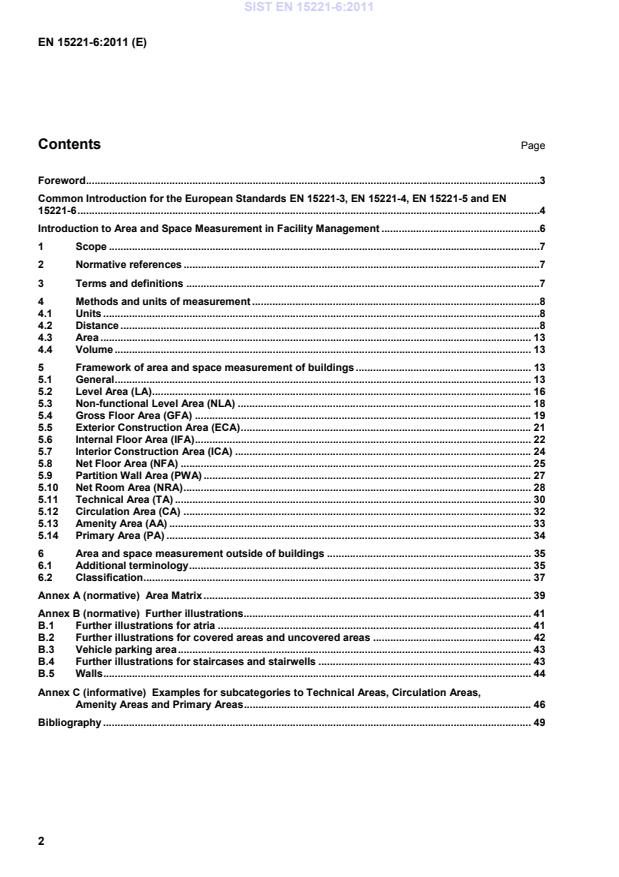
Further illustrations. 41B.1Further illustrations for atria . 41B.2Further illustrations for covered areas and uncovered areas . 42B.3Vehicle parking area . 43B.4Further illustrations for staircases and stairwells . 43B.5Walls . 44Annex C (informative)
Examples for subcategories to Technical Areas, Circulation Areas, Amenity Areas and Primary Areas . 46Bibliography . 49 SIST EN 15221-6:2011
The FM-model of EN 15221-1 is shown below.
Model EN 15221-1:2006 These standards also build on widely accepted management principles, in particular value chain (Porter, M E, (1985), "Competitive Advantage: creating and sustaining superior performance", Free Press, New York) and quality control (PDCA (Plan, Do, Check, Act). Deming, W E (1986), "Out of the Crisis", MIT, Cambridge). Reference to ISO 10014:2006, Quality management – Guidelines for realizing financial and economic benefits.
D E M A N D SPECIFYINGS L A s S U P P L Y D E L I
V E R I
N G STRATEGIC TACTICAL OPERATIONAL Client Customer End User O R G A N I S A T I O N PROVI DERInternaland/ orexternalPRIMARYPROCESSES SUPPORT PROCESSES KPIsFACILITY SERVICES PRIMARYACTIVITIESFacility Management Agreement D E M A N D SPECIFYINGS L A s S U P P L Y D E L I
V E R I
N G STRATEGIC TACTICAL OPERATIONAL Client Customer
End User O R G A N I S A T I O N PROVI DERInternalor /
and externalPRIMARY PROCESSES SUPPORT- PROCESSES KPIsFACILITY SERVICES
PRIMARY ACTIVITIES
Facility Management agreement SIST EN 15221-6:2011
These standards align to EN ISO 9000 family of standards for Quality Management Systems and applies specific guidance on the concepts and use of a process-based approach to management systems to the field of Facility Management.
The term "facility services" is used as a generic description in the standards. The term "standardized facility products" refers to the "standardized facility services" defined and described in EN 15221-4, Facility Management – Part 4: Taxonomy, Classification and Structures in Facility Management. Countries can decide to substitute the term "product" into "service", when they consider that it is important for a good acceptance and use of the standards in their own country. The aim of all the standards is to provide guidance to Facility Management (FM) organizations on the development and improvement of their FM processes to support the primary activities. This will support organizational development, innovation and improvement and will form a foundation for the further professional development of FM and its advancement in Europe. Therefore, generic examples are provided in the standard to assist organizations. These standards lay the foundation of the work that has to be done further more in developing Facility Management, for e.g. benchmark standards prEN 15221-7. SIST EN 15221-6:2011
UK building as measured by RICS with the Net Enclosed Area (Netto-Grundfläche) of a German building as measured by DIN or the Net Floor Area (Netto Vloeroppervlakte) of a Dutch building as measured by NEN are highly misleading as the floor areas are measured differently. In short, the fact that measuring specific floor areas in one and the same building using different national standards result in variations up to 30 % clearly highlights the need for a harmonised European approach to "area and space measurement".
3.4 space area or volume bounded actually or theoretically [see ISO 6707-1] 3.5 floor generally the lower horizontal structure of a room which constitutes the bounding element of a building or part thereof 3.6 ceiling generally the upper horizontal surface of a room SIST EN 15221-6:2011
Structural walls support floors or roofs and/or ensure structural integrity B
Non-structural walls are intended to divide/separate space only 1
Exterior walls divide/separate inside rooms from the outside 2
Interior walls divide/separate inside rooms only Combinations of the above are possible (e.g. interior walls can be structural and exterior walls can be non-structural). 3.9 room part of a building, entirely or partially bounded by dividing elements and whose floor and/or ceiling forms part of the construction of the building, accessible to people 3.10 building undivided shelter comprising a space entirely or partially bounded by enclosing structures, intended for specific purposes for its occupants 4 Methods and units of measurement 4.1 Units The units of measurement differ according to the type of calculation: distances are measures of one dimension and should be expressed in metres (m); areas are measures of two dimensions and should be expressed in square metres (m2); volumes are measures of three dimensions and should be expressed in cubic metres (m3). NOTE Where other measurements are used, this can be transformed by using existing formulas e.g. square feet vs. square metre. 4.2 Distance For distances, it is necessary to distinguish between length, width and height. The length is measured as linear extent from end to end (measurement of a horizontal distance). The width is measured as linear extent from side to side (measurement of a horizontal distance). The height is measured as linear extent from top to bottom (measurement of vertical distance). NOTE 1 Width is equal to or smaller than length. For lengths, widths and heights it is distinguished between gross and net distance: the gross length / width is measured as horizontal distance between the outer limiting faces of exterior walls or the horizontal distance between the centres of interior walls; SIST EN 15221-6:2011
Key 1 room 1 2 room 2 3 exterior wall 4 interior wall 5 floor 6 floor or roof 7 suspended ceiling 8 ceiling 9 raised floor bg1 gross width room 1 bg2 gross width room 2 l gross length lN net length h gross height hc construction height hp passage height hN net height hF free height a) – Measuring distances on a vertical plane SIST EN 15221-6:2011
Key 1 room 1 2 room 2 3 exterior wall 4 interior wall b gross width bg1 gross width room 1 bg2 gross width room 2 bp passage width bN1 net width 1 b N2 net width 2 l gross length lG1 gross length 1 lG2 gross length 2 lN1 net length 1 lN2 net length 2 b) — Measuring distances on a horizontal plane seen from above Figure 1 — Measuring Distances SIST EN 15221-6:2011
Key 1 highest floor level 2 intermediate floor level 3 lowest floor level 4 enclosed area 5 covered area 6 building area above ground 7
column h gross height Figure 2 — Examples of measuring gross distances in different buildings with multiple levels SIST EN 15221-6:2011
Key b width l length Figure 3 —
Vertical projection Gross areas are determined by the gross distances, net areas are determined by the net distances. Areas which are solely needed for maintenance and emergency exits are not taken into account in this standard. 4.4 Volume Volumes are measured by their actual dimensions. Inclined planes, whether floors or walls, define inclined bounds to the volume. Gross volumes are determined by the gross distances, net volumes are determined by the net distances. Note that Non-functional Level Area concepts such as voids do not apply here. When measuring volumes, a multi-level space is measured as a single volume. 5 Framework of area and space measurement of buildings 5.1 General Buildings, rooms and floors shall be measured at the floor level (at the height level to the top of a finished floor). Every floor level shall be measured separately. Areas with varying net heights within one floor level may be calculated separately.
The area of a floor shall be determined as the area of the vertical projection onto the horizontal plane. Wall openings in interior and exterior walls are also measured by the vertical projection of their outer limits at floor level onto the horizontal plane and belong to the volume and area of exterior and interior walls.
Circulation Area (CA)
Amenity Area (AA) Primary Area (PA)
examples of subdivisions see annex C examples of subdivisions see annex C examples of subdivisions see annex C examples of subdivisions see annex C Unrestricted Technical Area (UTA) Restricted Technical Area (RTA) Unrestricted Circulation Area (UCA)
Restricted Circulation Area (RCA)
Unrestricted Amenity Area (UAA)
Restricted Amenity Area (RAA)
Unrestricted Primary Area (UPA)
Restricted Primary Area (RPA)
NOTE When defining the Rentable Floor Area it is strongly recommended to use one of the defined measurements of the table above. The application of the framework given in Table 1 is illustrated in the following example.
A section of this building is being given in Figure 4. In the following figures, the grey coloured areas are showing in each case the area described in the subclause. SIST EN 15221-6:2011
Figure 4 —
Floor plan of the upper floor of the building used as an example SIST EN 15221-6:2011
Separate buildings have to be measured independently.
Here follows an exhaustive list of the elements contained within this term: a) voids, atriums and cavities; b) perimeter wall thickness; c) external columns and piers; d) structu
...
The article discusses the European Standard EN 15221-6:2011, which focuses on facility management and specifically area and space measurement. The standard provides a common framework for planning, design, financial assessment, and benchmarking in facility management. It covers both owned or leased existing buildings and those in the planning or development stage. The standard defines terms, methods, and measurements for floor areas and volumes within buildings, regardless of their function.
記事のタイトル:EN 15221-6:2011 - ファシリティマネジメント - 第6部:ファシリティマネジメントにおける面積とスペースの計測 記事の内容:このヨーロッパ標準では、ファシリティマネジメントの計画と設計、面積とスペースの管理、財務評価への共通の基盤を確立し、ベンチマーキングのツールとしても利用します。 この標準は、所有または賃貸している既存の建物だけでなく、計画または開発中の建物における面積とスペースの計測を対象としています。 この標準では、建物内の床面積や建物の外のエリアを計測するためのフレームワークを提供しています。また、機能に依存せずに建物または建物の一部の水平面積と容積を計測するための明確な用語、定義、および方法も含まれています。
기사 제목: EN 15221-6:2011 - 시설 관리 - 제6편: 시설 관리에서의 면적 및 공간 측정 기사 내용: 이 유럽 표준은 시설 관리 분야에서 계획 및 디자인, 면적 및 공간 관리, 재정 평가에 공통적인 기초를 확립하며, 벤치마킹 도구로 사용됩니다. 이 표준은 보유하거나 임대한 기존 건물뿐만 아니라 기획 또는 개발 단계의 건물에 대한 면적 및 공간 측정을 다룹니다. 이 표준은 건물 내부의 바닥 면적 및 건물 외부 지역을 측정하기 위한 프레임워크를 제시합니다. 또한 기능과는 관계없이 건물 또는 건물 부분 내의 수평 면적과 부피를 측정하기 위한 명확한 용어, 정의 및 방법을 포함하고 있습니다.
Questions, Comments and Discussion
Ask us and Technical Secretary will try to provide an answer. You can facilitate discussion about the standard in here.
Loading comments...