

EN 12758:2019/FprA1
(Amendment)Glass in building - Glazing and airborne sound insulation - Product descriptions, determination of properties and extension rules
- Abstract
This European Standard assigns sound insulation values to all transparent, translucent and opaque glass products, described in the European Standards for basic, special basic or processed glass products, when intended to be used in glazed assemblies in buildings, and which exhibit properties of acoustic protection, either as a prime intention or as a supplementary characteristic.
This document outlines the procedure, by which glass products may be rated, according to their acoustic performance which enables assessment of compliance with the acoustic requirements of buildings.
Rigorous technical analysis of measurement data remains an option, but this standard is intended to enable the derivation of simpler indices of performance, which can be adopted with confidence by non-specialists.
By adopting the principles of this standard the formulation of acoustic requirements in Building Codes and for product specification to satisfy particular needs for glazing is simplified.
It is recognised that the acoustic test procedures contained within EN ISO 140-1 and EN ISO 140-3 relate only to glass panes and their combinations. Although the same principles should be followed as closely as possible, it is inevitable that some compromises are necessary, because of the bulkier construction of other glazing types, e.g. glass blocks, paver units, channel-shaped glass, structural glazing and structural sealant glazing. Guidelines on how to adapt the test procedures for these glazing types are offered in Clause 4.
All the considerations of this standard relate to panes of glass/glazing alone. Incorporation of them into windows may cause changes in acoustic performance as a result of other influences, e.g. frame design, frame material, glazing material/method, mounting method, air tightness, etc. Measurements of the sound insulation of complete windows (glass and frame) may be undertaken to resolve such issues.
- Status
- Not Published
- Publication Date
- 08-May-2023
- Technical Committee
- CEN/TC 129 - Glass in building
- Drafting Committee
- CEN/TC 129/WG 10 - Sound insulating glazed assemblies
- Current Stage
- 5060 - Closure of Vote - Formal Approval
- Start Date
- 09-Mar-2023
- Due Date
- 25-Oct-2023
- Completion Date
- 09-Mar-2023

Overview
EN 12758:2019/FprA1 is a European standard developed by CEN that focuses on glass in building applications, specifically on glazing and its airborne sound insulation properties. This standard provides a comprehensive methodology for product descriptions, determination of acoustic performance, and extension rules for glass products used in construction. It applies to all types of glass-transparent, translucent, or opaque-that contribute to acoustic protection within building assemblies, either as a primary function or an additional benefit.
The standard simplifies the assessment of sound insulation characteristics for glazing products, enabling industry professionals and non-specialists alike to confidently evaluate and specify glazing solutions that meet acoustic requirements in buildings. It also offers guidelines on adapting test methods for various glazing types, ensuring relevance to different construction applications.
Key Topics
- Sound Insulation Values: The standard assigns specific sound insulation ratings to glass products, assisting in the clear categorization of their acoustic performance.
- Product Descriptions: Detailed definitions and classifications cover basic, special basic, and processed glass products for building glazing.
- Testing and Measurement Procedures: Based on established standards EN ISO 140-1 and EN ISO 140-3, with provisions for the specific challenges of testing complex glazing like glass blocks and structural glazing.
- Extension Rules: Guidelines clarify how test data and acoustic ratings can be extrapolated or adjusted for varying configurations, including insulated glass units (IGUs) with different spacer widths.
- Acoustic Performance Assessment: Establishes simplified indices for sound insulation ratings, reducing the need for complex technical analysis while maintaining accuracy.
- Limitations and Considerations: Addresses potential changes in acoustic properties when glass panes are incorporated into window assemblies, considering factors such as frame design and air tightness.
Applications
This standard is critically important for:
- Building Design and Architecture: Architects and engineers can specify suitable glazing products to meet noise control regulations and ensure acoustic comfort.
- Construction and Installation: Builders and contractors benefit from clear product specifications and performance data, facilitating compliance with building codes related to sound insulation.
- Product Manufacturing: Glass manufacturers use the standard to classify and label their products accurately, aiding market acceptance based on acoustic performance.
- Acoustic Consultants: Enables more straightforward evaluation and reporting of glazing solutions in relation to airborne sound insulation requirements.
- Regulatory Bodies: Simplifies the incorporation of glazing sound insulation criteria into national and regional building regulations.
Related Standards
EN 12758:2019/FprA1 aligns with and complements other relevant standards in the domain of glass and acoustic performance, such as:
- EN ISO 140-1: Measurement of sound insulation in buildings and building elements.
- EN ISO 140-3: Laboratory measurement of sound insulation of building elements.
- EN 1279: Glass in building - Insulating glass units.
- Other CEN Standards on Glass Products: Defining product characteristics and testing methods for glass types used in construction contexts.
By integrating these standards, EN 12758:2019/FprA1 provides a robust framework for assessing and specifying glazing solutions that enhance noise reduction and acoustic comfort in built environments.
Keywords: EN 12758:2019/FprA1, glazing sound insulation, glass acoustic performance, airborne sound insulation, building glass standards, sound insulation glass, acoustic glass specification, construction glazing standards, European glass standards, insulated glass units (IGUs).
Relations
- Effective Date
- 22-Mar-2023
- Effective Date
- 06-Oct-2021
Get Certified
Connect with accredited certification bodies for this standard

DIBt (Deutsches Institut für Bautechnik)
German Institute for Building Technology.
DIN CERTCO
DIN Group product certification.

Aboma Certification B.V.
Specialized in construction, metal, and transport sectors.
Sponsored listings
Frequently Asked Questions
EN 12758:2019/FprA1 is a draft published by the European Committee for Standardization (CEN). Its full title is "Glass in building - Glazing and airborne sound insulation - Product descriptions, determination of properties and extension rules". This standard covers: This European Standard assigns sound insulation values to all transparent, translucent and opaque glass products, described in the European Standards for basic, special basic or processed glass products, when intended to be used in glazed assemblies in buildings, and which exhibit properties of acoustic protection, either as a prime intention or as a supplementary characteristic. This document outlines the procedure, by which glass products may be rated, according to their acoustic performance which enables assessment of compliance with the acoustic requirements of buildings. Rigorous technical analysis of measurement data remains an option, but this standard is intended to enable the derivation of simpler indices of performance, which can be adopted with confidence by non-specialists. By adopting the principles of this standard the formulation of acoustic requirements in Building Codes and for product specification to satisfy particular needs for glazing is simplified. It is recognised that the acoustic test procedures contained within EN ISO 140-1 and EN ISO 140-3 relate only to glass panes and their combinations. Although the same principles should be followed as closely as possible, it is inevitable that some compromises are necessary, because of the bulkier construction of other glazing types, e.g. glass blocks, paver units, channel-shaped glass, structural glazing and structural sealant glazing. Guidelines on how to adapt the test procedures for these glazing types are offered in Clause 4. All the considerations of this standard relate to panes of glass/glazing alone. Incorporation of them into windows may cause changes in acoustic performance as a result of other influences, e.g. frame design, frame material, glazing material/method, mounting method, air tightness, etc. Measurements of the sound insulation of complete windows (glass and frame) may be undertaken to resolve such issues.
This European Standard assigns sound insulation values to all transparent, translucent and opaque glass products, described in the European Standards for basic, special basic or processed glass products, when intended to be used in glazed assemblies in buildings, and which exhibit properties of acoustic protection, either as a prime intention or as a supplementary characteristic. This document outlines the procedure, by which glass products may be rated, according to their acoustic performance which enables assessment of compliance with the acoustic requirements of buildings. Rigorous technical analysis of measurement data remains an option, but this standard is intended to enable the derivation of simpler indices of performance, which can be adopted with confidence by non-specialists. By adopting the principles of this standard the formulation of acoustic requirements in Building Codes and for product specification to satisfy particular needs for glazing is simplified. It is recognised that the acoustic test procedures contained within EN ISO 140-1 and EN ISO 140-3 relate only to glass panes and their combinations. Although the same principles should be followed as closely as possible, it is inevitable that some compromises are necessary, because of the bulkier construction of other glazing types, e.g. glass blocks, paver units, channel-shaped glass, structural glazing and structural sealant glazing. Guidelines on how to adapt the test procedures for these glazing types are offered in Clause 4. All the considerations of this standard relate to panes of glass/glazing alone. Incorporation of them into windows may cause changes in acoustic performance as a result of other influences, e.g. frame design, frame material, glazing material/method, mounting method, air tightness, etc. Measurements of the sound insulation of complete windows (glass and frame) may be undertaken to resolve such issues.
EN 12758:2019/FprA1 is classified under the following ICS (International Classification for Standards) categories: 81.040.20 - Glass in building; 91.120.20 - Acoustics in building. Sound insulation. The ICS classification helps identify the subject area and facilitates finding related standards.
EN 12758:2019/FprA1 has the following relationships with other standards: It is inter standard links to EN 12758:2019+A1:2023, EN 12758:2019. Understanding these relationships helps ensure you are using the most current and applicable version of the standard.
EN 12758:2019/FprA1 is associated with the following European legislation: EU Directives/Regulations: 305/2011; Standardization Mandates: M/135. When a standard is cited in the Official Journal of the European Union, products manufactured in conformity with it benefit from a presumption of conformity with the essential requirements of the corresponding EU directive or regulation.
EN 12758:2019/FprA1 is available in PDF format for immediate download after purchase. The document can be added to your cart and obtained through the secure checkout process. Digital delivery ensures instant access to the complete standard document.
Standards Content (Sample)
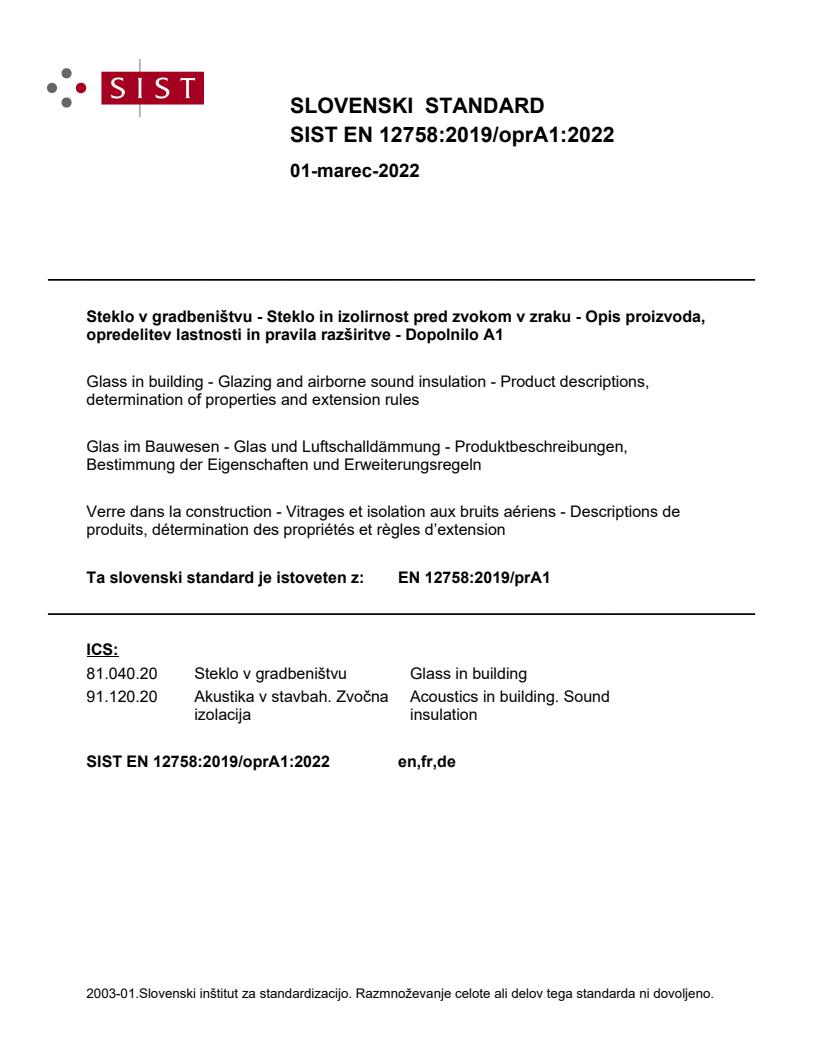
SLOVENSKI STANDARD
SIST EN 12758:2019/oprA1:2022
01-marec-2022
Steklo v gradbeništvu - Steklo in izolirnost pred zvokom v zraku - Opis proizvoda,
opredelitev lastnosti in pravila razširitve - Dopolnilo A1
Glass in building - Glazing and airborne sound insulation - Product descriptions,
determination of properties and extension rules
Glas im Bauwesen - Glas und Luftschalldämmung - Produktbeschreibungen,
Bestimmung der Eigenschaften und Erweiterungsregeln
Verre dans la construction - Vitrages et isolation aux bruits aériens - Descriptions de
produits, détermination des propriétés et règles d’extension
Ta slovenski standard je istoveten z: EN 12758:2019/prA1
ICS:
81.040.20 Steklo v gradbeništvu Glass in building
91.120.20 Akustika v stavbah. Zvočna Acoustics in building. Sound
izolacija insulation
SIST EN 12758:2019/oprA1:2022 en,fr,de
2003-01.Slovenski inštitut za standardizacijo. Razmnoževanje celote ali delov tega standarda ni dovoljeno.
SIST EN 12758:2019/oprA1:2022
SIST EN 12758:2019/oprA1:2022
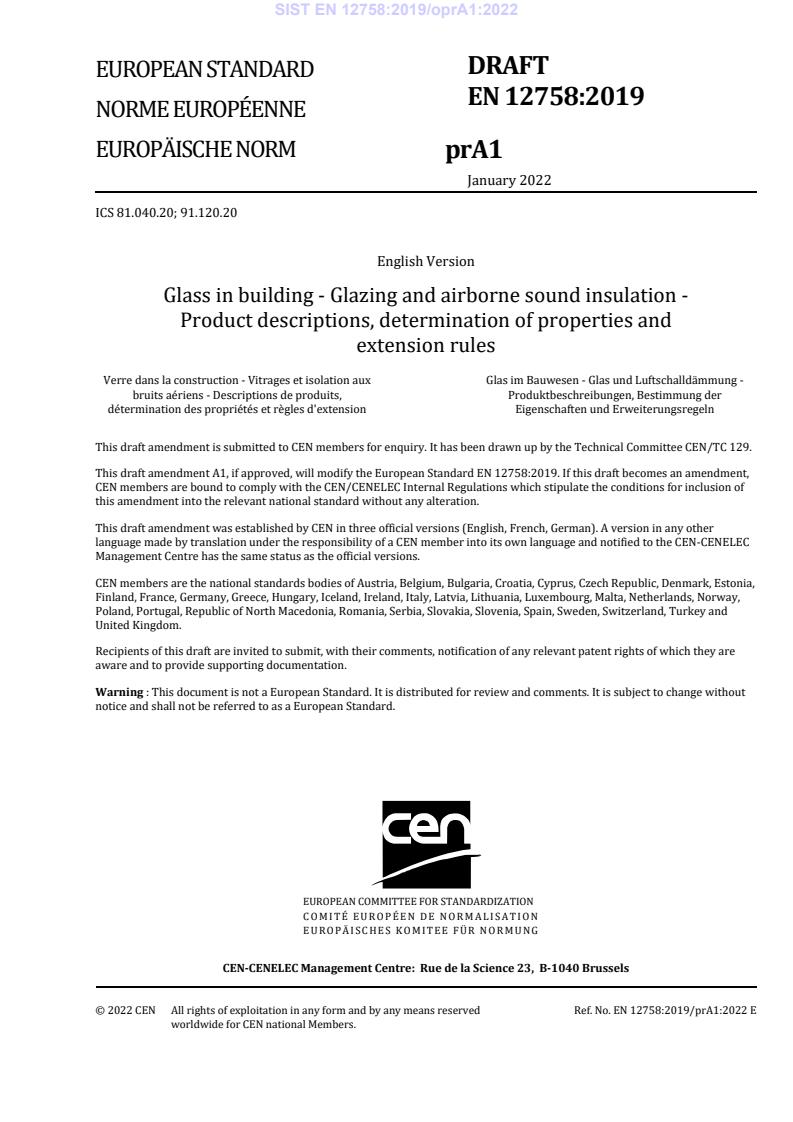
DRAFT
EUROPEAN STANDARD
EN 12758:2019
NORME EUROPÉENNE
EUROPÄISCHE NORM
prA1
January 2022
ICS 81.040.20; 91.120.20
English Version
Glass in building - Glazing and airborne sound insulation -
Product descriptions, determination of properties and
extension rules
Verre dans la construction - Vitrages et isolation aux Glas im Bauwesen - Glas und Luftschalldämmung -
bruits aériens - Descriptions de produits, Produktbeschreibungen, Bestimmung der
détermination des propriétés et règles d'extension Eigenschaften und Erweiterungsregeln
This draft amendment is submitted to CEN members for enquiry. It has been drawn up by the Technical Committee CEN/TC 129.
This draft amendment A1, if approved, will modify the European Standard EN 12758:2019. If this draft becomes an amendment,
CEN members are bound to comply with the CEN/CENELEC Internal Regulations which stipulate the conditions for inclusion of
this amendment into the relevant national standard without any alteration.
This draft amendment was established by CEN in three official versions (English, French, German). A version in any other
language made by translation under the responsibility of a CEN member into its own language and notified to the CEN-CENELEC
Management Centre has the same status as the official versions.
CEN members are th
...