

EN 12823-1:2014
(Main)Foodstuffs - Determination of vitamin A by high performance liquid chromatography - Part 1: Measurement of all-E-retinol and 13-Z-retinol
General Information
- Abstract
This European Standard specifies a method for the determination of vitamin A in foodstuffs by high performance liquid chromatography (HPLC). This method has been validated in an interlaboratory study with samples of margarine and milk powder with all-E-retinol levels ranging from 653 µg/100 g to 729 µg/100 g and with 13-Z-retinol levels ranging from 30 µg/100 g to 39 µg/100 g. The determination of vitamin A content is carried out by the measurement of all-E-retinol, 13-Z-retinol and β-carotene. This part covers the measurement of all-E-retinol and 13-Z-retinol.
The extract obtained after saponification in this method can be used for the determination of β-carotene, as described in EN 12823 2:2000 Foodstuffs - Determination of vitamin A by high performance liquid chromatography - Part 2: Measurements of β-carotene. In this case, the saponification temperature should preferably not exceed 80 °C in order to prevent isomerisation and oxidation of β-carotene.
- Status
- Published
- Publication Date
- 27-May-2014
- Technical Committee
- CEN/TC 275 - Food analysis - Horizontal methods
- Drafting Committee
- CEN/TC 275/WG 9 - Vitamins and Carotenoids
- Current Stage
- 9060 - Closure of 2 Year Review Enquiry - Review Enquiry
- Start Date
- 04-Jun-2026
- Completion Date
- 04-Jun-2026



Overview
EN 12823-1:2014 (CEN) describes a validated analytical method for the determination of vitamin A in foodstuffs by high performance liquid chromatography (HPLC). Part 1 covers the measurement of all‑E‑retinol (all‑trans retinol) and 13‑Z‑retinol (13‑cis retinol). The method was validated in an interlaboratory study using margarine and milk powder with all‑E levels ~653–729 µg/100 g and 13‑Z levels ~30–39 µg/100 g. The procedure includes sample saponification, extraction, chromatographic separation and quantification by UV or fluorescence detection.
Key Topics and Requirements
- Analytical scope: Measurement of all‑E‑retinol and 13‑Z‑retinol by HPLC; β‑carotene measurement is covered in EN 12823‑2.
- Sample preparation: Saponification (reflux or alternative conditions), antioxidant use, solvent extraction and concentration of extracts for HPLC analysis.
- Saponification guidance: Typical conditions 15–45 min at 80–100 °C; if the extract will be used for β‑carotene determination, saponification preferably should not exceed 80 °C to avoid isomerisation/oxidation.
- Chromatography: Normal‑phase silica columns (examples: LiChrospher® Si 60 / LiChrosorb® Si 60) and mobile phases such as n‑hexane/2‑propanol or iso‑octane/2‑propanol; baseline resolution of all‑E and 13‑Z is required.
- Detection & quantification: UV‑VIS or fluorescence detection; identification by retention time and quantification by external standard using peak areas or heights.
- Standards & stability: Preparation of all‑E and 13‑Z stock/standard solutions; spectrometric concentration and purity checks (absorbance maxima around 325–326 nm for all‑E; molar extinction coefficients provided). Store vitamin A standards protected from light, under inert gas, typically at −20 °C.
- Quality reagents & water: Use analytical grade reagents and water meeting EN ISO 3696.
Applications and Who Uses This Standard
- Food testing laboratories performing routine or regulatory analysis of vitamin A in fortified and unfortified food matrices (dairy, margarine, powders).
- Quality control teams in food manufacturing verifying label claims and nutritional content.
- Regulatory agencies and research organizations conducting intercomparison studies and method validation.
- Analysts seeking a harmonized, CEN‑endorsed HPLC procedure for vitamin A determination in foodstuffs.
Practical Value
- Provides a harmonized, validated HPLC workflow ensuring comparable results across laboratories.
- Offers practical guidance for sample handling (light/oxygen protection, nitrogen blanketing), chromatographic conditions, and standard preparation to minimize isomerisation and degradation.
- Facilitates compliance with nutrition labeling and food safety programs.
Related Standards
- EN 12823‑2:2000 - Determination of vitamin A by HPLC - Part 2: Measurement of β‑carotene (useful when the same extract is analyzed for provitamin A carotenoids).
- EN ISO 3696 - Water for analytical laboratory use.
Relations
- Effective Date
- 08-Jun-2022
- Effective Date
- 28-Jan-2026
Get Certified
Connect with accredited certification bodies for this standard

BSI Group
BSI (British Standards Institution) is the business standards company that helps organizations make excellence a habit.

Bureau Veritas
Bureau Veritas is a world leader in laboratory testing, inspection and certification services.

DNV
DNV is an independent assurance and risk management provider.
Sponsored listings
Frequently Asked Questions
EN 12823-1:2014 is a standard published by the European Committee for Standardization (CEN). Its full title is "Foodstuffs - Determination of vitamin A by high performance liquid chromatography - Part 1: Measurement of all-E-retinol and 13-Z-retinol". This standard covers: This European Standard specifies a method for the determination of vitamin A in foodstuffs by high performance liquid chromatography (HPLC). This method has been validated in an interlaboratory study with samples of margarine and milk powder with all-E-retinol levels ranging from 653 µg/100 g to 729 µg/100 g and with 13-Z-retinol levels ranging from 30 µg/100 g to 39 µg/100 g. The determination of vitamin A content is carried out by the measurement of all-E-retinol, 13-Z-retinol and β-carotene. This part covers the measurement of all-E-retinol and 13-Z-retinol. The extract obtained after saponification in this method can be used for the determination of β-carotene, as described in EN 12823 2:2000 Foodstuffs - Determination of vitamin A by high performance liquid chromatography - Part 2: Measurements of β-carotene. In this case, the saponification temperature should preferably not exceed 80 °C in order to prevent isomerisation and oxidation of β-carotene.
This European Standard specifies a method for the determination of vitamin A in foodstuffs by high performance liquid chromatography (HPLC). This method has been validated in an interlaboratory study with samples of margarine and milk powder with all-E-retinol levels ranging from 653 µg/100 g to 729 µg/100 g and with 13-Z-retinol levels ranging from 30 µg/100 g to 39 µg/100 g. The determination of vitamin A content is carried out by the measurement of all-E-retinol, 13-Z-retinol and β-carotene. This part covers the measurement of all-E-retinol and 13-Z-retinol. The extract obtained after saponification in this method can be used for the determination of β-carotene, as described in EN 12823 2:2000 Foodstuffs - Determination of vitamin A by high performance liquid chromatography - Part 2: Measurements of β-carotene. In this case, the saponification temperature should preferably not exceed 80 °C in order to prevent isomerisation and oxidation of β-carotene.
EN 12823-1:2014 is classified under the following ICS (International Classification for Standards) categories: 67.040 - Food products in general; 67.050 - General methods of tests and analysis for food products. The ICS classification helps identify the subject area and facilitates finding related standards.
EN 12823-1:2014 has the following relationships with other standards: It is inter standard links to EN 12823-1:2000, EN ISO 3696:1995. Understanding these relationships helps ensure you are using the most current and applicable version of the standard.
EN 12823-1:2014 is available in PDF format for immediate download after purchase. The document can be added to your cart and obtained through the secure checkout process. Digital delivery ensures instant access to the complete standard document.
Standards Content (Sample)
2003-01.Slovenski inštitut za standardizacijo. Razmnoževanje celote ali delov tega standarda ni dovoljeno.Lebensmittel - Bestimmung von Vitamin A mit Hochleistungs-Flüssigchromatographie - Teil 1: Bestimmung von all-trans-Retinol und 13-cis-RetinolProduits alimentaires - Dosage de la vitamine A par chromatographie liquide haute performance - Partie 1: Dosage du tout-trans-rétinol et du 13-cis-rétinolFoodstuffs - Determination of vitamin A by high performance liquid chromatography - Part 1: Measurement of all-trans-retinol and 13-cis-retinol67.050Splošne preskusne in analizne metode za živilske proizvodeGeneral methods of tests and analysis for food productsICS:Ta slovenski standard je istoveten z:EN 12823-1:2014SIST EN 12823-1:2014en,fr,de01-julij-2014SIST EN 12823-1:2014SLOVENSKI
STANDARDSIST EN 12823-1:20001DGRPHãþD
EUROPEAN STANDARD NORME EUROPÉENNE EUROPÄISCHE NORM
EN 12823-1
May 2014 ICS 67.050 Supersedes EN 12823-1:2000English Version
Foodstuffs - Determination of vitamin A by high performance liquid chromatography - Part 1: Measurement of all-E-retinol and 13-Z-retinol
Produits alimentaires - Détermination de la teneur en vitamine A par chromatographie liquide haute performance - Partie 1: Dosage du tout-E-rétinol et du 13-Z-rétinol
Lebensmittel - Bestimmung von Vitamin A mit Hochleistungs-Flüssigchromatographie - Teil 1: Bestimmung von all-E-Retinol und 13-Z-Retinol This European Standard was approved by CEN on 24 April 2014.
CEN members are bound to comply with the CEN/CENELEC Internal Regulations which stipulate the conditions for giving this European Standard the status of a national standard without any alteration. Up-to-date lists and bibliographical references concerning such national standards may be obtained on application to the CEN-CENELEC Management Centre or to any CEN member.
This European Standard exists in three official versions (English, French, German). A version in any other language made by translation under the responsibility of a CEN member into its own language and notified to the CEN-CENELEC Management Centre has the same status as the official versions.
CEN members are the national standards bodies of Austria, Belgium, Bulgaria, Croatia, Cyprus, Czech Republic, Denmark, Estonia, Finland, Former Yugoslav Republic of Macedonia, France, Germany, Greece, Hungary, Iceland, Ireland, Italy, Latvia, Lithuania, Luxembourg, Malta, Netherlands, Norway, Poland, Portugal, Romania, Slovakia, Slovenia, Spain, Sweden, Switzerland, Turkey and United Kingdom.
EUROPEAN COMMITTEE FOR STANDARDIZATION
COMITÉ EUROPÉEN DE NORMALISATION EUROPÄISCHES KOMITEE FÜR NORMUNG
CEN-CENELEC Management Centre:
Avenue Marnix 17,
B-1000 Brussels © 2014 CEN All rights of exploitation in any form and by any means reserved worldwide for CEN national Members. Ref. No. EN 12823-1:2014 ESIST EN 12823-1:2014
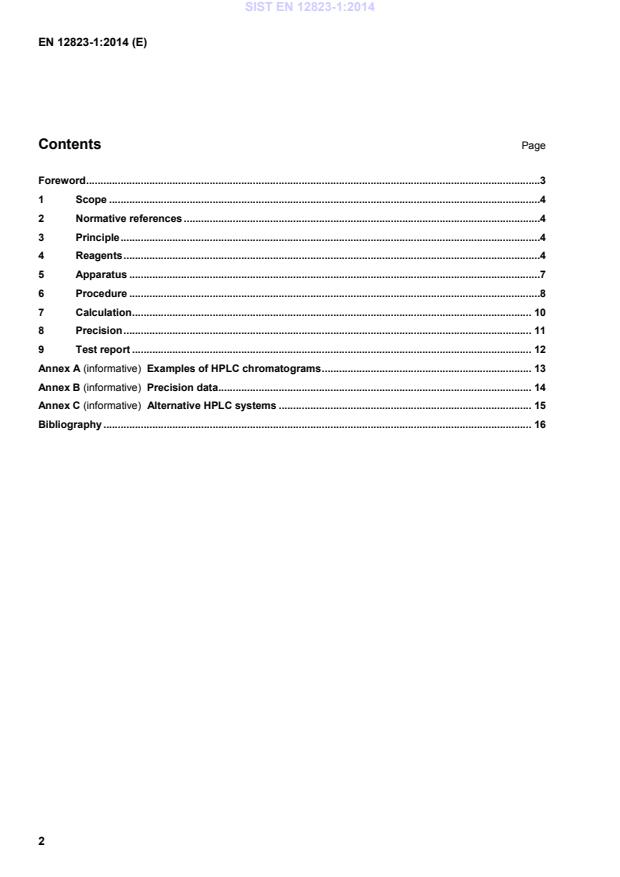
Examples of HPLC chromatograms . 13 Annex B (informative)
Precision data . 14 Annex C (informative)
Alternative HPLC systems . 15 Bibliography . 16
3 Principle Retinol is saponified by using methanolic or ethanolic potassium hydroxide solution and extracted by an appropriate solvent. The determination is carried out by high performance liquid chromatography (HPLC) with either fluorometric (F) or ultraviolet (UV) detection. The substances are identified on the basis of the retention times and determined by the external standard procedure using peak areas or heights, see [1] to [4]. 4 Reagents During the analysis, unless otherwise stated, use only reagents of recognized analytical grade and water of at least grade 1 according to EN ISO 3696. 4.1 Methanol. 4.2 Ethanol absolute, volume fraction, m(C2H5OH) = 100 %. 4.3 Ethanol, m(C2H5OH) = 96 %. 4.4 Sodium sulfate, anhydrous. 4.5 KOH solution for saponification, in suitable mass concentrations, e.g. (KOH) = 50 g/100 ml or 60 g/100 ml, or alcoholic solutions, e.g. 28 g KOH in 100 ml of a mixture of 9 parts per volume of ethanol and 1 part per volume of water. 4.6 Antioxidants, such as ascorbic acid (AA), sodium ascorbate, sodium sulfide (Na2S), butylated hydroxytoluene (BHT), pyrogallol or hydroquinone. 4.7 Solvents and extraction solvents, such as diethyl ether (peroxide-free), di-isopropylether, light petroleum (boiling range of 40 °C to 60 °C), n-hexane, butanol, iso-octane or appropriate mixtures thereof. SIST EN 12823-1:2014
...