

EN 1634-1:2014+A1:2018
(Main + Amendment)Fire resistance and smoke control tests for door and shutter assemblies, openable windows and elements of building hardware - Part 1: Fire resistance test for door and shutter assemblies and openable windows
General Information
- Abstract
This European Standard specifies a method for determining the fire resistance of door and shutter assemblies and openable windows designed for installation within openings incorporated in vertical separating elements, such as:
a) hinged and pivoted doors;
b) horizontally sliding and vertically sliding doors including articulated sliding doors and sectional doors;
c) folding doors, sliding folding doors /shutters;
d) tilting doors;
e) rolling shutter doors;
f) openable windows;
g) operable fabric curtains.
This European Standard is used in conjunction with EN 1363-1.
The testing of fire dampers is covered by EN 1366-2.
The testing of closures for conveyor systems is covered by EN 1366-7.
By prior agreement with the test sponsor, additional information may be gained for individual elements of building hardware in order to fulfil the performance criteria identified in EN 1634-2. Based on the observations recorded during the test, the results may be presented in a separate report which should be in accordance with the requirements of EN 1634-2.
Doors tested in accordance with this European Standard and classified in accordance with EN 13501-2 may be accepted for lift landing door applications as an alternative to EN 81-58 and subject to National Regulations. EN 81-58 represents a specific test for lift landing doors and results in an alternative classification which may not be suitable for some other purposes as defined in National Regulations.
- Status
- Published
- Publication Date
- 23-Jan-2018
- Withdrawal Date
- 30-Jul-2018
- Technical Committee
- CEN/TC 127 - Fire safety in buildings
- Drafting Committee
- CEN/TC 127/WG 3 - Fire Doors
- Current Stage
- 9000 - Start of review/2 Year Review Enquiry - Review Enquiry
- Start Date
- 15-Jan-2019
- Completion Date
- 15-Jan-2019


Overview
EN 1634-1:2014+A1:2018 specifies a standardized method for determining fire resistance of door and shutter assemblies and openable windows installed in vertical separating elements. The scope covers a wide range of closures including hinged and pivoted doors, sliding and sectional doors, folding and tilting doors, rolling shutters, openable windows and operable fabric curtains. The standard is intended for use with EN 1363-1 (general fire test requirements) and supports product evaluation, classification and regulatory compliance.
Key technical topics and requirements
- Scope of test specimens: Defines which types of doorsets, shutters and openable windows are covered (hinged, sliding, folding, rolling, fabric curtains, etc.).
- Test equipment & conditions: Specifies furnace and instrumentation set-up and environmental/test conditions required for a valid fire resistance test.
- Specimen preparation and installation: Requirements for specimen size, number, construction details, installation within supporting construction and permissible gaps.
- Conditioning: Pre-test conditioning rules (moisture content and mechanical conditioning) to ensure repeatable, representative results.
- Instrumentation: Placement and use of thermocouples, pressure, deflection and radiation measuring devices to monitor fire exposure and assembly response.
- Test procedure: Step-by-step requirements for conducting the fire exposure and monitoring assembly behaviour until test end criteria are met.
- Performance criteria: Clear definitions of acceptance limits for integrity, insulation and radiation characteristics during the fire resistance interval.
- Reporting & field of direct application: Required contents of the test report and rules for extending results to other sizes, materials, asymmetric constructions and supporting constructions (see Annexes B and C).
- Optional hardware characterisation: By agreement, additional data on elements of building hardware can be collected to meet EN 1634-2 performance criteria.
Practical applications - who uses this standard
- Manufacturers of doors, shutters, openable windows and hardware for product testing and CE marking.
- Accredited fire test laboratories performing standardized fire resistance tests.
- Specifiers, architects and fire engineers selecting products to meet compartmentation and egress requirements.
- Certification bodies, regulators and product approval authorities assessing compliance with national fire safety regulations.
- Lift and elevator specifiers (note: doors tested to EN 1634-1 may be accepted for lift landing doors as an alternative to EN 81-58 subject to national rules).
Related standards
- EN 1363-1 - Fire resistance tests: General requirements (used alongside EN 1634-1)
- EN 1634-2 - Fire resistance characterisation for hardware elements
- EN 1634-3 - Smoke control test for door and shutter assemblies
- EN 13501-2 - Fire classification using fire resistance test data
- EN 1366-2 / EN 1366-7 - Tests for fire dampers and conveyor closures (other specific closures)
Keywords: EN 1634-1, fire resistance test, door assemblies, shutter assemblies, openable windows, fire test standard, integrity, insulation, smoke control.
Relations
- Effective Date
- 19-Jan-2023
- Effective Date
- 19-Jan-2023
- Effective Date
- 02-Sep-2026
- Effective Date
- 28-Jan-2026
- Effective Date
- 28-Jan-2026
- Effective Date
- 28-Jan-2026
- Effective Date
- 28-Jan-2026
- Effective Date
- 28-Jan-2026
- Effective Date
- 28-Jan-2026
- Effective Date
- 28-Jan-2026
- Effective Date
- 28-Jan-2026
- Effective Date
- 28-Jan-2026
- Effective Date
- 28-Jan-2026
- Effective Date
- 17-Jun-2026
- Effective Date
- 09-Feb-2026
Get Certified
Connect with accredited certification bodies for this standard

DIBt (Deutsches Institut für Bautechnik)
German Institute for Building Technology.
DIN CERTCO
DIN Group product certification.

Kiwa BDA Testing
Building and construction product certification.
Sponsored listings
Frequently Asked Questions
EN 1634-1:2014+A1:2018 is a standard published by the European Committee for Standardization (CEN). Its full title is "Fire resistance and smoke control tests for door and shutter assemblies, openable windows and elements of building hardware - Part 1: Fire resistance test for door and shutter assemblies and openable windows". This standard covers: This European Standard specifies a method for determining the fire resistance of door and shutter assemblies and openable windows designed for installation within openings incorporated in vertical separating elements, such as: a) hinged and pivoted doors; b) horizontally sliding and vertically sliding doors including articulated sliding doors and sectional doors; c) folding doors, sliding folding doors /shutters; d) tilting doors; e) rolling shutter doors; f) openable windows; g) operable fabric curtains. This European Standard is used in conjunction with EN 1363-1. The testing of fire dampers is covered by EN 1366-2. The testing of closures for conveyor systems is covered by EN 1366-7. By prior agreement with the test sponsor, additional information may be gained for individual elements of building hardware in order to fulfil the performance criteria identified in EN 1634-2. Based on the observations recorded during the test, the results may be presented in a separate report which should be in accordance with the requirements of EN 1634-2. Doors tested in accordance with this European Standard and classified in accordance with EN 13501-2 may be accepted for lift landing door applications as an alternative to EN 81-58 and subject to National Regulations. EN 81-58 represents a specific test for lift landing doors and results in an alternative classification which may not be suitable for some other purposes as defined in National Regulations.
This European Standard specifies a method for determining the fire resistance of door and shutter assemblies and openable windows designed for installation within openings incorporated in vertical separating elements, such as: a) hinged and pivoted doors; b) horizontally sliding and vertically sliding doors including articulated sliding doors and sectional doors; c) folding doors, sliding folding doors /shutters; d) tilting doors; e) rolling shutter doors; f) openable windows; g) operable fabric curtains. This European Standard is used in conjunction with EN 1363-1. The testing of fire dampers is covered by EN 1366-2. The testing of closures for conveyor systems is covered by EN 1366-7. By prior agreement with the test sponsor, additional information may be gained for individual elements of building hardware in order to fulfil the performance criteria identified in EN 1634-2. Based on the observations recorded during the test, the results may be presented in a separate report which should be in accordance with the requirements of EN 1634-2. Doors tested in accordance with this European Standard and classified in accordance with EN 13501-2 may be accepted for lift landing door applications as an alternative to EN 81-58 and subject to National Regulations. EN 81-58 represents a specific test for lift landing doors and results in an alternative classification which may not be suitable for some other purposes as defined in National Regulations.
EN 1634-1:2014+A1:2018 is classified under the following ICS (International Classification for Standards) categories: 13.220.50 - Fire-resistance of building materials and elements; 91.060.50 - Doors and windows. The ICS classification helps identify the subject area and facilitates finding related standards.
EN 1634-1:2014+A1:2018 has the following relationships with other standards: It is inter standard links to EN 1634-1:2014/FprA1:2017, EN 1634-1:2014, EN 15269-5:2026, EN 15269-10:2011, EN 1363-2:1999, EN 15269-11:2018+AC:2019, EN 15269-7:2009, EN 1363-1:2020, EN 12519:2018, EN ISO 13943:2023, EN 15269-4:2025, EN 13501-2:2023, EN 16034:2014, EN 1303:2026, EN 50600-2-5:2016. Understanding these relationships helps ensure you are using the most current and applicable version of the standard.
EN 1634-1:2014+A1:2018 is associated with the following European legislation: EU Directives/Regulations: 305/2011, 93/68/EEC; Standardization Mandates: M/117. When a standard is cited in the Official Journal of the European Union, products manufactured in conformity with it benefit from a presumption of conformity with the essential requirements of the corresponding EU directive or regulation.
EN 1634-1:2014+A1:2018 is available in PDF format for immediate download after purchase. The document can be added to your cart and obtained through the secure checkout process. Digital delivery ensures instant access to the complete standard document.
Standards Content (Sample)
2003-01.Slovenski inštitut za standardizacijo. Razmnoževanje celote ali delov tega standarda ni dovoljeno.Preskusi požarne odpornosti in dimotesnosti vrat, zapor in oken, ki se odpirajo, ter elementov stavbnega okovja - 1. del: Preskus požarne odpornosti za vrata, zapore in okna, ki se odpirajoFeuerwiderstandsprüfungen und Rauchschutzprüfungen für Türen, Tore, Abschlüsse, Fenster und Baubeschläge - Teil 1: Feuerwiderstandsprüfungen für Türen, Tore, Abschlüsse und FensterEssais de résistance au feu et d'étanchéité aux fumées des portes, fermetures, fenêtres et éléments de quincailleries - Partie 1: Essais de résistance au feu des portes, fermetures et fenêtresFire resistance and smoke control tests for door and shutter assemblies, openable windows and elements of building hardware - Part 1: Fire resistance test for door and shutter assemblies and openable windows91.190Stavbna opremaBuilding accessories91.060.50Vrata in oknaDoors and windows13.220.50Požarna odpornost gradbenih materialov in elementovFire-resistance of building materials and elementsICS:Ta slovenski standard je istoveten z:EN 1634-1:2014+A1:2018SIST EN 1634-1:2014+A1:2018en,fr,de01-marec-2018SIST EN 1634-1:2014+A1:2018SLOVENSKI
STANDARDSIST EN 1634-1:20141DGRPHãþD
EUROPEAN STANDARD NORME EUROPÉENNE EUROPÄISCHE NORM
EN 1634-1:2014+A1
January
t r s z ICS
{ sä r x rä w râ
s uä t t rä w r English Version
Fire resistance and smoke control tests for door and shutter assembliesá openable windows and elements of building hardware æ Part
sã Fire resistance test for door and shutter assemblies and openable windows Essais de résistance au feu et d 5étanchéité aux fumées des portesá fermeturesá fenêtres et éléments de quincailleries æ Partie
sã Essais de résistance au feu des portesá fermetures et fenêtres
Feuerwiderstandsprüfungen und Rauchschutzprüfungen für Türená Toreá Abschlüsseá Fenster und Baubeschläge æ Teil
sã Feuerwiderstandsprüfungen für Türená Toreá Abschlüsse und Fenster This European Standard was approved by CEN on
t { December
t r s t and includes Amendment
s approved by CEN on
t w September
t r s yä
egulations which stipulate the conditions for giving this European Standard the status of a national standard without any alterationä Upætoædate lists and bibliographical references concerning such national standards may be obtained on application to the CENæCENELEC Management Centre or to any CEN memberä
translation under the responsibility of a CEN member into its own language and notified to the CENæCENELEC Management Centre has the same status as the official versionsä
CEN members are the national standards bodies of Austriaá Belgiumá Bulgariaá Croatiaá Cyprusá Czech Republicá Denmarká Estoniaá Finlandá Former Yugoslav Republic of Macedoniaá Franceá Germanyá Greeceá Hungaryá Icelandá Irelandá Italyá Latviaá Lithuaniaá Luxembourgá Maltaá Netherlandsá Norwayá Polandá Portugalá Romaniaá Serbiaá Slovakiaá Sloveniaá Spainá Swedená Switzerlandá Turkey and United Kingdomä
EUROPEAN COMMITTEE FOR STANDARDIZATION COMITÉ EUROPÉEN DE NORMALISATION EUROPÄISCHES KOMITEE FÜR NORMUNG
CEN-CENELEC Management Centre:
Rue de la Science 23,
B-1040 Brussels
t r s z CEN All rights of exploitation in any form and by any means reserved worldwide for CEN national Membersä Refä Noä EN
s x u væ sã t r s v ªA sã t r s z ESIST EN 1634-1:2014+A1:2018
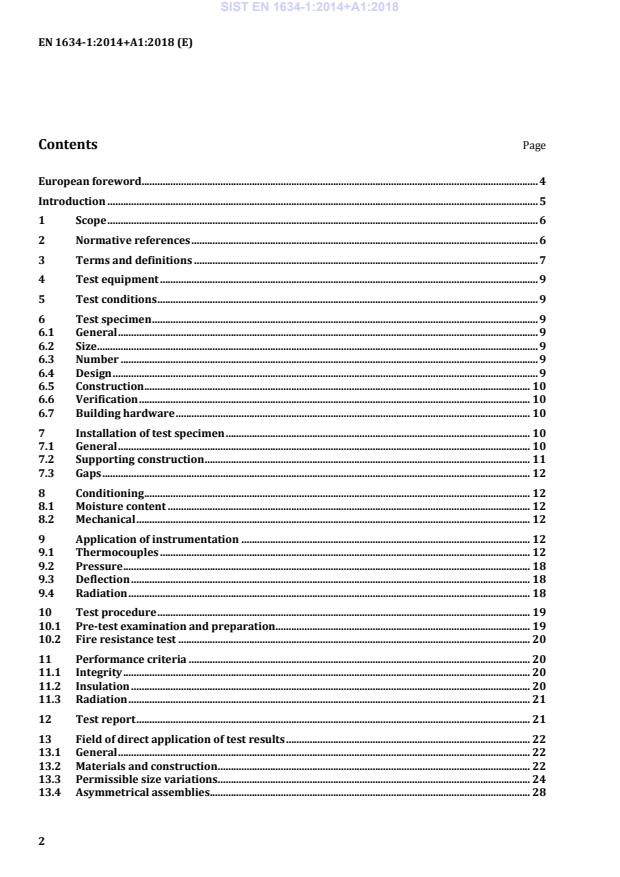
Conditioning requirements . 66 A.1 General . 66 A.2 Requirements . 66 Annex B (normative)
Field of direct application limits of permitted size variations . 68 Annex C (informative)
Background to field of direct application statements for asymmetric constructions and supporting constructions . 70 C.1 General . 70 C.2 Hinged doorsets . 70 C.3 Pivot hung doorsets . 73 C.4 Rolling shutter doorsets . 74 C.5 Sliding/folding doorsets. 75 Bibliography . 76
Part 1: Fire resistance test for door and shutter assemblies and openable windows (the present document);
Part 2: Fire resistance characterisation test for elements of building hardware;
Part 3: Smoke control test for door and shutter assemblies. According to the CEN-CENELEC Internal Regulations, the national standards organizations of the following countries are bound to implement this European Standard: Austria, Belgium, Bulgaria, Croatia, Cyprus, Czech Republic, Denmark, Estonia, Finland, Former Yugoslav Republic of Macedonia, France, Germany, Greece, Hungary, Iceland, Ireland, Italy, Latvia, Lithuania, Luxembourg, Malta, Netherlands, Norway, Poland, Portugal, Romania, Serbia, Slovakia, Slovenia, Spain, Sweden, Switzerland, Turkey and the United Kingdom. SIST EN 1634-1:2014+A1:2018
9.1.2 Unexposed face thermocouples 9.1.2.1 General Where no evaluation against the insulation criteria is required of the doorset or openable window, or any part thereof, no temperature measurements are required. Where compliance with the insulation criteria is required to be evaluated, thermocouples of the type specified in EN 1363-1 shall be attached to the unexposed face of the doorset for the purpose of SIST EN 1634-1:2014+A1:2018
0,1 m2 (e.g. flush over panels, transom panels, side panels, or glazed panels within a door leaf but not astragals), extra thermocouples shall be evenly distributed over the surface of those areas to determine the average temperature at a density of one thermocouple per square metre or part thereof. When the total area of a single portion of the doorset or openable window represents less than 0,1 m2, it shall be disregarded for the purpose of ascertaining the average unexposed face temperature. 9.1.2.3 Maximum temperature 9.1.2.3.1 General The maximum temperature shall be determined from the thermocouples fixed to determine the average temperature rise (as given in 9.1.2.2), the roving thermocouple and from additional thermocouples fixed as indicated in 9.1.2.3.2, 9.1.2.3.3 and 9.1.2.3.4. If the doorset or openable window incorporates discrete areas of different thermal insulation
0,1 m2 (e.g. flush over panels, transom panels, side panels or glazed panels within a door leaf but not astragals) which are required to be evaluated separately with respect to average temperature rise, then the evaluation of maximum unexposed face temperature of those areas shall also be undertaken separately. SIST EN 1634-1:2014+A1:2018
115 mm wide, position the thermocouples on the door leaf 100 mm in from the inside edges of the clear opening or from the visible part of the edge of the door leaf, as defined in 9.1.2.3.3. If the visible width of the framework of the door leaf is between 85 mm and 115 mm wide, position the thermocouples on the discrete area of different thermal insulation as close as possible to the framework of the door leaf. If the visible width of the framework of the door leaf is
85 mm, position the thermocouples on the discrete area of different thermal insulation 100 mm in from the inside edge of the clear opening for:
hinged or pivoted doorsets or openable windows opening towards the furnace;
shutters or sliding doorsets or openable windows installed on the exposed side of the supporting construction. If the visible width of the framework of the door leaf is
85 mm, position the thermocouples on the discrete area of different thermal insulation 100 mm in from the visible part of the edge of the door leaf for:
hinged or pivoted doorsets or openable windows opening away from the furnace;
shutters or sliding doorsets or openable windows installed on the unexposed side of the supporting construction. 9.1.2.3.4 Temperatures of other areas Thermocouples for determination of the maximum temperature rise of side, transom and flush over panels and discrete areas of different thermal insulation within the door leaf shall be applied as for door leaves. However, if there is more than one other area of the same type, then they shall be treated as one large area (as those for the average temperature rise are). See Figures 25 and 26. SIST EN 1634-1:2014+A1:2018
EN 1634-1:2014+A1:201
...