

EN 15167-1:2006
(Main)Ground granulated blast furnace slag for use in concrete, mortar and grout - Part 1: Definitions, specifications and conformity criteria
General Information
- Abstract
This European Standard specifies requirements for the chemical and physical properties as well as quality control procedures for ground granulated blastfurnace slag for use as a type II addition in the production of concrete, including in particular cast-in-situ or prefabricated structural concrete conforming to EN 206-1. Ground granulated blastfurnace slag conforming to this European Standard may also be used in mortars and grouts.
Ground granulated blastfurnace slag containing any added materials other than grinding aids, is not within the scope of this European Standard. It is also not within the scope of this European Standard to specify provisions governing the practical application of ground granulated blastfurnace slag in the production of concrete, mortar or grout, i.e. requirements concerning composition, mixing, placing, curing etc. As regards such provisions, reference should be made to other European or national standards, such as EN 206-1.
- Status
- Published
- Publication Date
- 01-Aug-2006
- Withdrawal Date
- 30-May-2008
- Technical Committee
- CEN/TC 104 - Concrete ( performance, production, placing and compliance criteria )
- Drafting Committee
- CEN/TC 104/WG 15 - Ground granulated blast furnace slag
- Current Stage
- 9093 - Decision to confirm - Review Enquiry
- Start Date
- 25-Nov-2011
- Completion Date
- 25-Nov-2011
- Directive
- 305/2011 - Regulation (eu) No 305/2011 of the European Parliament and of the Council of 9 march 2011 laying down harmonised conditions for the marketing of construction products and repealing council directive 89/106/eecOJ Ref: C, C 259 OJ Date: 08-Aug-2014
89/106/EEC - Construction productsOJ Ref: C, C 290 OJ Date: 04-Dec-2007



Overview
EN 15167-1:2006 is a CEN (European) standard that defines requirements, definitions and conformity criteria for ground granulated blast furnace slag (GGBS) used as a Type II addition in concrete, mortar and grout. The standard sets chemical and physical characteristic values, quality control (factory autocontrol) and statistical conformity procedures for GGBS intended for structural applications in accordance with EN 206-1. It does not cover added materials (other than limited grinding aids) or practical placing and curing procedures for concrete - those are covered by other standards such as EN 206-1.
Key topics & technical requirements
- Constituent chemistry: GGBS must be predominantly vitrified slag with at least two-thirds by mass of (CaO + MgO + SiO2). The ratio (CaO + MgO)/SiO2 must exceed 1.0.
- Limits on additives: No added materials except grinding aids. Grinding aids ≤ 1.0% (by mass) and organic content ≤ 0.2%.
- Chemical characteristic values (examples specified):
- Magnesium oxide ≤ 18%
- Sulfide ≤ 2.0%
- Sulfate ≤ 2.5%
- Loss on ignition (corrected) ≤ 3.0%
- Chloride ≤ 0.10% (unless higher value is declared)
- Moisture ≤ 1.0% (method in Annex A)
- Physical requirements:
- Fineness (Blaine air-permeability) ≥ 275 m2/kg.
- Activity index (50:50 mix with a specified test cement) ≥ 45% at 7 days and ≥ 70% at 28 days (EN 196-1 test method).
- Initial setting time of a 50:50 blend must be no more than twice that of the test cement (EN 196-3).
- Test cement specification: The standard defines properties for the test cement used in activity/index and setting tests (CEM I, strength class ≥ 42.5, Blaine ≥ 300 m2/kg, C3A 6–12%, alkali 0.5–1.2%).
- Quality control & conformity: Factory autocontrol, sampling plans and statistical conformity criteria are required. EN 15167-2 covers conformity evaluation details.
- Packaging, labelling and sampling provisions included; Annex A gives a moisture determination method.
Applications & who uses it
- Target users:
- GGBS producers and quality managers - to certify product compliance.
- Concrete, mortar and grout manufacturers - to select compliant GGBS for durable structural mixes.
- Testing laboratories, specifiers, procurement officers, structural engineers and regulators - for verification, procurement and regulatory compliance.
- Practical uses:
- Specifying compliant GGBS for cast-in-situ and precast structural concrete, as well as mortars and grouts.
- Establishing factory production control, sampling plans and documentation for CE-marking and contracts.
Related standards
- EN 206-1 (concrete specification and durability)
- EN 15167-2 (conformity evaluation)
- EN 197-1 (cement composition/specs)
- EN 196 series (test methods: strength, chemical analysis, setting time, fineness, sampling)
Keywords: EN 15167-1, ground granulated blast furnace slag, GGBS, concrete addition, activity index, fineness, conformity criteria, CEN standard, quality control.
Relations
- Effective Date
- 28-Jan-2026
- Refers
EN 196-3:2016 - Methods of testing cement - Part 3: Determination of setting times and soundness - Effective Date
- 28-Jan-2026
- Effective Date
- 28-Jan-2026
- Effective Date
- 28-Jan-2026
- Effective Date
- 28-Jan-2026
- Effective Date
- 28-Jan-2026
- Effective Date
- 28-Jan-2026
- Effective Date
- 15-Apr-2026
- Effective Date
- 28-Jan-2026
- Effective Date
- 28-Jan-2026
- Effective Date
- 28-Jan-2026
- Effective Date
- 28-Jan-2026
- Effective Date
- 28-Jan-2026
- Effective Date
- 28-Jan-2026
- Effective Date
- 28-Jan-2026
Get Certified
Connect with accredited certification bodies for this standard

DIBt (Deutsches Institut für Bautechnik)
German Institute for Building Technology.
DIN CERTCO
DIN Group product certification.

Aboma Certification B.V.
Specialized in construction, metal, and transport sectors.
Sponsored listings
Frequently Asked Questions
EN 15167-1:2006 is a standard published by the European Committee for Standardization (CEN). Its full title is "Ground granulated blast furnace slag for use in concrete, mortar and grout - Part 1: Definitions, specifications and conformity criteria". This standard covers: This European Standard specifies requirements for the chemical and physical properties as well as quality control procedures for ground granulated blastfurnace slag for use as a type II addition in the production of concrete, including in particular cast-in-situ or prefabricated structural concrete conforming to EN 206-1. Ground granulated blastfurnace slag conforming to this European Standard may also be used in mortars and grouts. Ground granulated blastfurnace slag containing any added materials other than grinding aids, is not within the scope of this European Standard. It is also not within the scope of this European Standard to specify provisions governing the practical application of ground granulated blastfurnace slag in the production of concrete, mortar or grout, i.e. requirements concerning composition, mixing, placing, curing etc. As regards such provisions, reference should be made to other European or national standards, such as EN 206-1.
This European Standard specifies requirements for the chemical and physical properties as well as quality control procedures for ground granulated blastfurnace slag for use as a type II addition in the production of concrete, including in particular cast-in-situ or prefabricated structural concrete conforming to EN 206-1. Ground granulated blastfurnace slag conforming to this European Standard may also be used in mortars and grouts. Ground granulated blastfurnace slag containing any added materials other than grinding aids, is not within the scope of this European Standard. It is also not within the scope of this European Standard to specify provisions governing the practical application of ground granulated blastfurnace slag in the production of concrete, mortar or grout, i.e. requirements concerning composition, mixing, placing, curing etc. As regards such provisions, reference should be made to other European or national standards, such as EN 206-1.
EN 15167-1:2006 is classified under the following ICS (International Classification for Standards) categories: 01.040.91 - Construction materials and building (Vocabularies); 91.100.15 - Mineral materials and products. The ICS classification helps identify the subject area and facilitates finding related standards.
EN 15167-1:2006 has the following relationships with other standards: It is inter standard links to EN 196-6:2018, EN 196-3:2016, EN 196-1:2016, EN 196-7:2007, EN 15167-2:2006, EN 196-2:2025, EN 197-1:2011, EN 206-1:2026, EN 206:2013, EN 14227-2:2013, EN ISO 11073-10201:2005, EN 16907-4:2018, EN 206:2013+A1:2016, EN 206:2013+A2:2021, CEN/TR 16563:2013. Understanding these relationships helps ensure you are using the most current and applicable version of the standard.
EN 15167-1:2006 is associated with the following European legislation: EU Directives/Regulations: 305/2011, 89/106/EEC; Standardization Mandates: M/128. When a standard is cited in the Official Journal of the European Union, products manufactured in conformity with it benefit from a presumption of conformity with the essential requirements of the corresponding EU directive or regulation.
EN 15167-1:2006 is available in PDF format for immediate download after purchase. The document can be added to your cart and obtained through the secure checkout process. Digital delivery ensures instant access to the complete standard document.
Standards Content (Sample)
2003-01.Slovenski inštitut za standardizacijo. Razmnoževanje celote ali delov tega standarda ni dovoljeno.Ground granulated blast furnace slag for use in concrete, mortar and grout - Part 1: Definitions, specifications and conformity criteriaGrobozrnata plavžna žlindra za uporabo v betonu, malti in injekcijski malti – 1. del. Definicije, specifikacije in merila skladnostiLaitier granulé de haut-fourneau moulu pour utilisation dans le béton, mortier et coulis - Partie 1: Définitions, exigences et criteres de conformitéHüttensandmehl zur Verwendung in Beton, Mörtel und Einpressmörtel - Teil 1: Definitionen, Anforderungen und KonformitätskriterienTa slovenski standard je istoveten z:EN 15167-1:2006SIST EN 15167-1:2006en91.100.15Mineralni materiali in izdelkiMineral materials and products01.040.91Gradbeni materiali in gradnja (Slovarji)Construction materials and building (Vocabularies)ICS:SLOVENSKI
STANDARDSIST EN 15167-1:200601-december-2006
EUROPEAN STANDARDNORME EUROPÉENNEEUROPÄISCHE NORMEN 15167-1August 2006ICS 91.100.15; 01.040.91 English VersionGround granulated blast furnace slag for use in concrete, mortarand grout - Part 1: Definitions, specifications and conformitycriteriaLaitier granulé de haut-fourneau moulu pour utilisation dansle béton, mortier et coulis - Partie 1: Définitions, exigenceset critères de conformitéHüttensandmehl zur Verwendung in Beton, Mörtel undEinpressmörtel - Teil 1: Definitionen, Anforderungen undKonformitätskriterienThis European Standard was approved by CEN on 26 June 2006.CEN members are bound to comply with the CEN/CENELEC Internal Regulations which stipulate the conditions for giving this EuropeanStandard the status of a national standard without any alteration. Up-to-date lists and bibliographical references concerning such nationalstandards may be obtained on application to the Central Secretariat or to any CEN member.This European Standard exists in three official versions (English, French, German). A version in any other language made by translationunder the responsibility of a CEN member into its own language and notified to the Central Secretariat has the same status as the officialversions.CEN members are the national standards bodies of Austria, Belgium, Cyprus, Czech Republic, Denmark, Estonia, Finland, France,Germany, Greece, Hungary, Iceland, Ireland, Italy, Latvia, Lithuania, Luxembourg, Malta, Netherlands, Norway, Poland, Portugal, Romania,Slovakia, Slovenia, Spain, Sweden, Switzerland and United Kingdom.EUROPEAN COMMITTEE FOR STANDARDIZATIONCOMITÉ EUROPÉEN DE NORMALISATIONEUROPÄISCHES KOMITEE FÜR NORMUNGManagement Centre: rue de Stassart, 36
B-1050 Brussels© 2006 CENAll rights of exploitation in any form and by any means reservedworldwide for CEN national Members.Ref. No. EN 15167-1:2006: E
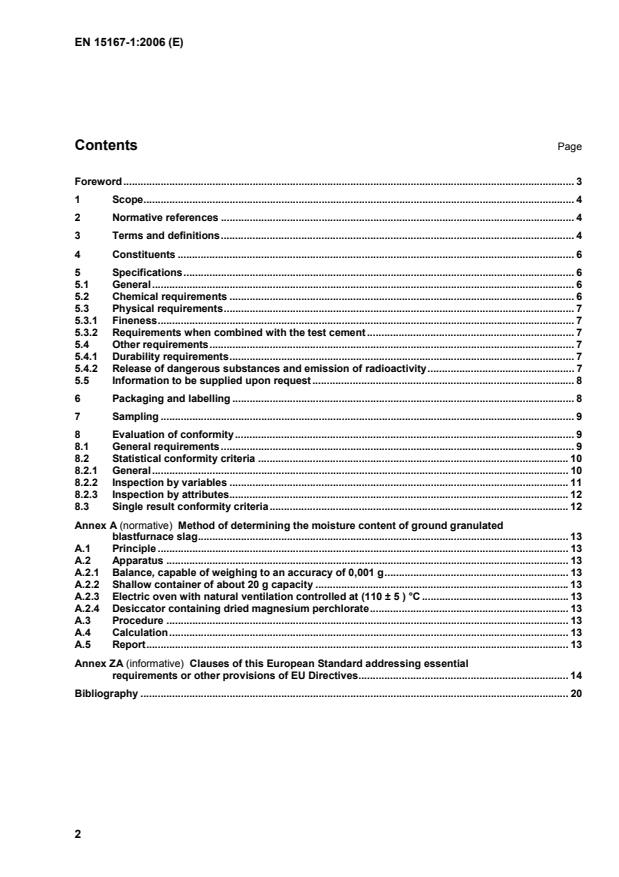
Method of determining the moisture content of ground granulated blastfurnace slag.13 A.1 Principle.13 A.2 Apparatus.13 A.2.1 Balance, capable of weighing to an accuracy of 0,001 g.13 A.2.2 Shallow container of about 20 g capacity.13 A.2.3 Electric oven with natural ventilation controlled at (110 ± 5 ) °C.13 A.2.4 Desiccator containing dried magnesium perchlorate.13 A.3 Procedure.13 A.4 Calculation.13 A.5 Report.13 Annex ZA (informative)
Clauses of this European Standard addressing essential requirements or other provisions of EU Directives.14 Bibliography.20
Requirements are given by mass of the ground granulated blastfurnace slag.
b
Ground granulated blastfurnace slag may contain more than 0,10 % chloride but in that case the maximum chloride content, as a value not to be exceeded, shall be stated on the packages or the documents (see Clause 6).
EN 196-6, shall be not less than 275 m2/kg. 5.3.2 Requirements when combined with the test cement 5.3.2.1 Test cement The test cement shall conform to EN 197-1 and shall be selected by the ground granulated blastfurnace slag manufacturer, subject to the following restrictions: it shall be a type CEM I, of strength class 42,5 or higher; the Blaine fineness shall be at least 300 m2/kg; the tricalcium aluminate shall be between 6 % and 12 %; the alkali (Na2O equivalent) content shall be between 0,5 % and 1,2 %. 5.3.2.2 Initial setting time When determined in accordance with EN 196-3, the initial setting time of a combination (by mass) of 50 % of ground granulated blastfurnace slag with 50 % of test cement, shall not be more than twice as long as that of the test cement on its own. 5.3.2.3 Activity index The activity index shall be expressed as the ratio (in percent) of the compressive strength of the combination (by mass) of 50 % of ground granulated blastfurnace slag with 50 % of test cement, to the compressive strength of the test cement on its own. The compressive strengths shall be determined in accordance with EN 196-1 and the water:combination ratio and the water:cement ratio shall both be 0,50. The activity index at 7 days and at 28 days shall be not less than 45 % and 70 % respectively. NOTE The activity index gives no direct information on the strength contribution of ground granulated blastfurnace slag in concrete, nor is the use of the ground granulated blastfurnace slag limited to the mixing ratio used in the activity index test. 5.4 Other requirements 5.4.1 Durability requirements The composition and the performance of the ground granulated blastfurnace slag shall be such that durable concrete may be produced when using it. GGBS conforming to this European Standard is deemed to satisfy the durability requirements, provided that other requirements for durability of concrete in relevant standards and/or regulations valid in the place of use are fulfilled. 5.4.2 Release of dangerous substances and emission of radioactivity NOTE
In the absence of specific requirement with respect to substances, dangerous to health, hygiene and environment in this European Standard, Annex ZA.1, Note 1 applies.
...