

ISO 14002-3:2026
(Main)Environmental management systems — Guidelines for using ISO 14001 to address environmental aspects and conditions within an environmental topic area — Part 3: Climate
- Abstract
This document gives guidance to organizations on addressing climate-related environmental aspects, environmental conditions, and the associated risks and opportunities within an environmental management system (EMS) in accordance with ISO 14001 [26]. It addresses the environmental topic area of climate from both perspectives: mitigation and adaptation. This document is applicable to any organization, regardless of type, size or nature. It includes consideration of the organization’s activities, products and services that the organization determines it can either control or influence, taking a life cycle perspective.
- Status
- Published
- Publication Date
- 30-Aug-2026
- Technical Committee
- ISO/TC 207/SC 1 - Environmental management systems
- Current Stage
- 6060 - International Standard published - 60 Publication
- Start Date
- 31-Aug-2026
- Due Date
- 25-Jul-2026
- Completion Date
- 25-Jul-2026
ISO 14002-3:2026 is an International Standard from ISO that gives guidance for using ISO 14001 to address climate-related environmental aspects and conditions in an environmental management system (EMS). It covers both climate change mitigation and climate change adaptation, and it is intended for any organization that wants to manage climate-related risks, opportunities and impacts across its own activities, products and services.
What does ISO 14002-3:2026 specify?
ISO 14002-3:2026 gives guidance on how to use an EMS based on ISO 14001 to address the environmental topic area of climate. It is written for any organization, regardless of type, size or nature, and it uses a life cycle perspective so the organization can consider what it controls or influences in its operations, products and services.
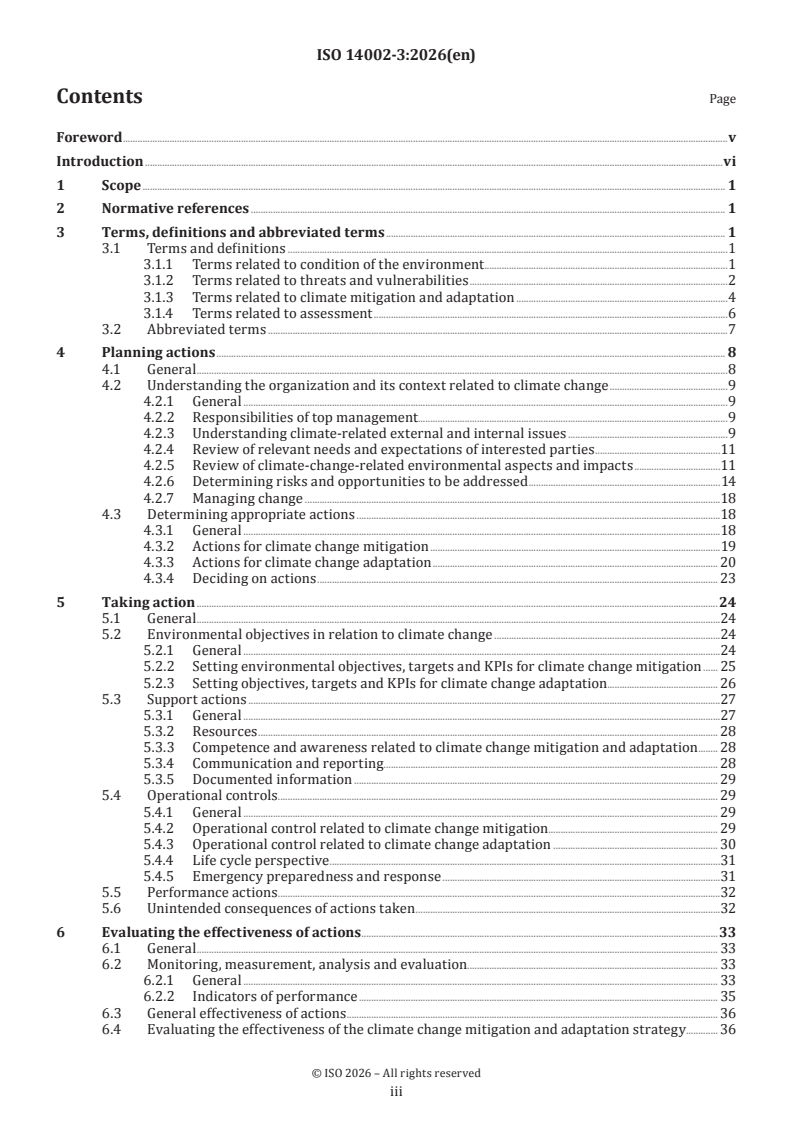
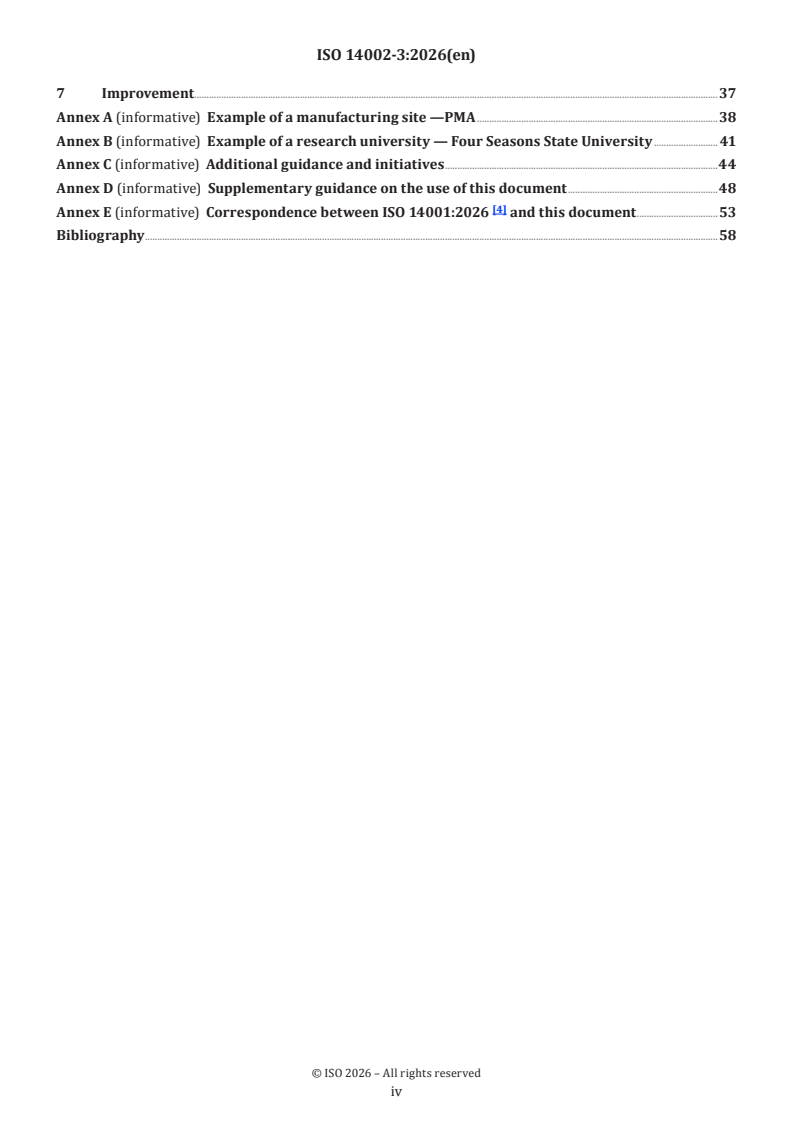
The document follows the ISO 14001 order and the PDCA logic, then adds climate-specific guidance. Clause 1 states the scope, Clause 2 names the normative reference, Clause 3 defines the key terms and abbreviations, Clauses 4 to 7 guide planning, action, evaluation and improvement, and Annexes A to E provide examples, guidance and cross-references.
| Annex | What it covers |
|---|---|
| Annex A | Example of a manufacturing site, PMA |
| Annex B | Example of a research university, Four Seasons State University |
| Annex C | Additional guidance and initiatives linked to the clauses |
| Annex D | Supplementary guidance on using the document and climate-related concepts |
| Annex E | Correspondence between ISO 14001:2026 and this document |
What are the key requirements of ISO 14002-3:2026?
ISO 14002-3:2026 guides an organization through a climate-focused EMS cycle: understand the context, plan actions, take action, evaluate effectiveness, and improve. The practical value is that climate change is treated as a management issue, not only as a reporting topic.
Plan the climate response
Clause 4 asks the organization to secure top management commitment and then review its climate-related context. That includes external and internal issues, the needs and expectations of interested parties, climate-related environmental aspects and impacts, risks and opportunities, and how change is managed. In practice, this means looking at climate exposure, regulatory pressure, supply chains, infrastructure, workforce sensitivity and location.
Clause 4.3 separates the planning of actions for climate change mitigation and climate change adaptation. This matters because emissions reduction and resilience need different actions, and the document also warns against maladaptation, where an adaptation action increases risk elsewhere.
Set objectives and support them
Clause 5.2 asks the organization to set environmental objectives, targets and KPIs for both climate change mitigation and climate change adaptation. That gives the EMS measurable climate aims, so progress can be tracked rather than just discussed.
Clause 5.3 covers the support needed to make the plan work: resources, competence and awareness, communication and reporting, and documented information. Clause 5.4 then turns the plan into operational control, including mitigation controls, adaptation controls, the life cycle perspective, and emergency preparedness and response. In practice, climate action should reach design, procurement, operations, maintenance and response planning.
Keep the whole system balanced
Clause 5.6 tells the organization to look for unintended consequences of climate action. The document points to possible effects on other environmental media, on compliance obligations, on emergency situations, and on the organization’s ability to meet other objectives. This matters because a climate project can shift impacts to water, soil, habitats, human rights or other parts of the value chain.
Check whether it works
Clause 6 requires regular monitoring, measurement, analysis and evaluation of the actions taken. The organization should use the results to judge the effectiveness of the CCM and CCA actions and to review the overall strategy in management review.
Clause 6.4 links the evaluation to current best practice, new climate evidence and changes in the organization’s context. That means the strategy should be revisited as climate conditions, science and business realities change.
Improve continuously
Clause 7 uses the evaluation results to identify opportunities to improve or transform the CCM and CCA strategy. The document encourages learning from other organizations, the scientific community, benchmarking and capacity building. In practice, climate management is an ongoing cycle of review, adjustment and improvement.
What terms does ISO 14002-3:2026 define?
- Environmental topic area - an area of interest or concern for environmental management in relation to an organization’s surroundings.
- Climate risk - the potential adverse effects of climate change that arise from vulnerability, exposure and hazard.
- Mitigation - in a climate context, human intervention to reduce greenhouse gas (GHG) emissions or enhance GHG removals.
- Adaptation - the process of adjusting to actual or expected climate and its effects.
- Life cycle perspective - considering the environmental aspects of a product or service through its whole life cycle, from raw materials to final disposal.
- Indicator - a quantitative, qualitative or binary variable used to represent status, conditions, operations or impact.
- EMS - environmental management system, the management framework that ISO 14002-3:2026 helps organizations apply to climate.
- KPI - key performance indicator, a measure used to track whether climate objectives are being met.
Who uses ISO 14002-3:2026?
ISO 14002-3:2026 is for organizations that want to embed climate issues into an EMS based on ISO 14001. It is useful for top management, environmental managers, EMS coordinators, sustainability teams, operations leaders, maintenance and facilities staff, and people responsible for reporting, procurement, supply chains and emergency planning.
The document is relevant across sectors because it applies to any organization and considers activities, products and services that the organization can control or influence. The examples show use in manufacturing and higher education, but the guidance also fits sites facing physical climate risks, transition risks, emissions pressures or adaptation needs.
Which standards are used with ISO 14002-3:2026?
Clause 2 gives ISO 14001 as the normative reference. Annex C then points to related standards and guidance that support specific parts of the climate EMS.
| Standard | What it contributes |
|---|---|
| ISO 14001 | The EMS requirements and the framework that this document helps apply to climate |
| ISO 14002-1 | The general part of the ISO 14002 series |
| ISO 14080 | Framework and principles for methodologies on climate actions |
| ISO 14090 | Principles, requirements and guidelines for adaptation to climate change |
| ISO 14091 | Vulnerability, impacts and risk assessment for climate change |
| ISO/TS 14092 | Adaptation planning for local governments and communities |
| ISO 14093 | Performance-based climate resilience grants and related guidance |
| ISO 14064-1 | Organization-level quantification and reporting of GHG emissions and removals |
| ISO 14068-1 | Carbon neutrality and related GHG removal concepts |
| ISO 14031 | Environmental performance evaluation |
| ISO 14026 | Communication of footprint information |
| ISO 14019 series | Sustainability information |
| ISO 19694-1 | Determination of GHG emissions in energy-intensive industries |
| ISO 22301 | Business continuity management systems |
| ISO 22316 | Organizational resilience |
| ISO/TS 10020 | Organizational change management |
| ISO 14065 | Validation and verification of environmental information |
What does the ISO 14002-3:2026 document contain?
ISO 14002-3:2026 contains clause-by-clause guidance, definitions, abbreviations, and detailed explanatory text for planning, action, evaluation and improvement. It includes figures showing how ISO 14001 and the ISO 14002 series relate, and how adaptation fits the PDCA cycle.
The document also includes a dairy-company example in the main body, plus two fictional case studies in Annex A and Annex B. Its tables show example context reviews, action planning, life cycle thinking, emergency preparedness, monitoring, KPIs, unintended consequences and improvement actions. Annex D adds concept clarifications, and Annex E maps this document against ISO 14001:2026.
Get Certified
Connect with accredited certification bodies for this standard

BSI Group
BSI (British Standards Institution) is the business standards company that helps organizations make excellence a habit.

Bureau Veritas
Bureau Veritas is a world leader in laboratory testing, inspection and certification services.

DNV
DNV is an independent assurance and risk management provider.
Sponsored listings
Frequently Asked Questions
ISO 14002-3:2026 is a standard published by the International Organization for Standardization (ISO). Its full title is "Environmental management systems — Guidelines for using ISO 14001 to address environmental aspects and conditions within an environmental topic area — Part 3: Climate". This standard covers: This document gives guidance to organizations on addressing climate-related environmental aspects, environmental conditions, and the associated risks and opportunities within an environmental management system (EMS) in accordance with ISO 14001 [26]. It addresses the environmental topic area of climate from both perspectives: mitigation and adaptation. This document is applicable to any organization, regardless of type, size or nature. It includes consideration of the organization’s activities, products and services that the organization determines it can either control or influence, taking a life cycle perspective.
This document gives guidance to organizations on addressing climate-related environmental aspects, environmental conditions, and the associated risks and opportunities within an environmental management system (EMS) in accordance with ISO 14001 [26]. It addresses the environmental topic area of climate from both perspectives: mitigation and adaptation. This document is applicable to any organization, regardless of type, size or nature. It includes consideration of the organization’s activities, products and services that the organization determines it can either control or influence, taking a life cycle perspective.
ISO 14002-3:2026 is classified under the following ICS (International Classification for Standards) categories: 03.100.70 - Management systems; 13.020.10 - Environmental management; 13.020.40 - Pollution, pollution control and conservation. The ICS classification helps identify the subject area and facilitates finding related standards.
ISO 14002-3:2026 is available in PDF format for immediate download after purchase. The document can be added to your cart and obtained through the secure checkout process. Digital delivery ensures instant access to the complete standard document.
Standards Content (Sample)
Contents
- Introduction
- 0.1 Background
- 0.2 Risk-based approach
- 0.3 Holistic approach to climate change mitigation and adaptation
- 0.5 Case studies
- 0.6 Benefits
- 1 Scope
- 2 Normative references
- 3 Terms, definitions and abbreviated terms
- 3.1 Terms and definitions
- 3.1.1.1 environmental topic area
- 3.1.1.2 ecosystem
- 3.1.1.3 climate
- 3.1.1.4 climate change
- 3.1.1.5 sensitivity
- 3.1.2.1 life cycle perspective
- 3.1.2.2 climate risk
- 3.1.2.3 exposure
- 3.1.2.4 hazard
- 3.1.2.5 physical risk
- 3.1.2.6 transition risk
- 3.1.2.7 vulnerability
- 3.1.3.1 climate action
- 3.1.3.2 climate goals
- 3.1.3.3 mitigation
- 3.1.3.4 indirect greenhouse gas emission
- 3.1.3.5 greenhouse gas removal
- 3.1.3.6 offsetting
- 3.1.3.7 carbon neutrality
- 3.1.3.8 adaptation
- 3.1.3.9 adaptive capacity
- 3.1.3.10 maladaptation
- 3.1.3.11 resilience
- 3.1.4.1 base year
- 3.1.4.2 baseline
- 3.1.4.3 climate projection
- 3.1.4.4 climate scenario
- 3.1.4.5 indicator
- 3.1.4.6 global warming potential
- 3.2 Abbreviated terms
- 4 Planning actions
- 4.1 General
- 4.2 Understanding the organization and its context related to climate change
- 4.3 Determining appropriate actions
- 5 Taking action
- 5.1 General
- 5.2 Environmental objectives in relation to climate change
- 5.3 Support actions
- 5.4 Operational controls
- 5.5 Performance actions
- 5.6 Unintended consequences of actions taken
- 6 Evaluating the effectiveness of actions
- 6.1 General
- 6.2 Monitoring, measurement, analysis and evaluation
- 6.3 General effectiveness of actions
- 6.4 Evaluating the effectiveness of the climate change mitigation and adaptation strategy
- 7 Improvement
- Annex A
- Annex B
- Annex C
- 4.1 General
- 4.2 Understanding the organiza- ISO 14080:2018 IFRS S2 (TCFD)
- 4.3 Determining appropriate
- 5.1 General
- 5.3 Support actions
- 5.4 Operational controls
- 5.5 Performance actions
- 6.1 General
- 6.3 General effectiveness of ISO 14031:2021 IFRS S2 /TCFD
- Annex D
- Annex E
- 3.1 Terms and definitions
- 3.2 Abbreviated terms
- 5.1 General
- 5.5 Performance actions
- 5.6 Unintended consequences of actions taken
- 6.2 Monitoring, measurement, analysis and evaluation
- 6.3 General effectiveness of actions
- 6.4 Evaluating the effectiveness of the climate change
- 6.4 Evaluating the effectiveness of the climate change
Introduction
0.1 Background
The climate crisis is putting lives and livelihoods at risk across the globe, especially for the most vulnerable. As the effects on people and nature will only intensify in the coming decades, this calls for fundamental shifts in development, business practices and urgent, transformative actions. Generally, all economic activity leads to a certain degree of direct or indirect contribution to global climate change. The Intergovernmental Panel on Climate Change (IPCC) has indicated that stabilizing the climate will require strong, rapid, and sustained reductions in greenhouse gas (GHG) emissions, and reaching net zero CO emissions. In addition, the IPCC has stated that limiting other GHGs and air pollutants, especially
[1] methane, can have benefits both for health and the climate.
Organizations affect global climate, and can in turn be affected by changing climate and environmental conditions. Until recently, the climate change dialogue has been largely focused on mitigation issues relating to the reduction in emissions of GHGs. However, adaptation is as urgent as mitigation. It is therefore prescient to globally ramp up actions to become more resilient to the changing climate while continuing to reduce GHG emissions.
The overall level of adaptation effort is dependent on the rate and scale of global GHG emission reductions. However, for individual organizations, the level of adaptation is dependent on threats from cumulative global emissions over several decades, rather than their own emissions and mitigation efforts. In addition, the effects vary with geographic location, as some regions of the world are much more vulnerable than others. This document provides guidance to organizations on becoming more climate resilient and preparing for the inevitable effects of the climate crisis while simultaneously managing and reducing their GHG emissions. Successful climate change mitigation and adaptation are integral to achieving sustainable development and the United Nations (UN) Sustainable Development Goals (SDGs).
[2] Many organizations apply the general ISO 14001 framework to manage their interactions with the [2] environment. This document provides guidance and examples focused on applying the ISO 14001 framework to address climate-related environmental aspects and impacts, as well as climate-related environmental conditions, vulnerabilities and dependencies that can have an effect on the organization. It supports organizations to plan action(s) where needed in relation to environmental impacts, risks and opportunities at their site(s) and in the life cycle of their products and services. This document is designed for compatibility with other standards related to climate change mitigation and [2] adaptation. It follows the same approach and order of elements as ISO 14001 but does not address every subclause.
0.2 Risk-based approach
This document enables organizations to address:
- actual and potential adverse or beneficial climate-related environmental impacts originating from their activities or their supply chains;
- actual and potential effects of climate change on the organization itself, including risks and opportunities related to climate change.
Potential effects of climate change on the organization can include acute and chronic physical threats (e.g. increasing frequency of extreme weather events) as well as transitional risks and opportunities related to changes in regulations, technology and markets. The organization’s reputation and its opportunity to contribute to sustainable development from a life cycle perspective can also be affected. The magnitude of climate-related risks and opportunities can be influenced by various context-related factors such as physical, social, economic and environmental factors that determine vulnerability to climate change, including an organization’s geographic location, availability of natural resources, conditions of existing infrastructure, characteristics of the built environment, sensitivity of the workforce and adaptive capacity.
ISO 14002-3:2026(en)
0.3 Holistic approach to climate change mitigation and adaptation
[2] An environmental management system (EMS) conforming to ISO 14001 requires an organization to determine and address significant environmental aspects and impacts associated with its activities, products and services, as well as environmentally related risks and opportunities for the organization that need to be addressed in relation to its context. This process involves using a life cycle perspective as part of a comprehensive evaluation of the influence the organization can have on the environment and how it depends on it.
This document provides guidance on addressing climate-related environmental impacts, as well as the effects of climate change on the organization, addressing both climate change mitigation and climate change adaptation. The organization can control or reduce its climate-related environmental aspects such as GHG emissions through climate change mitigation. In addition, the organization can consider its internal and external context and how it is affected by climate change and take action to minimize potential adverse effects or leverage beneficial effects through climate change adaptation. An organization that intends to strengthen its environmental management efforts on climate change mitigation and adaptation should recognize the interrelation of climate with other environmental media and respective ecosystems. Actions taken for climate change mitigation and adaptation can potentially incur adverse environmental impacts on media such as soil and water, or on terrestrial and aquatic ecosystems. To avoid such unintended consequences, this document encourages the organization to take a holistic [2] approach when taking mitigation and adaptation action. Figure 1 shows how ISO 14001 and the parts of [3] the ISO 14002 series can be applied using a holistic approach. The correlation between the clauses in this [4] document and the corresponding clauses in ISO 14001:2026 are shown in Annex E. [2] [3] Figure 1 — Interaction between ISO 14001 and the ISO 14002 series 0.4 Using this document to address the environmental topic area of climate within an environmental management system An organization can use this document to help determine the most appropriate way to address and embed climate change mitigation and climate change adaptation within its EMS. This can be related to, for example:
- specific commitment(s) in the organization’s environmental policy (e.g. reduction of GHG emissions, enhancement of infrastructure resilience, improved energy efficiency, conservation of ecosystems and related biodiversity);
- one or more of the organization’s significant environmental aspects or compliance obligations related to climate, energy use or air pollution associated with GHGs;
ISO 14002-3:2026(en) - compliance with applicable climate-related permits; - commitments related to the organization’s social responsibility; - specific risks and opportunities that need to be addressed for climate-related environmental conditions or dependencies; - management of environmental aspects across the life cycle of the organization’s products and services. [2] Climate change mitigation and adaptation can be implemented following the existing ISO 14001 framework, based on a Plan-Do-Check-Act (PDCA) cycle. Climate change mitigation fits directly into the [2] ISO 14001 PDCA framework in relation to environmental aspects. Climate change adaptation fits into [2] the ISO 14001 framework as a means to address risks and opportunities to the organization. Related [5] frameworks for climate change adaptation, such as ISO 14090 , follow a similar cycle and include additional guidance, organized in different elements. Figure 2 illustrates climate change adaptation within the PDCA framework and the clauses of this document.
Figure 2 — Adaptation cycle [2] NOTE Figure 2 is adapted from ISO 14001 and the European Environment Agency (EEA) Climate-ADAPT. Climate change adaptation should start with preparing the ground for adaptation in a structured way, and assessing climate-related environmental impact(s) and the organization’s climate risks and vulnerabilities with consideration of current and future climate conditions, as well as transboundary issues to avoid maladaptation. Identifying, assessing and prioritizing adaptation options are part of the planning process. The adaptation options should be implemented, monitored and evaluated, consistent with the Do, Check and Act phases in the PDCA cycle.
As shown in Figure 2, adaptation to climate change is not static. It is a continuous process that must be reevaluated and adjusted regularly in accordance with a changing climate and state of the art knowledge. Table E.2 provides additional information regarding the climate adaptation process. References to other standards and helpful guidance can be found in Annex C.
ISO 14002-3:2026(en)
0.5 Case studies
The guidance provided in this document includes three case studies of organizations applying the ISO 14001 [2] framework to address climate-related environmental aspects and environmental impacts, the effects of climate change on the organization, and the associated risks and opportunities that need to be addressed. The organizations in these case studies are fictional and serve as illustrative examples in diverse contexts, including different business and service sectors and different geographic locations and environmental conditions.
These cases are provided to illustrate how this document can be applied, with examples from different [2] settings and perspectives, and are not intended as models or templates for applying ISO 14001 or this document. The first of these cases represents a dairy company and is incorporated in the main body of the document, with examples shown in each clause as appropriate. The other cases in Annex A and Annex B represent a medium-sized polyurethane manufacturer and a large research university.
0.6 Benefits
The benefits of applying this document include:
- addressing compliance obligations related to climate change, energy use and air quality, as well as supporting public socio-economic policies;
- enhancing environmental performance and fostering resilient ecosystems through the improved management of climate-related environmental aspects;
- protecting the environment through prevention or mitigation of adverse climate-related environmental impacts on natural resources and ecosystems;
- preventing and mitigating adverse climate-related effects on business and leveraging opportunities in the organization’s operations and its supply chain, in response to changing environmental conditions;
- aligning the EMS with the organization’s strategic direction, to support specific environmental policy or organizational commitments related to climate change mitigation and adaptation;
- supporting climate-related global goals for sustainable development (e.g. the UN SDGs);
- contributing to just transition principles, protecting workers and vulnerable communities;
- contributing to conformity with international agreements and conventions related to climate change;
- protecting infrastructure and built environment.
These benefits can also lead to cost reductions, security of supply and production, better relations with relevant interested parties, improved public image, or the maintenance of a “social licence to operate”.
International Standard ISO 14002-3:2026(en) Environmental management systems — Guidelines for using ISO 14001 to address environmental aspects and conditions within an environmental topic area — Part 3:
Climate
1 Scope
This document gives guidance to organizations on addressing climate-related environmental aspects, environmental conditions, and the associated risks and opportunities within an environmental management [2] system (EMS) in accordance with ISO 14001 . It addresses the environmental topic area of climate from both perspectives: mitigation and adaptation.
This document is applicable to any organization, regardless of type, size or nature. It includes consideration of the organization’s activities, products and services that the organization determines it can either control or influence, taking a life cycle perspective.
2 Normative references
The following documents are referred to in the text in such a way that some or all of their content constitutes requirements of this document. For dated references, only the edition cited applies. For undated references, the latest edition of the referenced document (including any amendments) applies. ISO 14001, Environmental management systems — Requirements with guidance for use
3 Terms, definitions and abbreviated terms
For the purposes of this document, the terms and definitions given in ISO 14001 and the following apply. ISO and IEC maintain terminology databases for use in standardization at the following addresses:
- ISO Online browsing platform: available at https:// www .iso .org/ obp
- IEC Electropedia: available at https:// www .electropedia .org/
3.1 Terms and definitions
3.1.1 Terms related to condition of the environment
3.1.1.1 environmental topic area
area of interest or concern for environmental management in an organization in relation to its surroundings [6] [SOURCE: ISO 14002-1:2019 , 3.1]
ISO 14002-3:2026(en)
3.1.1.2 ecosystem
dynamic complex of plant, animal and microorganism communities, and their non-living environment interacting as a functional entity EXAMPLE Deserts, coral reefs, wetlands, rain forests, boreal forests, grasslands, urban parks, cultivated farmlands.
Note 1 to entry: Ecosystems can be influenced by human activity. [7] [SOURCE: ISO 14008:2019 , 3.1.6]
3.1.1.3 climate
statistical description of weather in terms of the mean and variability of relevant quantities over a period of time ranging from months to thousands or millions of years Note 1 to entry: The classical period for averaging these variables is 30 years, as defined by the World Meteorological Organization.
Note 2 to entry: The relevant quantities are most often near-surface variables such as temperature, precipitation and wind.
[8] [SOURCE: ISO 14090:2019 , 3.4]
3.1.1.4 climate change
change in climate (3.1.1.3) that persists for an extended period, typically decades or longer Note 1 to entry: Climate change can be due to natural processes, internal to the climate system, or external forcings such as modulations of the solar cycles, volcanic eruptions and persistent anthropogenic changes in the composition of the atmosphere or in land, water or raw materials and natural resource use. [8] [SOURCE: ISO 14090:2019 , 3.5, modified — Note 1 to entry deleted. “land, water or raw materials and natural resource use” replaced “land use” in Note 2 to entry.]
3.1.1.5 sensitivity
degree to which a system or species is affected, either adversely or beneficially, by climate (3.1.1.3) Note 1 to entry: The effect can be direct (e.g. a change in crop yield in response to a change in the mean, range or variability of temperature) or indirect (e.g. damages caused by an increase in the frequency of coastal flooding due to sea level rise).
[9] [SOURCE: ISO 14091:2021 , 3.10, modified — “variability or change” deleted in the definition.]
3.1.2 Terms related to threats and vulnerabilities
3.1.2.1 life cycle perspective
consideration of the environmental aspects relating to a product (or service) during its entire life cycle Note 1 to entry: The life cycle stages include acquisition of raw materials, design, production, transportation/delivery, use, end-of-life treatment and final disposal.
[10] [SOURCE: ISO 14050:2020 , 3.6.33, modified — “life cycle thinking” deleted as the preferred term. “(or service)” added to the definition. Note 1 to entry added.]
ISO 14002-3:2026(en)
3.1.2.2 climate risk
potential adverse effects of climate change (3.1.1.4) that reflects the interaction among vulnerability (3.1.2.7), exposure (3.1.2.3) and hazard (3.1.2.4) Note 1 to entry: Climate risk can be reduced by enhancing adaptive capacity (3.1.3.9) and strengthening resilience (3.1.3.11) of ecology, society and economy.
[11] [SOURCE: ISO 14080:2018 , 3.1.3.3, modified — “adverse effects” replaced “negative impacts” in the definition.]
3.1.2.3 exposure
presence of people, livelihoods, species or ecosystems (3.1.1.2), environmental functions, services, resources, infrastructure, or economic, social or cultural assets in places and settings that can be affected Note 1 to entry: Exposure can change over time, for example as a result of land use change. [8] [SOURCE: ISO 14090:2019 , 3.6]
3.1.2.4 hazard
potential source of harm Note 1 to entry: The potential for harm can be in terms of loss of life, injury or other health effects, as well as damage and loss of property, infrastructure, livelihoods, service provision, ecosystems (3.1.1.2) and environmental resources. Note 2 to entry: Hazard comprises slow-onset developments (e.g. rising temperatures over the long term) as well as rapidly developing climatic extremes (e.g. heatwave or a landslide) or increased variability. [8] [SOURCE: ISO 14090:2019 , 3.7, modified — Note 2 to entry deleted.]
3.1.2.5 physical risk
potential adverse effects resulting from event-driven (acute) or longer-term shifts (chronic) in climate patterns associated with climate change (3.1.1.4) Note 1 to entry: Physical risks can have financial implications for organizations, such as direct effect to assets and indirect effects on supply chains owing to changes in water availability, sourcing and quality, food security, and for organizations’ premises and operations, supply chain, transport needs and employee safety owing to extreme temperature changes.
Note 2 to entry: Acute physical risks refer to potential adverse effects that are event-driven, including increased severity of extreme weather events, such as cyclones, hurricanes or floods. Note 3 to entry: Chronic physical risks refer to longer-term shifts in climate patterns (e.g. sustained higher temperatures) that can cause, for example, sea-level rise or chronic heatwaves. [12] [SOURCE: ISO 14097:2021 , 3.26, modified — “potential adverse effects” used instead of “risk”, “impacts” changed to “effects” in Note 1 to entry, “potential adverse effects” used instead of “those risks” in Note 2 to entry, “such as” added in Note 3 to entry.]
3.1.2.6 transition risk
potential adverse effects related to the transition to a lower-carbon economy Note 1 to entry: The transition risk is related to policy, legal, technology, and market changes to address mitigation (3.1.3.3) and adaptation (3.1.3.8) requirements related to climate change (3.1.1.4). Note 2 to entry: Transition risk results in varying levels of effect on the financial performance and reputation of the organization.
[12] [SOURCE: ISO 14097:2021 , 3.25, modified — Note 1 to entry changed, Note 3 to entry deleted, “reputation of the financier” changed to “reputation of the organization” in Note 2 to entry.]
ISO 14002-3:2026(en)
3.1.2.7 vulnerability
propensity or predisposition to be adversely affected Note 1 to entry: Vulnerability encompasses a variety of concepts and elements including sensitivity (3.1.1.5) or susceptibility to harm and lack of capacity to cope and adapt. [8] [SOURCE: ISO 14090:2019 , 3.15]
3.1.3 Terms related to climate mitigation and adaptation
3.1.3.1 climate action
initiative to achieve climate change (3.1.1.4) measures or goals based on mitigation (3.1.3.3) and/or adaptation (3.1.3.8) priorities under climate change policies Note 1 to entry: Climate action intends to:
...