

kSIST-V ETSI/prEG 202 843 V1.1.1:2011
(Main)User Group - Quality of ICT Services - Definitions and Methods for Assessing the QoS parameters of the Customer Relationship Stages other than utilization
- Abstract
DEG/USER-00024
- Status
- Not Published
- Technical Committee
- I16 - ETSI Technical Committee
- Current Stage
- 5020 - Formal vote (FV) (Adopted Project)
- Start Date
- 19-Jan-2011
- Due Date
- 09-Mar-2011
- Completion Date
- 16-May-2011
Buy Documents
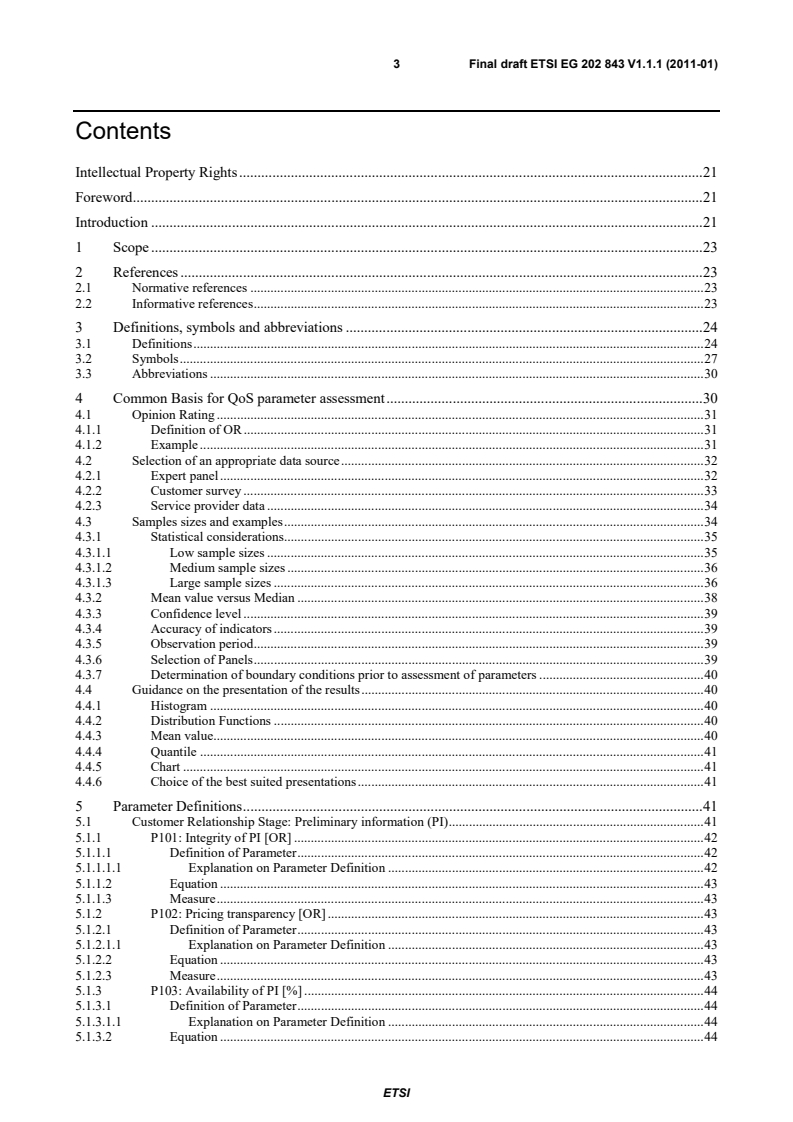
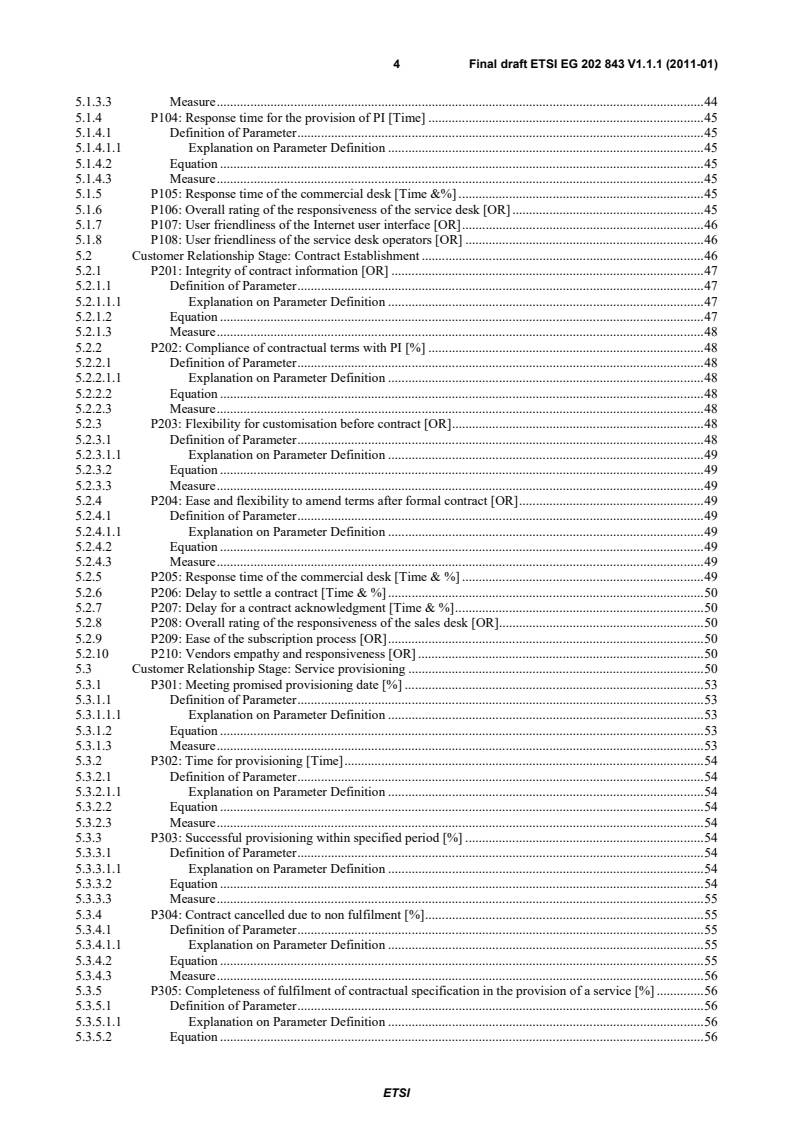
eg_202843v010101p - User Group; Quality of ICT Services; Definitions and Methods for Assessing the QoS parameters of the Customer Relationship Stages other than utilization
eg_202843v010117m - User Group; Quality of ICT Services; Definitions and Methods for Assessing the QoS parameters of the Customer Relationship Stages other than utilization
kSIST-V ETSI/prEG 202 843 V1.1.1:2011 is an ETSI Guide published by ETSI for assessing the quality of ICT services across the customer relationship stages other than utilization. It specifies common methods and parameter definitions for evaluating preliminary information, contract establishment, provisioning, alteration, technical upgrade, support, repair, billing, customer-managed network/service activities, and cessation. The guide is meant for service providers, quality teams, buyers, and assessors who need comparable QoS measurements.
What does kSIST-V ETSI/prEG 202 843 V1.1.1:2011 specify?
kSIST-V ETSI/prEG 202 843 V1.1.1:2011 specifies definitions and assessment methods for QoS parameters linked to the customer relationship stages of an ICT service, excluding utilization. The document is organized around a common assessment basis, stage-by-stage parameter definitions, evaluation-specific methodology, and Annex A with transformation and presentation examples.
| Annex | What it covers |
|---|---|
| Annex A | Background, description, transformation rules, weighting and transform examples, and graphic display examples for QoS assessment results |
The scope is practical: it helps organizations measure how customers experience the service before, during, and after supply, not just the technical use of the service itself. That matters because many service problems appear in ordering, delivery, support, billing, or termination rather than in the active service.
What are the key requirements of kSIST-V ETSI/prEG 202 843 V1.1.1:2011?
kSIST-V ETSI/prEG 202 843 V1.1.1:2011 does not read like a product specification with pass/fail limits. Instead, it sets out a measurement framework: what to measure, how to choose data, how to present results, and how to define each QoS parameter consistently.
Clause 4 - common basis for QoS parameter assessment
Clause 4 gives the basic assessment approach. It says the assessor should select an appropriate data source, and the document explicitly discusses expert panels, customer surveys, and service provider data.
That matters in practice because different data sources answer different questions. A customer survey is useful for perceived quality, while service provider data is better for operational timing and event counts.
Clause 4 also addresses sample sizes, mean value versus median, confidence level, accuracy of indicators, observation period, panel selection, and boundary conditions before assessment. In practice, this tells the reader to define the measurement conditions before comparing results, otherwise two measurements may look similar while actually being based on different populations or time windows.
Clause 4 also gives guidance on how to present results, including histograms, distribution functions, mean value, quantiles, and charts. That matters because a single average can hide variability, while a distribution can show whether a service is consistently good or only sometimes good.
Clause 5 - parameter definitions by customer relationship stage
Clause 5 defines the QoS parameters stage by stage. The main stages are:
- Preliminary information (PI)
- Contract Establishment
- Service provisioning
- Service alteration
- Technical upgrade
- Service Support
- Repair services
- Metering, Charging, Billing
- Network/Service (N/S) Management by the customer
- Cessation
This structure matters because it lets an organization monitor the customer journey end to end. A provider can see whether problems come from sales information, provisioning delays, support handling, or closing the contract.
Several parameter families recur across the stages:
- time-based measures, such as response time, delivery delay, outage time, and resolution time
- percentage measures, such as successful completion within a period, accessibility, or timely delivery
- Opinion Rating (OR) measures, used where the customer’s perception or a subjective rating is needed
- count-based measures, such as number of attempts, modes of support, or frequency of complaints
Clause 5 also shows where special cases matter. For example, the service provisioning stage includes portage delay and problems with number portability procedures, which is useful when service transfer between providers is part of the process. The billing stage covers tariff information, budget notification, bill delivery, and bill correctness complaints, which helps separate service quality from billing quality.
Clause 6 - evaluation-specific methodology/system
Clause 6 adds the method for evaluating each parameter. For each QoS parameter, Clause 6 includes an evaluation-specific description, trigger points, accuracy of the indicator, representativeness, and presentation of parameter values.
That is important in practice because the same parameter can be measured in different ways unless the trigger conditions and measurement quality are fixed. Clause 6 pushes the reader to define when measurement starts, what counts as a valid event, and whether the sample is representative enough to report.
Clause 6 also distinguishes the parameters by stage, so an assessor can apply the same reporting structure across PI, provisioning, alteration, technical upgrade, support, repair, billing, N/S management, and cessation. That makes comparisons easier across teams and across service providers.
Annex A - transformation and comparison of results
Annex A gives the background, description, transformation rules, and an example of weighting and transformational rules. It also provides example graphics for displaying QoS assessment results, including a provisioning-stage assessment and a comparison of the QoS achieved by different SPs.
That matters because raw indicators often need to be normalized or combined before management can use them. Annex A shows how to turn many measured parameters into a result that can be displayed and compared.
What terms does kSIST-V ETSI/prEG 202 843 V1.1.1:2011 define?
kSIST-V ETSI/prEG 202 843 V1.1.1:2011 uses several recurring terms and abbreviations across the stages and methods.
- QoS - Quality of Service, the overall quality subject that the guide measures across customer relationship stages.
- OR - Opinion Rating, a rating method used where the parameter depends on judgement or user perception.
- PI - Preliminary information, the early stage where a customer receives service and pricing information before contract.
- SP - Service provider, the organization being assessed for how it delivers and supports the service.
- SPO - Organisational efficiency of SP, used for parameters that judge how efficiently the service provider performs a process.
- N/S - Network/Service, the stage where the customer manages network or service functions directly.
- Cessation - the end-of-service stage, covering acknowledgement, accessibility, completion, and ease of ending the relationship.
Who uses kSIST-V ETSI/prEG 202 843 V1.1.1:2011?
kSIST-V ETSI/prEG 202 843 V1.1.1:2011 is used by ICT service providers and by the people who measure or review customer-facing performance. It is relevant to quality managers, service assurance teams, customer service managers, technical support teams, billing teams, complaint handlers, and repair teams.
It is also useful for buyers and assessors who need to compare service providers on more than network performance alone. In practice, the guide helps them review ordering, provisioning, support, billing, and termination performance in a structured way.
Which standards are used with kSIST-V ETSI/prEG 202 843 V1.1.1:2011?
kSIST-V ETSI/prEG 202 843 V1.1.1:2011 explicitly refers to ETSI EG 202 009-1 [i.1] in the definition of PI. That companion guide provides details on what preliminary information should provide.
What does the kSIST-V ETSI/prEG 202 843 V1.1.1:2011 document contain?
kSIST-V ETSI/prEG 202 843 V1.1.1:2011 contains a common assessment framework, parameter definitions for each customer relationship stage, and evaluation-specific methods for reporting the parameters. Many parameter entries include a definition, an equation, and a measure, so the document is useful both for defining the KPI and for calculating it.
The document also includes guidance on sampling, choosing data sources, confidence level, accuracy, and how to present results. In the later clauses, each parameter is paired with method details such as trigger points, representativeness, and presentation of parameter values.
Annex A adds transformation rules, weighting examples, and graphic display examples. That makes the document useful for management reporting, service comparison, and structured QoS assessment rather than only for raw data collection.
Buy Documents
eg_202843v010101p - User Group; Quality of ICT Services; Definitions and Methods for Assessing the QoS parameters of the Customer Relationship Stages other than utilization
eg_202843v010117m - User Group; Quality of ICT Services; Definitions and Methods for Assessing the QoS parameters of the Customer Relationship Stages other than utilization
Get Certified
Connect with accredited certification bodies for this standard

BSI Group
BSI (British Standards Institution) is the business standards company that helps organizations make excellence a habit.

Bureau Veritas
Bureau Veritas is a world leader in laboratory testing, inspection and certification services.

DNV
DNV is an independent assurance and risk management provider.
Sponsored listings
Frequently Asked Questions
kSIST-V ETSI/prEG 202 843 V1.1.1:2011 is a standard published by the Slovenian Institute for Standardization (SIST). Its full title is "User Group - Quality of ICT Services - Definitions and Methods for Assessing the QoS parameters of the Customer Relationship Stages other than utilization". This standard covers: DEG/USER-00024
DEG/USER-00024
kSIST-V ETSI/prEG 202 843 V1.1.1:2011 is classified under the following ICS (International Classification for Standards) categories: 03.120.99 - Other standards related to quality; 35.240.01 - Application of information technology in general. The ICS classification helps identify the subject area and facilitates finding related standards.
kSIST-V ETSI/prEG 202 843 V1.1.1:2011 is available in PDF format for immediate download after purchase. The document can be added to your cart and obtained through the secure checkout process. Digital delivery ensures instant access to the complete standard document.
Standards Content (Sample)
Contents
- Introduction
- 22 Final draft ETSI EG 202 843 V1.1.1 (2011-01)
- 23 Final draft ETSI EG 202 843 V1.1.1 (2011-01)
- 1 Scope
- 2 References
- 2.1 Normative references
- 2.2 Informative references
- 24 Final draft ETSI EG 202 843 V1.1.1 (2011-01)
- 3 Definitions, symbols and abbreviations
- 3.1 Definitions
- 25 Final draft ETSI EG 202 843 V1.1.1 (2011-01)
- 26 Final draft ETSI EG 202 843 V1.1.1 (2011-01)
- 27 Final draft ETSI EG 202 843 V1.1.1 (2011-01)
- 3.2 Symbols
- 28 Final draft ETSI EG 202 843 V1.1.1 (2011-01)
- 29 Final draft ETSI EG 202 843 V1.1.1 (2011-01)
- 30 Final draft ETSI EG 202 843 V1.1.1 (2011-01)
- 3.3 Abbreviations
- 4 Common Basis for QoS parameter assessment
- 31 Final draft ETSI EG 202 843 V1.1.1 (2011-01)
- 4.1 Opinion Rating
- 32 Final draft ETSI EG 202 843 V1.1.1 (2011-01)
- 0 Neither satisfied nor dissatisfied
- 4.2 Selection of an appropriate data source
- 33 Final draft ETSI EG 202 843 V1.1.1 (2011-01)
- 34 Final draft ETSI EG 202 843 V1.1.1 (2011-01)
- 4.3 Samples sizes and examples
- 35 Final draft ETSI EG 202 843 V1.1.1 (2011-01)
- 36 Final draft ETSI EG 202 843 V1.1.1 (2011-01)
- 0.35 0.4
- 0.30 0.25
- 0.3 0.20
- 0.2 0.15
- 0.10 0.1
- 0.05 0.0
- 0.00 6 8 10 12 14
- 37 Final draft ETSI EG 202 843 V1.1.1 (2011-01)
- 1.0 0.4 0.4
- 0.8 0.3 0.3
- 0.6 0.2 0.2
- 0.4 0.1 0.1
- 0.2 0.0 0.0 0.0
- 0.75 F(x) F(x) f(x)
- 38 Final draft ETSI EG 202 843 V1.1.1 (2011-01)
- 39 Final draft ETSI EG 202 843 V1.1.1 (2011-01)
- 40 Final draft ETSI EG 202 843 V1.1.1 (2011-01)
- 4.4 Guidance on the presentation of the results
- 41 Final draft ETSI EG 202 843 V1.1.1 (2011-01)
- 5 Parameter Definitions
- 5.1 Customer Relationship Stage: Preliminary information (PI)
- 42 Final draft ETSI EG 202 843 V1.1.1 (2011-01)
- 43 Final draft ETSI EG 202 843 V1.1.1 (2011-01)
- 44 Final draft ETSI EG 202 843 V1.1.1 (2011-01)
- 45 Final draft ETSI EG 202 843 V1.1.1 (2011-01)
- 46 Final draft ETSI EG 202 843 V1.1.1 (2011-01)
- 5.2 Customer Relationship Stage: Contract Establishment
- 47 Final draft ETSI EG 202 843 V1.1.1 (2011-01)
- 48 Final draft ETSI EG 202 843 V1.1.1 (2011-01)
- 49 Final draft ETSI EG 202 843 V1.1.1 (2011-01)
- 50 Final draft ETSI EG 202 843 V1.1.1 (2011-01)
- 5.3 Customer Relationship Stage: Service provisioning
- 51 Final draft ETSI EG 202 843 V1.1.1 (2011-01)
- 52 Final draft ETSI EG 202 843 V1.1.1 (2011-01)
- 53 Final draft ETSI EG 202 843 V1.1.1 (2011-01)
- 54 Final draft ETSI EG 202 843 V1.1.1 (2011-01)
- 55 Final draft ETSI EG 202 843 V1.1.1 (2011-01)
- 56 Final draft ETSI EG 202 843 V1.1.1 (2011-01)
- 57 Final draft ETSI EG 202 843 V1.1.1 (2011-01)
- 58 Final draft ETSI EG 202 843 V1.1.1 (2011-01)
- 59 Final draft ETSI EG 202 843 V1.1.1 (2011-01)
- 60 Final draft ETSI EG 202 843 V1.1.1 (2011-01)
- 5.4 Customer Relationship Stage: Service alteration
- 61 Final draft ETSI EG 202 843 V1.1.1 (2011-01)
- 62 Final draft ETSI EG 202 843 V1.1.1 (2011-01)
- 63 Final draft ETSI EG 202 843 V1.1.1 (2011-01)
- 64 Final draft ETSI EG 202 843 V1.1.1 (2011-01)
- 65 Final draft ETSI EG 202 843 V1.1.1 (2011-01)
- 66 Final draft ETSI EG 202 843 V1.1.1 (2011-01)
- 67 Final draft ETSI EG 202 843 V1.1.1 (2011-01)
- 68 Final draft ETSI EG 202 843 V1.1.1 (2011-01)
Introduction
With the emergence of new telecommunications services, the increasing number of service providers (SP) and the increased complexity of the offers, the user may have a lot of difficulty to compare the respective performance of the different SP and of the offered services. Even within the wide range of services offered by a SP the user may face difficulties when selecting the most suited for their particular needs. The selection of parameters for each stage of the customer relationship is intended to cover most, if not all eventualities. A selection of parameters from the present document could enable potential customers to compare performances of various SP which in turn could enable them to make an informed choice of provider for their needs. These parameters could form the basis of a benchmark for the industry.
The present document provides generic definitions and test methods for most, if not all, of the key parameters of telecommunication services and procedures to enable customers to understand easily different SP's offerings and their performance. The compendium of parameters covers the customer relationship phases of the service, but not the QoS of the telecommunication services themselves (already covered by other ETSI documents, e.g. EG 202 057 series [i.3], [i.4], [i.5] and [i.6]). Thus, it covers the range from the earliest to the latest stages of the customer relationship of a service: Preliminary Information, Establishment of the contract, Service provisioning, Service alteration, Technical upgrade, Service support, Complaint management, Repair, Charging/Billing, Network/service management and Cessation.
ETSI
22 Final draft ETSI EG 202 843 V1.1.1 (2011-01)
All the stakeholders, e.g. regulators, national institutions, operators, SP, users organisations may find in the present document a set of reference definitions and test methods to be used for delivering performance statistics. The same applies to any party which has an interest in the performance of SP, e.g. newspapers or consumers publications. When reported the data becomes a useful guide for the customer to choose a SP most suited for their particular needs. They may be used for any type of application e.g. quality monitoring or benchmark. General principles formula for an aggregate quality rating of each customer relationship stage are also provided in Annex for an overall assessment although such aggregation should be used with much care (see EG 202 765-1 [i.7]). Note copied from clause 6 of EG 202 765-1 [i.7]:
"It is very important to present the quality indicators in a relevant way. This presentation allows us to make our own judgement of the global performance of the evaluated object. There is a great temptation to try to give one unique note which aggregates all quality items. Through its uniqueness, this note approaches the concepts of global evaluation and more generally of global satisfaction. But there are two problems of doing this aggregation. First, there is a gap between technical aspects and perceptive aspects. The links between these two aspects are not trivial. The second problem is that overall satisfaction or overall quality can hardly be modelled. Satisfaction and even quality strongly depends on expectancy levels and environment circumstances. As an example, you will be happy to call your wife/husband at the top of the mountain you climb, even if quality is poor and your QoE would be great. But with the same quality, if you call your wife/husband from your office, you won't … and your QoE will be bad. Therefore it is difficult to evaluate quality using one unique note. It is recommended to visualise all indicators at the same time." NOTE: For compatibility issues, the equations from the original draft of the present document have been kept in a docx file. It is contained in archive eg_202843v010117m0.zip which accompanies the present document. ETSI
23 Final draft ETSI EG 202 843 V1.1.1 (2011-01)
1 Scope
The QoS parameters of the Customer Relationship Stages other than Utilization are listed in EG 202 009-2 [i.2]. These stages comprise Preliminary information, Establishment of the contract, Service provisioning, Service alteration, Technical upgrade, Service support, Complaint management, Repair, Charging/Billing, Network/service management and Cessation as detailed in EG 202 009-1 [i.1].
The present document provides detailed definitions and methods for the assessment of the values of the QoS parameters of the service Customer Relationship stages. A major purpose of the present document is to ensure that the results of these QoS measurements are fully reproducible and statistically valid. Then it could be used to assess the delivered QoS performance of Service Providers (SP). The Guide does not cover the QoS of the telecommunication services themselves (already defined by other ETSI documents, e.g. EG 202 057 series [i.3], [i.4], [i.5] and [i.6], and EG 202 765 series [i.7], [i.8]). The results could be used to compare the providers' performances over time or for benchmark.
The intention of the present document is to define the QoS parameters and the methodology of testing and not recommend any requirement (i.e. targets values) for the different parameters defined in the present document.
2 References
References are either specific (identified by date of publication and/or edition number or version number) or non-specific. For specific references, only the cited version applies. For non-specific references, the latest version of the reference document (including any amendments) applies.
Referenced documents which are not found to be publicly available in the expected location might be found at http://docbox.etsi.org/Reference.
NOTE: While any hyperlinks included in this clause were valid at the time of publication ETSI cannot guarantee their long term validity.
2.1 Normative references
The following referenced documents are necessary for the application of the present document. Not applicable.
2.2 Informative references
The following referenced documents are not necessary for the application of the present document but they assist the user with regard to a particular subject area.
[i.1] ETSI EG 202 009-1: "User Group; Quality of telecom services; Part 1: Methodology for identification of parameters relevant to the Users".
[i.2] ETSI EG 202 009-2: "User Group; Quality of Telecom Services; Part 2: User related parameters on a service specific basis".
[i.3] ETSI EG 202 057-1: "Speech Processing, Transmission and Quality Aspects (STQ); User related QoS parameter definitions and measurements; Part 1: General".
[i.4] ETSI EG 202 057-2: "Speech Processing, Transmission and Quality Aspects (STQ); User related QoS parameter definitions and measurements; Part 2: Voice telephony, Group 3 fax, modem data services and SMS".
[i.5] ETSI EG 202 057-3: "Speech Processing, Transmission and Quality Aspects (STQ); User related QoS parameter definitions and measurements; Part 3: QoS parameters specific to Public Land Mobile Networks (PLMN)".
ETSI
24 Final draft ETSI EG 202 843 V1.1.1 (2011-01)
[i.6] ETSI EG 202 057-4: "Speech Processing, Transmission and Quality Aspects (STQ); User related QoS parameter definitions and measurements; Part 4: Internet access". [i.7] ETSI EG 202 765-1: "Speech and multimedia Transmission Quality (STQ); QoS and network performance metrics and measurement methods; Part 1: General considerations". [i.8] ETSI EG 202 765-2: "Speech and multimedia Transmission Quality (STQ); QoS and network performance metrics and measurement methods; Part 2: Transmission Quality Indicator combining Voice Quality Metrics".
[i.9] ETSI TS 102 250-6 (V1.2.1): "Speech Processing, Transmission and Quality Aspects (STQ); QoS aspects for popular services in GSM and 3G networks; Part 6: Post processing and statistical methods".
[i.10] ETSI TS 102 844: "User Group; Quality of Telecom Services; Conformity assessment; Requirements for bodies providing QoS audits and surveys".
[i.11] ETSI TS 102 852: "User Group; Quality of ICT Services; Assessment process of the QoS parameters of the customer relationship stages".
[i.12] Public Opinion Quarterly, 49, 535-552: "The measurement of values in surveys: A comparison of ratings and rankings", Alwin, D. F. & Krosnick, J. A. (1985).
[i.13] ITU-T Recommendation E.800 (09/2008): "Definitions of terms related to Quality of Service". [i.14] ITU-T Recommendation E.801: "Quality of telecommunication services; Concepts, models, objectives and dependatibility planning. Terms and definitions related to the quality of telecommunication services".
[i.15] ITU-T Recommendation P.505: "Objective measuring apparatus; One-view visualization of speech quality measurement results".
[i.16] ITIL ® V3 Glossary v3.1.24, (30 May 2007): Glossary of Terms, Definitions and Acronyms. [i.17] ISO/IEC 18028-3: 2005: "Information technology -- Security techniques -- IT network security -- Part 3: Securing communications between networks using security gateways". [i.18] ITU-T Recommendation P.851: "Subjective quality evaluation of telephone services based on spoken dialogue systems".
3 Definitions, symbols and abbreviations
3.1 Definitions
For the purposes of the present document, the following terms and definitions apply:
assurance: knowledge and courtesy of employees and their ability to convey trust and confidence audit: formal inquiry, formal examination, or verification of facts against expectations, for compliance and conformity NOTE: From ISO/IEC 18028-3: 2005 [i.17].
avatar: animated computer graphics resembling humans, cartoon characters, etc. NOTE: Applications of this technology include "salespeople" who will demonstrate or show goods to the visitor, and help him or her in selecting items to buy.
Adapted from BusinessDictionary.com.
ETSI
25 Final draft ETSI EG 202 843 V1.1.1 (2011-01)
availability: ability of a Configuration Item or IT Service to perform its agreed Function when required NOTE: Availability is determined by Reliability, Maintainability, Serviceability, Performance, and Security. Availability is usually calculated as a percentage. This calculation is often based on Agreed Service Time and Downtime. It is Best Practice to calculate Availability using measurements of the Business output of the IT Service.
From ITIL [i.16].
benchmark: evaluation of performance value/s of a parameter or set of parameters for the purpose of establishing value/s as the norm against which future performance achievements may be compared or assessed NOTE: From ITU-T Recommendation E.800 [i.13].
billing: administrative function to prepare bills to service customers, to prompt payments, to obtain revenues and to take care of customer reclaims NOTE: From ITU-T Recommendation E.800 [i.13].
cessation: all activities associated with the cessation of a service by a service provider from the instant a contractual agreement is in force between the customer and the service provider to the instant all hardware and software associated with the service is made inoperative and/or removed from the customer's premises NOTE: From ITU-T recommendation E.800 [i.13].
charging: set of functions needed to determine the price assigned to the service utilization NOTE: From ITU-T Recommendation E.800 [i.13].
complaint: statement by a user or customer expressing dissatisfaction due to a gap between the expected and the delivered benefits from the use of a service NOTE: A complaint may be made in various forms, writing, electronic means, or in person. From ITU-T Recommendation E.800 [i.13].
complaint management desk: service desk dedicated to complaint management commercial desk: service desk dedicated to commercial issues customer: user who is responsible for payment for the services NOTE: From ITU-T Recommendation E.800 [i.13].
customer survey measurements: customer satisfaction measurements (surveys) obtained through interviews with customers or via statistical analysis of customer reported data in order to evaluate service quality from a customer's perspective NOTE: Consideration should be given to both incident driven and non-incident (i.e. stock survey) sampling techniques.
From ITU-T Recommendation E.801 [i.14].
empathy: degree of caring and individual attention provided to customers Help Desk: point of contact for Users to log Incidents NOTE: A Help Desk is usually more technically focussed than a Service Desk and does not provide a Single Point of Contact for all interaction. The term Help Desk is often used as a synonym for Service Desk. From ITIL [i.16].
mystery call: call performed anonymously to gain information about SP and his services NOTE: In order to obtain this information, specific tasks, such as purchasing a product, asking for information, posing questions, registering complaints or behaving in a certain way are performed via telephone calls. ETSI
26 Final draft ETSI EG 202 843 V1.1.1 (2011-01)
Opinion Rating (OR): quantitative value (a number) assigned to a qualitative performance criterion on a predefined rating scale to reflect the merit of that criterion to a user/customer NOTE: See clause 4.1 for more details.
panel: group of individuals interviewed at intervals over a given period of time NOTE: From wikipedia (extract).
quality of service (QoS): totality of characteristics of a telecommunications service that bear on its ability to satisfy stated and implied needs of the user of the service NOTE: From ITU-T Recommendation E.800 [i.13].
reliability: measure of how long a Configuration Item or IT Service can perform its agreed Function without interruption NOTE: Usually measured as MTBF or MTBSI. The term Reliability can also be used to state how likely it is that a Process, Function etc. will deliver its required outputs.
See Availability.
From ITIL [i.16].
repair (corrective maintenance): maintenance carried out after fault recognition and intended to restore an item to a state in which it can perform a required function NOTE: From ITU-T Recommendation E.800 [i.13].
responsiveness: willingness to help customers and provide prompt services service desk: Single Point of Contact between the Service Provider and the Users NOTE 1: A typical Service Desk manages Incidents and Service Requests, and also handles communication with the Users.
From ITIL [i.16].
NOTE 2: Many organizations have implemented a central point of contact for handling Customer, User and related issues. The Service Desk function is known under several titles (often interpreted as having increasing levels of business relevance) including:
- Call center;
- Contact center;
- Help desk.
NOTE 3: In the present document, complaint management desk, commercial desk or technical desk are used when a specific call number is often dedicated to the related issues within the service desk. Service Provider (SP): organization that provides electronic communications services to users and customers NOTE: From ITU-T Recommendation E.800 [i.13].
(service) provision: all activities associated with the provision of a service by the service provider from the instant an order for a service is contracted to the instant the service is available for use by the customer/user NOTE: From ITU-T Recommendation E.800 [i.13].
tariff information: set of non ambiguous rules defined by a Service Provider to price the electronic communication service it offers to its consumers technical desk: service desk dedicated to technical issues ETSI
27 Final draft ETSI EG 202 843 V1.1.1 (2011-01)
third party: person, group, or Business who is not part of the Service Level Agreement for an ICT Service, but is required to ensure successful delivery of that ICT Service NOTE: For example a software Supplier, a hardware maintenance company, or a facilities department. Requirements for Third Parties are typically specified in Underpinning Contracts or Operational Level Agreements.
From ITIL [i.16].
user: individual, including consumer, or organization using or requesting telecommunications services available on public or private networks NOTE: The user may or may not be the person who has subscribed to the provision of the service. Without any specific addition this word is used to identify the telecommunication user community in general, e.g. endusers and IT&T managers who use products and services possibly conforming to standards.
3.2 Symbols
For the purposes of the present document, the following symbols apply:
� Opinion rating for assurance � Opinion rating for contents �� Customer segment � Opinion rating for empathy � Opinion rating for responsiveness � Date on which service provisioning is announced to happen
� Date on which service provisioning event occurs
� Index of attempt/customer/event/expert/interval/mode/request/user � Opinion rating for the language m Number of modes N Number of customers/event/experts/modes/requests/users whithin the CRS possibly linked to a E particular event (E = event identification) p Weighting factor P101 Integrity of PI [OR] P102 Pricing transparency [OR] P103 Availability of PI [%] P104 Response time for the provision of PI [Time] P105 Response time of the commercial desk [Time &%] P106 Overall rating of the responsiveness of the service desk [OR] P107 User friendliness of the Internet user interface [OR] P108 User friendliness of the service desk operators [OR] P201 Integrity of contract information [OR] P202 Compliance of contractual terms with PI [%] P203 Flexibility for customisation before contract [OR] P204 Ease and flexibility to amend terms after formal contract [OR] P205 Response time of the commercial desk [Time & %] P206 Delay to settle a contract [Time & %] P207 Delay for a contract acknowledgment [Time & %] P208 Overall rating of the responsiveness of the sales desk [OR] P209 Ease of the subscription process [OR] P210 Vendors empathy and responsiveness [OR] P301 Meeting promised provisioning date [%] P302 Time for provisioning [Time] P303 Successful provisioning within a specified period [%] P304 Contract cancelled due to non fulfilment [%] P305 Completeness of fulfilment of contractual specification in the provision of a service [%] P306 Punctuality of service provisioning [Time] P307 Punctuality of equipment delivery for service provisioning [Time] P308 Provisioning not complete and correct first time [%] P309 Provisioning time [Time & %] P310 Overall quality of the provisioning process including the reception desk [OR] P311 Provider ability to match the customer's wishes for conditions of achievement [OR] ETSI
...
Contents
- Introduction
- 22 Final draft ETSI EG 202 843 V1.1.17 (2010-10)
- 23 Final draft ETSI EG 202 843 V1.1.17 (2010-10)
- 1 Scope
- 2 References
- 2.1 Normative references
- 2.2 Informative references
- 24 Final draft ETSI EG 202 843 V1.1.17 (2010-10)
- 3 Definitions, symbols and abbreviations
- 3.1 Definitions
- 25 Final draft ETSI EG 202 843 V1.1.17 (2010-10)
- 26 Final draft ETSI EG 202 843 V1.1.17 (2010-10)
- 27 Final draft ETSI EG 202 843 V1.1.17 (2010-10)
- 3.2 Symbols
- 28 Final draft ETSI EG 202 843 V1.1.17 (2010-10)
- 29 Final draft ETSI EG 202 843 V1.1.17 (2010-10)
- 30 Final draft ETSI EG 202 843 V1.1.17 (2010-10)
- 3.3 Abbreviations
- 4 Common Basis for QoS parameter assessment
- 31 Final draft ETSI EG 202 843 V1.1.17 (2010-10)
- 4.1 Opinion Rating
- 32 Final draft ETSI EG 202 843 V1.1.17 (2010-10)
- 0 Neither satisfied nor dissatisfied
- 4.2 Selection of an appropriate data source
- 33 Final draft ETSI EG 202 843 V1.1.17 (2010-10)
- 34 Final draft ETSI EG 202 843 V1.1.17 (2010-10)
- 4.3 Samples sizes and examples
- 35 Final draft ETSI EG 202 843 V1.1.17 (2010-10)
- 36 Final draft ETSI EG 202 843 V1.1.17 (2010-10)
- 0.35 0.4
- 0.30 0.25
- 0.3 0.20
- 0.2 0.15
- 0.10 0.1
- 0.05 0.0
- 0.00 6 8 10 12 14
- 37 Final draft ETSI EG 202 843 V1.1.17 (2010-10)
- 1.0 0.4 0.4
- 0.8 0.3 0.3
- 0.6 0.2 0.2
- 0.4 0.1 0.1
- 0.2 0.0 0.0 0.0
- 0.75 F(x) F(x) f(x)
- 38 Final draft ETSI EG 202 843 V1.1.17 (2010-10)
- 39 Final draft ETSI EG 202 843 V1.1.17 (2010-10)
- 40 Final draft ETSI EG 202 843 V1.1.17 (2010-10)
- 4.4 Guidance on the presentation of the results
- 41 Final draft ETSI EG 202 843 V1.1.17 (2010-10)
- 5 Parameter Definitions
- 5.1 Customer Relationship Stage: Preliminary information (PI)
- 42 Final draft ETSI EG 202 843 V1.1.17 (2010-10)
- 43 Final draft ETSI EG 202 843 V1.1.17 (2010-10)
- 44 Final draft ETSI EG 202 843 V1.1.17 (2010-10)
- 45 Final draft ETSI EG 202 843 V1.1.17 (2010-10)
- 46 Final draft ETSI EG 202 843 V1.1.17 (2010-10)
- 5.2 Customer Relationship Stage: Contract Establishment
- 47 Final draft ETSI EG 202 843 V1.1.17 (2010-10)
- 48 Final draft ETSI EG 202 843 V1.1.17 (2010-10)
- 49 Final draft ETSI EG 202 843 V1.1.17 (2010-10)
- 50 Final draft ETSI EG 202 843 V1.1.17 (2010-10)
- 51 Final draft ETSI EG 202 843 V1.1.17 (2010-10)
- 5.3 Customer Relationship Stage: Service provisioning
- 52 Final draft ETSI EG 202 843 V1.1.17 (2010-10)
- 53 Final draft ETSI EG 202 843 V1.1.17 (2010-10)
- 54 Final draft ETSI EG 202 843 V1.1.17 (2010-10)
- 55 Final draft ETSI EG 202 843 V1.1.17 (2010-10)
- 56 Final draft ETSI EG 202 843 V1.1.17 (2010-10)
- 57 Final draft ETSI EG 202 843 V1.1.17 (2010-10)
- 58 Final draft ETSI EG 202 843 V1.1.17 (2010-10)
- 59 Final draft ETSI EG 202 843 V1.1.17 (2010-10)
- 60 Final draft ETSI EG 202 843 V1.1.17 (2010-10)
- 5.4 Customer Relationship Stage: Service alteration
- 61 Final draft ETSI EG 202 843 V1.1.17 (2010-10)
- 62 Final draft ETSI EG 202 843 V1.1.17 (2010-10)
- 63 Final draft ETSI EG 202 843 V1.1.17 (2010-10)
- 64 Final draft ETSI EG 202 843 V1.1.17 (2010-10)
- 65 Final draft ETSI EG 202 843 V1.1.17 (2010-10)
- 66 Final draft ETSI EG 202 843 V1.1.17 (2010-10)
- 67 Final draft ETSI EG 202 843 V1.1.17 (2010-10)
- 68 Final draft ETSI EG 202 843 V1.1.17 (2010-10)
Introduction
With the emergence of new telecommunications services, the increasing number of service providers (SP) and the increased complexity of the offers, the user may have a lot of difficulty to compare the respective performance of the different SP and of the offered services. Even within the wide range of services offered by a SP the user may face difficulties when selecting the most suited for their particular needs. The selection of parameters for each stage of the customer relationship is intended to cover most, if not all eventualities. A selection of parameters from the present document could enable potential customers to compare performances of various SP which in turn could enable them to make an informed choice of provider for their needs. These parameters could form the basis of a benchmark for the industry.
The present document provides generic definitions and test methods for most, if not all, of the key parameters of telecommunication services and procedures to enable customers to understand easily different SP's offerings and their performance. The compendium of parameters covers the customer relationship phases of the service, but not the QoS of the telecommunication services themselves (already covered by other ETSI documents, e.g. EG 202 057 series [i.3], [i.4], [i.5] and [i.6]). Thus, it covers the range from the earliest to the latest stages of the customer relationship of a service: Preliminary Information, Establishment of the contract, Service provisioning, Service alteration, Technical upgrade, Service support, Complaint management, Repair, Charging/Billing, Network/service management and Cessation.
ETSI
22 Final draft ETSI EG 202 843 V1.1.17 (2010-10)
All the stakeholders, e.g. regulators, national institutions, operators, SP, users organisations may find in the present document a set of reference definitions and test methods to be used for delivering performance statistics. The same applies to any party which has an interest in the performance of SP, e.g. newspapers or consumers publications. When reported the data becomes a useful guide for the customer to choose a SP most suited for their particular needs. They may be used for any type of application e.g. quality monitoring or benchmark. General principles formula for an aggregate quality rating of each customer relationship stage are also provided in Annex for an overall assessment although such aggregation should be used with much care (see EG 202 765-1 [i.7]). Note copied from clause 6 of EG 202 765-1 [i.7]:
"It is very important to present the quality indicators in a relevant way. This presentation allows us to make our own judgement of the global performance of the evaluated object. There is a great temptation to try to give one unique note which aggregates all quality items. Through its uniqueness, this note approaches the concepts of global evaluation and more generally of global satisfaction. But there are two problems of doing this aggregation. First, there is a gap between technical aspects and perceptive aspects. The links between these two aspects are not trivial. The second problem is that overall satisfaction or overall quality can hardly be modelled. Satisfaction and even quality strongly depends on expectancy levels and environment circumstances. As an example, you will be happy to call your wife/husband at the top of the mountain you climb, even if quality is poor and your QoE would be great. But with the same quality, if you call your wife/husband from your office, you won't … and your QoE will be bad. Therefore it is difficult to evaluate quality using one unique note. It is recommended to visualise all indicators at the same time." NOTE: For compatibility issues, the equations from the original draft of the present document have been kept in a docx file. It is contained in archive eg_202843v010117m0.zip which accompanies the present document. ETSI
23 Final draft ETSI EG 202 843 V1.1.17 (2010-10)
1 Scope
The QoS parameters of the Customer Relationship Stages other than Utilization are listed in EG 202 009-2 [i.2]. These stages comprise Preliminary information, Establishment of the contract, Service provisioning, Service alteration, Technical upgrade, Service support, Complaint management, Repair, Charging/Billing, Network/service management and Cessation as detailed in EG 202 009-1 [i.1].
The present document provides detailed definitions and methods for the assessment of the values of the QoS parameters of the service Customer Relationship stages. A major purpose of the present document is to ensure that the results of these QoS measurements are fully reproducible and statistically valid. Then it could be used to assess the delivered QoS performance of Service Providers (SP). The Guide does not cover the QoS of the telecommunication services themselves (already defined by other ETSI documents, e.g. EG 202 057 series [i.3], [i.4], [i.5] and [i.6], and EG 201 765 series [i.7], [i.8]). The results could be used to compare the providers' performances over time or for benchmark.
The intention of the present document is to define the QoS parameters and the methodology of testing and not recommend any requirement (i.e. targets values) for the different parameters defined in the present document.
2 References
References are either specific (identified by date of publication and/or edition number or version number) or non-specific. For specific references, only the cited version applies. For non-specific references, the latest version of the reference document (including any amendments) applies.
Referenced documents which are not found to be publicly available in the expected location might be found at http://docbox.etsi.org/Reference.
NOTE: While any hyperlinks included in this clause were valid at the time of publication ETSI cannot guarantee their long term validity.
2.1 Normative references
The following referenced documents are necessary for the application of the present document. Not applicable.
2.2 Informative references
The following referenced documents are not necessary for the application of the present document but they assist the user with regard to a particular subject area.
[i.1] ETSI EG 202 009-1: "User Group; Quality of telecom services; Part 1: Methodology for identification of parameters relevant to the Users".
[i.2] ETSI EG 202 009-2: "User Group; Quality of Telecom Services; Part 2: User related parameters on a service specific basis".
[i.3] ETSI EG 202 057-1: "Speech Processing, Transmission and Quality Aspects (STQ); User related QoS parameter definitions and measurements; Part 1: General".
[i.4] ETSI EG 202 057-2: "Speech Processing, Transmission and Quality Aspects (STQ); User related QoS parameter definitions and measurements; Part 2: Voice telephony, Group 3 fax, modem data services and SMS".
[i.5] ETSI EG 202 057-3: "Speech Processing, Transmission and Quality Aspects (STQ); User related QoS parameter definitions and measurements; Part 3: QoS parameters specific to Public Land Mobile Networks (PLMN)".
ETSI
24 Final draft ETSI EG 202 843 V1.1.17 (2010-10)
[i.6] ETSI EG 202 057-4: "Speech Processing, Transmission and Quality Aspects (STQ); User related QoS parameter definitions and measurements; Part 4: Internet access". [i.7] ETSI EG 202 765-1: "Speech and multimedia Transmission Quality (STQ); QoS and network performance metrics and measurement methods; Part 1: General considerations". [i.8] ETSI EG 202 765-2: "Speech and multimedia Transmission Quality (STQ); QoS and network performance metrics and measurement methods; Part 2: Transmission Quality Indicator combining Voice Quality Metrics".
[i.9] ETSI TS 102 250-6 (V1.2.1): "Speech Processing, Transmission and Quality Aspects (STQ); QoS aspects for popular services in GSM and 3G networks; Part 6: Post processing and statistical methods".
[i.10] ETSI TS 102 844: "User Group; Quality of Telecom Services; Conformity assessment; Requirements for bodies providing QoS audits and surveys".
[i.11] ETSI TS 102 852: "User Group; Quality of ICT Services; Assessment process of the QoS parameters of the customer relationship stages".
[i.12] Public Opinion Quarterly, 49, 535-552: "The measurement of values in surveys: A comparison of ratings and rankings", Alwin, D. F. & Krosnick, J. A. (1985).
[i.13] ITU-T Recommendation E.800 (09/2008): "Definitions of terms related to Quality of Service". [i.14] ITU-T Recommendation E.801: "Quality of telecommunication services; Concepts, models, objectives and dependatibility planning. Terms and definitions related to the quality of telecommunication services".
[i.15] ITU-T Recommendation P.505: "Objective measuring apparatus; One-view visualization of speech quality measurement results".
[i.16] ITIL ® V3 Glossary v3.1.24, (30 May 2007): Glossary of Terms, Definitions and Acronyms. [i.17] ISO/IEC 18028-3: 2005: "Information technology -- Security techniques -- IT network security -- Part 3: Securing communications between networks using security gateways". [i.18] ITU-T Recommendation P.851: "Subjective quality evaluation of telephone services based on spoken dialogue systems".
3 Definitions, symbols and abbreviations
3.1 Definitions
For the purposes of the present document, the following terms and definitions apply:
assurance: knowledge and courtesy of employees and their ability to convey trust and confidence audit: formal inquiry, formal examination, or verification of facts against expectations, for compliance and conformity NOTE: From ISO/IEC 18028-3: 2005 [i.17].
avatar: animated computer graphics resembling humans, cartoon characters, etc. NOTE: Applications of this technology include "salespeople" who will demonstrate or show goods to the visitor, and help him or her in selecting items to buy.
Adapted from BusinessDictionary.com.
ETSI
25 Final draft ETSI EG 202 843 V1.1.17 (2010-10)
availability: ability of a Configuration Item or IT Service to perform its agreed Function when required NOTE: Availability is determined by Reliability, Maintainability, Serviceability, Performance, and Security. Availability is usually calculated as a percentage. This calculation is often based on Agreed Service Time and Downtime. It is Best Practice to calculate Availability using measurements of the Business output of the IT Service.
From ITIL [i.16].
benchmark: evaluation of performance value/s of a parameter or set of parameters for the purpose of establishing value/s as the norm against which future performance achievements may be compared or assessed NOTE: From ITU-T Recommendation E.800 [i.13].
billing: administrative function to prepare bills to service customers, to prompt payments, to obtain revenues and to take care of customer reclaims NOTE: From ITU-T Recommendation E.800 [i.13].
cessation: all activities associated with the cessation of a service by a service provider from the instant a contractual agreement is in force between the customer and the service provider to the instant all hardware and software associated with the service is made inoperative and/or removed from the customer's premises NOTE: From ITU-T recommendation E.800 [i.13].
charging: set of functions needed to determine the price assigned to the service utilization NOTE: From ITU-T Recommendation E.800 [i.13].
complaint: statement by a user or customer expressing dissatisfaction due to a gap between the expected and the delivered benefits from the use of a service NOTE: A complaint may be made in various forms, writing, electronic means, or in person. From ITU-T Recommendation E.800 [i.13].
complaint management desk: service desk dedicated to complaint management commercial desk: service desk dedicated to commercial issues customer: user who is responsible for payment for the services NOTE: From ITU-T Recommendation E.800 [i.13].
customer survey measurements: customer satisfaction measurements (surveys) obtained through interviews with customers or via statistical analysis of customer reported data in order to evaluate service quality from a customer's perspective NOTE: Consideration should be given to both incident driven and non-incident (i.e. stock survey) sampling techniques.
From ITU-T Recommendation E.801 [i.14].
empathy: degree of caring and individual attention provided to customers Help Desk: point of contact for Users to log Incidents NOTE: A Help Desk is usually more technically focussed than a Service Desk and does not provide a Single Point of Contact for all interaction. The term Help Desk is often used as a synonym for Service Desk. From ITIL [i.16].
mystery call: call performed anonymously to gain information about SP and his services NOTE: In order to obtain this information, specific tasks, such as purchasing a product, asking for information, posing questions, registering complaints or behaving in a certain way are performed via telephone calls. ETSI
26 Final draft ETSI EG 202 843 V1.1.17 (2010-10)
Opinion Rating (OR): quantitative value (a number) assigned to a qualitative performance criterion on a predefined rating scale to reflect the merit of that criterion to a user/customer NOTE: See clause 4.1 for more details.
panel: group of individuals interviewed at intervals over a given period of time NOTE: From wikipedia (extract).
quality of service (QoS): totality of characteristics of a telecommunications service that bear on its ability to satisfy stated and implied needs of the user of the service NOTE: From ITU-T Recommendation E.800 [i.13].
reliability: measure of how long a Configuration Item or IT Service can perform its agreed Function without interruption NOTE: Usually measured as MTBF or MTBSI. The term Reliability can also be used to state how likely it is that a Process, Function etc. will deliver its required outputs.
See Availability.
From ITIL [i.16].
repair (corrective maintenance): maintenance carried out after fault recognition and intended to restore an item to a state in which it can perform a required function NOTE: From ITU-T Recommendation E.800 [i.13].
responsiveness: willingness to help customers and provide prompt services service desk: Single Point of Contact between the Service Provider and the Users NOTE 1: A typical Service Desk manages Incidents and Service Requests, and also handles communication with the Users.
From ITIL [i.16].
NOTE 2: Many organizations have implemented a central point of contact for handling Customer, User and related issues. The Service Desk function is known under several titles (often interpreted as having increasing levels of business relevance) including:
- Call center;
- Contact center;
- Help desk.
NOTE 3: In the present document, complaint management desk, commercial desk or technical desk are used when a specific call number is often dedicated to the related issues within the service desk. Service Provider (SP): organization that provides electronic communications services to users and customers NOTE: From ITU-T Recommendation E.800 [i.13].
(service) provision: all activities associated with the provision of a service by the service provider from the instant an order for a service is contracted to the instant the service is available for use by the customer/user NOTE: From ITU-T Recommendation E.800 [i.13].
tariff information: set of non ambiguous rules defined by a Service Provider to price the electronic communication service it offers to its consumers technical desk: service desk dedicated to technical issues ETSI
27 Final draft ETSI EG 202 843 V1.1.17 (2010-10)
third party: person, group, or Business who is not part of the Service Level Agreement for an ICT Service, but is required to ensure successful delivery of that ICT Service NOTE: For example a software Supplier, a hardware maintenance company, or a facilities department. Requirements for Third Parties are typically specified in Underpinning Contracts or Operational Level Agreements.
From ITIL [i.16].
user: individual, including consumer, or organization using or requesting telecommunications services available on public or private networks NOTE: The user may or may not be the person who has subscribed to the provision of the service. Without any specific addition this word is used to identify the telecommunication user community in general, e.g. endusers and IT&T managers who use products and services possibly conforming to standards.
3.2 Symbols
For the purposes of the present document, the following symbols apply:
Opinion rating for assurance Opinion rating for contents Customer segment Opinion rating for empathy Opinion rating for responsiveness Date on which service provisioning is announced to happen Date on which service provisioning event occurs Index of attempt/customer/event/expert/interval/mode/request/user Opinion rating for the language m Number of modes N Number of customers/event/experts/modes/requests/users whithin the CRS possibly linked to a E particular event (E = event identification) p Weighting factor P101 Integrity of PI [OR] P102 Pricing transparency [OR] P103 Availability of PI [%] P104 Response time for the provision of PI [Time] P105 Response time of the commercial desk [Time &%] P106 Overall rating of the responsiveness of the service desk [OR] P107 User friendliness of the Internet user interface [OR] P108 User friendliness of the service desk operators [OR] P201 Integrity of contract information [OR] P202 Compliance of contractual terms with PI [%] P203 Flexibility for customisation before contract [OR] P204 Ease and flexibility to amend terms after formal contract [OR] P205 Response time of the commercial desk [Time & %] P206 Delay to settle a contract [Time & %] P207 Delay for a contract acknowledgment [Time & %] P208 Overall rating of the responsiveness of the sales desk [OR] P209 Ease of the subscription process [OR] P210 Vendors empathy and responsiveness [OR] P301 Meeting promised provisioning date [%] P302 Time for provisioning [Time] P303 Successful provisioning within a specified period [%] P304 Contract cancelled due to non fulfilment [%] P305 Completeness of fulfilment of contractual specification in the provision of a service [%] P306 Punctuality of service provisioning [Time] P307 Punctuality of equipment delivery for service provisioning [Time] P308 Provisioning not complete and correct first time [%] P309 Provisioning time [Time & %] P310 Overall quality of the provisioning process including the reception desk [OR] ETSI
...