

SIST IEC 60502-2:2022
(Main)Power cables with extruded insulation and their accessories for rated voltages from 1 kV (Um = 1,2 kV) up to 30 kV (Um = 36 kV) – Part 2: Cables for rated voltages from 6 kV (Um = 7,2 kV) up to 30 kV (Um = 36 kV)
General Information
- Abstract
IEC 60502-2:2014 is available as IEC 60502-2:2014 RLV which contains the International Standard and its Redline version, showing all changes of the technical content compared to the previous edition.
IEC 60502-2:2014 specifies the construction, dimensions and test requirements of power cables with extruded solid insulation from 6 kV up to 30 kV for fixed installations such as distribution networks or industrial installations. When determining applications, it is recommended that the possible risk of radial water ingress is considered. Cable designs with barriers claimed to prevent longitudinal water penetration and an associated test are included in this part of IEC 60502. Cables for special installation and service conditions are not included, for example cables for overhead networks, the mining industry, nuclear power plants (in and around the containment area) nor for submarine use or shipboard application. This third edition cancels and replaces the second edition, published in 2005, and constitutes a technical revision. This edition includes the following significant technical changes with respect to the previous edition:
a) a simplified calculation procedure for the thickness of the lead sheath and the oversheath;
b) a new subclause for the determination of the cable conductor temperature;
c) a modified procedure for the routine voltage test;
d) a new subclause for a routine electrical test on oversheath;
e) modified requirements for the non-metal sheaths including semi-conductive layer;
f) modified tolerances for the bending test cylinder;
g) the inclusion of a 0,1 Hz test after installation.
In addition, the modified structure of the IEC 60811 series has been adopted for this third edition.
- Status
- Published
- Publication Date
- 18-Sep-2022
- Technical Committee
- IEKA - Electric cables
- Current Stage
- 6100 - Translation of adopted SIST standards (Adopted Project)
- Start Date
- 11-Apr-2024
- Due Date
- 10-Apr-2025
- Completion Date
- 18-Mar-2026
Buy Documents


IEC 60502-2:2014+AMD1:2024 CSV/COR1:2026 - Corrigendum 1 - Power cables with extruded insulation and their accessories for rated voltages from 1 kV (Um = 1,2 kV) up to 30 kV (Um = 36 kV) - Part 2: Cables for rated voltages from 6 kV (Um = 7,2 kV) up to 30 kV (Um = 36 kV)



IEC 60502-2:2014+AMD1:2024 CSV - Power cables with extruded insulation and their accessories for rated voltages from 1 kV (Um = 1,2 kV) up to 30 kV (Um = 36 kV) - Part 2: Cables for rated voltages from 6 kV (Um = 7,2 kV) up to 30 kV (Um = 36 kV)
IEC 60502-2:2014 RLV - Power cables with extruded insulation and their accessories for rated voltages from 1 kV (<em>U</em><sub>m</sub> = 1,2 kV) up to 30 kV (<em>U</em><sub>m</sub> = 36 kV) – Part 2: Cables for rated voltages from 6 kV (<em>U</em><sub>m</sub> = 7,2 kV) up to 30 kV (<em>U</em><sub>m</sub> = 36 kV) Released:2/20/2014
IEC 60502-2:2014 - Power cables with extruded insulation and their accessories for rated voltages from 1 kV (<em>U</em><sub>m</sub> = 1,2 kV) up to 30 kV (<em>U</em><sub>m</sub> = 36 kV) - Part 2: Cables for rated voltages from 6 kV (<em>U</em><sub>m</sub> = 7,2 kV) up to 30 kV (<em>U</em><sub>m</sub> = 36 kV) Released:2/20/2014

Overview
SIST IEC 60502-2:2022 addresses the requirements for power cables with extruded solid insulation and their accessories for rated voltages from 6 kV (Um = 7.2 kV) up to 30 kV (Um = 36 kV). This International Standard specifies the construction, dimensions, and test requirements for cables intended for fixed installations such as distribution and industrial networks. It does not cover cables for special applications like overhead networks, mining, nuclear plants, or submarine and shipboard uses.
This third edition aligns with the technical revisions introduced in IEC 60502-2:2014 and its amendment, incorporating the latest updates to constructional criteria, testing protocols, and cable performance requirements. The standard is published by SIST and reflects the continually evolving safety, performance, and quality expectations for medium voltage power cables in energy transmission and distribution.
Key Topics
- Scope and Definitions: Clarifies rated voltages, relevant materials for insulation and sheathing, and the overarching specifications for eligible cable types.
- Cable Construction:
- Conductors, insulation, screens, metal sheaths, and oversheath materials and thickness requirements.
- Options for single-core and three-core cables.
- Provisions for blocking radial and longitudinal water penetration.
- Testing Requirements:
- Routine, sample, and type tests for electrical and mechanical performance, including:
- Voltage and partial discharge tests.
- Mechanical tests (bending, armour integrity, thermal properties).
- Water penetration checks.
- Fire performance tests and halogen content determination.
- New addition: a 0.1 Hz voltage test after installation.
- Routine, sample, and type tests for electrical and mechanical performance, including:
- Significant Revisions in the Latest Edition:
- Simplified calculation of sheath thickness.
- Updated process for determining conductor temperature.
- Modified procedures for voltage and oversheath electrical testing.
- Revised requirements for non-metallic sheaths and bending test tolerances.
- Integration with IEC 60811 series for method consistency.
Applications
- Power Distribution Networks: Ensures safe and reliable operation of medium voltage networks supplying electricity to residential, commercial, and industrial premises.
- Industrial Installations: Used extensively in factories, refineries, and process plants for internal network power distribution and motor supply.
- Infrastructure Projects: Applicable for tunnels, rail and metro systems, and large-scale energy infrastructure requiring robust, high-performance power cables.
- Fixed Installations: Required wherever durable, extruded-insulation cables are selected for permanent installation underground, in ducts, or indoors.
The standard emphasizes considering the risk of water ingress and suggests cable designs that incorporate barriers against water penetration, crucial for underground and harsh environmental installations.
Related Standards
- IEC 60502-1: Power cables with extruded insulation for rated voltages up to 1 kV (Um = 1,2 kV).
- IEC 60811 Series: Test methods for non-metallic materials used in cables.
- IEC 60228: Conductors of insulated cables.
- IEC 60332: Tests on electric and optical fibre cables under fire conditions.
By following SIST IEC 60502-2:2022, manufacturers and system designers can ensure their medium voltage power cable installations meet internationally recognized standards for safety, reliability, and performance in electrical power distribution applications. This standard is essential for compliance in regulated environments and supports the operational integrity of critical infrastructures.
Buy Documents
IEC 60502-2:2014+AMD1:2024 CSV/COR1:2026 - Corrigendum 1 - Power cables with extruded insulation and their accessories for rated voltages from 1 kV (Um = 1,2 kV) up to 30 kV (Um = 36 kV) - Part 2: Cables for rated voltages from 6 kV (Um = 7,2 kV) up to 30 kV (Um = 36 kV)
IEC 60502-2:2014+AMD1:2024 CSV - Power cables with extruded insulation and their accessories for rated voltages from 1 kV (Um = 1,2 kV) up to 30 kV (Um = 36 kV) - Part 2: Cables for rated voltages from 6 kV (Um = 7,2 kV) up to 30 kV (Um = 36 kV)
IEC 60502-2:2014 RLV - Power cables with extruded insulation and their accessories for rated voltages from 1 kV (<em>U</em><sub>m</sub> = 1,2 kV) up to 30 kV (<em>U</em><sub>m</sub> = 36 kV) – Part 2: Cables for rated voltages from 6 kV (<em>U</em><sub>m</sub> = 7,2 kV) up to 30 kV (<em>U</em><sub>m</sub> = 36 kV) Released:2/20/2014
IEC 60502-2:2014 - Power cables with extruded insulation and their accessories for rated voltages from 1 kV (<em>U</em><sub>m</sub> = 1,2 kV) up to 30 kV (<em>U</em><sub>m</sub> = 36 kV) - Part 2: Cables for rated voltages from 6 kV (<em>U</em><sub>m</sub> = 7,2 kV) up to 30 kV (<em>U</em><sub>m</sub> = 36 kV) Released:2/20/2014
Get Certified
Connect with accredited certification bodies for this standard

IMQ S.p.A. (Certification)
Italian electrical product certification.

SLG Prüf- und Zertifizierungs GmbH
German testing and certification body.

UL Solutions
Global safety science company with testing, inspection and certification.
Sponsored listings
Frequently Asked Questions
SIST IEC 60502-2:2022 is a standard published by the Slovenian Institute for Standardization (SIST). Its full title is "Power cables with extruded insulation and their accessories for rated voltages from 1 kV (Um = 1,2 kV) up to 30 kV (Um = 36 kV) – Part 2: Cables for rated voltages from 6 kV (Um = 7,2 kV) up to 30 kV (Um = 36 kV)". This standard covers: IEC 60502-2:2014 is available as IEC 60502-2:2014 RLV which contains the International Standard and its Redline version, showing all changes of the technical content compared to the previous edition. IEC 60502-2:2014 specifies the construction, dimensions and test requirements of power cables with extruded solid insulation from 6 kV up to 30 kV for fixed installations such as distribution networks or industrial installations. When determining applications, it is recommended that the possible risk of radial water ingress is considered. Cable designs with barriers claimed to prevent longitudinal water penetration and an associated test are included in this part of IEC 60502. Cables for special installation and service conditions are not included, for example cables for overhead networks, the mining industry, nuclear power plants (in and around the containment area) nor for submarine use or shipboard application. This third edition cancels and replaces the second edition, published in 2005, and constitutes a technical revision. This edition includes the following significant technical changes with respect to the previous edition: a) a simplified calculation procedure for the thickness of the lead sheath and the oversheath; b) a new subclause for the determination of the cable conductor temperature; c) a modified procedure for the routine voltage test; d) a new subclause for a routine electrical test on oversheath; e) modified requirements for the non-metal sheaths including semi-conductive layer; f) modified tolerances for the bending test cylinder; g) the inclusion of a 0,1 Hz test after installation. In addition, the modified structure of the IEC 60811 series has been adopted for this third edition.
IEC 60502-2:2014 is available as IEC 60502-2:2014 RLV which contains the International Standard and its Redline version, showing all changes of the technical content compared to the previous edition. IEC 60502-2:2014 specifies the construction, dimensions and test requirements of power cables with extruded solid insulation from 6 kV up to 30 kV for fixed installations such as distribution networks or industrial installations. When determining applications, it is recommended that the possible risk of radial water ingress is considered. Cable designs with barriers claimed to prevent longitudinal water penetration and an associated test are included in this part of IEC 60502. Cables for special installation and service conditions are not included, for example cables for overhead networks, the mining industry, nuclear power plants (in and around the containment area) nor for submarine use or shipboard application. This third edition cancels and replaces the second edition, published in 2005, and constitutes a technical revision. This edition includes the following significant technical changes with respect to the previous edition: a) a simplified calculation procedure for the thickness of the lead sheath and the oversheath; b) a new subclause for the determination of the cable conductor temperature; c) a modified procedure for the routine voltage test; d) a new subclause for a routine electrical test on oversheath; e) modified requirements for the non-metal sheaths including semi-conductive layer; f) modified tolerances for the bending test cylinder; g) the inclusion of a 0,1 Hz test after installation. In addition, the modified structure of the IEC 60811 series has been adopted for this third edition.
SIST IEC 60502-2:2022 is classified under the following ICS (International Classification for Standards) categories: 01 - GENERALITIES. TERMINOLOGY. STANDARDIZATION. DOCUMENTATION; 29.060.20 - Cables; 97.040.50 - Small kitchen appliances. The ICS classification helps identify the subject area and facilitates finding related standards.
SIST IEC 60502-2:2022 is available in PDF format for immediate download after purchase. The document can be added to your cart and obtained through the secure checkout process. Digital delivery ensures instant access to the complete standard document.
Standards Content (Sample)
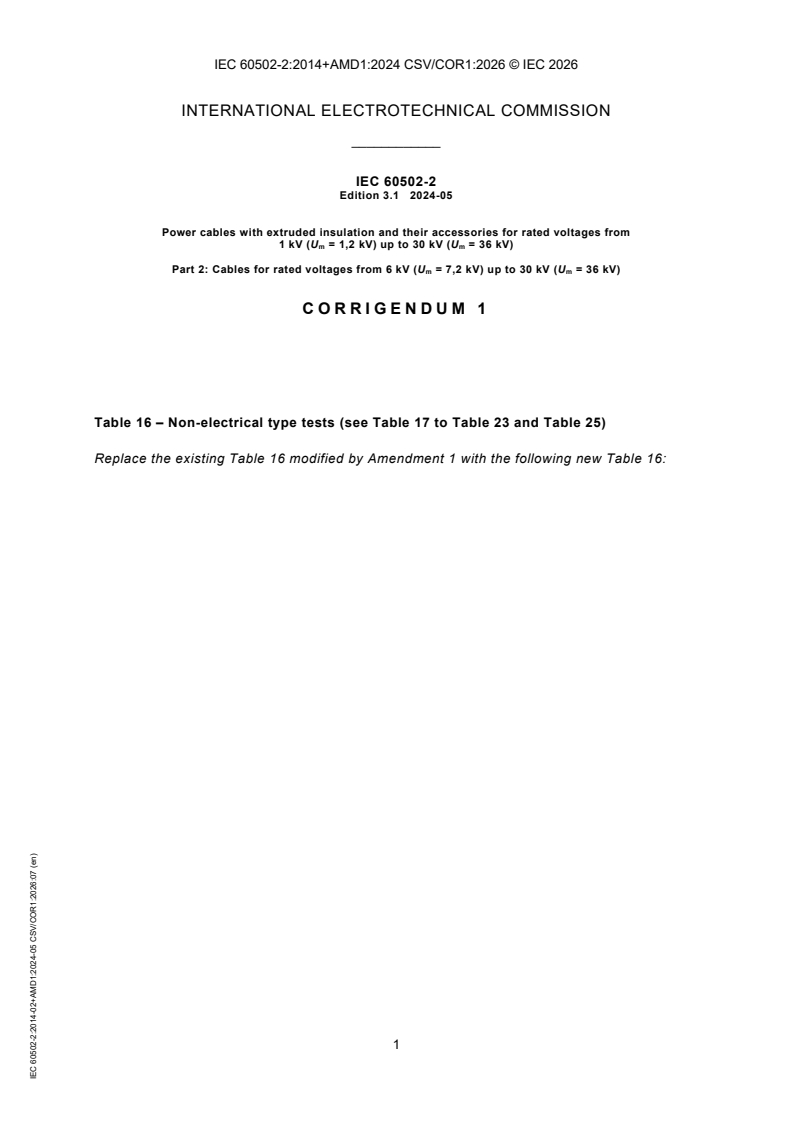
INTERNATIONAL ELECTROTECHNICAL COMMISSION
____________
IEC 60502-2
Edition 3.1 2024-05
Power cables with extruded insulation and their accessories for rated voltages from
1 kV (U = 1,2 kV) up to 30 kV (U = 36 kV)
m m
Part 2: Cables for rated voltages from 6 kV (U = 7,2 kV) up to 30 kV (U = 36 kV)
m m
CO RRI G E NDUM 1
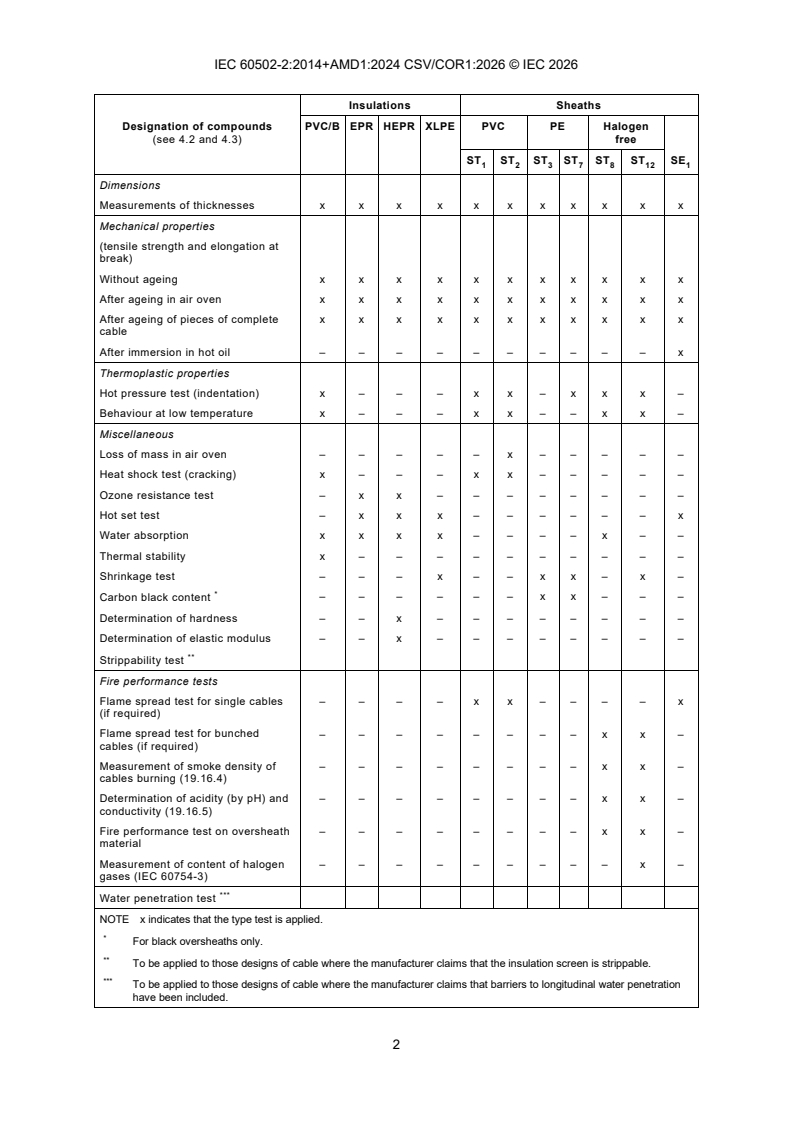
Table 16 – Non-electrical type tests (see Table 17 to Table 23 and Table 25)
Replace the existing Table 16 modified by Amendment 1 with the following new Table 16:
Insulations Sheaths
Designation of compounds PVC/B EPR HEPR XLPE PVC PE Halogen
(see 4.2 and 4.3) free
ST ST ST ST ST ST SE
1 2 3 7 8 12 1
Dimensions
Measurements of thicknesses x x x x x x x x x x x
Mechanical properties
(tensile strength and elongation at
break)
Without ageing x x x x x x x x x x x
After ageing in air oven x x x x x x x x x x x
After ageing of pieces of complete x x x x x x x x x x x
cable
After immersion in hot oil – – – – – – – – – – x
Thermoplastic properties
Hot pressure test (indentation) x – – – x x – x x x –
Behaviour at low temperature x – – – x x – – x x –
Miscellaneous
Loss o
...
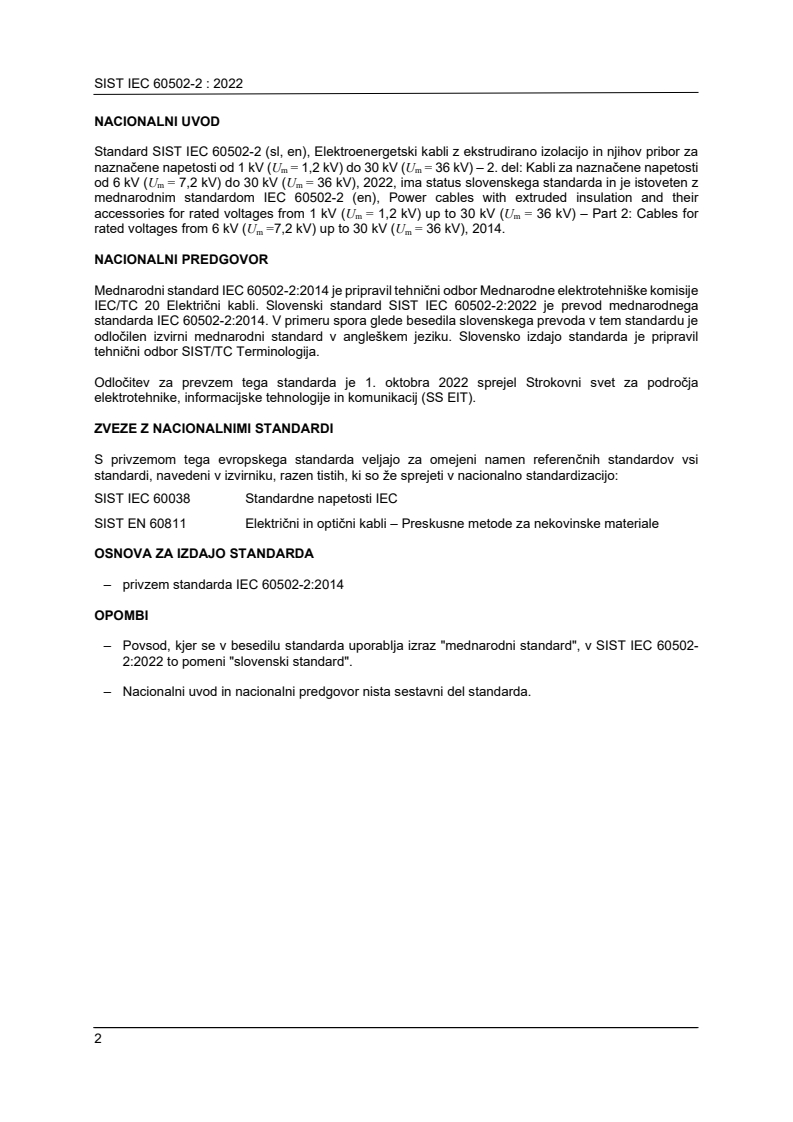
SLOVENSKI STANDARD
01-oktober-2022
Elektroenergetski kabli z ekstrudirano izolacijo in njihov pribor za naznačene
napetosti od 1 kV (Um = 1,2 kV) do 30 kV (Um = 36 kV) - 2. del: Kabli za naznačene
napetosti od 6 kV (Um = 7,2 kV) do 30 kV (Um = 36 kV)
Power cables with extruded insulation and their accessories for rated voltages from 1 kV
(Um = 1,2 kV) up to 30 kV (Um = 36 kV) – Part 2: Cables for rated voltages from 6 kV
(Um = 7,2 kV) up to 30 kV (Um = 36 kV)
Câbles d'énergie à isolant extrudé et leurs accessoires pour des tensions assignées de 1
kV (Um = 1,2 kV) à 30 kV (Um = 36 kV) – Partie 2: Câbles de tensions assignées de 6
kV(Um = 7,2 kV) à 30 kV (Um = 36 kV)
Ta slovenski standard je istoveten z: IEC 60502-2:2014
ICS:
29.060.20 Kabli Cables
2003-01.Slovenski inštitut za standardizacijo. Razmnoževanje celote ali delov tega standarda ni dovoljeno.
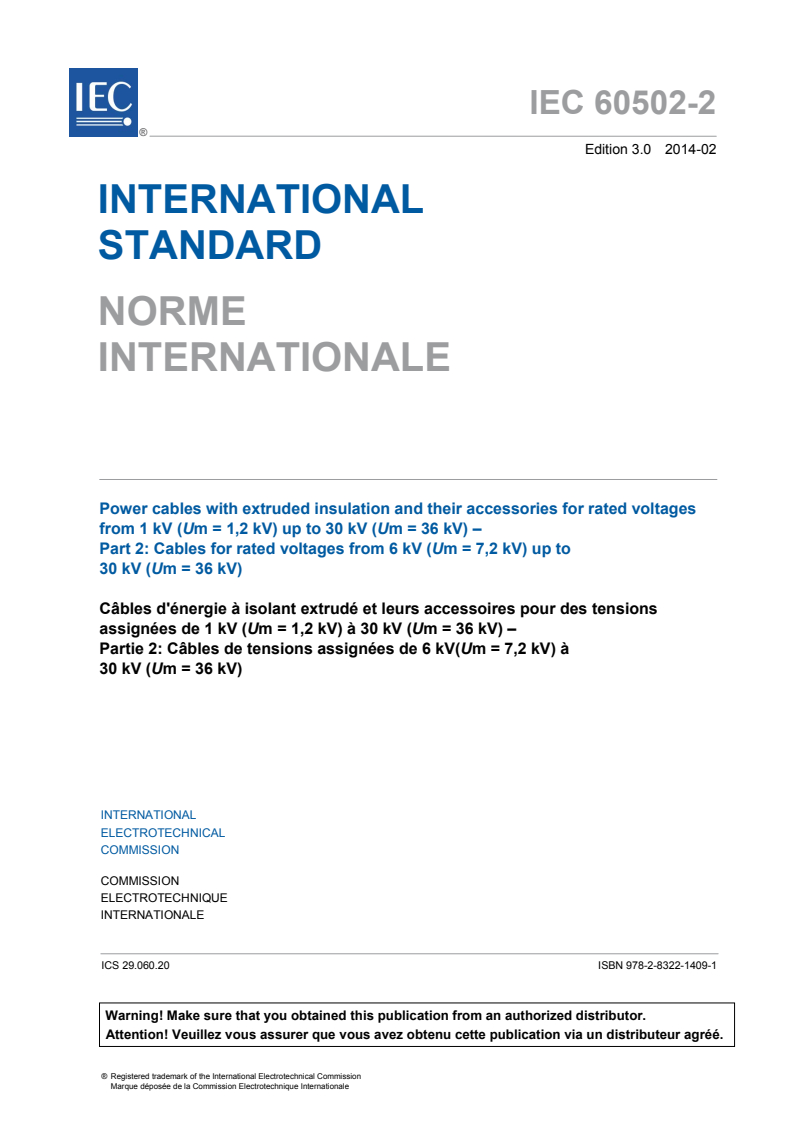
IEC 60502-2 ®
Edition 3.0 2014-02
INTERNATIONAL
STANDARD
NORME
INTERNATIONALE
Power cables with extruded insulation and their accessories for rated voltages
from 1 kV (Um = 1,2 kV) up to 30 kV (Um = 36 kV) –
Part 2: Cables for rated voltages from 6 kV (Um = 7,2 kV) up to
30 kV (Um = 36 kV)
Câbles d'énergie à isolant extrudé et leurs accessoires pour des tensions
assignées de 1 kV (Um = 1,2 kV) à 30 kV (Um = 36 kV) –
Partie 2: Câbles de tensions assignées de 6 kV(Um = 7,2 kV) à
30 kV (Um = 36 kV)
INTERNATIONAL
ELECTROTECHNICAL
COMMISSION
COMMISSION
ELECTROTECHNIQUE
PRICE CODE
INTERNATIONALE
CODE PRIX XC
ICS 29.060.20 ISBN 978-2-8322-1409-1
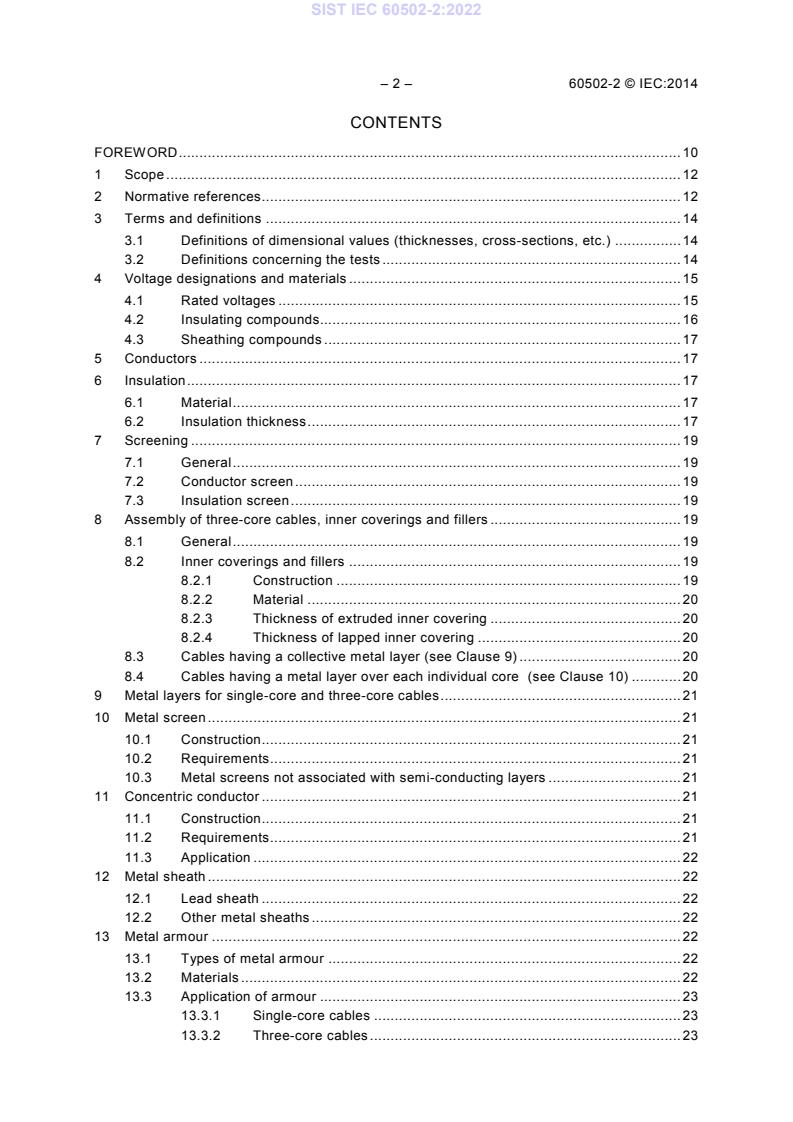
– 2 – 60502-2 © IEC:2014
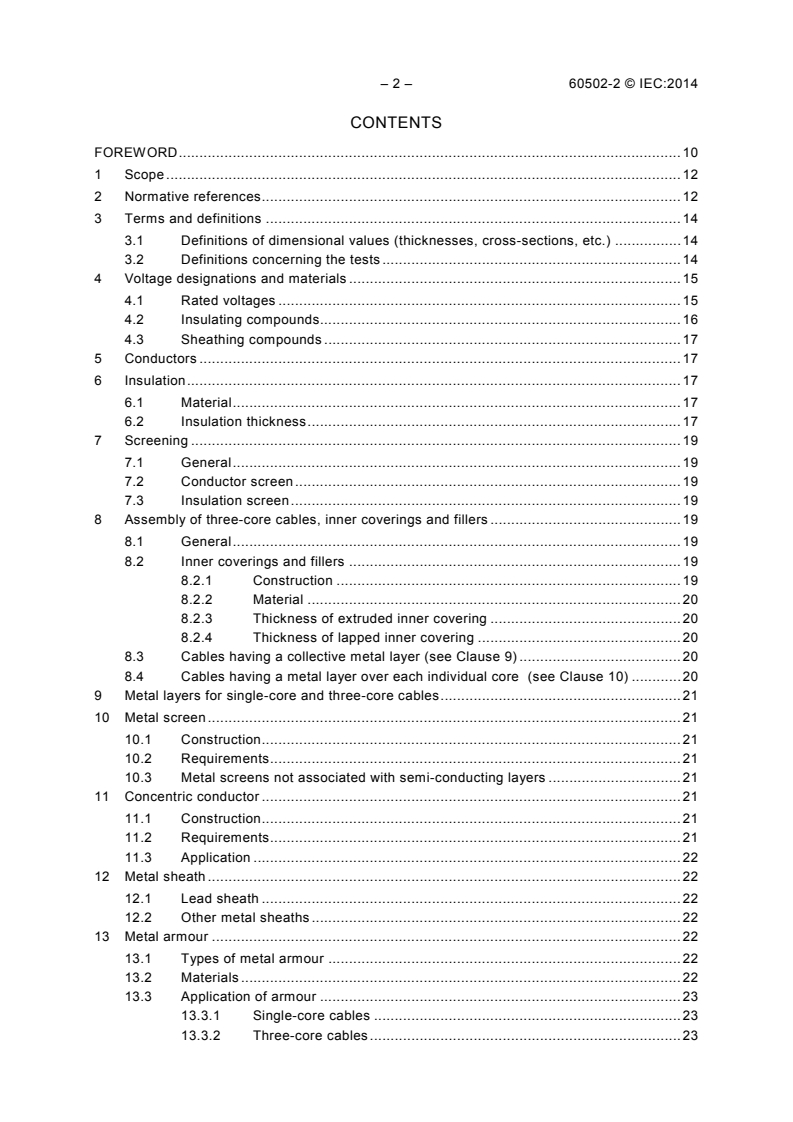
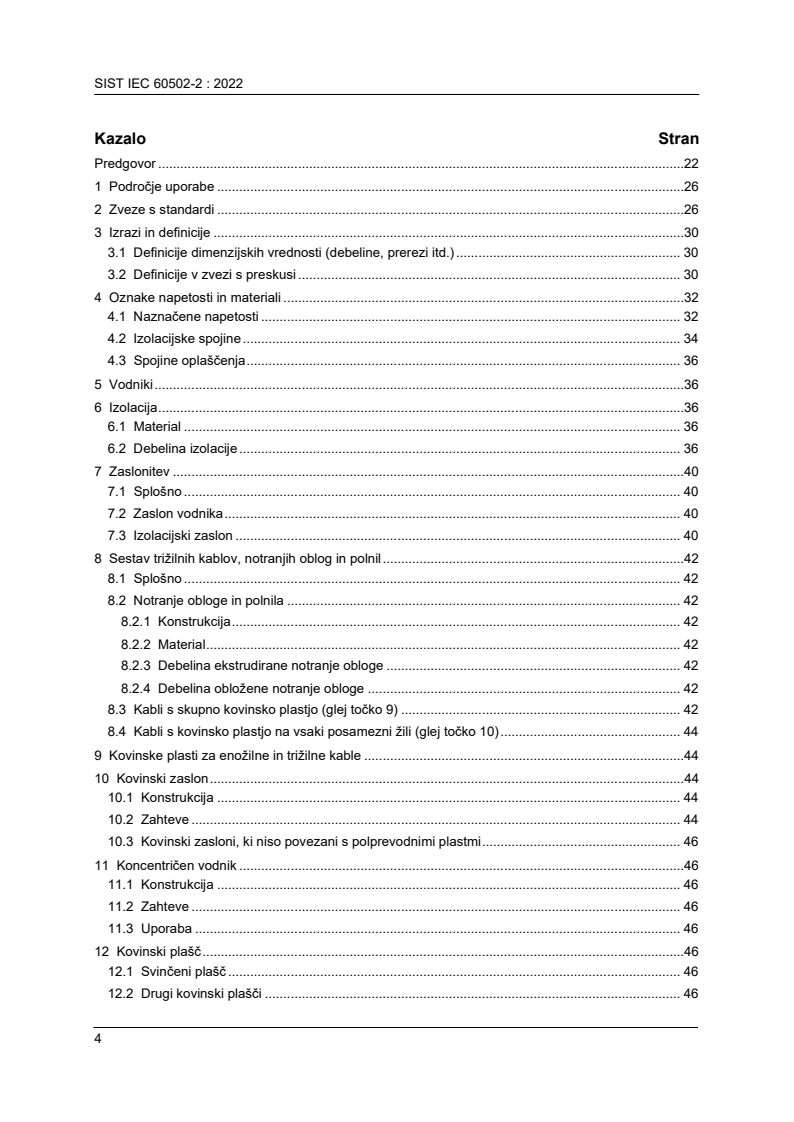
CONTENTS
FOREWORD . 10
1 Scope . 12
2 Normative references . 12
3 Terms and definitions . 14
3.1 Definitions of dimensional values (thicknesses, cross-sections, etc.) . 14
3.2 Definitions concerning the tests . 14
4 Voltage designations and materials . 15
4.1 Rated voltages . 15
4.2 Insulating compounds. 16
4.3 Sheathing compounds . 17
5 Conductors . 17
6 Insulation . 17
6.1 Material . 17
6.2 Insulation thickness . 17
7 Screening . 19
7.1 General . 19
7.2 Conductor screen . 19
7.3 Insulation screen . 19
8 Assembly of three-core cables, inner coverings and fillers . 19
8.1 General . 19
8.2 Inner coverings and fillers . 19
8.2.1 Construction . 19
8.2.2 Material . 20
8.2.3 Thickness of extruded inner covering . 20
8.2.4 Thickness of lapped inner covering . 20
8.3 Cables having a collective metal layer (see Clause 9) . 20
8.4 Cables having a metal layer over each individual core (see Clause 10) . 20
9 Metal layers for single-core and three-core cables . 21
10 Metal screen . 21
10.1 Construction . 21
10.2 Requirements . 21
10.3 Metal screens not associated with semi-conducting layers . 21
11 Concentric conductor . 21
11.1 Construction . 21
11.2 Requirements . 21
11.3 Application . 22
12 Metal sheath . 22
12.1 Lead sheath . 22
12.2 Other metal sheaths . 22
13 Metal armour . 22
13.1 Types of metal armour . 22
13.2 Materials . 22
13.3 Application of armour . 23
13.3.1 Single-core cables . 23
13.3.2 Three-core cables . 23
60502-2 © IEC:2014 – 3 –
13.3.3 Separation sheath . 23
13.3.4 Lapped bedding under armour for lead sheathed cables . 23
13.4 Dimensions of the armour wires and armour tapes. 24
13.5 Correlation between cable diameters and armour dimensions . 24
13.6 Round or flat wire armour . 24
13.7 Double tape armour . 25
14 Oversheath . 25
14.1 General . 25
14.2 Material . 25
14.3 Thickness . 25
15 Test conditions . 26
15.1 Ambient temperature . 26
15.2 Frequency and waveform of power frequency test voltages . 26
15.3 Waveform of impulse test voltages . 26
15.4 Determination of the cable conductor temperature . 26
16 Routine tests . 26
16.1 General . 26
16.2 Electrical resistance of conductors . 26
16.3 Partial discharge test . 27
16.4 Voltage test . 27
16.4.1 General . 27
16.4.2 Test procedure for single-core cables . 27
16.4.3 Test procedure for three-core cables . 27
16.4.4 Test voltage . 27
16.4.5 Requirement . 28
16.5 Electrical test on oversheath of the cable . 28
17 Sample tests . 28
17.1 General . 28
17.2 Frequency of sample tests . 28
17.2.1 Conductor examination and check of dimensions . 28
17.2.2 Electrical and physical tests . 28
17.3 Repetition of tests . 29
17.4 Conductor examination . 29
17.5 Measurement of thickness of insulation and of non-metal sheaths
(including extruded separation sheaths, but excluding inner extruded
coverings) . 29
17.5.1 General . 29
17.5.2 Requirements for the insulation . 29
17.5.3 Requirements for the non-metal sheaths . 30
17.6 Measurement of thickness of lead sheath . 30
17.6.1 General . 30
17.6.2 Strip method . 30
17.6.3 Ring method . 30
17.7 Measurement of armour wires and tapes . 30
17.7.1 Measurement on wires . 30
17.7.2 Measurement on tapes . 31
17.7.3 Requirements . 31
17.8 Measurement of external diameter . 31
17.9 Voltage test for 4 h . 31
– 4 – 60502-2 © IEC:2014
17.9.1 Sampling . 31
17.9.2 Procedure . 31
17.9.3 Test voltages . 31
17.9.4 Requirements . 31
17.10 Hot set test for EPR, HEPR and XLPE insulations and elastomeric
sheaths . 31
17.10.1 Procedure . 31
17.10.2 Requirements . 32
18 Type tests, electrical . 32
18.1 General . 32
18.2 Cables having conductor screens and insulation screens . 32
18.2.1 General . 32
18.2.2 Sequence of tests . 32
18.2.3 Special provisions . 32
18.2.4 Bending test . 33
18.2.5 Partial discharge test . 33
18.2.6 Tan δ measurement for cables of rated voltage 6/10 (12) kV
and above . 33
18.2.7 Heating cycle test . 34
18.2.8 Impulse test followed by a voltage test . 34
18.2.9 Voltage test for 4 h . 34
18.2.10 Resistivity of semi-conducting screens . 35
18.3 Cables of rated voltage 3,6/6 (7,2) kV having unscreened insulation . 35
18.3.1 General . 35
18.3.2 Insulation resistance measurement at ambient temperature . 35
18.3.3 Insulation resistance measurement at maximum conductor
temperature . 36
18.3.4 Voltage test for 4 h . 36
18.3.5 Impulse test . 37
19 Type tests, non-electrical . 37
19.1 General . 37
19.2 Measurement of thickness of insulation . 37
19.2.1 Sampling . 37
19.2.2 Procedure . 37
19.2.3 Requirements . 37
19.3 Measurement of thickness of non-metal sheaths (including extruded
separation sheaths, but excluding inner coverings) . 37
19.3.1 Sampling . 37
19.3.2 Procedure . 37
19.3.3 Requirements . 38
19.4 Measurement of thickness of lead sheath . 38
19.4.1 Sampling . 38
19.4.2 Procedure . 38
19.4.3 Requirements . 38
19.5 Tests for determining the mechanical properties of insulation before and
after ageing . 38
19.5.1 Sampling . 38
19.5.2 Ageing treatments . 38
19.5.3 Conditioning and mechanical tests . 38
19.5.4 Requirements . 38
60502-2 © IEC:2014 – 5 –
19.6 Tests for determining the mechanical properties of non-metal sheaths
before and after ageing . 38
19.6.1 Sampling . 38
19.6.2 Ageing treatments . 38
19.6.3 Conditioning and mechanical tests . 38
19.6.4 Requirements . 39
19.7 Additional ageing test on pieces of completed cables . 39
19.7.1 General . 39
19.7.2 Sampling . 39
19.7.3 Ageing treatment . 39
19.7.4 Mechanical tests . 39
19.7.5 Requirements . 39
19.8 Loss of mass test on PVC sheaths of type ST . 39
19.8.1 Procedure . 39
19.8.2 Requirements . 39
19.9 Pressure test at high temperature on insulations and non-metal sheaths . 39
19.9.1 Procedure . 39
19.9.2 Requirements . 39
19.10 Test on PVC insulation and sheaths at low temperatures . 40
19.10.1 Procedure . 40
19.10.2 Requirements . 40
19.11 Test for resistance of PVC insulation and sheaths to cracking (heat shock
test) . 40
19.11.1 Procedure . 40
19.11.2 Requirements . 40
19.12 Ozone resistance test for EPR and HEPR insulations . 40
19.12.1 Procedure . 40
19.12.2 Requirements . 40
19.13 Hot set test for EPR, HEPR and XLPE insulations and elastomeric
sheaths . 40
19.14 Oil immersion test for elastomeric sheaths . 40
19.14.1 Procedure . 40
19.14.2 Requirements . 40
19.15 Water absorption test on insulation . 40
19.15.1 Procedure . 40
19.15.2 Requirements . 40
19.16 Flame spread test on single cables . 41
19.17 Measurement of carbon black content of black PE oversheaths . 41
19.17.1 Procedure . 41
19.17.2 Requirements . 41
19.18 Shrinkage test for XLPE insulation . 41
19.18.1 Procedure . 41
19.18.2 Requirements . 41
19.19 Thermal stability test for PVC insulation . 41
19.19.1 Procedure . 41
19.19.2 Requirements . 41
19.20 Determination of hardness of HEPR insulation . 41
19.20.1 Procedure . 41
19.20.2 Requirements . 41
19.21 Determination of the elastic modulus of HEPR insulation . 41
– 6 – 60502-2 © IEC:2014
19.21.1 Procedure . 41
19.21.2 Requirements . 42
19.22 Shrinkage test for PE oversheaths . 42
19.22.1 Procedure . 42
19.22.2 Requirements . 42
19.23 Strippability test for insulation screen . 42
19.23.1 General . 42
19.23.2 Procedure . 42
19.23.3 Requirements . 42
19.24 Water penetration test . 43
20 Electrical tests after installation . 43
20.1 General . 43
20.2 DC voltage test of the oversheath . 43
20.3 Insulation test. 43
20.3.1 AC testing . 43
20.3.2 DC testing . 44
Annex A (normative) Fictitious calculation method for determination of dimensions of
protective coverings . 50
A.1 General . 50
A.2 Method . 50
A.2.1 Conductors . 50
A.2.2 Cores. 51
A.2.3 Diameter over laid-up cores . 51
A.2.4 Inner coverings . 51
A.2.5 Concentric conductors and metal screens . 52
A.2.6 Lead sheath . 53
A.2.7 Separation sheath . 53
A.2.8 Lapped bedding . 53
A.2.9 Additional bedding for tape-armoured cables (provided over
the inner covering) . 53
A.2.10 Armour . 54
Annex B (informative) Tabulated continuous current ratings for cables having extruded
insulation and a rated voltage from 3,6/6 kV up to 18/30 kV . 55
B.1 General . 55
B.2 Cable constructions . 55
B.3 Temperatures. 55
B.4 Soil thermal resistivity . 56
B.5 Methods of installation . 56
B.5.1 General . 56
B.5.2 Single-core cables in air . 56
B.5.3 Single-core cables buried direct . 56
B.5.4 Single-core cables in earthenware ducts . 57
B.5.5 Three-core cables . 57
B.6 Screen bonding . 58
B.7 Cable loading . 58
B.8 Rating factors for grouped circuits . 58
B.9 Correction factors . 58
Annex C (normative) Rounding of numbers. 74
C.1 Rounding of numbers for the purpose of the fictitious calculation method . 74
60502-2 © IEC:2014 – 7 –
C.2 Rounding of numbers for other purposes . 74
Annex D (normative) Method of measuring resistivity of semi-conducting screens . 75
Annex E (normative) Determination of hardness of HEPR insulations . 78
E.1 Test piece . 78
E.2 Test procedure . 78
E.2.1 General . 78
E.2.2 Surfaces of large radius of curvature . 78
E.2.3 Surfaces of small radius of curvature . 78
E.2.4 Conditioning and test temperature . 78
E.2.5 Number of measurements . 79
Annex F (normative) Water penetration test . 80
F.1 Test piece . 80
F.2 Test . 80
F.3 Requirements . 81
Annex G (informative) Determination of the cable conductor temperature . 82
G.1 Purpose . 82
G.2 Calibration of the temperature of the main test loop . 82
G.2.1 General . 82
G.2.2 Installation of cable and temperature sensors . 82
G.2.3 Calibration method . 84
G.3 Heating for the test . 85
G.3.1 Method 1 – Test using a reference cable . 85
G.3.2 Method 2 – Test using conductor temperature calculations and
measurement of the surface temperature . 85
Bibliography . 87
Figure B.1 – Single-core cables in air . 56
Figure B.2 – Single-core cables buried direct . 57
Figure B.3 – Single-core cables in earthenware ducts . 57
Figure B.4 – Three-core cables . 58
Figure D.1 – Preparation of samples for measurement of resistivity of conductor and
insulation screens . 77
Figure E.1 – Test on surfaces of large radius of curvature . 79
Figure E.2 – Test on surfaces of small radius of curvature . 79
Figure F.1 – Schematic diagram of apparatus for water penetration test . 81
Figure G.1 – Typical test set-up for the reference loop and the main test loop . 83
Figure G.2 – Example of an arrangement of the temperature sensors on the conductor
of the reference loop . 84
Table 1 – Recommended rated voltages U . 16
Table 2 – Insulating compounds . 16
Table 3 – Maximum conductor temperatures for different types of insulating compound . 16
Table 4 – Maximum conductor temperatures for different types of sheathing compound . 17
Table 5 – Nominal thickness of PVC/B insulation . 18
Table 6 – Nominal thickness of cross-linked polyethylene (XLPE) insulation . 18
– 8 – 60502-2 © IEC:2014
Table 7 – Nominal thickness of ethylene propylene rubber (EPR) and hard ethylene
propylene rubber (HEPR) insulation . 18
Table 8 – Thickness of extruded inner covering . 20
Table 9 – Nominal diameter of round armour wires . 24
Table 10 – Nominal thickness of armour tapes . 24
Table 11 – Routine test voltages . 28
Table 12 – Number of samples for sample tests . 29
Table 13 – Sample test voltages . 31
Table 14 – Impulse voltages . 34
Table 15 – Electrical type test requirements for insulating compounds . 44
Table 16 – Non-electrical type tests (see Tables 17 to 23) . 44
Table 17 – Test requirements for mechanical characteristics of insulating compounds
(before and after ageing) . 45
Table 18 – Test requirements for particular characteristics for PVC insulating
compound . 46
Table 19 – Test requirements for particular characteristics of various crosslinked
insulating compounds . 47
Table 20 – Test requirements for mechanical characteristics of sheathing compounds
(before and after ageing) . 47
Table 21 – Test requirements for particular characteristics for PVC sheathing
compounds . 48
Table 22 – Test requirements for particular characteristics of PE (thermoplastic
polyethylene) sheathing compounds . 48
Table 23 – Test requirements for particular characteristics of elastomeric sheathing
compound . 49
Table A.1 – Fictitious diameter of conductor . 51
Table A.2 – Increase of diameter for concentric conductors and metal screens . 52
Table A.3 – Increase of diameter for additional bedding . 53
Table B.1 – Nominal screen cross-sectional areas . 55
Table B.2 – Current ratings for single-core cables with XLPE insulation – Rated voltage
3,6/6 kV to 18/30 kV * – Copper conductor . 59
Table B.3 – Current ratings for single-core cables with XLPE insulation – Rated voltage
3,6/6 kV to 18/30 kV * – Aluminium conductor . 60
Table B.4 – Current ratings for single-core cables with EPR insulation – Rated voltage
3,6/6 kV to 18/30 kV * – Copper conductor . 61
Table B.5 – Current ratings for single-core cables with EPR insulation – Rated voltage
3,6/6 kV to 18/30 kV * – Aluminium conductor . 62
Table B.6 – Current rating for three-core XLPE insulated cables – Rated voltage
3,6/6 kV to 18/30 kV * – Copper conductor, armoured and unarmoured. 63
Table B.7 – Current rating for three-core XLPE insulated cables – Rated voltage
3,6/6 kV to 18/30 kV * – Aluminium conductor, armoured and unarmoured . 64
Table B.8 – Current rating for three-core EPR insulated cables – Rated voltage 3,6/6 kV
to 18/30 kV * – Copper conductor, armoured and unarmoured . 65
Table B.9 – Current rating for three-core EPR insulated cables – Rated voltage 3,6/6 kV
to 18/30 kV * – Aluminium conductor, armoured and unarmoured . 66
Table B.10 – Correction factors for ambient air temperatures other than 30 °C . 66
Table B.11 – Correction factors for ambient ground temperatures other than 20 °C . 67
60502-2 © IEC:2014 – 9 –
Table B.12 – Correction factors for depths of laying other than 0,8 m for direct buried
cables . 67
Table B.13 – Correction factors for depths of laying other than 0,8 m for cables in ducts . 67
.
Table B.14 – Correction factors for soil thermal resistivities other than 1,5 K m/W for
direct buried single-core cables . 68
.
Table B.15 – Correction factors for soil thermal resistivities other than 1,5 K m/W
single-core cables in buried ducts. 68
.
Table B.16 – Correction factors for soil thermal resistivities other than 1,5 K m/W for
direct buried three-core cables . 69
.
Table B.17 – Correction factors for soil thermal resistivities other than 1,5 K m/W for
three-core cables in ducts . 69
Table B.18 – Correction factors for groups of three-core cables in horizontal formation
laid direct in the ground . 70
Table B.19 – Correction factors for groups of three-phase circuits of single-core cables
laid direct in the ground . 70
Table B.20 – Correction factors for groups of three-core cables in single way ducts in
horizontal formation . 71
Table B.21 – Correction factors for groups of three-phase circuits of single-core cables
in single-way ducts . 71
Table B.22 – Reduction factors for groups of more than one multi-core cable in air – To
be applied to the current-carrying capacity for one multi-core cable in free air . 72
Table B.23 – Reduction factors for groups of more than one circuit of single-core cables
(Note 2) – To be applied to the current-carrying capacity for one circuit of single-core
cables in free air . 73
– 10 – 60502-2 © IEC:2014
INTERNATIONAL ELECTROTECHNICAL COMMISSION
____________
POWER CABLES WITH EXTRUDED INSULATION
AND THEIR ACCESSORIES FOR RATED VOLTAGES
FROM 1 kV (U = 1,2 kV) UP TO 30 kV (U = 36 kV) –
m m
Part 2: Cables for rated voltages from 6 kV
(U = 7,2 kV) up to 30 kV (U = 36 kV)
m m
FOREWORD
1) The International Electrotechnical Commission (IEC) is a worldwide organization for standardization comprising
all national electrotechnical committees (IEC National Committees). The object of IEC is to promote
international co-operation on all questions concerning standardization in the electrical and electronic fields. To
this end and in addition to other activities, IEC publishes International Standards, Technical Specifications,
Technical Reports, Publicly Available Specifications (PAS) and Guides (hereafter referred to as “IEC
Publication(s)”). Their preparation is entrusted to technical committees; any IEC National Committee interested
in the subject dealt with may participate in this preparatory work. International, governmental and non-
governmental organizations liaising with the IEC also participate in this preparation. IEC collaborates closely
with the International Organization for Standardization (ISO) in accordance with conditions determined by
agreement between the two organizations.
2) The formal decisions or agreements of IEC on technical matters express, as nearly as possible, an international
consensus of opinion on the relevant subjects since each technical committee has representation from all
interested IEC National Committees.
3) IEC Publications have the form of recommendations for international use and are accepted by IEC National
Committees in that sense. While all reasonable efforts are made to ensure that the technical content of IEC
Publications is accurate, IEC cannot be held responsible for the way in which they are used or for any
misinterpretation by any end user.
4) In order to promote international uniformity, IEC National Committees undertake to apply IEC Publications
transparently to the maximum extent possible in their national and regional publications. Any divergence
between any IEC Publication and the corresponding national or regional publication shall be clearly indicated in
the latter.
5) IEC itself does not provide any attestation of conformity. Independent certification bodies provide conformity
assessment services and, in some areas, access to IEC marks of conformity. IEC is not responsible for any
services carried out by independent certification bodies.
6) All users should ensure that they have the latest edition of this publication.
7) No liability sha
...
IEC 60502-2 ®
Edition 3.1 2024-05
CONSOLIDATED VERSION
INTERNATIONAL
STANDARD
colour
inside
Power cables with extruded insulation and their accessories for rated voltages
from 1 kV (Um = 1,2 kV) up to 30 kV (Um = 36 kV) –
Part 2: Cables for rated voltages from 6 kV (Um = 7,2 kV) up to 30 kV (Um = 36 kV)
All rights reserved. Unless otherwise specified, no part of this publication may be reproduced or utilized in any form
or by any means, electronic or mechanical, including photocopying and microfilm, without permission in writing from
either IEC or IEC's member National Committee in the country of the requester. If you have any questions about IEC
copyright or have an enquiry about obtaining additional rights to this publication, please contact the address below or
your local IEC member National Committee for further information.
IEC Secretariat Tel.: +41 22 919 02 11
3, rue de Varembé info@iec.ch
CH-1211 Geneva 20 www.iec.ch
Switzerland
About the IEC
The International Electrotechnical Commission (IEC) is the leading global organization that prepares and publishes
International Standards for all electrical, electronic and related technologies.
About IEC publications
The technical content of IEC publications is kept under constant review by the IEC. Please make sure that you have the
latest edition, a corrigendum or an amendment might have been published.
IEC publications search - webstore.iec.ch/advsearchform IEC Products & Services Portal - products.iec.ch
The advanced search enables to find IEC publications by a Discover our powerful search engine and read freely all the
variety of criteria (reference number, text, technical publications previews, graphical symbols and the glossary.
committee, …). It also gives information on projects, replaced With a subscription you will always have access to up to date
and withdrawn publications. content tailored to your needs.
IEC Just Published - webstore.iec.ch/justpublished
Electropedia - www.electropedia.org
Stay up to date on all new IEC publications. Just Published
The world's leading online dictionary on electrotechnology,
details all new publications released. Available online and once
containing more than 22 500 terminological entries in English
a month by email.
and French, with equivalent terms in 25 additional languages.
Also known as the International Electrotechnical Vocabulary
IEC Customer Service Centre - webstore.iec.ch/csc
(IEV) online.
If you wish to give us your feedback on this publication or need
further assistance, please contact the Customer Service
Centre: sales@iec.ch.
IEC 60502-2 ®
Edition 3.1 2024-05
CONSOLIDATED VERSION
INTERNATIONAL
STANDARD
colour
inside
Power cables with extruded insulation and their accessories for rated voltages
from 1 kV (U = 1,2 kV) up to 30 kV (U = 36 kV) –
m m
Part 2: Cables for rated voltages from 6 kV (U = 7,2 kV) up to 30 kV (U = 36 kV)
m m
INTERNATIONAL
ELECTROTECHNICAL
COMMISSION
ICS 29.060.20 ISBN 978-2-8322-9033-0
REDLINE VERSION – 2 – IEC 60502-2:2014+AMD1:2024 CSV
© IEC 2024
CONTENTS
FOREWORD . 11
1 Scope . 13
2 Normative references . 13
3 Terms and definitions . 15
3.1 Definitions of dimensional values (thicknesses, cross-sections, etc.) . 15
3.2 Definitions concerning the tests . 16
4 Voltage designations and materials . 16
4.1 Rated voltages . 16
4.2 Insulating compounds . 17
4.3 Sheathing compounds . 18
5 Conductors . 19
6 Insulation. 19
6.1 Material . 19
6.2 Insulation thickness . 19
7 Screening . 20
7.1 General . 20
7.2 Conductor screen . 20
7.3 Insulation screen . 20
8 Assembly of three-core cables, inner coverings and fillers . 21
8.1 General . 21
8.2 Inner coverings and fillers . 21
8.2.1 Construction . 21
8.2.2 Material . 21
8.2.3 Thickness of extruded inner covering . 21
8.2.4 Thickness of lapped inner covering . 21
8.3 Cables having a collective metal layer (see Clause 9) . 22
8.4 Cables having a metal layer over each individual core (see Clause 10) . 22
9 Metal layers for single-core and three-core cables . 22
10 Metal screen . 22
10.1 Construction . 22
10.2 Requirements . 23
10.3 Metal screens not associated with semi-conducting layers . 23
11 Concentric conductor . 23
11.1 Construction . 23
11.2 Requirements . 23
11.3 Application . 23
12 Metal sheath . 23
12.1 Lead sheath . 23
12.2 Other metal sheaths . 23
13 Metal armour . 24
13.1 Types of metal armour . 24
13.2 Materials . 24
13.3 Application of armour . 24
13.3.1 Single-core cables . 24
13.3.2 Three-core cables . 24
© IEC 2024
13.3.3 Separation sheath . 24
13.3.4 Lapped bedding under armour for lead sheathed cables . 25
13.4 Dimensions of the armour wires, and armour tapes and armour strips . 25
13.5 Correlation between cable diameters and armour dimensions . 25
13.6 Round or flat wire armour . 26
13.7 Double tape armour . 26
13.8 Interlock metal tape armour . 27
14 Oversheath . 27
14.1 General . 27
14.2 Material . 27
14.3 Thickness . 28
15 Test conditions . 28
15.1 Ambient temperature. 28
15.2 Frequency and waveform of power frequency test voltages . 28
15.3 Waveform of impulse test voltages . 28
15.4 Determination of the cable conductor temperature . 28
16 Routine tests . 29
16.1 General . 29
16.2 Electrical resistance of conductors . 29
16.3 Partial discharge test . 29
16.4 Voltage test . 29
16.4.1 General . 29
16.4.2 Test procedure for single-core cables . 30
16.4.3 Test procedure for three-core cables . 30
16.4.4 Test voltage . 30
16.4.5 Requirement . 30
16.5 Electrical test on oversheath of the cable . 30
17 Sample tests . 30
17.1 General . 30
17.2 Frequency of sample tests . 31
17.2.1 Conductor examination and check of dimensions . 31
17.2.2 Electrical and physical tests . 31
17.3 Repetition of tests . 31
17.4 Conductor examination . 31
17.5 Measurement of thickness of insulation and of non-metal sheaths
(including extruded separation sheaths, but excluding inner extruded
coverings) . 31
17.5.1 General . 31
17.5.2 Requirements for the insulation . 31
17.5.3 Requirements for the non-metal sheaths . 32
17.6 Measurement of thickness of lead sheath . 32
17.6.1 General . 32
17.6.2 Strip method . 32
17.6.3 Ring method . 32
17.7 Measurement of armour wires, and tapes and armour strips . 33
17.7.1 Measurement on wires . 33
17.7.2 Measurement on tapes and armour strips . 33
17.7.3 Requirements . 33
REDLINE VERSION – 4 – IEC 60502-2:2014+AMD1:2024 CSV
© IEC 2024
17.8 Measurement of external diameter . 33
17.9 Voltage test for 4 h . 33
17.9.1 Sampling . 33
17.9.2 Procedure . 33
17.9.3 Test voltages . 33
17.9.4 Requirements . 34
17.10 Hot set test for EPR, HEPR and XLPE insulations and elastomeric
sheaths . 34
17.10.1 Procedure . 34
17.10.2 Requirements . 34
17.11 Bending test on interlock armour cable followed by examination . 34
18 Type tests, electrical . 34
18.1 General . 34
18.2 Cables having conductor screens and insulation screens . 34
18.2.1 General . 34
18.2.2 Sequence of tests . 35
18.2.3 Special provisions . 35
18.2.4 Bending test . 35
18.2.5 Partial discharge test . 36
18.2.6 Tan δ measurement for cables of rated voltage 6/10 (12) kV
and above. 36
18.2.7 Heating cycle test . 36
18.2.8 Impulse test followed by a voltage test . 37
18.2.9 Voltage test for 4 h . 37
18.2.10 Resistivity of semi-conducting screens . 37
18.3 Cables of rated voltage 3,6/6 (7,2) kV having unscreened insulation . 38
18.3.1 General . 38
18.3.2 Insulation resistance measurement at ambient temperature . 38
18.3.3 Insulation resistance measurement at maximum conductor
temperature . 39
18.3.4 Voltage test for 4 h . 39
18.3.5 Impulse test . 39
19 Type tests, non-electrical . 40
19.1 General . 40
19.2 Measurement of thickness of insulation . 40
19.2.1 Sampling . 40
19.2.2 Procedure . 40
19.2.3 Requirements . 40
19.3 Measurement of thickness of non-metal sheaths (including extruded
separation sheaths, but excluding inner coverings) . 40
19.3.1 Sampling . 40
19.3.2 Procedure . 40
19.3.3 Requirements . 40
19.4 Measurement of thickness of lead sheath . 40
19.4.1 Sampling . 40
19.4.2 Procedure . 40
19.4.3 Requirements . 40
19.5 Tests for determining the mechanical properties of insulation before and
after ageing . 40
© IEC 2024
19.5.1 Sampling . 40
19.5.2 Ageing treatments . 41
19.5.3 Conditioning and mechanical tests . 41
19.5.4 Requirements . 41
19.6 Tests for determining the mechanical properties of non-metal sheaths
before and after ageing . 41
19.6.1 Sampling . 41
19.6.2 Ageing treatments . 41
19.6.3 Conditioning and mechanical tests . 41
19.6.4 Requirements . 41
19.7 Additional ageing test on pieces of completed cables . 41
19.7.1 General . 41
19.7.2 Sampling . 41
19.7.3 Ageing treatment . 41
19.7.4 Mechanical tests . 42
19.7.5 Requirements . 42
19.8 Loss of mass test on PVC sheaths of type ST . 42
19.8.1 Procedure . 42
19.8.2 Requirements . 42
19.9 Pressure test at high temperature on insulations and non-metal sheaths . 42
19.9.1 Procedure . 42
19.9.2 Requirements . 42
19.10 Test on PVC insulation, and PVC sheaths and halogen free sheaths at
low temperatures . 42
19.10.1 Procedure . 42
19.10.2 Requirements . 42
19.11 Test for resistance of PVC insulation and sheaths to cracking (heat shock
test) . 42
19.11.1 Procedure . 42
19.11.2 Requirements . 42
19.12 Ozone resistance test for EPR and HEPR insulations . 43
19.12.1 Procedure . 43
19.12.2 Requirements . 43
19.13 Hot set test for EPR, HEPR and XLPE insulations and elastomeric
sheaths . 43
19.14 Oil immersion test for elastomeric sheaths . 43
19.14.1 Procedure . 43
19.14.2 Requirements . 43
19.15 Water absorption test on insulation . 43
19.15.1 Procedure . 43
19.15.2 Requirements . 43
19.16 Flame spread test on single cables .
19.16 Test under fire conditions . 43
19.16.1 General . 43
19.16.2 Flame spread test for single cables . 43
19.16.3 Flame spread test for bunched cables . 44
19.16.4 Measurement of smoke density of cables burning under
defined conditions . 44
REDLINE VERSION – 6 – IEC 60502-2:2014+AMD1:2024 CSV
© IEC 2024
19.16.5 Determination of acidity (by pH measurement) and
conductivity of gases evolved during combustion of the non-
metallic materials in the cable . 44
19.16.6 Fire performance tests on halogen free oversheath material
ST . 44
19.16.7 Fire performance tests on halogen free oversheath material
ST . 45
19.16.8 Measurement of halogen content of gases evolved during
combustion of the non-metallic materials in the cable . 45
19.17 Measurement of carbon black content of black PE oversheaths . 45
19.17.1 Procedure . 45
19.17.2 Requirements . 45
19.18 Shrinkage test for XLPE insulation . 46
19.18.1 Procedure . 46
19.18.2 Requirements . 46
19.19 Thermal stability test for PVC insulation . 46
19.19.1 Procedure . 46
19.19.2 Requirements . 46
19.20 Determination of hardness of HEPR insulation . 46
19.20.1 Procedure . 46
19.20.2 Requirements . 46
19.21 Determination of the elastic modulus of HEPR insulation . 46
19.21.1 Procedure . 46
19.21.2 Requirements . 46
19.22 Shrinkage test for PE and halogen free oversheaths . 46
19.22.1 Procedure . 46
19.22.2 Requirements . 46
19.23 Strippability test for insulation screen . 47
19.23.1 General . 47
19.23.2 Procedure . 47
19.23.3 Requirements . 47
19.24 Water penetration test . 47
19.25 Additional tests on halogen free oversheath of type ST . 48
19.25.1 General . 48
19.25.2 Water absorption test for halogen free oversheath of type ST . 48
19.25.3 Abrasion test on halogen free oversheath of type ST . 48
19.26 Bending test on interlock armour . 48
20 Electrical tests after installation . 48
20.1 General . 48
20.2 DC voltage test of the oversheath . 48
20.3 Insulation test AC voltage test of the insulation . 48
Annex A (normative) Fictitious calculation method for determination of dimensions of
protective coverings . 58
A.1 General . 58
A.2 Method . 58
A.2.1 Conductors . 58
A.2.2 Cores . 59
A.2.3 Diameter over laid-up cores . 59
A.2.4 Inner coverings . 59
A.2.5 Concentric conductors and metal screens . 60
© IEC 2024
A.2.6 Lead sheath . 61
A.2.7 Separation sheath . 61
A.2.8 Lapped bedding . 61
A.2.9 Additional bedding for tape-armoured cables (provided over
the inner covering) . 62
A.2.10 Armour . 62
Annex B (informative) Tabulated continuous current ratings for cables having extruded
insulation and a rated voltage from 3,6/6 kV up to 18/30 kV . 63
B.1 General . 63
B.2 Cable constructions . 63
B.3 Temperatures . 63
B.4 Soil thermal resistivity . 64
B.5 Methods of installation . 64
B.5.1 General . 64
B.5.2 Single-core cables in air . 64
B.5.3 Single-core cables buried direct . 64
B.5.4 Single-core cables in earthenware ducts . 65
B.5.5 Three-core cables . 65
B.6 Screen bonding . 66
B.7 Cable loading . 66
B.8 Rating factors for grouped circuits . 66
B.9 Correction factors . 66
Annex C (normative) Rounding of numbers . 82
C.1 Rounding of numbers for the purpose of the fictitious calculation method . 82
C.2 Rounding of numbers for other purposes . 82
Annex D (normative) Method of measuring resistivity of semi-conducting screens . 83
Annex E (normative) Determination of hardness of HEPR insulations . 86
E.1 Test piece . 86
E.2 Test procedure . 86
E.2.1 General . 86
E.2.2 Surfaces of large radius of curvature . 86
E.2.3 Surfaces of small radius of curvature . 86
E.2.4 Conditioning and test temperature . 86
E.2.5 Number of measurements . 87
Annex F (normative) Water penetration test . 88
F.1 Test piece . 88
F.2 Test . 88
F.3 Requirements . 89
Annex G (informative) Determination of the cable conductor temperature . 90
G.1 Purpose . 90
G.2 Calibration of the temperature of the main test loop . 90
G.2.1 General . 90
G.2.2 Installation of cable and temperature sensors . 90
G.2.3 Calibration method . 92
G.3 Heating for the test . 93
G.3.1 Method 1 – Test using a reference cable . 93
G.3.2 Method 2 – Test using conductor temperature calculations
and measurement of the surface temperature . 93
REDLINE VERSION – 8 – IEC 60502-2:2014+AMD1:2024 CSV
© IEC 2024
Annex H (normative) Test for water penetration in the conductor . 95
H.1 General . 95
H.2 Test piece . 95
H.3 Test . 95
H.4 Requirements . 95
Annex I (normative) Methods of determining the weighted value of halogen content of
the non-metallic materials in the cable . 97
I.1 Calculating the weighted value of the cable when the halogen content of
individual materials is tested . 97
I.2 Preparation of the test sample for measurement of halogen content on a
sample representative of the non-metallic materials in the cable . 97
Bibliography . 98
Figure B.1 – Single-core cables in air . 64
Figure B.2 – Single-core cables buried direct . 65
Figure B.3 – Single-core cables in earthenware ducts . 65
Figure B.4 – Three-core cables . 66
Figure D.1 – Preparation of samples for measurement of resistivity of conductor and
insulation screens . 85
Figure E.1 – Test on surfaces of large radius of curvature . 87
Figure E.2 – Test on surfaces of small radius of curvature . 87
Figure F.1 – Schematic diagram of apparatus for water penetration test . 89
Figure G.1 – Typical test set-up for the reference loop and the main test loop . 91
Figure G.2 – Example of an arrangement of the temperature sensors on the conductor
of the reference loop . 92
Figure H.1 – Schematic diagram of apparatus for water penetration test in the
conductor . 96
Table 1 – Recommended rated voltages U . 17
Table 2 – Insulating compounds. 17
Table 3 – Maximum conductor temperatures for different types of insulating compound . 18
Table 4 – Maximum conductor temperatures for different types of sheathing compound . 18
Table 5 – Nominal thickness of PVC/B insulation . 19
Table 6 – Nominal thickness of cross-linked polyethylene (XLPE) insulation . 19
Table 7 – Nominal thickness of ethylene propylene rubber (EPR) and hard ethylene
propylene rubber (HEPR) insulation . 20
Table 8 – Thickness of extruded inner covering . 21
Table 9 – Nominal diameter of round armour wires . 26
Table 10 – Nominal thickness of armour tapes . 26
Table 24 – Nominal thickness of armour strips . 26
Table 11 – Routine test voltages . 30
Table 12 – Number of samples for sample tests . 31
Table 13 – Sample test voltages . 34
Table 14 – Impulse voltages . 37
Table 15 – Electrical type test requirements for insulating compounds . 49
Table 16 – Non-electrical type tests (see Table 17 to Table 23 and Table 25) . 50
© IEC 2024
Table 17 – Test requirements for mechanical characteristics of insulating compounds
(before and after ageing) . 51
Table 18 – Test requirements for particular characteristics for PVC insulating
compound . 52
Table 19 – Test requirements for particular characteristics of various crosslinked
insulating compounds . 53
Table 20 – Test requirements for mechanical characteristics of sheathing compounds
(before and after ageing) . 54
Table 21 – Test requirements for particular characteristics for PVC sheathing
compounds . 54
Table 22 – Test requirements for particular characteristics of PE (thermoplastic
polyethylene) sheathing compounds . 55
Table 23 – Test requirements for particular characteristics of elastomeric sheathing
compound . 55
Table 25 – Test requirements for particular characteristics of halogen free sheathing
compounds . 56
Table A.1 – Fictitious diameter of conductor . 59
Table A.2 – Increase of diameter for concentric conductors and metal screens . 60
Table A.3 – Increase of diameter for additional bedding . 62
Table A.4 – Increase of diameter over interlocked armour. 62
Table B.1 – Nominal screen cross-sectional areas . 63
Table B.2 – Current ratings for single-core cables with XLPE insulation – Rated voltage
3,6/6 kV to 18/30 kV * – Copper conductor . 67
Table B.3 – Current ratings for single-core cables with XLPE insulation – Rated voltage
3,6/6 kV to 18/30 kV * – Aluminium conductor . 68
Table B.4 – Current ratings for single-core cables with EPR insulation – Rated voltage
3,6/6 kV to 18/30 kV * – Copper conductor . 69
Table B.5 – Current ratings for single-core cables with EPR insulation – Rated voltage
3,6/6 kV to 18/30 kV * – Aluminium conductor . 70
Table B.6 – Current rating for three-core XLPE insulated cables – Rated voltage
3,6/6 kV to 18/30 kV * – Copper conductor, armoured and unarmoured . 71
Table B.7 – Current rating for three-core XLPE insulated cables – Rated voltage
3,6/6 kV to 18/30 kV * – Aluminium conductor, armoured and unarmoured . 72
Table B.8 – Current rating for three-core EPR insulated cables – Rated voltage
3,6/6 kV to 18/30 kV * – Copper conductor, armoured and unarmoured . 73
Table B.9 – Current rating for three-core EPR insulated cables – Rated voltage
3,6/6 kV to 18/30 kV * – Aluminium conductor, armoured and unarmoured . 74
Table B.10 – Correction factors for ambient air temperatures other than 30 °C . 74
Table B.11 – Correction factors for ambient ground temperatures other than 20 °C . 75
Table B.12 – Correction factors for depths of laying other than 0,8 m for direct buried
cables . 75
Table B.13 – Correction factors for depths of laying other than 0,8 m for cables in
ducts . 75
.
Table B.14 – Correction factors for soil thermal resistivities
...
IEC 60502-2 ®
Edition 3.0 2014-02
REDLINE VERSION
INTERNATIONAL
STANDARD
colour
inside
Power cables with extruded insulation and their accessories for rated voltages
from 1 kV (Um = 1,2 kV) up to 30 kV (Um = 36 kV) –
Part 2: Cables for rated voltages from 6 kV (Um = 7,2 kV) up to
30 kV (Um = 36 kV)
All rights reserved. Unless otherwise specified, no part of this publication may be reproduced or utilized in any form
or by any means, electronic or mechanical, including photocopying and microfilm, without permission in writing from
either IEC or IEC's member National Committee in the country of the requester. If you have any questions about IEC
copyright or have an enquiry about obtaining additional rights to this publication, please contact the address below or
your local IEC member National Committee for further information.
IEC Central Office Tel.: +41 22 919 02 11
3, rue de Varembé Fax: +41 22 919 03 00
CH-1211 Geneva 20 info@iec.ch
Switzerland www.iec.ch
About the IEC
The International Electrotechnical Commission (IEC) is the leading global organization that prepares and publishes
International Standards for all electrical, electronic and related technologies.
About IEC publications
The technical content of IEC publications is kept under constant review by the IEC. Please make sure that you have the
latest edition, a corrigenda or an amendment might have been published.
IEC Catalogue - webstore.iec.ch/catalogue Electropedia - www.electropedia.org
The stand-alone application for consulting the entire The world's leading online dictionary of electronic and
bibliographical information on IEC International Standards, electrical terms containing more than 30 000 terms and
Technical Specifications, Technical Reports and other definitions in English and French, with equivalent terms in 14
documents. Available for PC, Mac OS, Android Tablets and additional languages. Also known as the International
iPad. Electrotechnical Vocabulary (IEV) online.
IEC publications search - www.iec.ch/searchpub IEC Glossary - std.iec.ch/glossary
The advanced search enables to find IEC publications by a More than 55 000 electrotechnical terminology entries in
variety of criteria (reference number, text, technical English and French extracted from the Terms and Definitions
committee,…). It also gives information on projects, replaced clause of IEC publications issued since 2002. Some entries
and withdrawn publications. have been collected from earlier publications of IEC TC 37,
77, 86 and CISPR.
IEC Just Published - webstore.iec.ch/justpublished
Stay up to date on all new IEC publications. Just Published IEC Customer Service Centre - webstore.iec.ch/csc
details all new publications released. Available online and If you wish to give us your feedback on this publication or
also once a month by email. need further assistance, please contact the Customer Service
Centre: csc@iec.ch.
IEC 60502-2 ®
Edition 3.0 2014-02
REDLINE VERSION
INTERNATIONAL
STANDARD
colour
inside
Power cables with extruded insulation and their accessories for rated voltages
from 1 kV (Um = 1,2 kV) up to 30 kV (Um = 36 kV) –
Part 2: Cables for rated voltages from 6 kV (Um = 7,2 kV) up to
30 kV (Um = 36 kV)
INTERNATIONAL
ELECTROTECHNICAL
COMMISSION
ICS 29.060.20 ISBN 978-2-8322-1457-2
– 2 – 60502-2:2014 RLV © IEC:2014
CONTENTS
CONTENTS . 2
FOREWORD . 10
1 Scope . 12
2 Normative references . 12
3 Terms and definitions . 14
3.1 Definitions of dimensional values (thicknesses, cross-sections, etc.) . 14
3.2 Definitions concerning the tests . 15
4 Voltage designations and materials . 15
4.1 Rated voltages . 15
4.2 Insulating compounds. 16
4.3 Sheathing compounds . 17
5 Conductors . 18
6 Insulation . 18
6.1 Material . 18
6.2 Insulation thickness . 18
7 Screening . 19
7.1 General . 19
7.2 Conductor screen . 20
7.3 Insulation screen . 20
8 Assembly of three-core cables, inner coverings and fillers . 20
8.1 General . 20
8.2 Inner coverings and fillers . 20
8.2.1 Construction . 20
8.2.2 Material . 20
8.2.3 Thickness of extruded inner covering . 20
8.2.4 Thickness of lapped inner covering . 21
8.3 Cables having a collective metallic layer (see Clause 9) . 21
8.4 Cables having a metallic layer over each individual core (see Clause 10) . 21
9 Metallic layers for single-core and three-core cables . 21
10 Metallic screen. 22
10.1 Construction . 22
10.2 Requirements . 22
10.3 Metallic screens not associated with semi-conducting layers . 22
11 Concentric conductor . 22
11.1 Construction . 22
11.2 Requirements . 22
11.3 Application . 22
12 Metallic sheath . 23
12.1 Lead sheath . 23
12.2 Other metallic sheaths . 23
13 Metallic armour . 23
13.1 Types of metallic armour . 23
13.2 Materials . 23
60502-2:2014 RLV © IEC:2014 – 3 –
13.3 Application of armour . 24
13.3.1 Single-core cables . 24
13.3.2 Three-core cables . 24
13.3.3 Separation sheath . 24
13.3.4 Lapped bedding under armour for lead sheathed cables . 24
13.4 Dimensions of the armour wires and armour tapes. 25
13.5 Correlation between cable diameters and armour dimensions . 25
13.6 Round or flat wire armour . 25
13.7 Double tape armour . 26
14 Oversheath . 26
14.1 General . 26
14.2 Material . 26
14.3 Thickness . 26
15 Test conditions . 27
15.1 Ambient temperature . 27
15.2 Frequency and waveform of power frequency test voltages . 27
15.3 Waveform of impulse test voltages . 27
15.4 Determination of the cable conductor temperature . 27
16 Routine tests . 27
16.1 General . 27
16.2 Electrical resistance of conductors . 28
16.3 Partial discharge test . 28
16.4 Voltage test . 28
16.4.1 General . 28
16.4.2 Test procedure for single-core cables . 28
16.4.3 Test procedure for three-core cables . 28
16.4.4 Test voltage . 29
16.4.5 Requirement . 29
16.5 Electrical test on oversheath of the cable . 29
17 Sample tests . 29
17.1 General . 29
17.2 Frequency of sample tests . 29
17.2.1 Conductor examination and check of dimensions . 29
17.2.2 Electrical and physical tests . 29
17.3 Repetition of tests . 30
17.4 Conductor examination . 30
17.5 Measurement of thickness of insulation and of non-metallic sheaths
(including extruded separation sheaths, but excluding inner extruded
coverings) . 30
17.5.1 General . 30
17.5.2 Requirements for the insulation . 30
17.5.3 Requirements for the non-metallic sheaths . 31
17.6 Measurement of thickness of lead sheath . 31
17.6.1 General . 31
17.6.2 Strip method . 31
17.6.3 Ring method . 31
– 4 – 60502-2:2014 RLV © IEC:2014
17.7 Measurement of armour wires and tapes . 32
17.7.1 Measurement on wires . 32
17.7.2 Measurement on tapes . 32
17.7.3 Requirements . 32
17.8 Measurement of external diameter . 32
17.9 Voltage test for 4 h . 32
17.9.1 Sampling . 32
17.9.2 Procedure . 32
17.9.3 Test voltages . 32
17.9.4 Requirements . 33
17.10 Hot set test for EPR, HEPR and XLPE insulations and elastomeric
sheaths . 33
17.10.1 Procedure . 33
17.10.2 Requirements . 33
18 Type tests, electrical . 33
18.1 General . 33
18.2 Cables having conductor screens and insulation screens . 33
18.2.1 General . 33
18.2.2 Sequence of tests . 33
18.2.3 Special provisions . 34
18.2.4 Bending test . 34
18.2.5 Partial discharge test . 34
18.2.6 Tan δ measurement for cables of rated voltage 6/10 (12) kV
and above . 35
18.2.7 Heating cycle test . 35
18.2.8 Impulse test followed by a voltage test . 35
18.2.9 Voltage test for 4 h . 36
18.2.10 Resistivity of semi-conducting screens . 36
18.3 Cables of rated voltage 3,6/6 (7,2) kV having unscreened insulation . 36
18.3.1 General . 36
18.3.2 Insulation resistance measurement at ambient temperature . 36
18.3.3 Insulation resistance measurement at maximum conductor
temperature . 37
18.3.4 Voltage test for 4 h . 38
18.3.5 Impulse test . 38
19 Type tests, non-electrical . 38
19.1 General . 38
19.2 Measurement of thickness of insulation . 38
19.2.1 Sampling . 38
19.2.2 Procedure . 38
19.2.3 Requirements . 38
19.3 Measurement of thickness of non-metallic sheaths (including extruded
separation sheaths, but excluding inner coverings) . 39
19.3.1 Sampling . 39
19.3.2 Procedure . 39
19.3.3 Requirements . 39
60502-2:2014 RLV © IEC:2014 – 5 –
19.4 Measurement of thickness of lead sheath . 39
19.4.1 Sampling . 39
19.4.2 Procedure . 39
19.4.3 Requirements . 39
19.5 Tests for determining the mechanical properties of insulation before and
after ageing . 39
19.5.1 Sampling . 39
19.5.2 Ageing treatments . 39
19.5.3 Conditioning and mechanical tests . 39
19.5.4 Requirements . 39
19.6 Tests for determining the mechanical properties of non-metallic sheaths
before and after ageing . 39
19.6.1 Sampling . 39
19.6.2 Ageing treatments . 40
19.6.3 Conditioning and mechanical tests . 40
19.6.4 Requirements . 40
19.7 Additional ageing test on pieces of completed cables . 40
19.7.1 General . 40
19.7.2 Sampling . 40
19.7.3 Ageing treatment . 40
19.7.4 Mechanical tests . 40
19.7.5 Requirements . 40
19.8 Loss of mass test on PVC sheaths of type ST . 40
19.8.1 Procedure . 40
19.8.2 Requirements . 41
19.9 Pressure test at high temperature on insulations and non-metallic sheaths . 41
19.9.1 Procedure . 41
19.9.2 Requirements . 41
19.10 Test on PVC insulation and sheaths at low temperatures . 41
19.10.1 Procedure . 41
19.10.2 Requirements . 41
19.11 Test for resistance of PVC insulation and sheaths to cracking (heat shock
test) . 41
19.11.1 Procedure . 41
19.11.2 Requirements . 41
19.12 Ozone resistance test for EPR and HEPR insulations . 41
19.12.1 Procedure . 41
19.12.2 Requirements . 41
19.13 Hot set test for EPR, HEPR and XLPE insulations and elastomeric
sheaths . 41
19.14 Oil immersion test for elastomeric sheaths . 42
19.14.1 Procedure . 42
19.14.2 Requirements . 42
19.15 Water absorption test on insulation . 42
19.15.1 Procedure . 42
19.15.2 Requirements . 42
19.16 Flame spread test on single cables . 42
19.17 Measurement of carbon black content of black PE oversheaths . 42
19.17.1 Procedure . 42
19.17.2 Requirements . 42
– 6 – 60502-2:2014 RLV © IEC:2014
19.18 Shrinkage test for XLPE insulation . 42
19.18.1 Procedure . 42
19.18.2 Requirements . 42
19.19 Thermal stability test for PVC insulation . 42
19.19.1 Procedure . 42
19.19.2 Requirements . 43
19.20 Determination of hardness of HEPR insulation . 43
19.20.1 Procedure . 43
19.20.2 Requirements . 43
19.21 Determination of the elastic modulus of HEPR insulation . 43
19.21.1 Procedure . 43
19.21.2 Requirements . 43
19.22 Shrinkage test for PE oversheaths . 43
19.22.1 Procedure . 43
19.22.2 Requirements . 43
19.23 Strippability test for insulation screen . 43
19.23.1 General . 43
19.23.2 Procedure . 43
19.23.3 Requirements . 44
19.24 Water penetration test . 44
20 Electrical tests after installation . 44
20.1 General . 44
20.2 DC voltage test of the oversheath . 44
20.3 Insulation test. 45
20.3.1 AC testing . 45
20.3.2 DC testing . 45
Annex A (normative) Fictitious calculation method for determination of dimensions of
protective coverings . 52
A.1 General . 52
A.2 Method . 52
A.2.1 Conductors . 52
A.2.2 Cores. 53
A.2.3 Diameter over laid-up cores . 53
A.2.4 Inner coverings . 53
A.2.5 Concentric conductors and metallic screens . 54
A.2.6 Lead sheath . 55
A.2.7 Separation sheath . 55
A.2.8 Lapped bedding . 55
A.2.9 Additional bedding for tape-armoured cables (provided over
the inner covering) . 56
A.2.10 Armour . 56
Annex B (informative) Tabulated continuous current ratings for cables having extruded
insulation and a rated voltage from 3,6/6 kV up to 18/30 kV . 57
B.1 General . 57
B.2 Cable constructions . 57
B.3 Temperatures. 57
B.4 Soil thermal resistivity . 58
60502-2:2014 RLV © IEC:2014 – 7 –
B.5 Methods of installation . 58
B.5.1 General . 58
B.5.2 Single-core cables in air . 58
B.5.3 Single-core cables buried direct . 58
B.5.4 Single-core cables in earthenware ducts . 59
B.5.5 Three-core cables . 59
B.6 Screen bonding . 60
B.7 Cable loading . 60
B.8 Rating factors for grouped circuits . 60
B.9 Correction factors . 60
Annex C (normative) Rounding of numbers. 76
C.1 Rounding of numbers for the purpose of the fictitious calculation method . 76
C.2 Rounding of numbers for other purposes . 76
Annex D (normative) Method of measuring resistivity of semi-conducting screens . 77
Annex E (normative) Determination of hardness of HEPR insulations . 80
E.1 Test piece . 80
E.2 Test procedure . 80
E.2.1 General . 80
E.2.2 Surfaces of large radius of curvature . 80
E.2.3 Surfaces of small radius of curvature . 80
E.2.4 Conditioning and test temperature . 80
E.2.5 Number of measurements . 81
Annex F (normative) Water penetration test . 82
F.1 Test piece . 82
F.2 Test . 82
F.3 Requirements . 83
Annex G (informative) Determination of the cable conductor temperature . 84
G.1 Purpose . 84
G.2 Calibration of the temperature of the main test loop . 84
G.2.1 General . 84
G.2.2 Installation of cable and temperature sensors . 84
G.2.3 Calibration method . 86
G.3 Heating for the test . 87
G.3.1 Method 1 – Test using a reference cable . 87
G.3.2 Method 2 – Test using conductor temperature calculations and
measurement of the surface temperature . 87
Bibliography . 89
Figure B.1 – Single-core cables in air . 58
Figure B.2 – Single-core cables buried direct . 59
Figure B.3 – Single-core cables in earthenware ducts . 59
Figure B.4 – Three-core cables . 60
Figure D.1 – Preparation of samples for measurement of resistivity of conductor and
insulation screens . 79
Figure E.1 – Test on surfaces of large radius of curvature . 81
Figure E.2 – Test on surfaces of small radius of curvature . 81
– 8 – 60502-2:2014 RLV © IEC:2014
Figure F.1 – Schematic diagram of apparatus for water penetration test . 83
Figure G.1 – Typical test set-up for the reference loop and the main test loop . 85
Figure G.2 – Example of an arrangement of the temperature sensors on the conductor
of the reference loop . 86
Table 1 – Recommended rated voltages U . 16
Table 2 – Insulating compounds . 17
Table 3 – Maximum conductor temperatures for different types of insulating compound . 17
Table 4 – Maximum conductor temperatures for different types of sheathing compound . 18
Table 5 – Nominal thickness of PVC/B insulation . 18
Table 6 – Nominal thickness of cross-linked polyethylene (XLPE) insulation . 19
Table 7 – Nominal thickness of ethylene propylene rubber (EPR) and hard ethylene
propylene rubber (HEPR) insulation . 19
Table 8 – Thickness of extruded inner covering . 21
Table 9 – Nominal diameter of round armour wires . 25
Table 10 – Nominal thickness of armour tapes . 25
Table 11 – Routine test voltages . 29
Table 12 – Number of samples for sample tests . 30
Table 13 – Sample test voltages . 32
Table 14 – Impulse voltages . 35
Table 15 – Electrical type test requirements for insulating compounds . 45
Table 16 – Non-electrical type tests (see Tables 17 to 23) . 46
Table 17 – Test requirements for mechanical characteristics of insulating compounds
(before and after ageing) . 47
Table 18 – Test requirements for particular characteristics for PVC insulating
compound . 48
Table 19 – Test requirements for particular characteristics of various thermosetting
crosslinked insulating compounds . 49
Table 20 – Test requirements for mechanical characteristics of sheathing compounds
(before and after ageing) . 49
Table 21 – Test requirements for particular characteristics for PVC sheathing
compounds . 50
Table 22 – Test requirements for particular characteristics of PE (thermoplastic
polyethylene) sheathing compounds . 50
Table 23 – Test requirements for particular characteristics of elastomeric sheathing
compound . 51
Table A.1 – Fictitious diameter of conductor . 53
Table A.2 – Increase of diameter for concentric conductors and metallic screens . 54
Table A.3 – Increase of diameter for additional bedding . 56
Table B.1 – Nominal screen cross-sectional areas . 57
Table B.2 – Current ratings for single-core cables with XLPE insulation – Rated voltage
3,6/6 kV to 18/30 kV * – Copper conductor . 61
Table B.3 – Current ratings for single-core cables with XLPE insulation – Rated voltage
3,6/6 kV to 18/30 kV * – Aluminium conductor . 62
Table B.4 – Current ratings for single-core cables with EPR insulation – Rated voltage
3,6/6 kV to 18/30 kV * – Copper conductor . 63
60502-2:2014 RLV © IEC:2014 – 9 –
Table B.5 – Current ratings for single-core cables with EPR insulation – Rated voltage
3,6/6 kV to 18/30 kV * – Aluminium conductor . 64
Table B.6 – Current rating for three-core XLPE insulated cables – Rated voltage
3,6/6 kV to 18/30 kV * – Copper conductor, armoured and unarmoured. 65
Table B.7 – Current rating for three-core XLPE insulated cables – Rated voltage
3,6/6 kV to 18/30 kV * – Aluminium conductor, armoured and unarmoured . 66
Table B.8 – Current rating for three-core EPR insulated cables – Rated voltage 3,6/6 kV
to 18/30 kV * – Copper conductor, armoured and unarmoured . 67
Table B.9 – Current rating for three-core EPR insulated cables – Rated voltage 3,6/6 kV
to 18/30 kV * – Aluminium conductor, armoured and unarmoured . 68
Table B.10 – Correction factors for ambient air temperatures other than 30 °C . 68
Table B.11 – Correction factors for ambient ground temperatures other than 20 °C . 69
Table B.12 – Correction factors for depths of laying other than 0,8 m for direct buried
cables . 69
Table B.13 – Correction factors for depths of laying other than 0,8 m for cables in ducts . 69
.
Table B.14 – Correction factors for soil thermal resistivities other than 1,5 K m/W for
direct buried single-core cables . 70
.
Table B.15 – Correction factors for soil thermal resistivities other than 1,5 K m/W
single-core cables in buried ducts. 70
.
Table B.16 – Correction factors for soil thermal resistivities other than 1,5 K m/W for
direct buried three-core cables . 71
.
Table B.17 – Correction factors for soil thermal resistivities other than 1,5 K m/W for
three-core cables in ducts . 71
Table B.18 – Correction factors for groups of three-core cables in horizontal formation
laid direct in the ground . 72
Table B.19 – Correction factors for groups of three-phase circuits of single-core cables
laid direct in the ground . 72
Table B.20 – Correction factors for groups of three-core cables in single way ducts in
horizontal formation . 73
Table B.21 – Correction factors for groups of three-phase circuits of single-core cables
in single-way ducts . 73
Table B.22 – Reduction factors for groups of more than one multi-core cable in air – To
be applied to the current-carrying capacity for one multi-core cable in free air . 74
Table B.23 – Reduction factors for groups of more than one circuit of single-core cables
(Note 2) – To be applied to the current-carrying capacity for one circuit of single-core
cables in free air . 75
– 10 – 60502-2:2014 RLV © IEC:2014
INTERNATIONAL ELECTROTECHNICAL COMMISSION
____________
POWER CABLES WITH EXTRUDED INSULATION
AND THEIR ACCESSORIES FOR RATED VOLTAGES
FROM 1 kV (U = 1,2 kV) UP TO 30 kV (U = 36 kV) –
m m
Part 2: Cables for rated voltages from 6 kV
(U = 7,2 kV) up to 30 kV (U = 36 kV)
m m
FOREWORD
1) The International Electrotechnical Commission (IEC) is a worldwide organization for standardization comprising
all national electrotechnical committees (IEC National Committees). The object of IEC is to promote
international co-operation on all questions concerning standardization in the electrical and electronic fields. To
this end and in addition to other activities, IEC publishes International Standards, Technical Specifications,
Technical Reports, Publicly Available Specifications (PAS) and Guides (hereafter referred to as “IEC
Publication(s)”). Their preparation is entrusted to technical committees; any IEC National Committ
...
IEC 60502-2 ®
Edition 3.0 2014-02
INTERNATIONAL
STANDARD
NORME
INTERNATIONALE
Power cables with extruded insulation and their accessories for rated voltages
from 1 kV (Um = 1,2 kV) up to 30 kV (Um = 36 kV) –
Part 2: Cables for rated voltages from 6 kV (Um = 7,2 kV) up to
30 kV (Um = 36 kV)
Câbles d'énergie à isolant extrudé et leurs accessoires pour des tensions
assignées de 1 kV (Um = 1,2 kV) à 30 kV (Um = 36 kV) –
Partie 2: Câbles de tensions assignées de 6 kV(Um = 7,2 kV) à
30 kV (Um = 36 kV)
All rights reserved. Unless otherwise specified, no part of this publication may be reproduced or utilized in any form
or by any means, electronic or mechanical, including photocopying and microfilm, without permission in writing from
either IEC or IEC's member National Committee in the country of the requester. If you have any questions about IEC
copyright or have an enquiry about obtaining additional rights to this publication, please contact the address below or
your local IEC member National Committee for further information.
Droits de reproduction réservés. Sauf indication contraire, aucune partie de cette publication ne peut être reproduite
ni utilisée sous quelque forme que ce soit et par aucun procédé, électronique ou mécanique, y compris la photocopie
et les microfilms, sans l'accord écrit de l'IEC ou du Comité national de l'IEC du pays du demandeur. Si vous avez des
questions sur le copyright de l'IEC ou si vous désirez obtenir des droits supplémentaires sur cette publication, utilisez
les coordonnées ci-après ou contactez le Comité national de l'IEC de votre pays de résidence.
IEC Central Office Tel.: +41 22 919 02 11
3, rue de Varembé Fax: +41 22 919 03 00
CH-1211 Geneva 20 info@iec.ch
Switzerland www.iec.ch
About the IEC
The International Electrotechnical Commission (IEC) is the leading global organization that prepares and publishes
International Standards for all electrical, electronic and related technologies.
About IEC publications
The technical content of IEC publications is kept under constant review by the IEC. Please make sure that you have the
latest edition, a corrigenda or an amendment might have been published.
IEC Catalogue - webstore.iec.ch/catalogue Electropedia - www.electropedia.org
The stand-alone application for consulting the entire The world's leading online dictionary of electronic and
bibliographical information on IEC International Standards, electrical terms containing more than 30 000 terms and
Technical Specifications, Technical Reports and other definitions in English and French, with equivalent terms in 14
documents. Available for PC, Mac OS, Android Tablets and additional languages. Also known as the International
iPad. Electrotechnical Vocabulary (IEV) online.
IEC publications search - www.iec.ch/searchpub IEC Glossary - std.iec.ch/glossary
The advanced search enables to find IEC publications by a More than 55 000 electrotechnical terminology entries in
variety of criteria (reference number, text, technical English and French extracted from the Terms and Definitions
committee,…). It also gives information on projects, replaced clause of IEC publications issued since 2002. Some entries
and withdrawn publications. have been collected from earlier publications of IEC TC 37,
77, 86 and CISPR.
IEC Just Published - webstore.iec.ch/justpublished
Stay up to date on all new IEC publications. Just Published IEC Customer Service Centre - webstore.iec.ch/csc
details all new publications released. Available online and If you wish to give us your feedback on this publication or
also once a month by email. need further assistance, please contact the Customer Service
Centre: csc@iec.ch.
A propos de l'IEC
La Commission Electrotechnique Internationale (IEC) est la première organisation mondiale qui élabore et publie des
Normes internationales pour tout ce qui a trait à l'électricité, à l'électronique et aux technologies apparentées.
A propos des publications IEC
Le contenu technique des publications IEC est constamment revu. Veuillez vous assurer que vous possédez l’édition la
plus récente, un corrigendum ou amendement peut avoir été publié.
Catalogue IEC - webstore.iec.ch/catalogue Electropedia - www.electropedia.org
Application autonome pour consulter tous les renseignements
Le premier dictionnaire en ligne de termes électroniques et
bibliographiques sur les Normes internationales,
électriques. Il contient plus de 30 000 termes et définitions en
Spécifications techniques, Rapports techniques et autres
anglais et en français, ainsi que les termes équivalents dans
documents de l'IEC. Disponible pour PC, Mac OS, tablettes
14 langues additionnelles. Egalement appelé Vocabulaire
Android et iPad.
Electrotechnique International (IEV) en ligne.
Recherche de publications IEC - www.iec.ch/searchpub
Glossaire IEC - std.iec.ch/glossary
Plus de 55 000 entrées terminologiques électrotechniques, en
La recherche avancée permet de trouver des publications IEC
en utilisant différents critères (numéro de référence, texte, anglais et en français, extraites des articles Termes et
comité d’études,…). Elle donne aussi des informations sur les Définitions des publications IEC parues depuis 2002. Plus
projets et les publications remplacées ou retirées. certaines entrées antérieures extraites des publications des
CE 37, 77, 86 et CISPR de l'IEC.
IEC Just Published - webstore.iec.ch/justpublished
Service Clients - webstore.iec.ch/csc
Restez informé sur les nouvelles publications IEC. Just
Published détaille les nouvelles publications parues. Si vous désirez nous donner des commentaires sur cette
Disponible en ligne et aussi une fois par mois par email. publication ou si vous avez des questions contactez-nous:
csc@iec.ch.
IEC 60502-2 ®
Edition 3.0 2014-02
INTERNATIONAL
STANDARD
NORME
INTERNATIONALE
Power cables with extruded insulation and their accessories for rated voltages
from 1 kV (Um = 1,2 kV) up to 30 kV (Um = 36 kV) –
Part 2: Cables for rated voltages from 6 kV (Um = 7,2 kV) up to
30 kV (Um = 36 kV)
Câbles d'énergie à isolant extrudé et leurs accessoires pour des tensions
assignées de 1 kV (Um = 1,2 kV) à 30 kV (Um = 36 kV) –
Partie 2: Câbles de tensions assignées de 6 kV(Um = 7,2 kV) à
30 kV (Um = 36 kV)
INTERNATIONAL
ELECTROTECHNICAL
COMMISSION
COMMISSION
ELECTROTECHNIQUE
PRICE CODE
INTERNATIONALE
CODE PRIX XC
ICS 29.060.20 ISBN 978-2-8322-1409-1
– 2 – 60502-2 © IEC:2014
CONTENTS
FOREWORD . 10
1 Scope . 12
2 Normative references . 12
3 Terms and definitions . 14
3.1 Definitions of dimensional values (thicknesses, cross-sections, etc.) . 14
3.2 Definitions concerning the tests . 14
4 Voltage designations and materials . 15
4.1 Rated voltages . 15
4.2 Insulating compounds. 16
4.3 Sheathing compounds . 17
5 Conductors . 17
6 Insulation . 17
6.1 Material . 17
6.2 Insulation thickness . 17
7 Screening . 19
7.1 General . 19
7.2 Conductor screen . 19
7.3 Insulation screen . 19
8 Assembly of three-core cables, inner coverings and fillers . 19
8.1 General . 19
8.2 Inner coverings and fillers . 19
8.2.1 Construction . 19
8.2.2 Material . 20
8.2.3 Thickness of extruded inner covering . 20
8.2.4 Thickness of lapped inner covering . 20
8.3 Cables having a collective metal layer (see Clause 9) . 20
8.4 Cables having a metal layer over each individual core (see Clause 10) . 20
9 Metal layers for single-core and three-core cables . 21
10 Metal screen . 21
10.1 Construction . 21
10.2 Requirements . 21
10.3 Metal screens not associated with semi-conducting layers . 21
11 Concentric conductor . 21
11.1 Construction . 21
11.2 Requirements . 21
11.3 Application . 22
12 Metal sheath . 22
12.1 Lead sheath . 22
12.2 Other metal sheaths . 22
13 Metal armour . 22
13.1 Types of metal armour . 22
13.2 Materials . 22
13.3 Application of armour . 23
13.3.1 Single-core cables . 23
13.3.2 Three-core cables . 23
60502-2 © IEC:2014 – 3 –
13.3.3 Separation sheath . 23
13.3.4 Lapped bedding under armour for lead sheathed cables . 23
13.4 Dimensions of the armour wires and armour tapes. 24
13.5 Correlation between cable diameters and armour dimensions . 24
13.6 Round or flat wire armour . 24
13.7 Double tape armour . 25
14 Oversheath . 25
14.1 General . 25
14.2 Material . 25
14.3 Thickness . 25
15 Test conditions . 26
15.1 Ambient temperature . 26
15.2 Frequency and waveform of power frequency test voltages . 26
15.3 Waveform of impulse test voltages . 26
15.4 Determination of the cable conductor temperature . 26
16 Routine tests . 26
16.1 General . 26
16.2 Electrical resistance of conductors . 26
16.3 Partial discharge test . 27
16.4 Voltage test . 27
16.4.1 General . 27
16.4.2 Test procedure for single-core cables . 27
16.4.3 Test procedure for three-core cables . 27
16.4.4 Test voltage . 27
16.4.5 Requirement . 28
16.5 Electrical test on oversheath of the cable . 28
17 Sample tests . 28
17.1 General . 28
17.2 Frequency of sample tests . 28
17.2.1 Conductor examination and check of dimensions . 28
17.2.2 Electrical and physical tests . 28
17.3 Repetition of tests . 29
17.4 Conductor examination . 29
17.5 Measurement of thickness of insulation and of non-metal sheaths
(including extruded separation sheaths, but excluding inner extruded
coverings) . 29
17.5.1 General . 29
17.5.2 Requirements for the insulation . 29
17.5.3 Requirements for the non-metal sheaths . 30
17.6 Measurement of thickness of lead sheath . 30
17.6.1 General . 30
17.6.2 Strip method . 30
17.6.3 Ring method . 30
17.7 Measurement of armour wires and tapes . 30
17.7.1 Measurement on wires . 30
17.7.2 Measurement on tapes . 31
17.7.3 Requirements . 31
17.8 Measurement of external diameter . 31
17.9 Voltage test for 4 h . 31
– 4 – 60502-2 © IEC:2014
17.9.1 Sampling . 31
17.9.2 Procedure . 31
17.9.3 Test voltages . 31
17.9.4 Requirements . 31
17.10 Hot set test for EPR, HEPR and XLPE insulations and elastomeric
sheaths . 31
17.10.1 Procedure . 31
17.10.2 Requirements . 32
18 Type tests, electrical . 32
18.1 General . 32
18.2 Cables having conductor screens and insulation screens . 32
18.2.1 General . 32
18.2.2 Sequence of tests . 32
18.2.3 Special provisions . 32
18.2.4 Bending test . 33
18.2.5 Partial discharge test . 33
18.2.6 Tan δ measurement for cables of rated voltage 6/10 (12) kV
and above . 33
18.2.7 Heating cycle test . 34
18.2.8 Impulse test followed by a voltage test . 34
18.2.9 Voltage test for 4 h . 34
18.2.10 Resistivity of semi-conducting screens . 35
18.3 Cables of rated voltage 3,6/6 (7,2) kV having unscreened insulation . 35
18.3.1 General . 35
18.3.2 Insulation resistance measurement at ambient temperature . 35
18.3.3 Insulation resistance measurement at maximum conductor
temperature . 36
18.3.4 Voltage test for 4 h . 36
18.3.5 Impulse test . 37
19 Type tests, non-electrical . 37
19.1 General . 37
19.2 Measurement of thickness of insulation . 37
19.2.1 Sampling . 37
19.2.2 Procedure . 37
19.2.3 Requirements . 37
19.3 Measurement of thickness of non-metal sheaths (including extruded
separation sheaths, but excluding inner coverings) . 37
19.3.1 Sampling . 37
19.3.2 Procedure . 37
19.3.3 Requirements . 38
19.4 Measurement of thickness of lead sheath . 38
19.4.1 Sampling . 38
19.4.2 Procedure . 38
19.4.3 Requirements . 38
19.5 Tests for determining the mechanical properties of insulation before and
after ageing . 38
19.5.1 Sampling . 38
19.5.2 Ageing treatments . 38
19.5.3 Conditioning and mechanical tests . 38
19.5.4 Requirements . 38
60502-2 © IEC:2014 – 5 –
19.6 Tests for determining the mechanical properties of non-metal sheaths
before and after ageing . 38
19.6.1 Sampling . 38
19.6.2 Ageing treatments . 38
19.6.3 Conditioning and mechanical tests . 38
19.6.4 Requirements . 39
19.7 Additional ageing test on pieces of completed cables . 39
19.7.1 General . 39
19.7.2 Sampling . 39
19.7.3 Ageing treatment . 39
19.7.4 Mechanical tests . 39
19.7.5 Requirements . 39
19.8 Loss of mass test on PVC sheaths of type ST . 39
19.8.1 Procedure . 39
19.8.2 Requirements . 39
19.9 Pressure test at high temperature on insulations and non-metal sheaths . 39
19.9.1 Procedure . 39
19.9.2 Requirements . 39
19.10 Test on PVC insulation and sheaths at low temperatures . 40
19.10.1 Procedure . 40
19.10.2 Requirements . 40
19.11 Test for resistance of PVC insulation and sheaths to cracking (heat shock
test) . 40
19.11.1 Procedure . 40
19.11.2 Requirements . 40
19.12 Ozone resistance test for EPR and HEPR insulations . 40
19.12.1 Procedure . 40
19.12.2 Requirements . 40
19.13 Hot set test for EPR, HEPR and XLPE insulations and elastomeric
sheaths . 40
19.14 Oil immersion test for elastomeric sheaths . 40
19.14.1 Procedure . 40
19.14.2 Requirements . 40
19.15 Water absorption test on insulation . 40
19.15.1 Procedure . 40
19.15.2 Requirements . 40
19.16 Flame spread test on single cables . 41
19.17 Measurement of carbon black content of black PE oversheaths . 41
19.17.1 Procedure . 41
19.17.2 Requirements . 41
19.18 Shrinkage test for XLPE insulation . 41
19.18.1 Procedure . 41
19.18.2 Requirements . 41
19.19 Thermal stability test for PVC insulation . 41
19.19.1 Procedure . 41
19.19.2 Requirements . 41
19.20 Determination of hardness of HEPR insulation . 41
19.20.1 Procedure . 41
19.20.2 Requirements . 41
19.21 Determination of the elastic modulus of HEPR insulation . 41
– 6 – 60502-2 © IEC:2014
19.21.1 Procedure . 41
19.21.2 Requirements . 42
19.22 Shrinkage test for PE oversheaths . 42
19.22.1 Procedure . 42
19.22.2 Requirements . 42
19.23 Strippability test for insulation screen . 42
19.23.1 General . 42
19.23.2 Procedure . 42
19.23.3 Requirements . 42
19.24 Water penetration test . 43
20 Electrical tests after installation . 43
20.1 General . 43
20.2 DC voltage test of the oversheath . 43
20.3 Insulation test. 43
20.3.1 AC testing . 43
20.3.2 DC testing . 44
Annex A (normative) Fictitious calculation method for determination of dimensions of
protective coverings . 50
A.1 General . 50
A.2 Method . 50
A.2.1 Conductors . 50
A.2.2 Cores. 51
A.2.3 Diameter over laid-up cores . 51
A.2.4 Inner coverings . 51
A.2.5 Concentric conductors and metal screens . 52
A.2.6 Lead sheath . 53
A.2.7 Separation sheath . 53
A.2.8 Lapped bedding . 53
A.2.9 Additional bedding for tape-armoured cables (provided over
the inner covering) . 53
A.2.10 Armour . 54
Annex B (informative) Tabulated continuous current ratings for cables having extruded
insulation and a rated voltage from 3,6/6 kV up to 18/30 kV . 55
B.1 General . 55
B.2 Cable constructions . 55
B.3 Temperatures. 55
B.4 Soil thermal resistivity . 56
B.5 Methods of installation . 56
B.5.1 General . 56
B.5.2 Single-core cables in air . 56
B.5.3 Single-core cables buried direct . 56
B.5.4 Single-core cables in earthenware ducts . 57
B.5.5 Three-core cables . 57
B.6 Screen bonding . 58
B.7 Cable loading . 58
B.8 Rating factors for grouped circuits . 58
B.9 Correction factors . 58
Annex C (normative) Rounding of numbers. 74
C.1 Rounding of numbers for the purpose of the fictitious calculation method . 74
60502-2 © IEC:2014 – 7 –
C.2 Rounding of numbers for other purposes . 74
Annex D (normative) Method of measuring resistivity of semi-conducting screens . 75
Annex E (normative) Determination of hardness of HEPR insulations . 78
E.1 Test piece . 78
E.2 Test procedure . 78
E.2.1 General . 78
E.2.2 Surfaces of large radius of curvature . 78
E.2.3 Surfaces of small radius of curvature . 78
E.2.4 Conditioning and test temperature . 78
E.2.5 Number of measurements . 79
Annex F (normative) Water penetration test . 80
F.1 Test piece . 80
F.2 Test . 80
F.3 Requirements . 81
Annex G (informative) Determination of the cable conductor temperature . 82
G.1 Purpose . 82
G.2 Calibration of the temperature of the main test loop . 82
G.2.1 General . 82
G.2.2 Installation of cable and temperature sensors . 82
G.2.3 Calibration method . 84
G.3 Heating for the test . 85
G.3.1 Method 1 – Test using a reference cable . 85
G.3.2 Method 2 – Test using conductor temperature calculations and
measurement of the surface temperature . 85
Bibliography . 87
Figure B.1 – Single-core cables in air . 56
Figure B.2 – Single-core cables buried direct . 57
Figure B.3 – Single-core cables in earthenware ducts . 57
Figure B.4 – Three-core cables . 58
Figure D.1 – Preparation of samples for measurement of resistivity of conductor and
insulation screens . 77
Figure E.1 – Test on surfaces of large radius of curvature . 79
Figure E.2 – Test on surfaces of small radius of curvature . 79
Figure F.1 – Schematic diagram of apparatus for water penetration test . 81
Figure G.1 – Typical test set-up for the reference loop and the main test loop . 83
Figure G.2 – Example of an arrangement of the temperature sensors on the conductor
of the reference loop . 84
Table 1 – Recommended rated voltages U . 16
Table 2 – Insulating compounds . 16
Table 3 – Maximum conductor temperatures for different types of insulating compound . 16
Table 4 – Maximum conductor temperatures for different types of sheathing compound . 17
Table 5 – Nominal thickness of PVC/B insulation . 18
Table 6 – Nominal thickness of cross-linked polyethylene (XLPE) insulation . 18
– 8 – 60502-2 © IEC:2014
Table 7 – Nominal thickness of ethylene propylene rubber (EPR) and hard ethylene
propylene rubber (HEPR) insulation . 18
Table 8 – Thickness of extruded inner covering . 20
Table 9 – Nominal diameter of round armour wires . 24
Table 10 – Nominal thickness of armour tapes . 24
Table 11 – Routine test voltages . 28
Table 12 – Number of samples for sample tests . 29
Table 13 – Sample test voltages . 31
Table 14 – Impulse voltages . 34
Table 15 – Electrical type test requirements for insulating compounds . 44
Table 16 – Non-electrical type tests (see Tables 17 to 23) . 44
Table 17 – Test requirements for mechanical characteristics of insulating compounds
(before and after ageing) . 45
Table 18 – Test requirements for particular characteristics for PVC insulating
compound . 46
Table 19 – Test requirements for particular characteristics of various crosslinked
insulating compounds . 47
Table 20 – Test requirements for mechanical characteristics of sheathing compounds
(before and after ageing) . 47
Table 21 – Test requirements for particular characteristics for PVC sheathing
compounds . 48
Table 22 – Test requirements for particular characteristics of PE (thermoplastic
polyethylene) sheathing compounds . 48
Table 23 – Test requirements for particular characteristics of elastomeric sheathing
compound . 49
Table A.1 – Fictitious diameter of conductor . 51
Table A.2 – Increase of diameter for concentric conductors and metal screens . 52
Table A.3 – Increase of diameter for additional bedding . 53
Table B.1 – Nominal screen cross-sectional areas . 55
Table B.2 – Current ratings for single-core cables with XLPE insulation – Rated voltage
3,6/6 kV to 18/30 kV * – Copper conductor . 59
Table B.3 – Current ratings for single-core cables with XLPE insulation – Rated voltage
3,6/6 kV to 18/30 kV * – Aluminium conductor . 60
Table B.4 – Current ratings for single-core cables with EPR insulation – Rated voltage
3,6/6 kV to 18/30 kV * – Copper conductor . 61
Table B.5 – Current ratings for single-core cables with EPR insulation – Rated voltage
3,6/6 kV to 18/30 kV * – Aluminium conductor . 62
Table B.6 – Current rating for three-core XLPE insulated cables – Rated voltage
3,6/6 kV to 18/30 kV * – Copper conductor, armoured and unarmoured. 63
Table B.7 – Current rating for three-core XLPE insulated cables – Rated voltage
3,6/6 kV to 18/30 kV * – Aluminium conductor, armoured and unarmoured . 64
Table B.8 – Current rating for three-core EPR insulated cables – Rated voltage 3,6/6 kV
to 18/30 kV * – Copper conductor, armoured and unarmoured . 65
Table B.9 – Current rating for three-core EPR insulated cables – Rated voltage 3,6/6 kV
to 18/30 kV * – Aluminium conductor, armoured and unarmoured . 66
Table B.10 – Correction factors for ambient air temperatures other than 30 °C . 66
Table B.11 – Correction factors for ambient ground temperatures other than 20 °C . 67
60502-2 © IEC:2014 – 9 –
Table B.12 – Correction factors for depths of laying other than 0,8 m for direct buried
cables . 67
Table B.13 – Correction factors for depths of laying other than 0,8 m for cables in ducts . 67
.
Table B.14 – Correction factors for soil thermal resistivities other than 1,5 K m/W for
direct buried single-core cables . 68
.
Table B.15 – Correction factors for soil therma
...
SIST IEC 60502-2
SL O V EN S K I
S T ANDAR D oktober 2022
Elektroenergetski kabli z ekstrudirano izolacijo in njihov pribor za
naznačene napetosti od 1 kV (Um = 1,2 kV) do 30 kV (Um = 36 kV) – 2. del:
Kabli za naznačene napetosti od 6 kV (Um = 7,2 kV) do 30 kV (Um = 36 kV)
Power cables with extruded insulation and their accessories for rated voltages
from 1 kV (U = 1,2 kV) up to 30 kV (U = 36 kV) – Part 2: Cables for rated
m m
voltages from 6 kV (U = 7,2 kV) up to 30 kV (U = 36 kV)
m m
Câbles d'énergie à isolant extrudé et leurs accessoires pour des tensions
assignées de 1 kV (Um = 1,2 kV) à 30 kV (Um = 36 kV) – Partie 2: Câbles de
tensions assignées de 6 kV(U = 7,2 kV) à 30 kV (U = 36 kV)
m m
Referenčna oznaka
ICS 29.160.20 SIST IEC 60502-2:2022 (sl, en)
Nadaljevanje na straneh 2 do 179
2026-04. Slovenski inštitut za standardizacijo. Razmnoževanje ali kopiranje celote ali delov tega dokumenta ni dovoljeno.
SIST IEC 60502-2 : 2022
NACIONALNI UVOD
Standard SIST IEC 60502-2 (sl, en), Elektroenergetski kabli z ekstrudirano izolacijo in njihov pribor za
naznačene napetosti od 1 kV (U = 1,2 kV) do 30 kV (U = 36 kV) – 2. del: Kabli za naznačene napetosti
m m
od 6 kV (U = 7,2 kV) do 30 kV (U = 36 kV), 2022, ima status slovenskega standarda in je istoveten z
m m
mednarodnim standardom IEC 60502-2 (en), Power cables with extruded insulation and their
accessories for rated voltages from 1 kV (U = 1,2 kV) up to 30 kV (U = 36 kV) – Part 2: Cables for
m m
rated voltages from 6 kV (U =7,2 kV) up to 30 kV (U = 36 kV), 2014.
m m
NACIONALNI PREDGOVOR
Mednarodni standard IEC 60502-2:2014 je pripravil tehnični odbor Mednarodne elektrotehniške komisije
IEC/TC 20 Električni kabli. Slovenski standard SIST IEC 60502-2:2022 je prevod mednarodnega
standarda IEC 60502-2:2014. V primeru spora glede besedila slovenskega prevoda v tem standardu je
odločilen izvirni mednarodni standard v angleškem jeziku. Slovensko izdajo standarda je pripravil
tehnični odbor SIST/TC Terminologija.
Odločitev za prevzem tega standarda je 1. oktobra 2022 sprejel Strokovni svet za področja
elektrotehnike, informacijske tehnologije in komunikacij (SS EIT).
ZVEZE Z NACIONALNIMI STANDARDI
S privzemom tega evropskega standarda veljajo za omejeni namen referenčnih standardov vsi
standardi, navedeni v izvirniku, razen tistih, ki so že sprejeti v nacionalno standardizacijo:
SIST IEC 60038 Standardne napetosti IEC
SIST EN 60811 Električni in optični kabli – Preskusne metode za nekovinske materiale
OSNOVA ZA IZDAJO STANDARDA
– privzem standarda IEC 60502-2:2014
OPOMBI
– Povsod, kjer se v besedilu standarda uporablja izraz "mednarodni standard", v SIST IEC 60502-
2:2022 to pomeni "slovenski standard".
– Nacionalni uvod in nacionalni predgovor nista sestavni del standarda.
SIST IEC 60502-2 :2022
(prazna stran)
SIST IEC 60502-2 : 2022
Kazalo Stran
Predgovor .22
1 Področje uporabe .26
2 Zveze s standardi .26
3 Izrazi in definicije .30
3.1 Definicije dimenzijskih vrednosti (debeline, prerezi itd.) . 30
3.2 Definicije v zvezi s preskusi . 30
4 Oznake napetosti in materiali .32
4.1 Naznačene napetosti . 32
4.2 Izolacijske spojine . 34
4.3 Spojine oplaščenja . 36
5 Vodniki .36
6 Izolacija .36
6.1 Material . 36
6.2 Debelina izolacije . 36
7 Zaslonitev .40
7.1 Splošno . 40
7.2 Zaslon vodnika . 40
7.3 Izolacijski zaslon . 40
8 Sestav trižilnih kablov, notranjih oblog in polnil .42
8.1 Splošno . 42
8.2 Notranje obloge in polnila . 42
8.2.1 Konstrukcija . 42
8.2.2 Material . 42
8.2.3 Debelina ekstrudirane notranje obloge . 42
8.2.4 Debelina obložene notranje obloge . 42
8.3 Kabli s skupno kovinsko plastjo (glej točko 9) . 42
8.4 Kabli s kovinsko plastjo na vsaki posamezni žili (glej točko 10) . 44
9 Kovinske plasti za enožilne in trižilne kable .44
10 Kovinski zaslon .44
10.1 Konstrukcija . 44
10.2 Zahteve . 44
10.3 Kovinski zasloni, ki niso povezani s polprevodnimi plastmi . 46
11 Koncentričen vodnik .46
11.1 Konstrukcija . 46
11.2 Zahteve . 46
11.3 Uporaba . 46
12 Kovinski plašč .46
12.1 Svinčeni plašč . 46
12.2 Drugi kovinski plašči . 46
SIST IEC 60502-2 : 2022
Contens Page
Foreword .23
1 Scope .27
2 Normative references .27
3 Terms and definitions .31
3.1 Definitions of dimensional values (thicknesses, cross-sections, etc.) . 31
3.2 Definitions concerning the tests . 31
4 Voltage designations and materials .33
4.1 Rated voltages . 33
4.2 Insulating compounds . 35
4.3 Sheathing compounds . 37
5 Conductors .37
6 Insulation .37
6.1 Material . 37
6.2 Insulation thickness . 37
7 Screening .37
7.1 General . 41
7.2 Conductor screen . 41
7.3 Insulation screen . 41
8 Assembly of three-core cables, inner coverings and fillers .43
8.1 General . 43
8.2 Inner coverings and fillers . 43
8.2.1 Construction . 43
8.2.2 Material . 43
8.2.3 Thickness of extruded inner covering . 43
8.2.4 Thickness of lapped inner covering . 43
8.3 Cables having a collective metal layer (see clause 9) . 43
8.4 Cables having a metal layer over each individual core (see clause 10) . 45
9 Metal layers for single-core and three-core cables .45
10 Metal screen .45
10.1 Construction . 45
10.2 Requirements . 45
10.3 Metal screens not associated with semi-conducting layers . 47
11 Concentric conductor.47
11.1 Construction . 47
11.2 Requirements . 47
11.3 Application . 47
12 Metal sheath .47
12.1 Lead sheath . 47
12.2 Other metal sheaths. 47
SIST IEC 60502-2 : 2022
13 Kovinska armatura .46
13.1 Vrste kovinske armature . 46
13.2 Materiali . 48
13.3 Uporaba armature . 48
13.3.1 Enožilni kabli . 48
13.3.2 Trižilni kabli . 48
13.3.3 Ločilni plašč . 48
13.3.4 Obložena podloga pod armaturo za kable s svinčenim plaščem . 50
13.4 Mere armaturnih žic in armaturnih trakov . 50
13.5 Povezava med premeri kabla in dimenzijami armature . 50
13.6. Armatura z okroglimi ali ploščatimi žicami . 52
13.7 Armatura z dvojnim trakom . 52
14 Zaščitni plašč .52
14.1 Splošno . 52
14.2 Material . 54
14.3 Debelina . 54
15 Preskusni pogoji .54
15.1 Temperatura okolice . 54
15.2 Frekvenca in oblika preskusnih valov napetosti omrežne frekvence . 54
15.3 Valovna oblika udarnih preskusnih napetosti . 54
15.4 Ugotavljanje temperature kabelskega vodnika . 56
16 Kosovni preskusi .56
16.1 Splošno . 56
16.2 Električna upornost vodnikov . 56
16.3 Preskus z delno razelektritvijo . 56
16.4 Napetostni preskus . 58
16.4.1 Splošno . 58
16.4.2 Preskusni postopek za enožilne kable . 58
16.4.3 Preskusni postopek za trižilne kable . 58
16.4.4 Preskusna napetost . 58
16.4.5 Zahteva . 58
16.5 Električni preskus na zaščitnem plašču kabla . 58
17 Vzorčni preskusi .60
17.1 Splošno . 60
17.2 Pogostost vzorčnih preskusov . 60
17.2.1 Pregled vodnika in preverjanje dimenzij . 60
17.2.2 Električni in fizični preskusi . 60
17.3 Ponavljanje preskusov . 60
17.4 Pregled vodnika . 60
SIST IEC 60502-2 : 2022
13 Metal armour .47
13.1 Types of metal armour . 47
13.2 Materials . 47
13.3 Application of armour . 49
13.3.1 Single-core cables . 49
13.3.2 Three-core cables . 49
13.3.3 Separation sheath . 49
13.3.4 Lapped bedding under armour for lead sheathed cables . 49
13.4 Dimensions of the armour wires and armour tapes . 51
13.5 Correlation between cable diameters and armour dimensions . 51
13.6 Round or flat wire armour . 53
13.7 Double tape armour . 53
14 Oversheath .53
14.1 General . 53
14.2 Material . 55
14.3 Thickness . 55
15 Test Conditions .55
15.1 Ambient temperature . 55
15.2 Frequency and waveform of power frequency test voltages . 55
15.3 Waveform of impulse test voltages . 55
15.4 Determination of the cable conductor temperature . 57
16 Routine tests .57
16.1 General . 57
16.2 Electrical resistance of conductors . 57
16.3 Partial discharge test . 57
16.4 Voltage test . 59
16.4.1 General . 59
16.4.2 Test procedure for single-core cables . 59
16.4.3 Test procedure for three-core cables . 59
16.4.4 Test voltage . 59
16.4.5 Requirement . 59
16.5 Electrical test on oversheath of the cable . 59
17 Sample tests .61
17.1 General . 61
17.2 Frequency of sample tests . 61
17.2.1 Conductor examination and check of dimensions . 61
17.2.2 Electrical and physical tests . 61
17.3 Repetition of tests . 61
17.4 Conductor examination . 61
SIST IEC 60502-2 : 2022
17.5 Merjenje debeline izolacije in nekovinskih plaščev (vključno z ekstrudiranimi ločilnimi
plašči, vendar brez notranjih ekstrudiranih oblog) . 62
17.5.1 Splošno . 62
17.5.2 Zahteve za izolacijo . 62
17.5.3 Zahteve za nekovinske plašče . 62
17.6 Merjenje debeline svinčenega plašča . 62
17.6.1 Splošno . 62
17.6.2 Metoda s trakovi . 62
17.6.3 Metoda z obročem . 64
17.7 Merjenje armaturnih žic in trakov . 64
17.7.1 Merjenje žic . 64
17.7.2 Merjenje trakov . 64
17.7.3 Zahteve . 64
17.8 Merjenje zunanjega premera . 64
17.9 Štiriurni napetostni preskus . 64
17.9.1 Vzorčenje . 64
17.9.2 Postopek . 66
17.9.3 Preskusne napetosti . 66
17.9.4 Zahteve . 66
17.10 Preskus toplotnega raztezanja izolacij EPR, HEPR in XLPE ter elastomernih plaščev . 66
17.10.1 Postopek . 66
17.10.2 Zahteve . 66
18 Preskusi tipa, električni .66
18.1 Splošno . 66
18.2 Kabli z zasloni vodnika in izolacijskimi zasloni . 68
18.2.1 Splošno . 68
18.2.2 Zaporedje preskusov . 68
18.2.3 Posebna določila . 68
18.2.4 Upogibni preskus . 68
18.2.5 Preskus z merjenjem delnih razelektritev . 70
18.2.6 Merjenje tan δ za kable z naznačeno napetostjo 6/10 (12) kV in več . 70
18.2.7 Preskus s cikličnim segrevanjem . 70
18.2.8 Preskus z udarno napetostjo, ki mu sledi napetostni preskus . 72
18.2.9 Štiriurni napetostni preskus . 72
18.2.10 Upornost polprevodnih zaslonov . 72
18.3 Kabli z naznačeno napetostjo 3,6/6 (7,2) kV z nezaslonjeno izolacijo . 74
18.3.1 Splošno . 74
18.3.2 Merjenje izolacijske upornosti pri temperaturi okolice . 74
18.3.3 Merjenje izolacijske upornosti pri najvišji temperaturi vodnika . 76
18.3.4 Štiriurni napetostni preskus . 76
18.3.5 Preskus z udarno napetostjo . 76
SIST IEC 60502-2 : 2022
17.5 Measurement of thickness of insulation and of non-metal sheaths (including extruded
separation sheaths, but excluding inner extruded coverings) . 63
17.5.1 General . 63
17.5.2 Requirements for the insulation . 63
17.5.3 Requirements for the non-metal sheaths . 63
17.6 Measurement of thickness of lead sheath . 63
17.6.1 General . 63
17.6.2 Strip method . 63
17.6.3 Ring method . 65
17.7 Measurement of armour wires and tapes . 65
17.7.1 Measurement on wires . 65
17.7.2 Measurement on tapes . 65
17.7.3 Requirements . 65
17.8 Measurement of external diameter . 65
17.9 Voltage test for 4 h . 65
17.9.1 Sampling . 65
17.9.2 Procedure . 67
17.9.3 Test voltages . 67
17.9.4 Requirements . 67
17.10 Hot set test for EPR, HEPR and XLPE insulations and elastomeric sheaths . 67
17.10.1 Procedure . 67
17.10.2 Requirements . 67
18 Type tests, electrical .67
18.1 General . 67
18.2 Cables having conductor screens and insulation screens . 69
18.2.1 General . 69
18.2.2 Sequence of tests . 69
18.2.3 Special provisions . 69
18.2.4 Bending test . 69
18.2.5 Partial discharge test . 71
18.2.6 Tan δ measurement for cables of rated voltage 6/10 (12) kV and above . 71
18.2.7 Heating cycle test . 71
18.2.8 Impulse test followed by a voltage test . 73
18.2.9 Voltage test for 4 h . 73
18.2.10 Resistivity of semi-conducting screens . 73
18.3 Cables of rated voltage 3,6/6 (7,2) kV having unscreened insulation . 75
18.3.1 General . 75
18.3.2 Insulation resistance measurement at ambient temperature . 75
18.3.3 Insulation resistance measurement at maximum conductor temperature . 77
18.3.4 Voltage test for 4 h . 77
18.3.5 Impulse test . 77
SIST IEC 60502-2 : 2022
19 Preskusi tipa, neelektrični .78
19.1 Splošno . 78
19.2 Merjenje debeline izolacije . 78
19.2.1 Vzorčenje . 78
19.2.2 Postopek . 78
19.2.3 Zahteve . 78
19.3 Merjenje debeline nekovinskih plaščev (vključno z ekstrudiranimi ločevalnimi plašči, vendar
brez notranjih oblog) . 78
19.3.1 Vzorčenje . 78
19.3.2 Postopek . 78
19.3.3 Zahteve . 78
19.4 Merjenje debeline svinčenega plašča . 78
19.4.1 Vzorčenje . 78
19.4.2 Postopek . 78
19.4.3 Zahteve . 78
19.5 Preskusi za ugotavljanje mehanskih karakteristik izolacije pred staranjem in po njem . 78
19.5.1 Vzorčenje . 78
19.5.2 Postopki staranja . 80
19.5.3 Kondicioniranje in mehanski preskusi . 80
19.5.4 Zahteve . 80
19.6 Preskusi za ugotavljanje mehanskih karakteristik nekovinskih plaščev pred staranjem in
po njem . 80
19.6.1 Vzorčenje . 80
19.6.2 Postopki staranja . 80
19.6.3 Kondicioniranje in mehanski preskusi . 80
19.6.4 Zahteve . 80
19.7 Dodatni preskus staranja na kosih dokončanega kabla . 80
19.7.1 Splošno . 80
19.7.2 Vzorčenje . 80
19.7.3 Postopki staranja . 80
19.7.4 Mehanski preskusi . 82
19.7.5 Zahteve . 82
19.8 Preskus izgube mase na PVC-plaščih tipa St2 . 82
19.8.1 Postopek . 82
19.8.2 Zahteve . 82
19.9 Tlačni preskus pri visoki temperaturi na izolacijah in nekovinskih ploščah . 82
19.9.1 Postopek . 82
19.9.2 Zahteve . 82
19.10 Preskusi na PVC-izolaciji in plaščih pri nizki temperaturi . 82
19.10.1 Postopek . 82
19.10.2 Zahteve . 82
SIST IEC 60502-2 : 2022
19 Type tests, non-electrical .79
19.1 General . 79
19.2 Measurement of thickness of insulation. 79
19.2.1 Sampling . 79
19.2.2 Procedure . 79
19.2.3 Requirements . 79
19.3 Measurement of thickness of non-metal sheaths (including extruded separation sheaths,
but excluding inner coverings) . 79
19.3.1 Sampling . 79
19.3.2 Procedure . 79
19.3.3 Requirements . 79
19.4 Measurement of thickness of lead sheath . 79
19.4.1 Sampling .
...