


SIST ISO 21102:2021
(Main)Adventure tourism - Leaders - Personnel competence
Adventure tourism - Leaders - Personnel competence
This document establishes the requirements and recommendations of competencies and the related expected results of competencies for adventure tourism activity leaders common to any adventure tourism activity, which can affect the quality and safety of the services provided. It can be used by all types and sizes of providers operating in different geographic, cultural and social environments.
This document does not apply to diving leaders, for whom References [1], [2] and [4] to [9] apply.
Tourisme d'aventure - Leaders - Compétence du personnel
Avanturistični turizem - Voditelji - Usposobljenost zaposlenih
General Information
- Status
- Published
- Publication Date
- 05-Sep-2021
- Current Stage
- 6060 - National Implementation/Publication (Adopted Project)
- Start Date
- 01-Sep-2021
- Due Date
- 06-Nov-2021
- Completion Date
- 06-Sep-2021
Relations
- Effective Date
- 01-Oct-2021
Overview
ISO 21102:2020 - Adventure tourism - Leaders - Personnel competence defines minimum requirements and recommendations for the competencies and expected results of adventure tourism activity leaders. It focuses on the common, transferable competencies that affect the quality and safety of adventure tourism services across different geographic, cultural and social environments. The standard applies to all types and sizes of adventure tourism providers (except diving leaders) and supports safer delivery, better participant care and alignment with a provider’s safety management system.
Key topics and requirements
ISO 21102:2020 sets out practical competency expectations and associated outcomes. Major technical topics include:
Role of the leader (Clause 4)
- Responsibility for participant assistance, safety management, emergency procedure implementation, participant information and sustainable practice implementation.
Expected results (Clause 5) - leaders shall be able to deliver outcomes related to:
- Compliance: identify and apply relevant legal requirements.
- Leading groups: planning, briefing, group control, conflict mediation, adapting programmes, assessing participant capabilities.
- Technical abilities: orientation/navigation, first aid and rescue techniques, equipment checks, basic repairs, and instructing participants.
- Managing risks: continuous hazard assessment, fatigue/distress monitoring, recommending gear and contingency measures.
- Responding to incidents and emergencies and professional/ethical behaviour.
Competencies framework (Clause 6)
- Competence based on knowledge, skills, and attitudes/attributes; assessment and expected results approach.
Qualifications and continuous development (Clause 7)
- Guidance on formal and informal qualifications, continuing professional development, and maintenance of competencies.
Practical applications and users
Who benefits from ISO 21102:2020 and how it’s used:
- Adventure tourism operators and SMEs - to develop role descriptions, hire criteria, and leader training programs.
- Training organizations and assessors - to design curricula and competency assessment tools aligned to expected results.
- Safety managers and auditors - to integrate leader competence requirements into safety management systems (e.g., ISO 21101).
- Regulators, insurers and certification bodies - to benchmark minimum leader competence for compliance, risk reduction and quality assurance.
- Guides and individual leaders - to structure continuing professional development and evidence competence.
Related standards
- ISO 21101 - Adventure tourism - Safety management systems (operational integration).
- ISO 21103 - Adventure tourism - Information for participants (participant communications).
- ISO 20611 - Good practices for sustainability in adventure tourism.
Note: ISO 21102:2020 does not apply to diving leaders; specific diving references are listed in the standard.
Using ISO 21102:2020 helps operators improve risk management, leader training, and participant safety, while aligning competence practices with global adventure tourism best practices.



Frequently Asked Questions
SIST ISO 21102:2021 is a standard published by the Slovenian Institute for Standardization (SIST). Its full title is "Adventure tourism - Leaders - Personnel competence". This standard covers: This document establishes the requirements and recommendations of competencies and the related expected results of competencies for adventure tourism activity leaders common to any adventure tourism activity, which can affect the quality and safety of the services provided. It can be used by all types and sizes of providers operating in different geographic, cultural and social environments. This document does not apply to diving leaders, for whom References [1], [2] and [4] to [9] apply.
This document establishes the requirements and recommendations of competencies and the related expected results of competencies for adventure tourism activity leaders common to any adventure tourism activity, which can affect the quality and safety of the services provided. It can be used by all types and sizes of providers operating in different geographic, cultural and social environments. This document does not apply to diving leaders, for whom References [1], [2] and [4] to [9] apply.
SIST ISO 21102:2021 is classified under the following ICS (International Classification for Standards) categories: 03.080.30 - Services for consumers; 03.100.30 - Management of human resources; 03.200.10 - Adventure tourism. The ICS classification helps identify the subject area and facilitates finding related standards.
SIST ISO 21102:2021 has the following relationships with other standards: It is inter standard links to SIST-TP ISO/TR 21102:2017. Understanding these relationships helps ensure you are using the most current and applicable version of the standard.
SIST ISO 21102:2021 is available in PDF format for immediate download after purchase. The document can be added to your cart and obtained through the secure checkout process. Digital delivery ensures instant access to the complete standard document.
Standards Content (Sample)
SLOVENSKI STANDARD
01-oktober-2021
Nadomešča:
SIST-TP ISO/TR 21102:2017
Avanturistični turizem - Voditelji - Usposobljenost zaposlenih
Adventure tourism - Leaders - Personnel competence
Tourisme d'aventure - Leaders - Compétence du personnel
Ta slovenski standard je istoveten z: ISO 21102:2020
ICS:
03.080.30 Storitve za potrošnike Services for consumers
03.100.30 Vodenje ljudi Management of human
resources
03.200.10 Pustolovski turizem Adventure tourism
2003-01.Slovenski inštitut za standardizacijo. Razmnoževanje celote ali delov tega standarda ni dovoljeno.
INTERNATIONAL ISO
STANDARD 21102
First edition
2020-08
Adventure tourism — Leaders —
Personnel competence
Tourisme d'aventure — Leaders — Compétence du personnel
Reference number
©
ISO 2020
© ISO 2020
All rights reserved. Unless otherwise specified, or required in the context of its implementation, no part of this publication may
be reproduced or utilized otherwise in any form or by any means, electronic or mechanical, including photocopying, or posting
on the internet or an intranet, without prior written permission. Permission can be requested from either ISO at the address
below or ISO’s member body in the country of the requester.
ISO copyright office
CP 401 • Ch. de Blandonnet 8
CH-1214 Vernier, Geneva
Phone: +41 22 749 01 11
Email: copyright@iso.org
Website: www.iso.org
Published in Switzerland
ii © ISO 2020 – All rights reserved
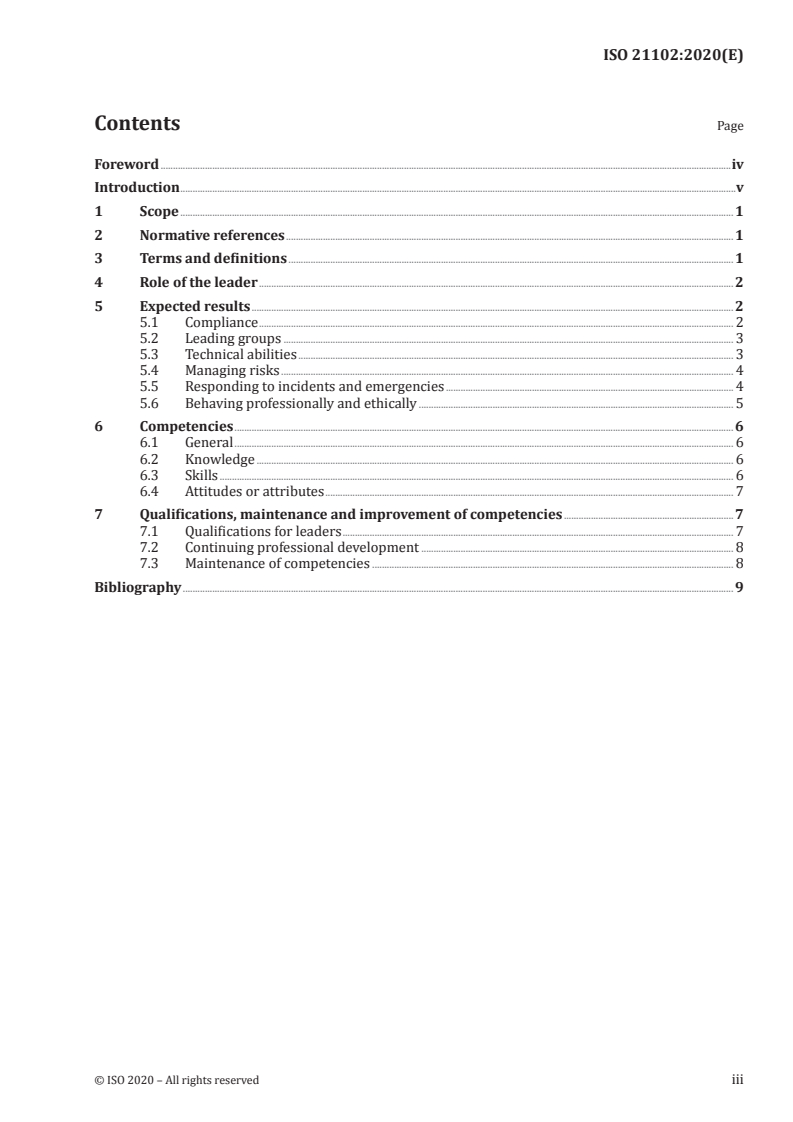
Contents Page
Foreword .iv
Introduction .v
1 Scope . 1
2 Normative references . 1
3 Terms and definitions . 1
4 Role of the leader . 2
5 Expected results . 2
5.1 Compliance . 2
5.2 Leading groups . 3
5.3 Technical abilities . 3
5.4 Managing risks . 4
5.5 Responding to incidents and emergencies . 4
5.6 Behaving professionally and ethically . 5
6 Competencies . 6
6.1 General . 6
6.2 Knowledge . 6
6.3 Skills . 6
6.4 Attitudes or attributes . 7
7 Qualifications, maintenance and improvement of competencies .7
7.1 Qualifications for leaders . 7
7.2 Continuing professional development . 8
7.3 Maintenance of competencies . 8
Bibliography . 9
Foreword
ISO (the International Organization for Standardization) is a worldwide federation of national standards
bodies (ISO member bodies). The work of preparing International Standards is normally carried out
through ISO technical committees. Each member body interested in a subject for which a technical
committee has been established has the right to be represented on that committee. International
organizations, governmental and non-governmental, in liaison with ISO, also take part in the work.
ISO collaborates closely with the International Electrotechnical Commission (IEC) on all matters of
electrotechnical standardization.
The procedures used to develop this document and those intended for its further maintenance are
described in the ISO/IEC Directives, Part 1. In particular, the different approval criteria needed for the
different types of ISO documents should be noted. This document was drafted in accordance with the
editorial rules of the ISO/IEC Directives, Part 2 (see www .iso .org/ directives).
Attention is drawn to the possibility that some of the elements of this document may be the subject of
patent rights. ISO shall not be held responsible for identifying any or all such patent rights. Details of
any patent rights identified during the development of the document will be in the Introduction and/or
on the ISO list of patent declarations received (see www .iso .org/ patents).
Any trade name used in this document is information given for the convenience of users and does not
constitute an endorsement.
For an explanation of the voluntary nature of standards, the meaning of ISO specific terms and
expressions related to conformity assessment, as well as information about ISO's adherence to
the World Trade Organization (WTO) principles in the Technical Barriers to Trade (TBT) see
w w w . is o . or g / is o/ f or ewor d . ht m l .
This document was prepared by Technical Committee ISO/TC 228, Tourism and related services.
This first edition cancels and replaces ISO/TR 21102:2013, which has been technically revised. The
main changes are as follows:
— ISO 20611 has been added as a reference in the Introduction;
— Normative references have been included in Clause 2;
— Requirements have been added (previously there were recommendations) in Clauses 4 to 7;
— Information on qualifications for leaders (formal and otherwise) has been added in 7.1.
Any feedback or questions on this document should be directed to the user’s national standards body. A
complete listing of these bodies can be found at www .iso .org/ members .html.
iv © ISO 2020 – All rights reserved
Introduction
0.1 Adventure tourism
Adventure tourism is a global industry that is growing in importance. Whether provided on a
commercial, not for profit or charitable basis, adventure tourism activities involve an accepted, inherent
element of risk and challenge. Taking risks brings rewards but also dangers. In order to maximize the
rewards, adventure tourism activity providers should operate as safely as practicable.
0.2 Adventure tourism standards
The purpose of these documents is to set out the minimum requirements for safety management
systems and for providing information to participants.
This document, along with ISO 20611, ISO 21101 and ISO 21103, provides a basis for adventure tourism
activity providers to plan, deliver and provide information on adventure tourism activities as safely as
practicable.
The following documents are independent entities since they apply to different aspects of adventure
tourism:
— ISO 20611 provides requirements and recommendations on good practices for sustainability
(environmental, social and economic aspects) for adventure tourism activities.
— ISO 21101 specifies how the adventure tourism organization manages its operations in terms of safety.
NOTE ISO 21101, Adventure tourism — Safety management systems — A practical guide for SMEs is
a handbook that offers step-by-step guidance and examples to help small and medium-sized adventure
tourism operators to develop, implement and continually improve a safety management system following
the requirements of ISO 21101.
— This document specifies the minimum requirements and recommendations of competencies and
the related expected results of competencies for adventure tourism activity leaders common to any
adventure tourism activity.
— ISO 21103 specifies the minimum information to be communicated to participants and potential
participants before, during and after the activity.
Effective implementation of these documents will help consumers and other participants make
informed choices about activities and providers.
0.3 Purpose of this document
Adventure tourism activity leaders' competencies for leading participants and assuming responsibility
for them is a critical factor in ensuring delivery of safe adventure tourism activities.
Competency is a concept that is based on knowledge, skills and attitudes or attributes.
Depending on the type of adventure tourism activity (e.g. rafting, hiking, cascading, climbing), different
competencies are required. Nevertheless, there are some competencies that are common to every
adventure tourism activity. These common competencies (and the respective expected results) are the
focus of this document.
INTERNATIONAL STANDARD ISO 21102:2020(E)
Adventure tourism — Leaders — Personnel competence
1 Scope
This document establishes the requirements and recommendations of competencies and the related
expected results of competencies for adventure tourism activity leaders common to any adventure
tourism activity, which can affect the quality and safety of the services provided. It can be used by all
types and sizes of providers operating in different geographic, cultural and social environments.
This document does not apply to diving leaders, for whom References [1], [2] and [4] to [9] apply.
2 Normative references
The following documents are referred to in the text in such a way that some or all of their content
constitutes requirements of this document. For dated references, only the edition cited applies. For
undated references, the latest edition of the referenced document (including any amendments) applies.
ISO 20611, Adventure tourism — Good practices for sustainability — Requirements and recommendations
ISO 21103, Adventure tourism — Information for participants
3 Terms and definitions
For the purposes of this document, the following terms and definitions apply.
ISO and IEC maintain terminological databases for use in standardization at the following addresses:
— ISO Online browsing platform: available at https:// www .iso .org/ obp
— IEC Electropedia: available at http:// www .electropedia .org/
3.1
adventure tourism activity
adventure activity for tourism purposes that involves a degree of instruction or leadership and a
deliberate accepted element of risk
Note 1 to entry: An accepted element of risk means that the participant (3.9) has a reasonable understanding of
potential risks.
[SOURCE: ISO 21101:2014, 3.35, modified.]
3.2
competence
ability to apply knowledge and skills to achieve expected results (3.6)
[SOURCE: ISO 21101:2014, 3.11, modified.]
3.3
competent person
someone who has the competence (3.2) to perform specific functions
3.4
contingency measures
preventive or corrective action to be adopted in response to an event and a need to depart from the
agreed plan of action
3.5
emergency
serious situation requiring immediate action
[SOURCE: ISO 21101:2014, 3.43]
3.6
expected results
results of performed activities in provision of service
Note 1 to entry: Expected results can refer to an occupation, a competence (3.2) or a set of competencies.
3.7
first aid
emergency (3.5) procedures aimed at maintaining vital functions while ensuring that the condition of a
person who is injured, unconscious or whose life is in danger is not aggravated, until he or she receives
more qualified assistance
3.8
leader
competent person (3.3) who takes responsibility for people, and is able to lead, guide and supervise an
assigned activity
Note 1 to entry: A leader might also be referred to as a ‘guide’, ‘monitor’ or similar.
3.9
participant
person taking part in the adventure tourism activity (3.1) but not a member of the leadership team
Note 1 to entry: A participant might also be referred to as a ‘client’, ‘customer’ or similar.
Note 2 to entry: A leadership team comprises several leaders (3.8).
[SOURCE: ISO 21101:2014, 3.37]
4 Role of the leader
Prior to leading specific activities, leaders shall have the appropriate competencies gained through
training, experience, expertise or qualifications, and the role shall include:
a) participant assistance;
b) safety management and care of participants and the leadership team in accordance with the
advent
...
INTERNATIONAL ISO
STANDARD 21102
First edition
2020-08
Adventure tourism — Leaders —
Personnel competence
Tourisme d'aventure — Leaders — Compétence du personnel
Reference number
©
ISO 2020
© ISO 2020
All rights reserved. Unless otherwise specified, or required in the context of its implementation, no part of this publication may
be reproduced or utilized otherwise in any form or by any means, electronic or mechanical, including photocopying, or posting
on the internet or an intranet, without prior written permission. Permission can be requested from either ISO at the address
below or ISO’s member body in the country of the requester.
ISO copyright office
CP 401 • Ch. de Blandonnet 8
CH-1214 Vernier, Geneva
Phone: +41 22 749 01 11
Email: copyright@iso.org
Website: www.iso.org
Published in Switzerland
ii © ISO 2020 – All rights reserved
Contents Page
Foreword .iv
Introduction .v
1 Scope . 1
2 Normative references . 1
3 Terms and definitions . 1
4 Role of the leader . 2
5 Expected results . 2
5.1 Compliance . 2
5.2 Leading groups . 3
5.3 Technical abilities . 3
5.4 Managing risks . 4
5.5 Responding to incidents and emergencies . 4
5.6 Behaving professionally and ethically . 5
6 Competencies . 6
6.1 General . 6
6.2 Knowledge . 6
6.3 Skills . 6
6.4 Attitudes or attributes . 7
7 Qualifications, maintenance and improvement of competencies .7
7.1 Qualifications for leaders . 7
7.2 Continuing professional development . 8
7.3 Maintenance of competencies . 8
Bibliography . 9
Foreword
ISO (the International Organization for Standardization) is a worldwide federation of national standards
bodies (ISO member bodies). The work of preparing International Standards is normally carried out
through ISO technical committees. Each member body interested in a subject for which a technical
committee has been established has the right to be represented on that committee. International
organizations, governmental and non-governmental, in liaison with ISO, also take part in the work.
ISO collaborates closely with the International Electrotechnical Commission (IEC) on all matters of
electrotechnical standardization.
The procedures used to develop this document and those intended for its further maintenance are
described in the ISO/IEC Directives, Part 1. In particular, the different approval criteria needed for the
different types of ISO documents should be noted. This document was drafted in accordance with the
editorial rules of the ISO/IEC Directives, Part 2 (see www .iso .org/ directives).
Attention is drawn to the possibility that some of the elements of this document may be the subject of
patent rights. ISO shall not be held responsible for identifying any or all such patent rights. Details of
any patent rights identified during the development of the document will be in the Introduction and/or
on the ISO list of patent declarations received (see www .iso .org/ patents).
Any trade name used in this document is information given for the convenience of users and does not
constitute an endorsement.
For an explanation of the voluntary nature of standards, the meaning of ISO specific terms and
expressions related to conformity assessment, as well as information about ISO's adherence to
the World Trade Organization (WTO) principles in the Technical Barriers to Trade (TBT) see
w w w . is o . or g / is o/ f or ewor d . ht m l .
This document was prepared by Technical Committee ISO/TC 228, Tourism and related services.
This first edition cancels and replaces ISO/TR 21102:2013, which has been technically revised. The
main changes are as follows:
— ISO 20611 has been added as a reference in the Introduction;
— Normative references have been included in Clause 2;
— Requirements have been added (previously there were recommendations) in Clauses 4 to 7;
— Information on qualifications for leaders (formal and otherwise) has been added in 7.1.
Any feedback or questions on this document should be directed to the user’s national standards body. A
complete listing of these bodies can be found at www .iso .org/ members .html.
iv © ISO 2020 – All rights reserved
Introduction
0.1 Adventure tourism
Adventure tourism is a global industry that is growing in importance. Whether provided on a
commercial, not for profit or charitable basis, adventure tourism activities involve an accepted, inherent
element of risk and challenge. Taking risks brings rewards but also dangers. In order to maximize the
rewards, adventure tourism activity providers should operate as safely as practicable.
0.2 Adventure tourism standards
The purpose of these documents is to set out the minimum requirements for safety management
systems and for providing information to participants.
This document, along with ISO 20611, ISO 21101 and ISO 21103, provides a basis for adventure tourism
activity providers to plan, deliver and provide information on adventure tourism activities as safely as
practicable.
The following documents are independent entities since they apply to different aspects of adventure
tourism:
— ISO 20611 provides requirements and recommendations on good practices for sustainability
(environmental, social and economic aspects) for adventure tourism activities.
— ISO 21101 specifies how the adventure tourism organization manages its operations in terms of safety.
NOTE ISO 21101, Adventure tourism — Safety management systems — A practical guide for SMEs is
a handbook that offers step-by-step guidance and examples to help small and medium-sized adventure
tourism operators to develop, implement and continually improve a safety management system following
the requirements of ISO 21101.
— This document specifies the minimum requirements and recommendations of competencies and
the related expected results of competencies for adventure tourism activity leaders common to any
adventure tourism activity.
— ISO 21103 specifies the minimum information to be communicated to participants and potential
participants before, during and after the activity.
Effective implementation of these documents will help consumers and other participants make
informed choices about activities and providers.
0.3 Purpose of this document
Adventure tourism activity leaders' competencies for leading participants and assuming responsibility
for them is a critical factor in ensuring delivery of safe adventure tourism activities.
Competency is a concept that is based on knowledge, skills and attitudes or attributes.
Depending on the type of adventure tourism activity (e.g. rafting, hiking, cascading, climbing), different
competencies are required. Nevertheless, there are some competencies that are common to every
adventure tourism activity. These common competencies (and the respective expected results) are the
focus of this document.
INTERNATIONAL STANDARD ISO 21102:2020(E)
Adventure tourism — Leaders — Personnel competence
1 Scope
This document establishes the requirements and recommendations of competencies and the related
expected results of competencies for adventure tourism activity leaders common to any adventure
tourism activity, which can affect the quality and safety of the services provided. It can be used by all
types and sizes of providers operating in different geographic, cultural and social environments.
This document does not apply to diving leaders, for whom References [1], [2] and [4] to [9] apply.
2 Normative references
The following documents are referred to in the text in such a way that some or all of their content
constitutes requirements of this document. For dated references, only the edition cited applies. For
undated references, the latest edition of the referenced document (including any amendments) applies.
ISO 20611, Adventure tourism — Good practices for sustainability — Requirements and recommendations
ISO 21103, Adventure tourism — Information for participants
3 Terms and definitions
For the purposes of this document, the following terms and definitions apply.
ISO and IEC maintain terminological databases for use in standardization at the following addresses:
— ISO Online browsing platform: available at https:// www .iso .org/ obp
— IEC Electropedia: available at http:// www .electropedia .org/
3.1
adventure tourism activity
adventure activity for tourism purposes that involves a degree of instruction or leadership and a
deliberate accepted element of risk
Note 1 to entry: An accepted element of risk means that the participant (3.9) has a reasonable understanding of
potential risks.
[SOURCE: ISO 21101:2014, 3.35, modified.]
3.2
competence
ability to apply knowledge and skills to achieve expected results (3.6)
[SOURCE: ISO 21101:2014, 3.11, modified.]
3.3
competent person
someone who has the competence (3.2) to perform specific functions
3.4
contingency measures
preventive or corrective action to be adopted in response to an event and a need to depart from the
agreed plan of action
3.5
emergency
serious situation requiring immediate action
[SOURCE: ISO 21101:2014, 3.43]
3.6
expected results
results of performed activities in provision of service
Note 1 to entry: Expected results can refer to an occupation, a competence (3.2) or a set of competencies.
3.7
first aid
emergency (3.5) procedures aimed at maintaining vital functions while ensuring that the condition of a
person who is injured, unconscious or whose life is in danger is not aggravated, until he or she receives
more qualified assistance
3.8
leader
competent person (3.3) who takes responsibility for people, and is able to lead, guide and supervise an
assigned activity
Note 1 to entry: A leader might also be referred to as a ‘guide’, ‘monitor’ or similar.
3.9
participant
person taking part in the adventure tourism activity (3.1) but not a member of the leadership team
Note 1 to entry: A participant might also be referred to as a ‘client’, ‘customer’ or similar.
Note 2 to entry: A leadership team comprises several leaders (3.8).
[SOURCE: ISO 21101:2014, 3.37]
4 Role of the leader
Prior to leading specific activities, leaders shall have the appropriate competencies gained through
training, experience, expertise or qualifications, and the role shall include:
a) participant assistance;
b) safety management and care of participants and the leadership team in accordance with the
adventure tourism activity provider's safety management systems, including provision of
appropriate information, instruction, supervision and training;
NOTE For more information, see ISO 21101 and Reference [10].
c) implementation of emergency procedures, if necessary;
d) sharing relevant information, in accordance with ISO 21103;
e) implementation of relevant sustainable practices, in accordance with ISO 20611.
5 Expected results
5.1 Compliance
The leader shall establish, implement and mai
...
Questions, Comments and Discussion
Ask us and Technical Secretary will try to provide an answer. You can facilitate discussion about the standard in here.
Loading comments...