

oSIST prEN 10088-3:2026
(Main)Stainless steels - Part 3: Technical delivery conditions for semi-finished products, bars, rods, wire, sections and bright products of corrosion resistant steels for general purposes
- Abstract
This document specifies the technical delivery conditions for semi-finished products, hot or cold formed bars, rods, wire, sections and bright products of standard grades and special grades of corrosion resistant stainless steels for general purposes.
NOTE 1 General purposes include the use of stainless steels in contact with foodstuffs.
NOTE 2 For general technical delivery conditions, see EN 10021.
This document does not apply to components manufactured by further processing of the product forms listed above with quality characteristics altered as a result of such further processing.
- Status
- Not Published
- Public Enquiry End Date
- 30-Oct-2026
- Technical Committee
- PKG - Testing of metallic materials
- Current Stage
- 4020 - Public enquire (PE) (Adopted Project)
- Start Date
- 26-Aug-2026
- Due Date
- 13-Jan-2027

oSIST prEN 10088-3:2026 is a CEN draft European Standard for the technical delivery conditions of semi-finished products, bars, rods, wire, sections and bright products made from corrosion resistant stainless steels for general purposes. It sets how these products are designated, ordered, inspected, tested and marked, so it is the document a purchaser and supplier use to agree what is delivered and how it is verified.
What does oSIST prEN 10088-3:2026 specify?
oSIST prEN 10088-3:2026 specifies the technical delivery conditions for a wide set of stainless steel product forms used for general purposes, including use in contact with foodstuffs. It also gives the structure of the document: designation and ordering, grade classification, requirements, inspection and testing, marking, and four informative annexes.
This standard applies to semi-finished products, hot or cold formed bars, rods, wire, sections and bright products of standard grades and special grades of corrosion resistant stainless steels. It excludes components made by further processing when that further processing changes the product’s quality characteristics.
| Annex | What it covers |
|---|---|
| Annex A | List of all stainless steel grades that appear in the document |
| Annex B | Guidelines for further treatment, including heat treatment, in fabrication |
| Annex C | Availability of corrosion resistant steel wire in the cold work-hardened condition |
| Annex D | Applicable dimensional standards |
What are the key requirements of oSIST prEN 10088-3:2026?
oSIST prEN 10088-3:2026 is built around agreed delivery condition, chemistry, properties, inspection and marking. In practice, that means the purchaser needs to specify the product form, grade, condition and test package clearly at enquiry and order.
Designation and ordering
Clause 4 requires the steel name and steel number to follow EN 10027-1 and EN 10027-2, and Annex A gives the full list of grades used in the document. For ordering, the product description has to identify the quantity, product form, applicable dimensional standard or required dimensions, material type, document number, steel designation, condition, tests and inspection document. This matters because the same grade can be delivered in different conditions with different properties.
Delivery condition and treatment state
Clause 6.2 says the delivery condition shall be agreed at enquiry and order by reference to Table 7 and, where needed, to the treatment conditions in Tables 8 to 19 and Table 25. Clause 6.1 leaves the steelmaking and manufacturing process to the manufacturer unless agreed otherwise. In practice, the buyer does not just buy a grade - the buyer buys a grade plus a condition such as hot formed, cold processed, solution annealed, annealed, quenched and tempered, or precipitation hardened.
Chemical composition
Clause 6.3 ties chemical composition to the cast analysis limits in Tables 2 to 5, with product-analysis tolerances in Table 6. Elements not listed shall not be intentionally added without purchaser agreement, except when needed to finish the cast. This matters for mill test certificates and incoming inspection, because the standard controls both the intended alloy range and how far the delivered product may deviate from it.
Corrosion resistance and mechanical properties
Clause 6.4 uses EN ISO 3651-2 for resistance to intergranular corrosion in austenitic, austenitic-ferritic and ferritic steels, with the relevant tables identifying when that applies. Clause 6.5 sets room-temperature properties for different product forms and conditions, and Tables 20 to 24 give elevated-temperature proof strengths. Clause 6.5.3 also allows grade- and size-specific values to be agreed when the tables do not cover the required dimension. In practice, the grade family, thickness or diameter, and heat treatment condition determine which property table applies.
Surface quality, soundness and formability
Clause 6.6 links surface finish to Table 7 and sets limits for discontinuities in Table 1, while sections use EN 10163-3 and wires in certain conditions are agreed at order. Clause 6.7 requires products to be free of internal defects that would prevent normal use, and ultrasonic testing may be agreed for H-beams, IPE beams and steel bars using EN 10306 or EN 10308. Clause 6.8 says cold formability may be verified by elongation in the tensile test. This is practical because it turns surface appearance, internal integrity and forming behavior into orderable and testable items.
Dimensions and mass
Clause 6.9 requires dimensions and tolerances to be agreed and, where available, to follow an applicable dimensional standard listed in Table 7 and Annex D. Clause 6.10 bases nominal mass on the steel density in EN 10088-1 and the nominal dimensions of the product, while mass tolerances may be agreed. This is the part that matters for fit, processing allowance and weight-based purchasing.
Inspection, testing and marking
Clause 7 requires process control, inspection and testing suited to the order. Clause 7.2 says products are delivered with an EN 10204 inspection document, and if nothing is specified at order, at least a test report 2.2 is required; if 3.1 or 3.2 is agreed, the specific inspections in Clause 7.3 apply. Table 26 defines the mandatory and optional tests, sample units and number of test pieces, while Clause 7.4 assigns the test methods, including tensile testing, impact testing, hardness testing and corrosion testing. Clause 8 requires durable marking, with Table 27 setting the identification items for products with and without specific testing.
What terms does oSIST prEN 10088-3:2026 define?
- Stainless steel - steel with at least 10.5 % chromium and a maximum 1.20 % carbon.
- Corrosion resistant steel - stainless steel where corrosion resistance is the primary property.
- General purpose - a purpose other than the special purposes mentioned in the bibliography.
- Standard grade - a grade with relatively good availability and a wider range of application.
- Special grade - a grade intended for special use and/or limited availability.
Who uses oSIST prEN 10088-3:2026?
oSIST prEN 10088-3:2026 is used by steel producers, processors, purchasers, quality managers and inspection bodies that buy or certify stainless steel semi-finished products, bars, rods, wire, sections and bright products. It is relevant wherever the supplier and customer need to agree grade, condition, test level, inspection document and marking before delivery.
It is especially useful in metalworking, fabrication and supply chains that need corrosion resistant stainless steels for general industrial use. The standard also explicitly includes use in contact with foodstuffs, so buyers in food-related applications can use it as the delivery-condition reference for covered product forms.
What changed in oSIST prEN 10088-3:2026 from the previous edition?
oSIST prEN 10088-3:2026 supersedes EN 10088-3:2023. The significant technical change stated for this draft is a change to the chemical composition of ferritic grade 1.4106.
Which standards are used with oSIST prEN 10088-3:2026?
- EN 10021 - general technical delivery conditions for steel products, used as the general reference for delivery conditions and retests.
- EN 10027-1 and EN 10027-2 - steel name and numerical designation systems used for grade designation.
- EN 10088-1:2023 - the list of stainless steels and the density reference used for mass calculation.
- EN 10017, EN 10058, EN 10059, EN 10060, EN 10061, EN 10024, EN 10034, EN 10055, EN 10056-2, EN 10279, EN 10218-2, EN 10278 - dimensional standards for rods, bars, sections, wire and bright products.
- EN 10163-3 - surface condition requirements for sections.
- EN 10168 and EN 10204 - inspection document content and document types.
- EN 10306 and EN 10308 - ultrasonic testing of H-beams/IPE beams and steel bars.
- EN ISO 148-1, EN ISO 6506-1, EN ISO 6892-1, EN ISO 6892-2 - impact, hardness and tensile test methods.
- EN ISO 14284 and EN ISO 377 - sampling and sample preparation.
- EN ISO 3651-2 - intergranular corrosion testing.
- EN ISO 4885 - heat-treatment vocabulary used in the terms and definitions.
- EN ISO 9443 - surface quality classes for hot-rolled bars and wire rod.
- EN 10373 - modelling route that may be used for tensile-property verification by agreement.
- EN 10261 - cited as the source of available European standards for chemical analysis.
What does the oSIST prEN 10088-3:2026 document contain?
oSIST prEN 10088-3:2026 contains chemical composition tables for austenitic, austenitic-ferritic, ferritic, martensitic and precipitation hardening grades, together with product-analysis tolerances. It also contains property tables for room temperature and elevated temperature, with separate coverage for hot worked products, cold processed products, bright bars and wire.
The document includes Table 7 for surface finish and process route, Table 26 for the test matrix, Table 27 for marking, and Figures 1 to 3 for sampling positions on bars, rods and section products. Annex B gives fabrication heat-treatment guidance by steel family, Annex C summarizes wire availability by tensile strength and diameter, and Annex D lists the dimensional standards used in practice.
Relations
- Effective Date
- 01-Apr-2026
Get Certified
Connect with accredited certification bodies for this standard

Element Materials Technology
Materials testing and product certification.

Inštitut za kovinske materiale in tehnologije
Institute of Metals and Technology. Materials testing, metallurgical analysis, NDT.
Sponsored listings
Frequently Asked Questions
oSIST prEN 10088-3:2026 is a draft published by the Slovenian Institute for Standardization (SIST). Its full title is "Stainless steels - Part 3: Technical delivery conditions for semi-finished products, bars, rods, wire, sections and bright products of corrosion resistant steels for general purposes". This standard covers: This document specifies the technical delivery conditions for semi-finished products, hot or cold formed bars, rods, wire, sections and bright products of standard grades and special grades of corrosion resistant stainless steels for general purposes. NOTE 1 General purposes include the use of stainless steels in contact with foodstuffs. NOTE 2 For general technical delivery conditions, see EN 10021. This document does not apply to components manufactured by further processing of the product forms listed above with quality characteristics altered as a result of such further processing.
This document specifies the technical delivery conditions for semi-finished products, hot or cold formed bars, rods, wire, sections and bright products of standard grades and special grades of corrosion resistant stainless steels for general purposes. NOTE 1 General purposes include the use of stainless steels in contact with foodstuffs. NOTE 2 For general technical delivery conditions, see EN 10021. This document does not apply to components manufactured by further processing of the product forms listed above with quality characteristics altered as a result of such further processing.
oSIST prEN 10088-3:2026 is classified under the following ICS (International Classification for Standards) categories: 77.140.20 - Stainless steels; 77.140.50 - Flat steel products and semi-products; 77.140.65 - Steel wire, wire ropes and link chains. The ICS classification helps identify the subject area and facilitates finding related standards.
oSIST prEN 10088-3:2026 has the following relationships with other standards: It is inter standard links to SIST EN 10088-3:2024. Understanding these relationships helps ensure you are using the most current and applicable version of the standard.
oSIST prEN 10088-3:2026 is available in PDF format for immediate download after purchase. The document can be added to your cart and obtained through the secure checkout process. Digital delivery ensures instant access to the complete standard document.
Standards Content (Sample)
SLOVENSKI STANDARD
01-oktober-2026
Nerjavna jekla - 3. del: Tehnični dobavni pogoji za polizdelke, drogove, palice, žico,
profile in svetle izdelke iz korozijsko odpornih jekel za splošno uporabo
Stainless steels - Part 3: Technical delivery conditions for semi-finished products, bars,
rods, wire, sections and bright products of corrosion resistant steels for general purposes
Nichtrostende Stähle - Teil 3: Technische Lieferbedingungen für Halbzeug, Stäbe,
Walzdraht, gezogenen Draht, Profile und Blankstahlerzeugnisse aus
korrosionsbeständigen Stählen für allgemeine Verwendung
Aciers inoxydables - Partie 3 : Conditions techniques de livraison pour les demi-produits,
barres, fils, fils tréfilés, profils et produits transformés à froid en acier résistant à la
corrosion pour usage général
Ta slovenski standard je istoveten z: prEN 10088-3
ICS:
77.140.20 Visokokakovostna jekla Stainless steels
77.140.50 Ploščati jekleni izdelki in Flat steel products and semi-
polizdelki products
77.140.65 Jeklene žice, jeklene vrvi in Steel wire, wire ropes and
verige link chains
2003-01.Slovenski inštitut za standardizacijo. Razmnoževanje celote ali delov tega standarda ni dovoljeno.
DRAFT
EUROPEAN STANDARD
NORME EUROPÉENNE
EUROPÄISCHE NORM
October 2026
ICS 77.140.20; 77.140.50; 77.140.65 Will supersede EN 10088-3:2023
English Version
Stainless steels - Part 3: Technical delivery conditions for
semi-finished products, bars, rods, wire, sections and
bright products of corrosion resistant steels for general
purposes
Aciers inoxydables - Partie 3 : Conditions techniques de Nichtrostende Stähle - Teil 3: Technische
livraison pour les demi-produits, barres, fils, fils Lieferbedingungen für Halbzeug, Stäbe, Walzdraht,
tréfilés, profils et produits transformés à froid en acier gezogenen Draht, Profile und Blankstahlerzeugnisse
résistant à la corrosion pour usage général aus korrosionsbeständigen Stählen für allgemeine
Verwendung
This draft European Standard is submitted to CEN members for enquiry. It has been drawn up by the Technical Committee
CEN/TC 459/SC 13.
If this draft becomes a European Standard, CEN members are bound to comply with the CEN/CENELEC Internal Regulations
which stipulate the conditions for giving this European Standard the status of a national standard without any alteration.
This draft European Standard was established by CEN in three official versions (English, French, German). A version in any other
language made by translation under the responsibility of a CEN member into its own language and notified to the CEN-CENELEC
Management Centre has the same status as the official versions.
CEN members are the national standards bodies of Austria, Belgium, Bulgaria, Croatia, Cyprus, Czech Republic, Denmark, Estonia,
Finland, France, Germany, Greece, Hungary, Iceland, Ireland, Italy, Latvia, Lithuania, Luxembourg, Malta, Netherlands, Norway,
Poland, Portugal, Republic of North Macedonia, Romania, Serbia, Slovakia, Slovenia, Spain, Sweden, Switzerland, Türkiye and
United Kingdom.
Recipients of this draft are invited to submit, with their comments, notification of any relevant patent rights of which they are
aware and to provide supporting documentation.
Warning : This document is not a European Standard. It is distributed for review and comments. It is subject to change without
notice and shall not be referred to as a European Standard.
EUROPEAN COMMITTEE FOR STANDARDIZATION
COMITÉ EUROPÉEN DE NORMALISATION
EUROPÄISCHES KOMITEE FÜR NORMUNG
CEN-CENELEC Management Centre: Rue de la Science 23, B-1040 Brussels
© 2026 CEN All rights of exploitation in any form and by any means reserved Ref. No. prEN 10088-3:2026 E
worldwide for CEN national Members.
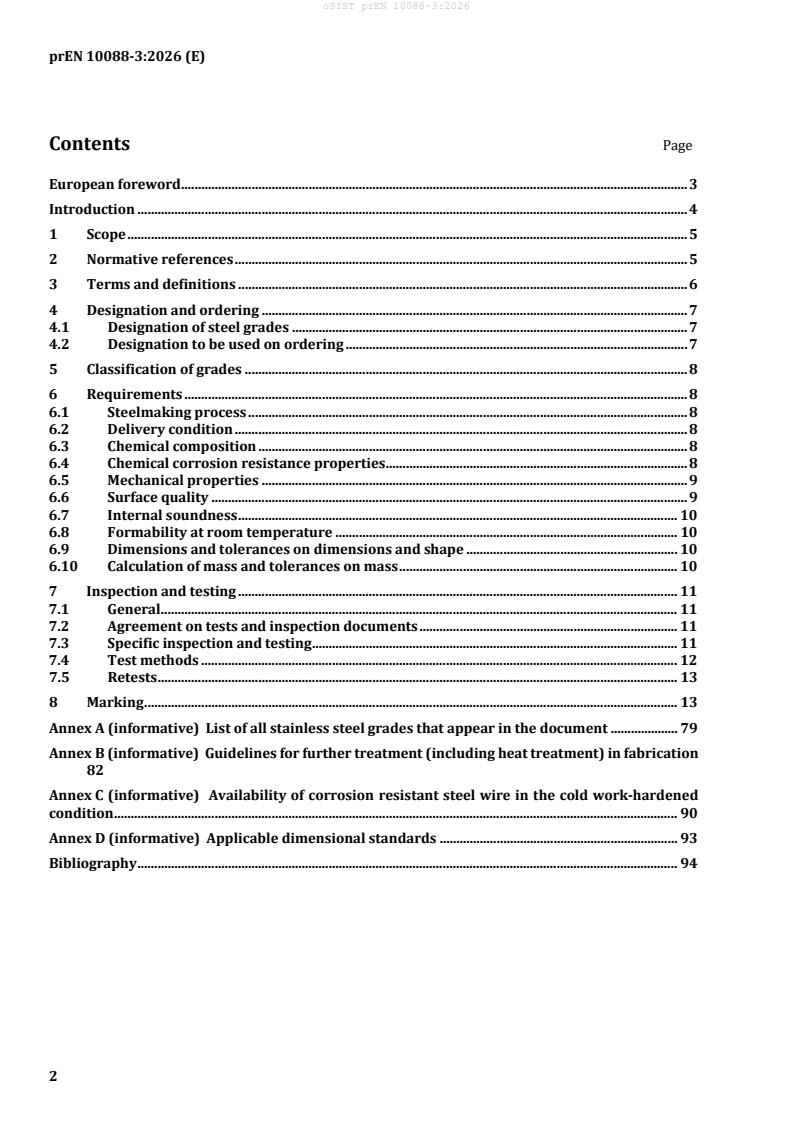
Contents Page
European foreword . 3
Introduction . 4
1 Scope . 5
2 Normative references . 5
3 Terms and definitions . 6
4 Designation and ordering . 7
4.1 Designation of steel grades . 7
4.2 Designation to be used on ordering . 7
5 Classification of grades . 8
6 Requirements . 8
6.1 Steelmaking process . 8
6.2 Delivery condition . 8
6.3 Chemical composition . 8
6.4 Chemical corrosion resistance properties . 8
6.5 Mechanical properties . 9
6.6 Surface quality . 9
6.7 Internal soundness . 10
6.8 Formability at room temperature . 10
6.9 Dimensions and tolerances on dimensions and shape . 10
6.10 Calculation of mass and tolerances on mass . 10
7 Inspection and testing . 11
7.1 General . 11
7.2 Agreement on tests and inspection documents . 11
7.3 Specific inspection and testing . 11
7.4 Test methods . 12
7.5 Retests . 13
8 Marking . 13
Annex A (informative) List of all stainless steel grades that appear in the document . 79
Annex B (informative) Guidelines for further treatment (including heat treatment) in fabrication
Annex C (informative) Availability of corrosion resistant steel wire in the cold work-hardened
condition . 90
Annex D (informative) Applicable dimensional standards . 93
Bibliography . 94
European foreword
This document (prEN 10088-3:2026) has been prepared by Technical Committee CEN/TC 459 “ECISS -
European Committee for Iron and Steel Standardization ”, the secretariat of which is held by AFNOR.
This document will supersede EN 10088-3:2023.
EN 10088-3:2023:
— chemical composition of ferritic grade 1.4106 has been changed
The EN 10088 series, under the general title Stainless steels, consists of the following parts:
— Part 1: List of stainless steels (including a table of European Standards, in which these stainless steels
are further specified, see Annex C);
— Part 2: Technical delivery conditions for sheet/plate and strip of corrosion resistant steels for general
purposes;
— Part 3: Technical delivery conditions for semi-finished products, bars, rods, wire, sections and bright
products of corrosion resistant steels for general purposes;
— Part 4: Technical delivery conditions for sheet/plate and strip of corrosion resisting steels for
construction purposes;
— Part 5: Technical delivery conditions for bars, rods, wire, sections and bright products of corrosion
resisting steels for construction purposes.
Through its sub-committee SC 13 “Stainless steels”, (secretariat: SIS).
Introduction
The European Committee for Standardization (CEN) draws attention to the fact that it is claimed that
compliance with this document may involve the use of patents applied to seven steel grades, given in 8.3,
A and B and which is claimed to be relevant for the following clause(s) of this document:
Clauses 8, A and B.
CEN takes no position concerning the evidence, validity and scope of these patent rights. The holders of
these patent rights have ensured CEN that they are willing to negotiate licenses, under reasonable and
non-discriminatory terms and conditions, with applicants throughout the world. In this respect, the
statements of the holders of these patent rights are registered with CEN. Information may be obtained
from:
Grade: 1.4662
Outokumpu Stainless AB
SE-77480 Avesta, Sweden
Grade 1.4062, 1.4669, 1.4670
Ugitech
F-73403 Ugine Cedex, France,
Grade 1.4062, 1.4669
Industeel
F-71200 Creusot, 56 Rue Clemenceau, France
Grade 1.4646, 1.4611, 1.4613
Acciai Speciali Terni
I-05100 Terni, Italy
Attention is drawn to the possibility that some of the elements of this document may be the subject of
patent rights other than those identified above. CEN shall not be held responsible for identifying any or
all such patent rights.
1 Scope
This document specifies the technical delivery conditions for semi-finished products, hot or cold formed
bars, rods, wire, sections and bright products of standard grades and special grades of corrosion resistant
stainless steels for general purposes.
NOTE 1 General purposes include the use of stainless steels in contact with foodstuffs.
NOTE 2 For general technical delivery conditions, see EN 10021.
This document does not apply to components manufactured by further processing of the product forms
listed above with quality characteristics altered as a result of such further processing.
2 Normative references
The following documents are referred to in the text in such a way that some or all of their content
constitutes requirements of this document. For dated references, only the edition cited applies. For
undated references, the latest edition of the referenced document (including any amendments) applies.
EN 10017, Steel rod for drawing and/or cold rolling — Dimensions and tolerances
EN 10021:2006, General technical delivery conditions for steel products
EN 10058, Hot rolled flat steel bars and steel wide flats for general purposes - Dimensions and tolerances on
shape and dimensions
EN 10059, Hot rolled square steel bars for general purposes — Dimensions and tolerances on shape and
dimensions
EN 10060, Hot rolled round steel bars for general purposes — Dimensions and tolerances on shape and
dimensions
EN 10061, Hot rolled hexagon steel bars for general purposes — Dimensions and tolerances on shape and
dimensions
EN 10079, Definition of steel products
EN 10088-1:2023, Stainless steels — Part 1: List of stainless steels
EN 10163-3, Delivery requirements for surface condition of hot-rolled steel plates, wide flats and sections
— Part 3: Sections
EN 10168, Steel products — Inspection documents — List of information and description
EN 10204, Metallic products — Types of inspection documents
EN 10218-2, Steel wire and wire products — General — Part 2: Wire dimensions and tolerances
EN 10278, Dimensions and tolerances of bright steel products of stainless and other special steels
EN 10306, Iron and steel — Ultrasonic testing of H beams with parallel flanges and IPE beams
EN 10308, Non-destructive testing — Ultrasonic testing of steel bars
EN ISO 148-1, Metallic materials - Charpy pendulum impact test - Part 1: Test method (ISO 148-1)
EN ISO 286-1, Geometrical product specifications (GPS) - ISO code system for tolerances on linear sizes -
Part 1: Basis of tolerances, deviations and fits (ISO 286-1)
EN ISO 377, Steel and steel products - Location and preparation of samples and test pieces for mechanical
testing (ISO 377)
EN ISO 3651-2, Determination of resistance to intergranular corrosion of stainless steels - Part 2: Ferritic,
austenitic and ferritic-austenitic (duplex) stainless steels - Corrosion test in media containing sulfuric acid
(ISO 3651-2)
EN ISO 4885, Ferrous materials - Heat treatments - Vocabulary (ISO 4885)
EN ISO 6506-1, Metallic materials - Brinell hardness test - Part 1: Test method (ISO 6506-1)
EN ISO 6892-1, Metallic materials - Tensile testing - Part 1: Method of test at room temperature (ISO 6892-
1)
EN ISO 6892-2, Metallic materials - Tensile testing - Part 2: Method of test at elevated temperature (ISO
6892-2)
EN ISO 9443, Surface quality classes for hot-rolled bars and wire rod (ISO 9443)
EN ISO 14284, Steel and iron - Sampling and preparation of samples for the determination of chemical
composition (ISO 14284)
3 Terms and definitions
For the purposes of this document, the terms and definitions regarding types of heat-treatment in
EN ISO 4885 and regarding product forms in EN 10079 and the following apply.
ISO and IEC maintain terminology databases for use in standardization at the following addresses:
— ISO Online browsing platform: available at https://www.iso.org/obp
— IEC Electropedia: available at https://www.electropedia.org/
3.1
stainless steel
steel with at least 10,5 % of chromium and maximum 1,20 % of carbon
Note 1 to entry: Stainless steels are further subdivided in accordance with their main property into corrosion
resistant steels, heat resistant steels and creep resistant steels.
[SOURCE: EN 10020:2000, 3.2.2]
3.2
corrosion resistant steel
stainless steel (see 3.1) where its resistance to corrosion is of primary importance
3.3
general purpose
purpose other than the special purposes mentioned in the Bibliography
3.4
standard grade
grade with a relatively good availability and a wider range of application
3.5
special grade
grade for special use and/or with limited availability
4 Designation and ordering
4.1 Designation of steel grades
The steel names and steel numbers (see Tables 2 to 5) were formed in accordance with EN 10027-1 and
EN 10027-2, respectively.
A complete overview of all grades that are in this document is given in Annex A.
4.2 Designation to be used on ordering
The complete designation for ordering a product according to this document shall contain the following
information:
— desired quantity;
— product form (e.g. round bars, square bars or rod);
— where an appropriate dimensional standard is available (see Table 7 and Annex D) the number of
the standard plus any choice of requirements; if there is no dimensional standard, the nominal
dimensions and tolerances required;
— type of material (steel);
— number of this document;
— steel name or steel number;
— if for the relevant steel in the table for the mechanical properties more than one treatment condition
is covered, the symbol for the desired heat treatment or cold worked condition;
— desired condition (see symbols in Table 7);
— if a verification of internal soundness is required, products shall be tested in accordance with
EN 10306 or EN 10308;
— any additional optional tests or inspections (see 7.2.3 d);
— standard designation for a test report 2.2 or, if required, any other type of inspection document in
accordance with EN 10204 (see 7.2.1).
EXAMPLE 10 t round bars according to EN 10060 of 50 mm diameter made of steel grade EN 10088-3 with
the name X5CrNi18–10 and the number 1.4301 in condition 1D (see Table 7), inspection certificate 3.1 as specified
in EN 10204:
10 t round bars EN 10060 — 50
Steel EN 10088-3 — X5CrNi18–10+1D
EN 10204 — 3.1
or
10 t round bars EN 10060 — 50
Steel EN 10088-3-1.4301+1D
EN 10204 — 3.1.
5 Classification of grades
Steels covered in this document are classified according to their structure into:
— austenitic steels;
— austenitic-ferritic steels;
— ferritic steels;
— martensitic steels;
— precipitation hardening steels.
NOTE See also EN 10088-1:2023, Annex C.
6 Requirements
6.1 Steelmaking process
Unless otherwise agreed at the time of enquiry and order, the steelmaking and manufacturing process
for steels conforming to this document are at the discretion of the manufacturer.
6.2 Delivery condition
The products shall be supplied in the delivery condition agreed at the time of enquiry and order by
reference to the conditions given in Table 7 and, where different alternatives exist, to the treatment
conditions given in Tables 8 to 19 and Table 25 (see also Annex B).
6.3 Chemical composition
6.3.1 The chemical composition requirements given in Tables 2 to 5 shall apply with respect to the
chemical composition according to the cast analysis.
Elements not quoted (“-”) or not listed in these tables shall not be intentionally added to the steel without
the agreement of the purchaser except for finishing the cast. All precautions shall be taken to avoid the
addition of such elements from scrap and other materials used in production which would impair
mechanical properties and the suitability of the steel.
6.3.2 The product analysis shall not deviate from the limiting values for the cast analysis given in
Tables 2 to 5 by more than the tolerances listed in Table 6.
6.4 Chemical corrosion resistance properties
For austenitic, austenitic-ferritic and ferritic stainless steels, the specifications in Tables 8, 9 and 10,
referring to resistance to intergranular corrosion as defined in EN ISO 3651-2 shall apply (see also 7.4.7).
NOTE 1 EN ISO 3651-2 is not applicable for testing martensitic and precipitation hardening steels.
NOTE 2 The corrosion resistance of stainless steels is very dependent on the type of environment and can
therefore not always be clearly ascertained through laboratory tests. It is therefore advisable to draw on the
available experience of the use of the steels.
NOTE 3 EN ISO 3651-2 is not applicable for testing the austenitic-ferritic stainless steels to all sensitized
conditions.
6.5 Mechanical properties
6.5.1 The mechanical properties at room temperature as specified in Tables 8 to 12 shall apply for hot
worked products of every condition, condition 1U and semi-finished products excluded, for cold
processed products in condition 2D (excluding wire), and for each specified heat treatment condition.
For cold processed products of every specified condition, condition 2D and wire excluded, and each
specified heat treatment condition, the mechanical properties at room temperature as specified in
Tables 13 to 17 shall apply. For these products, the condition is the prime property with the mechanical
properties secondary.
If by agreement at the time of ordering the products shall be supplied in a non-heat-treated condition,
the mechanical properties specified in Tables 8 to 17 shall be obtained from reference test pieces which
have received the appropriate heat treatment (simulated heat treatment).
For wire, the properties as specified in Tables 18 and 19 shall apply.
For bars which are intentionally cold work hardened in order to increase their tensile strength to a
specified level, the mechanical properties at room temperature as specified in Table 25 shall apply. For
these products, the mechanical properties are prime, with the condition a secondary property.
NOTE Austenitic steels are insensitive to brittle fracture in the solution annealed condition. Because they do
not have a pronounced transition temperature, which is characteristic of other steels, they are also useful for
application at cryogenic temperatures.
6.5.2 The values in Tables 20 to 24 shall apply for the 0,2 %- and 1,0 %-proof strength at elevated
temperatures.
6.5.3 A number of grades in Tables 2 to 5 are not listed or have limited information included in Tables
13 to 25. In this case, grade dimensions and corresponding mechanical properties shall be agreed upon
at the time of enquiry and order.
In case of demand for larger diameters than stated in Tables 13 to 19, appropriate mechanical property
values shall be agreed at the time of enquiry and order.
6.6 Surface quality
The available surface finishes are given in Table 7. Slight surface imperfections, inherent to the
production process, are permitted. Exact requirements concerning maximum depth of acceptable
discontinuities for bars, rods and sections in the relevant conditions shall be in accordance with Table 1.
Table 1 — Maximum depth of acceptable discontinuities for bars, rods and sections
Conditions Product forms a Max. % of delivered weight in
Permissible depth of discontinuities
excess of permissible depth of
discontinuities
1U, 1C, 1E, 1D Sections To be agreed upon at the time of enquiry and order in accordance with EN 10163-3.
1U, 1C, 1E, 1D Rounds and rod Unless otherwise specified at the time of enquiry and order:
EN ISO 9443 - class A.
b b b Rounds - max. 0,2 mm for d ≤ 20 mm 1 %
1X , 2H , 2D
- max. 0,01 d for 20 < d ≤ 75 mm
- max. 0,75 mm for d > 75 mm
Hexagons - max. 0,3 mm for d ≤ 15 mm 2 %
- max. 0,02 d for 15 < d ≤ 63 mm
Other bars - max. 0,3 mm for d ≤ 15 mm 4 %
- max. 0,02 d for 15 < d ≤ 63 mm
1G, 2B, 2G, 2P Rounds Technically defect free by manufacture. 0,2 %
a
Depth of discontinuities is understood as being the distance, measured normally to the surface, between the bottom of the
discontinuities and that surface.
b
At the time of enquiry and order it may be agreed that the product shall be delivered with a surface being technically defect
free by manufacture. In this case, also the maximum % of delivered weight in excess of permissible depth of discontinuities
shall be agreed.
For further information, e.g. roughness in conditions 2G and 2P, see Table 7.
For wires supplied in 2H condition according to Table 18 or 2D according to Table 19, the surface quality
shall be agreed upon at the time of enquiry and order.
6.7 Internal soundness
The products shall be free of internal defects which would exclude them from being used for their usual
purpose. At the time of enquiry and order ultrasonic testing of H-beams with parallel flanges and IPE-
beams may be agreed in accordance with EN 10306 and ultrasonic testing of steel bars may be agreed in
accordance with EN 10308.
6.8 Formability at room temperature
Cold formability may be verified by elongation in the tensile test.
6.9 Dimensions and tolerances on dimensions and shape
The dimensions and the tolerances on dimensions shall be agreed at the time of enquiry and order and
in accordance with an applicable dimensional standard (see lists of dimensional standards in Table 7 and
in Annex D).
6.10 Calculation of mass and tolerances on mass
6.10.1 The nominal mass shall be calculated by using the steel density given in EN 10088-1:2023
Annex E and the nominal dimensions of the steel product.
6.10.2 Tolerances on mass, may be agreed at the time of enquiry and order.
7 Inspection and testing
7.1 General
The appropriate process control, inspection, testing and modelling shall be carried out to ensure that the
product complies with the requirements of the order.
This includes the following:
— suitable frequency of verification of the dimensions of the products;
— adequate intensity of visual examination of the surface quality of the products;
— appropriate frequency and type of test to ensure that the correct grade of steel is used.
The nature and frequency of these verifications, examinations and tests is determined in the light of the
degree of consistency that has been determined by the evidence of the quality system. In view of this,
verifications by specific tests for these requirements are not necessary unless otherwise agreed.
7.2 Agreement on tests and inspection documents
7.2.1 Products complying with this document shall be ordered and delivered with one of the inspection
documents as specified in EN 10204. The type of document shall be agreed upon at the time of enquiry
and order. If the order does not contain any specification of this type, at least a test report 2.2 shall be
issued.
7.2.2 If it is agreed to issue a test report 2.2 in accordance with EN 10204, it shall indicate the following
information:
a) information groups A, B and Z of EN 10168;
b) results of the cast analysis in accordance with Tables 2 to 5 with the code numbers C71 to C92 in
EN 10168.
7.2.3 If the issuing of an inspection certificate 3.1 or 3.2 according to EN 10204 has been agreed,
specific inspections according to 7.3 shall be carried out and the following information shall be given in
the inspection document with the code numbers and details required by EN 10168:
a) information groups A, B and Z of EN 10168;
b) results of the cast analysis in accordance with Tables 2 to 5 with the code numbers C71 to C92 in
EN 10168;
c) results of all mandatory (m) tests according to Table 26;
d) results of any optional (o) test according to Table 26 or any further product verification agreed at the
time of enquiry and order.
7.3 Specific inspection and testing
7.3.1 Extent of testing
The tests to be carried out, either mandatorily (m) or optionally by agreement (o) and the composition
and size of the test units, and the number of sample products, samples and test pieces to be taken are
given in Table 26.
7.3.2 Selection and preparation of samples
7.3.2.1 Sampling and sample preparation shall be in accordance with EN ISO 14284 and EN ISO 377.
In addition, for the mechanical tests the stipulations in 7.3.2.2 shall apply.
7.3.2.2 The samples for tensile testing shall be taken in accordance with Figures 1 to 3. If it has been
agreed that optional impact tests shall be carried out, the samples shall be taken from the same location.
The samples shall be taken from products in the delivery condition. If agreed, samples from bars may be
taken before straightening. For samples to be given a simulated heat treatment (see also 6.5.1) the
conditions for annealing, hardening and tempering shall be agreed.
7.3.2.3 The samples for hardness testing on martensitic steels and for optional testing of the
resistance to intergranular corrosion, shall be taken from the same locations as those for the mechanical
tests see 7.3.2.2).
7.4 Test methods
7.4.1 The chemical analysis shall be carried out using appropriate European Standards. The choice of a
suitable physical or chemical analytical method for the analysis shall be at the discretion of the
manufacturer. The manufacturer shall declare the test method used if required.
NOTE The list of available European Standards on chemical analysis is given in CEN/TR 10261.
7.4.2 Tensile testing at room temperature shall be carried out in accordance with EN ISO 6892-1, this
generally being with proportional test pieces having a gauge length L = 5,65 √S . (S = cross-section of
0 0 0
the parallel length). In cases of doubt and in referee testing these test pieces shall be used.
The tensile strength, elongation after fracture and the 0,2 %-proof strength shall be determined. In
addition, for austenitic steels in condition 1C, 1E, 1D, 1X, 1G and 2D only, the 1,0 %-proof strength shall
also be determined.
For wire of nominal diameter < 4 mm, the tensile test is made directly on the product using a gauge length
of 100 mm.
7.4.3 If a tensile test at elevated temperature has been ordered, this shall be carried out in accordance
with EN ISO 6892-2. If the proof strength shall be verified, the 0,2 %-proof strength shall be determined,
for ferritic, martensitic, precipitation hardening and austenitic-ferritic steels. In the case of austenitic
steels, the 0,2 % and the 1,0 %-proof strength shall be determined.
7.4.4 For the determination of the mechanical properties measured by tensile testing, the manufacturer
may use modelling with a verification method approved in accordance with EN 10373, if agreed with the
purchaser at the time of enquiry and order.
7.4.5 If an impact test has been ordered, it shall be carried out in accordance with EN ISO 148-1 on test
pieces with a V-notch. The impact test shall be performed according to EN ISO 148-1, and using a striker
with a radius of 2 mm (KV ). The test results shall be determined as an average value obtained from one
set of three test pieces. This testing and possible additional testing shall be performed in accordance with
EN 10021:2006, 8.3.4.2
7.4.6 A Brinell hardness test shall be carried out in accordance with EN ISO 6506-1.
7.4.7 The resistance to intergranular corrosion shall be tested in accordance with EN ISO 3651-2.
7.4.8 The tolerances on dimensions and form of the product, and the measurement methods of
dimension and form shall be in accordance with the requirements of the relevant dimensional standards,
where available.
7.5 Retests
Retests shall be carried out in accordance with EN 10021.
8 Marking
8.1 Marking shall be durable.
8.2 Unless otherwise agreed, the requirements listed in Table 27 shall apply.
8.3 Unless otherwise agreed, the products shall be marked as follows:
— semi-finished products, bars and sections in thicknesses over 35 mm by inking, adhesive labels,
electrolytic etching or stamping;
— bars and sections in thicknesses up to 35 mm by labels attached to the bundle or by means of the
possibilities listed in the first hyphen;
— rods by means of a label attached to the coil.
If the marking shall be applied by inking or adhesive label, the inks or adhesives should be carefully
selected to ensure that resistance to corrosion is not impaired.
Table 2 — Chemical composition (cast analysis) of austenitic corrosion resistant steels
a
Steel designation
% by mass
Name Number C Si Mn P S Cr Ni Mo N Cu Others
Standard grades
0,030 to
X10CrNi18–8 1.4310 2,00 2,00 0,045 0,015 16,0 to 19,0 6,0 to 9,5 0,80 0,10 - -
0,15
0,030
X2CrNi18–9 1.4307 0,030 1,00 2,00 0,045 17,5 to 19,5 8,0 to 10,5 - 0,10 - -
b
0,15 to
X8CrNiS18–9 1.4305 0,10 1,00 2,00 0,045 17,0 to 19,0 8,0 to 10,0 - 0,10 1,00 -
0,35
0,15 to 1,40 to
X6CrNiCuS18–9-2 1.4570 0,08 1,00 2,00 0,045 17,0 to 19,0 8,0 to 10,0 0,60 0,10 -
d
0,35 1,80
0,030 3,00 to
X3CrNiCu18–9-4 1.4567 0,04 1,00 2,00 0,045 17,0 to 19,0 8,5 to 10,5 - 0,10 -
b
4,0
0,030
0,12 to
X2CrNiN18–10 1.4311 0,030 1,00 2,00 0,045 17,5 to 19,5 8,5 to 11,5 - - -
b 0,22
0,030
X5CrNi18–10 1.4301 0,07 1,00 2,00 0,045 17,5 to 19,5 8,0 to 10,5 - 0,10 - -
b
0,030
c
X6CrNiTi18–10 1.4541 0,08 1,00 2,00 0,045 17,0 to 19,0 - - - Ti: 5 × C to 0,70
9,0 to 12,0
b
0,030
c
X2CrNi19–11 1.4306 0,030 1,00 2,00 0,045 18,0 to 20,0 - 0,10 - -
10,0 to 12,0
b
0,030
X4CrNi18–12 1.4303 0,06 1,00 2,00 0,045 17,0 to 19,0 11,0 to 13,0 - 0,10 - -
b
0,030 0,12 to
c
X2CrNiMoN17–11–2 1.4406 0,030 1,00 2,00 0,045 16,5 to 18,5 2,00 to 2,50 - -
10,0 to 12,5
b
0,22
0,030
c
X2CrNiMo17–12–2 1.4404 0,030 1,00 2,00 0,045 16,5 to 18,5 2,00 to 3,00 0,10 - -
10,0 to 13,0
b
0,030
X5CrNiMo17–12–2 1.4401 0,07 1,00 2,00 0,045 16,5 to 18,5 10,0 to 13,0 2,00 to 2,50 0,10 - -
b
a
Steel designation
% by mass
Name Number C Si Mn P S Cr Ni Mo N Cu Others
0,030
c
X6CrNiMoTi17–12–2 1.4571 0,08 1,00 2,00 0,045 16,5 to 18,5 2,00 to 2,50 - - Ti: 5 × C to 0,70
10,5 to 13,5
b
0,030
X2CrNiMo17–12–3 1.4432 0,030 1,00 2,00 0,045 16,5 to 18,5 10,5 to 13,0 2,50 to 3,00 0,10 - -
b
0,030
c
X3CrNiMo17–12–3 1.4436 0,05 1,00 2,00 0,045 16,5 to 18,5 2,50 to 3,00 0,10 - -
10,5 to 13,0
b
0,12 to
c
X2CrNiMoN17–13–3 1.4429 0,030 1,00 2,00 0,045 0,015 16,5 to 18,5 2,50 to 3,00 - -
11,0 to 14,0
0,22
0,030
X2CrNiMo18–14–3 1.4435 0,030 1,00 2,00 0,045 17,0 to 19,0 12,5 to 15,0 2,50 to 3,00 0,10 - -
b
0,12 to
X2CrNiMoN17–13–5 1.4439 0,030 1,00 2,00 0,045 0,015 16,5 to18,5 12,5 to 14,5 4,0 to 5,0 - -
0,22
1,20 to
X1NiCrMoCu25–20–5 1.4539 0,020 0,70 2,00 0,030 0,010 19,0 to 21,0 24,0 to 26,0 4,0 to 5,0 0,15 -
2,00
Special grades
0,030 to
X9CrNi18–9 1.4325 1,00 2,00 0,045 0,030 17,0 to 19,0 8,0 to 10,0 - - - -
0,15
0,12 to
X5CrNiN19–9 1.4315 0,06 1,00 2,00 0,045 0,015 18,0 to 20,0 8,0 to 11,0 - - -
0,22
1,50 to 1,50 to
X3CrNiCu19–9-2 1.4560 0,035 1,00 0,045 0,015 18,0 to 19,0 8,0 to 9,0 - 0,10 -
2,00 2,00
c
X6CrNiNb18–10 1.4550 0,08 1,00 2,00 0,045 0,015 17,0 to 19,0 - - - Nb: 10 × C to 1,00
9,0 to 12,0
X1CrNiSi18–15–4 1.4361 0,015 3,7 to 4,5 2,00 0,025 0,010 16,5 to 18,5 14,0 to 16,0 0,20 0,10 - -
0,10 to 2,00 to
X8CrMnCuN17–8-3 1.4597 0,10 2,00 6,5 to 9,0 0,040 0,030 15,0 to 18,0 3,00 1,00 -
0,30 3,5
0,02 to 2,00 to
X3CrMnNiCu15–8-5–3 1.4615 0,030 1,00 7,0 to 9,0 0,040 0,010 14,0 to 16,0 4,5 to 6,0 0,80 -
0,06 4,0
0,05 to
X12CrMnNiN17–7-5 1.4372 0,15 1,00 5,5 to 7,5 0,045 0,015 16,0 to 18,0 3,5 to 5,5 - - -
0,25
a
Steel designation
% by mass
Name Number C Si Mn P S Cr Ni Mo N Cu Others
0,30 to 9,0 to 0,25 to
X8CrMnNiN18–9-5 1.4374 0,05 to 0,10 0,035 0,030 17,5 to 18,5 5,0 to 6,0 0,50 0,40 -
0,60 10,0 0,32
0,50 to 0,20 to
X11CrNiMnN19–8-6 1.4369 0,07 to 0,15 5,0 to 7,5 0,030 0,015 17,5 to 19,5 6,5 to 8,5 - - -
1,00 0,30
11,0 to 0,20 to
X13MnNiN18–13–2 1.4020 0,15 1,00 0,045 0,030 16,5 to 19,0 0,50 to 2,50 - - -
14,0 0,45
11,5 to 0,20 to
X6CrMnNiN18–13–3 1.4378 0,08 1,00 0,060 0,030 17,0 to 19,0 2,30 to 3,7 - - -
14,5 0,40
X6CrMnNiCuN18–12–4- 0,020 to 10,5 to 0,20 to 1,50 to
1.4646 * 1,00 0,050 0,015 17,0 to 19,0 3,5 to 4,5 0,50 -
2 * 0,10 12,5 0,30 3,00
8,0 to 0,15 to
X3CrMnNiN20–9-6 1.4391 0,04 1,00 0,045 0,030 19,0 to 21,5 5,5 to 7,5 0,75 - -
10,0 0,40
0,10 to 1,30 to
X2CrNiMoCuS17–10–2 1.4598 0,030 1,00 2,00 0,045 16,5 to 18,5 10,0 to 13,0 2,00 to 2,50 0,10 -
0,20 1,80
3,00 to
X3CrNiCuMo17–11–3-2 1.4578 0,04 1,00 2,00 0,045 0,015 16,5 to 17,5 10,0 to 11,0 2,00 to 2,50 0,10 -
3,5
X6CrNiMoNb17–12–2 1.4580 0,08 1,00 2,00 0,045 0,015 16,5 to 18,5 10,5 to 13,5 2,00 to 2,50 - - Nb: 10 × C to 1,00
0,030
c
X2CrNiMo18–15–4 1.4438 0,030 1,00 2,00 0,045 17,5 to 19,5 3,00 to 4,0 0,10 - -
13,0 to 16,0
b
Nb: 0,10 to 0,30
X5CrNiMnMoNNbV22– 0,20 to
1.4681 0,06 1,00 4,0 to 6,0 0,045 0,030 20,5 to 23,5 11,5 to 13,5 1,50 to 3,00 -
12–5-2 0,40
V: 0,10 to 0,30
0,18 to 0,50 to
X1CrNiMoCuN20–18–7 1.4547 0,020 0,70 1,00 0,030 0,010 19,5 to 20,5 17,5 to 18,5 6,0 to 7,0 -
0,25 1,00
0,10 to
X1CrNiMoN25–22–2 1.4466 0,020 0,70 2,00 0,025 0,010 24,0 to 26,0 21,0 to 23,0 2,00 to 2,50 - -
0,16
X1CrNiMoCuNW24–22– 2,00 to 0,35 to 1,00 to
1.4659 0,020 0,70 0,030 0,010 23,0 to 25,0 21,0 to 23,0 5,5 to 6,5 W: 1,50 to 2,50
6 4,0 0,50 2,00
2,00 to 0,45 to 0,30 to
X1CrNiMoCuN24–22–8 1.4652 0,020 0,50 0,030 0,005 23,0 to 25,0 21,0 to 23,0 7,0 to 8,0 -
4,0 0,55 0,60
a
Steel designation
% by mass
Name Number C Si Mn P S Cr Ni Mo N Cu Others
X2CrNiMnMoN25–18– 0,30 to
1.4565 0,030 1,00 5,0 to 7,0 0,030 0,015 24,0 to 26,0 16,0 to 19,0 4,0 to 5,0 - Nb : 0,15
6-5 0,60
0,15 to 0,50 to
X1NiCrMoCuN25–20–7 1.4529 0,020 0,75 2,00 0,030 0,010 19,0 to 21,0 24,0 to 26,0 6,0 to 7,0 -
0,25 1,50
0,70 to
X1NiCrMoCu31–27–4 1.4563 0,020 0,70 2,00 0,030 0,010 26,0 to 28,0 30,0 to 32,0 3,00 to 4,0 0,10 -
1,50
Elements not quoted (“-”) or not listed in this table shall not be intentionally added to the steel without the agreement of the purchaser except for finishing the cast. All appropriate
precautions shall be taken to avoid the addition of such elements from scrap and other materials used in production which would impair mechanical properties and the suitability of
the steel.
a
Maximum values unless indicated otherwise.
b
Particular ranges of sulfur content may provide improvement of particular properties. For machinability a controlled sulfur content of 0,015 % to 0,030 % is recommended and
permitted. For weldability, a controlled sulfur content of 0,008 % to 0,030 % is recommended and permitted. For polishability, a controlled sulfur content of 0,015 % max. is
recommended.
c
Where for special reasons, e.g. hot workability for the fabrication of seamless tubes where it is necessary to minimize the delta ferrite content, or with the aim of low magnetic
permeability, the maximum Ni content may be increased by the following amounts:
0,50 % (by mass): 1.4571
1,00 % (by mass): 1.4306, 1.4406, 1.4429, 1.4436, 1.4438, 1.4541, 1.4550
1,50 % (by mass): 1.4404.
d
For cold heading and cold extruding, a Cu-content of max. 3,5 % can be agreed upon at the time of enquiry and order.
* Patented steel grade.
Table 3 — Chemical composition (cast analysis) of austenitic-ferritic corrosion resistant steels
a
Steel designation
% by mass
Name Number C Si Mn P S Cr Ni Mo N Cu Others
Standard grades
X2CrNiN22–2 * 1.4062 * 0,030 1,00 2,00 0,040 0,010 21,5 to 24,0 1,00 to 2,90 0,45 0,16 to 0,28 - -
0,10 to
X2CrNiN23–4 1.4362 0,030 1,00 2,00 0,035 0,015 22,0 to 24,5 3,5 to 5,5 0,10 to 0,60 0,05 to 0,20 -
0,60
0,10 to
X2CrMnNiN21–5-1 1.4162 0,04 1,00 4,0 to 6,0 0,040 0,015 21,0 to 22,0 1,35 to 1,90 0,10 to 0,80 0,20 to 0,25 -
0,80
X2CrMnNiMoN21–5-3 1.4482 0,030 1,00 4,0 to 6,0 0,035 0,030 19,5 to 21,5 1,50 to 3,5 0,10 to 0,60 0,05 to 0,20 1,00 -
c c
0,030 1,00 2,00 0,035 0,015 21,0 to 23,0 4,5 to 6,5 2,50 to 3,5 0,10 to 0,22 - -
X2CrNiMoN22–5-3 1.4462
b
X3CrNiMoN27–5-2 1.4460 0,05 1,00 2,00 0,035 25,0 to 28,0 4,5 to 6,5 1,30 to 2,00 0,05 to 0,20 - -
0,030
Special grades
1,60 to
X2CrCuNiN23–2-2 * 1.4669 * 0,045 1,00 1,00 to 3,00 0,040 0,030 21,5 to 24,0 1,00 to 3,00 0,50 0,12 to 0,20 -
3,00
1,50 to
X2CrMnNiSiN20–5-4–2 * 1.4670 * 0,030 4,0 to 6,0 0,040 0,010 18,0 to 21,0 3,00 to 5,5 0,60 0,10 to 0,20 1,00 -
3,00
1,40 to
X2CrNiMoSi18–5-3 1.4424 0,030 1,20 to 2,00 0,035 0,015 18,0 to 19,0 4,5 to 5,2 2,50 to 3,00 0,05 to 0,10 - -
2,00
X2CrNiMnMoCuN24–4-3–2 0,10 to
1.4662 * 0,030 0,70 2,50 to 4,0 0,035 0,005 23,0 to 25,0 3,0 to 4,5 1,00 to 2,00 0,20 to 0,30 -
* 0,80
1,00 to
X2CrNiMoCuN25–6-3 1.4507 0,030 0,70 2,00 0,035 0,015 24,0 to 26,0 6,0 to 8,0 3,00 to 4,0 0,20 to 0,30 -
2,50
X2CrNiMoN25–7-4 1.4410 0,030 1,00 2,00 0,035 0,015 24,0 to 26,0 6,0 to 8,0 3,00 to 4,5 0,24 to 0,35 - -
0,50 to W: 0,50 to
X2CrNiMoCuWN25–7-4 1.4501 0,030 1,00 1,00 0,035 0,015 24,0 to 26,0 6,0 to 8,0 3,0 to 4,0 0,20 to 0,30
1,00 1,00
X2CrNiMoN29–7-2 1.4477 0,030 0,50 0,80 to 1,50 0,030 0,015 28,0 to 30,0 5,8 to 7,5 1,50 to 2,60 0,30 to 0,40 0,80
a
Steel designation
% by mass
Name Number C Si Mn P S Cr Ni Mo N Cu Others
Co: 0,50 to
X2CrNiMoCoN28–8-5–1 1.4658 0,030 0,50 1,50 0,035 0,010 26,0 to 29,0 5,5 to 9,5 4,0 to 5,0 0,30 to 0,50 1,00
2,00
Elements not quoted (“-”) or not listed in this table shall not be intentionally added to the steel without the agreement of the purchaser except for finishing the cast. All appropriate
precautions shall be taken to avoid the addition of such elements from scrap and other materials used in production which would impair mechanical properties and the suitability of the
steel.
a
Maximum values unless indicated otherwise.
b
Particular ranges of sulfur content may provide improvement of particular properties. For machinability a controlled sulfur content of 0,015 % to 0,030 % is recommended and
permitted. For weldability, a controlled sulfur content of 0,008 % to 0,030 % is recommended and permitted. For polishability, a controlled sulfur content of 0,015 % max. is
recommended.
c
A minimum value of the pitting resistance equivalent (PRE = Cr +3,3 Mo + 16 N) can be agreed upon at the time of enquiry and order.
* Patented steel grade.
Table 4 — Chemical composition (cast analysis) of ferritic corrosion resistant steels
a
Steel designation
% by mass
Name Number C Si Mn P S Cr Ni Mo N Ti Others
Standard grades
0,30 to
b
X2CrNi12 1.4003 0,030 1,00 2,00 0,040 10,5 to 12,5 - 0,030 - -
0,030
1,00
b
X6Cr13 1.4000 0,08 1,00 1,00 0,040 12,0 to 14,0 - - - - -
0,030
b
X6Cr17 1.4016 0,08 1,00 1,00 0,040 16,0 to 18,0 - - - - -
0,030
X6CrMoS17 1.4105 0,08 1,50 1,50 0,040 0,15 to 0,35 16,0 to 18,0 - 0,20 to 0,60 - - -
b
X6CrMo17–1 1.4113 0,08 1,00 1,00 0,040 16,0 to 18,0 - 0,90 to 1,40 - - -
0,030
X2CrMoSiS18–2-1 1.4106 0,030 2,00 1,00 0,040 0,25 to 0,35 17,0 to 19,0 - 1,50 to 2,50 - - -
Special grades
X3CrS12 1.4045 0,06 2,00 1,50 0,040 0,15 to 0,35 11,0 to 13,0 - 1,00 - - -
[4 × (C+N) + 0,15]
b
X2CrTi17 1.4520 0,025 0,50 0,50 0,040 16,0 to 18,0 - - 0,015 -
0,015
c
to 0,80
b
X3CrNb17 1.4511 0,05 1,00 1,00 0,040 16,0 to 18,0 - - - - Nb: 12 × C to 1,00
0,030
Nb: [(3 × C) + 0,30] to
b
X2C
...