

EN 14638-1:2006
(Main)Transportable gas cylinders - Refillable welded receptacles of a capacity not exceeding 150 litres - Part 1: Welded austenitic stainless steel cylinders made to a design justified by experimental methods
- Abstract
This European Standard gives minimum requirements concerning material, design, construction and workmanship, procedures and tests at manufacture of refillable transportable welded cylinders made of austenitic stainless steel, justified by experimental methods, of water capacities from 0,5 l up to and including 150 l for compressed or liquefied gases and of a test pressure up to 90 bar.
NOTE This European Standard may also be used as a guideline for cylinders less than 0,5 litres water capacity.
This European Standard is primarily for industrial gases other than LPG but may also be applied for LPG. However for dedicated LPG cylinders, see EN 14140, Transportable refillable welded steel cylinders for liquefied petroleum gas (LPG) Alternative design and construction prepared by CEN/TC 286 Liquefied petroleum gas equipment and accessories.
- Status
- Published
- Publication Date
- 02-May-2006
- Withdrawal Date
- 29-Nov-2006
- Technical Committee
- CEN/TC 23 - Transportable gas cylinders
- Current Stage
- 9093 - Decision to confirm - Review Enquiry
- Start Date
- 02-Feb-2023
- Completion Date
- 21-Oct-2026

Overview
EN 14638-1:2006 - Transportable gas cylinders: Refillable welded receptacles (≤ 150 L) - Part 1 covers welded austenitic stainless steel cylinders made to a design justified by experimental methods. This European Standard specifies minimum requirements for material, design, construction, workmanship, manufacturing procedures and factory tests for refillable transportable cylinders of water capacity from 0.5 L up to and including 150 L and for test pressures up to 90 bar. It is primarily aimed at industrial gases (other than dedicated LPG cylinders) and may serve as guidance for very small cylinders (<0.5 L).
Key topics and requirements
- Scope and applicability: Refillable welded austenitic stainless-steel cylinders for compressed or liquefied gases; test pressure up to 90 bar; water capacity 0.5–150 L.
- Materials & traceability: Use of austenitic stainless steels compliant with EN 10088 / EN 10028-7 (or equivalent) and material certificates including ladle analysis; compatibility of materials with intended gas service.
- Design methodology: Emphasis on experimental methods supported by appropriate stress analysis; design shall consider finished-product yield stress and use Ph (test pressure) as design pressure base.
- Construction & workmanship: Welding procedure qualification, qualified welders, weld consumables chosen to ensure consistent, compatible joints.
- Manufacture tests: Prototype and batch testing, mechanical tests (tensile, proof), pressure testing, and stress-corrosion resistance where relevant.
- Non‑destructive examination (NDE): Visual, radiographic and other NDE requirements for welds (see Annex A).
- Inspection, marking & records: Final visual inspection criteria, stamping/marking rules, conformity evaluation and manufacturer production records (model certificates and rejection criteria in Annex B/C).
- Heat treatment: No mandatory heat treatment; when applied, recommendations in Annex D and retest procedures for failures are specified.
Practical applications
- Establishing safe design and production processes for refillable transportable gas cylinders made from austenitic stainless steel.
- Providing acceptance criteria and factory testing protocols for manufacturers, quality managers and inspection bodies.
- Guiding material selection and welding practice to ensure compatibility with corrosive or embrittling gases.
- Supporting conformity assessment for transport and storage of industrial gases where cylinders must meet CEN/ADR/RID requirements.
Who should use this standard
- Cylinder designers and manufacturers
- Welding engineers and production supervisors
- Quality assurance and NDE personnel
- Testing laboratories and certification bodies
- Gas suppliers, safety managers and regulatory authorities
Related standards
- EN 14140 (dedicated LPG cylinders)
- EN 10088 / EN 10028-7 (stainless steel material standards)
- EN ISO 11114-1 (compatibility of cylinder/valve materials with gases)
- EN 1435 / EN 970 (NDE and visual examination of welds)
Keywords: EN 14638-1:2006, transportable gas cylinders, refillable welded cylinders, austenitic stainless steel, design justified by experimental methods, cylinder manufacture, pressure up to 90 bar.
Relations
- Effective Date
- 25-Aug-2026
- Effective Date
- 08-Jul-2026
- Effective Date
- 28-Jan-2026
- Effective Date
- 28-Jan-2026
- Effective Date
- 28-Jan-2026
- Effective Date
- 28-Jan-2026
- Effective Date
- 28-Jan-2026
- Effective Date
- 28-Jan-2026
- Effective Date
- 28-Jan-2026
- Effective Date
- 28-Jan-2026
- Effective Date
- 28-Jan-2026
- Refers
EN 10028-7:2016 - Flat products made of steels for pressure purposes - Part 7: Stainless steels - Effective Date
- 28-Jan-2026
- Refers
EN ISO 5173:2023 - Destructive tests on welds in metallic materials - Bend tests (ISO 5173:2023) - Effective Date
- 28-Jan-2026
- Effective Date
- 28-Jan-2026
- Effective Date
- 28-Jan-2026
Get Certified
Connect with accredited certification bodies for this standard

Institut za varilstvo d.o.o. (Welding Institute)
Slovenia's leading welding institute since 1952. ISO 3834, EN 1090, pressure equipment certification, NDT personnel, welder qualification. Only IIW Au
Sponsored listings
Frequently Asked Questions
EN 14638-1:2006 is a standard published by the European Committee for Standardization (CEN). Its full title is "Transportable gas cylinders - Refillable welded receptacles of a capacity not exceeding 150 litres - Part 1: Welded austenitic stainless steel cylinders made to a design justified by experimental methods". This standard covers: This European Standard gives minimum requirements concerning material, design, construction and workmanship, procedures and tests at manufacture of refillable transportable welded cylinders made of austenitic stainless steel, justified by experimental methods, of water capacities from 0,5 l up to and including 150 l for compressed or liquefied gases and of a test pressure up to 90 bar. NOTE This European Standard may also be used as a guideline for cylinders less than 0,5 litres water capacity. This European Standard is primarily for industrial gases other than LPG but may also be applied for LPG. However for dedicated LPG cylinders, see EN 14140, Transportable refillable welded steel cylinders for liquefied petroleum gas (LPG) Alternative design and construction prepared by CEN/TC 286 Liquefied petroleum gas equipment and accessories.
This European Standard gives minimum requirements concerning material, design, construction and workmanship, procedures and tests at manufacture of refillable transportable welded cylinders made of austenitic stainless steel, justified by experimental methods, of water capacities from 0,5 l up to and including 150 l for compressed or liquefied gases and of a test pressure up to 90 bar. NOTE This European Standard may also be used as a guideline for cylinders less than 0,5 litres water capacity. This European Standard is primarily for industrial gases other than LPG but may also be applied for LPG. However for dedicated LPG cylinders, see EN 14140, Transportable refillable welded steel cylinders for liquefied petroleum gas (LPG) Alternative design and construction prepared by CEN/TC 286 Liquefied petroleum gas equipment and accessories.
EN 14638-1:2006 is classified under the following ICS (International Classification for Standards) categories: 23.020.30 - Pressure vessels, gas cylinders; 23.020.35 - Gas cylinders. The ICS classification helps identify the subject area and facilitates finding related standards.
EN 14638-1:2006 has the following relationships with other standards: It is inter standard links to ISO 2504:1973, EN 13445-2:2026, EN ISO 10692-2:2001, EN ISO 7539-6:2018, EN ISO 9606-1:2017, EN ISO 6892-1:2019, EN ISO 3651-2:1998, EN ISO 15614-1:2017, EN ISO 5817:2023, EN ISO 17637:2016, EN ISO 11117:2019, EN 10028-7:2016, EN ISO 5173:2023, EN ISO 15607:2019, EN 10088-2:2024. Understanding these relationships helps ensure you are using the most current and applicable version of the standard.
EN 14638-1:2006 is associated with the following European legislation: EU Directives/Regulations: 94/55/EC, 96/49/EC, 96/86/EC, 96/87/EC, TRRTP121; Standardization Mandates: M/086. When a standard is cited in the Official Journal of the European Union, products manufactured in conformity with it benefit from a presumption of conformity with the essential requirements of the corresponding EU directive or regulation.
EN 14638-1:2006 is available in PDF format for immediate download after purchase. The document can be added to your cart and obtained through the secure checkout process. Digital delivery ensures instant access to the complete standard document.
Standards Content (Sample)
2003-01.Slovenski inštitut za standardizacijo. Razmnoževanje celote ali delov tega standarda ni dovoljeno.Transportable gas cylinders - Refillable welded receptacles of a capacity not exceeding 150 litres - Part 1: Welded austenitic stainless steel cylinders made to a design justified by experimental methodsBouteilles a gaz transportables - Récipients soudés rechargeables d'une capacité inférieure ou égale a 150 litres - Partie 1: Bouteilles en acier inoxydable austénitique soudées conçues par des méthodes expérimentalesOrtsbewegliche Gasflaschen - Wiederbefüllbare geschweißte Gefäße mit einem Fassungsraum von nicht mehr als 150 Liter - Teil 1: Flaschen aus geschweißtem, austenitischen, nichtrostendem Stahl, ausgelegt nach experimentellen VerfahrenTa slovenski standard je istoveten z:EN 14638-1:2006SIST EN 14638-1:2006en23.020.30MHNOHQNHPressure vessels, gas cylindersICS:SLOVENSKI
STANDARDSIST EN 14638-1:200601-oktober-2006
EUROPEAN STANDARDNORME EUROPÉENNEEUROPÄISCHE NORMEN 14638-1May 2006ICS 23.020.30 English VersionTransportable gas cylinders - Refillable welded receptacles of acapacity not exceeding 150 litres - Part 1: Welded austeniticstainless steel cylinders made to a design justified byexperimental methodsBouteilles à gaz transportables - Récipients soudésrechargeables d'une capacité inférieure ou égale à 150litres - Partie 1: Bouteilles en acier inoxydable austénitiquesoudées, conçues selon des méthodes expérimentalesOrtsbewegliche Gasflaschen - Wiederbefüllbaregeschweißte Gefäße mit einem Fassungsraum von nichtmehr als 150 Liter - Teil 1: Flaschen aus geschweißtem,austenitischen, nichtrostendem Stahl, ausgelegt nachexperimentellen VerfahrenThis European Standard was approved by CEN on 23 March 2006.CEN members are bound to comply with the CEN/CENELEC Internal Regulations which stipulate the conditions for giving this EuropeanStandard the status of a national standard without any alteration. Up-to-date lists and bibliographical references concerning such nationalstandards may be obtained on application to the Central Secretariat or to any CEN member.This European Standard exists in three official versions (English, French, German). A version in any other language made by translationunder the responsibility of a CEN member into its own language and notified to the Central Secretariat has the same status as the officialversions.CEN members are the national standards bodies of Austria, Belgium, Cyprus, Czech Republic, Denmark, Estonia, Finland, France,Germany, Greece, Hungary, Iceland, Ireland, Italy, Latvia, Lithuania, Luxembourg, Malta, Netherlands, Norway, Poland, Portugal, Romania,Slovakia, Slovenia, Spain, Sweden, Switzerland and United Kingdom.EUROPEAN COMMITTEE FOR STANDARDIZATIONCOMITÉ EUROPÉEN DE NORMALISATIONEUROPÄISCHES KOMITEE FÜR NORMUNGManagement Centre: rue de Stassart, 36
B-1050 Brussels© 2006 CENAll rights of exploitation in any form and by any means reservedworldwide for CEN national Members.Ref. No. EN 14638-1:2006: E
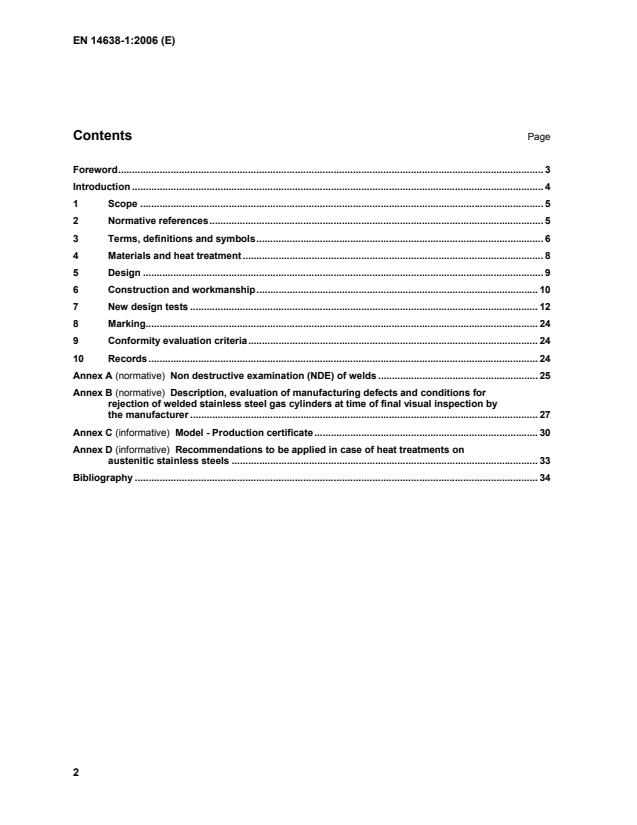
Non destructive examination (NDE) of welds.25 Annex B (normative)
Description, evaluation of manufacturing defects and conditions for rejection of welded stainless steel gas cylinders at time of final visual inspection by the manufacturer.27 Annex C (informative)
Model - Production certificate.30 Annex D (informative)
Recommendations to be applied in case of heat treatments on austenitic stainless steels.33 Bibliography.34
1 Scope This European Standard gives minimum requirements concerning material, design, construction and workmanship, procedures and tests at manufacture of refillable transportable welded cylinders made of austenitic stainless steel, justified by experimental methods, of water capacities from 0,5 l up to and including 150 l for compressed or liquefied gases and of a test pressure up to 90 bar. NOTE This European Standard may also be used as a guideline for cylinders less than 0,5 litres water capacity. This European Standard is primarily for industrial gases other than LPG but may also be applied for LPG. However for dedicated LPG cylinders, see EN 14140, Transportable refillable welded steel cylinders for liquefied petroleum gas (LPG) – Alternative design and construction prepared by CEN/TC 286 Liquefied petroleum gas equipment and accessories. 2 Normative references The following referenced documents are indispensable for the application of this document. For dated references, only the edition cited applies. For undated references, the latest edition of the referenced document (including any amendments) applies. EN 287-1, Qualification test of welders - Fusion welding - Part 1: Steels EN 473, Non destructive testing — Qualification and certification of NDT personnel — General principles EN 910, Destructive tests on welds in metallic materials — Bend tests EN 962, Transportable gas cylinders — Valve protection caps and valve guards for industrial and medical gas cylinders — Design, construction and tests EN 970, Non-destructive examination of fusion welds — Visual examination EN 1435, Non destructive examination of welds — Radiographic examination of welded joints EN 10002-1, Metallic materials — Tensile testing — Part 1: Method of test at ambient temperature EN 10028-7, Flat products made of steels for pressure purposes — Part 7: Stainless steels EN 10045-1, Metallic materials — Charpy impact test — Part1: Test method EN 10088-2, Stainless steels - Part 2: Technical delivery conditions for sheet/plate and strip of corrosion resisting steels for general purposes EN 13445-2, Unfired pressure vessels — Part 2: Materials EN ISO 3651-2, Determination of resistance to intergranular corrosion of stainless steels — Part 2: Ferritic, austenitic and ferritic-austenitic (duplex) stainless steels — Corrosion test in media containing sulfuric acid (ISO 3651-2:1998) EN ISO 5817, Welding — Fusion-welded joints in steel, nickel, titanium and their alloys (beam welding excluded) — Quality levels for imperfections (ISO 5817:2003) EN ISO 7539-6, Corrosion of metals and alloys — Stress corrosion testing — Part 6: Preparation and use of pre-cracked specimens for tests under constant load or constant displacement (ISO 7539-6:2003)
for the calculation under consideration; L, original gauge length, in millimetres, in accordance with EN 10002-1; n ratio of diameter of bend test former to the thickness of the test piece; Ph test pressure, in bar, above atmospheric pressure; Pb minimum burst pressure, in bar; Pba actual burst pressure, in bar; Rpi1,0 minimum value of 1,0 % proof stress in MPa, guaranteed by the cylinder manufacturer for the finished cylinder, at a determined area “i” of the cylinder; Rgi minimum value of tensile stress, in MPa, guaranteed by the cylinder manufacturer for the finished cylinder, at a determined area “i” of the cylinder; Rmi actual value of tensile stress, in MPa, determined by tensile test specified in Clause 7, at a determined area “i” of the cylinder; Rei yield stress means the stress at which a permanent elongation of 1 % of the gauge length on the test-piece, has been produced, at a determined area “i” of the cylinder; Reai actual value of yield stress used for calculation, in MPa, at a determined area “i” of the cylinder;
aa Figure 1 — Weld clearance 6.2 Welding procedures Each manufacturer, before proceeding with the production of a given design of cylinder, shall qualify the welding procedures and welders according to EN ISO 15614-1, EN ISO 15607 and EN 287-1. Records of such qualification shall be kept on file by the manufacturer. The welding procedure approval shall include a sensitisation test performed according to EN ISO 3651-2. 6.3 Plates and pressed parts Care shall be taken to avoid contamination from other manufacturing materials, e.g. potential of galvanic corrosion from carbon steel particles. 6.4 Welded pressure containing joints With exception of welds for openings, all welded joints shall be butt welded or joggle welded. When designing the welds, the cylinder manufacturer shall take into account the intended service, e.g. corrosive gases according to EN ISO 11114-1. 6.5 Non-pressure-containing attachments 6.5.1 Non pressure containing parts such as footrings, handles and neckrings which are not submitted to pressure shall be made in accordance with 4.1.6. 6.5.2 Each attachment shall be designed to permit inspection of the welds, which shall be clear of longitudinal and circumferential joints, and so designed as to avoid trapping water.
Cylindrical walled cylinders For cylinders with cylindrical walls there is no need to repeat prototype testing for a family of cylinders, with the same diameter and shape, when the length of the cylindrical part of the cylinder has been reduced from the length of the prototype cylinder. 7.4 Valve protection If a change in the method of valve protection is made, only tests related to valves protection shall be repeated in accordance with EN 962. 7.5 Prototype tests 7.5.1 General For the purpose of these tests, a minimum of 50 cylinders, which are guaranteed by the manufacturer to be representative of new design, shall be made available for prototype testing. However, if the total production is less than 50 cylinders, enough cylinders shall be made to complete the prototype tests required, in addition to the production quantity. In this case the type approval validity is limited to the particular batch. 7.5.2 Verification and testing a) In the course of the type approval process, It shall be verified that:
the conditions specified in Clause 4 (materials) are fulfilled; the design conforms to the requirements of Clause 5; the thickness of the walls in all determined areas “i” of two cylinders meet the requirements of the agreed technical specification with respect to the guaranteed minimum thickness (abi). The measurements shall be taken on at least three locations for each determined area “i”. the requirements of Clause 6 (construction and workmanship) and Annex B (radiographic examination) are conformed to for all cylinders selected for the tests; the internal and external surfaces of the cylinders at warring stages of production are free of any defect which may make them unsafe (see Annex C); NOTE It may be necessary to section finished cylinders to undertake this inspection.
The following shall be performed on cylinders selected after the welds of the cylinders have been visually inspected: the tests specified in 7.5.3 - Fatigue testing. Two cylinders. The cylinders shall bear all representative markings. the tests specified in 7.5.4, when applicable. - Corrosion test. the tests specified in 7.5.5 - Drop test. Six cylinders. The cylinders shall bear all representative markings; the tests specified in 7.5.3; 7.5.4; 7.5.5 and 7.5.6 - Mechanical testing. Two cylinders. The test pieces shall be identifiable with the batch; the tests specified in 7.7 - Hydraulic burst test. Two cylinders. The cylinders shall bear all representative markings. These tests are to be performed on finished, unpainted cylinders, after all manufacturing processes have been completed. 7.5.3 Fatigue tests The fatigue tests shall be carried out on two cylinders, bearing all representative stamp markings (see Clause 8). This test shall be carried out on two cylinders for each type approval, with a non-corrosive liquid subjecting the cylinders to successive reversal at an upper hydraulic pressure equal to the test pressure, in which case the cylinder shall be subjected to 12 000 cycles without leakage or failure. The value of the lower pressure shall not exceed 10 % of the upper cyclic pressure. The frequency of reversals of pressure shall not exceed 5 cycles/min. The temperature measured on the outside surface of the cylinder shall not exceed 50 °C during the test. After the test, one cylinder shall be sectioned in order to measure the profile and to ascertain that this profile is sufficiently close to that prescribed in the design. The second cylinder shall be subjected to a burst test in accordance with 7.7. 7.5.4 Corrosion test An inter-granular corrosion test shall be carried out on two specimens obtained from one cylinder for each type approval in accordance with 4.1.5. The specimens shall be taken from the part of the cylinder providing a specimen geometry suitable for bend testing. Exact location of the samples shall be specified and agreed upon by the parties both shall include samples taken from welded areas. Corrosion tests carried out for other type approvals (except material and/or heat treatment changes) shall be considered applicable to type approvals for new designs. 7.5.5 Impact test 7.5.5.1 General 7.5.5.1.1 The integrity of the cylinder shell, of the specified thickness(e
...