


EN 1834-1:2000
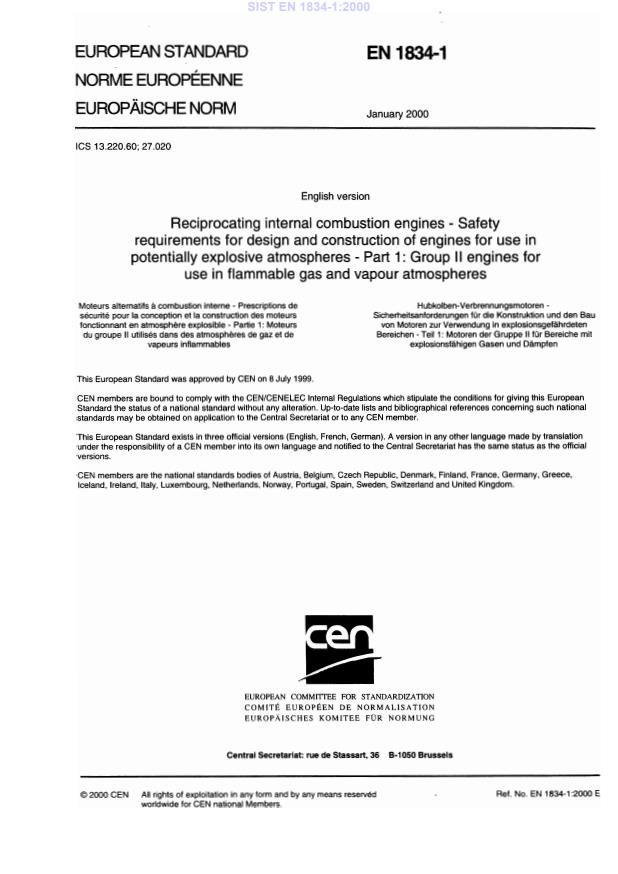
(Main)Reciprocating internal combustion engines - Safety requirements for design and construction of engines for use in potentially explosive atmospheres - Part 1: Group II engines for use in flammable gas and vapour atmospheres
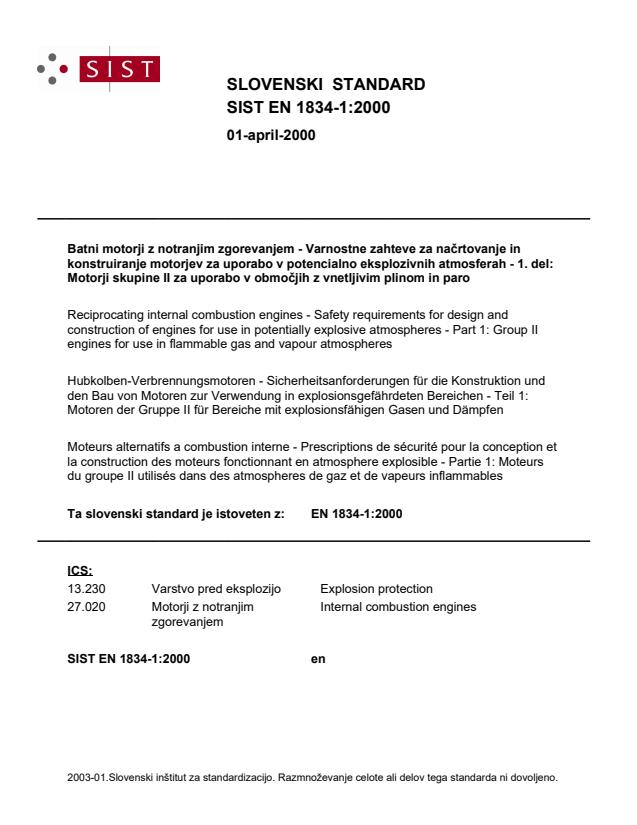
Reciprocating internal combustion engines - Safety requirements for design and construction of engines for use in potentially explosive atmospheres - Part 1: Group II engines for use in flammable gas and vapour atmospheres
This European standard specifies the safety requirements and/or measures to remove the hazards and limit the risks on reciprocating internal combustion compression ignition engines hereinafter referred to as "engines" of group II categories 2 and 3 for use in potentially explosive atmospheres of flammable gas and vapour. This European standard does not apply to flammable gas and vapour atmospheres containing carbon disulphide (CS2).
Hubkolben-Verbrennungsmotoren - Sicherheitsanforderungen für die Konstruktion und den Bau von Motoren zur Verwendung in explosionsgefährdeten Bereichen - Teil 1: Motoren der Gruppe II für Bereiche mit explosionsfähigen Gasen und Dämpfen
Diese Europäische Norm spezifiziert die Sicherheitsanforderungen und/oder Maßnahmen, um Gefahren abzuwenden und die Risiken zu begrenzen, die selbstzündende Hubkolben-Verbrennungsmotoren -im nachfolgenden Motoren genannt- der Gruppe II Kategorien 2 und 3, die in explosionsgefährdeten Bereichen durch Gase und Dämpfe betrieben werden, darstellen. Die Europäische Norm gilt nicht für explosionsgefährdete Bereiche durch Gase- und Dämpfe, die Schwefelkohlenstoff (CS2) enthalten.
Moteurs alternatifs à combustion interne - Prescriptions de sécurité pour la conception et la construction des moteurs fonctionnant en atmosphère explosible - Partie 1: Moteurs du groupe II utilisés dans des atmosphères de gaz et de vapeurs inflammables
La présente norme européenne spécifie les prescriptions et/ou les mesures qui doivent être prises pour éliminer les phénomènes dangereux et limiter les risques sur les moteurs alternatifs à allumage par compression du groupe II et des catégories 2 et 3 désignés ci-après sous le terme de "moteur" fonctionnant dans des atmosphères de gaz et vapeurs inflammables. La présente norme européenne ne s'applique pas aux moteurs fonctionnant dans des atmosphères de gaz et vapeurs inflammables contenant du sulfure de carbone (CS2).
Batni motorji z notranjim zgorevanjem - Varnostne zahteve za načrtovanje in konstruiranje motorjev za uporabo v potencialno eksplozivnih atmosferah - 1. del: Motorji skupine II za uporabo v območjih z vnetljivim plinom in paro
General Information
- Status
- Published
- Publication Date
- 18-Jan-2000
- Withdrawal Date
- 30-Jul-2000
- Current Stage
- 9093 - Decision to confirm - Review Enquiry
- Start Date
- 03-Sep-2007
- Completion Date
- 03-Sep-2007
- Directive
- 98/37/EC - Machinery
Relations
- Effective Date
- 20-Aug-2025
Overview
EN 1834-1:2000 (CEN) specifies safety requirements for the design and construction of reciprocating internal combustion compression ignition engines intended for use in potentially explosive atmospheres containing flammable gas and vapour. The standard applies to Group II engines in categories 2 and 3, and focuses on measures to remove hazards and limit risks associated with engine use in such atmospheres. Note: this part does not apply to atmospheres containing carbon disulphide (CS2).
Key Topics
The standard establishes normative requirements and guidance on safety aspects including, but not limited to:
- Design and construction principles for compression ignition (diesel) engines used in hazardous environments.
- Hazard elimination and risk limitation measures to prevent ignition of flammable gas and vapour.
- Material selection and mechanical integrity to withstand operating stresses in explosive atmospheres.
- Containment and venting concepts to manage potential release of flammable fluids.
- Control of ignition sources, including hot surfaces, sparks and electrical equipment interfacing with engines.
- Sealing and enclosure practices to minimize ingress of flammable atmospheres to ignition-capable components.
- Inspection, maintenance and marking requirements to ensure ongoing safe operation and traceability.
- Exclusions and scope limits, explicitly excluding CS2-containing atmospheres from Part 1’s coverage.
(These topics reflect the standard’s focus on safety requirements for reciprocating internal combustion compression ignition engines in flammable gas and vapour atmospheres.)
Applications
EN 1834-1:2000 is used where compression ignition engines operate in environments with potential explosive gas/vapour atmospheres. Typical practical applications include:
- Industrial power and prime movers in petrochemical and chemical plants
- Emergency and standby diesel generators located in hazardous areas
- Engine-driven pumps and compressors in oil & gas processing and storage facilities
- Mobile or fixed equipment that must meet safety requirements before installation in flammable gas zones
Who Uses This Standard
- Engine manufacturers designing Group II compression ignition engines for hazardous areas
- System integrators and OEMs specifying engines for installations in potentially explosive atmospheres
- Safety engineers and compliance officers ensuring installations conform to European safety requirements
- Testing and certification bodies assessing engines for conformity with explosion-protection requirements
Related Standards
Relevant reference documents often consulted alongside EN 1834-1:2000 include other EN/ISO standards and regional explosion-protection regulations addressing equipment categories, installation practices, and conformity assessment (e.g., standards and directives covering explosion protection, electrical equipment in hazardous areas, and engine testing).
Keywords: EN 1834-1:2000, reciprocating internal combustion engines, compression ignition engines, explosion protection, potentially explosive atmospheres, flammable gas and vapour, safety requirements, Group II engines, CEN.

Frequently Asked Questions
EN 1834-1:2000 is a standard published by the European Committee for Standardization (CEN). Its full title is "Reciprocating internal combustion engines - Safety requirements for design and construction of engines for use in potentially explosive atmospheres - Part 1: Group II engines for use in flammable gas and vapour atmospheres". This standard covers: This European standard specifies the safety requirements and/or measures to remove the hazards and limit the risks on reciprocating internal combustion compression ignition engines hereinafter referred to as "engines" of group II categories 2 and 3 for use in potentially explosive atmospheres of flammable gas and vapour. This European standard does not apply to flammable gas and vapour atmospheres containing carbon disulphide (CS2).
This European standard specifies the safety requirements and/or measures to remove the hazards and limit the risks on reciprocating internal combustion compression ignition engines hereinafter referred to as "engines" of group II categories 2 and 3 for use in potentially explosive atmospheres of flammable gas and vapour. This European standard does not apply to flammable gas and vapour atmospheres containing carbon disulphide (CS2).
EN 1834-1:2000 is classified under the following ICS (International Classification for Standards) categories: 13.220.01 - Protection against fire in general; 27.020 - Internal combustion engines. The ICS classification helps identify the subject area and facilitates finding related standards.
EN 1834-1:2000 has the following relationships with other standards: It is inter standard links to prEN ISO/IEC 80079-41. Understanding these relationships helps ensure you are using the most current and applicable version of the standard.
EN 1834-1:2000 is associated with the following European legislation: EU Directives/Regulations: 2014/34/EU, 94/9/EC, 98/37/EC; Standardization Mandates: M/BC/CEN/88/13, M/BC/CEN/92/46. When a standard is cited in the Official Journal of the European Union, products manufactured in conformity with it benefit from a presumption of conformity with the essential requirements of the corresponding EU directive or regulation.
You can purchase EN 1834-1:2000 directly from iTeh Standards. The document is available in PDF format and is delivered instantly after payment. Add the standard to your cart and complete the secure checkout process. iTeh Standards is an authorized distributor of CEN standards.
Standards Content (Sample)
2003-01.Slovenski inštitut za standardizacijo. Razmnoževanje celote ali delov tega standarda ni dovoljeno.DURHubkolben-Verbrennungsmotoren - Sicherheitsanforderungen für die Konstruktion und den Bau von Motoren zur Verwendung in explosionsgefährdeten Bereichen - Teil 1: Motoren der Gruppe II für Bereiche mit explosionsfähigen Gasen und DämpfenMoteurs alternatifs a combustion interne - Prescriptions de sécurité pour la conception et la construction des moteurs fonctionnant en atmosphere explosible - Partie 1: Moteurs du groupe II utilisés dans des atmospheres de gaz et de vapeurs inflammablesReciprocating internal combustion engines - Safety requirements for design and construction of engines for use in potentially explosive atmospheres - Part 1: Group II engines for use in flammable gas and vapour atmospheres27.020Motorji z notranjim zgorevanjemInternal combustion engines13.230Varstvo pred eksplozijoExplosion protectionICS:Ta slovenski standard je ist
...
La norme EN 1834-1:2000 présente un cadre de référence crucial pour la conception et la construction de moteurs à combustion interne à pistons destinés à être utilisés dans des atmosphères potentiellement explosibles. Elle s'applique spécifiquement aux moteurs de groupe II, catégories 2 et 3, en ce qui concerne les environnements où des gaz et des vapeurs inflammables peuvent être présents. Cette norme définit des exigences de sécurité essentielles, ainsi que des mesures visant à éliminer les dangers et à limiter les risques associés à l'utilisation de ces moteurs. L'un des points forts de la norme est son approche systématique de l'évaluation des risques, qui est primordiale pour garantir une exploitation sécuritaire dans des environnements sensibles. En intégrant des critères spécifiques pour les moteurs devant opérer dans des atmosphères inflammables, la norme EN 1834-1:2000 contribue à protéger les opérateurs et les installations contre les incidents potentiels. De plus, la norme souligne l'importance de respecter des standards de sécurité rigoureux, ce qui renforce sa pertinence dans les secteurs industriels concernés. Bien que la norme n'inclut pas les atmosphères de gaz et de vapeur inflammables contenant du disulfure de carbone (CS2), sa portée reste suffisamment large pour couvrir de nombreux cas d'utilisation fréquente. En somme, la norme EN 1834-1:2000 est indispensable pour toute organisation cherchant à assurer la sécurité des moteurs à combustion interne dans des conditions où des atmosphères potentiellement dangereuses sont présentes.
Die Norm EN 1834-1:2000 bietet einen umfassenden Rahmen für die Sicherheitsanforderungen und -maßnahmen beim Design und der Konstruktion von Verbrennungsmotoren für den Einsatz in potenziell explosionsgefährdeten Atmosphären. Mit ihrem spezifischen Fokus auf Gruppe II Motoren, die in brennbaren Gas- und Dampfumgebungen eingesetzt werden, definiert die Norm klare Richtlinien zur Risikominderung und zur Beseitigung von Gefahren, die mit diesen anspruchsvollen Anwendungen verbunden sind. Ein herausragendes Merkmal dieser Norm ist ihre detaillierte Herangehensweise an Sicherheitsanforderungen, die nicht nur die technischen Funktionen der Motoren, sondern auch die Betriebsbedingungen berücksichtigt, unter denen diese Motoren arbeiten. Dies ist besonders relevant in Industriezweigen, in denen der Einsatz von Verbrennungsmotoren in explosiven Atmosphären eine kritische Rolle spielt, wie z.B. in der chemischen Industrie oder in der Öl- und Gaswirtschaft. Die Stärken der EN 1834-1:2000 liegen in ihrer Fähigkeit, relevante Sicherheitsstandards international zu harmonisieren. Sie unterstützt Hersteller und Betreiber dabei, die Konformität mit den bestehenden Vorschriften zu gewährleisten, was sowohl die Produktsicherheit als auch den Schutz der Mitarbeiter fördert. Zudem wird durch die Norm sichergestellt, dass wichtige Konzepte wie die Risikobewertung und die Anwendung geeigneter Sicherheitselemente in den Designprozess integriert werden. Ein weiterer relevanter Aspekt der Norm besteht darin, dass sie den Fokus auf Motoren legt, die in schwer zugänglichen und potenziell gefährlichen Umgebungen eingesetzt werden, wodurch die Bedeutung der Einhaltung dieser Vorschriften unterstrichen wird. Die klare Abgrenzung, dass die Norm nicht für atmosphärische Bedingungen gilt, die Kohlenstoffdisulfid (CS2) enthalten, verdeutlicht die spezifischen Anwendungsbereiche und verhindert Fehlinterpretationen. Insgesamt ist EN 1834-1:2000 nicht nur ein kritisches Dokument für die Sicherheitsstandards im Bereich der Verbrennungsmotoren, sondern auch ein unverzichtbares Werkzeug für Hersteller und Betreiber, die in hochriskanten Umgebungen tätig sind. Durch die Einführung und Anwendung dieser Norm können Unternehmen die Betriebssicherheit ihrer Anlagen signifikant verbessern und gleichzeitig die gesetzlichen Anforderungen erfüllen.
SIST EN 1834-1:2000 표준은 잠재적으로 폭발적인 환경에서 사용되는 왕복 내부 연소 엔진에 대한 안전 요구 사항을 규정하고 있습니다. 이 표준의 범위는 그룹 II 카테고리 2 및 3에 속하는 엔진의 설계 및 구조와 관련된 안전 요구 사항 및 위험을 제거하거나 제한하기 위한 조치를 명확하게 제시하고 있습니다. 이는 특히 인화성 가스와 증기가 존재하는 환경에서 중요한 요소입니다. 이 표준의 강점 중 하나는 다양한 위험 요소를 체계적으로 분석하고, 그에 대한 대응 방안을 명시함으로써 사용자가 보다 안전한 작업 환경을 조성할 수 있도록 도와준다는 점입니다. 또한, 엔진의 설계 및 제작 과정에서 이 표준을 따른다면, 실제 현장에서 발생할 수 있는 사고를 예방할 수 있는 기반을 마련할 수 있습니다. 또한 SIST EN 1834-1:2000은 특정한 상황, 즉 카본 디설파이드(CS2)가 포함된 인화성 가스 및 증기 환경을 제외한 나머지 인화성 환경에 대한 적용 범위가 명확히 설정되어 있어, 사용자에게 보다 구체적인 이해를 제공합니다. 이는 특히 위험 요소가 높은 산업 분야에서 안전성을 확보하는 데 매우 중요한 부분입니다. 전반적으로, SIST EN 1834-1:2000 표준은 엔진의 안전성을 높이고 잠재적으로 위험한 환경에서의 안전 작업을 보장하기 위한 필수적인 지침이 됩니다. 이 표준은 기술적 요구 사항과 안전 수칙을 통합하여 사용자가 보다 효율적이고 안전하게 작업할 수 있도록 지원합니다.
The EN 1834-1:2000 standard serves a crucial role in establishing safety requirements specifically for reciprocating internal combustion engines that operate in potentially explosive atmospheres. This standard is particularly relevant for those working with engines categorized under Group II, specifically for use in environments with flammable gas and vapour, although it intentionally excludes consideration of atmospheres containing carbon disulphide (CS2). One of the significant strengths of the EN 1834-1:2000 standard is its comprehensive approach to identifying and mitigating hazards associated with engine use in explosive conditions. By providing clear guidelines on design and construction, the standard promotes higher safety levels, which is essential for industries where such engines are common. The focus on group II categories 2 and 3 ensures that the standard caters to a broad range of applications, making it versatile and applicable across various sectors. Additionally, the emphasis on practical measures to limit risks showcases the standard's proactive stance towards safety. This applicability is increasingly relevant today, as industries continue to innovate and expand the use of reciprocating internal combustion engines within potentially hazardous environments. Another strength of the EN 1834-1:2000 standard is its alignment with international safety benchmarks, contributing to a uniform understanding of safety measures within Europe and beyond. This relevance not only facilitates compliance for manufacturers but also enhances the safety culture within organizations employing such engines. Overall, the EN 1834-1:2000 standard stands out for its thorough documentation of safety requirements, its focus on risk mitigation, and its applicability to a variety of potentially explosive atmospheres, ensuring that industries can effectively navigate the complexities of using reciprocating internal combustion engines safely.
EN 1834-1:2000は、可燃性ガスおよび蒸気の大気中で使用される内燃機関に関する安全要件を定めた重要なヨーロッパ規格です。この標準は、グループIIに分類されるカテゴリ2および3の内燃機関に焦点を当てており、潜在的に爆発性のある環境における設計と構築に必要な安全対策を詳細に説明しています。 この標準の主な強みは、内燃機関の安全性を確保するために必要なガイドラインを明確に定義している点です。エンジンの設計や施工における危険性を除去し、リスク制限策を導入することで、作業環境の安全性を向上させることができます。また、可燃性ガスと蒸気が存在する可能性のある危険な状況下において、ユーザーが安心してエンジンを使用できるよう保護する役割も果たしています。 さらに、この標準は、炭素ジスルファイド(CS2)を含む可燃性ガスおよび蒸気の環境には適用されないため、特定の条件下でも明確な指針を提供することができます。これは、使用者が適切なエンジンを選定する際に重要な情報となります。 EN 1834-1:2000は、内燃機関の設計と施工において、ユーザーの安全を最優先に考えた有用な資料です。爆発の危険性を最小限に抑えるための具体的な規定を含んでおり、内燃機関の開発・運用における安全基準の確立に寄与しています。このように、安全要件の標準化は従業員の保護と周囲の安全確保に不可欠な要素であると言えるでしょう。
Questions, Comments and Discussion
Ask us and Technical Secretary will try to provide an answer. You can facilitate discussion about the standard in here.
Loading comments...