


EN 40-3-2:2013
(Main)Lighting columns - Part 3-2: Design and verification - Verification by testing
Lighting columns - Part 3-2: Design and verification - Verification by testing
This European Standard specifies the requirements for the verification of the design of steel, aluminium, concrete and fibre reinforced polymer composite lighting columns by testing. It gives type tests and so does not cover testing for quality control purposes. It applies to lighting columns of nominal height (including any bracket) not exceeding 20 m. Special structural designs to permit the attachment of signs, overhead wires, etc. are not covered by this European Standard.
This European Standard includes a simplified method for testing steel and aluminium lighting columns. Refer to EN 40-4 for concrete lighting columns and to EN 40-7 for fibre reinforced polymer composite lighting columns.
NOTE For a more detailed test procedure, refer to Annex D of EN 1990:2002.
The requirements for lighting columns made from materials other than concrete, steel, aluminium or fibre reinforced polymer composite (for example wood, plastic and cast iron) are not specifically covered in this European Standard.
This European Standard includes performance requirements for horizontal loads due to wind. Passive safety and the behaviour of a lighting column under the impact of a vehicle are not addressed. Such lighting columns will have additional requirements (see EN 12767).
Lichtmaste - Teil 3-2: Bemessung und Nachweis - Nachweis durch Prüfung
Diese Europäische Norm legt die Anforderungen an den Nachweis der Bemessung durch Prüfung von Lichtmasten aus Stahl, Aluminium, Beton und faserverstärktem Polymerverbundstoff fest. Sie enthält Typprüfungen und aufgrund dessen werden Prüfungen zur Überwachung der Qualität nicht behandelt. Sie gilt für Lichtmaste (einschließlich jegliche Ausleger) mit einer Nennhöhe von bis zu 20 m. Besondere bauliche Bemessungen, um das Anbringen von Verkehrsschildern, Freileitungen usw. zu ermöglichen, werden nicht in dieser Europäischen Norm behandelt.
Diese Europäische Norm enthält ein vereinfachtes Verfahren zur Prüfung von Lichtmasten aus Stahl und Aluminium. EN 40-4 befasst sich mit Lichtmasten aus Stahl und EN 40-7 mit Lichtmasten aus faserverstärktem Polymerverbundstoff.
ANMERKUNG Für ein ausführlicheres Prüfverfahren siehe EN 1990:2002, Anhang D.
Die Anforderungen an Lichtmaste aus anderen Werkstoffen als Beton, Stahl, Aluminium oder faserverstärktem Polymerverbundstoff (z. B. Holz, Kunststoff und Gusseisen) werden in dieser Europäischen Norm nicht besonders behandelt.
Diese Europäische Norm enthält Leistungsanforderungen hinsichtlich horizontaler Lasten aus Wind. Passive Sicherheit und das Verhalten eines Lichtmastes bei einem Anprall eines Fahrzeugs werden nicht behandelt. Für diese Lichtmaste gelten zusätzliche Anforderungen (siehe EN 12767).
Candélabres d'éclairage public - Partie 3-2: Conception et vérification - Vérification par essais
LLa présente Norme Européenne spécifie les exigences relatives à la vérification par essai de la conception des candélabres d'éclairage public en acier, en aluminium, en béton et en composite polymère renforcé de fibres. Elle présente des essais type et ne traite donc pas des essais effectués dans le cadre d'un contrôle qualité. Elle s’applique aux candélabres d’éclairage public d’une hauteur nominale (avec la crosse) ne dépassant pas 20 m. Les conceptions structurelles particulières permettant de fixer des panneaux de signalisation, des fils aériens, etc., ne sont pas traitées dans la Norme européenne.
La présente Norme Européenne inclut une méthode simplifiée pour soumettre à l’essai les candélabres d’éclairage public en acier et en aluminium. Se référer à l’EN 40-4 pour les candélabres d’éclairage public en béton et à l’EN 40-7 pour les candélabres d'éclairage public en composite polymère renforcé de fibres.
NOTE Pour une procédure d’essai plus détaillée, se référer à l’Annexe D de l’EN 1990:2002.
Les exigences relatives aux candélabres d'éclairage public réalisés dans d'autres matériaux que le béton, l'acier, l'aluminium ou le composite polymère renforcé de fibres (par exemple le bois, le plastique et la fonte) ne sont pas spécifiquement traitées dans la présente Norme européenne.
La présente Norme européenne inclut les exigences de performance pour les charges horizontales dues au vent. La sécurité passive et le comportement d'un candélabre d'éclairage public soumis à l'impact d'un véhicule ne sont pas abordés. Des exigences supplémentaires s’appliqueront à cette catégorie de candélabres (voir l’EN 12767).
Drogovi za razsvetljavo - Projektiranje in preverjanje - 3-2. del: Preverjanje s preskušanjem
Ta evropski standard določa zahteve za preverjanje projektiranja jeklenih, aluminijastih in betonskih drogov za razsvetljavo ter drogov za razsvetljavo iz vlaknatoarmiranega polimernega kompozita s preskušanjem. V njem so navedeni tipski preskusi, ne vključuje pa preskušanja za namene kontrole kakovosti. Velja za drogove za razsvetljavo nazivne višine (vključno z vsemi nosilci), ki ne presega 20 m. Posebno projektiranje konstrukcij, ki omogoča namestitev znakov, nadzemnih žic itd., ni obravnavano v tem evropskem standardu. Ta evropski standard vključuje poenostavljeno metodo za preskušanje jeklenih in aluminijastih drogov za razsvetljavo. Betonski drogi za razsvetljavo so obravnavani v standardu EN 40-4, drogi za razsvetljavo iz vlaknatoarmiranega polimernega kompozita pa v standardu EN 40-7. V tem evropskem standardu niso posebej obravnavane zahteve za drogove za razsvetljavo, ki niso izdelani iz betona, jekla, aluminija ali vlaknatoarmiranega polimernega kompozita (npr. les, plastika in železova litina). Ta evropski standard vključuje zahteve glede zmogljivosti za vodoravne obtežbe zaradi vetra. Pasivna varnost in učinek, ki ga ima trčenje vozila na drog za razsvetljavo, nista obravnavana. Za takšne drogove za razsvetljavo veljajo dodatne zahteve.
General Information
Relations
Overview
EN 40-3-2:2013 - Lighting columns: Design and verification - Verification by testing (CEN) specifies the type-test procedure for verifying the structural design of lighting columns made from steel, aluminium, concrete and fibre‑reinforced polymer (FRP) composite. It applies to columns up to a nominal height of 20 m (including brackets) and defines serviceability and structural acceptance criteria, test preparation, loading sequences, reporting and certification. This is a type‑test standard (not quality control testing) and excludes special columns for signs/overhead wires and passive vehicle‑impact behaviour (see EN 12767).
Key topics and technical requirements
- Scope & materials: Covers steel, aluminium, reinforced/prestressed concrete and FRP composite lighting columns; other materials (wood, cast iron, plastics) are not specifically covered.
- Test types: Type testing for verification by testing, with a simplified method for steel and aluminium columns. Optional ultimate‑failure testing may also be recorded.
- Serviceability limits:
- Vertical deflection of the luminaire connection ≤ 0.025 × bracket projection (w).
- Horizontal deflection limits referenced to EN 40-3-3 (Table 4).
- Residual/structural limits after unloading:
- Steel & aluminium: residual deflection ≤ 10% of test deflection.
- Concrete: ≤ 20%.
- FRP composite: ≤ 5%.
- Minimum ultimate requirement: A minimum ultimate load (factor γu) must be achieved; γu is determined from the ratio of actual to characteristic material strengths and inertias together with the relevant partial safety/test factor.
- Critical cross‑sections to check: base/fixings, door opening edges, bracket junctions, transitions in diameter/thickness, anti‑rotation devices and other critical positions.
- Test procedures: Forces applied by dead weights or calibrated load cells (±2% accuracy), staged horizontal loading, measurement of vertical/horizontal deflections, secure mounting and orientation rules.
- Documentation: Test report and type‑test certificate content specified (Annex A/B).
Practical applications
- Verifying design compliance for new lighting column types before production.
- Supporting product certification, tender submissions and technical dossiers.
- Providing evidence for municipal procurement specifications and safety reviews.
- Informing R&D and prototype validation in lighting‑column manufacturing.
Who should use this standard
- Lighting column manufacturers and product engineers
- Structural designers and verification engineers
- Independent test laboratories and certification bodies
- Municipal authorities, highway agencies and procurement teams
- Specifiers and consultants preparing technical requirements
Related standards
- EN 40-1 (terms/definitions), EN 40-3-1 (characteristic loads), EN 40-3-3 (verification by calculation)
- EN 40-4 (concrete columns), EN 40-7 (FRP composite columns)
- EN 12767 (passive safety / vehicle impact) and Annex D of EN 1990 for detailed test procedure guidance
Keywords: EN 40-3-2:2013, lighting columns, verification by testing, type tests, wind load testing, serviceability limits, structural verification, CEN.
Standards Content (Sample)
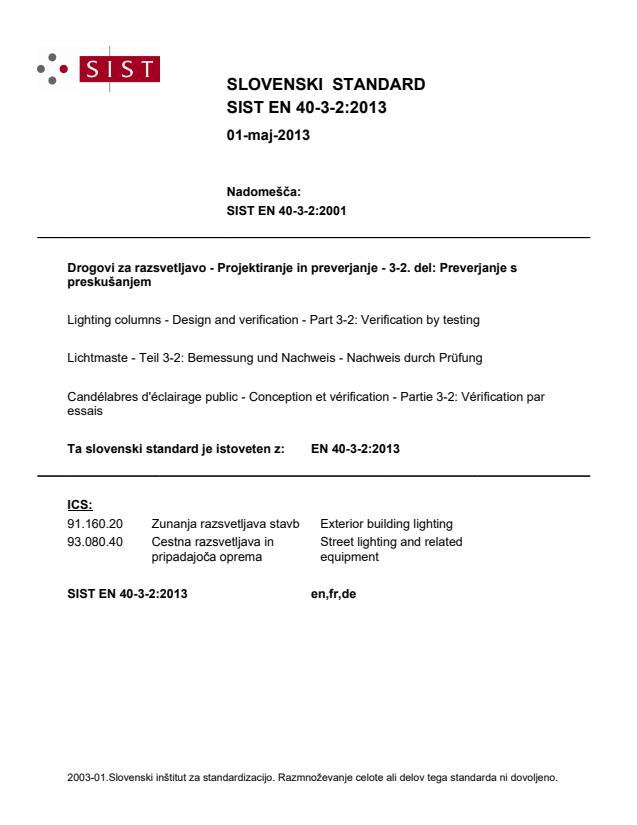
2003-01.Slovenski inštitut za standardizacijo. Razmnoževanje celote ali delov tega standarda ni dovoljeno.Drogovi za razsvetljavo - Projektiranje in preverjanje - 3-2. del: Preverjanje s preskušanjemLichtmaste - Teil 3-2: Bemessung und Nachweis - Nachweis durch PrüfungCandélabres d'éclairage public - Conception et vérification - Partie 3-2: Vérification par essaisLighting columns - Design and verification - Part 3-2: Verification by testing93.080.40Street lighting and related equipment91.160.20Zunanja razsvetljava stavbExterior building lightingICS:Ta slovenski standard je istoveten z:EN 40-3-2:2013SIST EN 40-3-2:2013en,fr,de01-maj-2013SIST EN 40-3-2:2013SLOVENSKI
STANDARDSIST EN 40-3-2:20011DGRPHãþD
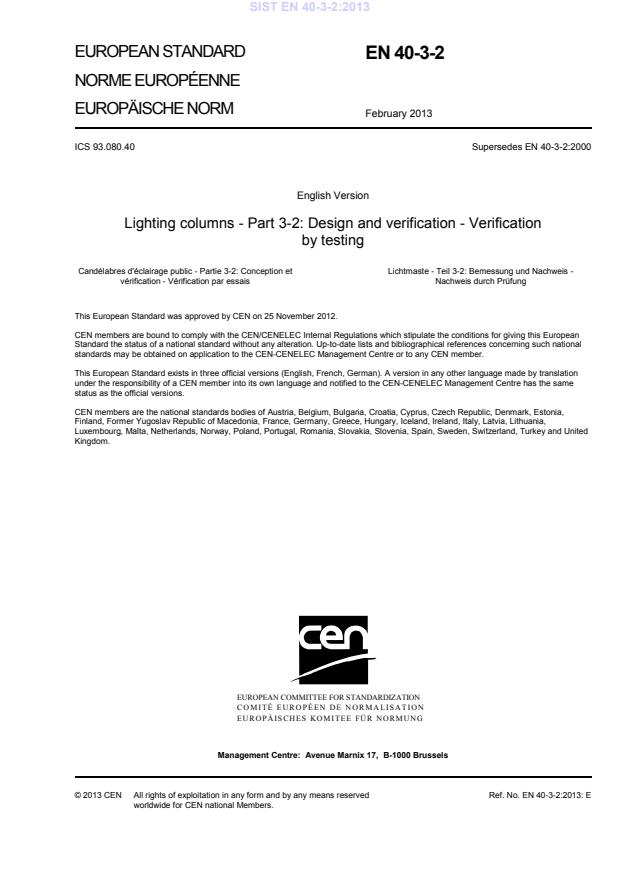
EUROPEAN STANDARD NORME EUROPÉENNE EUROPÄISCHE NORM
EN 40-3-2
February 2013 ICS 93.080.40 Supersedes EN 40-3-2:2000English Version
Lighting columns - Part 3-2: Design and verification - Verification by testing
Candélabres d'éclairage public - Partie 3-2: Conception et vérification - Vérification par essais
Lichtmaste - Teil 3-2: Bemessung und Nachweis - Nachweis durch Prüfung This European Standard was approved by CEN on 25 November 2012.
CEN members are bound to comply with the CEN/CENELEC Internal Regulations which stipulate the conditions for giving this European Standard the status of a national standard without any alteration. Up-to-date lists and bibliographical references concerning such national standards may be obtained on application to the CEN-CENELEC Management Centre or to any CEN member.
This European Standard exists in three official versions (English, French, German). A version in any other language made by translation under the responsibility of a CEN member into its own language and notified to the CEN-CENELEC Management Centre has the same status as the official versions.
CEN members are the national standards bodies of Austria, Belgium, Bulgaria, Croatia, Cyprus, Czech Republic, Denmark, Estonia, Finland, Former Yugoslav Republic of Macedonia, France, Germany, Greece, Hungary, Iceland, Ireland, Italy, Latvia, Lithuania, Luxembourg, Malta, Netherlands, Norway, Poland, Portugal, Romania, Slovakia, Slovenia, Spain, Sweden, Switzerland, Turkey and United Kingdom.
EUROPEAN COMMITTEE FOR STANDARDIZATION
COMITÉ EUROPÉEN DE NORMALISATION EUROPÄISCHES KOMITEE FÜR NORMUNG
Management Centre:
Avenue Marnix 17,
B-1000 Brussels © 2013 CEN All rights of exploitation in any form and by any means reserved worldwide for CEN national Members. Ref. No. EN 40-3-2:2013: ESIST EN 40-3-2:2013
Lighting columns: Report on type testing as specified in EN 40-3-2:2013 . 9 Annex B (normative)
Lighting columns: Certificate for the type test specified in EN 40-3-2:2013 . 12 Bibliography. 14
This European Standard includes performance requirements for horizontal loads due to wind. Passive safety and the behaviour of a lighting column under the impact of a vehicle are not addressed. Such lighting columns will have additional requirements (see EN 12767). 2 Normative references The following documents, in whole or in part, are normatively referenced in this document and are indispensable for its application. For dated references, only the edition cited applies. For undated references, the latest edition of the referenced document (including any amendments) applies. EN 40-1:1991, Lighting columns — Part 1: Definitions and terms EN 40-3-1:2013, Lighting columns — Part 3-1: Design and verification —Specification for characteristic loads EN 40-3-3:2013, Lighting columns — Part 3-3: Design and verification — Verification by calculation EN 40-4, Lighting columns — Part 4: Requirements for reinforced and prestressed concrete lighting columns EN 40-7, Lighting columns — Part 7: Requirements for fibre reinforced polymer composite lighting columns 3 Terms and definitions For the purposes of this document, the terms and definitions given in EN 40-1:1991 apply. 4 Symbols The following symbols are used in this European Standard. The definitions are abbreviated, the full definitions being given in the text. a Overall door opening length b Overall door opening width c Dimension from ground level to bottom of door opening fy Characteristic strength of material for design fyT Actual strength of test sample material as tested SIST EN 40-3-2:2013
Serviceability requirements Serviceability requirements are as follows: a) The vertical deflection of the luminaire connection caused by the vertical forces corresponding to the test load shall not exceed the value of 0,025 w (see EN 40-3-3:2013, 6.5.1). b) The temporary horizontal deflection of the luminaire connection caused during the load test by the incremental load due to the horizontal forces corresponding to the test load shall not excee
...
Frequently Asked Questions
EN 40-3-2:2013 is a standard published by the European Committee for Standardization (CEN). Its full title is "Lighting columns - Part 3-2: Design and verification - Verification by testing". This standard covers: This European Standard specifies the requirements for the verification of the design of steel, aluminium, concrete and fibre reinforced polymer composite lighting columns by testing. It gives type tests and so does not cover testing for quality control purposes. It applies to lighting columns of nominal height (including any bracket) not exceeding 20 m. Special structural designs to permit the attachment of signs, overhead wires, etc. are not covered by this European Standard. This European Standard includes a simplified method for testing steel and aluminium lighting columns. Refer to EN 40-4 for concrete lighting columns and to EN 40-7 for fibre reinforced polymer composite lighting columns. NOTE For a more detailed test procedure, refer to Annex D of EN 1990:2002. The requirements for lighting columns made from materials other than concrete, steel, aluminium or fibre reinforced polymer composite (for example wood, plastic and cast iron) are not specifically covered in this European Standard. This European Standard includes performance requirements for horizontal loads due to wind. Passive safety and the behaviour of a lighting column under the impact of a vehicle are not addressed. Such lighting columns will have additional requirements (see EN 12767).
This European Standard specifies the requirements for the verification of the design of steel, aluminium, concrete and fibre reinforced polymer composite lighting columns by testing. It gives type tests and so does not cover testing for quality control purposes. It applies to lighting columns of nominal height (including any bracket) not exceeding 20 m. Special structural designs to permit the attachment of signs, overhead wires, etc. are not covered by this European Standard. This European Standard includes a simplified method for testing steel and aluminium lighting columns. Refer to EN 40-4 for concrete lighting columns and to EN 40-7 for fibre reinforced polymer composite lighting columns. NOTE For a more detailed test procedure, refer to Annex D of EN 1990:2002. The requirements for lighting columns made from materials other than concrete, steel, aluminium or fibre reinforced polymer composite (for example wood, plastic and cast iron) are not specifically covered in this European Standard. This European Standard includes performance requirements for horizontal loads due to wind. Passive safety and the behaviour of a lighting column under the impact of a vehicle are not addressed. Such lighting columns will have additional requirements (see EN 12767).
EN 40-3-2:2013 is classified under the following ICS (International Classification for Standards) categories: 91.160.20 - Exterior building lighting; 93.080.40 - Street lighting and related equipment. The ICS classification helps identify the subject area and facilitates finding related standards.
EN 40-3-2:2013 has the following relationships with other standards: It is inter standard links to EN 40-3-2:2000. Understanding these relationships helps ensure you are using the most current and applicable version of the standard.
EN 40-3-2:2013 is associated with the following European legislation: EU Directives/Regulations: 305/2011, 89/106/EEC; Standardization Mandates: M/111. When a standard is cited in the Official Journal of the European Union, products manufactured in conformity with it benefit from a presumption of conformity with the essential requirements of the corresponding EU directive or regulation.
You can purchase EN 40-3-2:2013 directly from iTeh Standards. The document is available in PDF format and is delivered instantly after payment. Add the standard to your cart and complete the secure checkout process. iTeh Standards is an authorized distributor of CEN standards.
Die Norm EN 40-3-2:2013 behandelt die Anforderungen zur Verifizierung des Designs von Lichtmasten aus Stahl, Aluminium, Beton und faserverstärkten Polymerverbundstoffen durch Prüfungen. Ihr Anwendungsbereich ist klar umrissen, da sie sich auf Lichtmasten mit einer Nennhöhe (einschließlich aller Halterungen) von maximal 20 Metern konzentriert. Besonders hervorzuheben ist, dass die Norm spezielle Typprüfungen vorsieht, jedoch nicht für Qualitätskontrollzwecke konzipiert ist. Eine der Stärken dieser Norm ist der vereinfachte Prüfungsansatz für Lichtmasten aus Stahl und Aluminium. Die klare Anleitung für die Prüfung dieser Materialien erleichtert es Herstellern und Ingenieuren, die erforderlichen Standards zu erfüllen. Für Lichtmasten aus Beton und faserverstärkten Polymerverbundstoffen werden in den Normen EN 40-4 und EN 40-7 zusätzliche Richtlinien bereitgestellt, was die Konsistenz der Prüfverfahren fördert. Die Norm enthält spezifische Leistungsanforderungen hinsichtlich der horizontalen Lasten, die durch Wind entstehen. Dies macht die Norm besonders relevant in Bezug auf die Sicherheit und Haltbarkeit der Lichtmasten unter verschiedenen Umweltbedingungen. Es muss jedoch beachtet werden, dass Aspekte der passiven Sicherheit und das Verhalten von Lichtmasten bei einem Fahrzeugaufprall nicht behandelt werden. Dies markiert einen klaren Verantwortungsbereich, da solche Lichtmasten zusätzliche Anforderungen gemäß EN 12767 erfüllen müssen. Es ist auch wichtig zu erwähnen, dass Materialien wie Holz, Kunststoff und Gusseisen nicht in diesem Standard behandelt werden. Dies könnte eine Einschränkung darstellen für Hersteller, die solche Alternativen in Betracht ziehen, hebt aber gleichzeitig die spezialisierte Anwendung der Norm für die häufigsten Materialien hervor. Insgesamt bietet die EN 40-3-2:2013 eine fundierte Grundlage für die Design- und Verifizierungsprozesse von Lichtmasten in Europa und ist aufgrund ihrer klaren Anforderungen und spezifischen Prüfmethoden von hoher Relevanz für die laufende Entwicklung sicherer und effizienter Lichtmasten.
La norme EN 40-3-2:2013 fournit un cadre essentiel pour la vérification des conceptions de colonnes lumineuses en acier, aluminium, béton et composites en polymère renforcé de fibres, à travers des tests spécifiques. Son champ d'application est précisé, n'incluant pas les tests destinés à des fins de contrôle de qualité, ce qui l'oriente principalement vers des tests de type. L'une des forces de cette norme réside dans sa méthodologie simplifiée pour tester les colonnes lumineuses en acier et en aluminium, ce qui la rend accessible et facilement applicable par les concepteurs et fabricants. Les spécifications allant jusqu'à une hauteur nominale de 20 mètres garantissent que des solutions pratiques et sécurisées sont mises à disposition pour la plupart des applications urbaines. Cependant, la norme ne couvre pas les conceptions structurelles spéciales nécessaires à l'attache de panneaux ou de câbles aériens, ce qui peut être une limitation pour certains projets. De plus, elle n'aborde pas les exigences pour les colonnes de matériaux alternatifs tels que le bois ou la fonte, ce qui peut restreindre son utilisation dans des environnements divers. La mention des exigences de performance pour les charges horizontales dues au vent souligne l'importance accordée à la résistance structurelle, bien que la norme ne traite pas de la sécurité passive ou du comportement en cas d'impact d'un véhicule, ce qui pourrait nécessiter des référentiels complémentaires comme l'indique la norme EN 12767. Ainsi, la norme EN 40-3-2:2013 s'avère pertinente pour les professionnels de l'éclairage qui cherchent à garantir la sécurité et la fiabilité des colonnes lumineuses en métal et en composite, tout en reconnaissant les domaines qui nécessitent une attention particulière ou des normes additionnelles.
The EN 40-3-2:2013 standard is a pivotal document in the realm of lighting column design and verification. Its primary scope focuses on the verification of the design of lighting columns constructed from steel, aluminium, concrete, and fibre reinforced polymer composites through rigorous testing methodologies. This specification delineates the type tests necessary for establishing the integrity of lighting columns, which are critical for ensuring safe and reliable outdoor lighting infrastructures. A significant strength of this standard is its emphasis on testing for specific materials, particularly steel and aluminium, through a simplified method that enhances accessibility for manufacturers and engineers. This structured approach not only facilitates compliance with safety norms but also streamlines the testing process, making it more efficient and less resource-intensive. By providing guidelines for different materials, the EN 40-3-2:2013 standard ensures that various types of lighting columns, whether constructed from traditional or newer composite materials, can meet consistent performance expectations. The European Standard also specifies vertical heights for lighting columns, allowing for a clear understanding of its applicable range, which is limited to those not exceeding 20 m in nominal height. This particular focus is important for urban planners and designers, as it clarifies the context in which the standard can be applied effectively. However, it is noteworthy that this standard does not cover the testing requirements for non-traditional materials, such as wood, plastic, or cast iron, which might be used in certain contexts. This limitation underscores the necessity for additional standards to address other materials, ensuring that the entire range of lighting columns can be assessed for safety and efficacy. The inclusion of performance requirements for horizontal loads induced by wind serves as a critical aspect of the design verification, although it is acknowledged that passive safety measures and vehicle impact resilience are beyond the scope of this standard. This focus on wind loads ensures that the lighting columns can withstand environmental stresses, which is particularly relevant for areas prone to adverse weather conditions. Overall, the EN 40-3-2:2013 standard is a comprehensive document that is crucial for ensuring the safety and reliability of lighting columns. It addresses vital aspects of design verification through testing, making it relevant for industry practitioners who are involved in the design, manufacture, and maintenance of lighting infrastructure. Its structured approach to different materials and heights presents a robust framework for enhancing the performance standards of lighting columns within the urban landscape.
SIST EN 40-3-2:2013は、鋼、アルミニウム、コンクリート、繊維強化ポリマー複合材料で作られた照明柱の設計の検証をテストによって行うための要求事項を定めた欧州標準です。この標準の適用範囲は、20メートルを超えない名目高さの照明柱に限られており、標識やオーバーヘッドワイヤーの取り付けを考慮した特別な構造設計は含まれていません。 この標準は、鋼及びアルミニウム製照明柱のテストに対して簡素化された方法を提供しており、具体的にはEN 40-4やEN 40-7を参照することによりコンクリートや繊維強化ポリマー複合材料の照明柱のテストに関する情報も得ることができます。特に、照明柱の水平荷重の性能要件が盛り込まれているため、風による影響に対する評価が可能である点は強みといえます。 ただし、木材、プラスチック、鋳鉄など、コンクリート、鋼、アルミニウム、繊維強化ポリマー複合材料以外の材料で作られた照明柱に関する要求事項は、この欧州標準では特に扱われていません。また、照明柱の受動的安全性や車両衝突時の挙動に関しても言及されていないため、これらは別途EN 12767での対応が必要です。 全体的に、SIST EN 40-3-2:2013は、照明柱の設計と検証において具体的なテスト手順を示す貴重な基準となっており、その適用範囲と強みは、照明インフラの安全性と信頼性を確保する上で非常に重要です。特に、照明柱の風荷重に対する性能要件への対処は、現代の都市環境において必要不可欠な要素です。
EN 40-3-2:2013 표준은 조명 기둥의 설계 및 검증을 위한 중요한 요구 사항을 규정하고 있습니다. 이 표준의 적용 범위는 철강, 알루미늄, 콘크리트 및 섬유 강화 폴리머 복합재로 제작된 조명 기둥의 설계를 시험을 통해 검증하는 것으로, 20m를 초과하지 않는 모든 조명 기둥에 적합합니다. 이는 조명 기둥의 구조적 안전성과 신뢰성을 보장하는 데 필수적입니다. 이 표준의 강점 중 하나는 스틸 및 알루미늄 조명 기둥에 대한 간소화된 시험 방법을 제공한다는 점입니다. 이는 사용자와 제조업체가 보다 쉽게 조명 기둥의 성능을 평가할 수 있도록 돕습니다. 또한, 이 표준은 조명 기둥의 수직 하중뿐만 아니라 바람에 의한 수평 하중에 대한 성능 요구 사항도 포함하고 있습니다. 이는 기둥이 극한의 환경에서도 충분히 견딜 수 있도록 설계되었음을 보장합니다. 반면, 특정 구조 설계나 기타 재료(예: 목재, 플라스틱, 주철)로 제작된 조명 기둥에 대한 요구 사항은 이 표준에서 구체적으로 다루어지지 않는 점이 아쉽습니다. 이러한 내용은 추가적인 규정이 필요할 수 있음을 시사합니다. 또한, 조명 기둥이 차량의 충돌을 받을 경우의 안전성이나 행동에 대한 요구 사항은 EN 12767과 같은 다른 표준에 의존하게 됩니다. 결론적으로, SIST EN 40-3-2:2013 표준은 조명 기둥의 설계와 검증에 있어 중요한 기준을 제공하며, 특히 스틸 및 알루미늄 기둥의 시험 방법을 간소화하여 접근성을 높이고 있습니다. 그러나 다른 재료에 대한 요구 사항을 고려할 필요가 있으며, 이는 향후 표준 개정의 여지를 남깁니다. 이 표준은 현대 조명 기둥의 개발과 설계에서 매우 중요한 역할을 합니다.
Questions, Comments and Discussion
Ask us and Technical Secretary will try to provide an answer. You can facilitate discussion about the standard in here.
Loading comments...