

EN 17213:2020
(Main)Windows and doors - Environmental Product Declarations - Product category rules for windows and pedestrian doorsets
General Information
- Abstract
This document provides product category rules (PCR) for Type III environmental declarations for windows and pedestrian doorsets as defined in EN 14351-1 and EN 14351-2. Windows and pedestrian doorsets additionally providing fire resistance and/or smoke control characteristics according to EN 16034 are also covered by this document.
NOTE 1 Windows that incorporate shutters and/or shutter boxes and/or blinds are in scope of this PCR. For any connected electrical devices (e.g. motors, sensors) -see 6.3.4.2.
This document complements the core rules for the product category of construction products as defined in the European standard EN 15804:2012+A1:2013. The document is to be used in conjunction with EN 15804:2012+A1:2013, not replace it.
NOTE 2 The assessment of social and economic performances at product level is not covered by this document.
The core PCR:
- defines the parameters to be declared and the way in which they are collated and reported;
- describes which stages of a product’s life cycle are considered in the EPD and which processes are to be included in the life cycle stages;
- defines rules for the development of scenarios;
- includes the rules for calculating the Life Cycle Inventory and the Life Cycle Impact Assessment underlying the EPD, including the specification of the data quality to be applied;
- includes the rules for reporting the predetermined, environmental and health information that is not covered by Life Cycle Assessment (LCA) for the product, construction process(es) and construction service(s), as relevant;
- defines the conditions under which construction products can be compared based on the information provided by EPD.
For the EPD of construction services the same rules and requirements apply as for the EPD of construction products.
- Status
- Withdrawn
- Publication Date
- 24-Mar-2020
- Withdrawal Date
- 29-Sep-2026
- Technical Committee
- CEN/TC 33 - Doors, windows, shutters and building hardware
- Drafting Committee
- CEN/TC 33/WG 1/2 - Windows and doors
- Current Stage
- 9960 - Withdrawal effective - Withdrawal
- Start Date
- 15-Oct-2025
- Completion Date
- 30-Sep-2026

Relations
- Effective Date
- 23-Jul-2025
- Effective Date
- 25-Aug-2026
- Effective Date
- 01-Apr-2026
- Effective Date
- 28-Jan-2026
- Effective Date
- 28-Jan-2026
- Effective Date
- 28-Jan-2026
- Effective Date
- 28-Jan-2026
- Effective Date
- 28-Jan-2026
- Effective Date
- 28-Jan-2026
- Effective Date
- 28-Jan-2026
- Effective Date
- 28-Jan-2026
- Effective Date
- 28-Jan-2026
- Effective Date
- 28-Jan-2026
- Effective Date
- 28-Jan-2026
- Effective Date
- 28-Jan-2026
Get Certified
Connect with accredited certification bodies for this standard

DIBt (Deutsches Institut für Bautechnik)
German Institute for Building Technology.
DIN CERTCO
DIN Group product certification.

Aboma Certification B.V.
Specialized in construction, metal, and transport sectors.
Sponsored listings
Frequently Asked Questions
EN 17213:2020 is a standard published by the European Committee for Standardization (CEN). Its full title is "Windows and doors - Environmental Product Declarations - Product category rules for windows and pedestrian doorsets". This standard covers: This document provides product category rules (PCR) for Type III environmental declarations for windows and pedestrian doorsets as defined in EN 14351-1 and EN 14351-2. Windows and pedestrian doorsets additionally providing fire resistance and/or smoke control characteristics according to EN 16034 are also covered by this document. NOTE 1 Windows that incorporate shutters and/or shutter boxes and/or blinds are in scope of this PCR. For any connected electrical devices (e.g. motors, sensors) -see 6.3.4.2. This document complements the core rules for the product category of construction products as defined in the European standard EN 15804:2012+A1:2013. The document is to be used in conjunction with EN 15804:2012+A1:2013, not replace it. NOTE 2 The assessment of social and economic performances at product level is not covered by this document. The core PCR: - defines the parameters to be declared and the way in which they are collated and reported; - describes which stages of a product’s life cycle are considered in the EPD and which processes are to be included in the life cycle stages; - defines rules for the development of scenarios; - includes the rules for calculating the Life Cycle Inventory and the Life Cycle Impact Assessment underlying the EPD, including the specification of the data quality to be applied; - includes the rules for reporting the predetermined, environmental and health information that is not covered by Life Cycle Assessment (LCA) for the product, construction process(es) and construction service(s), as relevant; - defines the conditions under which construction products can be compared based on the information provided by EPD. For the EPD of construction services the same rules and requirements apply as for the EPD of construction products.
This document provides product category rules (PCR) for Type III environmental declarations for windows and pedestrian doorsets as defined in EN 14351-1 and EN 14351-2. Windows and pedestrian doorsets additionally providing fire resistance and/or smoke control characteristics according to EN 16034 are also covered by this document. NOTE 1 Windows that incorporate shutters and/or shutter boxes and/or blinds are in scope of this PCR. For any connected electrical devices (e.g. motors, sensors) -see 6.3.4.2. This document complements the core rules for the product category of construction products as defined in the European standard EN 15804:2012+A1:2013. The document is to be used in conjunction with EN 15804:2012+A1:2013, not replace it. NOTE 2 The assessment of social and economic performances at product level is not covered by this document. The core PCR: - defines the parameters to be declared and the way in which they are collated and reported; - describes which stages of a product’s life cycle are considered in the EPD and which processes are to be included in the life cycle stages; - defines rules for the development of scenarios; - includes the rules for calculating the Life Cycle Inventory and the Life Cycle Impact Assessment underlying the EPD, including the specification of the data quality to be applied; - includes the rules for reporting the predetermined, environmental and health information that is not covered by Life Cycle Assessment (LCA) for the product, construction process(es) and construction service(s), as relevant; - defines the conditions under which construction products can be compared based on the information provided by EPD. For the EPD of construction services the same rules and requirements apply as for the EPD of construction products.
EN 17213:2020 is classified under the following ICS (International Classification for Standards) categories: 91.010.99 - Other aspects; 91.060.50 - Doors and windows. The ICS classification helps identify the subject area and facilitates finding related standards.
EN 17213:2020 has the following relationships with other standards: It is inter standard links to EN 17213:2020+A1:2025, ISO 18292:2011, EN 15978:2026, EN 1279-5:2018, CEN/TR 16970:2016, EN 15942:2021, EN 15941:2024, EN 14351-1:2006+A2:2016, EN 15804:2012+A1:2013, EN 15978:2011, EN 1279-2:2018, EN 17074:2019, EN ISO 14044:2006, EN 16034:2014, EN 14351-2:2018. Understanding these relationships helps ensure you are using the most current and applicable version of the standard.
EN 17213:2020 is available in PDF format for immediate download after purchase. The document can be added to your cart and obtained through the secure checkout process. Digital delivery ensures instant access to the complete standard document.
Standards Content (Sample)
SLOVENSKI STANDARD
01-maj-2020
Okna in vrata - Okoljske deklaracije za proizvode - Pravila za kategorije proizvodov
za okna in vrata za prehod ljudi
Windows and doors - Environmental Product Declarations - Product category rules for
windows and pedestrian doorsets
Fenster und Türen - Umweltproduktdeklarationen - Produktkategorieregeln für Fenster
und Türen
Portes et fenêtres - Déclarations environnementales de produits - Règles de définition
des catégories de produits pour les fenêtres et blocs-portes pour piétons
Ta slovenski standard je istoveten z: EN 17213:2020
ICS:
13.020.20 Okoljska ekonomija. Environmental economics.
Trajnostnost Sustainability
91.060.50 Vrata in okna Doors and windows
2003-01.Slovenski inštitut za standardizacijo. Razmnoževanje celote ali delov tega standarda ni dovoljeno.
EN 17213
EUROPEAN STANDARD
NORME EUROPÉENNE
March 2020
EUROPÄISCHE NORM
ICS 91.010.99; 91.060.50
English Version
Windows and doors - Environmental Product Declarations
- Product category rules for windows and pedestrian
doorsets
Portes et fenêtres - Déclarations environnementales de Fenster und Türen - Umweltproduktdeklarationen -
produits - Règles de définition des catégories de Produktkategorieregeln für Fenster und Türen
produits pour les fenêtres et blocs-portes pour piétons
This European Standard was approved by CEN on 3 February 2020.
CEN members are bound to comply with the CEN/CENELEC Internal Regulations which stipulate the conditions for giving this
European Standard the status of a national standard without any alteration. Up-to-date lists and bibliographical references
concerning such national standards may be obtained on application to the CEN-CENELEC Management Centre or to any CEN
member.
This European Standard exists in three official versions (English, French, German). A version in any other language made by
translation under the responsibility of a CEN member into its own language and notified to the CEN-CENELEC Management
Centre has the same status as the official versions.
CEN members are the national standards bodies of Austria, Belgium, Bulgaria, Croatia, Cyprus, Czech Republic, Denmark, Estonia,
Finland, France, Germany, Greece, Hungary, Iceland, Ireland, Italy, Latvia, Lithuania, Luxembourg, Malta, Netherlands, Norway,
Poland, Portugal, Republic of North Macedonia, Romania, Serbia, Slovakia, Slovenia, Spain, Sweden, Switzerland, Turkey and
United Kingdom.
EUROPEAN COMMITTEE FOR STANDARDIZATION
COMITÉ EUROPÉEN DE NORMALISATION
EUROPÄISCHES KOMITEE FÜR NORMUNG
CEN-CENELEC Management Centre: Rue de la Science 23, B-1040 Brussels
© 2020 CEN All rights of exploitation in any form and by any means reserved Ref. No. EN 17213:2020 E
worldwide for CEN national Members.
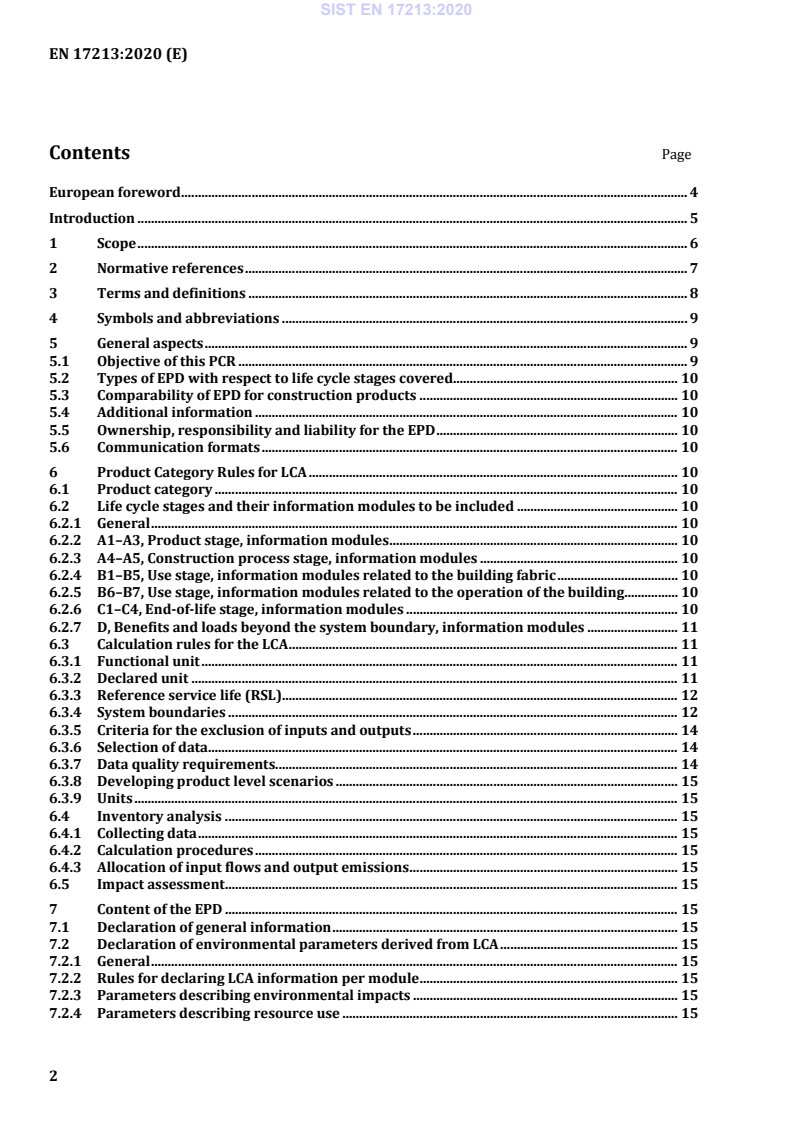
Contents Page
European foreword . 4
Introduction . 5
1 Scope . 6
2 Normative references . 7
3 Terms and definitions . 8
4 Symbols and abbreviations . 9
5 General aspects . 9
5.1 Objective of this PCR . 9
5.2 Types of EPD with respect to life cycle stages covered . 10
5.3 Comparability of EPD for construction products . 10
5.4 Additional information . 10
5.5 Ownership, responsibility and liability for the EPD . 10
5.6 Communication formats . 10
6 Product Category Rules for LCA . 10
6.1 Product category . 10
6.2 Life cycle stages and their information modules to be included . 10
6.2.1 General . 10
6.2.2 A1–A3, Product stage, information modules . 10
6.2.3 A4–A5, Construction process stage, information modules . 10
6.2.4 B1–B5, Use stage, information modules related to the building fabric . 10
6.2.5 B6–B7, Use stage, information modules related to the operation of the building. 10
6.2.6 C1–C4, End-of-life stage, information modules . 10
6.2.7 D, Benefits and loads beyond the system boundary, information modules . 11
6.3 Calculation rules for the LCA . 11
6.3.1 Functional unit . 11
6.3.2 Declared unit . 11
6.3.3 Reference service life (RSL). 12
6.3.4 System boundaries . 12
6.3.5 Criteria for the exclusion of inputs and outputs . 14
6.3.6 Selection of data . 14
6.3.7 Data quality requirements. 14
6.3.8 Developing product level scenarios . 15
6.3.9 Units . 15
6.4 Inventory analysis . 15
6.4.1 Collecting data . 15
6.4.2 Calculation procedures . 15
6.4.3 Allocation of input flows and output emissions . 15
6.5 Impact assessment . 15
7 Content of the EPD . 15
7.1 Declaration of general information . 15
7.2 Declaration of environmental parameters derived from LCA . 15
7.2.1 General . 15
7.2.2 Rules for declaring LCA information per module . 15
7.2.3 Parameters describing environmental impacts . 15
7.2.4 Parameters describing resource use . 15
7.2.5 Other environmental information describing different waste categories and output
flows . 15
7.3 Scenarios and additional technical information . 15
7.3.1 General . 15
7.3.2 Construction process stage . 16
7.3.3 B1–B7 use stage . 16
7.3.4 End-of-life . 16
7.4 Additional information on release of dangerous substances to indoor air, soil and
water during the use stage . 16
7.4.1 Indoor air . 16
7.4.2 Soil and water . 16
7.5 Aggregation of information modules . 16
8 Project report . 16
8.1 General . 16
8.2 LCA-related elements of the project report . 16
8.3 Documentation on additional information . 16
8.4 Data availability for verification . 16
9 Verification and validity of an EPD . 16
Annex A (informative) Guidance for defining representative products within a product
range . 17
Annex B (informative) Default use stage and EoL scenarios . 18
B.1 General . 18
B.2 Use stage . 18
B.2.1 A4 Transport . 18
B.2.2 A5 Construction installation process . 18
B.2.3 B2 Maintenance . 19
B.2.4 B3 Repair . 19
B.3 End-of-life (EoL) . 19
Annex C (informative) Voluntary use stage scenario based on energy balance calculation . 23
Bibliography . 26
European foreword
This document (EN 17213:2020) has been prepared by Technical Committee CEN/TC 33 “Windows,
doors, curtain walling and hardware”, the secretariat of which is held by AFNOR.
This European Standard shall be given the status of a national standard, either by publication of an
identical text or by endorsement, at the latest by September 2020, and conflicting national standards
shall be withdrawn at the latest by September 2020.
Attention is drawn to the possibility that some of the elements of this document may be the subject of
patent rights. CEN shall not be held responsible for identifying any or all such patent rights.
According to the CEN-CENELEC Internal Regulations, the national standards organisations of the
following countries are bound to implement this European Standard: Austria, Belgium, Bulgaria,
Croatia, Cyprus, Czech Republic, Denmark, Estonia, Finland, France, Germany, Greece, Hungary, Iceland,
Ireland, Italy, Latvia, Lithuania, Luxembourg, Malta, Netherlands, Norway, Poland, Portugal, Republic of
North Macedonia, Romania, Serbia, Slovakia, Slovenia, Spain, Sweden, Switzerland, Turkey and the
United Kingdom.
Introduction
This document provides core product category rules for all construction products and services. It
provides a structure to ensure that all Environmental Product Declarations (EPD) of construction
products, construction services and construction processes are derived, verified and presented in a
harmonized way.
This document provides complementary product category rules (cPCR) for Type III Environmental
Declarations (EPD) specifically for windows and pedestrian doorsets.
An EPD communicates verifiable, accurate, non-misleading environmental information for products and
their applications, thereby supporting scientifically based, fair choices and stimulating the potential for
market-driven continuous environmental improvement.
The standardization process has taken place in accordance with EN ISO 14025. All common issues for
windows and pedestrian doorsets are covered horizontally in order to minimize intra-sectorial
deviations.
EPD information is expressed in information modules, which allow easy organization and expression of
data packages throughout the lifecycle of the product. The approach requires that the underlying data
should be consistent, reproducible and comparable.
The EPD is expressed in a form that allows aggregation (addition) to provide complete information for
buildings. Neither EN 15804:2012+A1:2013 nor this document deals with aggregation at the building
level or describes the rules for applying EPD in building assessment.
This document deals with a limited number of quantifiable predetermined parameters as defined in
EN 15804:2012+A1:2013. Future revisions may incorporate additional predetermined parameters.
This document provides the means for developing a Type III environmental declaration for windows
and pedestrian doorsets, thereby supplementing the suite of standards that are intended to assess the
sustainability of construction works.
This suite of standards includes:
— EN 15643-1, Sustainability of construction works — Sustainability assessment of buildings — Part 1:
General framework;
— EN 15643-2, Sustainability of construction works — Sustainability assessment of buildings — Part 2:
Framework for the assessment of environmental performance;
— EN 15804:2012+A1:2013, Sustainability of construction works — Environmental product
declarations — Core rules for the product category of construction products;
— CEN/TR 15941, Sustainability of construction works — Environmental product declarations —
Methodology for selection and use of generic data;
— EN 15942, Sustainability of construction works — Environmental product declarations —
Communication formats: business to business;
— EN 15978, Sustainability of construction works — Assessment of environmental performance of
buildings — Calculation method.
1 Scope
This document provides product category rules (PCR) for Type III environmental declarations for
windows and pedestrian doorsets as defined in EN 14351-1 and EN 14351-2. Windows and pedestrian
doorsets additionally providing fire resistance and/or smoke control characteristics according to
EN 16034 are also covered by this document.
NOTE 1 Windows that incorporate shutters and/or shutter boxes and/or blinds are in scope of this PCR. For
any connected electrical devices (e.g. motors, sensors) — see 6.3.4.2.
This document complements the core rules for the product category of construction products as defined
in EN 15804:2012+A1:2013. This document is to be used in conjunction with EN 15804:2012+A1:2013,
not replace it.
NOTE 2 The assessment of social and economic performances at product level is not covered by this document.
The core PCR:
— defines the parameters to be declared and the way in which they are collated and reported;
— describes which stages of a product’s life cycle are considered in the EPD and which processes are
to be included in the life cycle stages;
— defines rules for the development of scenarios;
— includes the rules for calculating the Life Cycle Inventory and the Life Cycle Impact Assessment
underlying the EPD, including the specification of the data quality to be applied;
— includes the rules for reporting the predetermined, environmental and health information that is
not covered by Life Cycle Assessment (LCA) for the product, construction process(es) and
construction service(s), as relevant;
— defines the conditions under which construction products can be compared based on the
information provided by EPD.
For the EPD of construction services the same rules and requirements apply as for the EPD of
construction products.
2 Normative references
The following documents are referred to in the text in such a way that some or all of their content
constitutes requirements of this document. For dated references, only the edition cited applies. For
undated references, the latest edition of the referenced document (including any amendments) applies.
EN 1279-2, Glass in building — Insulating glass units — Part 2: Long term test method and requirements
for moisture penetration
EN 1279-5, Glass in building — Insulating glass units — Part 5: Product standard
EN 12519, Windows and pedestrian doors — Terminology
EN 14351-1, Windows and doors — Product standard, performance characteristics — Part 1: Windows
and external pedestrian doorsets
EN 14351-2, Windows and doors — Product standard, performance characteristics — Part 2: Internal
pedestrian doorsets
EN 15804:2012+A1:2013, Sustainability of construction works — Environmental product declarations —
Core rules for the product category of construction products
CEN/TR 15941, Sustainability of construction works — Environmental product declarations —
Methodology for selection and use of generic data
EN 15942, Sustainability of construction works — Environmental product declarations — Communication
format business to business
EN 15978, Sustainability of construction works — Assessment of environmental performance of
buildings — Calculation method
EN 16034, Pedestrian doorsets, industrial, commercial, garage doors and openable windows — Product
standard, performance characteristics — Fire resisting and/or smoke control characteristics
CEN/TR 16970:2016, Sustainability of construction works — Guidance for the implementation of
EN 15804
EN 17074, Glass in building — Environmental product declaration — Product category rules for flat glass
products
EN ISO 14044:2006, Environmental management — Life cycle assessment — Requirements and
guidelines (ISO 14044:2006)
EN ISO 52016-1:2017, Energy performance of buildings — Energy needs for heating and cooling, internal
temperatures and sensible and latent heat loads — Part 1: Calculation procedures (ISO 52016-1)
ISO 18292, Energy performance of fenestration systems for residential buildings — Calculation procedure
3 Terms and definitions
For the purposes of this document, the terms and definitions given in EN 12519, EN 14351-1,
EN 14351-2, EN 15804:2012+A1:2013, EN 16034 and the following apply.
ISO and IEC maintain terminological databases for use in standardization at the following addresses:
— IEC Electropedia: available at http://www.electropedia.org/
— ISO Online browsing platform: available at https://www.iso.org/obp
3.1
differences in the meaning of terms between EN 12519 and EN 15804:2012+A1:2013
EN 12519 EN 15804:2012+A1:2013
Door assembly, screen Element
Doorset, window Product
IGU, building hardware and other parts Component
3.2
insulating glass unit
IGU
assembly consisting of at least two panes of glass, separated by one or more spacers, hermetically
sealed along the periphery, mechanically stable and durable. Example of configuration: 4-16-4, which is
referring to a 4 mm glass layer, 16 mm spacer and 4 mm glass layer
Note 1 to entry: Systems are available where the spacer and hermetic seal are included within a single edge
sealing system.
3.3
building hardware
component of the window or doorset used for the operation of the product, such as hinges, handles,
locks, drives, etc.
3.4
optional device
component (e.g. shutters and blinds) integrated in the window or doorset during the manufacturing
process
4 Symbols and abbreviations
For the purposes of this document, the following symbols and abbreviations apply.
EPD Environmental product declaration
IGU Insulated glass unit
PCR Product category rules
LCA Life cycle assessment
RSL Reference service life
GWP Global warming potential
ODP Ozone depletion potential
AP Acidification potential
EP Eutrophication potential
POCP Photochemical ozone creation potential
ADPe Abiotic depletion potential (elements)
ADPf Abiotic depletion potential (fossil fuels)
BoM Bill of Materials
EoL End of Life
5 General aspects
5.1 Objective of this PCR
An EPD according to this document provides quantified environmental information for a window or
pedestrian doorset using a uniform and scientific basis. It also provides information on health related
emissions to indoor air, soil and water during the use stage of the building. The purpose of an EPD in
the construction sector is to provide the basis for assessing building and other construction works, and
identifying those which cause less stress to the environment.
Thus, the objective of this complementary PCR is to ensure:
— the provision of verifiable and consistent data for an EPD, based on LCA;
— the provision of verifiable and consistent product related technical data or scenarios for the
assessment of the environmental performance of buildings;
— the provision of verifiable and consistent product related technical data or scenarios potentially
related to the health of users for the assessment of the performance of buildings;
— that comparisons between doorsets/windows are carried out in the context of their application in
the building;
— the consistent communication of the environmental information of door sets and windows.
Declarations based on this document are not comparative assertions.
NOTE See EN 15804:2012+A1:2013, 3.4 and EN ISO 14044:2006, 5.3 for more information concerning LCA
used for comparative assertion.
5.2 Types of EPD with respect to life cycle stages covered
EN 15804:2012+A1:2013 shall apply.
5.3 Comparability of EPD for construction products
EN 15804:2012+A1:2013 shall apply.
5.4 Additional information
EN 15804:2012+A1:2013 shall apply.
5.5 Ownership, responsibility and liability for the EPD
A manufacturer or a group of manufacturers are the sole owners and have liability and responsibility
for an EPD.
It has to be stated which kind of EPD is created, e.g. company specific EPD or average EPD (e.g. by trade
association). For information how to calculate different types of EPD, see CEN/TR 16970:2016, 6.3.6
and EN 15804:2012+A1:2013, 6.3.6.
When intending to use average EPDs, the manufacturer shall be authorized to do so within the
document by the organization (program operator) responsible for the original EPD.
5.6 Communication formats
EN 15804:2012+A1:2013 shall apply.
6 Product Category Rules for LCA
6.1 Product category
The product category referred to in this document includes windows and pedestrian doorsets according
to EN 14351-1, EN 14351-2 and EN 16034. If not further specified, “doorsets” means both internal and
e
...