

EN 13655:2025
(Main)Plastics - Thermoplastic mulch films recoverable after use, for use in agriculture and horticulture
General Information
- Abstract
This document specifies the requirements related to dimensional, mechanical, optical and thermal characteristics of thermoplastic films for mulching applications in agriculture and horticulture.
These mulch films are intended to be removed after use and not incorporated in the soil.
These mulch films are not intended to be used for soil disinfection by fumigation. Films for soil disinfection are in the scope of EN 17098-1 [1] and EN 17098-2 [2].
The biodegradable mulch films intended to be incorporated in the soil after used are also not in the scope of this document. They are in the scope of EN 17033 [3].
This document specifies a classification for durability of mulching films and the test methods referred to in this document.
This document is applicable to thermoplastic mulch films, used for agriculture and horticulture in Europe, based on polyethylene and/or ethylene copolymers, of the following types:
- transparent films;
- black films;
- reflective films (e.g. white films, black/white films and black/silver films);
- films of other colour(s) for weed control (e.g. green, brown).
This document defines the criteria for design for recycling of mulch films and refer to EN 18109 for the product lifecycle, including installation, use, removal and collection for end of life for management of the product after its usage.
NOTE Mulch films can be highly soiled by organic and mineral residues at the end of their use life: the observed rates (or levels) of soilage of mulch films can vary from 70 % to 90 %, therefore the film thickness is a key factor on the rate of soilage, the thinnest films (e.g. less than 20 micron) will be the mostly soiled, difficult, expensive to remove, recover and recycle.
- Status
- Published
- Publication Date
- 19-Aug-2025
- Technical Committee
- CEN/TC 249 - Plastics
- Drafting Committee
- CEN/TC 249/WG 7 - Thermoplastic films for use in agriculture
- Current Stage
- 6060 - Definitive text made available (DAV) - Publishing
- Start Date
- 20-Aug-2025
- Due Date
- 12-Jan-2026
- Completion Date
- 20-Aug-2025

Overview
EN 13655:2025 - Plastics - Thermoplastic mulch films recoverable after use, for use in agriculture and horticulture - is a CEN standard that defines performance, testing and product-management requirements for thermoplastic mulching films that are intended to be removed and recovered after use. Approved 16 June 2025, it supersedes EN 13655:2018 and applies to polyethylene and ethylene‑copolymer based films (transparent, black, reflective and other colours) used across European agriculture and horticulture.
The standard covers dimensional, mechanical, optical and thermal characteristics, durability classification, test methods, roll acceptance, marking, storage/handling, instructions for installation/removal, and criteria for design for recycling and end‑of‑life management.
Key topics and technical requirements
- Scope limits: Not applicable to films for soil disinfection (see EN 17098‑1/2) or biodegradable films intended to be incorporated into soil (see EN 17033).
- Materials: Focus on polyethylene and ethylene copolymers; clause on materials extended in the 2025 revision.
- Durability classification: Defines service-life categories and associated test procedures.
- Dimensional & physical parameters: Requirements and test methods for thickness, width and roll length (ISO/EN methods referenced).
- Mechanical tests: Tensile properties, impact resistance (EN ISO 527 series; EN ISO 7765‑1).
- Optical & thermal tests: Total luminous transmittance, relative light transmission, solar reflectance, PAR/NIR radiation behaviour and resistance to artificial weathering (xenon‑arc exposure - EN ISO 4892‑2).
- Roll acceptance, storage & handling: Delivery checks and storage/handling guidance to preserve product integrity.
- Marking & instructions: Labelling, installation/use instructions and removal/collection guidance.
- Design for recycling: Criteria to support mechanical recycling and lifecycle management; reference to EN 18109 for product lifecycle and collection practice.
- Practical note: Mulch films can become highly soiled (observed soilage rates 70–90%); very thin films (< 20 µm) are more difficult and costly to recover and recycle.
Applications and who uses it
EN 13655:2025 is used for:
- Product specification and quality control by mulch film manufacturers
- Supplier selection and procurement by growers, nurseries and contractors
- Test laboratories performing mechanical, optical and weathering tests
- Recyclers and waste managers designing collection and mechanical recycling routes
- Certification bodies, agronomists and compliance teams assessing fitness for use, durability and recyclability
Benefits include standardized testing, clearer durability classes, improved design-for-recycling guidance and consistent labelling for end‑of‑life management.
Related standards
- EN 17098‑1 / EN 17098‑2 - films for soil disinfection
- EN 17033 - biodegradable mulch films incorporated in soil
- EN 18109 - product lifecycle and design-for-recycling guidance
- EN ISO 527‑1 / 527‑3, EN ISO 7765‑1, EN ISO 4892‑2, ISO 4591/2/3, ISO 9845‑1, ISO 22095, ASTM D1003 (referenced test methods)
Keywords: EN 13655:2025, thermoplastic mulch films, mulch film standards, agriculture mulching films, design for recycling, durability classification, mulch film test methods.
Relations
- Effective Date
- 28-Jan-2023
- Effective Date
- 25-Aug-2026
- Effective Date
- 25-Aug-2026
- Refers
ISO 4593:1993 - Plastics — Film and sheeting — Determination of thickness by mechanical scanning - Effective Date
- 25-Aug-2026
- Effective Date
- 25-Aug-2026
- Effective Date
- 25-Aug-2026
- Effective Date
- 28-Jan-2026
- Effective Date
- 28-Jan-2026
- Effective Date
- 28-Jan-2026
- Effective Date
- 28-Jan-2026
- Effective Date
- 28-Jan-2026
- Effective Date
- 28-Jan-2026
- Effective Date
- 28-Jan-2026
- Effective Date
- 28-Jan-2026
Get Certified
Connect with accredited certification bodies for this standard

DIN CERTCO
DIN Group product certification.

Smithers Quality Assessments
US management systems and product certification.
Sponsored listings
Frequently Asked Questions
EN 13655:2025 is a standard published by the European Committee for Standardization (CEN). Its full title is "Plastics - Thermoplastic mulch films recoverable after use, for use in agriculture and horticulture". This standard covers: This document specifies the requirements related to dimensional, mechanical, optical and thermal characteristics of thermoplastic films for mulching applications in agriculture and horticulture. These mulch films are intended to be removed after use and not incorporated in the soil. These mulch films are not intended to be used for soil disinfection by fumigation. Films for soil disinfection are in the scope of EN 17098-1 [1] and EN 17098-2 [2]. The biodegradable mulch films intended to be incorporated in the soil after used are also not in the scope of this document. They are in the scope of EN 17033 [3]. This document specifies a classification for durability of mulching films and the test methods referred to in this document. This document is applicable to thermoplastic mulch films, used for agriculture and horticulture in Europe, based on polyethylene and/or ethylene copolymers, of the following types: - transparent films; - black films; - reflective films (e.g. white films, black/white films and black/silver films); - films of other colour(s) for weed control (e.g. green, brown). This document defines the criteria for design for recycling of mulch films and refer to EN 18109 for the product lifecycle, including installation, use, removal and collection for end of life for management of the product after its usage. NOTE Mulch films can be highly soiled by organic and mineral residues at the end of their use life: the observed rates (or levels) of soilage of mulch films can vary from 70 % to 90 %, therefore the film thickness is a key factor on the rate of soilage, the thinnest films (e.g. less than 20 micron) will be the mostly soiled, difficult, expensive to remove, recover and recycle.
This document specifies the requirements related to dimensional, mechanical, optical and thermal characteristics of thermoplastic films for mulching applications in agriculture and horticulture. These mulch films are intended to be removed after use and not incorporated in the soil. These mulch films are not intended to be used for soil disinfection by fumigation. Films for soil disinfection are in the scope of EN 17098-1 [1] and EN 17098-2 [2]. The biodegradable mulch films intended to be incorporated in the soil after used are also not in the scope of this document. They are in the scope of EN 17033 [3]. This document specifies a classification for durability of mulching films and the test methods referred to in this document. This document is applicable to thermoplastic mulch films, used for agriculture and horticulture in Europe, based on polyethylene and/or ethylene copolymers, of the following types: - transparent films; - black films; - reflective films (e.g. white films, black/white films and black/silver films); - films of other colour(s) for weed control (e.g. green, brown). This document defines the criteria for design for recycling of mulch films and refer to EN 18109 for the product lifecycle, including installation, use, removal and collection for end of life for management of the product after its usage. NOTE Mulch films can be highly soiled by organic and mineral residues at the end of their use life: the observed rates (or levels) of soilage of mulch films can vary from 70 % to 90 %, therefore the film thickness is a key factor on the rate of soilage, the thinnest films (e.g. less than 20 micron) will be the mostly soiled, difficult, expensive to remove, recover and recycle.
EN 13655:2025 is classified under the following ICS (International Classification for Standards) categories: 83.140.10 - Films and sheets. The ICS classification helps identify the subject area and facilitates finding related standards.
EN 13655:2025 has the following relationships with other standards: It is inter standard links to EN 13655:2018, ISO 4592:1992, ISO 9845-1:2022, ISO 4593:1993, ISO 4591:1992, ISO 22095:2020, EN ISO 527-3:2018, prEN 13872, EN ISO 7765-1:2004, EN 4343:2002, CEN/CLC/TR 17603-31-16:2021, EN ISO 4892-2:2013, EN ISO 527-1:2019, EN 18109:2025. Understanding these relationships helps ensure you are using the most current and applicable version of the standard.
EN 13655:2025 is associated with the following European legislation: Standardization Mandates: M/584. When a standard is cited in the Official Journal of the European Union, products manufactured in conformity with it benefit from a presumption of conformity with the essential requirements of the corresponding EU directive or regulation.
EN 13655:2025 is available in PDF format for immediate download after purchase. The document can be added to your cart and obtained through the secure checkout process. Digital delivery ensures instant access to the complete standard document.
Standards Content (Sample)
SLOVENSKI STANDARD
01-november-2025
Polimerni materiali - Termoplastične folije za mulčenje, primerne za nadaljnjo
predelavo, za uporabo v kmetijstvu in vrtnarstvu
Plastics - Thermoplastic mulch films recoverable after use, for use in agriculture and
horticulture
Kunststoffe - Nach Gebrauch rückbaubare thermoplastische Mulchfolien für den Einsatz
in Landwirtschaft und im Gartenbau
Plastiques - Films de paillage thermoplastiques récupérables après usage, pour
utilisation en agriculture et horticulture
Ta slovenski standard je istoveten z: EN 13655:2025
ICS:
65.040.30 Rastlinjaki in druge naprave Greenhouses and other
installations
83.140.10 Filmi in folije Films and sheets
2003-01.Slovenski inštitut za standardizacijo. Razmnoževanje celote ali delov tega standarda ni dovoljeno.
EN 13655
EUROPEAN STANDARD
NORME EUROPÉENNE
August 2025
EUROPÄISCHE NORM
ICS 83.140.10 Supersedes EN 13655:2018
English Version
Plastics - Thermoplastic mulch films recoverable after use,
for use in agriculture and horticulture
Plastiques - Films de paillage thermoplastiques Kunststoffe - Nach Gebrauch rückbaubare
récupérables après usage, pour utilisation en thermoplastische Mulchfolien für den Einsatz in
agriculture et horticulture Landwirtschaft und im Gartenbau
This European Standard was approved by CEN on 16 June 2025.
CEN members are bound to comply with the CEN/CENELEC Internal Regulations which stipulate the conditions for giving this
European Standard the status of a national standard without any alteration. Up-to-date lists and bibliographical references
concerning such national standards may be obtained on application to the CEN-CENELEC Management Centre or to any CEN
member.
This European Standard exists in three official versions (English, French, German). A version in any other language made by
translation under the responsibility of a CEN member into its own language and notified to the CEN-CENELEC Management
Centre has the same status as the official versions.
CEN members are the national standards bodies of Austria, Belgium, Bulgaria, Croatia, Cyprus, Czech Republic, Denmark, Estonia,
Finland, France, Germany, Greece, Hungary, Iceland, Ireland, Italy, Latvia, Lithuania, Luxembourg, Malta, Netherlands, Norway,
Poland, Portugal, Republic of North Macedonia, Romania, Serbia, Slovakia, Slovenia, Spain, Sweden, Switzerland, Türkiye and
United Kingdom.
EUROPEAN COMMITTEE FOR STANDARDIZATION
COMITÉ EUROPÉEN DE NORMALISATION
EUROPÄISCHES KOMITEE FÜR NORMUNG
CEN-CENELEC Management Centre: Rue de la Science 23, B-1040 Brussels
© 2025 CEN All rights of exploitation in any form and by any means reserved Ref. No. EN 13655:2025 E
worldwide for CEN national Members.
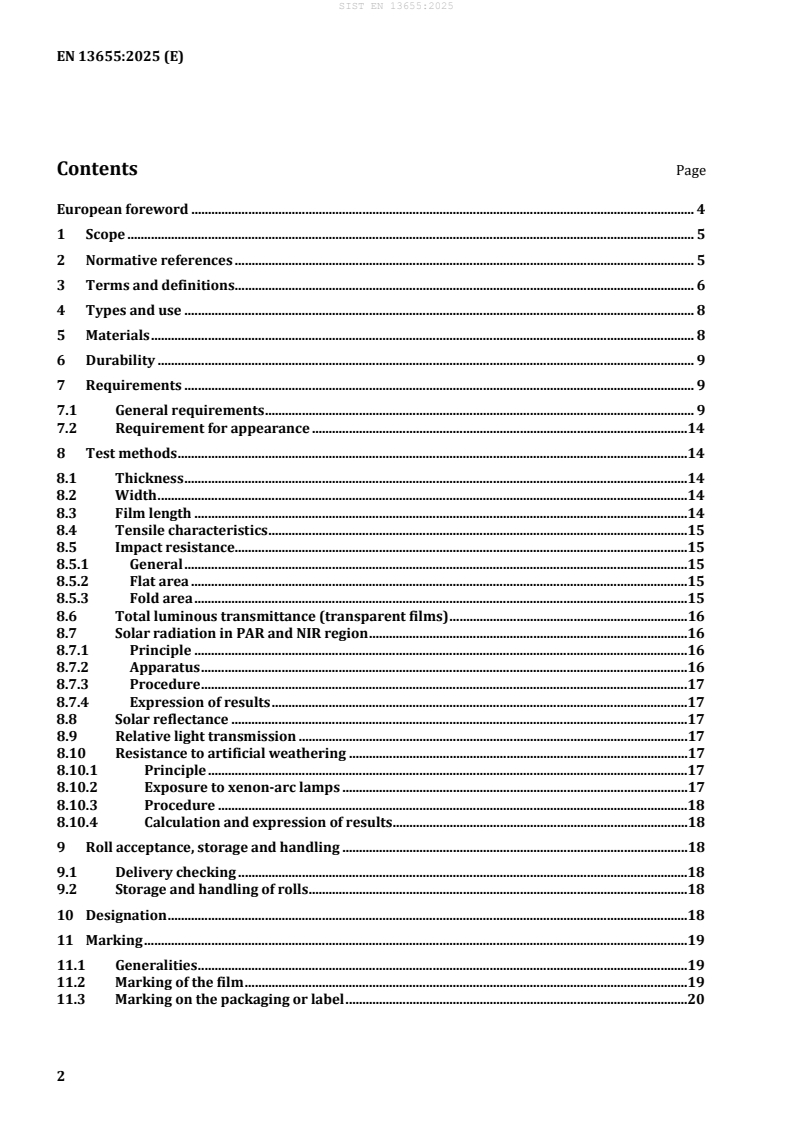
Contents Page
European foreword . 4
1 Scope . 5
2 Normative references . 5
3 Terms and definitions . 6
4 Types and use . 8
5 Materials . 8
6 Durability . 9
7 Requirements . 9
7.1 General requirements . 9
7.2 Requirement for appearance .14
8 Test methods .14
8.1 Thickness .14
8.2 Width .14
8.3 Film length .14
8.4 Tensile characteristics .15
8.5 Impact resistance.15
8.5.1 General .15
8.5.2 Flat area .15
8.5.3 Fold area .15
8.6 Total luminous transmittance (transparent films) .16
8.7 Solar radiation in PAR and NIR region .16
8.7.1 Principle .16
8.7.2 Apparatus .16
8.7.3 Procedure .17
8.7.4 Expression of results .17
8.8 Solar reflectance .17
8.9 Relative light transmission .17
8.10 Resistance to artificial weathering .17
8.10.1 Principle .17
8.10.2 Exposure to xenon-arc lamps .17
8.10.3 Procedure .18
8.10.4 Calculation and expression of results .18
9 Roll acceptance, storage and handling .18
9.1 Delivery checking .18
9.2 Storage and handling of rolls .18
10 Designation .18
11 Marking .19
11.1 Generalities .19
11.2 Marking of the film .19
11.3 Marking on the packaging or label .20
12 Instructions for storage, installation and use of mulch films. 20
13 Design for mechanical recycling and end of life of mulch films . 21
14 Removal and collection instructions of used mulch films . 22
15 Functions and factors of degradability of mulch films . 22
Annex A (informative) Exposure to other light sources . 23
Annex B (informative) Numerical correlation between durations of mulching films exposed to
artificial weathering and natural exposure . 27
Annex C (normative) Determination of solar reflectance . 30
Annex D (normative) Determination of the relative light transmission . 32
Annex E (informative) Guidance main functions of mulch films factors influencing degradability
........................................................................................................................................................................................... 33
Bibliography . 34
European foreword
This document (EN 13655:2025) has been prepared by Technical Committee CEN/TC 249 “Plastics”, the
secretariat of which is held by SIS.
This European Standard shall be given the status of a national standard, either by publication of an
identical text or by endorsement, at the latest by February 2026, and conflicting national standards shall
be withdrawn at the latest by February 2026.
Attention is drawn to the possibility that some of the elements of this document may be the subject of
patent rights. CEN shall not be held responsible for identifying any or all such patent rights.
This document supersedes EN 13655:2018.
— Clause 5 on materials has been extended;
— Clause 10, Clause 11 and Clause 12 on designation, marking and instructions for storage, installation
and use of mulch films, respectively, have been modified;
— Clause 13 on the design-for-recycling of end of life of mulch films has been added;
— Clause 14 on removal and collection instructions of used mulch films has been modified, referring to
EN 18109 for additional information;
— the informative Annex E has been modified, and previous Clauses E.3 and E.4 have been transferred
to EN 18109;
— Details on functions and factors of degradability of mulch films have been transferred to Clause 15 in
this document;
— the previous Annex E on the guidance for conditions for installation, use and removal of mulch films
has been transferred to EN 18109.
This document (EN 13655) has been prepared under a standardization request addressed to CEN by the
European Commission. The Standing Committee of the EFTA States subsequently approves these
requests for its Member States.
Any feedback and questions on this document should be directed to the users’ national standards body.
A complete listing of these bodies can be found on the CEN website.
According to the CEN-CENELEC Internal Regulations, the national standards organisations of the
following countries are bound to implement this European Standard: Austria, Belgium, Bulgaria, Croatia,
Cyprus, Czech Republic, Denmark, Estonia, Finland, France, Germany, Greece, Hungary, Iceland, Ireland,
Italy, Latvia, Lithuania, Luxembourg, Malta, Netherlands, Norway, Poland, Portugal, Republic of North
Macedonia, Romania, Serbia, Slovakia, Slovenia, Spain, Sweden, Switzerland, Türkiye and the United
Kingdom.
Under preparation
1 Scope
This document specifies the requirements related to dimensional, mechanical, optical and thermal
characteristics of thermoplastic films for mulching applications in agriculture and horticulture.
These mulch films are intended to be removed after use and not incorporated in the soil.
These mulch films are not intended to be used for soil disinfection by fumigation. Films for soil
[1] and EN 17098-2 [2].
disinfection are in the scope of EN 17098-1
The biodegradable mulch films intended to be incorporated in the soil after used are also not in the scope
of this document. They are in the scope of EN 17033 [3].
This document specifies a classification for durability of mulching films and the test methods referred to
in this document.
This document is applicable to thermoplastic mulch films, used for agriculture and horticulture in Europe,
based on polyethylene and/or ethylene copolymers, of the following types:
— transparent films;
— black films;
— reflective films (e.g. white films, black/white films and black/silver films);
— films of other colour(s) for weed control (e.g. green, brown).
This document defines the criteria for design for recycling of mulch films and refer to EN 18109 for the
product lifecycle, including installation, use, removal and collection for end of life for management of the
product after its usage.
NOTE Mulch films can be highly soiled by organic and mineral residues at the end of their use life: the observed
rates (or levels) of soilage of mulch films can vary from 70 % to 90 %, therefore the film thickness is a key factor on
the rate of soilage, the thinnest films (e.g. less than 20 micron) will be the mostly soiled, difficult, expensive to
remove, recover and recycle.
2 Normative references
The following documents are referred to in the text in such a way that some or all of their content
constitutes requirements of this document. For dated references, only the edition cited applies. For
undated references, the latest edition of the referenced document (including any amendments) applies.
EN ISO 527-1, Plastics — Determination of tensile properties — Part 1: General principles (ISO 527-1)
EN ISO 527-3, Plastics — Determination of tensile properties — Part 3: Test conditions for films and sheets
(ISO 527-3)
EN ISO 7765-1:2004, Plastics film and sheeting — Determination of impact resistance by the free-falling
dart method — Part 1: Staircase methods (ISO 7765-1:1988)
EN ISO 4892-2:2013, Plastics — Methods of exposure to laboratory light sources — Part 2: Xenon-arc lamps
(ISO 4892-2:2013)
ISO 4591, Plastics — Film and sheeting — Determination of average thickness of a sample, and average
thickness and yield of a roll, by gravimetric techniques (gravimetric thickness)
ISO 4592, Plastics — Film and sheeting — Determination of length and width
ISO 4593, Plastics — Film and sheeting — Determination of thickness by mechanical scanning
ISO 9845-1, Solar energy — Reference solar spectral irradiance at the ground at different receiving
conditions — Part 1: Direct normal and hemispherical solar irradiance for air mass 1,5
ISO 22095, Chain of custody — General terminology and models
ASTM D 1003-13, Standard Test Method for Haze and Luminous Transmittance of Transparent Plastics
3 Terms and definitions
For the purposes of this document, the following terms and definitions apply.
ISO and IEC maintain terminology databases for use in standardization at the following addresses:
— ISO Online browsing platform: available at https://www.iso.org/obp/
— IEC Electropedia: available at https://www.electropedia.org/
3.1
width
total width of a film when laid flat
Note 1 to entry: It is expressed in millimetres, mm.
3.2
nominal width
width of a film, as declared by the manufacturer/supplier
Note 1 to entry: It is expressed in millimetres, mm.
3.3
nominal thickness
thickness of a film, as declared by the manufacturer/supplier
Note 1 to entry: It is expressed in micrometres, μm.
3.4
roll length
largest dimension of the film corresponding to the length of the unwinded roll
Note 1 to entry: It is expressed in metres, m.
3.5
longitudinal direction of the film
MD
direction parallel to the roll length corresponding to the extrusion direction
3.6
transverse direction of the film
TD
direction parallel to the width, at right angles to the length
3.7
radiant exposure
H
time integral of irradiance
−2
Note 1 to entry: It is measured in joules per square metre (J ⋅ m ).
[SOURCE: ISO 9370:2017, 3.27] [4]
3.8
design for recycling
design of product, including the related accessories, in order to ensure its recyclability under the current
practices of removal, sorting, collection and recycling systems
Note 1 to entry: The purpose with the design for recycling criteria is to be able to use the recyclates back in the
same product, independent of producer of material.
[SOURCE: EN 18109:2024, 3.1.13, modified without DFR]
3.9
mechanical recycling
processing of plastic waste into secondary raw materials or products without significantly changing the
chemical structure of the material
Note 1 to entry: Plastic secondary raw material is a synonym of recyclate.
[SOURCE: EN ISO 472:2013, 2.1697, modified — Note 1 to entry changed; “plastics waste” changed to
read “plastic waste”.] [5]
3.10
post-consumer plastic
plastic, generated by the end-users of products, that has fulfilled its intended purpose and can no longer
be used for its intended purpose (including material returned from within the distribution chain)
Note 1 to entry: The term “post-use” is sometimes used synonymously.
Note 2 to entry: Often abbreviated as PCR.
3.11
pre-consumer plastic
plastic diverted from the manufatcuring process
Note 1 to entry: Excluded is reutilization of materials such as rework, regrind or scrap generated in a process and
capable of being reclaimed within the same process that generated it.
3.12
recycled content
proportion, by mass, of recycled plastic in a product or packaging
Note 1 to entry: Only pre consumer and post consumer materials shall be considered as recycled content,
consistent with the following usage of terms.
3.13
controlled blending model
chain of custody model in which materials or products with a set of specified characteristics are mixed
according to certain criteria with materials or products without that set of characteristics resulting in a
known proportion of the specified characteristics in the final output
Note 1 to entry: The adhered claim may refer to a certain percentage, at batch-level and /or site-level.
[SOURCE: ISO 22095: 2020, 3.3.3]
3.14
national collection scheme
NCS
voluntary or mandatory national collection system of defined plastic fractions used in agriculture or
horticulture applications
3.15
specular
indicates that the flux leaves a surface or medium at an angle that is numerically equal to the angle of
incidence, lies in the same plane as the incident ray and the perpendicular, but is on the opposite side of
the perpendicular to the surface
[SOURCE: ISO 16378:2022, 3.16] [6]
4 Types and use
The different types of mulch films, their optical characteristics and use are given in Table 1.
Table 1 — Types and use of mulching films
Type Optical characteristic Use
Transparent film Transparent to sunlight To warm up the soil
radiation
Not used for weed growth control
Black film Very low sunlight transmission When prevention of weeds growth is requested
in with a warming effect of the soil
a
Reflective film Very low sunlight transmission When prevention of weeds growth is requested
and sunlight reflection prevent young leaves
burning and improves photosynthesis by light
reflection
Film of other Selective sunlight transmission When prevention of weeds growth and warming
colour(s) for in PAR (photosynthesis active up of soil are needed
b
weed control radiation) and in near IR
a
E.g. white, black/white and black/silver.
b
E.g. green, brown, etc.
5 Materials
Mulch films according to this document are usually manufactured from polyethylene and polyethylene
copolymers and additives in accordance with requirement in Clause 14. If requested, the density shall be
declared by the film manufacturer in order to calculate the nominal thickness value.
The product shall be suitable for mechanical recycling as a PE fraction, according to the design for
recycling defined in Clause 12.
Recycled content in the film shall be verified with ratio of post-consumer plastic recyclates and/or pre-
consumer plastic recyclates following a controlled blending model according to ISO 22095.
The core, which is a part of the mulch film product, enables unrolling film on field. The core shall be
recyclable and clearly marked for which material fraction to be sorted.
6 Durability
The durability of mulch films is characterized by the class N, A, B, C and D. This classification, given in
Table 2, is depending on the duration of exposure of the film to an artificial weathering using xenon-arc
lamps according to 8.10, which induces a decrease of the value of tensile strain at break equal or less than
50 % of the initial value.
The class of durability shall be declared by the manufacturer/supplier.
Table 2 — Classification according to artificial weathering
Class Minimum duration of exposure
H
At irradiance At irradiance
(narrowband – 340 nm) (narrowband – 340 nm)
2 2
0,35 W/(m ·nm) 0,51 W/(m ·nm)
N 400 280
A 2 000 1 400
B 3 500 2 450
C 5 900 4 070
D 8 160 5 600
Other light sources may be used provided that a correlation between the test results obtained with these
light sources and these obtained after a natural exposure can be demonstrated. This can be useful when
the durations of the exposure to xenon-arc lamps as defined in Table 2 are too long. Details of these
methods are given in Annex A.
In case of dispute the choice of exposure equipment will be decided by the parties. If no agreement can
be found the exposure to xenon-arc lamps with 0,35 W/(m ·nm) at 340nm according to 8.10 and the
classification according to Table 2 shall be used.
NOTE A numerical correlation between durability of mulch films exposed to artificial weathering and natural
exposure is given in Annex B.
7 Requirements
7.1 General requirements
Transparent films, black films, reflective films and films of other colour(s) for weed control shall fulfil the
requirements of Tables 3, 4, 5 and 6, respectively.
Table 3 — Requirements for transparent films
Characteristics Unit Nominal thickness Test method
a
≥ 20 μm ≥ 35 μm Subclause
7.2
Appearance - Shall conform to 7.2
Dimensional characteristics
Tolerance of average
thickness/nominal % ±5 8.1
thickness
Tolerance of single
point % from - 20 to 25 from −15 to 25
8.1
thickness/nominal
b
thickness
%
Max. Tolerance of single 8.1
point
+100
thickness/nominal
thickness at gel
Width tolerance/
% ±2 8.2
nominal width
Tolerances of the roll
% −1 8.3
length/nominal length
Mechanical characteristics of unexposed film
Tensile stress at yield
MPa ≥ 9
(MD, TD)
Tensile stress at break
≥ 20
MPa
(MD, TD) 8.4
Tensile strain at break
≥ 250
%
MD
%
≥ 350
TD
Impact resistance
g ≥ 75 ≥ 80
Flat area 8.5
g ≥ 50 ≥ 60
Fold area
Optical characteristic of unexposed film
Total luminous
% ≥ 90 8.6
transmittance
a
20 μm ≤ nominal thickness < 35 μm.
b
Measurement shall be performed outside of any defects, e.g. gel from recycling material
Table 4 — Requirements for black films
Characteristics Unit Nominal thickness Test
method
a b
≥ 20 μm ≥ 50 μm ≥ 100 μm Subclause
Appearance - Shall conform to 7.2 7.2
Dimensional characteristics
Tolerance of average % 8.1
thickness/nominal ±5
thickness
Tolerance of single point % 8.1
from - 20 to
thickness/nominal ±15 ±15
c
thickness
Max. Tolerance of single % 8.1
point
+100
thickness/nominal
thickness at gel
Width tolerance/ nominal % 8.2
±2
width
Tolerances of the roll
% −1 8.3
length/nominal length
Mechanical characteristics of unexposed film
Tensile stress at yield (MD,
MPa ≥ 9
TD)
Tensile stress at break (MD,
MPa ≥ 20
TD)
8.4
Tensile strain at break
MD % ≥ 250
TD % ≥ 350
Impact resistance
flat area g ≥ 75 ≥ 120 ≥ 250 8.5
fold area g ≥ 50 ≥ 60 ≥ 120
Optical characteristic of unexposed film
−2 −2 −3
Relative light transmission % ≤ 10 ≤ 10 ≤ 10 8.9
a
20 μm ≤ nominal thickness < 50 μm.
b
50 μm ≤ nominal thickness < 100 μm.
c
Measurement shall be performed outside of any defects, e.g. gel from recycling material
Table 5 — Requirements for reflective films (white, black/white, black/silver)
Test
Characteristics Unit Nominal thickness
method
a
≥ 25 μm ≥ 60 μm Subclause
Appearance - Shall conform to 7.2 7.2
Dimensional characteristics
Tolerance of average
% ±5 8.1
thickness/nominal thickness
Tolerance of single point
% from - 20 to 25 ±15 8.1
b
thickness/nominal thickness
Max. Tolerance of single point % 8.1
+100
thickness/nominal thickness at gel
Width tolerance/ nominal width % ±2 8.2
Tolerances of the roll length/nominal
% −1 8.3
length
Mechanical characteristics on unexposed film
Tensile stress at yield
MPa ≥ 9
(MD, TD)
Tensile stress at break
MPa ≥ 20
(MD, TD)
8.4
Tensile strain at break
MD % ≥ 250
TD % ≥ 350
Impact resistance
Flat area g ≥ 80 ≥ 150 8.5
fold area g ≥ 40 ≥ 80
Optical characteristic of unexposed film
Relative light transmission
% ≤ 1 ≤ 0,1 8.9
(for film with at least one black layer)
Relative light transmission
% ≥ 60 ≥ 50 8.9
(for film without black layers)
Solar reflectance
% ≥ 55 ≥ 60 8.8
(for film with at least one white
layer)
To be declared
Solar reflectance
To be declared by
% by the 8.8
the manufacturer
(for film without white layers)
manufacturer
a
25 μm ≤ nominal thickness < 60 μm.
b
Measurement shall be performed outside of any defects, e.g. gel from recycling material
Table 6 — Requirements for films of other colour(s) for weed control
Characteristics Unit Nominal thickness Test method
≥ 25 μm Subclause
Appearance - Shall conform to 7.2 7.2
Dimensional characteristics
Tolerance of average thickness/nominal
% ±5 8.1
thickness
Tolerance of single point
% from - 20 to 25 8.1
a
thickness/nominal thickness
Max. Tolerance of single point % 8.1
+100
thickness/nominal thickness at gel
Width tolerance/ nominal width % ±2 8.2
Tolerances of the roll length/nominal −1
% 8.3
length
Mechanical characteristics of unexposed film
Tensile stress at yield (MD, TD) MPa ≥ 9
Tensile stress at break (MD, TD) MPa ≥ 20
Tensile strain at break 8.4
MD % ≥ 250
TD % ≥ 350
Impact resistance on flat area g ≥ 80 8.5
Optical characteristic of unexposed film
Transmission of solar radiation in the
photosynthesis active radiation (PAR)
Range 400 nm to 500 nm % < 25 8.7
Range 600 nm to 700 nm % < 20
Transmission of solar radiation in the
near-infrared region (NIR)
% > 55 8.7
Range 850 nm to 1 100 nm
a
Measurement shall be performed outside of any defects, e.g. gel from recycling material
7.2 Requirement for appearance
The last turn of the roll shall be sealed with adhesive tape or by some other similar means, in order to
prevent its unwinding before use
The edges shall be properly in line and there shall be sufficient tension to prevent the layers of the roll
from transversal slipping when it is handled.
The film shall be homogeneous for the purpose of the application and checked by unrolling at least 2 m
of the film and examining it against the light, holding it tight at arm’s length.
8 Test methods
8.1 Thickness
The minimum thickness of the single points of the film shall be determined in accordance with ISO 4593.
The average thickness of the film shall be determined in accordance with ISO 4591. Testing is performed
using one strip of film cut in transverse direction of the roll (TD).
8.2 Width
The width of the film shall be determined in accordance with ISO 4592.
8.3 Film length
The length of the film shall be determined by unwinding the roll by means of a calibrated reel in contact
continuously with its outside surface (see Figure 1). The calibrated reel is connected to a revolution
counter. The diameter of the calibrated reel shall be measured with an accuracy of ± 0,2 %. The roll shall
be totally unwound at a speed of 100 m/min ± 10 m/min.
The value of the length of the film is calculated by using Formula (1):
ln=⋅π⋅ d
(1)
where
l is the value of the length of the film, expressed in metres (m);
n is the number of revolutions of the calibrated reel during the total unwinding of the roll;
d is the diameter of the calibrated reel, expressed in metres (m).
Key
1 film roll
2 calibrated reel with a revolution counter
3 collection reel
4 deflection reel
d diameter of the calibrated reel
Figure 1 — Apparatus for the determination of the film length
8.4 Tensile characteristics
The tensile characteristics shall be determined according to EN ISO 527-1 and EN ISO 527-3 using five
test pieces type 2 (see Figure 1 of EN ISO 527-3:2018) with a width of 10 mm, cut in each direction of the
film [longitudinal direction (MD) and transverse direction (TD)], at a testing speed of 500 mm/min.
Calculate the arithmetic average value of the five measurements.
8.5 Impact resistance
8.5.1 General
In case of a folded film, a distinction shall be made between the test pieces taken from the folds (fold area)
and test pieces taken from areas which have not been folded (flat area).
NOTE Films which are wider than 2 000 mm are usually folded lengthwise at least once before winding on a
reel. These folds are retained even when the film is laid out flat, and this can affect test results.
8.5.2 Flat area
The impact resistance (dart drop test) in flat area shall be determined in accordance with
EN ISO 7765-1:2004, method A.
Calculate the impact failure mass m , in grams, in accordance with EN ISO 7765-1.
f
8.5.3 Fold area
The impact resistance (dart drop test) in fold area shall be determined using the apparatus specified in
EN ISO 7765-1:2004, method A.
Spread out the film with the marked face onto the apparatus and test every fold tangentially twice,
alternately internal and external folds, with a mass as specified in Table 3 to Table 6, as applicable. The
tangential test is obtained by shifting forward the fold of 13 mm from the vertical axle of the specimen
clamp (see Figure 2).
If no failure occurs, the result is declared “pass”.
If one failure occurs, carry out two additional tests on the fold which failed in the same position (internal
or external fold). Then, if no failure occurs, the result is declared “pass” and if one or two failure(s)
occur(s), the result is declared “fail”.
If two failures occur, the result is declared “fail”.
Key
1 external fold
2 internal fold
3 film
4 vertical axle of the specimen clamps
d = 13 mm
Figure 2 — Position of impact on folds
8.6 Total luminous transmittance (transparent films)
The total luminous transmittance shall be determined in accordance with ASTM D 1003-13 on five test
pieces cut from the film.
Calculate the arithmetic average value of the five measurements.
8.7 Solar radiation in PAR and NIR region
8.7.1 Principle
The Visible-NIR transmission spectrum within the wavelength range 400 nm to 1 100 nm of a film is
measured by means of spectrophotometer.
8.7.2 Apparatus
8.7.2.1 UV-Visible-Near-IR spectrophotometer equipped with an integrating sphere, capable of
measuring and recording continuously the transmittance at least between 300 nm and 1 200 nm.
8.7.2.2 Software, capable of integrating the transmittance.
8.7.3 Procedure
Carry out the measurement on five test pieces cut from the film.
Set up a test piece on the specimen holder of the integrating sphere and record the transmittance at least
between 300 nm and 1 200 nm.
Determine for each range of wavelength (i.e. 400 nm to 500 nm, 600 nm to 700 nm and 850 nm to
1 100 nm), by using the software, Formula (2):
s
R = (2)
ij−
s
where
s is the area between the line corresponding to a transmittance of 0 % and the curve of the
spectrum;
s is the area between the line corresponding to a transmittance of 0 % and the line
corresponding to a transmittance of 100 %.
These three different ratios correspond to different ranges of wavelengths (λ) on the recorded spectrum:
— R and R in the visible region of the spectrum:
400-500 600-700
— for R the limits of the spectrum are: λ = 400 nm and λ = 500 nm;
400-500
— for R600-700 the limits of the spectrum are: λ = 600 nm and λ = 700 nm.
— R in the Near-IR region of the spectrum:
850-1100
— for R the limits of the spectrum are: λ = 850 nm and λ = 1 100 nm.
850-1100
8.7.4 Expression of results
For each ratio calculate the arithmetic average value of the five measurements.
8.8 Solar reflectance
The solar reflectance shall be determined according to Annex C on five test pieces cut from the film.
8.9 Relative light transmission
The relative light transmission shall be determined in accordance with Annex D on five test pieces cut
from the film.
Calculate the arithmetic average value of the five measurements.
8.10 Resistance to artificial weathering
8.10.1 Principle
The variation of the tensile strain at break of specimens shall be determined before and after an exposure
to xenon-arc lamps.
8.10.2 Exposure to xenon-arc lamps
Carry out the artificial weathering according to EN ISO 4892-2 using the test conditions given in Table 7.
Table 7 — Exposure cycle and test conditions
Irradiance
Exposure Black-
Broadband Narrowband Chamber Relative
standard
conditions
(300 nm to 400 nm) (340 nm) Temperature humidity
Temperature
2 2
W/m W/(m⋅nm) °C %
°C
A 102 min dry 40 ± 2 0,35 ± 0,02 65 ± 3 38 ± 3 50 ± 5
18 min water spray 40 ± 2 0,35 ± 0,02 — — —
B 102 min dry 60 ± 2 0,51 ± 0,02 65 ± 3 38 ± 3 50 ± 5
18 min water spray 60 ± 2 0,51 ± 0,02 — — —
8.10.3 Procedure
Expose the specimens with a backing made of matt aluminium plate according to 8.10.2 during the
minimum duration of exposure specified in Table 2, corresponding to the class of durability of the film.
After the exposure, determine the tensile strain at break according to EN ISO 527-1 and EN ISO 527-3,
using five type 2 test pieces, (see Figure 1 of EN ISO 527-3:2018), 10 mm wide, 150 mm long, taken
longitudinally in the film (MD), at a test speed of 500 mm/min.
8.10.4 Calculation and expression of results
Calculate the arithmetic mean value of the five measurements performed on the test pieces cut from the
exposed specimens and the arithmetic mean value of the five measurements performed on the test pieces
cut from the unexposed specimens in longitudinal direction (MD) (see 8.4). Compare these two values.
The test is considered successful when the value calculated for specimens exposed to artificial weathering
is equal or greater than 50 % of the value calculated for unexposed specimens.
9 Roll acceptance, storage and handling
9.1 Delivery checking
Carefully examine the rolls upon delivery in order to find any apparent damage or anomalies.
If a defect is found, take the necessary actions for the case.
Whenever possible, it is recommended to take a photograph of the damage.
9.2 Storage and handling of rolls
The rolls shall be carried, not dragged over the ground or any other surface.
Keep the films in their original packaging and store them in a location protected from the elements (e.g.
sunlight, heat, rain).
It is recommended that the films be used within six months of delivery.
It is recommended that rolls delivered with a cardboard core be stored in a dry location.
Handling of rolls should be performed horizontally.
10 Designation
The designation of the film shall include the following information:
a) manufacturer’s trademark
b) reference to this document, i.e. EN 13655;
c) use of the film: MULCHING FILM with the type according to Table 1 of this document;
d) nominal width of the film in millimetres;
e) nominal roll length in metres;
f) nominal thickness of the film in micrometres (μm), if required;
g) colour when applicable;
h) class of durability according to Table 2;
i) declared minimum content of recycled post-consumer plastic (percentage of total mass) when post-
consumer plastic is integrated.
NOTE Content of recycled pre-consumer material can also be declared separately.
EXAMPLE The marking of a black mulch film, 5 000 mm wide, in roll of length 1 000 m, 30 μm thickness, and
with a duration of exposure to an artificial weathering, conforming to 8.10 of 1 700 h, manufactured with at least
50 % of recycled material by TRADEMARK:
TRADEMARK, EN 13655 BLACK FILM 5000 1000 30 A 50 % PCR
External documentary evidence may be requested by the purchaser or interested third parties as
collection schemes for used products.
11 Marking
11.1 Generalities
The purpose of marking is to ensure traceability of the product, conformity to this document and possibly
additional instructions for installation, use and removal.
11.2 Marking of the film
A marking shall be printed along the edges of the film and shall include at least the following information:
a) manufacturer's trademark;
b) reference to this document, i.e. EN 13655;
c) class of durability according to Table 2;
d) manufacturing code, including traceability to define manufacturing date;
Optional information:
e) nominal width, in millimetres (mm);
f) nominal length in meters (m);
g) thickness in micrometres (µm);
h) recovery logo;
i) declared minimum content of recycled post-consumer plastic (percentage of total mass) when post-
consumer plastic is integrated.
NOTE Content of recycled pre-consumer plastic can also be declared separately.
EXAMPLE The marking of a black mulch film, 5 000 mm wide, in roll of length 1 000 m, 30 μm thickness, and
with a duration of exposure to an artificial weathering, conforming to 8.10 of 1 700 h, manufactured with at least
50 % of recycled material by TRADEMARK:
TRADEMARK, EN 13655 BLACK FILM 2014-06 RXX d9XX 5000 1000 30 A 50 % PCR
11.3 Marking on the packaging or label
Marking on the packaging or label shall include at least the following information:
a) manufacturer's trademark;
b) reference to this document, i.e. EN 13655;
c) type of film see Table 1;
d) nominal width, in millimetres (mm);
e) nominal length in metres (m);
f) nominal thickness in micrometres (µm);
g) class of durability according to Table 2;
h) declared minimum content of recycled post-consumer plastic (percentage of total mass) when post-
consumer plastic is integrated.
NOTE Content of recycled pre-consumer plastic can also be declared separately.
i) manufacturing code, including traceability to define manufacturing date;
Optional information:
j) recovery logo.
EXAMPLE The marking of a black mulch film, 5 000 mm wide, in roll of length 1 000 m, 50 μm thickness, and
with a duration of exposure to an artificial weathering, conforming to 8.10 of 500 h, manufactured with at least
30 % of recycled material by TRADEMARK in June 2014:
TRADEMARK, EN 13655 BLACK FILM 5000 1000 30 A 30 % PCR 2014-06 RXX d9XX
12 Instructions for storage, installation and use of mulch films
The impact of the installation, use, removal and preparation for recycling should be considered when
preparing for the most effective end-of-life for the product.
Appropriate information and training should be given to all the users of plastic for agricultural purposes,
including manufacturer’s staff, agronomic advisers, retailers and final users given in EN 18109.
For the conditions of installation and use, including durability aspects, the instructions of the
manufacturer shall be followed. These instructions can be given in paper form accompanying the film
and/or with a QR code or via internet link printed on labels. In the absence of such instructions, guidance
is given in EN 18109:2025, Clause 5.
In order to ensure traceability, the labels accompanying films or their packaging up to end-of-use shall
be kept. Keeping only the pallet label for homogeneous pallet deliveries is acceptable.
13 Design for mechanical recycling and end of life of mulch films
The purpose with the design for recycling criteria is to be able to use the recyclates from mulch film back
in the same product, independent of producer of material.
The design for mechanical recycling criteria for mulch film are described in Table 8. The material can be
recycled with other processes but criteria need to be defined for e.g. chemical recycling or physical
recycling.
The design for mechanical recycling criteria for related components to mulch film is described in Table 9.
The material can be recycled with other processes but criteria need to be defined for e.g. chemical
recycling or physical recycling.
It is recommended to use recyclates coming from plastic collected by an NCS dedicated to agriculture.
Table 8 — Guideline design for recycling of a mulching film
Full compatibility with PE mulch No compatibility with PE mulch film
film recycling recycling
Materials PE (PE-LD, PE-LLD); PE-HD, polar PP, PET; PVC; PS; biodegradable,
ethylene copoly
...