


EN 14995:2006
(Main)Plastics - Evaluation of compostability - Test scheme and specifications
Plastics - Evaluation of compostability - Test scheme and specifications
This European Standard specifies requirements and procedures to determine the compostability or anaerobic treatability of plastic materials by addressing four characteristics:
I) biodegradability,
II) disintegration during biological treatment,
III) effect on the biological treatment process and
IV) effect on the quality of the resulting compost.
NOTE For packaging EN 13432 applies.
Kunststoffe - Bewertung der Kompostierbarkeit - Prüfschema und Spezifikationen
Diese Europäische Norm legt Anforderungen und Verfahren fest zum Bestimmen der Kompostierbarkeit oder anaeroben Behandelbarkeit von Kunststoffmaterialien mit Hilfe folgender vier Eigenschaften:
1) biologische Abbaubarkeit;
2) Desintegration während der biologischen Behandlung;
3) Auswirkung auf den biologischen Behandlungsprozess;
Auswirkung auf die Qualität des entstandenen Komposts.
Matières plastiques - Evaluation de la compostabilité - Programme d'essais et spécifications
Polimerni materiali - Vrednotenje primernosti za kompostiranje - Preskusna shema in specifikacije
General Information
- Status
- Published
- Publication Date
- 12-Dec-2006
- Withdrawal Date
- 29-Jun-2007
- Technical Committee
- CEN/TC 249 - Plastics
- Drafting Committee
- CEN/TC 249/WG 9 - Characterisation of degradability
- Current Stage
- 9093 - Decision to confirm - Review Enquiry
- Start Date
- 26-Aug-2023
- Completion Date
- 14-Apr-2025
Overview
EN 14995:2006 (CEN) - "Plastics - Evaluation of compostability - Test scheme and specifications" defines a harmonised European framework to determine whether plastic materials are suitable for organic recovery (composting or anaerobic treatability). The standard addresses four core characteristics: biodegradability, disintegration during biological treatment, effects on the biological treatment process, and effects on the quality of the resulting compost. (Note: packaging-specific requirements fall under EN 13432.)
Key topics and technical requirements
- Four assessment pillars
- Biodegradability (ultimate and inherent)
- Disintegration under biological treatment
- No negative effect on the biological treatment process
- No adverse effect on final compost quality
- Assessment workflow
- Characterization (constituents, hazardous substances, organic carbon, total dry solids, volatile solids)
- Laboratory biodegradability tests
- Pilot-scale or full-scale disintegration tests
- Compost quality and ecotoxicity evaluation
- Recognizability for end users (labelling/identification)
- Required test methods (normative references)
- EN ISO 14855 (controlled aerobic composting, CO2 evolution)
- EN ISO 14851 / EN ISO 14852 (aqueous medium biodegradability with O2/CO2 measures)
- ISO 16929 (pilot-scale disintegration under composting conditions)
- OECD 208 (terrestrial plant growth test) used for ecotoxicity with modifications in Annex D
- Chemical limits and pass criteria
- Minimum volatile solids: 50% (to exclude largely inert materials)
- Heavy metals limits (mg/kg dry substance): e.g., Zn 150, Cu 50, Ni 25, Cd 0.5, Pb 50, Hg 0.5, Cr 50, Mo 1, Se 0.75, As 5, F 100 (Table A.1)
- Exemptions
- Materials demonstrated compostable in one form are accepted in other forms with equal or smaller mass-to-surface ratio and wall thickness.
Applications and users
- Manufacturers of biodegradable/compostable plastics and polymer formulations seeking market claims for organic recoverability.
- Composting facility operators and waste-management authorities evaluating feedstock compatibility and process impacts.
- Test laboratories performing biodegradability, disintegration, and ecotoxicity analyses.
- Product designers and sustainability teams assessing end-of-life recovery routes (composting vs. anaerobic treatment).
- Regulators and certification bodies referencing European harmonised criteria for compostable materials.
Practical value
- Provides a structured, test-based route to support compostability claims.
- Helps prevent introduction of hazardous constituents into biowaste streams.
- Aligns laboratory and pilot/full‑scale testing to real composting conditions, improving reliability of compost quality outcomes.
Related standards
- EN 13432 (packaging compostability)
- EN ISO 14855, EN ISO 14851, EN ISO 14852 (biodegradability test methods)
- ISO 16929 (disintegration pilot-scale test)
- OECD 208 (plant growth ecotoxicity test)



Frequently Asked Questions
EN 14995:2006 is a standard published by the European Committee for Standardization (CEN). Its full title is "Plastics - Evaluation of compostability - Test scheme and specifications". This standard covers: This European Standard specifies requirements and procedures to determine the compostability or anaerobic treatability of plastic materials by addressing four characteristics: I) biodegradability, II) disintegration during biological treatment, III) effect on the biological treatment process and IV) effect on the quality of the resulting compost. NOTE For packaging EN 13432 applies.
This European Standard specifies requirements and procedures to determine the compostability or anaerobic treatability of plastic materials by addressing four characteristics: I) biodegradability, II) disintegration during biological treatment, III) effect on the biological treatment process and IV) effect on the quality of the resulting compost. NOTE For packaging EN 13432 applies.
EN 14995:2006 is classified under the following ICS (International Classification for Standards) categories: 13.030.99 - Other standards related to wastes; 83.080.01 - Plastics in general. The ICS classification helps identify the subject area and facilitates finding related standards.
You can purchase EN 14995:2006 directly from iTeh Standards. The document is available in PDF format and is delivered instantly after payment. Add the standard to your cart and complete the secure checkout process. iTeh Standards is an authorized distributor of CEN standards.
Standards Content (Sample)
2003-01.Slovenski inštitut za standardizacijo. Razmnoževanje celote ali delov tega standarda ni dovoljeno.Plastics - Evaluation of compostability - Test scheme and specificationsPolimerni materiali - Vrednotenje primernosti za kompostiranje - Preskusna shema in specifikacijeMatieres plastiques - Evaluation de la compostabilité - Programme d'essais et spécificationsKunststoffe - Bewertung der Kompostierbarkeit - Prüfschema und SpezifikationenTa slovenski standard je istoveten z:EN 14995:2006SIST EN 14995:2007en;fr;de83.080.01Polimerni materiali na splošnoPlastics in general13.030.99Drugi standardi v zvezi z odpadkiOther standards related to wastesICS:SLOVENSKI
STANDARDSIST EN 14995:200701-april-2007
EUROPEAN STANDARDNORME EUROPÉENNEEUROPÄISCHE NORMEN 14995December 2006ICS 13.030.99; 83.080.01 English VersionPlastics - Evaluation of compostability - Test scheme andspecificationsMatières plastiques - Evaluation de la compostabilité -Programme d'essais et spécificationsKunststoffe - Bewertung der Kompostierbarkeit -Prüfschema und SpezifikationenThis European Standard was approved by CEN on 9 November 2006.CEN members are bound to comply with the CEN/CENELEC Internal Regulations which stipulate the conditions for giving this EuropeanStandard the status of a national standard without any alteration. Up-to-date lists and bibliographical references concerning such nationalstandards may be obtained on application to the Central Secretariat or to any CEN member.This European Standard exists in three official versions (English, French, German). A version in any other language made by translationunder the responsibility of a CEN member into its own language and notified to the Central Secretariat has the same status as the officialversions.CEN members are the national standards bodies of Austria, Belgium, Cyprus, Czech Republic, Denmark, Estonia, Finland, France,Germany, Greece, Hungary, Iceland, Ireland, Italy, Latvia, Lithuania, Luxembourg, Malta, Netherlands, Norway, Poland, Portugal, Romania,Slovakia, Slovenia, Spain, Sweden, Switzerland and United Kingdom.EUROPEAN COMMITTEE FOR STANDARDIZATIONCOMITÉ EUROPÉEN DE NORMALISATIONEUROPÄISCHES KOMITEE FÜR NORMUNGManagement Centre: rue de Stassart, 36
B-1050 Brussels© 2006 CENAll rights of exploitation in any form and by any means reservedworldwide for CEN national Members.Ref. No. EN 14995:2006: E
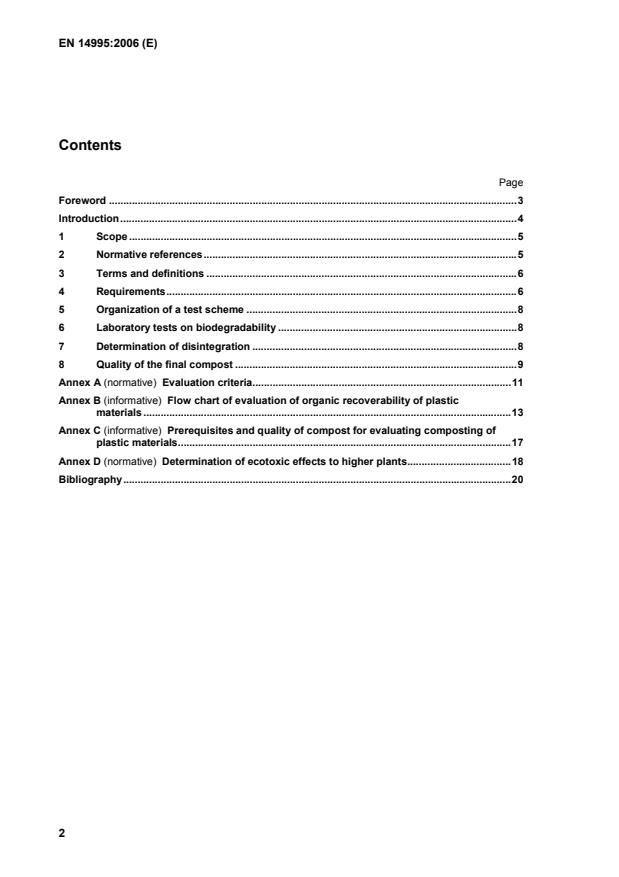
Evaluation criteria.11 Annex B (informative)
Flow chart of evaluation of organic recoverability of plastic materials.13 Annex C (informative)
Prerequisites and quality of compost for evaluating composting of plastic materials.17 Annex D (normative)
Determination of ecotoxic effects to higher plants.18 Bibliography.20
biodegradability, II)
disintegration during biological treatment, III)
effect on the biological treatment process and IV)
effect on the quality of the resulting compost. NOTE For packaging EN 13432 applies. 2 Normative references The following referenced documents are indispensable for the application of this document. For dated references, only the edition cited applies. For undated references, the latest edition of the referenced document (including any amendments) applies. EN ISO 14851, Determination of the ultimate aerobic biodegradability of plastic materials in an aqueous medium - Method by measuring the oxygen demand in a closed respirometer (ISO 14851:1999)
EN ISO 14852, Determination of the ultimate aerobic biodegradability of plastic materials in an aqueous medium — Method by analysis of evolved carbon dioxide (ISO 14852:1999) EN ISO 14855, Determination of the ultimate aerobic biodegradability and disintegration of plastic materials under controlled composting conditions — Method by analysis of evolved carbon dioxide (ISO 14855:1999) ISO 16929, Plastics — Determination of the degree of disintegration of plastic materials under defined composting conditions in a pilot-scale test OECD Guidelines for Testing of Chemicals 208: Terrestrial Plants, Growth Test; Organisation for Economic Co-operation and Development, 2 rue André Pascal, F - 75775 Paris
Control of constituents Constituents known to be, or expected to become, harmful to the environment during the biological treatment process (see Clause 8), in excess of the limits given in A.1, shall not be deliberately introduced into plastic materials intended to be designated as suitable for organic recovery. 4.2
Assessment 4.2.1 General Except as identified in 4.3, assessment of the biological treatability of plastic materials shall include the following 5 assessment procedures as a minimum: characterization (4.2.2); biodegradability (4.2.3); disintegration including effects on the biological treatment process (4.2.4); compost quality (4.2.5); recognizability (4.2.6).
...
Questions, Comments and Discussion
Ask us and Technical Secretary will try to provide an answer. You can facilitate discussion about the standard in here.
Loading comments...