

EN 14504:2024
(Main)Inland navigation vessels - Floating landing stages and floating bridges on inland waters - Requirements, tests
- Abstract
This document specifies safety requirements for floating landing stages and floating bridges for use by passengers and crew.
Requirements for facilities for supply and waste disposals are not covered by this document.
This document is not applicable to:
- floating landing stages for motor vehicle traffic;
- floating landing stages for recreational craft and inland navigation craft that are not vessels, e.g. floating equipment;
- more severe requirements for floating landing stages used for the transhipment of dangerous goods;
- any gangway required between vessel and floating landing stage;
- specialized floating structures which are not used for passenger traffic or the berthing of vessels;
- floating landing stages and bridges with equipment for cargo handling.
- Status
- Published
- Publication Date
- 08-Oct-2024
- Technical Committee
- CEN/TC 15 - Inland navigation vessels
- Drafting Committee
- CEN/TC 15/WG 2 - Maintenance of Inland navigation standards
- Current Stage
- 6060 - Definitive text made available (DAV) - Publishing
- Start Date
- 09-Oct-2024
- Due Date
- 04-Aug-2025
- Completion Date
- 09-Oct-2024

Overview
EN 14504:2024 - published by CEN - defines safety requirements and tests for floating landing stages and floating bridges on inland waters. Targeting passenger and crew use, this European Standard covers design, strength, buoyancy, stability, equipment, walkways, anchoring and test methods for floating establishments used with inland navigation vessels. EN 14504:2024 supersedes EN 14504:2019 and aligns with the EU technical requirements for inland waterway vessels (Directive (EU) 2016/1629).
Key topics and technical requirements
This standard addresses core technical aspects for floating landing stages and floating bridges:
- Scope and exclusions - applies to passenger/crew installations; excludes vehicle ramps, recreational floating equipment, gangways, cargo-handling structures and installations for dangerous goods transhipment.
- Components and structural requirements - requirements for freeboard, floating bodies and materials used for buoyancy bodies.
- Strength and testing - prescribes structural strength checks and verification tests.
- Buoyancy and stability - intact and damaged stability criteria and associated design situations (Annex A).
- Anchorages and mooring - anchorage devices, pier anchors and mooring line forces for safe berthing.
- Walkways and connecting bridges - design, accessibility (reference to EN 17210), slopes and arrangement of climbing devices.
- Equipment and safety fittings - railings, barriers (EN 711), life‑saving equipment (lifebuoys per EN 14144), lighting, electrical protection (IP ratings per EN 60529) and storage areas.
- Marking and instructions - draught marks, manufacturer’s mark, storage and use instructions.
- Annex B - additional requirements for floating landing stages used in cargo shipping (ramps, bollards, cargo‑specific fittings).
Significant 2024 updates include definitions (e.g., dolphins), climbing device arrangement details, EN 17210 accessibility reference, and the addition of Annex B for cargo-related requirements.
Applications and users
EN 14504:2024 is intended for professionals involved in inland water infrastructure and vessel interfaces, including:
- Port and terminal designers and civil/structural engineers
- Manufacturers and suppliers of floating landing stages and floating bridges
- Inland navigation authorities and regulatory bodies
- Ship operators, ferry companies and port operators responsible for berthing systems
- Safety and compliance officers conducting conformity assessments and testing
Related standards (not exhaustive)
- EN 1990, Eurocode - basis of structural design
- EN 1991-1-4 - wind actions
- EN 711 - railings for decks
- EN 13281 - safety for walkways
- EN 13574 - climbing devices
- EN 14144 / EN 14145 - lifebuoys and holders
- EN 17210 - accessibility and usability of the built environment
Keywords: EN 14504:2024, floating landing stages, floating bridges, inland waters, safety requirements, buoyancy, stability, anchorages, CEN.
Relations
- Effective Date
- 26-Apr-2023
- Effective Date
- 25-Aug-2026
- Effective Date
- 25-Aug-2026
- Effective Date
- 25-Mar-2026
- Effective Date
- 09-Feb-2026
- Effective Date
- 28-Jan-2026
- Effective Date
- 28-Jan-2026
- Refers
EN 13281:2023 - Inland navigation vessels - Safety requirements for walkways and working places - Effective Date
- 28-Jan-2026
- Effective Date
- 28-Jan-2026
- Effective Date
- 28-Jan-2026
- Effective Date
- 28-Jan-2026
- Effective Date
- 28-Jan-2026
- Effective Date
- 28-Jan-2026
- Effective Date
- 28-Jan-2026
- Refers
EN 1991-1-4:2005 - Eurocode 1: Actions on structures - Part 1-4: General actions - Wind actions - Effective Date
- 28-Jan-2026
Get Certified
Connect with accredited certification bodies for this standard

Zavod za gradbeništvo Slovenije (ZAG) - Inšpekcija
ZAG inspection body for construction products, structures, and materials.
Sponsored listings
Frequently Asked Questions
EN 14504:2024 is a standard published by the European Committee for Standardization (CEN). Its full title is "Inland navigation vessels - Floating landing stages and floating bridges on inland waters - Requirements, tests". This standard covers: This document specifies safety requirements for floating landing stages and floating bridges for use by passengers and crew. Requirements for facilities for supply and waste disposals are not covered by this document. This document is not applicable to: - floating landing stages for motor vehicle traffic; - floating landing stages for recreational craft and inland navigation craft that are not vessels, e.g. floating equipment; - more severe requirements for floating landing stages used for the transhipment of dangerous goods; - any gangway required between vessel and floating landing stage; - specialized floating structures which are not used for passenger traffic or the berthing of vessels; - floating landing stages and bridges with equipment for cargo handling.
This document specifies safety requirements for floating landing stages and floating bridges for use by passengers and crew. Requirements for facilities for supply and waste disposals are not covered by this document. This document is not applicable to: - floating landing stages for motor vehicle traffic; - floating landing stages for recreational craft and inland navigation craft that are not vessels, e.g. floating equipment; - more severe requirements for floating landing stages used for the transhipment of dangerous goods; - any gangway required between vessel and floating landing stage; - specialized floating structures which are not used for passenger traffic or the berthing of vessels; - floating landing stages and bridges with equipment for cargo handling.
EN 14504:2024 is classified under the following ICS (International Classification for Standards) categories: 93.140 - Construction of waterways, ports and dykes. The ICS classification helps identify the subject area and facilitates finding related standards.
EN 14504:2024 has the following relationships with other standards: It is inter standard links to EN 14504:2019, ISO 8793:1986, ISO 18421:2016, EN 1991-1-4:2026, EN 60529:1991, EN 13411-2:2001+A1:2008, EN ISO 14122-3:2016, EN 13281:2023, EN ISO 18422:2017, EN 13445-3:2014/prA20:2019, EN 711:2024, EN ISO 1140:2021, EN 790:2001, EN ISO 14122-1:2016, EN 1991-1-4:2005. Understanding these relationships helps ensure you are using the most current and applicable version of the standard.
EN 14504:2024 is available in PDF format for immediate download after purchase. The document can be added to your cart and obtained through the secure checkout process. Digital delivery ensures instant access to the complete standard document.
Standards Content (Sample)
SLOVENSKI STANDARD
01-december-2024
Plovila za celinske vode - Plavajoči privezi in pontonski mostovi na celinskih
vodah - Zahteve, preskusi
Inland navigation vessels - Floating landing stages and floating bridges on inland waters
- Requirements, tests
Fahrzeuge der Binnenschifffahrt - Schwimmende Anlegestellen und schwimmende
Brücken auf Binnengewässern - Anforderungen, Prüfungen
Bateaux de navigation intérieure - Embarcadères flottants et appontements flottants sur
des eaux intérieures - Exigences, essais
Ta slovenski standard je istoveten z: EN 14504:2024
ICS:
93.140 Gradnja vodnih poti, Construction of waterways,
pristanišč in nasipov ports and dykes
2003-01.Slovenski inštitut za standardizacijo. Razmnoževanje celote ali delov tega standarda ni dovoljeno.
EN 14504
EUROPEAN STANDARD
NORME EUROPÉENNE
October 2024
EUROPÄISCHE NORM
ICS 93.140 Supersedes EN 14504:2019
English Version
Inland navigation vessels - Floating landing stages and
floating bridges on inland waters - Requirements, tests
Bateaux de navigation intérieure - Embarcadères Fahrzeuge der Binnenschifffahrt - Schwimmende
flottants et appontements flottants sur des eaux Anlegestellen und schwimmende Brücken auf
intérieures - Exigences, essais Binnengewässern - Anforderungen, Prüfungen
This European Standard was approved by CEN on 23 September 2024.
CEN members are bound to comply with the CEN/CENELEC Internal Regulations which stipulate the conditions for giving this
European Standard the status of a national standard without any alteration. Up-to-date lists and bibliographical references
concerning such national standards may be obtained on application to the CEN-CENELEC Management Centre or to any CEN
member.
This European Standard exists in three official versions (English, French, German). A version in any other language made by
translation under the responsibility of a CEN member into its own language and notified to the CEN-CENELEC Management
Centre has the same status as the official versions.
CEN members are the national standards bodies of Austria, Belgium, Bulgaria, Croatia, Cyprus, Czech Republic, Denmark, Estonia,
Finland, France, Germany, Greece, Hungary, Iceland, Ireland, Italy, Latvia, Lithuania, Luxembourg, Malta, Netherlands, Norway,
Poland, Portugal, Republic of North Macedonia, Romania, Serbia, Slovakia, Slovenia, Spain, Sweden, Switzerland, Türkiye and
United Kingdom.
EUROPEAN COMMITTEE FOR STANDARDIZATION
COMITÉ EUROPÉEN DE NORMALISATION
EUROPÄISCHES KOMITEE FÜR NORMUNG
CEN-CENELEC Management Centre: Rue de la Science 23, B-1040 Brussels
© 2024 CEN All rights of exploitation in any form and by any means reserved Ref. No. EN 14504:2024 E
worldwide for CEN national Members.
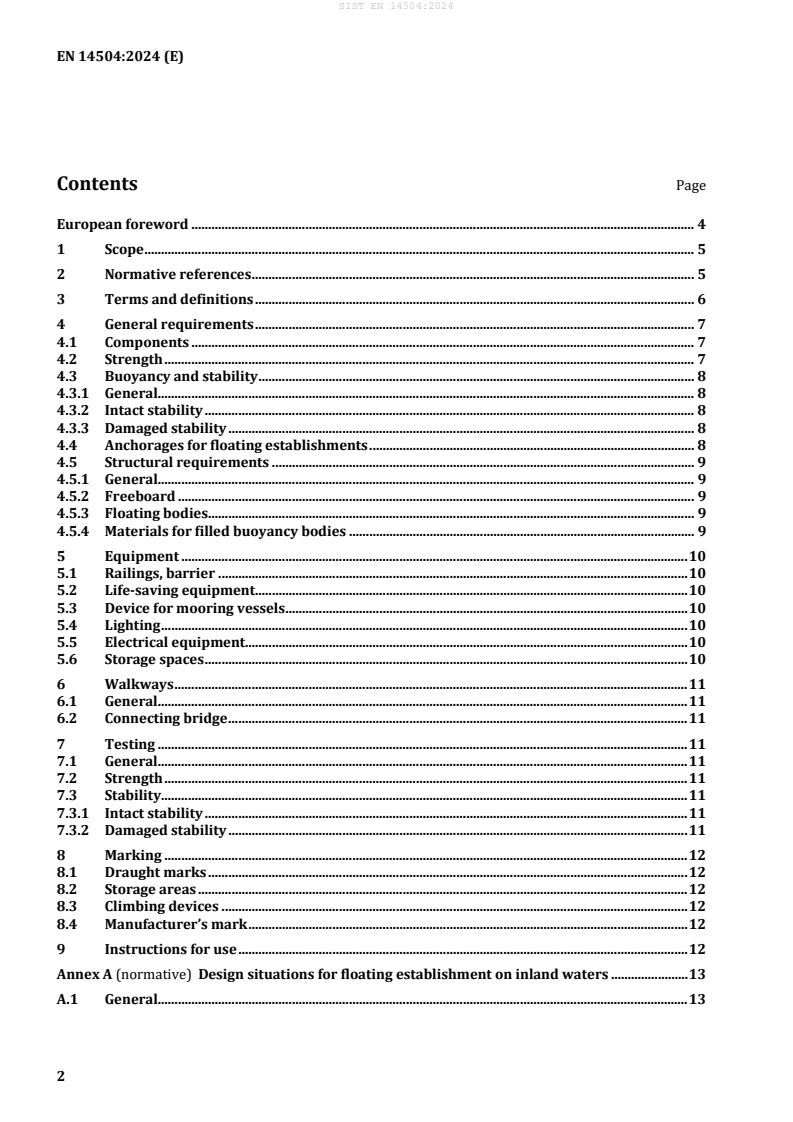
Contents Page
European foreword . 4
1 Scope . 5
2 Normative references . 5
3 Terms and definitions . 6
4 General requirements . 7
4.1 Components . 7
4.2 Strength . 7
4.3 Buoyancy and stability . 8
4.3.1 General. 8
4.3.2 Intact stability . 8
4.3.3 Damaged stability . 8
4.4 Anchorages for floating establishments . 8
4.5 Structural requirements . 9
4.5.1 General. 9
4.5.2 Freeboard . 9
4.5.3 Floating bodies . 9
4.5.4 Materials for filled buoyancy bodies . 9
5 Equipment . 10
5.1 Railings, barrier . 10
5.2 Life-saving equipment. 10
5.3 Device for mooring vessels . 10
5.4 Lighting . 10
5.5 Electrical equipment. 10
5.6 Storage spaces . 10
6 Walkways . 11
6.1 General. 11
6.2 Connecting bridge . 11
7 Testing . 11
7.1 General. 11
7.2 Strength . 11
7.3 Stability . 11
7.3.1 Intact stability . 11
7.3.2 Damaged stability . 11
8 Marking . 12
8.1 Draught marks . 12
8.2 Storage areas . 12
8.3 Climbing devices . 12
8.4 Manufacturer’s mark . 12
9 Instructions for use . 12
Annex A (normative) Design situations for floating establishment on inland waters . 13
A.1 General. 13
A.2 Design situations for floating landing stages . 13
A.3 Design situations for floating bridges . 14
A.4 Actions on floating establishments . 15
A.5 Permanent actions . 16
A.6 Live load and cargo load . 17
A.7 Hydrodynamic actions . 17
A.8 Vessel berthing impact . 20
A.8.1 General . 20
A.8.2 Vessel berthing impact according to Figure A.6 . 20
A.8.3 Vessel berthing impact according to Figure A.7 . 24
A.8.4 Vessel berthing impact according to Figure A.8 . 25
A.8.5 Vessel berthing impact according to Figure A.9 . 25
A.9 Vessel mooring line force of the moored vessel . 26
A.10 Vessel friction . 27
A.11 Wind load . 27
A.12 Special loads . 28
Annex B (normative) Additional requirements for floating landing stages for cargo shipping . 29
B.1 General . 29
B.2 Ramps . 29
B.3 Anchorages, bollards, and other mooring equipment . 31
Bibliography . 32
European foreword
This document (EN 14504:2024) has been prepared by Technical Committee CEN/TC 15 “Inland
navigation vessels”, the secretariat of which is held by DIN.
This European Standard shall be given the status of a national standard, either by publication of an
identical text or by endorsement, at the latest by April 2025, and conflicting national standards shall be
withdrawn at the latest by April 2025.
Attention is drawn to the possibility that some of the elements of this document may be the subject of
patent rights. CEN shall not be held responsible for identifying any or all such patent rights.
This document will supersede EN 14504:2019.
— definition for dolphins added;
— more detailed specification regarding the arrangement of climbing devices in 5.2.2 added;
— reference to EN 17210 regarding accessibility, added in 6.1 and for this the requirement for the
slope angle in 6.2.3 deleted;
— Annex B “Additional requirements for floating landing stages for cargo shipping” added;
— Bibliography updated.
This document specifies safety requirements for floating landing stages and floating bridges on inland
waters within the meaning of European Parliament and Council Directive (EU) 2016/1629 of
14 September 2016 laying down technical requirements for inland waterway vessels.
Any feedback and questions on this document should be directed to the users’ national standards body.
A complete listing of these bodies can be found on the CEN website.
According to the CEN-CENELEC Internal Regulations, the national standards organisations of the
following countries are bound to implement this European Standard: Austria, Belgium, Bulgaria,
Croatia, Cyprus, Czech Republic, Denmark, Estonia, Finland, France, Germany, Greece, Hungary, Iceland,
Ireland, Italy, Latvia, Lithuania, Luxembourg, Malta, Netherlands, Norway, Poland, Portugal, Republic of
North Macedonia, Romania, Serbia, Slovakia, Slovenia, Spain, Sweden, Switzerland, Türkiye and the
United Kingdom.
1 Scope
This document specifies safety requirements for floating landing stages and floating bridges for use by
passengers and crew.
Requirements for facilities for supply and waste disposals are not covered by this document.
This document is not applicable to:
— floating landing stages for motor vehicle traffic;
— floating landing stages for recreational craft and inland navigation craft that are not vessels,
e.g. floating equipment;
— more severe requirements for floating landing stages used for the transhipment of dangerous
goods;
— any gangway required between vessel and floating landing stage;
— specialized floating structures which are not used for passenger traffic or the berthing of vessels;
— floating landing stages and bridges with equipment for cargo handling.
2 Normative references
The following documents are referred to in the text in such a way that some or all of their content
constitutes requirements of this document. For dated references, only the edition cited applies. For
undated references, the latest edition of the referenced document (including any amendments) applies.
EN 711, Inland navigation vessels — Railings for decks and side decks — Requirements, designs and types
EN 790, Inland navigation vessels — Stairs with inclination angles of 45° to 60° — Requirements, types
EN 1492-4, Textile slings — Safety — Part 4: Lifting slings for general service made from natural and
man-made fibre ropes
EN 1990, Eurocode — Basis of structural and geotechnical design
EN 1991-1-4, Eurocode 1: Actions on structures — Part 1-4: General actions — Wind actions
EN 13056, Inland navigation vessels — Stairs with inclination angles of 30° to < 45° — Requirements,
types
EN 13281, Inland navigation vessels — Safety requirements for walkways and working places
EN 13411-2, Terminations for steel wire ropes — Safety — Part 2: Splicing of eyes for wire rope slings
EN 13574, Inland navigation vessels — Permanently installed climbing devices with a length not
exceeding 5 m
EN 14144, Lifebuoys — Requirements, tests
EN 14145, Holders for lifebuoys
EN 17210, Accessibility and usability of the built environment — Functional requirements
EN 60529, Degrees of protection provided by enclosures (IP Code) (IEC 60529)
EN ISO 1140, Fibre ropes — Polyamide — 3-, 4-, 8- and 12-strand ropes (ISO 1140)
EN ISO 1346, Fibre ropes — Polypropylene split film, monofilament and multifilament (PP2) and
polypropylene high-tenacity multifilament (PP3) - 3-, 4-, 8- and 12-strand ropes (ISO 1346)
EN ISO 14122 (all parts), Safety of machinery — Permanent means of access to machinery (ISO 14122
(all parts)
EN ISO 18422, Ships and marine technology — Inland navigation vessels — Plate with instructions for
rescue, resuscitation and first aid for drowning persons (ISO 18422)
ISO 8793, Steel wire ropes — Ferrule-secured eye terminations
ISO 18421, Ships and marine technology — Inland navigation vessels — Lifebuoy housings
3 Terms and definitions
For the purposes of this document, the terms and definitions given in EN 1990 and the following apply.
ISO and IEC maintain terminology databases for use in standardization at the following addresses:
— ISO Online browsing platform: available at https://www.iso.org/obp/
— IEC Electropedia: available at https://www.electropedia.org/
3.1
floating establishment
floating construction used for the safe passage of persons on inland waters
Note 1 to entry: A floating establishment is either a floating landing stage or a floating bridge.
3.1.1
floating landing stage
floating establishment used for berthing and mooring of vessels and for passenger traffic
3.1.2
floating bridge
floating establishment without berth, used solely for passenger traffic and not for berthing or mooring
vessels
3.2
floating body
one or more fixed buoyancy bodies with a traffic area and/or a connecting bridge support
3.3
buoyancy body
body capable of floating that either
— consists of waterproof air chambers or
— is completely filled with a closed-pore material
3.4
connecting bridge
movable traffic area between floating body and shore
3.5
anchorage for the floating establishment
device by which the floating establishment is secured to its berth
3.6
pier anchor
hinged spacer (e.g. mooring arm) for transfering compressive and tensile forces
3.7
freeboard
distance between the plane of maximum draught (waterline) and a parallel plane passing through the
lowest point of the upper edge of the buoyancy body
3.8
residual freeboard
distance between the plane of maximum draught (waterline) and a parallel plane passing through the
lowest point of the upper edge of the buoyancy body in the event of leak
3.9
safety distance
distance between waterline and lowest point of buoyancy body with air chambers that is no longer
watertight
3.10
residual safety distance
distance between the waterline and the lowest point of a buoyancy body with air chambers that is no
longer watertight in the event of a leak
3.11
maximum draught level
draught of the floating establishment at the sum of the maximum actions
3.12
dolphin
permanent pile or bundle of piles with or without mooring system
[SOURCE: EN 14329:2004, 3.7 modified, “or without” has been added]
4 General requirements
4.1 Components
The floating establishment shall consist of floating body, connecting bridge and anchorage.
Additionally, a ramp may be necessary. Additional requirements for components of floating landing
stages for cargo shipping are specified in Annex B.
4.2 Strength
The strength of the components of floating establishments shall be fixed taking into account the actions
described in Annex A.
The strength shall be tested as specified in 7.2.
4.3 Buoyancy and stability
4.3.1 General
In combination with the following proof of buoyancy and stability, for floating establishments the
actions in accordance with Annex A shall have a partial safety coefficient of γ = 1,0.
F
4.3.2 Intact stability
At maximum draught level,
— a freeboard of at least 0,15 m,
— a safety distance of at least 0,30 m, and
— a heeling angle of no more than 10°
shall be maintained.
In addition, the metacentric height for floating establishments under option A (see 4.4) under impacts
as per A.5 to A.7 and A.11 shall be at least 0,15 m. For these structures, heeling motions caused by the
vessel’s movement or by the mooring equipment as well as open areas of liquid, which occur during the
operation of the floating establishment, shall also be taken into consideration.
Intact stability shall be tested as specified in 7.3.1.
4.3.3 Damaged stability
It shall be ensured that the floating establishment will neither sink nor capsize in the case, that one air
chamber is damaged. In this case, a residual freeboard and a residual safety distance each of not less
than 10 cm shall be maintained; if greater residual safety distances or residual freeboards are required
by the specifics of the waterway, these shall be taken into account.
Free surfaces of liquids that can occur during operation shall also be taken into account.
If all buoyancy bodies are completely filled with a material according to 4.5.4, proof of leak stability may
be omitted.
Damage stability shall be tested as specified in 7.3.2.
4.4 Anchorages for floating establishments
Floating establishments shall be anchored in their positions to prevent them from being torn loose or
being displaced by currents, wind, waves, fluctuations in water level or the draught or wash of passing
vessels or possible special loads. In the case of floating landing stages, the influence of berthing ships
shall also be taken into consideration. The functioning capability of the anchoring of the floating
establishment shall also be proven for the case that the floating body of the floating establishment
springs a leak.
Anchorage for the floating establishment shall comply with one of the following two options:
a) option A: the floating establishment shall be secured to the land by means of:
1) chains;
2) steel wire ropes;
3) fibre ropes as per EN ISO 1140 or EN ISO 1346;
4) a pier anchor of appropriate strength and length; or
5) the connecting bridge.
The fastenings shall be secured against deliberate undoing. This requirement is met if it is not
possible to undo the fastenings without the use of a tool.
End connections of steel wire ropes shall be designed as splicers according to EN 13411-2 or by
means of aluminium ferrules according to ISO 8793. Textile slings of fibre ropes shall be designed
according to EN 1492-4;
b) option B: the floating establishment shall be attached to guides or dolphins in accordance with 4.5.3.
4.5 Structural requirements
4.5.1 General
The floating establishment shall be designed so that it can follow all changes in water level during
operation.
4.5.2 Freeboard
Taking into account 4.3, for floating landing stages the height difference between the traffic areas of the
floating body and the deck of the vessel shall be as small as possible for the berthing vessels expected.
For floating bridges the height of the traffic areas of the floating body shall be selected taking 4.3 into
account, so that no waves enter the traffic areas under predictable wind and wave conditions.
4.5.3 Floating bodies
Floating bodies using option B (see 4.4) anchorages shall be fixed so that they cannot twist. The height
of the guides or dolphins shall be sufficient dimensioned so that the floating body is not flooded at the
maximum water level to be expected or the floating body shall be secured against floating away.
Floating bodies shall have one or more buoyancy bodies, which
— comprise a total of at least three watertight air chambers or
— are completely filled with a material according to 4.5.4.
It shall be possible to seal the openings in the air chambers so that they are waterproof.
4.5.4 Materials for filled buoyancy bodies
Materials used to fill the filled buoyancy body shall have closed pores.
The water absorption characteristics of the material shall be taken into consideration during proving.
For buoyancy elements made of expanded polystyrene according to EN 13163, water absorption
characteristics according to EN ISO 16535 of a maximum of 5 % by volume are recommended.
These materials shall be resistant against external influences or protected against such influences.
5 Equipment
5.1 Railings, barrier
5.1.1 The traffic areas on floating landing stages shall be fitted with fixed railings as specified in
EN 711 at points where it is possible to fall into the water or to lower-lying levels when a vessel is
moored. The railings shall be of types PF, PG or PZ.
In areas provided for the berthing of vessels, the distance between the railings and the outer edge of the
floating landing stage shall be at least 0,70 m.
5.1.2 There shall be a barrier at the shore-side access point to the connecting bridge of the floating
landing stage if the design of the landing stage does not prevent persons being subjected to any hazards
when the vessel is going alongside.
5.1.3 Where a fall into the water or onto lower levels is possible, the traffic areas of floating bridges
shall be fitted with Type PF, PG or PZ fixed railings according to EN 711.
5.2 Life-saving equipment
5.2.1 The floating establishments shall have at least one plate with instructions for rescue,
resuscitation and first aid for drowning persons in accordance with EN ISO 18422 and at least
every 100 m one lifebuoy as specified in EN 14144 with a 30 m long floating line and holder as specified
in EN 14145 or housing according to ISO 18421.
5.2.2 Floating establishments with a height of the traffic areas above the water of more than 0,30 m
under dead load shall be equipped at least every 30 m with a permanently installed climbing device
according to EN 13574. The location of the climbing device shall be either at both ends on the
downstream side and/or alongside considering the flow conditions.
5.3 Device for mooring vessels
There shall be at least two bollards on the landing stage side of the floating landing stages. Each bollard
shall withstand at least a vessel mooring line force as specified in A.9. The tops of the bollards shall be of
non skid design and be permanently marked with signal paint.
5.4 Lighting
Lights attached to floating establishment shall not mislead or hinder shipping through dazzling effects
or reflections, nor give rise to confusion with waterway signs or impair their effect.
5.5 Electrical equipment
On the exposed deck, the electrical equipment shall have at least IP55 ingress protection code, in moist
rooms at least IP44 and for installation fittings for currents of 125A and greater at least IP66 according
to EN 60529.
5.6 Storage spaces
If the storing of loads which can influence the stability is foreseen on the deck of the floating body, this
shall be taken into consid
...