


EN 287-1:2011
(Main)Qualification test of welders - Fusion welding - Part 1: Steels
Qualification test of welders - Fusion welding - Part 1: Steels
This European Standard defines the qualification testing of welders for the fusion welding of steels.
It provides a set of technical rules for a systematic qualification test of the welder, and enables such qualifications to be uniformly accepted independently of the type of product, location and examiner/examining body.
When qualifying welders, the emphasis is placed on the welder's ability to manually manipulate the electrode / welding torch / welding blowpipe and thereby producing a weld of acceptable quality.
The welding processes referred to in this standard include those fusion-welding processes which are designated as manual or partly mechanized welding. It does not cover fully mechanized and automated welding processes (see EN 1418).
Prüfung von Schweißern - Schmelzschweißen - Teil 1: Stähle
Diese Europäische Norm definiert die Schweißerprüfung für das Schmelzschweißen von Stählen. Sie stellt eine Reihe technischer Regeln für systematische Prüfungen von Schweißern auf und ermöglicht so, dass solche Qualifizierungen unabhängig von der Art des Erzeugnisses, des Ortes und des Prüfers/der Prüfstelle einheitlich akzeptiert werden. Wenn Schweißer qualifiziert werden, liegt der Schwerpunkt auf der Fähigkeit des Schweißers, den Elektrodenhalter/die Schweißpistole/den Schweißbrenner so zu handhaben, dass damit eine Schweißung von zulässiger Qualität erzeugt wird. Die Schweißprozesse nach dieser Norm schließen nur solche Schmelzschweißprozesse ein, die als Handschweißen oder teilmechanisches Schweißen bezeichnet werden. Sie schließen nicht die vollmechanischen und automatischen Schweißprozesse ein (siehe EN 1418).
Epreuve de qualification des soudeurs - Soudage par fusion - Partie 1 : Aciers
La présente Norme européenne définit l’épreuve de qualification des soudeurs pour le soudage par fusion des
aciers.
Elle fournit un ensemble de règles techniques pour l’épreuve de qualification systématique des soudeurs, et
permet à de telles qualifications d’être acceptées uniformément, indépendamment du type de produit, du lieu
et de l’examinateur ou de l’organisme d’examen.
Lors de la qualification des soudeurs, l’accent est porté sur l’aptitude du soudeur à guider manuellement
l’électrode, la torche ou le chalumeau de soudage pour produire une soudure de qualité acceptable.
Les procédés de soudage concernés par la présente norme sont les procédés de soudage par fusion
désignés en tant que, manuels ou semi-automatiques. Elle ne traite pas des procédés de soudage totalement
mécanisés et automatisés (voir l’EN 1418).
Preskušanje varilcev - Talilno varjenje - 1. del: Jekla
Ta evropski standard določa preskus kvalifikacij varilcev za talilno varjenje jekel.
Podaja nabor tehničnih pravil za sistematično preskušanje kvalifikacij varilca in omogoča, da so tovrstne kvalifikacije enotno sprejete, neodvisno od tipa izdelka, lokacije in preglednika/organa za preverjanje.
Pri kvalifikaciji varilcev je poudarek na varilčevi sposobnosti ročnega upravljanja elektrode/varilnega gorilnika/varilnega pihalnika, da proizvede zvar sprejemljive kakovosti.
Postopki varjenja, navedeni v tem standardu, vključujejo talilne postopke varjenja, ki so opredeljeni kot ročno ali delno mehanizirano varjenje. Ne zajema popolnoma mehaniziranih in avtomatiziranih postopkov varjenja (glej EN 1418).
General Information
- Status
- Withdrawn
- Publication Date
- 12-Jul-2011
- Withdrawal Date
- 15-Oct-2013
- Technical Committee
- CEN/TC 121 - Welding
- Drafting Committee
- CEN/TC 121/SC 4 - Quality management in the field of welding
- Current Stage
- 9960 - Withdrawal effective - Withdrawal
- Start Date
- 16-Oct-2013
- Completion Date
- 16-Oct-2013
- Directive
- 87/404/EEC - Simple pressure vessels
- Directive
- 97/23/EC - Pressure equipment
Relations
- Effective Date
- 16-Jul-2011
- Effective Date
- 16-Jul-2011
- Effective Date
- 16-Jul-2011
- Effective Date
- 17-Oct-2012
- Effective Date
- 28-Jan-2026
- Effective Date
- 28-Jan-2026
- Effective Date
- 28-Jan-2026
- Effective Date
- 28-Jan-2026
- Effective Date
- 28-Jan-2026
- Effective Date
- 28-Jan-2026
- Effective Date
- 28-Jan-2026
- Effective Date
- 28-Jan-2026
- Refers
EN ISO 5173:2010 - Destructive tests on welds in metallic materials - Bend tests (ISO 5173:2009) - Effective Date
- 28-Jan-2026
- Effective Date
- 28-Jan-2026
- Refers
EN 1435:1997 - Non-destructive examination of welds - Radiographic examination of welded joints - Effective Date
- 28-Jan-2026
Get Certified
Connect with accredited certification bodies for this standard

National Aerospace and Defense Contractors Accreditation Program (NADCAP)
Global cooperative program for special process quality in aerospace.
CARES (UK Certification Authority for Reinforcing Steels)
UK certification for reinforcing steels and construction.
DVS-ZERT GmbH
German welding certification society.
Sponsored listings
Frequently Asked Questions
EN 287-1:2011 is a standard published by the European Committee for Standardization (CEN). Its full title is "Qualification test of welders - Fusion welding - Part 1: Steels". This standard covers: This European Standard defines the qualification testing of welders for the fusion welding of steels. It provides a set of technical rules for a systematic qualification test of the welder, and enables such qualifications to be uniformly accepted independently of the type of product, location and examiner/examining body. When qualifying welders, the emphasis is placed on the welder's ability to manually manipulate the electrode / welding torch / welding blowpipe and thereby producing a weld of acceptable quality. The welding processes referred to in this standard include those fusion-welding processes which are designated as manual or partly mechanized welding. It does not cover fully mechanized and automated welding processes (see EN 1418).
This European Standard defines the qualification testing of welders for the fusion welding of steels. It provides a set of technical rules for a systematic qualification test of the welder, and enables such qualifications to be uniformly accepted independently of the type of product, location and examiner/examining body. When qualifying welders, the emphasis is placed on the welder's ability to manually manipulate the electrode / welding torch / welding blowpipe and thereby producing a weld of acceptable quality. The welding processes referred to in this standard include those fusion-welding processes which are designated as manual or partly mechanized welding. It does not cover fully mechanized and automated welding processes (see EN 1418).
EN 287-1:2011 is classified under the following ICS (International Classification for Standards) categories: 25.160.01 - Welding, brazing and soldering in general; 25.160.10 - Welding processes. The ICS classification helps identify the subject area and facilitates finding related standards.
EN 287-1:2011 has the following relationships with other standards: It is inter standard links to EN 287-1:2004/A2:2006, EN 287-1:2004/AC:2004, EN 287-1:2004, EN ISO 9606-1:2013, EN 1320:1996, EN ISO 6947:2019, EN ISO 15608:2025, EN ISO 4063:2009, EN ISO 15609-2:2001, EN ISO 5817:2007, EN ISO 17637:2016, EN 3475-413:2002, EN ISO 5173:2010, EN ISO 15609-1:2004, EN 1435:1997. Understanding these relationships helps ensure you are using the most current and applicable version of the standard.
EN 287-1:2011 is associated with the following European legislation: EU Directives/Regulations: 2009/105/EC, 87/404/EEC, 97/23/EC; Standardization Mandates: M/071. When a standard is cited in the Official Journal of the European Union, products manufactured in conformity with it benefit from a presumption of conformity with the essential requirements of the corresponding EU directive or regulation.
EN 287-1:2011 is available in PDF format for immediate download after purchase. The document can be added to your cart and obtained through the secure checkout process. Digital delivery ensures instant access to the complete standard document.
Standards Content (Sample)
2003-01.Slovenski inštitut za standardizacijo. Razmnoževanje celote ali delov tega standarda ni dovoljeno.Preskušanje varilcev - Talilno varjenje - 1. del: JeklaPrüfung von Schweißern - Schmelzschweißen - Teil 1: StähleEpreuve de qualification des soudeurs - Soudage par fusion - Partie 1 : AciersQualification test of welders - Fusion welding - Part 1: Steels25.160.01Varjenje, trdo in mehko spajkanje na splošnoWelding, brazing and soldering in generalICS:Ta slovenski standard je istoveten z:EN 287-1:2011SIST EN 287-1:2011en,fr,de01-november-2011SIST EN 287-1:2011SLOVENSKI
STANDARDSIST EN 287-1:2004/AC:2004SIST EN 287-1:2004/A2:2006SIST EN 287-1:20041DGRPHãþD
EUROPEAN STANDARD NORME EUROPÉENNE EUROPÄISCHE NORM
EN 287-1
July 2011 ICS 25.160.01 Supersedes EN 287-1:2004English Version
Qualification test of welders - Fusion welding - Part 1: Steels
Epreuve de qualification des soudeurs - Soudage par fusion - Partie 1 : Aciers
Prüfung von Schweißern - Schmelzschweißen - Teil 1: Stähle This European Standard was approved by CEN on 16 June 2011.
CEN members are bound to comply with the CEN/CENELEC Internal Regulations which stipulate the conditions for giving this European Standard the status of a national standard without any alteration. Up-to-date lists and bibliographical references concerning such national standards may be obtained on application to the CEN-CENELEC Management Centre or to any CEN member.
This European Standard exists in three official versions (English, French, German). A version in any other language made by translation under the responsibility of a CEN member into its own language and notified to the CEN-CENELEC Management Centre has the same status as the official versions.
CEN members are the national standards bodies of Austria, Belgium, Bulgaria, Croatia, Cyprus, Czech Republic, Denmark, Estonia, Finland, France, Germany, Greece, Hungary, Iceland, Ireland, Italy, Latvia, Lithuania, Luxembourg, Malta, Netherlands, Norway, Poland, Portugal, Romania, Slovakia, Slovenia, Spain, Sweden, Switzerland and United Kingdom.
EUROPEAN COMMITTEE FOR STANDARDIZATION
COMITÉ EUROPÉEN DE NORMALISATION EUROPÄISCHES KOMITEE FÜR NORMUNG
Management Centre:
Avenue Marnix 17,
B-1000 Brussels © 2011 CEN All rights of exploitation in any form and by any means reserved worldwide for CEN national Members. Ref. No. EN 287-1:2011: ESIST EN 287-1:2011
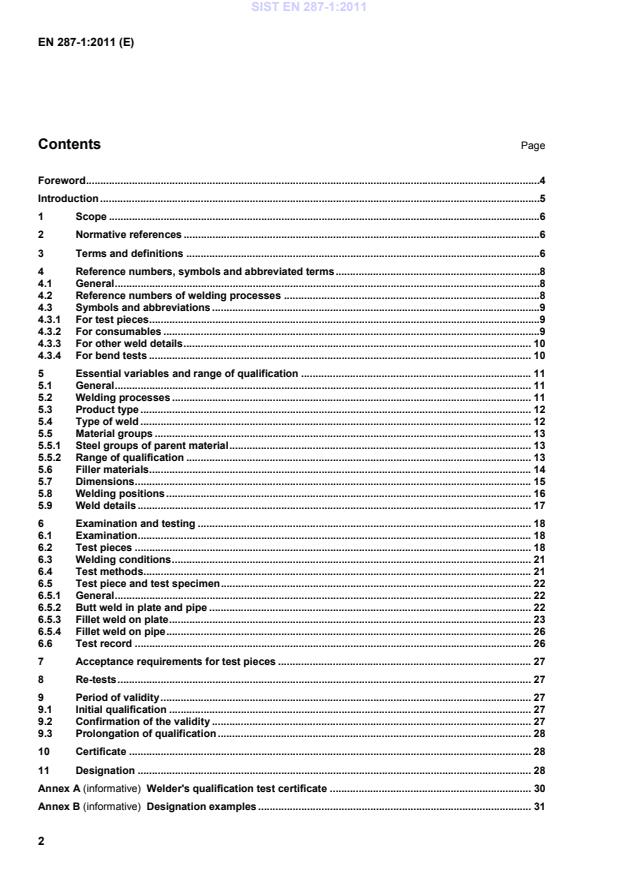
Welder's qualification test certificate . 30Annex B (informative)
Designation examples . 31SIST EN 287-1:2011
Job knowledge . 35C.1 General . 35C.2 Requirements . 35C.2.1 Welding equipment . 35C.2.2 Welding process
................................................................................................................................. 36C.2.3 Parent metals ....................................................................................................................................... 36C.2.4 Welding consumables ......................................................................................................................... 36C.2.5 Safety precautions .............................................................................................................................. 37C.2.6 Welding sequences/procedures ........................................................................................................ 37C.2.7 Joint preparation and weld representation....................................................................................... 37C.2.8 Weld imperfections ............................................................................................................................. 37C.2.9 Welder qualification ............................................................................................................................ 38Annex ZA (informative)
Relationship between this European Standard and the Essential Requirements of EC Directive 97/23/EC . 39Bibliography . 40 SIST EN 287-1:2011
manual metal arc welding; 114
self-shielded tubular-cored arc welding; 121
submerged arc welding with solid wire electrode (partly mechanized); 125
submerged arc welding with tubular cored electrode (partly mechanized); 131
MIG welding with solid wire electrode; SIST EN 287-1:2011
MAG welding with solid wire electrode; 136
MAG welding with flux cored electrode; 138
MAG welding with metal cored electrode; 141
TIG welding with solid filler material; 142
Autogenous TIG welding; 143
TIG welding with tubular cored filler material; 145
TIG welding using reducing gas and solid filler material; 15
plasma arc welding; 311
oxy-acetylene welding. NOTE The principles of this standard can be applied to other fusion welding processes. 4.3 Symbols and abbreviations 4.3.1 For test pieces BW
butt weld D
outside pipe diameter FW
fillet weld l1
length of test piece l2
half width of test piece lf
examination length P
plate ReH
yield strength s1
deposited thickness of weld metal for welding process 1 s2
deposited thickness of weld metal for welding process 2 t
material thickness of test piece (plate or wall thickness) T
pipe 1) 4.3.2 For consumables nm
no filler metal A
acid covering
1) The word "pipe" alone or in combination, is used to mean "pipe", "tube" or "hollow section". SIST EN 287-1:2011
basic covering or electrode core - basic C
cellulosic covering M
electrode core - metal powder P
electrode core - rutile, fast freezing slag R
rutile covering or electrode core – rutile, slow freezing slag RA
rutile-acid covering RB
rutile-basic covering RC
rutile-cellulosic covering RR
rutile-thick covering S
solid wire/rod V
electrode core - rutile or basic / fluoride W
electrode core - basic / fluoride, slow freezing slag Y
electrode core - basic / fluoride, fast freezing slag Z
electrode core - other types 4.3.3 For other weld details bs
welding from both sides lw
leftward welding mb
welding with backing ml
multi layer nb
welding without backing rw
rightward welding sl
single layer
ss
single-side welding 4.3.4 For bend tests A
minimum tensile elongation required by the material specification d
diameter of the former or the inner roller ts
thickness of the bend test specimen SIST EN 287-1:2011
Key 1 Welding process 1 (nb) 2 Welding process 2 (mb) according to Table 5 for welding process 1: t = s1 for welding process 2: t = s2 according to Table 5 with t = s1 + s2
Key 1 Welding process 1 according to Table 5 for welding process 1: t =
s1 for welding process 2: t = s2 according to Table 5 t = s1 + s2 welding process 1 only for welding of the root area
Key 2 Welding process 2 3 Welding with backing (mb) 4 Welding without backing (nb)
5.3 Product type The qualification test shall be carried out on plate or pipe. The following criteria are applicable: a) Test piece welds with outside pipe diameter D > 25 mm cover welds in plates; b) Test piece welds in plates cover welds in pipes of outside pipe diameter D ≥ 150 mm, for welding positions PA, PB and PC, according to range of qualification of Table8; c) Test piece welds in plates cover welds in pipe of outside pipe diameter D ≥ 500 mm for all other welding positions. 5.4 Type of weld The qualification test shall be carried out as butt or fillet weld. The following criteria are applicable: a) butt welds cover butt welds in any type of joint except branch connections (see also 5.4 d)); b) butt welds do not qualify fillet welds or vice versa; SIST EN 287-1:2011
CEN ISO/TR 20172, CEN ISO/TR 20173 and CEN ISO/TR 20174. 5.5.2 Range of qualification The welding of any one metal in a material group covers qualification on the welder for the welding of all other metal within the same material group as well as other material groups according to Table 2. When welding parent materials outside the grouping system, a separate qualification test is required. Qualification of dissimilar metal joints: When using filler metals from the material group 8 or 10 (see Table 2), all combinations with the material group 8 or 10 to other material groups are covered. A qualification test made on wrought material groups gives qualification for cast material and a mixture of cast and wrought material in the same material group. SIST EN 287-1:2011
of the test piece Range of qualification 1.1 1.2 1.4 1.3 2 3 4 5 6 7 8 9 10 11
9.1 9.2 + 9.3
1.1, 1.2, 1.4 × – – – – – – – – – – – – 1.3 × × × × – – – – – × – – × 2 × × × × – – – – – × – – × 3 × × × × – – – – – × – – × 4 × × × × × × × × – × – – × 5 × × × × × × × × – × – – × 6 × × × × × × × × – × – – × 7 × × × × × × × × – × – – × 8 – – – – – – – – × – × × – 9 9.1 × × × × – – – – – × – – × 9.2 + 9.3 × – – – – – – – – – × – – 10 – – – – – – – – × – × × – 11 × × – – – – – – – – – – × a Material group according to CEN ISO/TR 15608. Key × indicates those material groups for which the welder is qualified. – indicates those material groups for which the welder is not qualified.
5.6 Filler materials Welding with filler material qualifies for welding without filler material, but not vice versa. The ranges of qualification for filler materials are given in Tables 3 and 4. Table 3 — Range of qualification for covered electrodes a, b Electrode used in the test
Range of qualification A, RA, RB, RC, RR, R B C A, RA, RB, RC, RR, R × – – B × × – C – – × a Abbreviations, see 4.3.2. b The type of core used in the qualification test of welders for root run welding without backing (ss nb) is the type of
core qualified for root run welding in production. Key ×
indicates those covered electrodes for which the welder is qualified. –
indicates those covered electrodes for which the welder is not qualified.
(R, P, V, W, Y, Z) – – – × a Abbreviations, see 4.3.2. b The type of core used in the qualification test of welders for root run welding without backing (ss nb) is the type of
core qualified for root run welding in production. Key ×
indicates those filler materials for which the welder is qualified. –
indicates those filler materials for which the welder is not qualified.
5.7 Dimensions The welder qualification test of butt welds is based on the material thickness and outside pipe diameters. The ranges of qualification are specified in Tables 5 and 6. NOTE It is not intended that material thickness or outside pipe diameters should be measured precisely but rather the general philosophy behind the values given in Tables 5 and 6 should be applied. For fillet welds the range of qualification for material thickness is specified in Table 7. For test pieces of different outside pipe diameters and deposited thicknesses, the welder is qualified for: thinnest through to the thickest weld metal and/or parent metal thickness qualified (refer to Table 5); and the smallest through to the largest diameter qualified (refer to Table 6). Table 5 — Range of qualification of material thickness and deposited thickness of weld metal (multi process) of test piece for butt welds Dimension in millimetres Thicknessa
t Range of qualification t < 3 t to 2 × t b 3 ≤ t ≤ 12 3 to 2 × t c t > 12 ≥ 5 a For multi processes, s1 and s2 of Table 1 apply. b For oxy-acetylene welding (311): t to 1,5
× t . c For oxy-acetylene welding (311): 3 mm to 1,5
× t . SIST EN 287-1:2011
Table 7 — Range of qualification of material thickness of test piece for fillet welds a Dimension in millimetres Material thickness of test piece t Range of qualification t < 3 t to 3 t ≥ 3 ≥ 3 a See also Table 10. In the case of branch welding, the material thickness criteria to which Table 5 applies and the outside pipe diameter criteria to which Table 6 applies is as follows: Set on: The material thickness and outside pipe diameter of the branch; Set in or set through: The material thickness of the main pipe or shell and the outside pipe diameter of the branch. 5.8 Welding positions The range of qualification for each welding position is given in Table 8. The welding positions and symbols refer to EN ISO 6947. The test pieces shall be welded in accordance with the testing positions according to EN ISO 6947. Welding two pipes with the same outside pipe diameter, one in welding position
...
Questions, Comments and Discussion
Ask us and Technical Secretary will try to provide an answer. You can facilitate discussion about the standard in here.
Loading comments...