

EN 12385-5:2021+A1:2025
(Main + Amendment)Steel wire ropes - Safety - Part 5: Stranded ropes for lifts
- Abstract
This document specifies the particular materials, manufacturing and testing requirements for stranded ropes for suspension, compensating and governor duties for traction drive and hydraulic lifts moving between guides and similar applications.
The particular hazards covered by this Part are identified in Clause 4.
This document does not establish requirements for information for use other than those given in Clause 7 of Part 1. Neither does it cover the requirements for ropes fitted with terminations.
Minimum breaking force values for the more common classes, sizes and grades of rope are provided in Tables 6 to 10.
- Status
- Published
- Publication Date
- 22-Apr-2025
- Technical Committee
- CEN/TC 168 - Chains, ropes, webbing, slings and accessories - safaty
- Current Stage
- 9060 - Closure of 2 Year Review Enquiry - Review Enquiry
- Start Date
- 02-Sep-2026
- Completion Date
- 02-Sep-2026

Overview
EN 12385-5:2021+A1:2025 - Steel wire ropes - Safety - Part 5: Stranded ropes for lifts (CEN) specifies the materials, manufacturing and testing requirements for stranded ropes used in lifts. It covers suspension, compensating and governor ropes for both traction-drive and roped hydraulic lifts that run between guides and similar applications. The document identifies particular hazards (Clause 4), provides minimum breaking force tables (Tables 6–10) and includes calculation and ordering information in Annex A and Annex B.
Key topics and requirements
- Scope & exclusions
- Applies to stranded ropes for suspension, compensating and governor duties for lifts.
- Does not cover ropes fitted with terminations and limits information-for-use requirements to those in Clause 7 of Part 1.
- Materials
- Wire requirements reference EN 10264-2:2012.
- Recognised rope grades include 1180/1770, 1370/1770, 1570, 1770 and 1960 (governors).
- Core types
- Fibre, steel (IWRC), steel-based composite (steel+fibre/polymer) and other non-metallic cores.
- Lubrication
- Lubricant shall comply with ISO 4346:1977; lubrication is limited to the strands.
- Manufacture & construction
- Approved constructions are those in Tables 6–10 or as specified by the manufacturer.
- Diameter tolerances
- Measured under specified loads; tolerances vary by core and application and are detailed in Tables 2–4.
- Strength and verification
- Minimum breaking forces provided; Annex A describes calculation methods. Verification and testing requirements are addressed in Clause 6.
Applications and users
Who uses EN 12385-5:2021+A1:2025:
- Lift designers and OEMs specifying steel wire ropes for lifts
- Rope manufacturers and suppliers producing stranded ropes for traction and hydraulic lifts
- Lift installers, maintenance teams and safety engineers verifying compliance with rope diameter tolerances, breaking force and material grade
- Procurement teams and specifiers requiring standard-compliant rope data (construction, core, grade, lubrication, tables)
Practical uses:
- Selecting appropriate rope grade and core for suspension, compensating or governor duties
- Ensuring rope diameter and tolerances meet lift design and safety margins
- Validating minimum breaking force for common rope classes and sizes
- Preparing accurate enquiries and purchase orders using Annex B guidance
Related standards
- EN 12385-1 to -10 (other parts of the EN 12385 series; Part 1 covers general requirements)
- EN 10264-2:2012 (steel wire for ropes)
- EN ISO 12100 (risk assessment and design principles)
- ISO 4346:1977 (rope lubricants)
Keywords: EN 12385-5:2021+A1:2025, steel wire ropes, stranded ropes for lifts, suspension ropes, compensating ropes, governor ropes, traction drive, roped hydraulic lifts, minimum breaking force, rope grade, diameter tolerances.
Relations
- Effective Date
- 26-Mar-2025
- Effective Date
- 29-Jan-2025
- Effective Date
- 29-Jan-2025
- Effective Date
- 22-Apr-2026
- Effective Date
- 28-Jan-2026
- Effective Date
- 28-Jan-2026
- Effective Date
- 28-Jan-2026
- Effective Date
- 28-Jan-2026
- Effective Date
- 28-Jan-2026
- Effective Date
- 28-Jan-2026
- Effective Date
- 28-Jan-2026
- Effective Date
- 28-Jan-2026
- Effective Date
- 28-Jan-2026
- Effective Date
- 28-Jan-2026
- Effective Date
- 28-Jan-2026
Get Certified
Connect with accredited certification bodies for this standard

Element Materials Technology
Materials testing and product certification.

Inštitut za kovinske materiale in tehnologije
Institute of Metals and Technology. Materials testing, metallurgical analysis, NDT.
Sponsored listings
Frequently Asked Questions
EN 12385-5:2021+A1:2025 is a standard published by the European Committee for Standardization (CEN). Its full title is "Steel wire ropes - Safety - Part 5: Stranded ropes for lifts". This standard covers: This document specifies the particular materials, manufacturing and testing requirements for stranded ropes for suspension, compensating and governor duties for traction drive and hydraulic lifts moving between guides and similar applications. The particular hazards covered by this Part are identified in Clause 4. This document does not establish requirements for information for use other than those given in Clause 7 of Part 1. Neither does it cover the requirements for ropes fitted with terminations. Minimum breaking force values for the more common classes, sizes and grades of rope are provided in Tables 6 to 10.
This document specifies the particular materials, manufacturing and testing requirements for stranded ropes for suspension, compensating and governor duties for traction drive and hydraulic lifts moving between guides and similar applications. The particular hazards covered by this Part are identified in Clause 4. This document does not establish requirements for information for use other than those given in Clause 7 of Part 1. Neither does it cover the requirements for ropes fitted with terminations. Minimum breaking force values for the more common classes, sizes and grades of rope are provided in Tables 6 to 10.
EN 12385-5:2021+A1:2025 is classified under the following ICS (International Classification for Standards) categories: 77.140.65 - Steel wire, wire ropes and link chains. The ICS classification helps identify the subject area and facilitates finding related standards.
EN 12385-5:2021+A1:2025 has the following relationships with other standards: It is inter standard links to EN 12385-5:2021/AC:2021, EN 12385-5:2021, EN 12385-5:2021/FprA1, ISO 4346:1977, EN 12385-2:2002+A1:2008, EN 15112:2006, EN 10264-2:2012, EN 12385-1:2002+A1:2008, EN ISO 12100:2010, EN 13814:2004, EN 14010:2003+A1:2009, EN 81-30:2025, EN 81-20:2014, EN 81-42:2025, EN 13814-2:2019+A1:2024. Understanding these relationships helps ensure you are using the most current and applicable version of the standard.
EN 12385-5:2021+A1:2025 is associated with the following European legislation: EU Directives/Regulations: 2006/42/EC, 2014/33/EU; Standardization Mandates: M/396, M/549. When a standard is cited in the Official Journal of the European Union, products manufactured in conformity with it benefit from a presumption of conformity with the essential requirements of the corresponding EU directive or regulation.
EN 12385-5:2021+A1:2025 is available in PDF format for immediate download after purchase. The document can be added to your cart and obtained through the secure checkout process. Digital delivery ensures instant access to the complete standard document.
Standards Content (Sample)
SLOVENSKI STANDARD
01-oktober-2025
Jeklene žične vrvi - Varnost - 5. del: Pramenaste vrvi za dvižno tehniko
Steel wire ropes - Safety - Part 5: Stranded ropes for lifts
Drahtseile aus Stahldraht - Sicherheit - Teil 5: Litzenseile für Aufzüge
Câbles en acier - Sécurité - Partie 5 : Câbles à torons pour ascenseurs
Ta slovenski standard je istoveten z: EN 12385-5:2021+A1:2025
ICS:
53.020.30 Pribor za dvigalno opremo Accessories for lifting
equipment
77.140.65 Jeklene žice, jeklene vrvi in Steel wire, wire ropes and
verige link chains
2003-01.Slovenski inštitut za standardizacijo. Razmnoževanje celote ali delov tega standarda ni dovoljeno.
EN 12385-5:2021+A1
EUROPEAN STANDARD
NORME EUROPÉENNE
April 2025
EUROPÄISCHE NORM
ICS 77.140.65 Supersedes EN 12385-5:2021
English Version
Steel wire ropes - Safety - Part 5: Stranded ropes for lifts
Câbles en acier - Sécurité - Partie 5 : Câbles à torons Drahtseile aus Stahldraht - Sicherheit - Teil 5:
pour ascenseurs Litzenseile für Aufzüge
This European Standard was approved by CEN on 15 February 2021 and includes Corrigendum 1 issued by CEN on 10 November
2021 and Amendment 1 approved by CEN on 28 October 2024.
CEN members are bound to comply with the CEN/CENELEC Internal Regulations which stipulate the conditions for giving this
European Standard the status of a national standard without any alteration. Up-to-date lists and bibliographical references
concerning such national standards may be obtained on application to the CEN-CENELEC Management Centre or to any CEN
member.
This European Standard exists in three official versions (English, French, German). A version in any other language made by
translation under the responsibility of a CEN member into its own language and notified to the CEN-CENELEC Management
Centre has the same status as the official versions.
CEN members are the national standards bodies of Austria, Belgium, Bulgaria, Croatia, Cyprus, Czech Republic, Denmark, Estonia,
Finland, France, Germany, Greece, Hungary, Iceland, Ireland, Italy, Latvia, Lithuania, Luxembourg, Malta, Netherlands, Norway,
Poland, Portugal, Republic of North Macedonia, Romania, Serbia, Slovakia, Slovenia, Spain, Sweden, Switzerland, Türkiye and
United Kingdom.
EUROPEAN COMMITTEE FOR STANDARDIZATION
COMITÉ EUROPÉEN DE NORMALISATION
EUROPÄISCHES KOMITEE FÜR NORMUNG
CEN-CENELEC Management Centre: Rue de la Science 23, B-1040 Brussels
© 2025 CEN All rights of exploitation in any form and by any means reserved Ref. No. EN 12385-5:2021+A1:2025 E
worldwide for CEN national Members.
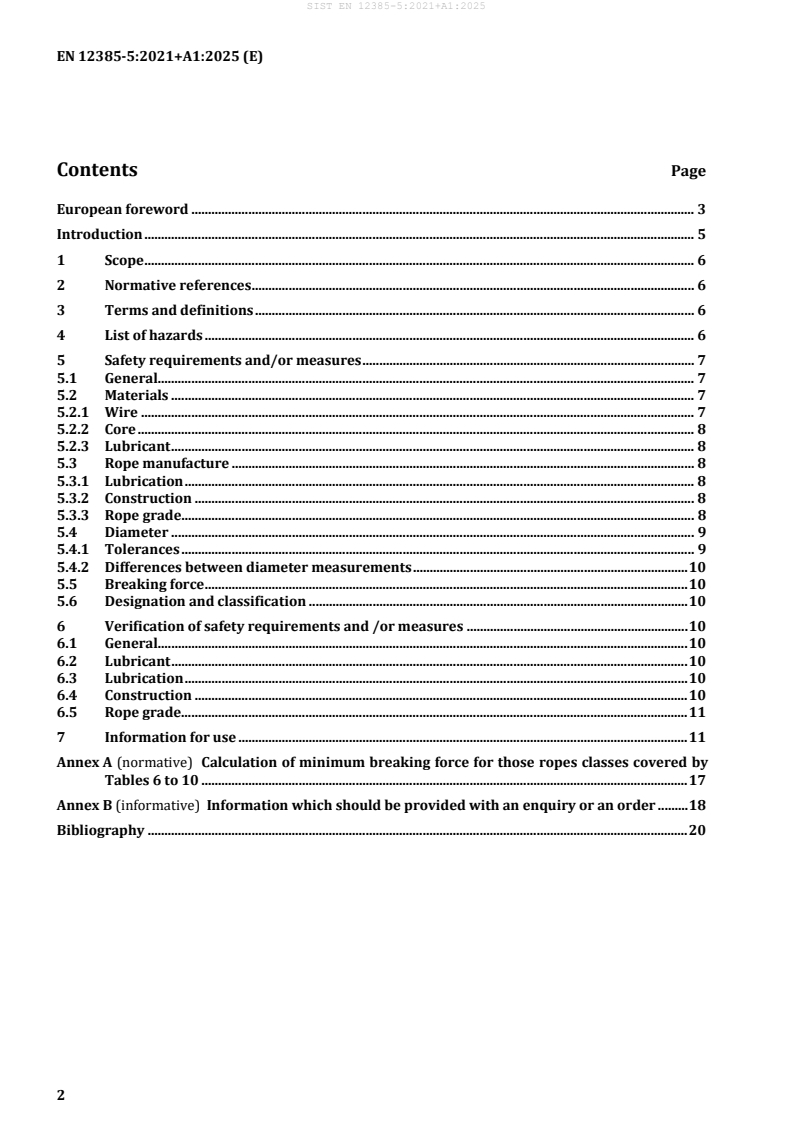
Contents Page
European foreword . 3
Introduction . 5
1 Scope . 6
2 Normative references . 6
3 Terms and definitions . 6
4 List of hazards . 6
5 Safety requirements and/or measures . 7
5.1 General. 7
5.2 Materials . 7
5.2.1 Wire . 7
5.2.2 Core . 8
5.2.3 Lubricant . 8
5.3 Rope manufacture . 8
5.3.1 Lubrication . 8
5.3.2 Construction . 8
5.3.3 Rope grade. 8
5.4 Diameter . 9
5.4.1 Tolerances . 9
5.4.2 Differences between diameter measurements . 10
5.5 Breaking force . 10
5.6 Designation and classification . 10
6 Verification of safety requirements and /or measures . 10
6.1 General. 10
6.2 Lubricant . 10
6.3 Lubrication . 10
6.4 Construction . 10
6.5 Rope grade. 11
7 Information for use . 11
Annex A (normative) Calculation of minimum breaking force for those ropes classes covered by
Tables 6 to 10 . 17
Annex B (informative) Information which should be provided with an enquiry or an order . 18
Bibliography . 20
European foreword
This document (EN 12385-5:2021+A1:2025) has been prepared by Technical Committee CEN/TC 168,
“Chains, ropes, webbing, slings and accessories – Safety”, the secretariat of which is held by BSI.
This European Standard shall be given the status of a national standard, either by publication of an
identical text or by endorsement, at the latest by October 2025, and conflicting national standards shall
be withdrawn at the latest by October 2025.
Attention is drawn to the possibility that some of the elements of this document may be the subject of
patent rights. CEN shall not be held responsible for identifying any or all such patent rights.
This document includes the corrigendum EN 12385-5:2021/AC:2021 issued by CEN on
10 November 2021, which replaces typical examples for ropes "6 x 9 W" with "6 x 19 W" in Table 6 and
"6 x 6 WS" with "6 x 36 WS" in Table 9.
The start and finish of text introduced or altered by corrigendum is indicated in the text by tags ˜™.
This document includes Amendment 1 approved by CEN on 28 October 2024.
This document supersedes !EN 12385-5:2021+AC:2021".
The start and finish of text introduced or altered by amendment is indicated in the text by tags !".
!EN 12385-5:2021+A1:2025 includes the following significant technical changes with respect to
EN 12385-5:2021+AC:2021:
— added in 5.3.3.2 in list item b) rope with fibre core/steel core 1570;
— added in 5.3.3.3 rope grade 1960;
— added rope grade 1960 in Table 8;
— deletion of Annex ZA, covering the Lifts Directive 2014/33/EU;
— deletion of Annex ZB, covering the Machinery Directive 2006/42/EC."
!deleted text"
!deleted text"
!deleted text"
The other Parts of EN 12385 are:
— Part 1: General requirements;
— Part 2: Definitions, designation and classification;
— Part 3: Information for use and maintenance;
— Part 4: Stranded ropes for general lifting applications;
— Part 6: Stranded ropes for mine shafts;
— Part 7: Locked coil ropes for mine shafts;
— Part 8: Stranded hauling and carrying-hauling ropes for cableway installations designed to carry
persons;
— Part 9: Locked coil carrying ropes for cableway installations designed to carry persons;
— Part 10: Spiral ropes for general structural applications.
Part 1 provides the general requirements of Parts 4 to 10.
Any feedback and questions on this document should be directed to the users’ national standards body.
A complete listing of these bodies can be found on the CEN website.
According to the CEN-CENELEC Internal Regulations, the national standards organisations of the
following countries are bound to implement this European Standard: Austria, Belgium, Bulgaria, Croatia,
Cyprus, Czech Republic, Denmark, Estonia, Finland, France, Germany, Greece, Hungary, Iceland, Ireland,
Italy, Latvia, Lithuania, Luxembourg, Malta, Netherlands, Norway, Poland, Portugal, Republic of North
Macedonia, Romania, Serbia, Slovakia, Slovenia, Spain, Sweden, Switzerland, Türkiye and the United
Kingdom.
Introduction
This document is a type C standard as stated in EN ISO 12100.
!deleted text"
During the preparation of this standard, it was assumed that a negotiation would take place between the
purchaser and the manufacturer concerning the intended purpose of the rope.
Although tables of breaking forces and masses are provided for a number of the more common classes,
diameters and rope grades, this Part of this standard is not limited to those given, providing all of the
other requirements are met.
When provisions of this type C standard are different from those which are stated in type A or B
standards, the provisions of this type C standard take precedence over the provisions of the other
standards for wire ropes that have been designed and produced according to the provisions of this type
C standard.
1 Scope
This document specifies the particular materials, manufacturing and testing requirements for stranded
ropes for suspension, compensating and governor duties for traction drive and hydraulic lifts moving
between guides and similar applications.
The particular hazards covered by this Part are identified in Clause 4.
This document does not establish requirements for information for use other than those given in Clause 7
of Part 1. Neither does it cover the requirements for ropes fitted with terminations.
Minimum breaking force values for the more common classes, sizes and grades of rope are provided in
Tables 6 to 10.
2 Normative references
The following documents are referred to in the text in such a way that some or all of their content
constitutes requirements of this document. For dated references, only the edition cited applies. For
undated references, the latest edition of the referenced document (including any amendments) applies.
EN 10264-2:2012, Steel wire and wire products — Steel wire for ropes — Part 2: Cold drawn non alloy steel
wire for ropes for general applications
EN 12385-1:2002+A1:2008, Steel wire ropes — Safety — Part 1: General requirements
EN 12385-2:2002+A1:2008, Steel wire ropes — Safety — Part 2: Definitions, designation and classification
EN ISO 12100:2010, Safety of machinery — General principles for design — Risk assessment and risk
reduction (ISO 12100:2010)
ISO 4346:1977, Steel wire ropes for general purposes — Lubricants — Basic requirements
3 Terms and definitions
For the purposes of this document, the terms and definitions given in EN ISO 12100:2010 and
EN 12385-2:2002+A1:2008 apply.
ISO and IEC maintain terminology databases for use in standardization at the following addresses:
— ISO Online browsing platform: available at https://www.iso.org/obp
— IEC Electropedia: available at https://www.electropedia.org/
4 List of hazards
In addition to the general hazards identified in Clause 4 of Part 1, Table 1 contains all the particular
hazards which require action to reduce risk as being specific and significant for steel wire ropes for lifts.
Table 1— Hazards and associated requirements
Hazards relevant to this standard identified Relevant clause of this standard
by reference to EN ISO 12100:2010
5.1
Inadequate mechanical strength
5.2
5.3
5.5
Annex A
5.4
Inadequate dimensional tolerances
Inadequate information about the handling,
storage, cutting and packaging of the wire rope
5.6
Inadequate information about the
specification, designation and performance of
the wire rope
Inadequate information for the selection of Annex B
ropes suitable for the particular application
NOTE For the purposes of this Part of EN 12385, inadequate strength of parts means failure to achieve
the minimum breaking force of the rope.
5 Safety requirements and/or measures
5.1 General
In addition to the requirements given in 5.2 to 5.6, the requirements shall also conform to those given in
part 1 of this standard.
5.2 Materials
5.2.1 Wire
All wires, before ropemaking, shall conform to EN 10264-2:2012.
For rope grades 1180/1770 (
...