

IEC 62742:2021
(Main)Electrical and electronic installations in ships - Electromagnetic compatibility (EMC) - Ships with a non-metallic hull
General Information
- Abstract
IEC 62742:2021 specifies minimum requirements for emission, immunity and performance criteria regarding electromagnetic compatibility (EMC) of electrical and electronic equipment for ships with non-metallic hull.
NOTE Requirements for metallic hull are given by IEC 60533. This documents acts an extension of IEC 60533 to cater for EMC effects on non-metallic hull.
This document further gives guidance on how to achieve electromagnetic compatibility (EMC) on ships whose hull (surface) is made from non-metallic material and can also be useful for ships with hull comprising of a metallic hull, but with non-metallic superstructure or components.
This document assists in meeting the requirements of IMO resolution A.813(19).
It does not specify basic safety requirements such as protection against electric shock and dielectric tests for equipment. Electromagnetic effects on human beings are not the subject of this document.
- Status
- Published
- Publication Date
- 04-Aug-2021
- Drafting Committee
- PT 62742 - TC 18/PT 62742
- Current Stage
- PPUB - Publication issued
- Start Date
- 05-Aug-2021
- Completion Date
- 27-Aug-2021





Overview
IEC 62742:2021 - Electrical and electronic installations in ships - Electromagnetic compatibility (EMC) - Ships with a non‑metallic hull - specifies minimum requirements and guidance for achieving electromagnetic compatibility on ships whose hull is made of non‑metallic materials (for example GRP/FRP or wooden constructions). It extends and complements IEC 60533 (which covers metallic hulls) and supports compliance with IMO resolution A.813(19). The standard focuses on EMC emission, immunity and performance criteria for on‑board electrical and electronic equipment and installation practices specific to non‑metallic hull environments.
Key topics and technical requirements
IEC 62742:2021 addresses practical EMC design and installation areas tailored to reduced inherent shielding of non‑metallic hulls. Key topics include:
- Electromagnetic environment (EME) and susceptibility studies to assess likely interference sources and vulnerable systems.
- Shielding strategies: principles for single and multiple protection layers where hull conductivity is insufficient.
- Antenna layout: siting and installation guidance for whip and loop antennas, including antenna ground plane considerations to limit interference and optimize performance.
- Earthing and equipotential bonding systems: recommended earthing topologies, protective earth, earth plates and conductor dimensioning appropriate for non‑metallic ships.
- Cable installation and routing: shielding, bonding, routing and segregation practices to reduce coupling, induced currents and radiated emissions.
- Overvoltage protection: measures to protect equipment from transients, lightning and switching events.
- Filtering and maintenance: recommended use of filters and inspection/testing regimes to maintain EMC performance throughout ship life.
The standard does not cover basic electrical safety (e.g., protection against electric shock) or electromagnetic effects on human beings.
Practical applications and users
IEC 62742 is practical guidance for professionals involved in design, construction and operation of non‑metallic ships and components, including:
- Naval architects and ship designers specifying EMC for composite hulls
- Shipyards and integrators implementing cable routing, earthing and antenna installation
- EMC engineers and test laboratories performing susceptibility studies and acceptance checks
- Equipment manufacturers producing shipboard electronics for composite vessels
- Classification societies, flag administrations and ship operators seeking compliance with IMO requirements
Using IEC 62742 during the design phase reduces in‑service EMI problems and supports certification and safe operation of shipboard systems.
Related standards
- IEC 60533 (EMC for ships with metallic hulls) - primary reference for metallic constructions.
- IMO resolution A.813(19) - regulatory framework supported by IEC 62742.
- Other IEC shipboard installation standards (e.g., IEC 60092 series) are referenced for complementary requirements.
Get Certified
Connect with accredited certification bodies for this standard

DNV
DNV is an independent assurance and risk management provider.

Lloyd's Register
Lloyd's Register is a global professional services organisation specialising in engineering and technology.

FSC International
Forest Stewardship Council certification.
Sponsored listings
Frequently Asked Questions
IEC 62742:2021 is a standard published by the International Electrotechnical Commission (IEC). Its full title is "Electrical and electronic installations in ships - Electromagnetic compatibility (EMC) - Ships with a non-metallic hull". This standard covers: IEC 62742:2021 specifies minimum requirements for emission, immunity and performance criteria regarding electromagnetic compatibility (EMC) of electrical and electronic equipment for ships with non-metallic hull. NOTE Requirements for metallic hull are given by IEC 60533. This documents acts an extension of IEC 60533 to cater for EMC effects on non-metallic hull. This document further gives guidance on how to achieve electromagnetic compatibility (EMC) on ships whose hull (surface) is made from non-metallic material and can also be useful for ships with hull comprising of a metallic hull, but with non-metallic superstructure or components. This document assists in meeting the requirements of IMO resolution A.813(19). It does not specify basic safety requirements such as protection against electric shock and dielectric tests for equipment. Electromagnetic effects on human beings are not the subject of this document.
IEC 62742:2021 specifies minimum requirements for emission, immunity and performance criteria regarding electromagnetic compatibility (EMC) of electrical and electronic equipment for ships with non-metallic hull. NOTE Requirements for metallic hull are given by IEC 60533. This documents acts an extension of IEC 60533 to cater for EMC effects on non-metallic hull. This document further gives guidance on how to achieve electromagnetic compatibility (EMC) on ships whose hull (surface) is made from non-metallic material and can also be useful for ships with hull comprising of a metallic hull, but with non-metallic superstructure or components. This document assists in meeting the requirements of IMO resolution A.813(19). It does not specify basic safety requirements such as protection against electric shock and dielectric tests for equipment. Electromagnetic effects on human beings are not the subject of this document.
IEC 62742:2021 is classified under the following ICS (International Classification for Standards) categories: 01.040.17 - Metrology and measurement. Physical phenomena (Vocabularies); 17.220.20 - Measurement of electrical and magnetic quantities; 33.100 - Electromagnetic compatibility (EMC); 47.020.60 - Electrical equipment of ships and of marine structures. The ICS classification helps identify the subject area and facilitates finding related standards.
IEC 62742:2021 is available in PDF format for immediate download after purchase. The document can be added to your cart and obtained through the secure checkout process. Digital delivery ensures instant access to the complete standard document.
Standards Content (Sample)
SLOVENSKI SIST IEC 60469-1:2005
STANDARD
junij 2005
Impulzna tehnika in naprave – 1. del: Izrazi in definicije impulzov
Pulse techniques and apparatus – Part 1: Pulse terms and definitions
ICS 01.040.17; 17.080 Referenčna številka
© Standard je založil in izdal Slovenski inštitut za standardizacijo. Razmnoževanje ali kopiranje celote ali delov tega dokumenta ni dovoljeno
NORME
CEI
INTERNATIONALE IEC
60469-1
INTERNATIONAL
Deuxième édition
STANDARD
Second edition
1987-12
Techniques des impulsions et
appareils
Première partie:
Termes et définitions concernant les impulsions
Pulse techniques and apparatus
Part 1:
Pulse terms and definitions
© IEC 1987 Droits de reproduction réservés — Copyright - all rights reserved
Aucune partie de cette publication ne peut être reproduite ni No part of this publication may be reproduced or utilized in
utilisée sous quelque forme que ce soit et par aucun any form or by any means, electronic or mechanical,
procédé, électronique ou mécanique, y compris la photo- including photocopying and microfilm, without permission in
copie et les microfilms, sans l'accord écrit de l'éditeur. writing from the publisher.
International Electrotechnical Commission 3, rue de Varembé Geneva, Switzerland
Telefax: +41 22 919 0300 e-mail: inmail@iec.ch IEC web site http: //www.iec.ch
CODE PRIX
Commission Electrotechnique Internationale
U
PRICE CODE
International Electrotechnical Commission
IEC MemnyHapomian 3nenrporexHwiecnan HoMHccein
Pour prix, voir catalogue en vigueur
• • For price, see current catalogue
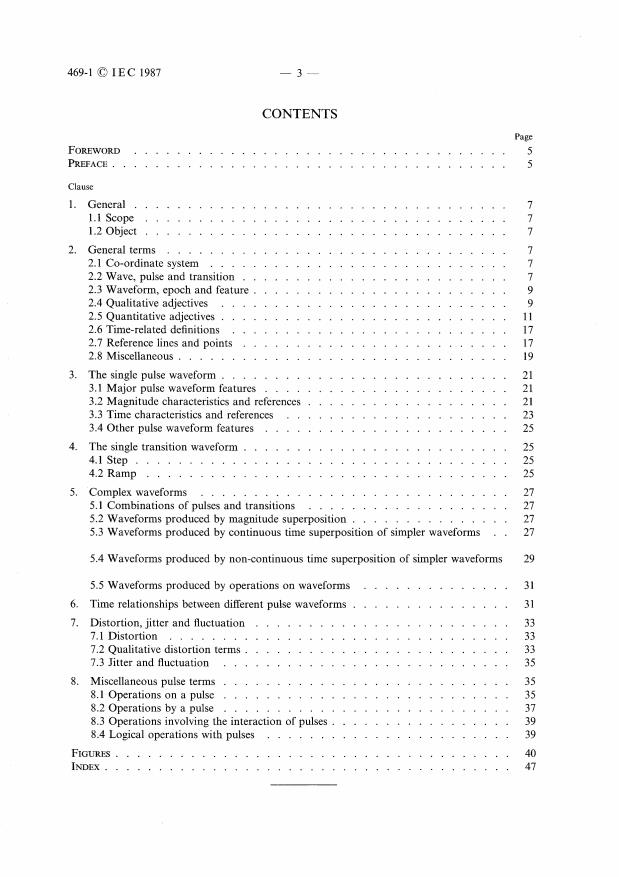
469-1 © I E C 1987 - 3 -
CONTENTS
Page
FOREWORD 5
PREFACE 5
Clause
1. General 7
1.1 Scope 7
1.2 Object 7
2. General terms 7
2.1
Co-ordinate system 7
2.2 Wave, pulse and transition 7
2.3 Waveform, epoch and feature 9
2.4
Qualitative adjectives 9
2.5
Quantitative adjectives 11
2.6 Time-related definitions 17
2.7 Reference lines and points 17
2.8 Miscellaneous 19
3. The single pulse waveform 21
3.1
Major pulse waveform features 21
3.2 Magnitude characteristics and references 21
3.3 Time characteristics and references 23
3.4 Other pulse waveform features 25
4.
The single transition waveform 25
4.1 Step 25
4.2 Ramp 25
5. Complex waveforms 27
5.1 Combinations of pulses and transitions 27
5.2 Waveforms produced by magnitude superposition 27
5.3 Waveforms produced by continuous time superposition of simpler waveforms 27
5.4 Waveforms produced by non-continuous time superposition of simpler waveforms 29
5.5 Waveforms produced by operations on waveforms 31
6. Time relationships between different pulse waveforms 31
7. Distortion, jitter and fluctuation 33
7.1 Distortion 33
7.2 Qualitative distortion terms 33
7.3 Jitter and fluctuation 35
8. Miscellaneous pulse terms 35
8.1 Operations on a pulse 35
8.2 Operations by a pulse 37
8.3 Operations involving the interaction of pulses 39
8.4 Logical operations with pulses 39
FIGURES 40
INDEX 47
469-1 © I E C 1987 5 —
INTERNATIONAL ELECTROTECHNICAL COMMISSION
PULSE TECHNIQUES AND APPARATUS
Part 1: Pulse terms and definitions
FOREWORD
The formal decisions or agreements of the I E C on technical matters, prepared by Technical Committees on which all
1)
the National Committees having a special interest therein are represented, express, as nearly as possible, an international
consensus of opinion on the subjects dealt with.
2) They have the form of recommendations for international use and they are accepted by the National Committees in that
sense.
In order to promote international unification, the I E C expresses the wish that all National Committees should adopt
3)
the text of the I E C recommendation for their national rules in so far as national conditions will permit. Any divergence
between the I E C recommendations and the corresponding national rules should, as far as possible, be clearly indicated
in the latter.
PREFACE
This standard has been prepared by Sub-Committee 66A: Generators, of I E C Technical Com-
mittee No. 66: Measuring Equipment for Electronic Techniques.
The text of this standard which replaces the first edition is based upon the following documents:
Six Months' Rule Report on Voting
66A(CO)38
66A(CO)36
Full information on the voting for the approval of this standard can be found in the Voting
Report indicated in the above table.
The following I E C publications are quoted in this standard:
Publications Nos. 351 (1976): Expression of the Properties of Cathode-ray Oscilloscopes.
469-2 (1987): Pulse Techniques and Apparatus,
Part 2: Pulse Measurement and Analysis, General Considerations.
469-1 © I E C 1987 — 7
PULSE TECHNIQUES AND APPARATUS
Part 1: Pulse terms and definitions
1. General
1.1 Scope
This standard provides fundamental definitions for general use in time domain pulse
technology. It defines terms for pulse phenomena and pulse characteristics which are prerequi-
site to:
– efficient communication of technical information;
– standards for methods of pulse characteristic measurement;
–
standards for pulse apparatus;
– standards for apparatus which employ pulse techniques.
1.2 Object
Within its scope, the object of this standard is the definition of an internally consistent,
mathematically rigorous and general set of pulse terms which are applicable:
– to hypothetical and practical pulses;
– regardless of the applicable limits of error;
– to a wide range of technologies and disciplines;
– in a measurement situation, regardless of the means of measurement or the means for
waveform evaluation employed.
2. General terms
2.1 Co-ordinate system
Throughout the following, a rectangular Cartesian co-ordinate system is assumed in which,
unless otherwise specified:
– is the independent variable taken along the horizontal axis, increasing in the positive
time (t)
sense from left to right;
– magnitude (m) is the dependent variable taken along the vertical axis, increasing in the
positive sense or polarity from bottom to top;
–
the following additional symbols are used:
e = base of natural logarithms;
a, b, c, etc. = real parameters which, unless otherwise specified, may have any value
and either sign;
n =
a positive integer.
2.2 Wave, pulse and transition
2.2.1
Wave
A modification of the physical state of a medium which propagates in that medium as a
function of time* as a result of one or more disturbances.
* Terms in italic type are defined in this standard.
469-1 © I E C 1987 — 9
2.2.2
Pulse
A
wave which departs from a first nominal state, attains a second nominal state and
ultimately returns to the first nominal state.
Throughout the remainder of this standard, "pulse" is included in "wave".
2.2.3 Transition
A portion of a wave or pulse between a first nominal state and a second nominal state.
Throughout the remainder of this standard, "transition" is included in "pulse" and "wave".
2.3 Waveform, epoch and feature
2.3.1 Waveform, pulse waveform, transition waveform
A manifestation or representation (e.g. graph, plot, oscilloscope presentation, equation(s),
table of co-ordinates or statistical data) or a visualization of a wave, pulse or transition.
Throughout the remainder of this standard:
— "pulse waveform" is included in "waveform;"
"transition waveform" is included in "pulse waveform" and "waveform."
2.3.2
Waveform epoch
The span of
time for which waveform data are known or knowable. A waveform epoch
manifested by equations may extend in time from – co to + o0 or, like all waveform
data, may
extend from a first datum time t o, to a second datum time t l (see Figure 1, page 40).
2.3.3 Waveform feature
A specified portion or segment of, or a specified event in, a waveform.
2.4
Qualitative adjectives
The adjectives in this sub-clause may be used individually or in combination, or in combi-
nation with adjectives in Sub-clause 2.5, to modify any substantive term in this standard.
2.4.1
Descriptive adjectives
2.4.1.1 Major (minor)
Having or pertaining to greater (lesser) importance, magnitude, time, extent, or the like, than
another similar feature(s).
2.4.1.2 Ideal
Of or pertaining to perfection in, or existing as a perfect exemplar of, a waveform or a
feature.
2.4.1.3
Reference
Of or pertaining to a
time, magnitude, waveform, feature or the like, which is used for
comparison with, or evaluation of, other times, magnitudes, waveforms, features or the like.
A reference entity may, or may not, be an ideal entity.
2.4.2 Time-related adjectives
2.4.2.1 Periodic (aperiodic)
Of or pertaining to a series of specified waveforms or features which repeat or recur regularly
(irregularly) in time.
469-1
© I EC 1987 — 11 —
2.4.2.2 Coherent (incoherent)
Of or pertaining to two or more repetitive waveforms whose constituent features have (lack)
time correlation.
2.4.2.3
Synchronous (asynchronous)
Of or pertaining to two or more repetitive waveforms whose sequential constituent features
have (lack)
time correlation.
2.4.3
Magnitude-related adjectives
2.4.3.1 Proximal (distal)
Of or pertaining to a region near to (remote from) a first state or region of origin.
2.4.3.2 Mesial
Of or pertaining to the region between the
proximal and distal regions.
2.4.4
Polarity-related adjectives
2.4.4.1
Unipolar
Of, having or pertaining to a single polarity.
2.4.4.2
Bipolar
Of, having or pertaining to both polarities.
2.4.5
Geometrical adjectives
2.4.5.1 Trapezoidal
Having or approaching the shape of a trapezoid.
2.4.5.2
Rectangular
Having or approaching the shape of a rectangle.
2.4.5.3 Triangular
Having or approaching the shape of a triangle.
2.4.5.4 Sawtooth
Having or approaching the shape of a right-angled triangle (see Figure 2, page 41, wave-
form D).
2.4.5.5
Rounded
Having a curved shape characterized by a relatively gradual change in slope.
2.5 Quantitative adjectives
The adjectives in this sub-clause may be used individually or in combination, or in combi-
nation with adjectives in Sub-clause 2.4, to modify any substantive term in this standard.
2.5.1 Integer adjectives
The ordinal integers (i.e. first, second, ., nth, last) or the cardinal integers (i.e. 1, 2, .,
n) may be used as adjectives to identify or distinguish between similar or identical features.
The assignment of integer modifiers should be sequential as a function of time within a
waveform epoch
and/or within features thereof.
469-1 © I EC 1987 13 —
2.5.2 Mathematical adjectives
All definitions in this sub-clause are stated in terms of time (the independent variable) and
magnitude (the dependent variable). Unless otherwise specified, the following terms apply only
to waveform data within a waveform epoch. These adjectives may also be used to describe the
relation(s) between other specified variable pairs (e.g. time and power, time and voltage).
2.5.2.1 Instantaneous
Pertaining to the magnitude at a specified time.
2.5.2.2 Positive (negative) peak
Pertaining to the maximum (minimum) magnitude.
2.5.2.3 Peak-to-peak
Pertaining to the absolute value of the algebraic difference between the positive peak
magnitude and the negative peak magnitude.
2.5.2.4 Root-mean-square (r.m.s.)
magnitude.
Pertaining to the square root of the average of the squares of the values of the
If the magnitude takes on discrete values, m., its root-mean-square value is:
n
mrms= [()
j=1
wherein the time intervals between adjacent values of m. are equal.
If the magnitude is a continuous function of time, m(t), its r.m.s. value is:
tl
1 J m (t) dt lz
t,
=[(
The summation or the integral extends over the interval of time for which the r.m.s.
magnitude is desired or, if the function is periodic, over any integral number of periodic
repetitions of the function.
2.5.2.5 Average
Pertaining to the mean of the values of the magnitude. If the magnitude takes on n discrete
values, m., its average value is:
(—)
n
—
j=1
wherein the time intervals between adjacent values of m. are equal.
If the magnitude is a continuous function of time, m(t), its average value is:
) [z m (td
m_ (
t2ti
.
The summation or the integral extends over the interval of time for which the average
magnitude is desired or, if the function is periodic, over any integral number of periodic
repetitions of the function.
469-1 © I E C 1987 15 —
2.5.2.6 Average absolute
Pertaining to the mean of the absolute values of the magnitude. If the magnitude takes on
n discrete values, mj, its average absolute value is:
l
Fri-
\n/
wherein the time intervals between adjacent values of m are equal.
If the magnitude is a continuous function of time, m(t), its average absolute value is:
mt _ ^ 1 )
1 t m (t)dt
I
t 2 — t,
,lr
The summation or the integral extends over the interval of time for which the average
absolute magnitude is desired or, if the function is periodic, over any integral number of
periodic repetitions of the function.
2.5.2.7 Root sum of squares (r.s.s.)
Pertaining to the square root of the arithmetic sum of the squares of the values of the
magnitude. If the magnitude takes on n discrete values, m;, its root sum of squares value is:
mrss =
i=1
wherein the time intervals between adjacent values of m. are equal.
If the magnitude is a continuous function of time, m(t), its root sum of squares value is:
C m 2 (t) dt
m rss =
J 1
The summation or the integral extends over the interval of time for which the root sum of
squares magnitude is desired or, if the function is periodic, over any integral number of periodic
repetitions of the function.
2.5.3 Functional adjectives
2.5.3.1 Linear
Pertaining to a time
feature whose magnitude varies as a function of in accordance with the
following relation or its equivalent:
m=a
+bt
2.5.3.2 Exponential
Pertaining to a feature whose magnitude varies as a function of time in accordance with
either of the following relations or their equivalents:
-bt
m =ae
m= a(1— e-b`)
— 17 —
469-1 © I E C 1987
2.5.3.3 Gaussian
time in
whose magnitude varies as a function of
Pertaining to a waveform or feature
accordance with the following relation or its equivalent:
b(t
m=ae- -`)Z where b>0
2.5.3.4 Trigonometric
varies as a function of time in
waveform or feature whose magnitude
Pertaining to a
accordance with a specified trigonometric function or by a specified relationship based on
trigonometric functions (e.g. cosine squared).
2.6 Time-related definitions
2.6.1 Instant
of a
specified with respect to the first datum time, to,
Unless otherwise stated, a time
waveform epoch.
2.6.2 Interval
instant
difference calculated by subtracting the time of a first specified
The algebraic time
from the time of a second specified instant.
2.6.3 Duration
or feature exists or
The absolute value of the interval during which a specified waveform
continues.
2.6.4 Period
after which the same characteristics of a periodic
The absolute value of the minimum interval
waveform or a periodic feature recur.
2.6.5 Frequency
The reciprocal of period.
2.6.6 Cycle
through which a periodic waveform or a periodic
The complete range of states or magnitudes
feature passes before repeating itself identically.
2.7 Reference lines and points
The reference lines and points defined in this sub-clause and used throughout the remainder
of this standard are constructions which are (either actually or figuratively) superimposed on
for descriptive or analytical purposes. Unless otherwise specified, all defined lines
waveforms
waveform epoch.
and points lie within a
2.7.1 Time origin line
equal to
time which, unless otherwise specified, has a time
A line of constant and specified
(see Figure 1, page 40).
zero and passes through the first datum time, to, of a waveform epoch
2.7.2 Magnitude origin line
magnitude equal to zero
A line of specified magnitude which, unless otherwise specified, has a
and extends through the waveform epoch (see Figure 1).
2.7.3 Time reference line
A line parallel to the time origin line at a specified instant.
469-1
0 I E C 1987 19 —
2.7.4 Time referenced point
A point at the intersection of a time reference line
and a waveform.
2.7.5 Magnitude reference line
A line parallel to the magnitude origin line at a specified magnitude.
2.7.6 Magnitude referenced point
A point at the intersection of a magnitude reference line and a waveform.
2.7.7 Knot
A point tk, m k (where k =
1, 2, 3, ., n) in a sequence of points wherein tk k+ , through
, t
which a cubic natural spline passes (see Figure 3, page 41).
2.7.8 Cubic natural spline
A catenated piecewise sequence of cubic polynomial functions
p (1,2), p (2,3), .,p (n-1, n)
between knots t, m i and t2 m 2 , t 2 m2 and t3 m 3 , ., t _o mo i _ 1) and t„ mn,
respectively, wherein:
(n
a) at all
knots, the first and second derivatives of the adjacent polynomial functions are
equal, and
b) for all values of t less than tl and greater than to the function is linear (see Figure 3 and
Sub-clause 5.5).
Note. — The cubic natural spline yields a curve which, throughout, is continuous and has continuous first and second
derivatives. The resulting curve is the rigorous mathematical embodiment of what is conventionally called
a smooth curve drawn through a group of points (i.e. knots) and it consists of a sequence of curvilinear
segments which are defined by equations of the third degree.
2.8 Miscellaneous
2.8.1 Pulse shape
For descriptive purposes, a pulse waveform may be imprecisely described by any of the
adjectives, or combinations thereof, in Sub-clauses 2.4.1.1, 2.4.4, 2.4.5 and 2.5.3.2 to 2.5.3.4,
inclusive. When so used, these adjectives describe general shape only and no precise distinc-
tions are defined.
For tutorial purposes, a hypothetical pulse waveform may be precisely defined by the further
addition of the adjective "ideal" (Sub-clause 2.4.1.2).
For measurement or comparison purposes, a pulse waveform may be precisely defined by
the further addition of the adjective
"reference" (Sub-clause 2.4.1.3).
2.8.2 Transition shape
For descriptive purposes, a
transition waveform may be imprecisely described by any of the
adjectives, or combinations thereof, in Sub-clauses 2.4.1.1, 2.4.4, 2.4.5.5 and 2.5.3. When so
used, these adjectives describe general shape only and no precise distinctions are defined.
For tutorial purposes, a hypothetical transition waveform may be precisely defined by the
further addition of the adjective
"ideal" (Sub-clause 2.4.1.2).
For measurement or comparison purposes, a
transition waveform may be precisely defined
by the further addition of the adjective "reference" (Sub-clause 2.4.1.3).
2.8.3 Pulse power
The power transferred or transformed by a
pulse(s). Unless otherwise specified by a
mathematical adjective (from Sub-clause 2.5.2),
average power over a specified interval is
assumed.
469-1 © I E C 1987 — 21 —
2.8.4 Pulse energy
The energy transferred or transformed by a pulse(s). Unless otherwise specified by a
mathematical adjective (from Sub-clause 2.5.2), the total energy over a specified interval is
assumed.
3. The single pulse waveform
3.1 Major pulse waveform features
3.1.1 Base
The two portions of a which represent the first nominal state from which
pulse waveform
a pulse departs and to which it ultimately returns.
3.1.2 Top
The portion of a pulse waveform which represents the second nominal state of a pulse.
3.1.3 First transition
The major transition waveform of a pulse waveform between the base and the top.
3.1.4 Last transition
The major transition waveform of a pulse waveform between the top and the base.
3.2 Magnitude characteristics and references
All magnitude characteristics, unless otherwise specified, are derived from data within the
waveform epoch.
3.2.1 Base magnitude
The magnitude of the base as obtained by a specified procedure or algorithm. Unless
otherwise specified, both portions of the base are included in the procedure or algorithm (see
Figure 1, page 40, and I E C Publication 469-2, Sub-clause 4.3.1 for suitable algorithms).
3.2.2 Top magnitude
The magnitude of the top as obtained by a specified procedure or algorithm (see Figure 1
and I E C Publication 469-2, Sub-clause 4.3.1 for suitable algorithms).
3.2.3
Pulse amplitude
and the (see Figure 1).
The algebraic difference between the top magnitude base magnitude
3.2.4
Per cent reference magnitude
A
reference magnitude specified by:
(x) % MI 00 (Mt—Mb)
= Mb Tc—,6
+
where :
0
(x) % Mr = per cent reference magnitude
Mb =
base magnitude
Mt = top magnitude
(x)
Mb, Mt and % M r are all in the same unit of measurement
469-1 © I E C 1987 — 23 —
3.2.5 Magnitude reference lines
3.2.5.1 Base line (Top line)
The magnitude reference line at the base (top) magnitude (see Figure 1, page 40).
3.2.5.2 Proximal (distal) line
A magnitude reference line at a specified magnitude in the proximal (distal) region of a pulse
waveform. Unless otherwise specified, the proximal (distal) line is at the 10 (90) per cent
reference magnitude (see Figure 1).
3.2.5.3 Mesial line
A mesial region of a pulse waveform.
magnitude reference line at a specified magnitude in the
Unless otherwise specified, the mesial line is at the 50 per cent reference magnitude (see
Figure 1).
3.2.6 Magnitude reference point
3.2.6.1 Proximal (distal) point
A magnitude referenced point at the intersection of a waveform and a proximal (distal) line
(see Figure 1).
3.2.6.2 Mesial point
A magnitude referenced point at the intersection of a waveform and a mesial line (see
Figure 1).
3.3 Time characteristics and references
3.3.1 Pulse start (stop) time
The on the first (last) transition of a
instant specified by a magnitude referenced point pulse
waveform. Unless otherwise specified, the pulse start (stop) time is at the mesial point on the
first (last) transition (see Figure 1).
3.3.2 Pulse duration
The duration between pulse start time and pulse stop time (see Figure 1).
3.3.3 Transition duration
The duration between the proximal point and the distal point on a transition waveform.
3.3.3.1 First (last) transition duration
The transition duration of the first (last) transition waveform in a pulse waveform (see
Figure 1).
Note. — Previously called "rise (fall) time".
3.3.4 Time reference lines
3.3.4.1 Pulse start (stop) line
The time reference line (see Figure 1).
at pulse start (stop) time
3.3.4.2 Top centre line
The time reference line at the average of pulse start time and pulse stop time (see Figure 1).
469-1 © I E C 1987 — 25 —
3.3.5 Pulse time reference points
3.3.5.1 Top centre point
A specified time referenced point or magnitude referenced point on a pulse waveform top. If
no point is specified, the top centre point is the time referenced point at the intersection of a
pulse waveform and the top centre line (see Figure 1).
3.3.5.2 First (last) base point
(compare with base
Unless otherwise specified, the first (last) datum point in a pulse epoch
centre point, Sub-clause 5.3.2.7) (see Figure 1, page 40).
3.4 Other pulse waveform features
3.4.1 Pulse corner
A continuous pulse waveform feature of specified extent which includes a region of
maximum curvature or a point of discontinuity in the waveform slope. Unless otherwise
specified, the extent of the corners in a rectangular or a trapezoidal pulse waveform are as
specified in the following table:
Corner First point Last point
First transition proximal point
First First base point
Second First transition distal point Top centre point
Third Top centre point Last transition distal point
Fourth Last transition proximal point Last base point
3.4.2 Pulse quadrant
One of the four continuous and contiguous pulse waveform features of specified extent which
include a region of maximum curvature or a point of discontinuity in the waveform slope.
Unless otherwise specified, the extent of the quadrants in a rectangular or a trapezoidal pulse
waveform are as specified in the following table:
Quadrant First point Last point
First First base point First transition mesial point
Top centre point
Second First transition mesial point
Third Top centre point Last transition mesial point
Fourth Last transition mesial point Last base point
4. The single transition waveform
4.1 Step
A transition waveform which has a transition duration which is negligible relative to the
duration of the waveform epoch or to the duration of its adjacent first and second nominal
states.
4.2 Ramp
A
linear feature.
469-1 © I E C 1987 27 —
5.
Complex waveforms
5.1 Combinations of pulses and transitions
5.1.1 Double pulse
Two pulse waveforms of the same polarity which are adjacent in time and which are
considered or treated as a single feature.
5.1.2
Bipolar pulse
Two pulse waveforms of opposite polarity which are adjacent in time and which are consid-
ered or treated as a single feature.
5.1.3 Staircase
of steps of equal magnitude and
Unless otherwise specified, a periodic and finite sequence
of the same polarity.
5.2 Waveforms produced by magnitude superposition
5.2.1 Offset
The algebraic difference between two specified magnitude reference lines. Unless otherwise
specified, these two magnitude reference lines are the waveform base line and the magnitude
origin line (see Figure 1, page 40), in which case the offset is the base magnitude (see
Sub-clause 3.2.1).
5.2.2 Offset waveform
A waveform whose base line is offset from, unless otherwise specified, the magnitude origin
line.
5.2.3 Composite waveform
which is, or which for analytical or descriptive purposes is treated as, the
A waveform
algebraic summation of two or more waveforms (see Figure 2, page 41).
5.3 Waveforms produced by continuous time superposition of simpler waveforms
5.3.1 Pulse train
A continuous repetitive sequence of pulse waveforms.
5.3.2 Pulse train time-related definitions
5.3.2.1 Pulse repetition period
The interval between the pulse start time of a first pulse waveform and the pulse start time
of the immediately following pulse waveform in a periodic pulse train.
5.3.2.2 Pulse repetition frequency
The reciprocal of pulse repetition period.
5.3.2.3 Pulse separation
The interval between the pulse stop time of a first pulse waveform and the pulse start time
of the immediately following pulse waveform in a pulse train.
5.3.2.4 Duty factor
Unless otherwise specified, the ratio of the pulse waveform duration to the pulse repetition
period of a periodic pulse train.
469-1 © I E C 1987 29
5.3.2.5 On/off ratio
Unless otherwise specified, the ratio of the pulse waveform duration to the pulse separation
of a periodic pulse train.
5.3.2.6 Base centre line
pulse stop time of a first pulse waveform and
The time reference line at the average of the
of the immediately following pulse waveform in a pulse train.
the pulse start t
...
IEC 62742 ®
Edition 1.0 2021-08
INTERNATIONAL
STANDARD
Electrical and electronic installations in ships – Electromagnetic
compatibility (EMC) – Ships with a non-metallic hull
All rights reserved. Unless otherwise specified, no part of this publication may be reproduced or utilized in any form
or by any means, electronic or mechanical, including photocopying and microfilm, without permission in writing from
either IEC or IEC's member National Committee in the country of the requester. If you have any questions about IEC
copyright or have an enquiry about obtaining additional rights to this publication, please contact the address below or
your local IEC member National Committee for further information.
IEC Central Office Tel.: +41 22 919 02 11
3, rue de Varembé info@iec.ch
CH-1211 Geneva 20 www.iec.ch
Switzerland
About the IEC
The International Electrotechnical Commission (IEC) is the leading global organization that prepares and publishes
International Standards for all electrical, electronic and related technologies.
About IEC publications
The technical content of IEC publications is kept under constant review by the IEC. Please make sure that you have the
latest edition, a corrigendum or an amendment might have been published.
IEC publications search - webstore.iec.ch/advsearchform IEC online collection - oc.iec.ch
The advanced search enables to find IEC publications by a Discover our powerful search engine and read freely all the
variety of criteria (reference number, text, technical publications previews. With a subscription you will always
committee, …). It also gives information on projects, replaced have access to up to date content tailored to your needs.
and withdrawn publications.
Electropedia - www.electropedia.org
IEC Just Published - webstore.iec.ch/justpublished
The world's leading online dictionary on electrotechnology,
Stay up to date on all new IEC publications. Just Published
containing more than 22 000 terminological entries in English
details all new publications released. Available online and
and French, with equivalent terms in 18 additional languages.
once a month by email.
Also known as the International Electrotechnical Vocabulary
(IEV) online.
IEC Customer Service Centre - webstore.iec.ch/csc
If you wish to give us your feedback on this publication or
need further assistance, please contact the Customer Service
Centre: sales@iec.ch.
IEC 62742 ®
Edition 1.0 2021-08
INTERNATIONAL
STANDARD
Electrical and electronic installations in ships – Electromagnetic
compatibility (EMC) – Ships with a non-metallic hull
INTERNATIONAL
ELECTROTECHNICAL
COMMISSION
ICS 33.100; 47.020.60 ISBN 978-2-8322-1007-5
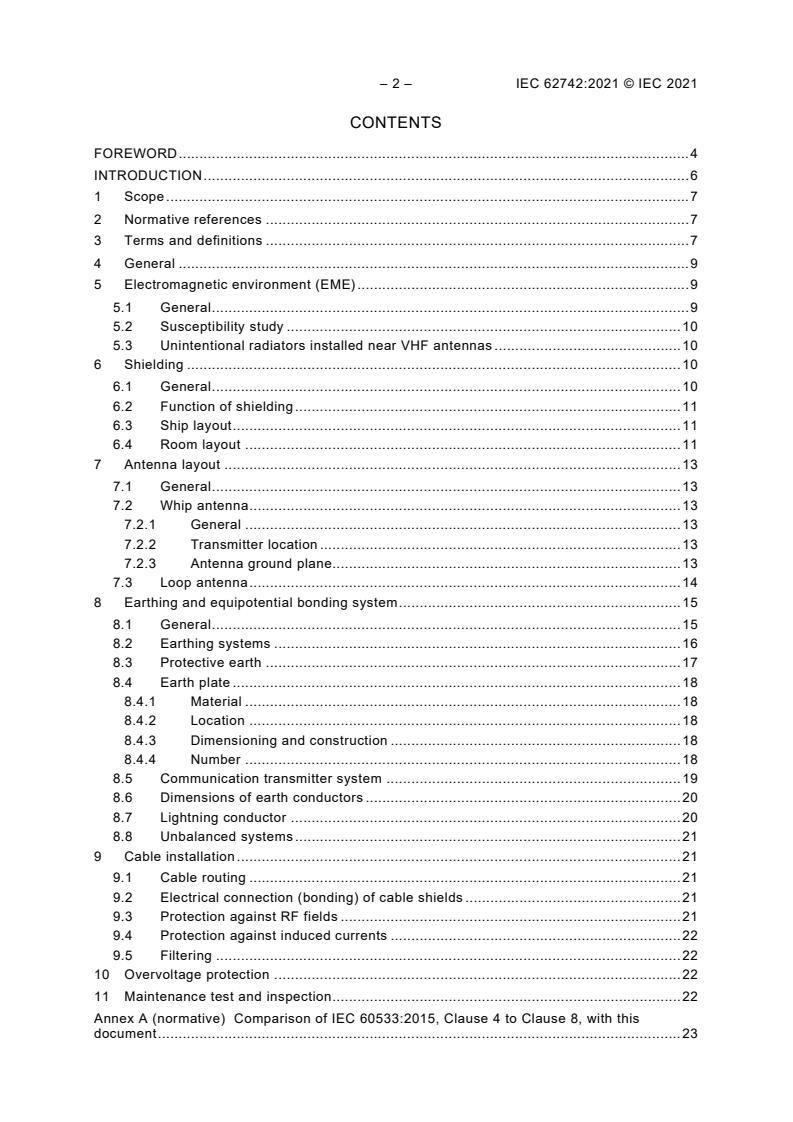
– 2 – IEC 62742:2021 © IEC 2021
CONTENTS
FOREWORD . 4
INTRODUCTION . 6
1 Scope . 7
2 Normative references . 7
3 Terms and definitions . 7
4 General . 9
5 Electromagnetic environment (EME) . 9
5.1 General . 9
5.2 Susceptibility study . 10
5.3 Unintentional radiators installed near VHF antennas . 10
6 Shielding . 10
6.1 General . 10
6.2 Function of shielding . 11
6.3 Ship layout . 11
6.4 Room layout . 11
7 Antenna layout . 13
7.1 General . 13
7.2 Whip antenna . 13
7.2.1 General . 13
7.2.2 Transmitter location . 13
7.2.3 Antenna ground plane. 13
7.3 Loop antenna . 14
8 Earthing and equipotential bonding system . 15
8.1 General . 15
8.2 Earthing systems . 16
8.3 Protective earth . 17
8.4 Earth plate . 18
8.4.1 Material . 18
8.4.2 Location . 18
8.4.3 Dimensioning and construction . 18
8.4.4 Number . 18
8.5 Communication transmitter system . 19
8.6 Dimensions of earth conductors . 20
8.7 Lightning conductor . 20
8.8 Unbalanced systems . 21
9 Cable installation . 21
9.1 Cable routing . 21
9.2 Electrical connection (bonding) of cable shields . 21
9.3 Protection against RF fields . 21
9.4 Protection against induced currents . 22
9.5 Filtering . 22
10 Overvoltage protection . 22
11 Maintenance test and inspection . 22
Annex A (normative) Comparison of IEC 60533:2015, Clause 4 to Clause 8, with this
document . 23
Annex B (informative) Comparison of IEC 60533:2015, Annex A (informative) and
Annex B (informative) with this document . 25
Bibliography . 28
Figure 1 – Principle of single protection layer . 12
Figure 2 – Principle of multiple protection layers . 12
Figure 3 – Unshielded cable penetrating the antenna ground plane . 14
Figure 4 – Radiation pattern of a vertically installed loop antenna (seen from above),
showing the main direction of radiation . 15
Figure 5 – Double-tree earthing system . 16
Figure 6 – Example of an earthing system with shielded spaces . 17
Figure 7 – Antenna ground plane, strap connection of base plate with earth plate. 19
Figure 8 – Antenna ground plane, tape connection of base plate with earth plate . 20
Table A.1 – Connection of this document with IEC 60533:2015 – Allocation, additions
or modifications . 23
Table B.1 – Connection of this document with IEC 60533:2015 – Allocation, additions
or modifications . 25
– 4 – IEC 62742:2021 © IEC 2021
INTERNATIONAL ELECTROTECHNICAL COMMISSION
____________
ELECTRICAL AND ELECTRONIC INSTALLATIONS IN SHIPS –
ELECTROMAGNETIC COMPATIBILITY (EMC) –
SHIPS WITH A NON-METALLIC HULL
FOREWORD
1) The International Electrotechnical Commission (IEC) is a worldwide organization for standardization comprising
all national electrotechnical committees (IEC National Committees). The object of IEC is to promote international
co-operation on all questions concerning standardization in the electrical and electronic fields. To this end and
in addition to other activities, IEC publishes International Standards, Technical Specifications, Technical Reports,
Publicly Available Specifications (PAS) and Guides (hereafter referred to as "IEC Publication(s)"). Their
preparation is entrusted to technical committees; any IEC National Committee interested in the subject dealt with
may participate in this preparatory work. International, governmental and non-governmental organizations liaising
with the IEC also participate in this preparation. IEC collaborates closely with the International Organization for
Standardization (ISO) in accordance with conditions determined by agreement between the two organizations.
2) The formal decisions or agreements of IEC on technical matters express, as nearly as possible, an international
consensus of opinion on the relevant subjects since each technical committee has representation from all
interested IEC National Committees.
3) IEC Publications have the form of recommendations for international use and are accepted by IEC National
Committees in that sense. While all reasonable efforts are made to ensure that the technical content of IEC
Publications is accurate, IEC cannot be held responsible for the way in which they are used or for any
misinterpretation by any end user.
4) In order to promote international uniformity, IEC National Committees undertake to apply IEC Publications
transparently to the maximum extent possible in their national and regional publications. Any divergence between
any IEC Publication and the corresponding national or regional publication shall be clearly indicated in the latter.
5) IEC itself does not provide any attestation of conformity. Independent certification bodies provide conformity
assessment services and, in some areas, access to IEC marks of conformity. IEC is not responsible for any
services carried out by independent certification bodies.
6) All users should ensure that they have the latest edition of this publication.
7) No liability shall attach to IEC or its directors, employees, servants or agents including individual experts and
members of its technical committees and IEC National Committees for any personal injury, property damage or
other damage of any nature whatsoever, whether direct or indirect, or for costs (including legal fees) and
expenses arising out of the publication, use of, or reliance upon, this IEC Publication or any other IEC
Publications.
8) Attention is drawn to the Normative references cited in this publication. Use of the referenced publications is
indispensable for the correct application of this publication.
9) Attention is drawn to the possibility that some of the elements of this IEC Publication may be the subject of patent
rights. IEC shall not be held responsible for identifying any or all such patent rights.
International Standard IEC 62742 has been prepared by Technical committee 18: Electrical
installations of ships and of mobile and fixed offshore units.
The text of this International Standard is based on the following documents:
FDIS Report on voting
18/1725/FDIS 18/1733/RVD
Full information on the voting for its approval can be found in the report on voting indicated in
the above table.
The language used for the development of this International Standard is English.
This document was drafted in accordance with ISO/IEC Directives, Part 2, and developed in
accordance with ISO/IEC Directives, Part 1 and ISO/IEC Directives, IEC Supplement, available
at www.iec.ch/members_experts/refdocs. The main document types developed by IEC are
described in greater detail at www.iec.ch/standardsdev/publications.
The committee has decided that the contents of this document will remain unchanged until the
stability date indicated on the IEC website under webstore.iec.ch in the data related to the
specific document. At this date, the document will be
• reconfirmed,
• withdrawn,
• replaced by a revised edition, or
• amended.
– 6 – IEC 62742:2021 © IEC 2021
INTRODUCTION
It is important that electrical installations of ships with electric and/or electronic systems
operate under a wide range of environmental conditions. The control of undesired
electromagnetic emission ensures that no other device on board will be unduly influenced by
the equipment under consideration. On the other hand, the equipment is expected to function
without degradation in the normal electromagnetic environment. It is also important to take
into account special risks, for instance lightning strikes, transients from the operation of
circuit breakers and electromagnetic radiation from radio transmitters.
Experience related to the EMC of non-metallic ships can be expected in the area of defence
technology. But most of this information including the documents is classified and therefore not
publicly available. This document was derived from the NATO document ANEP 45
(unclassified), MIL-STD-1310H (NAVY) and VG 95375 (all parts) due to lack of information from
other sources, for example from yards which had already built such kind of ships.
This document can assist to achieve electromagnetic compatibility of all electrical and electronic
installations in ships with non-metallic hull, for example manufactured from wood or composite.
Composite structures typically comprise of resin and fibre laminate layers combined with a core
material (colloquially referred to as a "sandwich"). The most widely used being glass fibre
reinforced plastic (GRP or FRP). Many composites are non-conductive and offer no inherent
electromagnetic shielding. Carbon fibre technology has the important characteristic of a
conductive material that can provide electromagnetic shielding.
This document should be used during the ship design process and not as a problem solving
procedure. The intent is to decrease the number of special EMI/EMC problems which could
occur as a consequence of the use of non-metallic constructions.
Originally, this document had been designed as a "stand-alone-document" which covers the
complete field of EMC similar to IEC 60533. But with progressing work, it became more and
more clear that many repetitions of requirements already contained in IEC 60533 would have
been necessary to fulfil the stand-alone demand: most of the requirements are identical, no
matter whether composite or metal is used.
Finally, the project team came to the conclusion that it would be better to avoid repetitions.
Therefore, this document was further prepared to align with, and refer to IEC 60533.
ELECTRICAL AND ELECTRONIC INSTALLATIONS IN SHIPS –
ELECTROMAGNETIC COMPATIBILITY (EMC) –
SHIPS WITH A NON-METALLIC HULL
1 Scope
This document specifies minimum requirements for emission, immunity and performance
criteria regarding electromagnetic compatibility (EMC) of electrical and electronic equipment for
ships with non-metallic hull.
NOTE Requirements for metallic hull are given by IEC 60533. This document acts an extension of IEC 60533 to
cater for EMC effects on non-metallic hull.
This document further gives guidance on how to achieve electromagnetic compatibility (EMC) on
ships whose hull (surface) is made from non-metallic material and can also be useful for ships
with hull comprising of a metallic hull, but with non-metallic superstructure or components.
This document assists in meeting the requirements of IMO resolution A.813(19).
It does not specify basic safety requirements such as protection against electric shock and
dielectric tests for equipment. Electromagnetic effects on human beings are not the subject of
this document.
NOTE More information on 'Basic safety' can be found in IEC guide 104.
2 Normative references
The following documents are referred to in the text in such a way that some or all of their content
constitutes requirements of this document. For dated references, only the edition cited applies.
For undated references, the latest edition of the referenced document (including any
amendments) applies.
IEC 60092-101, Electrical installations in ships – Part 101: Definitions and general requirements
IEC 60092-401, Electrical installations in ships – Part 401: Installation and test of completed
installation
IEC 60092-507, Electrical installations in ships – Part 507: Small vessels
IEC 60533:2015, Electrical and electronic installations in ships – Electromagnetic compatibility
(EMC) – Ships with a metallic hull
3 Terms and definitions
For the purposes of this document, the terms and definitions given in IEC 60533 and the
following apply.
ISO and IEC maintain terminological databases for use in standardization at the following
addresses:
• IEC Electropedia: available at http://www.electropedia.org/
• ISO Online browsing platform: available at http://www.iso.org/obp
– 8 – IEC 62742:2021 © IEC 2021
3.1
hull
watertight main part or body of a ship
3.2
compartment
subdivision of the hull formed by bulkheads
3.3
room
subdivision of a compartment or deck space
3.4
non-metallic
material which is non-conductive or has a high-impedance
EXAMPLE Carbon fibre, epoxy-glass resin, wood.
Note 1 to entry: The property under consideration is strictly seen not "metallic", but "conductive". "Conductive" is
technically more correct, but because of the title of IEC 60533 and the fact that "metallic" is a synonym for
"conductive", the term "metallic" has been applied. This also avoids the difficulty of having to specify measurement
values for "conductive" and/or "non-conductive".
3.5
composite
composition of several materials, usually consisting of a core with several layers
EXAMPLE Glass reinforced plastic (GRP).
3.6
shield
electrically conductive or magnetic material barrier or enclosure
EXAMPLE Metal plate, wire mesh, metal foil.
Note 1 to entry: Conductive ship structures can act as a shield.
3.7
shielding
construction method to protect against disturbing electromagnetic emissions and/or to
prevent unintended electromagnetic emissions
EXAMPLE Use of a conductive layer or enclosure.
3.8
screen
screening
property of conductive or magnetic material to reduce (damp, filter) electromagnetic
emissions
EXAMPLE A braided shield can be used for screening a cable from EMI.
Note 1 to entry: Shielding can be carried out by use of screening materials.
3.9
bond
electrically conductive path between two or more conductors
Note 1 to entry: A bond can be established by welding, bolting/clamping or with a special strap.
3.10
equipotential bonding
provision of electric connections between conductive parts, intended to achieve equipotentiality
[SOURCE: IEC 60050-195:1998, 195-01-10]
3.11
reference earth
reference earth potential
ground, US, CA
point, plane, or surface designated as the zero potential (nominally) common reference point
for electrical or electronic equipment
3.12
reference earthing
reference grounding, US, CA
method of establishing an electrical connection between a metallic item to earth potential
3.13
protective earthing
protective grounding, US, CA
earthing a point or points in a system or in an installation or in equipment, for purposes of
electrical safety
[SOURCE: IEC 60050-195:2001, 195-01-11]
3.14
earth plate
ground plate, US, CA
earth electrode consisting of a metal plate below water level for common use as protective earth
and reference earth
3.15
antenna ground plane
flat conductive surface that is at the same electric potential as reference earth
4 General
Installations shall comply with relevant requirements of IEC 60533, except those that are only
relevant for metallic hull.
NOTE 1 The requirements of IEC 60533 are not fully applicable for non-metallic hull.
NOTE 2 Basic requirements on the design of a ship's electrical system are specified in IEC 60092-201 and
IEC 60092-202. The ship specific climatic and mechanic environment is reflected by the condition limits and design
parameters given in IEC 60092-101.
Two detailed comparative tables about the connection of this document with IEC 60533:2015
are given in Annex A and Annex B.
5 Electromagnetic environment (EME)
5.1 General
The specified electromagnetic environment needed in the early design phase should be based
on prediction and experiences.
– 10 – IEC 62742:2021 © IEC 2021
NOTE The electromagnetic environment describes those interferences which act on a system or equipment from
outside. Because there is generally a lack of information in the early design phase, it is difficult to accurately define
the real electromagnetic environment. Scale-modelling or test mock-ups or numerical simulation can help to build up
the design information base. The field strengths are mainly influenced by the topside design and the maximum
transmitting power combined with the antenna type.
5.2 Susceptibility study
A study shall be made, on the susceptibility of the equipment to be placed in a certain room
compared with the expected electromagnetic environment, to decide if additional room-
shielding is required.
NOTE 1 The result of a study can be:
a) no susceptibility problem expected; additional room shielding is not needed;
b) susceptibility problem expected; change arrangement of equipment, additional room-shielding is not needed;
c) susceptibility problem expected; decrease equipment susceptibility, additional room-shielding is not needed;
d) susceptibility problem expected; replace the equipment by less susceptible ones, additional room-shielding is
not needed;
e) susceptibility problem expected; specify an overall shielded room if decreasing of equipment susceptibility is
more burdensome than creating an additional room-shielding;
f) susceptibility problem expected; the problem can be controlled by operational regulations.
Which rooms to be shielded shall be identified during the design phase.
NOTE 2 Required equipment, relevant standards, specifications and rules normally influence the decisions on which
rooms to be shielded, for example for the radiocommunication room.
NOTE 3 See the information about EMC plan in IEC 60533.
5.3 Unintentional radiators installed near VHF antennas
Lighting systems using light emitting diode (LED) technology (navigation lights, deck lighting,
rigging lighting) and other electronic devices capable of unintentional radiated emission can
cause interference to VHF marine radio and shipboard automatic identification system (AIS)
equipment when installed near antennas. LED lighting certified to IEC 60945 should be
separated from antennas by a distance greater than 15 m. If 15 m separation is not possible,
devices should be separated by as much as possible, placed above or below the antenna plane,
and should be tested after installation to verify the absence of interference.
NOTE Requirements to unintentional radiators are under consideration for IEC 60533.
6 Shielding
6.1 General
A significant reduction or elimination of radiated fields from the outside electromagnetic
environment can be achieved by shielding of sensitive equipment. This also applies vice-versa
against unintended radiation of electronic equipment which is mounted inside the shield.
A ship mainly constructed with non-metallic materials has a low hull conductivity. This is
synonymous with decreased or absence of shielding, normally provided by the metallic structure
of a conventional ship. Therefore, additional problems can be expected for electric and
electronic equipment operated on board.
6.2 Function of shielding
Shielding should be used to solve the following problem areas:
– interference to electrical/electronic systems and equipment by (intentional and
unintentional) emissions from sources outside of the ship;
– interference to electrical/electronic equipment by unintentional emissions of the ship's own
electrical and electronic installations, for example of an electric propulsion system;
– strong interference to electrical and electronic devices and systems by the intentional
emissions from the ship's on board transmitters.
Additional measures to achieve electromagnetic compatibility (EMC):
a) shielding critical rooms such as radio rooms;
b) fibre optic cables for the transfer of signals;
c) screened cables; the connection of the cable shields to earth should be preferably on both
ends of the cable. In special cases, it can be useful to earth one end only to avoid loops or
to ensure proper functionality of the system.
d) use of filters on unscreened cables entering or exiting a shielded room;
e) use of EMC standards for the equipment and subsystems;
f) measurement of relevant EMC parameters;
g) to implement EMC maintenance routines;
h) using radiation-absorbent material for rooms and equipment to reduce electromagnetic
emissions.
6.3 Ship layout
When identifying which rooms to be shielded, the following aspects shall be considered:
NOTE From an EMC point of view, two types of rooms normally exist on board a non-conductive ship: shielded
room and non-shielded room.
a) the electromagnetic environment, mostly caused by the radiation of RF antennas;
b) availability of information on the electromagnetic behaviour of the chosen systems
(sensitive or immune);
c) cost and complexity of additional shielding of systems compared with the total cost of the
shielding;
d) risk of hazard of electromagnetic radiation to personnel (HERP);
e) antenna ground plane;
f) keeping electromagnetic fields low inside shielded spaces in order that susceptible
equipment will not exhibit electromagnetic interference problems when high power
transmitters are being used;
g) the electromagnetic environment mostly caused by the radiation of RF antennas and
variable frequency drives (VFD).
6.4 Room layout
The shielding may be carried out by using the single protection layer approach as shown in
Figure 1, or the multiple protection layer approach as illustrated in Figure 2.
When the susceptibility study according to 5.2 is performed, the required attenuation and
frequency range should be defined.
NOTE 1 The principle of single protection layer is a method of protecting sensitive items of equipment by means of
a single overall shield.
– 12 – IEC 62742:2021 © IEC 2021
NOTE 2 The principle of multiple protection layer is a method of protecting sensitive items of equipment by means
of a number of concentric shields.
NOTE 3 When many sensitive systems or devices are located in one room, it can be more cost effective to keep
the susceptibility requirement for each individual system low compared to the external electromagnetic environment
by providing additional shielding for the room.
NOTE 4 The required attenuation for the shielded room can be defined by the electromagnetic environment and the
anticipated susceptibility level of each system
Key
1 shielding enclosure
2 electric cable
3 filter (for unshielded cable), connected with enclosure or EMC cable penetration
4 equipment
Figure 1 – Principle of single protection layer
Key
1 shielding enclosure
2 electric cable
3 filter (for unshielded cable) or EMC cable penetration
4 equipment
a
primary protection
b
secondary protection
Figure 2 – Principle of multiple protection layers
7 Antenna layout
7.1 General
A non-metallic structure does not attenuate the RF radiation from the transmitting antennas as
much as a structure of metallic material. Due to less shielding, the field strengths below deck
can be greater than on a metallic ship. This leads to the following implications which shall be
taken into account:
• radiation hazard (RADHAZ) for crew and passengers;
• coupling of high frequency electromagnetic energy into the electrical installation.
Therefore, RF antennas and their associated feeders should be positioned away from
unshielded electronic equipment and cabling.
For certain areas and countries, limited values for transmitting are mandatory and stated by the
...