

SIST EN 13579:2002
(Main)Products and systems for the protection and repair of concrete structures - Test methods - Drying test for hydrophobic impregnation
- Abstract
This European Standard specifies a test method to evaluate the effect of hydrophobic impregnation on the drying rate coefficient of impregnated specimens. The method primarily relates to the protection of concrete structures.
- Status
- Published
- Publication Date
- 31-Oct-2002
- Technical Committee
- BBB - Concrete, reinforced concrete and prestressed concrete
- Current Stage
- 6060 - National Implementation/Publication (Adopted Project)
- Start Date
- 01-Nov-2002
- Due Date
- 01-Nov-2002
- Completion Date
- 01-Nov-2002



SIST EN 13579:2002 is the SIST adoption of EN 13579:2002 from CEN. It specifies a laboratory test method for evaluating how hydrophobic impregnation affects the drying rate coefficient of impregnated concrete specimens. Engineers, manufacturers, test laboratories, and quality managers use it to compare treated and untreated concrete test cubes under controlled conditions.
What does SIST EN 13579:2002 specify?
SIST EN 13579:2002 specifies a drying test for hydrophobic impregnation used in products and systems for the protection and repair of concrete structures. The method compares the drying behavior of treated and untreated specimens from the same concrete batch, so users can judge the effect of the impregnant on moisture release.
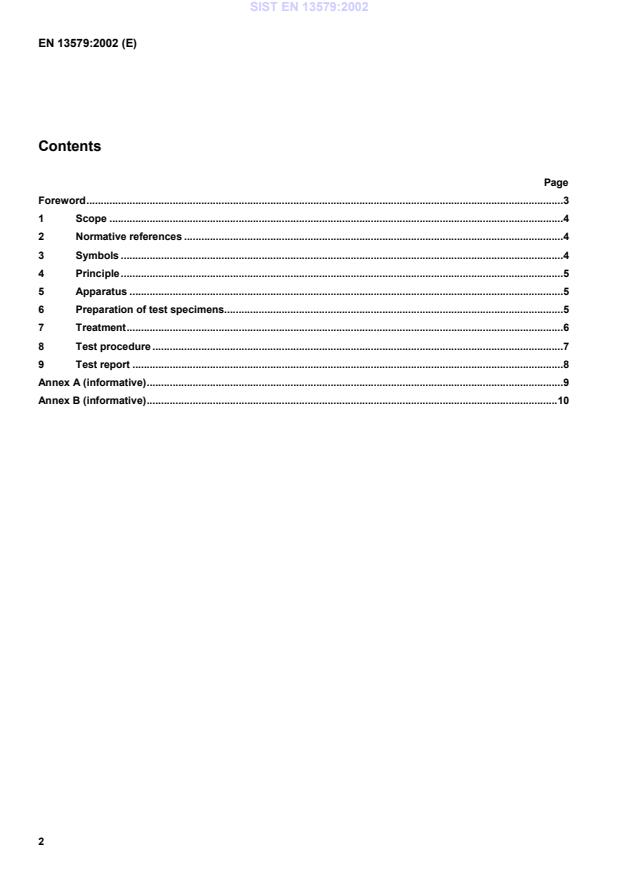
The document is organized into clauses for scope, normative references, symbols, principle, apparatus, specimen preparation, treatment, test procedure, and test report. It also includes two informative annexes that support the procedure and one optional concrete type note.
| Annex | What it covers |
|---|---|
| Annex A | Flow chart of the drying test procedure |
| Annex B | Optional use of Type C (0,70) concrete if all parties agree |
What are the key requirements of SIST EN 13579:2002?
SIST EN 13579:2002 requires nine 100 mm concrete cubes made from a single batch of Type C (0,45) concrete and cured for 28 days in accordance with EN 1766. This matters because the method depends on comparing cubes that start from the same concrete and curing history.
Specimen preparation and conditioning
SIST EN 13579:2002 requires six cubes to be conditioned for 7 days at (21 ± 2) °C and (60 ± 10) % relative humidity, while three cubes are oven-dried at (105 ± 5) °C for 7 days. The weights taken at these stages are used to estimate moisture content and the oven-dry weight of the conditioned cubes, which is the basis for the later drying comparison.
The cubes are then weighed until their moisture content reaches (5.0 ± 0.5) %. In practice, this means the test starts from a defined pre-treatment moisture condition rather than from an arbitrary wet or dry state.
Treatment of the impregnated cubes
SIST EN 13579:2002 requires three cubes to be treated in a fume cupboard by dipping each face in the impregnant for (120 ± 5) s, using 60 ml of material in a petri dish. The mass change before and after each face is used to calculate consumption per face and the mean consumption per cube.
If the consumption is below the manufacturer’s recommended value, the dipping time may be extended. If the cube treatment is not practical by this method, the standard allows treatment according to the manufacturer’s instructions, which gives some flexibility while still keeping the test meaningful.
Drying test and calculation
SIST EN 13579:2002 requires the treated cubes to be stored for 48 ± 1 h after treatment and then tested alongside the untreated cubes in an environmental cabinet at (30 ± 2) °C and (40 ± 5) % relative humidity. The untreated cubes are weighed after 6 h and again after a further 18 h; the treated cubes are weighed after 24 h and again after a further 24 h, with extra conditioning if needed so the treated cubes do not start wetter than their pre-treatment state.
The drying rate of each cube is calculated from the weight loss over time, and the drying rate coefficient is then calculated from the mean drying rate of the treated cubes and the mean drying rate of the untreated cubes. In practice, this gives one percentage value that shows how strongly the impregnation changes drying behavior.
Reuse for other tests
SIST EN 13579:2002 allows the cubes to be kept for water absorption and alkali resistance testing if required by prEN 13580, provided the treated and untreated cubes are stored separately in airtight boxes over saturated potassium sulphate solution. This helps laboratories use the same specimens for linked performance checks.
What terms does SIST EN 13579:2002 define?
- Hydrophobic impregnation - A surface treatment intended to reduce water uptake while allowing the concrete to dry, which is the behavior this standard evaluates.
- Drying rate coefficient (DRC) - The percentage ratio used to compare the drying rate of treated cubes with untreated cubes.
- Drying rate of a treated test cube (Dt) - The drying rate calculated for one treated cube from its weight loss during the test.
- Mean drying rate of three treated test cubes (Dtm) - The average drying rate for the three treated cubes, used in the final DRC calculation.
- Mean drying rate of three untreated test cubes (Dum) - The average drying rate for the three untreated cubes, used as the reference in the final DRC calculation.
- Saturated surface dry moisture content (Mssd) - The moisture content of a cube at the saturated surface dry condition, used to estimate the oven-dry weight of the conditioned cubes.
Who uses SIST EN 13579:2002?
SIST EN 13579:2002 is used by laboratories that test products and systems for the protection and repair of concrete structures. Manufacturers and suppliers of hydrophobic impregnants use it to measure product performance, while quality managers and buyers use it when they need a defined test method for comparing products or checking claimed drying behavior.
It is also relevant to people specifying repair and protection materials for concrete structures, because it provides a repeatable way to test how a surface impregnation affects drying.
Which standards are used with SIST EN 13579:2002?
- EN 1766 - Provides the reference concretes for testing and is used for specimen preparation and curing.
- EN 13580 - Provides the related test method for water absorption and resistance to alkali for hydrophobic impregnations; cubes from this drying test may be reused for that work.
- prEN 13580 - The body text refers to this draft designation when describing the optional further use of the test cubes.
What does the SIST EN 13579:2002 document contain?
SIST EN 13579:2002 contains the full test sequence from specimen preparation through reporting. It gives the principle of comparing treated and untreated cubes, lists the apparatus, and provides the conditioning, treatment, and drying steps used to derive the drying rate coefficient.
The document also includes formulas for moisture content, estimated oven-dry weight, impregnant consumption, drying rate, and the final coefficient. Annex A presents the flow chart for the test sequence, and the test report clause lists the items that must be recorded, including specimen identity, concrete mix details, storage conditions, consumption, and the final drying rate coefficient.
Relations
- Effective Date
- 28-Jan-2026
- Effective Date
- 28-Jan-2026
- Effective Date
- 28-Jan-2026
Get Certified
Connect with accredited certification bodies for this standard

DIBt (Deutsches Institut für Bautechnik)
German Institute for Building Technology.
DIN CERTCO
DIN Group product certification.

Aboma Certification B.V.
Specialized in construction, metal, and transport sectors.
Sponsored listings
Frequently Asked Questions
SIST EN 13579:2002 is a standard published by the Slovenian Institute for Standardization (SIST). Its full title is "Products and systems for the protection and repair of concrete structures - Test methods - Drying test for hydrophobic impregnation". This standard covers: This European Standard specifies a test method to evaluate the effect of hydrophobic impregnation on the drying rate coefficient of impregnated specimens. The method primarily relates to the protection of concrete structures.
This European Standard specifies a test method to evaluate the effect of hydrophobic impregnation on the drying rate coefficient of impregnated specimens. The method primarily relates to the protection of concrete structures.
SIST EN 13579:2002 is classified under the following ICS (International Classification for Standards) categories: 91.080.40 - Concrete structures; 91.100.99 - Other construction materials. The ICS classification helps identify the subject area and facilitates finding related standards.
SIST EN 13579:2002 has the following relationships with other standards: It is inter standard links to SIST EN 1766:2002, SIST EN 1504-2:2004, SIST EN 13580:2002. Understanding these relationships helps ensure you are using the most current and applicable version of the standard.
SIST EN 13579:2002 is associated with the following European legislation: EU Directives/Regulations: 305/2011, 89/106/EEC; Standardization Mandates: M/128. When a standard is cited in the Official Journal of the European Union, products manufactured in conformity with it benefit from a presumption of conformity with the essential requirements of the corresponding EU directive or regulation.
SIST EN 13579:2002 is available in PDF format for immediate download after purchase. The document can be added to your cart and obtained through the secure checkout process. Digital delivery ensures instant access to the complete standard document.
Standards Content (Sample)
2003-01.Slovenski inštitut za standardizacijo. Razmnoževanje celote ali delov tega standarda ni dovoljeno.Produkte und Systeme für den Schutz und die Instandsetzung von Betontragwerken - Prüfverfahren - Trocknungsprüfung für hydrophobierende ImprägnierungenProduits et systemes pour la protection et la réparation des structures en béton - Méthodes d'essai - Essai de séchage pour l'imprégnation hydrofugeProducts and systems for the protection and repair of concrete structures - Test methods - Drying test for hydrophobic impregnation91.100.99Drugi gradbeni materialiOther construction materials91.080.40Betonske konstrukcijeConcrete structuresICS:Ta slovenski standard je istoveten z:EN 13579:2002SIST EN 13579:2002en01-november-2002SIST EN 13579:2002SLOVENSKI
STANDARD
EUROPEAN STANDARDNORME EUROPÉENNEEUROPÄISCHE NORMEN 13579August 2002ICS 91.080.40; 91.100.99English versionProducts and systems for the protection and repair of concretestructures - Test methods - Drying test for hydrophobicimpregnationProduits et systèmes pour la protection et la réparation desstructures en béton - Méthodes d'essai - Essai de séchagepour l'imprégnation hydrofugeProdukte und Systeme für den Schutz und dieInstandsetzung von Betontragwerken - Prüfverfahren -Trocknungsprüfung für hydrophobierende ImprägnierungenThis European Standard was approved by CEN on 23 December 2001.CEN members are bound to comply with the CEN/CENELEC Internal Regulations which stipulate the conditions for giving this EuropeanStandard the status of a national standard without any alteration. Up-to-date lists and bibliographical references concerning such nationalstandards may be obtained on application to the Management Centre or to any CEN member.This European Standard exists in three official versions (English, French, German). A version in any other language made by translationunder the responsibility of a CEN member into its own language and notified to the Management Centre has the same status as the officialversions.CEN members are the national standards bodies of Austria, Belgium, Czech Republic, Denmark, Finland, France, Germany, Greece,Iceland, Ireland, Italy, Luxembourg, Malta, Netherlands, Norway, Portugal, Spain, Sweden, Switzerland and United Kingdom.EUROPEAN COMMITTEE FOR STANDARDIZATIONCOMITÉ EUROPÉEN DE NORMALISATIONEUROPÄISCHES KOMITEE FÜR NORMUNGManagement Centre: rue de Stassart, 36
B-1050 Brussels© 2002 CENAll rights of exploitation in any form and by any means reservedworldwide for CEN national Members.Ref. No. EN 13579:2002 ESIST EN 13579:2002
x 100 mm x 100 mm).5.2Soft brush.5.3Absorbent paper towel5.4Balance with an accuracy of 0,01 g.5.5Support for test cubes on bench in labora
...