

oSIST prEN 1127-2:2026
(Main)Explosive atmospheres - Explosion prevention and protection - Part 2: Basic concepts and methodology for mining
- Abstract
This document specifies methods for explosion prevention and protection in mining by outlining the basic concepts and methodology for the design and construction of equipment, protective systems and components.
This document applies to Group I equipment, protective systems and components intended for use in underground parts of mines and those parts of their surface installations at risk from firedamp and/or combustible dust.
NOTE Detailed information on specific equipment, protective systems and components is contained in the relevant individual standards. Safety-relevant data regarding flammable materials and explosive atmospheres are required for the design and construction of the explosion protection measures.
This document specifies methods for the identification and assessment of hazardous situations that may lead to explosions and describes the design and construction measures appropriate for the required safety. This is achieved by:
— risk assessment;
— risk reduction.
The safety of equipment, protective systems, and components can be achieved by eliminating hazards and/or limiting the risk, i.e.:
a) by appropriate design (without using safeguarding);
b) by safeguarding;
c) by information for use;
d) by any other preventive measures.
Measures in accordance with a) (prevention) and b) (protection) against explosions are dealt with in Clause 6 of this document; measures according to c) against explosions are dealt with in Clause 7 of this document. Measures in accordance with d) are not described in this document. They are dealt with in EN ISO 12100:2010, Clause 6.
The preventive and protective measures described in this document will not provide the required level of protection unless the equipment, protective systems and components are operated in line with their intended use and are installed and maintained according to the relevant codes of practice or requirements.
This document is applicable to any equipment, protective systems and components intended to be used in potentially explosive atmospheres. These atmospheres can arise from flammable materials processed, used or released by the equipment, protective systems and components or from materials in the vicinity of the equipment, protective systems and components and/or from the materials of construction of the equipment, protective systems and components.
As shot firing can release potentially explosive atmospheres, this document is also applicable to the equipment used for shot firing, apart from the explosives and detonators.
This document is applicable to equipment, protective systems and components at all stages of use.
This document is not applicable to:
— medical devices intended for use in a medical environment;
— equipment, protective systems and components where the explosion hazard results exclusively from the presence of explosives or unstable chemical substances;
— equipment, protective systems and components where the explosion can result from reaction of substances with oxidising agents other than atmospheric oxygen or by other hazardous reactions or conditions other than atmospheric conditions;
— equipment intended for use in domestic and non-commercial environments where explosive atmospheres may only rarely be created and solely as a result of the accidental leakage of fuel gas;
— personal protective equipment covered by Regulation (EU) 2016/425; the design and construction of systems containing desired, controlled combustion processes, unless they can act as ignition sources in potentially explosive atmospheres;
— mines where firedamp and/or combustible dust are not naturally present and surface installations such as coal preparation plants, power plants, coke oven plants etc. in which an explosive atmosphere can be present, but which are not part of a coal mine. These are covered by EN 1127-1:2019.
- Status
- Not Published
- Public Enquiry End Date
- 22-Sep-2026
- Technical Committee
- EXP - Product for explosive atmospheres
- Current Stage
- 4020 - Public enquire (PE) (Adopted Project)
- Start Date
- 29-Jul-2026
- Due Date
- 16-Dec-2026
- Completion Date
- 07-Oct-2026

oSIST prEN 1127-2:2026 is a CEN draft European Standard on explosion prevention and protection in mining. It specifies the basic concepts and methodology for the design and construction of Group I equipment, protective systems and components used in underground parts of mines and associated surface installations where firedamp and/or combustible dust can create explosive atmospheres. It is written for designers, manufacturers, mine operators and others who need to assess explosion risk and choose suitable protective measures.
What does oSIST prEN 1127-2:2026 specify?
oSIST prEN 1127-2:2026 specifies how to identify explosion hazards in mining and how to reduce the risk by design, safeguarding and information for use. It focuses on equipment, protective systems and components for underground mines and the parts of surface installations that are exposed to firedamp and/or combustible dust.
The document is organized into:
- Clause 1 - Scope
- Clause 2 - Normative references
- Clause 3 - Terms and definitions
- Clause 4 - Risk assessment
- Clause 5 - Possible ignition sources
- Clause 6 - Risk reduction
- Clause 7 - Information for use
- Annexes A, B, C, ZA and ZB
Annexes are used as follows:
| Annex | What it covers |
|---|---|
| Annex A | Relation between Equipment categories and hazardous atmospheric conditions |
| Annex B | Tools for use in potentially explosive atmospheres |
| Annex C | Significant technical changes from the previous edition |
| Annex ZA | Relationship with Directive 2014/34/EU |
| Annex ZB | Relationship with Regulation (EU) 2023/1230 |
The scope includes equipment used for shot firing, except explosives and detonators. It also covers equipment at all stages of use, so the document is relevant from design through operation, maintenance and repair.
What are the key requirements of oSIST prEN 1127-2:2026?
oSIST prEN 1127-2:2026 requires a mine-specific explosion safety approach. In practice, the standard asks the manufacturer or integrator to assess the atmosphere, identify ignition sources, choose prevention measures first, and add protection measures where needed.
Clause 4 - risk assessment
Clause 4 requires assessment of the likelihood of hazardous explosive atmospheres in mines based on the mineral being worked, the working method, firedamp in the surrounding strata, human effects on the strata and the dilution effect of ventilation. This matters because the same design can be acceptable in one mine and unsafe in another.
Clause 5 - identify ignition sources
Clause 5 lists the main ignition sources to check: hot surfaces, flames and hot gases, mechanically generated sparks, electrical equipment, stray electric currents, static electricity, lightning, radio frequency (RF) electromagnetic waves, other electromagnetic waves, ionizing radiation, ultrasonics, adiabatic compression and shock waves, and exothermic reactions including self-ignition of dusts. The practical point is that the design review must cover both electrical and non-electrical ignition risks, not only obvious sparks.
Clause 6.1 - prevention first, then protection
Clause 6.1 sets the order of measures: avoid or reduce explosive atmospheres, avoid effective ignition sources, then limit explosion effects. It also requires an explosion safety concept for each case and says normal operation, start-up, shutdown, malfunctions and foreseeable misuse must be considered. That means safety cannot rely only on ideal operating conditions.
Clause 6.2 - reduce the explosive atmosphere
Clause 6.2 calls for substitution of flammable substances where possible, minimum use of flammables where reduction is reasonably practicable, concentration control, inerting or pressurizing, leak limitation and ventilation. It also notes that monitoring such as gas or flow detection may need to be linked to alarms or automatic emergency functions. In practice, this is the section that drives process choices, ventilation design and leak control.
Clause 6.3 and Annex A - classify the hazardous atmosphere
Clause 6.3 distinguishes between explosive atmosphere and potentially explosive atmosphere for mines endangered by firedamp and/or combustible dust. Annex A links those atmospheric conditions to Equipment categories M 1 and M 2. This matters because equipment selection depends on whether the atmosphere is expected to be explosive now, or may become so under abnormal conditions.
Clause 6.4 - design against ignition
Clause 6.4 gives detailed measures for M 1 and M 2 equipment. It covers temperature limits for hot surfaces, restrictions on flames and hot gases, rules for sparks, electrical equipment, bonding against stray currents, static control, lightning protection, radio-frequency and other electromagnetic radiation, ionizing radiation, ultrasonics, compression and shock waves, and exothermic reactions. For users, this clause is the core design checklist for making sure a potential ignition source cannot become effective.
Clause 6.5 to 6.7 - limit explosion effects and manage control systems
Clause 6.5 provides the fallback measures when prevention is not enough: explosion-resistant design, explosion relief, explosion suppression and flame or explosion propagation prevention. Clause 6.6 adds emergency measures such as shutdown, emptying, interrupting material flow and flooding. Clause 6.7 requires measuring and control systems to follow the general principles of EN ISO 13849-1 and to be matched to the risk assessment. In practice, this is where detection, interlocking and automatic response are tied to the safety concept.
Clause 7 and Annex B - operating information
Clause 7 requires clear instructions for commissioning, maintenance, repair, cleaning, fault handling and testing after an explosion. Annex B adds rules for hand-held tools in potentially explosive atmospheres. This is important because correct use, maintenance and repair are part of the explosion protection strategy.
What terms does oSIST prEN 1127-2:2026 define?
- Firedamp - any potentially explosive mixture of gases or any flammable gas naturally occurring in a mine, usually mainly methane.
- Component - an item essential to the safe functioning of equipment and protective systems but with no autonomous function.
- Equipment - machines, apparatus, fixed or mobile devices, control components, instrumentation, and detection and prevention systems capable of causing an explosion through their own ignition sources.
- Machinery - an assembly with a drive system made up of linked parts or components, at least one of which moves, and arranged for a specific application.
- Protective system - a device intended to stop an incipient explosion immediately and/or limit its effective range.
- Self-ignition of dust in bulk - dust ignition caused when heat generation from oxidation and/or decomposition is greater than heat loss to the surroundings.
Who uses oSIST prEN 1127-2:2026?
oSIST prEN 1127-2:2026 is used by machine manufacturers, equipment designers, mine operators, maintenance providers, safety bodies and market surveillance authorities. It is also intended for bodies preparing type-C standards, because those standards may supplement or modify the requirements here.
In practice, it supports:
- design of mining equipment and protective systems
- selection of Group I equipment for mines with firedamp and/or combustible dust
- explosion risk assessment in mine workings and related surface installations
- commissioning, maintenance and repair planning
- preparation of operating instructions and training needs
What changed in oSIST prEN 1127-2:2026 from the previous edition?
oSIST prEN 1127-2:2026 supersedes EN 1127-2:2014. The document states three significant changes:
- the classification was corrected from type-A standard to type-B standard
- references were updated
- Annex ZA and Annex ZB were updated
Annex C also records the technical changes against the previous edition.
Which standards are used with oSIST prEN 1127-2:2026?
The document relies on several normative references that supply general concepts or detailed protection methods:
- EN 1127-1:2019 - general explosion prevention and protection concepts used where the mining part refers back to base methods and ignition sources
- EN 13237:2024 - terms and definitions for explosive atmospheres and related equipment
- EN 14373:2021+A1:2025 - explosion suppression systems
- EN 14460:2018 - explosion resistant equipment
- EN 14797:2006 - explosion venting devices
- EN 15089:2009 - explosion isolation systems
- EN 50303:2000 - Group I, category M1 equipment for firedamp and coal dust
- EN IEC 60079-0:2018 - general requirements for explosive-atmosphere equipment
- EN 60079-2:2014 - pressurized enclosure protection
- EN ISO 12100:2010 - general machinery risk assessment and risk reduction
- EN ISO 13849-1:2023 - safety-related control systems
- EN ISO 80079-36:2016 - non-electrical equipment for explosive atmospheres
- EN ISO/IEC 80079-38:2016 - equipment and components for underground mines
What does the oSIST prEN 1127-2:2026 document contain?
oSIST prEN 1127-2:2026 contains a structured method for mine explosion safety, from risk assessment through design measures and operating information. It gives long lists of ignition sources, detailed requirements for M 1 and M 2 equipment, and special provisions for underground mining such as explosion suppression systems, explosion barriers and explosion-proof ventilation structures. It also includes a table linking equipment categories to atmospheric conditions and a separate annex for hand tools in potentially explosive atmospheres.
Relations
- Effective Date
- 28-Jan-2026
- Effective Date
- 28-Jan-2026
- Effective Date
- 06-Mar-2024
Get Certified
Connect with accredited certification bodies for this standard

Bureau Veritas Chile
Bureau Veritas certification services in Chile.
Bureau Veritas Peru
Bureau Veritas certification services in Peru.
BVQI Peru
Bureau Veritas certification in Peru.
Sponsored listings
Frequently Asked Questions
oSIST prEN 1127-2:2026 is a draft published by the Slovenian Institute for Standardization (SIST). Its full title is "Explosive atmospheres - Explosion prevention and protection - Part 2: Basic concepts and methodology for mining". This standard covers: This document specifies methods for explosion prevention and protection in mining by outlining the basic concepts and methodology for the design and construction of equipment, protective systems and components. This document applies to Group I equipment, protective systems and components intended for use in underground parts of mines and those parts of their surface installations at risk from firedamp and/or combustible dust. NOTE Detailed information on specific equipment, protective systems and components is contained in the relevant individual standards. Safety-relevant data regarding flammable materials and explosive atmospheres are required for the design and construction of the explosion protection measures. This document specifies methods for the identification and assessment of hazardous situations that may lead to explosions and describes the design and construction measures appropriate for the required safety. This is achieved by: — risk assessment; — risk reduction. The safety of equipment, protective systems, and components can be achieved by eliminating hazards and/or limiting the risk, i.e.: a) by appropriate design (without using safeguarding); b) by safeguarding; c) by information for use; d) by any other preventive measures. Measures in accordance with a) (prevention) and b) (protection) against explosions are dealt with in Clause 6 of this document; measures according to c) against explosions are dealt with in Clause 7 of this document. Measures in accordance with d) are not described in this document. They are dealt with in EN ISO 12100:2010, Clause 6. The preventive and protective measures described in this document will not provide the required level of protection unless the equipment, protective systems and components are operated in line with their intended use and are installed and maintained according to the relevant codes of practice or requirements. This document is applicable to any equipment, protective systems and components intended to be used in potentially explosive atmospheres. These atmospheres can arise from flammable materials processed, used or released by the equipment, protective systems and components or from materials in the vicinity of the equipment, protective systems and components and/or from the materials of construction of the equipment, protective systems and components. As shot firing can release potentially explosive atmospheres, this document is also applicable to the equipment used for shot firing, apart from the explosives and detonators. This document is applicable to equipment, protective systems and components at all stages of use. This document is not applicable to: — medical devices intended for use in a medical environment; — equipment, protective systems and components where the explosion hazard results exclusively from the presence of explosives or unstable chemical substances; — equipment, protective systems and components where the explosion can result from reaction of substances with oxidising agents other than atmospheric oxygen or by other hazardous reactions or conditions other than atmospheric conditions; — equipment intended for use in domestic and non-commercial environments where explosive atmospheres may only rarely be created and solely as a result of the accidental leakage of fuel gas; — personal protective equipment covered by Regulation (EU) 2016/425; the design and construction of systems containing desired, controlled combustion processes, unless they can act as ignition sources in potentially explosive atmospheres; — mines where firedamp and/or combustible dust are not naturally present and surface installations such as coal preparation plants, power plants, coke oven plants etc. in which an explosive atmosphere can be present, but which are not part of a coal mine. These are covered by EN 1127-1:2019.
This document specifies methods for explosion prevention and protection in mining by outlining the basic concepts and methodology for the design and construction of equipment, protective systems and components. This document applies to Group I equipment, protective systems and components intended for use in underground parts of mines and those parts of their surface installations at risk from firedamp and/or combustible dust. NOTE Detailed information on specific equipment, protective systems and components is contained in the relevant individual standards. Safety-relevant data regarding flammable materials and explosive atmospheres are required for the design and construction of the explosion protection measures. This document specifies methods for the identification and assessment of hazardous situations that may lead to explosions and describes the design and construction measures appropriate for the required safety. This is achieved by: — risk assessment; — risk reduction. The safety of equipment, protective systems, and components can be achieved by eliminating hazards and/or limiting the risk, i.e.: a) by appropriate design (without using safeguarding); b) by safeguarding; c) by information for use; d) by any other preventive measures. Measures in accordance with a) (prevention) and b) (protection) against explosions are dealt with in Clause 6 of this document; measures according to c) against explosions are dealt with in Clause 7 of this document. Measures in accordance with d) are not described in this document. They are dealt with in EN ISO 12100:2010, Clause 6. The preventive and protective measures described in this document will not provide the required level of protection unless the equipment, protective systems and components are operated in line with their intended use and are installed and maintained according to the relevant codes of practice or requirements. This document is applicable to any equipment, protective systems and components intended to be used in potentially explosive atmospheres. These atmospheres can arise from flammable materials processed, used or released by the equipment, protective systems and components or from materials in the vicinity of the equipment, protective systems and components and/or from the materials of construction of the equipment, protective systems and components. As shot firing can release potentially explosive atmospheres, this document is also applicable to the equipment used for shot firing, apart from the explosives and detonators. This document is applicable to equipment, protective systems and components at all stages of use. This document is not applicable to: — medical devices intended for use in a medical environment; — equipment, protective systems and components where the explosion hazard results exclusively from the presence of explosives or unstable chemical substances; — equipment, protective systems and components where the explosion can result from reaction of substances with oxidising agents other than atmospheric oxygen or by other hazardous reactions or conditions other than atmospheric conditions; — equipment intended for use in domestic and non-commercial environments where explosive atmospheres may only rarely be created and solely as a result of the accidental leakage of fuel gas; — personal protective equipment covered by Regulation (EU) 2016/425; the design and construction of systems containing desired, controlled combustion processes, unless they can act as ignition sources in potentially explosive atmospheres; — mines where firedamp and/or combustible dust are not naturally present and surface installations such as coal preparation plants, power plants, coke oven plants etc. in which an explosive atmosphere can be present, but which are not part of a coal mine. These are covered by EN 1127-1:2019.
oSIST prEN 1127-2:2026 is classified under the following ICS (International Classification for Standards) categories: 13.230 - Explosion protection; 73.020 - Mining and quarrying; 73.100.01 - Mining equipment in general. The ICS classification helps identify the subject area and facilitates finding related standards.
oSIST prEN 1127-2:2026 has the following relationships with other standards: It is inter standard links to SIST EN ISO 12736-3:2023, SIST EN ISO 12736-2:2023, SIST EN 1127-2:2014. Understanding these relationships helps ensure you are using the most current and applicable version of the standard.
oSIST prEN 1127-2:2026 is associated with the following European legislation: EU Directives/Regulations: 2014/34/EU, 2023/1230, 2023/1230, 2023/1230; Standardization Mandates: M/396, M/596, M/605. When a standard is cited in the Official Journal of the European Union, products manufactured in conformity with it benefit from a presumption of conformity with the essential requirements of the corresponding EU directive or regulation.
oSIST prEN 1127-2:2026 is available in PDF format for immediate download after purchase. The document can be added to your cart and obtained through the secure checkout process. Digital delivery ensures instant access to the complete standard document.
Standards Content (Sample)
SLOVENSKI STANDARD
01-september-2026
Eksplozivne atmosfere - Protieksplozijska zaščita - 2. del: Osnovni pojmi in
metodologija za rudarstvo
Explosive atmospheres - Explosion prevention and protection - Part 2: Basic concepts
and methodology for mining
Explosionsfähige Atmosphären - Explosionsschutz - Teil 2: Grundlagen und Methodik in
Bergwerken
Atmosphères explosives - Prévention de l'explosion et protection contre l'explosion -
Partie 2 : Notions fondamentales et méthodologie dans l'exploitation des mines
Ta slovenski standard je istoveten z: prEN 1127-2
ICS:
13.230 Varstvo pred eksplozijo Explosion protection
73.020 Rudarstvo in kamnolomsko Mining and quarrying
izkopavanje
2003-01.Slovenski inštitut za standardizacijo. Razmnoževanje celote ali delov tega standarda ni dovoljeno.
DRAFT
EUROPEAN STANDARD
NORME EUROPÉENNE
EUROPÄISCHE NORM
September 2026
ICS 13.230; 73.100.01 Will supersede EN 1127-2:2014
English Version
Explosive atmospheres - Explosion prevention and
protection - Part 2: Basic concepts and methodology for
mining
Atmosphères explosives - Prévention de l'explosion et Explosionsfähige Atmosphären - Explosionsschutz -
protection contre l'explosion - Partie 2 : Notions Teil 2: Grundlagen und Methodik in Bergwerken
fondamentales et méthodologie dans l'exploitation des
mines
This draft European Standard is submitted to CEN members for enquiry. It has been drawn up by the Technical Committee
CEN/TC 305.
If this draft becomes a European Standard, CEN members are bound to comply with the CEN/CENELEC Internal Regulations
which stipulate the conditions for giving this European Standard the status of a national standard without any alteration.
This draft European Standard was established by CEN in three official versions (English, French, German). A version in any other
language made by translation under the responsibility of a CEN member into its own language and notified to the CEN-CENELEC
Management Centre has the same status as the official versions.
CEN members are the national standards bodies of Austria, Belgium, Bulgaria, Croatia, Cyprus, Czech Republic, Denmark, Estonia,
Finland, France, Germany, Greece, Hungary, Iceland, Ireland, Italy, Latvia, Lithuania, Luxembourg, Malta, Netherlands, Norway,
Poland, Portugal, Republic of North Macedonia, Romania, Serbia, Slovakia, Slovenia, Spain, Sweden, Switzerland, Türkiye and
United Kingdom.
Recipients of this draft are invited to submit, with their comments, notification of any relevant patent rights of which they are
aware and to provide supporting documentation.
Warning : This document is not a European Standard. It is distributed for review and comments. It is subject to change without
notice and shall not be referred to as a European Standard.
EUROPEAN COMMITTEE FOR STANDARDIZATION
COMITÉ EUROPÉEN DE NORMALISATION
EUROPÄISCHES KOMITEE FÜR NORMUNG
CEN-CENELEC Management Centre: Rue de la Science 23, B-1040 Brussels
© 2026 CEN All rights of exploitation in any form and by any means reserved Ref. No. prEN 1127-2:2026 E
worldwide for CEN national Members.
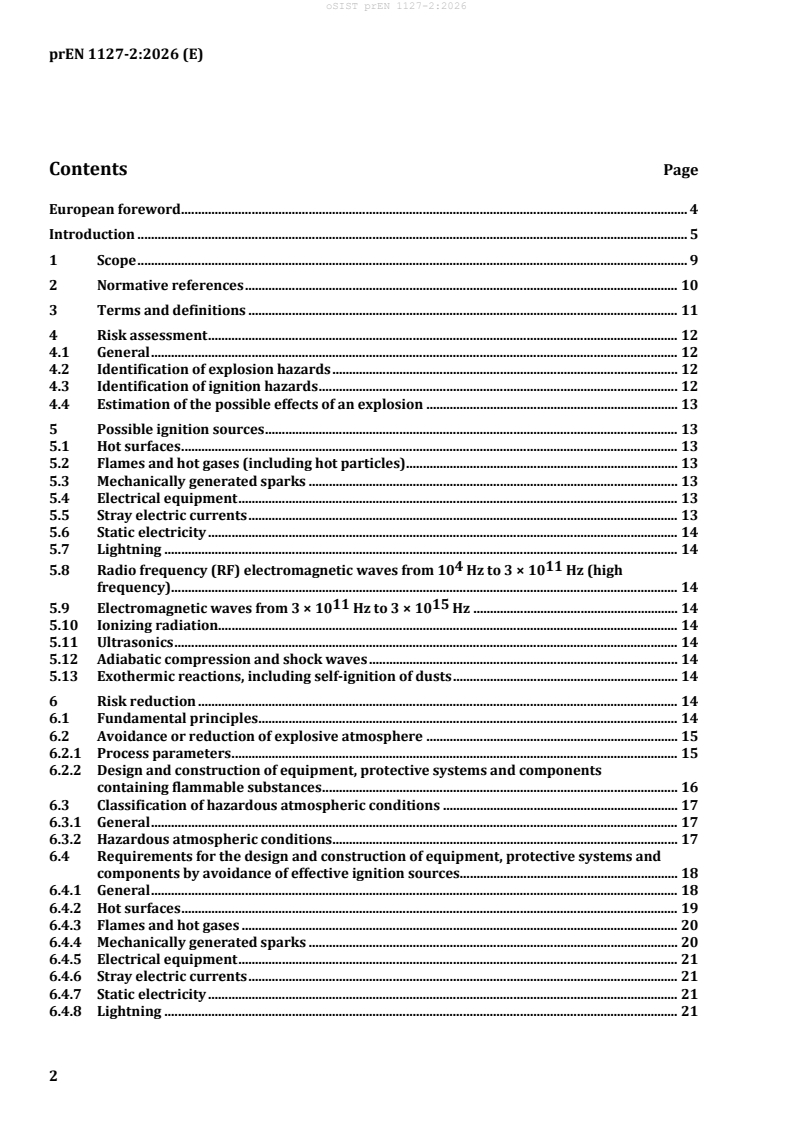
Contents Page
European foreword . 4
Introduction . 5
1 Scope . 9
2 Normative references . 10
3 Terms and definitions . 11
4 Risk assessment . 12
4.1 General . 12
4.2 Identification of explosion hazards . 12
4.3 Identification of ignition hazards . 12
4.4 Estimation of the possible effects of an explosion . 13
5 Possible ignition sources . 13
5.1 Hot surfaces . 13
5.2 Flames and hot gases (including hot particles) . 13
5.3 Mechanically generated sparks . 13
5.4 Electrical equipment . 13
5.5 Stray electric currents . 13
5.6 Static electricity . 14
5.7 Lightning . 14
4 11
5.8 Radio frequency (RF) electromagnetic waves from 10 Hz to 3 × 10 Hz (high
frequency) . 14
11 15
5.9 Electromagnetic waves from 3 × 10 Hz to 3 × 10 Hz . 14
5.10 Ionizing radiation. 14
5.11 Ultrasonics . 14
5.12 Adiabatic compression and shock waves . 14
5.13 Exothermic reactions, including self-ignition of dusts . 14
6 Risk reduction . 14
6.1 Fundamental principles . 14
6.2 Avoidance or reduction of explosive atmosphere . 15
6.2.1 Process parameters . 15
6.2.2 Design and construction of equipment, protective systems and components
containing flammable substances . 16
6.3 Classification of hazardous atmospheric conditions . 17
6.3.1 General . 17
6.3.2 Hazardous atmospheric conditions . 17
6.4 Requirements for the design and construction of equipment, protective systems and
components by avoidance of effective ignition sources. 18
6.4.1 General . 18
6.4.2 Hot surfaces . 19
6.4.3 Flames and hot gases . 20
6.4.4 Mechanically generated sparks . 20
6.4.5 Electrical equipment . 21
6.4.6 Stray electric currents . 21
6.4.7 Static electricity . 21
6.4.8 Lightning . 21
4 11
6.4.9 Radio frequency (RF) electromagnetic waves from 10 Hz to 3 × 10 Hz . 21
11 15
6.4.10 Electromagnetic waves from 3 × 10 Hz to 3 × 10 Hz . 22
6.4.11 Ionizing radiation . 22
6.4.12 Ultrasonics . 23
6.4.13 Adiabatic compression and shock waves . 23
6.4.14 Exothermic reactions, including self-ignition of dusts . 23
6.5 Requirements for design and construction of equipment, protective systems and
components to reduce the explosion effects . 23
6.5.1 General . 23
6.5.2 Special equipment for underground mining . 24
6.6 Provisions for emergency measures . 24
6.7 Principles for measuring and control systems for explosion prevention and
protection . 25
7 Information for use . 25
7.1 General . 25
7.2 Information for commissioning, maintenance and repair to prevent explosion . 26
7.3 Qualifications and training . 26
Annex A (informative) Relation between Equipment categories and hazardous atmospheric
conditions . 27
Annex B (normative) Tools for use in potentially explosive atmospheres . 28
Annex C (informative) Significant technical changes between this document and the
previous edition of this European Standard . 29
Annex ZA (informative) Relationship between this European Standard and the essential
health and safety requirements of Directive 2014/34/EU aimed to be covered . 31
Annex ZB (informative) Relationship between this European Standard and the essential
requirements of Regulation (EU) 2023/1230 aimed to be covered. 34
Bibliography . 39
European foreword
This document (prEN 1127-2:2026) has been prepared by Technical Committee CEN/TC 305 “Potentially
explosive atmospheres - Explosion prevention and protection”, the secretariat of which is held by DIN.
This document is currently submitted to the CEN Enquiry.
This document will supersede EN 1127-2:2014.
— classification corrected from type-A-standard to type-B-standard;
— references updated;
— Annex ZA and Annex ZB updated.
This document has been prepared under a standardization request addressed to CEN by the European
Commission. The Standing Committee of the EFTA States subsequently approves these requests for its
Member States.
For the relationship with EU Legislation, see informative Annex ZA and Annex ZB, which is an integral
part of this document.
Introduction
General
CEN and CENELEC are producing a series of standards to assist designers, manufacturers and other
interested bodies to interpret the essential safety requirements in order to achieve conformity with
European legislation. Within this series of standards, CEN has undertaken to draw up a standard to give
guidance in the field of explosion prevention and protection, as hazards from explosions are to be
considered in accordance with EN ISO 12100:2010.
This document is a type-B standard as stated in EN ISO 12100.
This document is of relevance, in particular, for the following stakeholder groups representing the market
players with regard to machinery safety:
— machine manufacturers (small, medium and large enterprises);
— health and safety bodies (regulators, accident prevention organizations, market surveillance etc.);
Others can be affected by the level of machinery safety achieved with the means of the document by the
above-mentioned stakeholder groups:
— machine users/employers (small, medium and large enterprises);
— machine users/employees (e.g. trade unions, organizations for people with special needs);
— service providers, e.g. for maintenance (small, medium and large enterprises);
— consumers (in case of machinery intended for use by consumers).
The above-mentioned stakeholder groups have been given the possibility to participate at the drafting
process of this document.
In addition, this document is intended for standardization bodies elaborating type-C standards.
The requirements of this document can be supplemented or modified by a type-C standard.
For machines that are covered by the scope of a type-C standard and have been designed and built
according to the requirements of that standard, the requirements of that type-C standard take
precedence.
Special considerations for mining
Explosions can result from:
— materials processed or used by the equipment and components, e.g. minerals obtained as part of the
winning process;
— materials released by the equipment and components;
— materials in the vicinity of the equipment, protective systems and components;
— materials of which the equipment, protective systems and components are constructed.
As the explosion protection of equipment, protective systems and components depends on:
— the design and construction of the equipment, protective systems and components;
— the intended use;
— the foreseeable misuse;
— the ambient conditions;
— the materials extracted and handled.
This document also includes safety aspects related to these factors, i.e. it is imperative that the
manufacturer consider how and for what the equipment, protective systems and components will be used
and take this into account during their design and construction. Only in this way can hazards inherent in
equipment, protective systems and components be reduced.
NOTE 1 This document can also serve as a guide for users of equipment, protective systems and components
when assessing the risk of explosion in the workplace and selecting the appropriate equipment, protective systems
and components.
Mines can be either gassy or non-gassy depending upon the mineral/material being extracted and
whether or not firedamp can occur in the workings. It is usual practice to consider all coal mines as gassy
mines. Non-coal mines can, however, also be susceptible to the occurrence of firedamp, e.g. if
minerals/materials are being extracted in the vicinity of oil-bearing strata or unworked coal seams which
are disturbed by the extraction process or mines susceptible to outbursts of flammable gas.
In mines where flammable minerals/materials are extracted, there can also be a risk of explosions
because small particles of the extracted product can be blown into the air to form dust/air mixtures able
to support rapid combustion. Combustible dust can either be an explosion risk on its own (when in the
form of an explosive dust/air mixture), or it can settle in layers which can be blown from the floor and
sides of the roadways by a firedamp explosion. In the latter case, the explosive violence can increase many
times as more and more fuel in the form of combustible dust is raised by a blast wave and added to the
flame as it travels along the roadways.
The risk of an explosive atmosphere occurring and its consequences will therefore vary from mine to
mine, depending on the type of mine, its layout, the mineral being extracted and the likelihood of firedamp
and/or combustible dust occurring.
In coal mining, firedamp and coal dust naturally associated with the coal is released by the activity of the
miners. Therefore, the potential explosion risk is greater as a result of explosive air/gas or air/dust
mixtures forming that cannot be totally excluded by the preventive measures taken.
Firedamp/air mixtures are usually diluted by the ventilation and evacuated to the surface via the mine
workings so that the gas content in normal operation is kept far below the lower explosion limit.
However, as a result of system malfunction (e.g. fan failure), sudden release of large gas quantities (gas
outbursts) or intensified gas release caused by decreasing air pressure or by increased coal production,
the permissible gas concentration thresholds may be exceeded. The explosive atmosphere caused in this
way, even though limited in space and/or time, can cause a hazard not just at its point of origin but also
in the escape roads, waste air paths and other connected mine structures in the mine layout.
Coal dust/air mixtures are usually neutralized at the dust source by water sprays, dust removal systems
on heading machines and/or treating with inert dust in order to reduce the explosive potential. However,
an explosion hazard can exist if explosive dust can become airborne, e.g. at transfer points, in bunkers
and other conveying systems.
In contrast to surface industries, in gassy mines electrical and non-electrical equipment and mining
personnel are in permanent contact with gas and/or dust/air mixtures which, under unfavourable
conditions, can constitute explosive atmospheres. Accordingly, particularly stringent safety
requirements are in force for explosion protection and escape possibilities in the event of a hazard. Due
to the possibly devastating effects of underground gas/dust explosions, underground mining is permitted
only well outside the explosion range.
In gassy mines, the decision as to whether or not mine workers can operate in a particular workplace
depends upon the atmospheric conditions prevailing at the time. Traditionally, a factor of safety is also
introduced so that it is common practice throughout the European member states for equipment to be
de-energized or made safe and for miners to be withdrawn from their workplace if the atmospheric
conditions attain a specific percentage of the lower explosion limit (LEL) of methane (firedamp) in air as
defined by the relevant national legislation of the member states.
NOTE 2 The current limit values for disconnecting equipment and withdrawing personnel are different in each
member state.
Two different ranges of explosive atmospheres originating from the intended installation and use of the
equipment are taken into account when dealing with requirements for Equipment categories M 2 and
M 1:
— potentially explosive atmosphere — range between 0 % and below LEL or above UEL up to 100 %
of firedamp in air;
— explosive atmosphere — range between LEL and UEL of firedamp in air.
In mine workings with explosive atmospheres, only Equipment category M 1 equipment is acceptable as
it has a very high level of protection. Equipment category M 1 equipment, e.g. telephones or gas
measuring equipment can continue to be operated in explosive atmospheres, because they are safe even
in the event of rare equipment faults. This is ensured by the existence of two independent protective
measures or double fail-safe systems.
In mine workings with potentially explosive atmospheres, both Equipment categories M 1 and M 2
equipment may be used. Equipment category M 2 equipment may be used as it has a high level of
protection and is suitable for the severe conditions in mining. In an explosive atmospheres, Equipment
category M 2 equipment needs to be capable of being disconnected or made safe.
NOTE 3 Under special conditions, it might be necessary to operate Equipment category M 2 equipment in an
explosive atmosphere for a short time, e.g. when personnel are escaping from mine workings with high firedamp
readings with their Equipment category M 2 caplights switched on, when personnel are being recovered by the mine
rescue service or the firedamp extraction system has been started up.
Equipment category M 1 and M 2 equipment can only be operated with the characteristics specified by
the manufacturer as only then do they ensure the relevant level of protection. The manufacturer specifies
the operating characteristics for the equipment.
In practice, national regulations require that gas measurements be taken at certain points and at specific
intervals and suitable measures are taken to de-energize the equipment either manually or automatically
if the firedamp concentration reaches a certain value. A subdivision into hazards caused by an explosive
gas atmosphere and those caused by an explosive dust atmosphere is, in contrast to EN 1127-1:2019, not
advisable in underground mining as the hazard to the mine workings can be caused simultaneously by
firedamp and by clouds of combustible dust. Therefore, the explosion protection measures will always
cover both, i.e. the hazard caused by firedamp and the one caused by combustible dust.
The definition of potentially explosive atmospheres in coal mines susceptible to firedamp based on
Directive 2014/34/EU extends the definition of potentially explosive atmosphere to include combustible
dust as well as firedamp. Extensive research has shown that the minimum ignition energy (MIE) of coal
dust/air mixtures is several hundred times that of firedamp/air mixtures and that the maximum
experimental safe gap (MESG) of coal dust particles is more than double that for firedamp. It is therefore
reasonable to assume that the equipment, protective systems and components which are designed and
constructed for use in firedamp/air mixtures are also suitable for use in coal dust/air mixtures.
The comparison of methane and coal dust experimental data relates only to atmospheres (mixtures of
gas and/or dust with air), not to dust layers. Additional precautions are required when considering coal
dust deposits as, in this case, the maximum surface temperature of the equipment (limited to 150 °C for
Group I equipment) on which the deposits can form can be limited to values below the minimum ignition
temperature.
It is vital to bear in mind that in both coal mines and non-coal mines there can be areas where firedamp
does not occur but where there is a risk of explosion because of combustible dust.
1 Scope
This document specifies methods for explosion prevention and protection in mining by outlining the
basic concepts and methodology for the design and construction of equipment, protective systems and
components.
This document applies to Group I equipment, protective systems and components intended for use in
underground parts of mines and those parts of their surface installations at risk from firedamp and/or
combustible dust.
NOTE Detailed information on specific equipment, protective systems and components is contained in the
relevant individual standards. Safety-relevant data regarding flammable materials and explosive atmospheres are
required for the design and construction of the explosion protection measures.
This document specifies methods for the identification and assessment of hazardous situations that may
lead to explosions and describes the design and construction measures appropriate for the required
safety. This is achieved by:
— risk assessment;
— risk reduction.
The safety of equipment, protective systems, and components can be achieved by eliminating hazards
and/or limiting the risk, i.e.:
a) by appropriate design (without using safeguarding);
b) by safeguarding;
c) by information for use;
d) by any other preventive measures.
Measures in accordance with a) (prevention) and b) (protection) against explosions are dealt with in
Clause 6 of this document; measures according to c) against explosions are dealt with in Clause 7 of this
document. Measures in accordance with d) are not described in this document. They are dealt with in
EN ISO 12100:2010, Clause 6.
The preventive and protective measures described in this document will not provide the required level
of protection unless the equipment, protective systems and components are operated in line with their
intended use and are installed and maintained according to the relevant codes of practice or
requirements.
This document is applicable to any equipment, protective systems and components intended to be used
in potentially explosive atmospheres. These atmospheres can arise from flammable materials processed,
used or released by the equipment, protective systems and components or from materials in the vicinity
of the equipment, protective systems and components and/or from the materials of construction of the
equipment, protective systems and components.
As shot firing can release potentially explosive atmospheres, this document is also applicable to the
equipment used for shot firing, apart from the explosives and detonators.
This document is applicable to equipment, protective systems and components at all stages of use.
This document is not applicable to:
— medical devices intended for use in a medical environment;
— equipment, protective systems and components where the explosion hazard results exclusively from
the presence of explosives or unstable chemical substances;
— equipment, protective systems and components where the explosion can result from reaction of
substances with oxidising agents other than atmospheric oxygen or by other hazardous reactions or
conditions other than atmospheric conditions;
— equipment intended for use in domestic and non-commercial environments where explosive
atmospheres may only rarely be created and solely as a result of the accidental leakage of fuel gas;
— personal protective equipment covered by Regulation (EU) 2016/425; the design and construction
of systems containing desired, controlled combustion processes, unless they can act as ignition
sources in potentially explosive atmospheres;
— mines where firedamp and/or combustible dust are not naturally present and surface installations
such as coal preparation plants, power plants, coke oven plants etc. in which an explosive atmosphere
can be present, but which are not part of a coal mine. These are covered by EN 1127-1:2019.
2 Normative references
The following documents, in whole or in part, are normatively referenced in this document and are
indispensable for its application. For dated references, only the edition cited applies. For undated
references, the latest edition of the referenced document (including any amendments) applies.
EN 1127-1:2019, Explosive atmospheres — Explosion prevention and protection — Part 1: Basic concepts
and methodology
EN 13237:2024, Potentially explosive atmospheres — Terms and definitions for equipment and protective
systems intended for use in potentially explosive atmospheres
EN 14373:2021+A1:2025, Explosion suppression systems
EN 14460:2018, Explosion resistant equipment
EN 14797:2006, Explosion venting devices
EN 15089:2009, Explosion isolation systems
EN 50303:2000, Group I, category M1 equipment intended to remain functional in atmospheres endangered
by firedamp and/or coal dust
EN IEC 60079-0:2018, Explosive atmospheres — Part 0: Equipment — General requirements
(IEC 60079-0:2017)
EN 60079-2:2014, Explosive atmospheres — Part 2: Equipment protection by pressurized enclosure “p”
(IEC 60079-2:2014)
As impacted by EN IEC 60079-0:2018/AC:2020 and EN IEC 60079-0:2018/A11:2024.
As impacted by EN 60079-2:2014/AC:2015.
EN ISO 12100:2010, Safety of machinery — General principles for design — Risk assessment and risk
reduction (ISO 12100:2010)
EN ISO 13849-1:2023, Safety of machinery — Safety-related parts of control systems — Part 1: General
principles for design (ISO 13849-1:2023)
EN ISO 80079-36:2016, Explosive atmospheres — Part 36: Non-electrical equipment for explosive
atmospheres — Basic method and requirements (ISO 80079-36:2016)
EN ISO/IEC 80079-38:2016, Explosive atmospheres — Part 38: Equipment and components in explosive
atmospheres in underground mines (ISO/IEC 80079-38:2016)
3 Terms and definitions
For the purposes of this document, the terms and definitions given in EN 13237:2024 and the following
apply.
ISO and IEC maintain terminology databases for use in standardization at the following addresses:
— ISO Online browsing platform: available at https://www.iso.org/obp/
— IEC Electropedia: available at https://www.electropedia.org/
3.1
firedamp
any potentially explosive mixture of gases or any flammable gas naturally occurring in a mine
Note 1 to entry: As firedamp consists mainly of methane, the terms firedamp and methane are used frequently in
mining practice as synonyms.
3.3
component
any item essential to the safe functioning of equipment and protective systems but with no autonomous
function
[SOURCE: EN 13237:2024]
3.4
equipment
machines, apparatus, fixed or mobile devices, control components and instrumentation thereof and
detection and prevention systems which, separately or jointly, are intended for the generation, transfer,
storage, measurement, control and conversion of energy, for the processing of material, and which are
capable of causing an explosion through their own potential sources of ignition
[SOURCE: EN 13237:2024]
As impacted by EN ISO 80079-36:2016/AC:2019.
As impacted by EN ISO/IEC 80079-38:2016/A1:2018.
3.5
machinery
machine
assembly, fitted with or intended to be fitted with a drive system consisting of linked parts or
components, at least one of which moves, and which are joined together for a specific application
Note 1 to entry: The term “machinery” also covers an assembly of machines which, in order to achieve the same
end, are arranged and controlled so that they function as an integral whole
Note 2 to entry: EN ISO 12100:2010, Annex A provides a general schematic representation of a machine
[SOURCE: EN ISO 12100:2010, 3.1 – modified : Annex specified in the note)
3.7
protective system
devices which are intended to halt incipient explosions immediately and/or to limit the effective range of
an explosion
Note 1 to entry: Protective systems are separately placed on the market for use as autonomous systems.
[SOURCE: EN 13237:2024]
3.8
self-ignition of dust in bulk
ignition of dusts caused by the rate of heat generation from oxidation and/or decomposition reactions of
the dust being greater than the rate of heat loss to the surroundings
4 Risk assessment
4.1 General
In addition to EN 1127-1:2019, 4.1 the following shall apply:
In assessment of the likelihood of occurrence of a hazardous explosive atmosphere in mines, the main
factors are:
— the properties of the mineral being worked;
— the manner of working it;
— the presence of firedamp in the immediate strata;
— the effects of human action on the strata in the vicinity of the mine workings;
— the degree of dilution by the ventilation system.
NOTE For further information see EN ISO 19353:2019.
4.2 Identification of explosion hazards
EN 1127-1:2019, 4.2 shall apply.
4.3 Identification of ignition hazards
EN 1127-1:2019, 4.3 shall apply.
4.4 Estimation of the possible effects of an explosion
EN 1127-1:2019, 4.4 shall apply with the following additions:
The expected injury to persons or damage to objects and the size of the endangered place can thus be
estimated only for each individual case.
The risk of an explosive atmosphere occurring and its consequences will therefore vary from mine to
mine, depending on the type of mine, its layout, the mineral being extracted and the likelihood of firedamp
and/or combustible dust occurring.
5 Possible ignition sources
5.1 Hot surfaces
The requirements of EN 1127-1:2019, 5.1 apply, but special consideration shall be given to hot surfaces
of internal combustion engines.
For protective measures against ignition hazards from hot surfaces, see 6.4.2.
5.2 Flames and hot gases (including hot particles)
The requirements of EN 1127-1:2019, 5.2 apply.
For protective measures against ignition hazards due to flames and hot gases, see 6.4.3.
5.3 Mechanically generated sparks
The requirements of EN 1127-1:2019, 5.3 of apply. During the cutting of mineral, sparks can be generated
and are very often a source of ignition.
For protective measures against ignition hazards due to mechanically generated sparks, see 6.4.4.
5.4 Electrical equipment
The requirements of EN 1127-1:2019, 5.4 apply. During shot firing, electrical sparks can be generated by
the blasting machine and/or detached cables and leads at the time of ignition.
For protective measures against ignition hazards due to electrical equipment, see 6.4.5.
5.5 Stray electric currents
Stray currents can flow in electrically conductive systems or parts of systems
— as return currents in power generating systems,
— as a result of a short-circuit or of a short-circuit to earth owing to faults in the electrical installations,
— as a result of magnetic induction (e.g. near electrical installations with high currents or radio
frequencies, see also 5.8),
— as a result of lightning (see 5.7) and
— as a result of induction from surface overhead lines.
If parts of a system able to carry stray currents are disconnected, connected or bridged - even in the case
of slight potential differences - an explosive atmosphere can be ignited as a result of electric sparks
and/or arcs. Moreover, ignition can also occur due to the heating up of these current paths (see 5.1).
For protective measures against ignition hazards due to stray electric currents, see 6.4.6.
5.6 Static electricity
The requirements of EN 1127-1:2019, 5.6 apply.
For protective measures against ignition hazards due to static electricity, see 6.4.7.
5.7 Lightning
The requirements of EN 1127-1:2019, 5.7 apply.
For protective measures against ignition hazards due to lightning, see 6.4.8.
4 11
5.8 Radio frequency (RF) electromagnetic waves from 10 Hz to 3 × 10 Hz (high
frequency)
The requirements of EN 1127-1:2019, 5.8 apply.
For protective measures against ignition hazards due to electromagnetic waves in the RF spectrum,
see 6.4.9.
11 15
5.9 Electromagnetic waves from 3 × 10 Hz to 3 × 10 Hz
The requirements of EN 1127-1:2019, 5.9 apply.
For protective measures against ignition hazards due to electromagnetic waves in this spectral range,
see 6.4.10.
5.10 Ionizing radiation
The requirements of EN 1127-1:2019, 5.10 apply.
For protective measures against ignition hazards due to ionizing radiation, see 6.4.11.
5.11 Ultrasonics
The requirements of EN 1127-1:2019, 5.11 apply.
For protective measures against ignition hazards due to ultrasonics, see 6.4.12.
5.12 Adiabatic compression and shock waves
The requirements of EN 1127-1:2019, 5.12 apply.
For protective measures against ignition hazards due to adiabatic compression and shock waves, see
6.4.13.
5.13 Exothermic reactions, including self-ignition of dusts
The requirements of EN 1127-1:2019, 5.13 apply. In mines, special attention shall be paid to the self-
ignition of coal at all times.
For protective measures against ignition hazards due to exothermic reactions, see 6.4.14.
6 Risk reduction
6.1 Fundamental principles
The necessity for the simultaneous presence of an explosive atmosphere and effective ignition source and
the anticipated effects of an explosion as described in Clause 4 lead immediately to the three basic
principles of explosion prevention and protection in the following order:
a) Prevention:
1) avoid or reduce explosive atmospheres. This objective can mainly be achieved by modifying
either the concentration of the flammable substance to a value outside the explosion range or
the concentration of oxygen to a value below the limiting oxygen concentration (LOC);
2) avoid any possible effective ignition source. This is achieved by a suitable design of the
equipment, protective systems and components;
3) de-energize equipment containing an ignition source when there is an explosive concentration.
b) Protection: limiting the effects of explosions to an acceptable degree. This can be done to a certain
extent by constructional protective measures. In contrast to the measures described above, here the
occurrence of a starting explosion is taken into account.
The elimination or minimization of risk can be achieved by applying one or more of the above prevention
or protection principles.
The avoidance of an explosive atmosphere shall always be the first choice.
The more likely the occurrence of an explosive atmosphere is, the higher the extent of measures against
effective ignition sources shall be and vice versa.
To allow selection of the appropriate measures, an explosion safety concept shall be developed for each
individual case.
In the planning of explosion prevention and protection measures, consideration shall be given to normal
operation, which includes start-up and shut-down. Moreover, possible technical malfunctions as well as
foreseeable misuse (see EN ISO 12100:2010) shall be taken into account. Application of explosion
prevention and protection measures requires a thorough knowledge of the facts and sufficient
experience. It is thus highly advisable to seek expert guidance.
6.2 Avoidance or reduction of explosive atmosphere
6.2.1 Process parameters
6.2.1.1 Substitution or reduction of the amount of substances capable of forming explosive
atmospheres
Wherever possible flammable substances, e.g. mineral oil for lubricating machines, shall be replaced by
non-flammable substances or by substances not capable of forming explosive atmospheres, e.g. use of
“water-in-oil emulsions” for hydraulic roof supports instead of mineral oil.
As far as reasonably practicable, the amount of flammable material shall be reduced to the minimum, e.g.
by firedamp drainage or by dust control measures.
The content of firedamp in the air can be substantially reduced by firedamp drainage before and during
winning operations.
6.2.1.2 Limitation of concentration
If it is not possible to avoid the occurrence or handling of substances that are capable of forming explosive
atmospheres, the formation of a hazardous amount of an explosive atmosphere inside and/or outside the
equipment, protective systems and components can be prevented or limited by measures to control the
amount and/or concentration.
These measures shall be monitored if the concentrations inherent in the process are not sufficiently
outside the explosion range.
Such monitoring, e.g. gas detectors or flow detectors, shall be coupled to alarms, other protective systems
or automatic emergency functions.
When carrying out these control measures, the concentration of the flammable substances shall be
sufficiently below the lower explosion limit outside equipment. Inside equipment, e.g. firedamp drainage
pipes, the concentration of flammable substances shall be sufficiently outside the explosion range.
Precautions shall be taken to minimize the risks during start up or shut down of the process when the
concentrations can reach the explosion range.
The limitation of the concentration of dust can be achieved by eliminating the dust at its place of
formation (e.g. by exhaust ventilation or by water spraying) as well as by immobilization of deposited
dust (e.g. by addition of hygroscopic substances).
6.2.1.3 Inerting/pressurizing
a) Inside equipment,
2)
1) the use of systems with pressurized apparatus shall be in accordance with EN 60079-2:2014 ;
2) the addition of inert gases (e.g. nitrogen, carbon dioxide) can prevent the formation of explosive
atmospheres (inerting);
3) inerting by the use of inert gases is based on reduction of the oxygen concentration in the
atmosphere so that the atmosphere is no longer explosive. The highest permissible oxygen
concentration is derived by applying a safety factor to the limiting oxygen concentration;
4) for mixtures of different f
...