

SIST EN 16587:2025
(Main)Railway applications - Design for PRM Use - Requirements on obstacle free routes for infrastructure
General Information
- Abstract
This document describes the specific ‘Design for PRM use’ requirements applying to infrastructure and the assessment of those requirements. The following applies to this document:
— The definitions and requirements describe specific aspects of ‘Design for PRM use’ required by persons with disabilities and persons with reduced mobility as defined in the PRM TSI.
— This document defines elements which are universally valid for obstacle-free travelling including toilets, elements for sitting, standing and moving and clearways and internal doors. The definitions and requirements of this document are to be used for infrastructure applications.
— This document only refers to aspects of accessibility for PRM passengers; it does not define non-PRM related requirements and definitions.
— This document assumes that the infrastructure is in its defined operating condition.
— Where minimum or maximum dimensions are quoted these are absolute NOT nominal requirements.
This document contains requirements relating to 'Obstacle-free routes'.
- Status
- Published
- Public Enquiry End Date
- 31-Jul-2022
- Publication Date
- 12-Oct-2025
- Technical Committee
- IŽNP - Reilway applications
- Current Stage
- 6060 - National Implementation/Publication (Adopted Project)
- Start Date
- 08-Oct-2025
- Due Date
- 13-Dec-2025
- Completion Date
- 13-Oct-2025

Overview
EN 16587:2025 - "Railway applications - Design for PRM Use - Requirements on obstacle free routes for infrastructure" is a CEN European standard that defines accessibility requirements for obstacle-free routes in railway infrastructure. Approved June 2025 and replacing EN 16587:2017, the standard specifies how stations, platforms and station buildings must be designed and assessed to allow independent navigation by PRM (persons with disabilities and persons with reduced mobility). Where dimensions are given they are absolute (not nominal) and the standard assumes infrastructure is in its defined operating condition.
Key topics and technical requirements
The standard covers practical, assessable requirements including:
- Obstacle-free routes: Provision of main routes that accommodate all PRM categories, with permitted divergences (ramps, lifts, stairs) that converge where possible.
- Step-free routes: Guidance for route divisions to avoid level changes or bridge them (ramps, lifts).
- Route identification and signage: Requirements for clear visual, tactile and spoken information so routes are predictable and usable.
- Doors and entrances: Requirements for manual and automatic doors that affect independent access.
- Floor surfaces and transparency highlighting: Criteria for slip resistance, tactile walking surface indicators and marking of transparent obstacles.
- Toilets and baby changing: Location and design elements relevant to obstacle-free routes.
- Furniture, ticketing and assistance points: Positioning and design to avoid obstructing the main route.
- Lighting and visual/spoken information: Ensuring visibility and intelligibility along routes.
- Platforms and boarding: Platform width, edge details, end-of-platform conditions, boarding aids and passenger track crossings.
- Assessment and measurement rules: All measurements in figures are in millimetres, and specific assessment criteria are provided.
Practical applications and users
Who uses EN 16587:2025:
- Railway infrastructure designers and architects planning accessible stations and platforms.
- Station operators and infrastructure managers responsible for operations and maintenance.
- Accessibility consultants, building control and compliance teams conducting PRM assessments.
- Regulators and procurement teams specifying accessible construction works and upgrades.
Practical uses:
- Designing or retrofitting stations to meet PRM needs and to enable clear pass/fail accessibility assessments.
- Preparing tender specifications, accessibility audits and station wayfinding strategies.
- Coordinating with rolling stock standards to ensure platform-vehicle interface compatibility.
Related standards
EN 16587:2025 is part of a suite on Design for PRM use and references several normative documents, including:
- EN 16584 series (General requirements: Contrast, Information, Optical/friсtion)
- EN 16585-1:2025 (toilets) and EN 16586-2:2025 (boarding aids)
- EN 81-70, EN 115-1, ISO 21542, ISO 23599
Using EN 16587:2025 together with these related standards ensures a consistent, interoperable approach to railway accessibility and obstacle-free route design.
Relations
- Effective Date
- 01-Nov-2025
- Refers
SIST ISO 21542:2022 - Building construction - Accessibility and usability of the built environment - Effective Date
- 01-Apr-2026
- Effective Date
- 28-Jan-2026
- Refers
SIST EN 115-1:2017 - Safety of escalators and moving walks - Part 1: Construction and installation - Effective Date
- 28-Jan-2026
- Effective Date
- 28-Jan-2026
- Effective Date
- 28-Jan-2026
- Effective Date
- 28-Jan-2026
- Effective Date
- 28-Jan-2026
- Effective Date
- 28-Jan-2026
- Effective Date
- 28-Jan-2026
- Effective Date
- 28-Jan-2026
- Effective Date
- 28-Jan-2026
Get Certified
Connect with accredited certification bodies for this standard

BSI Group
BSI (British Standards Institution) is the business standards company that helps organizations make excellence a habit.

TÜV Rheinland
TÜV Rheinland is a leading international provider of technical services.

TÜV SÜD
TÜV SÜD is a trusted partner of choice for safety, security and sustainability solutions.
Sponsored listings
Frequently Asked Questions
SIST EN 16587:2025 is a standard published by the Slovenian Institute for Standardization (SIST). Its full title is "Railway applications - Design for PRM Use - Requirements on obstacle free routes for infrastructure". This standard covers: This document describes the specific ‘Design for PRM use’ requirements applying to infrastructure and the assessment of those requirements. The following applies to this document: — The definitions and requirements describe specific aspects of ‘Design for PRM use’ required by persons with disabilities and persons with reduced mobility as defined in the PRM TSI. — This document defines elements which are universally valid for obstacle-free travelling including toilets, elements for sitting, standing and moving and clearways and internal doors. The definitions and requirements of this document are to be used for infrastructure applications. — This document only refers to aspects of accessibility for PRM passengers; it does not define non-PRM related requirements and definitions. — This document assumes that the infrastructure is in its defined operating condition. — Where minimum or maximum dimensions are quoted these are absolute NOT nominal requirements. This document contains requirements relating to 'Obstacle-free routes'.
This document describes the specific ‘Design for PRM use’ requirements applying to infrastructure and the assessment of those requirements. The following applies to this document: — The definitions and requirements describe specific aspects of ‘Design for PRM use’ required by persons with disabilities and persons with reduced mobility as defined in the PRM TSI. — This document defines elements which are universally valid for obstacle-free travelling including toilets, elements for sitting, standing and moving and clearways and internal doors. The definitions and requirements of this document are to be used for infrastructure applications. — This document only refers to aspects of accessibility for PRM passengers; it does not define non-PRM related requirements and definitions. — This document assumes that the infrastructure is in its defined operating condition. — Where minimum or maximum dimensions are quoted these are absolute NOT nominal requirements. This document contains requirements relating to 'Obstacle-free routes'.
SIST EN 16587:2025 is classified under the following ICS (International Classification for Standards) categories: 11.180.01 - Aids for disabled and handicapped persons in general; 45.020 - Railway engineering in general. The ICS classification helps identify the subject area and facilitates finding related standards.
SIST EN 16587:2025 has the following relationships with other standards: It is inter standard links to SIST EN 16587:2017, SIST ISO 21542:2022, SIST EN 16585-1:2025, SIST EN 115-1:2017, SIST EN 16586-2:2025, SIST EN ISO 13304-1:2023, SIST EN 16584-3:2025, SIST EN 16584-1:2025, SIST EN 16584-2:2025, SIST EN 81-70:2021+A1:2022, SIST EN ISO 2813:2015, SIST EN 16586-2:2017. Understanding these relationships helps ensure you are using the most current and applicable version of the standard.
SIST EN 16587:2025 is associated with the following European legislation: EU Directives/Regulations: 2016/797/EU; Standardization Mandates: M/483, M/591. When a standard is cited in the Official Journal of the European Union, products manufactured in conformity with it benefit from a presumption of conformity with the essential requirements of the corresponding EU directive or regulation.
SIST EN 16587:2025 is available in PDF format for immediate download after purchase. The document can be added to your cart and obtained through the secure checkout process. Digital delivery ensures instant access to the complete standard document.
Standards Content (Sample)
SLOVENSKI STANDARD
01-november-2025
Nadomešča:
SIST EN 16587:2017
Železniške naprave - Načrtovanje za osebe z omejenimi gibalnimi sposobnostmi -
Zahteve za infrastrukturo brez ovir na poti
Railway applications - Design for PRM Use - Requirements on obstacle free routes for
infrastructure
Bahnanwendungen - Gestaltung für die Nutzung durch PRM - Anforderungen an die
Infrastruktur für hindernisfreie Wege
Applications ferroviaires - Conception destinée à l'usage par les PMR - Exigences
relatives aux cheminements libres d'obstacles pour l'infrastructure
Ta slovenski standard je istoveten z: EN 16587:2025
ICS:
11.180.01 Pripomočki za Aids for disabled and
onesposobljene in handicapped persons in
hendikepirane osebe na general
splošno
45.020 Železniška tehnika na Railway engineering in
splošno general
2003-01.Slovenski inštitut za standardizacijo. Razmnoževanje celote ali delov tega standarda ni dovoljeno.
EN 16587
EUROPEAN STANDARD
NORME EUROPÉENNE
October 2025
EUROPÄISCHE NORM
ICS 45.020; 11.180.01 Supersedes EN 16587:2017
English Version
Railway applications - Design for PRM Use - Requirements
on obstacle free routes for infrastructure
Applications ferroviaires - Conception destinée à Bahnanwendungen - Gestaltung für die Nutzung durch
l'usage par les PMR - Exigences relatives aux PRM - Anforderungen an die Infrastruktur für
cheminements libres d'obstacles pour l'infrastructure hindernisfreie Wege
This European Standard was approved by CEN on 30 June 2025.
CEN members are bound to comply with the CEN/CENELEC Internal Regulations which stipulate the conditions for giving this
European Standard the status of a national standard without any alteration. Up-to-date lists and bibliographical references
concerning such national standards may be obtained on application to the CEN-CENELEC Management Centre or to any CEN
member.
This European Standard exists in three official versions (English, French, German). A version in any other language made by
translation under the responsibility of a CEN member into its own language and notified to the CEN-CENELEC Management
Centre has the same status as the official versions.
CEN members are the national standards bodies of Austria, Belgium, Bulgaria, Croatia, Cyprus, Czech Republic, Denmark, Estonia,
Finland, France, Germany, Greece, Hungary, Iceland, Ireland, Italy, Latvia, Lithuania, Luxembourg, Malta, Netherlands, Norway,
Poland, Portugal, Republic of North Macedonia, Romania, Serbia, Slovakia, Slovenia, Spain, Sweden, Switzerland, Türkiye and
United Kingdom.
EUROPEAN COMMITTEE FOR STANDARDIZATION
COMITÉ EUROPÉEN DE NORMALISATION
EUROPÄISCHES KOMITEE FÜR NORMUNG
CEN-CENELEC Management Centre: Rue de la Science 23, B-1040 Brussels
© 2025 CEN All rights of exploitation in any form and by any means reserved Ref. No. EN 16587:2025 E
worldwide for CEN national Members.
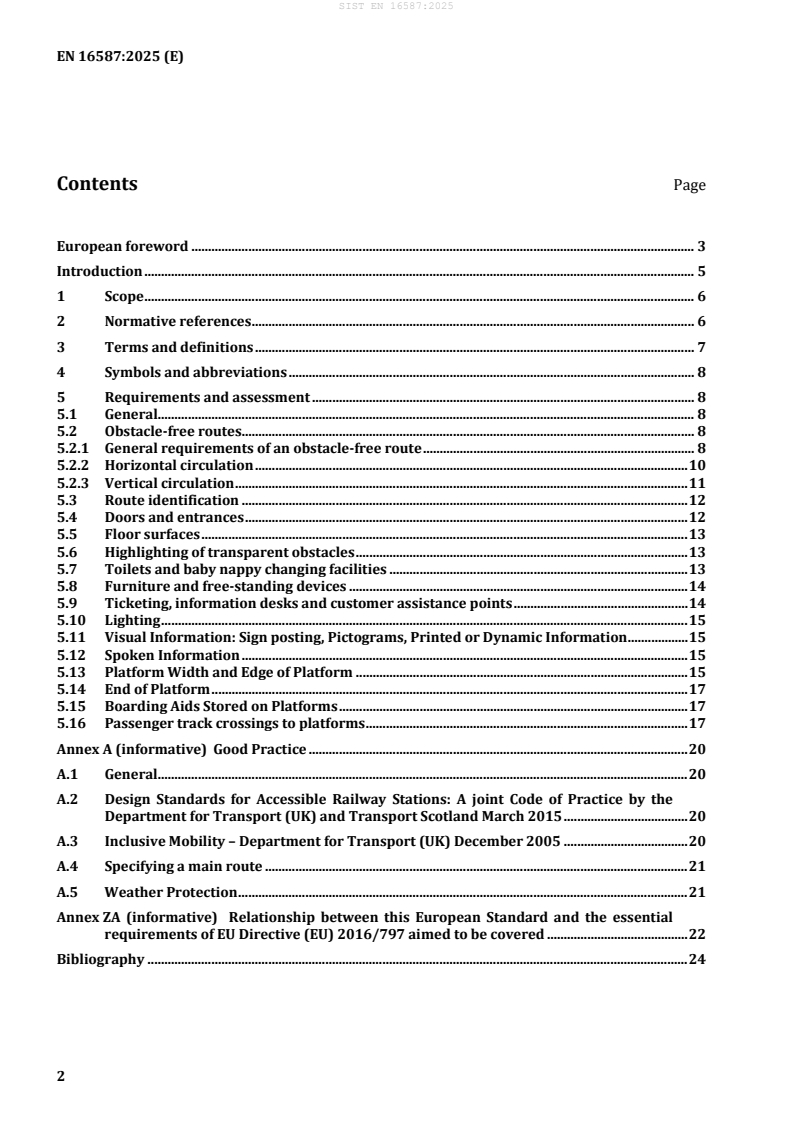
Contents Page
European foreword . 3
Introduction . 5
1 Scope . 6
2 Normative references . 6
3 Terms and definitions . 7
4 Symbols and abbreviations . 8
5 Requirements and assessment . 8
5.1 General. 8
5.2 Obstacle-free routes . 8
5.2.1 General requirements of an obstacle-free route . 8
5.2.2 Horizontal circulation . 10
5.2.3 Vertical circulation . 11
5.3 Route identification . 12
5.4 Doors and entrances . 12
5.5 Floor surfaces . 13
5.6 Highlighting of transparent obstacles . 13
5.7 Toilets and baby nappy changing facilities . 13
5.8 Furniture and free-standing devices . 14
5.9 Ticketing, information desks and customer assistance points . 14
5.10 Lighting . 15
5.11 Visual Information: Sign posting, Pictograms, Printed or Dynamic Information . 15
5.12 Spoken Information . 15
5.13 Platform Width and Edge of Platform . 15
5.14 End of Platform . 17
5.15 Boarding Aids Stored on Platforms . 17
5.16 Passenger track crossings to platforms . 17
Annex A (informative) Good Practice . 20
A.1 General. 20
A.2 Design Standards for Accessible Railway Stations: A joint Code of Practice by the
Department for Transport (UK) and Transport Scotland March 2015 . 20
A.3 Inclusive Mobility – Department for Transport (UK) December 2005 . 20
A.4 Specifying a main route . 21
A.5 Weather Protection . 21
Annex ZA (informative) Relationship between this European Standard and the essential
requirements of EU Directive (EU) 2016/797 aimed to be covered . 22
Bibliography . 24
European foreword
This document (EN 16587:2025) has been prepared by Technical Committee CEN/TC 256 “Railway
applications”, the secretariat of which is held by DIN.
This European Standard shall be given the status of a national standard, either by publication of an
identical text or by endorsement, at the latest by April 2026, and conflicting national standards shall be
withdrawn at the latest by April 2026.
Attention is drawn to the possibility that some of the elements of this document may be the subject of
patent rights. CEN shall not be held responsible for identifying any or all such patent rights.
This document supersedes EN 16587:2017.
In comparison with the previous edition, the following technical modifications have been made:
— the document template has been updated;
— the document has been revised generally for document references and editorial issues with
grammar;
— scope modified;
— normative references updated;
— terms and definitions revised;
— 5.14 References updated
— Annex A “EC verification - Interoperability constituents” removed;
— Annex B “Summary of testing requirements” removed;
— Annex C “Good practice” is now Annex A;
— Annex D “A-Deviations” removed;
— Annex ZA updated;
— Bibliography updated.
This document has been prepared under a standardization request addressed to CEN by the European
Commission. The Standing Committee of the EFTA States subsequently approves these requests for its
Member States.
For the relationship with EU Legislation, see informative Annex ZA, which is an integral part of this
document.
Any feedback and questions on this document should be directed to the users’ national standards body.
A complete listing of these bodies can be found on the CEN website.
According to the CEN-CENELEC Internal Regulations, the national standards organisations of the
following countries are bound to implement this European Standard: Austria, Belgium, Bulgaria,
Croatia, Cyprus, Czech Republic, Denmark, Estonia, Finland, France, Germany, Greece, Hungary, Iceland,
Ireland, Italy, Latvia, Lithuania, Luxembourg, Malta, Netherlands, Norway, Poland, Portugal, Republic of
North Macedonia, Romania, Serbia, Slovakia, Slovenia, Spain, Sweden, Switzerland, Türkiye and the
United Kingdom.
Introduction
This document is part of a suite of four ‘Design for PRM use’ standards that have in total nine parts:
— EN 16584 is a standard that covers both infrastructure and rolling stock — Railway applications —
Design for PRM use — General requirements:
— Part 1: Contrast (EN 16584-1);
— Part 2: Information (EN 16584-2);
— Part 3: Optical and friction characteristics (EN 16584-3).
— EN 16585 is a standard that covers rolling stock — Railway applications — Design for PRM use —
Equipment and components on board rolling stock:
— Part 1: Toilets (EN 16585-1);
— Part 2: Elements for sitting, standing and moving (EN 16585-2);
— Part 3: Clearways and internal doors (EN 16585-3).
— EN 16586 is a standard that covers rolling stock — Railway applications — Design for PRM use —
Accessibility of persons with reduced mobility to rolling stock:
— Part 1: Steps for access and egress (EN 16586-1);
— Part 2: Boarding aids (EN 16586-2).
— EN 16587 is a standard that covers Infrastructure — Railway applications — Design for PRM use —
Requirements for obstacle-free routes for infrastructure.
These standards aim to clarify the requirements (with clear and consistent terms and definitions) and
to define the associated criteria and, where appropriate, methodologies to allow a clear pass/fail
assessment.
1 Scope
This document describes the specific ‘Design for PRM use’ requirements applying to infrastructure and
the assessment of those requirements. The following applies to this document:
— The definitions and requirements describe specific aspects of ‘Design for PRM use’ required by
persons with disabilities and persons with reduced mobility as defined in the PRM TSI.
— This document defines elements which are universally valid for obstacle-free routes. The
definitions and requirements of this standard are to be used for infrastructure applications.
— This document only refers to aspects of accessibility for PRM passengers; it does not define non-
PRM related requirements and definitions.
— This document assumes that the infrastructure is in its defined operating condition.
— Where minimum or maximum dimensions are quoted these are absolute NOT nominal
requirements.
This document contains requirements relating to 'Obstacle-free routes'.
2 Normative references
The following documents are referred to in the text in such a way that some or all of their content
constitutes requirements of this document. For dated references, only the edition cited applies. For
undated references, the latest edition of the referenced document (including any amendments) applies.
EN 81-70:2021+A1:2022, Safety rules for the construction and installation of lifts - Particular
applications for passenger and goods passenger lift - Part 70: Accessibility to lifts for persons including
persons with disability
EN 115-1:2017, Safety of escalators and moving walks - Part 1: Construction and installation
EN 16584-1:2025, Railway applications — Design for PRM use — General requirements — Part 1:
Contrast
EN 16584-2:2025, Railway applications — Design for PRM use — General requirements — Part 2:
Information (Basel)
EN 16584-3:2025, Railway applications — Design for PRM use — General requirements — Part 3: Optical
and friction characteristics
EN 16585-1:2025, Railway Applications — Design for PRM Use — Equipment and Components on board
Rolling Stock — Part 1: Toilets
EN 16586-2:2025, Railway Applications — Design for PRM Use — Accessibility of Persons with Reduced
Mobility to Rolling Stock — Part 2: Boarding Aids
EN ISO 2813:2014, Paints and varnishes - Determination of gloss value at 20°, 60° and 85° (ISO
2813:2014)
ISO 21542:2021, Building construction — Accessibility and usability of the built environment
ISO 23599:2019, Assistive products for blind and vision-impaired persons — Tactile walking surface
indicators
3 Terms and definitions
For the purposes of this document, the following terms and definitions.
ISO and IEC maintain terminology databases for use in standardization at the following addresses:
— ISO Online browsing platform: available at https://www.iso.org/obp/
— IEC Electropedia: available at https://www.electropedia.org/
3.1
automatic door
powered door which opens and closes without the need for the passenger to operate a control device
3.2
boarding aid
device (fixed or portable) that bridges the gap between rolling stock and platform to allow a PRM to
board or alight from a train
Note 1 to entry: This includes manual, semi-automatic or automatic ramps, lifts and other devices.
3.3
handrail
continuous element with round cross section for passengers to use to aid personal stability by gripping
around
3.4
manual door
unpowered door which the passenger has to physically open and/or close
3.5
obstacle-free route
link between two or more public areas dedicated to the transport of passengers that can be navigated
independently by all persons with disabilities and reduced mobility
Note 1 to entry: In order to achieve this, the route can be divided to better meet the needs of all persons with
disabilities and reduced mobility. The combination of all the parts of the obstacle-free route constitutes the route
accessible for all persons with disabilities and reduced mobility.
3.6
station
any form of infrastructure where a train operates and passengers can board or alight in normal
operation
3.7
station building
any building or structure within the confines of the station in areas for use by passengers which can be
open at different times to the overall station
Note 1 to entry: This does not include other commercial structures that are not essential for travel.
3.8
step-free route
division of an obstacle-free route that meets the needs of mobility impaired persons by avoiding
changes in level or, when they cannot be avoided, are bridged via ramps or lifts
3.9
weather protection
protection against the effects of weather
Note 1 to entry: The level of weather protection is regulated by National Standards or Guidance
3.10
wheelchair
wheeled personal mobility device
Note 1 to entry: Wheelchair characteristics are defined in EN 16585-1:2025, Annex A.
4 Symbols and abbreviations
For purposes of this document, the symbols and abbreviations in Table 1 and Table 2 apply.
Table 1 — Abbreviations
Abbreviation Designation
EN European Standard (Euronorm)
ISO International Organization for Standardization
PRM Persons with disabilities and persons with reduced mobility
TSI Technical Specification for Interoperability
UIC Union Internationale des Chemins de Fer
Table 2 — Symbols
Symbols Designation Unit
km Length kilometre
GU Gloss value Gloss Unit
mm Length millimetre
N Force Newton
5 Requirements and assessment
5.1 General
Where additional assessment criteria apply, these will be identified against the relevant clause.
All measurements in figures unless otherwise stated shall be in full millimetres.
5.2 Obstacle-free routes
5.2.1 General requirements of an obstacle-free route
1) Obstacle-free routes shall be provided:
i. That accommodate all categories of PRM on the same route:
— There may be reasons that require the route to diverge to accommodate different
categories of PRM, provided each division is the shortest practical distance for that
category of PRM.
— Where there are height changes the route may diverge to accommodate ramps, steps or
lifts, for example.
— The route shall converge after the height changes and continue as a single route, unless the
destination has already been reached.
— When the station building is open during the operating time for passenger traffic the main
route shall pass through the station building if it is the shortest practical route.
— When the station building is closed during the operating time for passenger traffic, all
passengers shall be directed to an alternative route within the station confines.
— This should be based on good practice as described in Annex A. An example of a
specification for a main route is described in Annex A.
— For assessment: an example scenario would be moving through the station area to the
platform area, the route diverges to utilize stairs and a separate lift or ramp to
overcome the height change to the elevated walkway, the route converges on the
elevated walkway above the tracks, then diverges to stairs and a separate lift or ramp,
to overcome the height change back to platform level but there is no necessity to
converge the routes again to a single, point as the platform was the destination.
ii. At all times, for when trains are timetabled to operate at that station.
iii. That interconnect the following public areas of the infrastructure, where provided and during
the normal operation of those facilities:
1. stopping points for other connecting modes of transport within the station confines (for
example, taxi, bus, tram, metro, ferry);
2. car parks;
3. accessible entrances and exits;
4. information desks;
5. visual and audible information systems;
6. ticketing facilities;
7. customer assistance;
8. waiting areas;
9. toilet facilities;
10. platforms;
11. customs;
12. border control.
NOTE See Figure A.1 for an example of an obstacle-free route connecting to a variety of services with tactile
path.
2) Obstacle-free route floor surfaces and ground surfaces shall have low reflecting properties.
— Assessment shall be in accordance with EN ISO 2813:2014 for paints and varnishes, an
achieved gloss value of 50 GU or lower shall be assumed to be compliant. For any other ground
material and/or surface materials an assessment is not necessary.
5.2.2 Horizontal circulation
1) All obstacle-free routes, footbridges and subways shall have a free width of a minimum of
1 600 mm, except in areas that are specified in points 5.2.3 3) ramps, 5.4 doors, 5.13 platforms and
5.16 level crossings.
— Assessment: minimum width shall be maintained from floor height to the minimum headroom
requirement.
— Assessment: handrails may not encroach into the free width, shown in Figure 1.
— Assessment: exceptions for platforms are specified in 5.13.
NOTE 1 This requirement is further explained in UIC 140.
— Assessment: the minimum width requirement does not take into account any additional width
that may be required for passenger flows; these additional widths shall be in accordance with
National Standards or Guidance.
— Assessment: This requirement is not applicable to escalators, travelators and lifts. Where
travelators are provided other options are to be available to a wheelchair user.
Dimensions in millimetres
Figure 1 — Obstacle-free width at stairs example showing a minimum width of 1 600 mm
between handrails (tactile indicator shown as example only)
2) Where thresholds are installed on a horizontal route, they shall contrast with the surrounding floor
and shall not be higher than 25 mm.
— Assessment: Contrast shall be according to EN 16584-1:2025.
3) All obstacle-free routes, stairs, footbridges and subways shall have a minimum headroom of
2 100 mm (h) according to ISO 21542:2021 over the entire width of 1 600 mm.
— Assessment: the height shall be assessed from floor to ceiling over the full width of the
obstacle-free route, footbridges and subways
— Assessment: for stairs, the headroom shall be assessed vertically from the plane touching the
nosing of each step as shown in Figure 2.
Key
h minimum clear headroom of 2 100 mm on staircases
Figure 2 — Stair headroom
5.2.3 Vertical circulation
1) Where an obstacle-free route includes a change in level, there shall be a step-free route providing
an alternative to stairs (also escalators and inclined travelators) for mobility impaired people.
— Assessment: where there is a change in level along an obstacle-free route that is overcome by a
step or steps (also escalators and inclined travelators) an alternative step-free route shall be
demonstrated.
— Assessment: solutions provided shall be according to either National Standards or Guidance or
ISO 21542:2021.
2) Staircases on the obstacle-free routes shall:
i. Have a minimum width of 1 600 mm assessed between the handrails.
— Assessment: handrails may not encroach into the free width, shown in Figure 1.
ii. As a minimum the first and last steps shall be indicated by a contrasting band.
— Assessment: contrast of the band shall be according to EN 1658
...