


SIST-TP CEN/TR 10317:2020
(Main)European certified reference materials (EURONORM-CRMs) for the determination of the chemical composition of iron and steel products
European certified reference materials (EURONORM-CRMs) for the determination of the chemical composition of iron and steel products
This document describes the classification, method of sample preparation, certification main rules and certificate content of the EURONORM-CRMs.
It also details the sample presentation of the various producers' organizations and the distributing sources.
Europäische zertifizierte Referenzmaterialien (EURONORM-ZRM) für die Bestimmung der chemischen Zusammensetzung von Eisen und Stahlerzeugnissen
Matériaux de référence certifiés européens (EURONORM-MRC) destinés à la détermination de la composition chimique des produits en acier et en fonte
Le présent document décrit la classification, la méthode de préparation des échantillons, les principales règles de certification et le contenu des certificats des EURONORM-MRCs.
Il énumère également la présentation des échantillons des divers organismes producteurs et les sources de distribution.
Evropski certificirani referenčni materiali (EURONORM-CRM) za določanje kemijske sestave izdelkov iz železa in jekla
General Information
- Status
- Published
- Public Enquiry End Date
- 20-May-2020
- Publication Date
- 26-Jul-2020
- Technical Committee
- IFEK - Ferrous metals
- Current Stage
- 6060 - National Implementation/Publication (Adopted Project)
- Start Date
- 20-Jul-2020
- Due Date
- 24-Sep-2020
- Completion Date
- 27-Jul-2020



Relations
- Effective Date
- 15-Jul-2020
- Effective Date
- 09-Feb-2026
- Effective Date
- 09-Feb-2026
- Effective Date
- 09-Feb-2026
- Effective Date
- 09-Feb-2026
- Effective Date
- 09-Feb-2026
- Effective Date
- 09-Feb-2026
- Effective Date
- 09-Feb-2026
- Effective Date
- 09-Feb-2026
- Effective Date
- 09-Feb-2026
- Effective Date
- 28-Jan-2026
- Effective Date
- 28-Jan-2026
- Effective Date
- 28-Jan-2026
- Effective Date
- 27-Feb-2019
Overview
SIST-TP CEN/TR 10317:2020 provides comprehensive guidance on the classification, preparation, certification, and distribution of European certified reference materials (EURONORM-CRMs), specifically for determining the chemical composition of iron and steel products. Developed by the Technical Committee CEN/TC 459/SC 2, this standard supports laboratories and manufacturers in ensuring the reliability and consistency of chemical analysis for iron and steel through the use of certified reference materials.
EURONORM-CRMs are essential benchmarks, providing certified values for chemical constituents and ensuring traceability, uniformity, and comparability in analytical measurements across Europe and beyond.
Key Topics
Classification of EURONORM-CRMs
- Divided into cast/wrought materials (e.g., irons, steels, alloys, ferro-alloys) and non-metallic materials (e.g., ores, refractories, by-products).
- Further categorized by material type and composition, including high purity irons, low alloy steels, highly alloyed steels, special alloys, pig irons, cast irons, and by-products.
Sample Preparation Procedures
- Guidelines for producing homogeneous, representative samples of both metallic (e.g., billets, chips, discs) and non-metallic materials (e.g., ores, refractory powders).
- Homogeneity and stability checks are integral to the process.
Certification Rules and Certificate Content
- Certification involves interlaboratory testing, statistical analysis, and stringent quality control following ISO and EN standards.
- Each CRM is accompanied by a certificate summarizing key analytical data, statistical treatment, methods used, and statements on intended use and traceability.
Sample Presentation and Distribution
- Samples are presented in standardized packaging distinguished by producer.
- Distribution is managed by approved organizations across Europe, ensuring broad accessibility.
Applications
EURONORM-CRMs have significant practical applications in industries and laboratories concerned with the chemical analysis of iron and steel products. Key uses include:
- Analytical Method Validation: Laboratories use CRMs to verify the accuracy, precision, and suitability of new or existing analytical methods.
- Calibration of Analytical Instruments: Solid and powdered forms of EURONORM-CRMs serve as calibration standards for optical emission spectrometers, X-ray fluorescence analyzers, and other techniques.
- Quality Control and Proficiency Testing: Providing a benchmark for inter-laboratory comparisons and ongoing quality assurance programs.
- Secondary Reference Material Certification: Supporting the assignment of values for secondary CRM production.
CRMs ensure measurement traceability and comparability, underpinning product quality and regulatory compliance in the iron and steel sector.
Related Standards
SIST-TP CEN/TR 10317:2020 references and aligns its procedures with several key international standards:
- ISO Guide 30: Terms and definitions for reference materials
- ISO Guide 31: Requirements for certificates and labels accompanying reference materials
- ISO Guide 35: Characterization and assessment of homogeneity and stability
- EN ISO 17034: General requirements for the competence of reference material producers
- ISO 11459: Preparation and certification of iron ore CRMs
- ISO/IEC Guide 99 (VIM): Basic concepts and terms for metrology
- CEN/TR 10350: Laboratory procedures for analyzing steels and irons using CRMs
These references ensure that EURONORM-CRMs meet global expectations for reliability, traceability, and technical rigor, making them vital assets for laboratories and industries involved in chemical analysis of metallic products.
By adhering to SIST-TP CEN/TR 10317:2020, organizations can achieve consistent, reproducible results in iron and steel analysis, supporting both quality assurance and international trade.
Get Certified
Connect with accredited certification bodies for this standard

ECOCERT
Organic and sustainability certification.

Element Materials Technology
Materials testing and product certification.

Eurofins Food Testing Global
Global leader in food, environment, and pharmaceutical product testing.
Sponsored listings
Frequently Asked Questions
SIST-TP CEN/TR 10317:2020 is a technical report published by the Slovenian Institute for Standardization (SIST). Its full title is "European certified reference materials (EURONORM-CRMs) for the determination of the chemical composition of iron and steel products". This standard covers: This document describes the classification, method of sample preparation, certification main rules and certificate content of the EURONORM-CRMs. It also details the sample presentation of the various producers' organizations and the distributing sources.
This document describes the classification, method of sample preparation, certification main rules and certificate content of the EURONORM-CRMs. It also details the sample presentation of the various producers' organizations and the distributing sources.
SIST-TP CEN/TR 10317:2020 is classified under the following ICS (International Classification for Standards) categories: 71.040.30 - Chemical reagents; 77.040.30 - Chemical analysis of metals; 77.140 - Iron and steel products; 77.140.01 - Iron and steel products in general. The ICS classification helps identify the subject area and facilitates finding related standards.
SIST-TP CEN/TR 10317:2020 has the following relationships with other standards: It is inter standard links to SIST-TP CEN/TR 10317:2015, SIST EN IEC 63047:2021, SIST EN IEC 61158-5-10:2019, SIST EN IEC 61158-5-19:2019, SIST EN IEC 62942:2020, SIST EN IEC 61804-3:2020, SIST EN IEC 61158-6-2:2019, SIST EN IEC 61158-6-10:2019, SIST EN IEC 61158-5-12:2019, SIST EN IEC 61158-5-26:2019, SIST EN 17419-1:2021, SIST EN 16157-7:2019, SIST EN 1064:2020, SIST-TP CEN/TR 10317:2015. Understanding these relationships helps ensure you are using the most current and applicable version of the standard.
SIST-TP CEN/TR 10317:2020 is available in PDF format for immediate download after purchase. The document can be added to your cart and obtained through the secure checkout process. Digital delivery ensures instant access to the complete standard document.
Standards Content (Sample)
SLOVENSKI STANDARD
01-oktober-2020
Nadomešča:
SIST-TP CEN/TR 10317:2015
Evropski certificirani referenčni materiali (EURONORM-CRM) za določanje
kemijske sestave izdelkov iz železa in jekla
European certified reference materials (EURONORM-CRMs) for the determination of the
chemical composition of iron and steel products
Europäische zertifizierte Referenzmaterialien (EURONORM-ZRM) für die Bestimmung
der chemischen Zusammensetzung von Eisen und Stahlerzeugnissen
Matériaux de référence certifiés européens (EURONORM-MRC) destinés à la
détermination de la composition chimique des produits en acier et en fonte
Ta slovenski standard je istoveten z: CEN/TR 10317:2020
ICS:
77.040.30 Kemijska analiza kovin Chemical analysis of metals
77.140.01 Železni in jekleni izdelki na Iron and steel products in
splošno general
2003-01.Slovenski inštitut za standardizacijo. Razmnoževanje celote ali delov tega standarda ni dovoljeno.
CEN/TR 10317
TECHNICAL REPORT
RAPPORT TECHNIQUE
July 2020
TECHNISCHER BERICHT
ICS 71.040.30; 77.140 Supersedes CEN/TR 10317:2014
English Version
European certified reference materials (EURONORM-
CRMs) for the determination of the chemical composition
of iron and steel products
Matériaux de référence certifiés européens Europäische zertifizierte Referenzmaterialien
(EURONORM-MRC) destinés à la détermination de la (EURONORM-ZRM) für die Bestimmung der
composition chimique des produits en acier et en fonte chemischen Zusammensetzung von Eisen und
Stahlerzeugnissen
This Technical Report was approved by CEN on 22 June 2020. It has been drawn up by the Technical Committee CEN/TC 459/SC
2.
CEN members are the national standards bodies of Austria, Belgium, Bulgaria, Croatia, Cyprus, Czech Republic, Denmark, Estonia,
Finland, France, Germany, Greece, Hungary, Iceland, Ireland, Italy, Latvia, Lithuania, Luxembourg, Malta, Netherlands, Norway,
Poland, Portugal, Republic of North Macedonia, Romania, Serbia, Slovakia, Slovenia, Spain, Sweden, Switzerland, Turkey and
United Kingdom.
EUROPEAN COMMITTEE FOR STANDARDIZATION
COMITÉ EUROPÉEN DE NORMALISATION
EUROPÄISCHES KOMITEE FÜR NORMUNG
CEN-CENELEC Management Centre: Rue de la Science 23, B-1040 Brussels
© 2020 CEN All rights of exploitation in any form and by any means reserved Ref. No. CEN/TR 10317:2020 E
worldwide for CEN national Members.
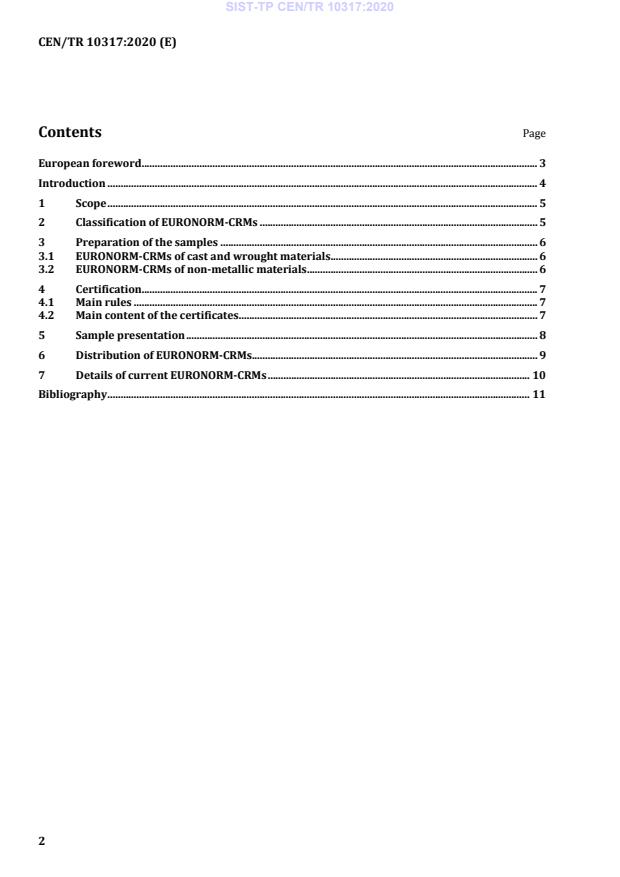
Contents Page
European foreword . 3
Introduction . 4
1 Scope . 5
2 Classification of EURONORM-CRMs . 5
3 Preparation of the samples . 6
3.1 EURONORM-CRMs of cast and wrought materials. 6
3.2 EURONORM-CRMs of non-metallic materials . 6
4 Certification . 7
4.1 Main rules . 7
4.2 Main content of the certificates . 7
5 Sample presentation . 8
6 Distribution of EURONORM-CRMs. 9
7 Details of current EURONORM-CRMs . 10
Bibliography . 11
European foreword
This document (CEN/TR 10317:2020) has been prepared by Technical Committee CEN/TC 459/SC 2
(former ECISS/TC 102) “Methods of chemical analysis for iron and steel”, the secretariat of which is
held by SIS.
Attention is drawn to the possibility that some of the elements of this document may be the subject of
patent rights. CEN shall not be held responsible for identifying any or all such patent rights.
This document supersedes CEN/TR 10317:2014.
In comparison with the previous edition, CEN/TR 10317:2014, the following technical modifications
have been made:
— title changed;
— deletion of all references to COCOR and ECISS;
— updating of the addresses of some of the producers;
— Bibliography updated.
Introduction
In accordance with the definition in ISO Guide 30, a Certified Reference Material (CRM) as described in
this document is a “reference material (RM) characterized by a metrologically valid procedure for one
or more specified properties, accompanied by a certificate that provides the value of the specified
property, its associated uncertainty, and a statement of metrological traceability”.
Furthermore, it is accompanied by a certificate issued by the producing organization, after approval by
the participating laboratories and all the producing organizations listed below:
a) France:
1) ArcelorMittal Maizières Research SA (AMMZ) [former Institut de Recherches de la Sidérurgie
Française (IRSID)],
2) Centre Technique des Industries de la Fonderie (CTIF);
b) Germany: Iron and Steel CRM Working Group (AGZRM) comprising:
1) Bundesanstalt für Materialforschung und -prüfung (BAM),
2) Max-Planck-Institut für Eisenforschung (MPI),
3) Stahlinstitut VDEh;
c) Nordic Countries: Nordic CRM Working Group, (NCRMWG) comprising:
1) Oy Narema AB,
2) Jernkontoret.
NOTE Bureau of Analysed Samples Ltd (BAS) – United Kingdom – was a member of the EURONORM-CRM
Producer's Group from 1975 until 2013.
Since 1968, EURONORM-CRMs have been analysed by laboratories in most countries in the European
Union (EU) or former European Community (EC).
Pending their eventual replacement by EURONORM-CRMs, a number of former national CRMs
prepared, analysed and certified by laboratories in Germany, France and the United Kingdom
respectively, were accepted as EURONORM-CRMs after their accuracy had been checked by other
European laboratories. This procedure ceased in 1990.
1 Scope
This document describes the classification, method of sample preparation, certification main rules and
certificate content of the EURONORM-CRMs.
It also details the sample presentation of the various producers' organizations and the distributing
sources.
2 Classification of EURONORM-CRMs
EURONORM-CRMs, are classified into two main groups:
— cast and wrought materials: irons, steels, special alloys and ferro-alloys;
— non-metallic materials: raw materials (ores, concentrates, additives and refractories) and by-
products (slags, dusts and similar materials).
Besides this first generic classification, EURONORM-CRMs are grouped into the following categories:
a) From 001 to 099 – High purity irons and unalloyed steels
Normally no element has a content (mass fraction) greater than the limit values in the following
list:
1) silicon, limit value 1,0 %;
2) manganese, limit value 1,5 %;
3) chromium and nickel, limit value for each 0,5 %;
4) cobalt, copper and tungsten, limit value for each 0,3 %;
5) other elements, limit value for each 0,1 %;
6) boron, carbon, phosphorus, lead and sulphur, no limit value.
b) From 101 to 199 – Low alloy steels
The content of one or more elements is greater than the limit given for unalloyed steels but none
exceeds 5 %. The sum of these alloying elements remains under 10 %.
c) From 201 – 299 – Highly alloyed steels
The content of one or more elements is greater than 5 % or the sum of all these alloying elements is
at least 10 %. Nevertheless the iron content will normally be greater than 50 %.
d) From 301 to 399 – Special alloys
The iron content is less than 50 %.
e) From 401 to 499 – Pig irons and cast irons
f) From 501 to 599 – Ferro-alloys
g) From 601 to 699 – Ores, concentrates, sinters and miscellaneous materials
h) From 701 to 799 – Additives and refractories
i) From 801 to 899 – By-products, such as slags, dusts and similar materials
The expression “-1” after a CRM number refers to the first issue of this CRM and “-2”, “-3”, etc. refer to
replacement CRMs of generally similar composition, but not to a further bottling of the original CRM.
NOTE This classification is used as a simple and convenient method of differentiating between samples of
different types of materials. It has no other objective and does not replace existing European or International
product specifications for metallic materials.
3 Preparation of the samples
3.1 EURONORM-CRMs of cast and wrought materials
3.1.1 High purity irons, steels and special alloys
The material is obtained as cylindrical, square or rectangular billets or slabs. After the homogeneity has
been verified, it is machined dry (avoiding excessive heat generation) on a suitable lathe or milling
machine in order to produce short chips; the chips are screened so that the fines can be removed. Some
steel samples are produced by atomisation of the liquid metal.
The whole preparation process provides a batch of generally more than
...