

oSIST prEN 50130-4:2026
(Main)Alarm systems - Part 4: Electromagnetic compatibility - Immunity requirements
- Abstract
This document specifies immunity requirements for electromagnetic compatibility (EMC). It applies to components of the following safety and security systems intended for use in residential, commercial, light industrial and industrial environments:
— access control systems, for security applications;
— alarm transmission systems ;
— video surveillance systems, for security applications;
— fire detection and fire alarm systems;
— hold-up alarm systems;
— intruder alarm systems;
— social alarm systems.
The document applies to indoor and outdoor applications of fixed, movable and portable equipment.
- Status
- Not Published
- Public Enquiry End Date
- 30-Jul-2026
- Technical Committee
- EAL - Alarm systems
- Current Stage
- 4020 - Public enquire (PE) (Adopted Project)
- Start Date
- 05-Jun-2026
- Due Date
- 23-Oct-2026
- Completion Date
- 03-Aug-2026

oSIST prEN 50130-4:2026 is the Slovene adoption of the CENELEC draft European Standard prEN 50130-4:2026 on electromagnetic compatibility (EMC) immunity for alarm systems. It specifies how components of access control, alarm transmission, video surveillance, fire detection and fire alarm, hold-up alarm, intruder alarm, and social alarm systems are tested for immunity in residential, commercial, light industrial, and industrial environments.
What does oSIST prEN 50130-4:2026 specify?
oSIST prEN 50130-4:2026 specifies EMC immunity requirements for indoor and outdoor fixed, movable, and portable equipment used in safety and security systems. The document is structured as a test standard: it states the scope, lists the referenced test methods, defines key terms, sets test conditions, then gives the required immunity tests and pass/fail criteria.
| Annex | What it covers |
|---|---|
| Annex A | Criteria for operation as intended |
| Annex B | Guidance for assessing operation as intended |
| Annex ZZ | Relationship with Directive 2014/30/EU |
The main body is organized into clauses on applicability, test conditions, mains supply dips and short interruptions, electrostatic discharge, radiated electromagnetic fields, conducted disturbances induced by electromagnetic fields, fast transient bursts, and slow high energy voltage surge. In practice, that means the standard is mainly used to set up laboratory immunity tests and to decide whether the equipment still performs its primary function after each exposure.
What are the key requirements of oSIST prEN 50130-4:2026?
Test setup, sequence, and reporting
oSIST prEN 50130-4:2026 requires each immunity test to be carried out as a single test, and if several tests are made on one sample, the order is optional. The equipment under test (EUT) has to be configured with suitable power, monitoring, loading, and representative cabling, and the test report has to record enough detail to reproduce the test. In practice, this means the user must document how the equipment was wired, what cables were used, and how the primary function was assessed.
The document also requires the EUT to be tested in a representative operating mode that gives maximum susceptibility while still matching intended use. Standard atmospheric conditions from EN 60068-1:2014 apply unless a basic EMC standard or test procedure says otherwise. If a test clause is not applicable because of the nature of the EUT, that has to be justified in the report.
General pass/fail criteria
oSIST prEN 50130-4:2026 separates performance criteria into continuous phenomena and transient phenomena. For continuous phenomena, the EUT shall not show an unintended change of operating mode or unintentional change of critical stored data during exposure, and after the test it shall operate as intended. For transient phenomena, the same post-test expectation applies, and the transient shall not leave behind an unintended change of mode or data.
Annex A is central here because it defines what “operate as intended” means for key primary functions such as detection, visualization, manual signaling, information processing, transmission, visual and audible signaling, physical access control, and power supply to components. In practice, this means the person testing the unit must check the function that matters most for the product, not just whether the device powers up.
Mains supply dips and electrostatic discharge
Clause 6 covers mains supply voltage dips and short interruptions on AC mains ports only. The test uses specified residual voltages and durations, including a complete interruption, and a temporary loss of function is allowed for equipment without an alternative source of power if the unit resumes operation without operator intervention and without damage or residual change. This matters because many alarm products are expected to ride through short mains events or recover cleanly.
Clause 7 covers electrostatic discharge. The standard requires contact and air discharges at defined levels, applied to accessible conductive and insulating surfaces, with special handling for wall and ceiling mounted equipment. Flicker of an indicator is allowed if it does not cause a residual change or an output change that another device could interpret as a status change.
Radiated and conducted RF immunity
Clauses 8 and 9 cover radiated electromagnetic fields and conducted disturbances induced by electromagnetic fields. The radiated test uses amplitude-modulated exposure across the stated frequency ranges, with a higher-frequency test for equipment whose highest frequency is above 500 MHz, and motion detectors and flame detectors also receive pulse-modulated exposure. The conducted test likewise uses amplitude-modulated exposure, with pulse modulation added for motion detectors and flame detectors.
For both clauses, cable arrangement matters. The EUT and at least 1 m of cable have to be in the uniform field area for the radiated test, and the conducted test allows an exemption for certain ports when the manufacturer limits the connected cable length to 3 m. In practice, this means test labs have to control cabling carefully, because the result can change noticeably with layout.
Fast transients and surge
Clause 10 covers fast transient bursts on AC mains supply lines, DC distribution networks, and signal lines, with the stated test levels and coupling methods. Clause 11 covers slow high energy voltage surge on mains, other supply and signal lines, and shielded lines, with different coupling arrangements and surge counts depending on the line type. These clauses are important for installations with long cable runs or exposed wiring.
For both clauses, indicator flicker is acceptable if the EUT does not end up with residual change or altered outputs. For surge testing, the document also allows selected samples when an EUT has many identical inputs or outputs, which helps testing stay representative without repeating identical setups unnecessarily.
What terms does oSIST prEN 50130-4:2026 define?
- Equipment Under Test (EUT) - the product or system being subjected to the immunity tests.
- Electromagnetic Compatibility (EMC) - the ability of equipment to function in its electromagnetic environment without unacceptable disturbance.
- Continuous Wave (CW) - an unmodulated carrier used as the basis for some radiated and conducted immunity tests.
- Coupling Decoupling Network (CDN) - a test network used to inject disturbances while limiting unwanted coupling into other paths.
- Primary function - the main intended purpose of the safety or security component, such as detection, transmission, or signaling.
- Response time - the time the system needs to react to a stimulus such as an alarm or fault.
- Signal line - a line used for signaling, communication, or supplying power that is not intended to connect to an AC or DC distribution network.
- DC distribution network - a local DC supply network in a site or building that is independent of the public mains network.
Who uses oSIST prEN 50130-4:2026?
oSIST prEN 50130-4:2026 is used by manufacturers of alarm and security equipment, EMC test laboratories, conformity assessment bodies, quality managers, and buyers who need to specify immunity performance. It is especially relevant for products in access control, alarm transmission, video surveillance, fire detection and fire alarm, hold-up alarm, intruder alarm, and social alarm systems.
In practice, users apply it when preparing type tests, choosing representative configurations, writing test reports, comparing product performance, and checking whether equipment still performs its primary function after EMC exposure. It is also used when a product must be aligned with the EMC requirements of the EU market.
What changed in oSIST prEN 50130-4:2026 from the previous edition?
oSIST prEN 50130-4:2026 supersedes EN 50130-4:2011 and EN 50130-4:2011/A1:2014. The draft notes these significant technical changes:
- the title was changed
- the referenced base standards were updated to the latest versions
- test methods and/or requirements were changed for Clauses 8 and 11
- equipment meeting this edition is deemed to meet EN 50130-4:2011
Which standards are used with oSIST prEN 50130-4:2026?
| Standard | What it contributes |
|---|---|
| EN 60068-1:2014 | General environmental test conditions and guidance |
| EN IEC 61000-4-2:2025 | Electrostatic discharge test method |
| EN IEC 61000-4-3:2020 | Radiated RF electromagnetic field immunity test method |
| EN 61000-4-4:2012 | Electrical fast transient/burst immunity test method |
| EN 61000-4-5:2014 | Surge immunity test method |
| EN IEC 61000-4-6:2023 | Conducted RF disturbance immunity test method |
| EN IEC 61000-4-11:2020 | Voltage dips, short interruptions, and voltage variations test method |
| EN 50131 series | Product performance requirements for intrusion and hold-up systems |
| EN 50134 series | Product performance requirements for social alarm systems |
| EN 50136 series | Product performance requirements for alarm transmission systems |
| EN 54 series | Product performance requirements for fire detection and fire alarm systems |
| EN 62676 series | Product performance requirements for video surveillance systems |
| EN 60839-11 series | Product performance requirements for electronic access control systems |
What does the oSIST prEN 50130-4:2026 document contain?
oSIST prEN 50130-4:2026 contains the full test framework for EMC immunity of alarm system components, including the configuration rules, environmental conditions, and reporting requirements needed for repeatable laboratory testing. It also contains the detailed immunity test clauses for mains dips, electrostatic discharge, radiated fields, conducted RF disturbances, fast transients, and surge.
The document includes Tables 1 to 8 for test conditions and levels, Figure 1 for the modulation forms, Annex A Table A.1 for primary-function criteria, and Annex B Table B.1 with examples for assessing operation as intended. Annex ZZ gives the legal relationship to Directive 2014/30/EU, which is relevant when the standard is used for conformity with EU EMC requirements.
Relations
- Effective Date
- 06-May-2025
Get Certified
Connect with accredited certification bodies for this standard

IMQ S.p.A. (Certification)
Italian electrical product certification.

SLG Prüf- und Zertifizierungs GmbH
German testing and certification body.

UL Solutions
Global safety science company with testing, inspection and certification.
Sponsored listings
Frequently Asked Questions
oSIST prEN 50130-4:2026 is a draft published by the Slovenian Institute for Standardization (SIST). Its full title is "Alarm systems - Part 4: Electromagnetic compatibility - Immunity requirements". This standard covers: This document specifies immunity requirements for electromagnetic compatibility (EMC). It applies to components of the following safety and security systems intended for use in residential, commercial, light industrial and industrial environments: — access control systems, for security applications; — alarm transmission systems ; — video surveillance systems, for security applications; — fire detection and fire alarm systems; — hold-up alarm systems; — intruder alarm systems; — social alarm systems. The document applies to indoor and outdoor applications of fixed, movable and portable equipment.
This document specifies immunity requirements for electromagnetic compatibility (EMC). It applies to components of the following safety and security systems intended for use in residential, commercial, light industrial and industrial environments: — access control systems, for security applications; — alarm transmission systems ; — video surveillance systems, for security applications; — fire detection and fire alarm systems; — hold-up alarm systems; — intruder alarm systems; — social alarm systems. The document applies to indoor and outdoor applications of fixed, movable and portable equipment.
oSIST prEN 50130-4:2026 is classified under the following ICS (International Classification for Standards) categories: 13.320 - Alarm and warning systems; 29.020 - Electrical engineering in general; 33.100.20 - Immunity. The ICS classification helps identify the subject area and facilitates finding related standards.
oSIST prEN 50130-4:2026 has the following relationships with other standards: It is inter standard links to SIST EN 50130-4:2011/A1:2014. Understanding these relationships helps ensure you are using the most current and applicable version of the standard.
oSIST prEN 50130-4:2026 is associated with the following European legislation: EU Directives/Regulations: 2014/30/EU; Standardization Mandates: M/552. When a standard is cited in the Official Journal of the European Union, products manufactured in conformity with it benefit from a presumption of conformity with the essential requirements of the corresponding EU directive or regulation.
oSIST prEN 50130-4:2026 is available in PDF format for immediate download after purchase. The document can be added to your cart and obtained through the secure checkout process. Digital delivery ensures instant access to the complete standard document.
Standards Content (Sample)
SLOVENSKI STANDARD
01-julij-2026
Alarmni sistemi - 4. del: Elektromagnetna združljivost - Zahteve za odpornost
Alarm systems - Part 4: Electromagnetic compatibility - Immunity requirements
Alarmanlagen - Teil 4: Elektromagnetische Verträglichkeit - Anforderungen an die
Störfestigkeit
Systèmes d'alarme - Partie 4: Compatibilité électromagnétique - Exigences relatives à
l'immunité
Ta slovenski standard je istoveten z: prEN 50130-4:2026
ICS:
13.320 Alarmni in opozorilni sistemi Alarm and warning systems
33.100.20 Imunost Immunity
2003-01.Slovenski inštitut za standardizacijo. Razmnoževanje celote ali delov tega standarda ni dovoljeno.
EUROPEAN STANDARD DRAFT
prEN 50130-4
NORME EUROPÉENNE
EUROPÄISCHE NORM
May 2026
ICS 13.320; 29.020 Will supersede EN 50130-4:2011; EN 50130-
4:2011/A1:2014
English Version
Alarm systems - Part 4: Electromagnetic compatibility - Immunity
requirements
To be completed Alarmanlagen - Teil 4: Elektromagnetische Verträglichkeit -
Anforderungen an die Störfestigkeit
This draft European Standard is submitted to CENELEC members for enquiry.
Deadline for CENELEC: 2026-08-21.
It has been drawn up by CLC/TC 79.
If this draft becomes a European Standard, CENELEC members are bound to comply with the CEN/CENELEC Internal Regulations which
stipulate the conditions for giving this European Standard the status of a national standard without any alteration.
This draft European Standard was established by CENELEC in three official versions (English, French, German).
A version in any other language made by translation under the responsibility of a CENELEC member into its own language and notified to
the CEN-CENELEC Management Centre has the same status as the official versions.
CENELEC members are the national electrotechnical committees of Austria, Belgium, Bulgaria, Croatia, Cyprus, the Czech Republic,
Denmark, Estonia, Finland, France, Germany, Greece, Hungary, Iceland, Ireland, Italy, Latvia, Lithuania, Luxembourg, Malta, the
Netherlands, Norway, Poland, Portugal, Republic of North Macedonia, Romania, Serbia, Slovakia, Slovenia, Spain, Sweden, Switzerland,
Türkiye and the United Kingdom.
Recipients of this draft are invited to submit, with their comments, notification of any relevant patent rights of which they are aware and to
provide supporting documentation.
Warning : This document is not a European Standard. It is distributed for review and comments. It is subject to change without notice and
shall not be referred to as a European Standard.
European Committee for Electrotechnical Standardization
Comité Européen de Normalisation Electrotechnique
Europäisches Komitee für Elektrotechnische Normung
CEN-CENELEC Management Centre: Rue de la Science 23, B-1040 Brussels
© 2026 CENELEC All rights of exploitation in any form and by any means reserved worldwide for CENELEC Members.
Project: 81881 Ref. No. prEN 50130-4:2026 E
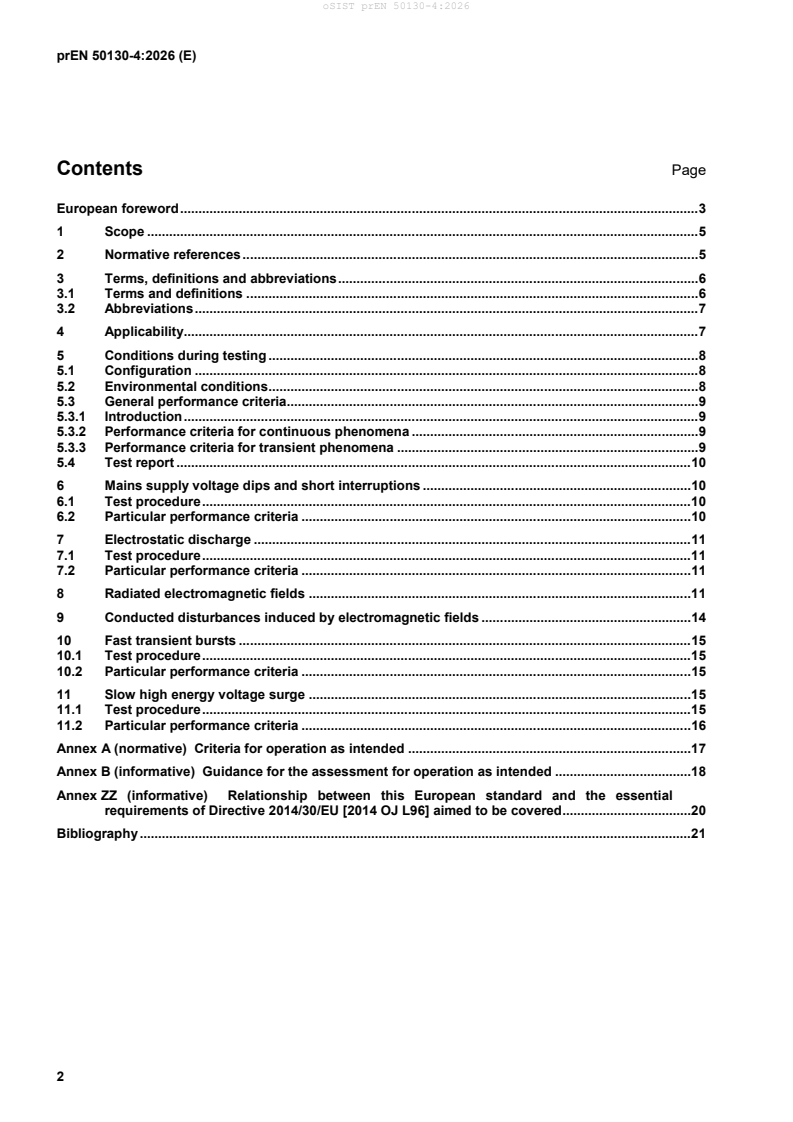
Contents Page
European foreword . 3
1 Scope . 5
2 Normative references . 5
3 Terms, definitions and abbreviations . 6
3.1 Terms and definitions . 6
3.2 Abbreviations . 7
4 Applicability. 7
5 Conditions during testing . 8
5.1 Configuration . 8
5.2 Environmental conditions . 8
5.3 General performance criteria. 9
5.3.1 Introduction . 9
5.3.2 Performance criteria for continuous phenomena . 9
5.3.3 Performance criteria for transient phenomena . 9
5.4 Test report . 10
6 Mains supply voltage dips and short interruptions . 10
6.1 Test procedure . 10
6.2 Particular performance criteria . 10
7 Electrostatic discharge . 11
7.1 Test procedure . 11
7.2 Particular performance criteria . 11
8 Radiated electromagnetic fields . 11
9 Conducted disturbances induced by electromagnetic fields . 14
10 Fast transient bursts . 15
10.1 Test procedure . 15
10.2 Particular performance criteria . 15
11 Slow high energy voltage surge . 15
11.1 Test procedure . 15
11.2 Particular performance criteria . 16
Annex A (normative) Criteria for operation as intended . 17
Annex B (informative) Guidance for the assessment for operation as intended . 18
Annex ZZ (informative) Relationship between this European standard and the essential
requirements of Directive 2014/30/EU [2014 OJ L96] aimed to be covered . 20
Bibliography . 21
European foreword
This document (prEN 50130-4:2026) has been prepared by CLC/TC 79 “Alarm systems”.
This document is currently submitted to the Enquiry.
The following dates are proposed:
• latest date by which the existence of this (doa) dav + 6 months
document has to be announced at national
level
• latest date by which this document has to be (dop) dav + 12 months
implemented at national level by publication of
an identical national standard or by
endorsement
• latest date by which the national standards (dow) dav + 36 months
conflicting with this document have to be (to be confirmed or
withdrawn modified when voting)
This document will supersede EN 50130-4:2011 and all of its amendments and corrigenda (if any).
a) the title was changed.
b) referenced based standards were updated to the latest versions;
c) changes were made to the test methods and/or requirements for Clauses 8 and 11;
Equipment meeting the requirements of this edition are deemed to meet the requirements of
EN 50130-4:2011 .
This document has been prepared under a standardization request addressed to CENELEC by the European
Commission. The Standing Committee of the EFTA States subsequently approves these requests for its
Member States.
For the relationship with EU Legislation, see informative Annex ZZ, which is an integral part of this document.
The following associated series of European documents are intended to give the other requirements (e.g.
performance requirements), which are applicable to the specific types of alarm systems:
— EN 50131, Alarm systems – Intrusion and hold-up systems;
— EN 50134, Alarm systems – Social alarm systems;
— EN 50136, Alarm systems – Alarm transmission systems and equipment;
— EN 54, Fire detection and fire alarm systems;
— EN 62676, Video surveillance systems for use in security applications;
As impacted by EN 50130-4:2011/A1:2014.
As impacted by EN 50130-4:2011/A1:2014.
— EN 60839-11, Alarm and electronic security systems - Part 11: Electronic access control systems.
1 Scope
This document specifies immunity requirements for electromagnetic compatibility (EMC). It applies to
components of the following safety and security systems intended for use in residential, commercial, light
industrial and industrial environments:
— access control systems, for security applications;
— alarm transmission systems ;
— video surveillance systems, for security applications;
— fire detection and fire alarm systems;
— hold-up alarm systems;
— intruder alarm systems;
— social alarm systems;
The document applies to indoor and outdoor applications of fixed, movable and portable equipment.
2 Normative references
The following documents are referred to in the text in such a way that some or all of their content constitutes
requirements of this document. For dated references, only the edition cited applies. For undated references,
the latest edition of the referenced document (including any amendments) applies.
EN 60068-1:2014, Environmental testing - Part 1: General and guidance (IEC 60068-1:2013)
EN IEC 61000-4-2:2025, Electromagnetic compatibility (EMC) - Part 4-2: Testing and measurement
techniques - Electrostatic discharge immunity test (IEC 61000-4-2:2025)
EN IEC 61000-4-3:2020, Electromagnetic compatibility (EMC) - Part 4-3 : Testing and measurement
techniques - Radiated, radio-frequency, electromagnetic field immunity test (IEC 61000-4-3:2020)
EN 61000-4-4:2012, Electromagnetic compatibility (EMC) - Part 4-4: Testing and measurement techniques -
Electrical fast transient/burst immunity test (IEC 61000-4-4:2012)
EN 61000-4-5:2014, Electromagnetic compatibility (EMC) - Part 4-5: Testing and measurement techniques -
Surge immunity test (IEC 61000-4-5:2014)
EN IEC 61000-4-6:2023, Electromagnetic compatibility (EMC) - Part 4-6: Testing and measurement
techniques - Immunity to conducted disturbances, induced by radio-frequency fields (IEC 61000-4-6:2023)
EN IEC 61000-4-11:2020, Electromagnetic compatibility (EMC) - Part 4-11: Testing and measurement
techniques - Voltage dips, short interruptions and voltage variations immunity tests for equipment with input
current up to 16 A per phase (IEC 61000-4-11:2020)
Apart from equipment which is part of a public communication network.
As impacted by EN 61000-4-5:2014/A1:2017 (IEC 61000-4-5:2014/A1:2017).
As impacted by EN IEC 61000-4-11:2020/AC:2022-10 (IEC 61000-4-11:2020/COR2:2022).
3 Terms, definitions and abbreviations
3.1 Terms and definitions
For the purposes of this document, the following terms and definitions apply.
ISO and IEC maintain terminology databases for use in standardization at the following addresses:
— ISO Online browsing platform: available at https://www.iso.org/obp/
— IEC Electropedia: available at https://www.electropedia.org/
3.1.1
access control system
system comprising all the constructional and organizational measures as well as those pertaining to the
equipment which are required for controlling access
3.1.2
alarm transmission system
Alarm Transmission Equipment and networks used to transfer information concerned with the state of one or
more alarm systems at a supervised premises to one or more annunciation equipment of one or more alarm
receiving centres
3.1.3
basic EMC standard
standard giving the description of, and test and measurement methods for an EMC phenomenon, along with
details of the test apparatus and test set-up, which can give guidance on the choice of severity but do not give
the prescribed limits or criteria for compliance
Note 1 to entry: Examples are standards of the EN 61000-4-x series
3.1.4
DC distribution network
local supply network in the infrastructure of a site or building intended for use by one or more different types of
equipment and providing power independent of the public mains network
Note 1 to entry: Connection to a remote local battery is not regarded as a DC distribution network, if such a link comprises
only power supply for a single piece of equipment.
3.1.5
European product performance standard
European Standard (EN) that specifies the product performance requirements, which can include EMC
requirements but is not limited to EMC requirements
Note 1 to entry: Examples are standards of the EN 54 series for fire alarm systems, and the EN 50131 series for intruder
alarm systems.
3.1.6
fire detection and fire alarm system
alarm system to detect the presence of fire in supervised premises and to raise the appropriate alarm
3.1.7
hold-up alarm system
alarm system providing the means for a user to deliberately generate a hold-up alarm condition
3.1.8
indication
annunciation of a condition in the alarm system by visual or audible means such as but not restricted to a LED
or a buzzer
3.1.9
intruder alarm system
alarm system to detect and indicate the presence, entry or attempted entry of an intruder into supervised
premises
3.1.10
primary function
function providing the intended purpose of the safety and security system components
Note 1 to entry: A safety and security system component can have more than one primary function. For example, the
primary functions of an intrusion detector include detection of a potential threat situation and transmitting the potential
threat situation
Note 2 to entry: Next to the primary function there might be other functions for example used for commissioning
3.1.11
response time
amount of time required for the system to react to a stimulus such as an alarm or fault
3.1.12
signal line
line used for signalling, communication or supplying power which is not intended to be connected to an AC or
DC distribution network
3.1.13
social alarm system
alarm system, providing facilities to summon assistance, for use by persons, who can be considered to be
living at risk
3.1.14
video surveillance system
system consisting of camera equipment, storage, monitoring and associated equipment for transmission and
controlling purposes which might be necessary for the surveillance of a defined secure area
3.2 Abbreviations
For the purposes of this document, the following abbreviations apply.
EUT Equipment Under Test
EMC Electromagnetic Compatibility
CW Continuous Wave, Carrier Wave
PCB Printed Circuit Board
VSS Video Surveillance System
CDN Coupling Decoupling Network
4 Applicability
The tests shall be carried out as single tests, as described in the later clauses, and the EUT shall meet the
criteria for compliance for each test. If several tests are made on a single example of the EUT, the sequence
of testing is optional, and it is permissible to substitute or omit intermediate assessments of the performance
of the EUT, provided that the assessment of the performance of the EUT is conducted after the last test.
NOTE If intermediate assessments of the performance of the EUT are substituted or omitted and a failure occurs, it
might not be possible to identify which test exposure caused the failure.
The tests and severities shall be the same for indoor and outdoor applications of fixed, movable and portable
equipment.
Where appropriate basic EMC standards exist, these are referred to in the relevant clauses. The content of
these basic EMC standards (i.e. the description of the test procedure, test apparatus and test set-up) are not
repeated here in full, however modifications or additional information needed for the particular application of
the tests are given in this document.
Where test clauses are not applicable due to the nature of the EUT, this shall be recorded in the test report,
along with a justification.
5 Conditions during testing
5.1 Configuration
The EUT shall be connected to a suitable power supply, monitoring and loading equipment. If the EUT is part
of a system, or can be connected to auxiliary equipment, then the EUT shall be tested while connected in a
configuration necessary for verifying its performance.
If the EUT has a large number of inputs/outputs, then a sufficient number shall be selected to simulate actual
operating conditions and to ensure that all the different types of inputs/outputs are covered. The connections
to inputs and outputs, which may be separated into different cables in a real installation, shall be separated
into different cables for the tests (e.g. detector loops).
Any external cables that are part of or attached to the EUT and or ancillary equipment shall be documented in
the test report. The minimum information provided shall be the cable type, length, termination and to which
port they are attached.
In cases where a EUT specification requires external protection devices or measures which are clearly
specified in the user's manual, the test requirements of this document shall be applied with the external
protection devices or measures in place.
The EUT shall be tested in an operation mode that permits examination of the criteria for compliance of this
document for each test. The configuration of the test sample shall be chosen to achieve maximum
susceptibility and shall be representative of its intended use. The configuration and mode of operation during
the tests shall be precisely noted in the test report.
During testing, the EUT shall be monitored to detect any change in its status, including any change in outputs,
which could be interpreted by associated equipment as a change in status.
Each test shall be carried out at one single set of parameters within the environmental conditions in 5.2 and at
the rated supply voltage of the EUT, unless otherwise indicated in this document.
If, as a result of the application of the tests defined in this document, the EUT becomes dangerous or unsafe,
it shall be deemed to have failed the test.
5.2 Environmental conditions
Unless otherwise indicated in the basic EMC standard or test procedure, the tests shall be carried out within
the following standard atmospheric conditions for measurements and tests, as specified in EN 60068-1:2014,
4.3:
— temperature: 15 °C to 35 °C;
— relative humidity: 25 % to 75 %;
— air pressure: 86 kPa to 106 kPa.
5.3 General performance criteria
5.3.1 Introduction
The performance criteria are used to take a decision on whether the EUT passes or fails immunity tests. For
the purpose of the present document two categories of performance criteria apply:
a) Performance criteria for continuous phenomena. Continuous phenomena are
— radiated electromagnetic fields;
— conducted disturbances induces by electromagnetic fields.
b) Performance criteria for transient phenomena. Transient phenomena are
— main supply voltage dips and short interruptions;
— electrostatic discharge;
— fast transient bursts;
— slow high energy voltage surge.
If, as a result of the application of the tests defined in this document, the EUT becomes dangerous or unsafe,
it shall be deemed to have failed the test.
5.3.2 Performance criteria for continuous phenomena
Unless otherwise indicated in this document, the criteria for compliance with tests for continuous phenomena
shall be:
— During application of the phenomena, the EUT shall not result in an unintentional change of the mode of
operation (e.g. signal alarm or fault).
— There should be no unintentional change of critical stored data as a result of the application of the
phenomena.
— For EUTs with the primary function of providing a video picture for monitoring a potential threat situation,
a temporary self-recovering deterioration of the picture is allowed, providing that the deterioration to the
video picture allows to detect a potential threat.
After application of the continuous phenomena the EUT shall operate as intended. This shall be verified by an
assessment of the expected performance of the primary function(s) according to Annex A.
NOTE If the EUT operates as intended after the application of the continuous phenomena it can be seen as proof
that no critical stored data were unintentional changed.
It is recommended to assess the performance of the primary function before application of the test to be able
to detect any deterioration of the primary function after the test.
5.3.3 Performance criteria for transient phenomena
Unless otherwise indicated in this document, the criteria for compliance with tests for transient phenomena
shall be:
— The application of the transient phenomena shall not result in the unintentional change of critical stored
data or an unintentional change of the mode of operation (e.g. signal alarm or fault) after the completion
of the test.
— After application of the transient phenomena the EUT shall operate as intended. This shall be verified by
an assessment of the expected performance of the primary function(s) according to Annex A.
NOTE If the EUT operates as intended after the application of the continuous phenomena it can be seen as proof
that no critical stored data were unintentional changed.
It is recommended to assess the performance of the primary function before application of the test to be able
to detect any deterioration of the primary function after the test.
5.4 Test report
The test report shall contain all the information necessary to reproduce the test. In particular,
EN IEC 61000-4-11:2020, Clause 10, EN IEC 61000-4-2:2025, Clause 9, EN IEC 61000-4-3:2020, Clause 10,
EN IEC 61000-4-6:2023, Clause 10, EN 61000-4-4:2012, Clause 10 and EN 61000-4-5:2014, Clause 10 shall
be applied. Additionally, the applied assessment method of the primary function and the result shall be
recorded in the test report.
6 Mains supply voltage dips and short interruptions
6.1 Test procedure
The test applies only to the port of the equipment intended to be connected to an A.C. mains supply.
The test apparatus and procedure shall be as described in EN IEC 61000-4-11:2020, Clauses 6, 7 and 8
The A.C. mains supply voltage shall be reduced from the nominal value by the following reductions for the
specified periods, in accordance with Table 1. The voltage changes shall occur at the zero crossings of the
voltage wave.
Table 1 — Mains supply voltage reductions and short interruptions – Test
Residual voltage 80 % 70 % 40 % 0 %
Duration of reduction (No. of periods)
250 25 10 250
(i.e. c
...