

oSIST prEN IEC 60335-2-83:2026
(Main)Household and similar electrical appliances - Safety - Part 2-83: Particular requirements for heated gullies for roof drainage
- Abstract
This European standard deals with the safety of electrically heated gullies for de-icing the inlet of the drainage system of flat roofs, balconies, and similar structures, their rated voltage being not more than 250 V including direct current (DC) supplied appliances and battery-operated appliances.
- Status
- Not Published
- Public Enquiry End Date
- 29-Nov-2026
- Technical Committee
- VGA - Safety of household and similar electrical appliances
- Current Stage
- 4020 - Public enquire (PE) (Adopted Project)
- Start Date
- 06-Oct-2026
- Due Date
- 23-Feb-2027

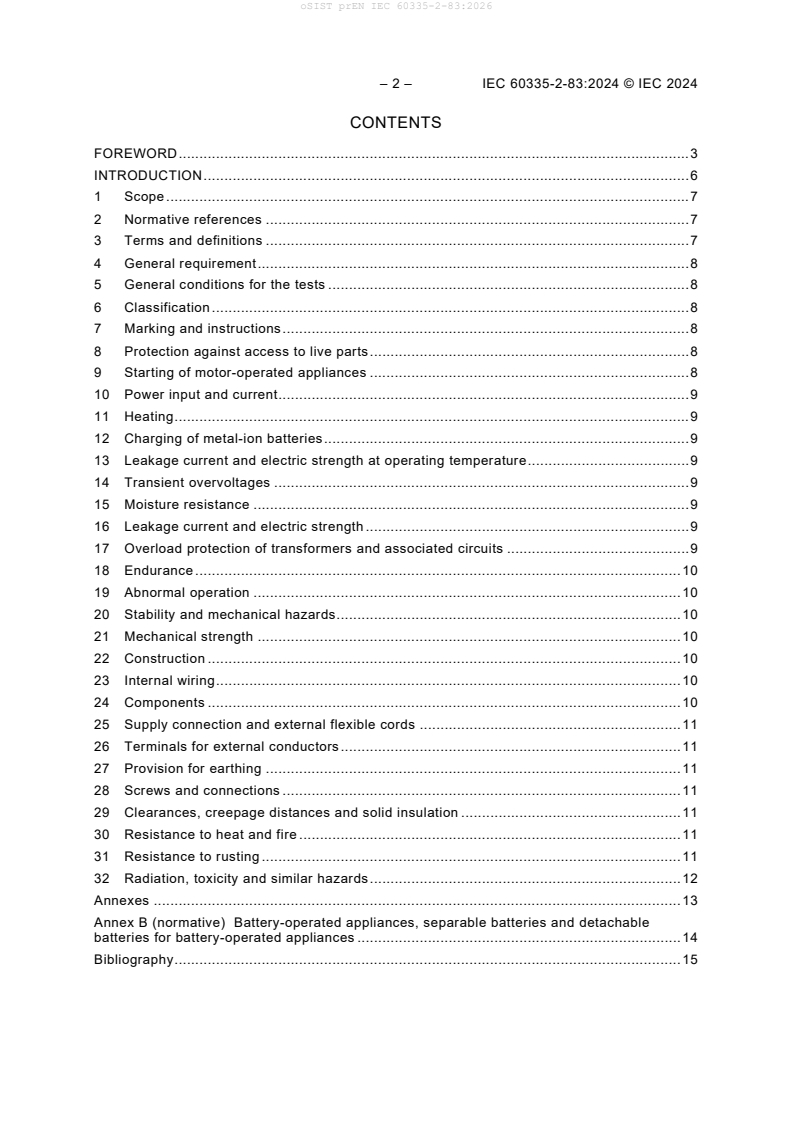
oSIST prEN IEC 60335-2-83:2026 is the SIST adoption of prEN IEC 60335-2-83:2026 for the safety of electrically heated gullies used to de-ice roof-drainage inlets on flat roofs, balconies, and similar structures. It applies to appliances rated up to 250 V, including DC-supplied and battery-operated appliances. The document is a Part 2 standard that adds product-specific safety requirements to IEC 60335-1.
What does oSIST prEN IEC 60335-2-83:2026 specify?
oSIST prEN IEC 60335-2-83:2026 specifies the safety requirements for heated gullies for roof drainage. It covers the common hazards of household and similar appliances in normal use and adds the extra checks needed for this outdoor drainage application.
The scope includes electrically heated gullies for de-icing drainage inlets on flat roofs, balconies, and similar structures. It is limited to appliances up to 250 V and includes direct current (DC) supplied and battery-operated appliances.
The standard does not target use in special atmospheres such as corrosive or explosive dust, vapour, or gas conditions. It is organized as a Part 2 document with Clauses 1 to 32, plus Annex B for battery-operated appliances and batteries.
| Annex | What it covers |
|---|---|
| Annex B | Battery-operated appliances, separable batteries, and detachable batteries for battery-operated appliances |
What are the key requirements of oSIST prEN IEC 60335-2-83:2026?
oSIST prEN IEC 60335-2-83:2026 mainly tightens the general IEC 60335-1 rules for wet, exposed, and permanently installed roof-drainage heaters. In practice, the important points are the water protection level, installation instructions, test conditions, and construction details that prevent access, overheating, and corrosion.
- Clauses 5.6 and 5.7 require thermostats to be short-circuited and several tests to run at 40 °C ± 2 °C. This makes the test conditions closer to real service in warm weather and checks the appliance under stress.
- Clause 6.1 and 6.2 allow class I, class II, or class III appliances and require at least IPX7. For users, this means the product must be designed for strong protection against water ingress and the chosen insulation or earthing concept must match the construction.
- Clause 7.12.1 requires instructions to say that the appliance should be installed in an area unlikely to be accessed. That matters because the appliance is meant to work on roofs and drainage points where people may not expect exposed heated parts.
- Clause 8.1.1 and Clause 20.2 state that test probe 18 is not applied. This changes the access and hazard checks used for this product type.
- Clause 11.7 and 11.8 require operation until steady conditions are reached, a 15 K reduction of the Table 3 temperature-rise values, and a maximum enclosure surface rise of 60 K. This is the main overheating control and directly affects enclosure design and material choice.
- Clause 15.1.2 and Clause 31 add water and corrosion measures: parts not intended to be exposed to drainage water are sealed before the moisture test, and corrosion resistance is checked with the salt mist test of IEC 60068-2-52. That is important for long service life outdoors.
- Clauses 21.1, 22.101, 24.101, 25.1, 25.5, 25.7, and 27.1 cover mechanical strength, non-detachable heating elements, non-self-resetting thermal cut-outs, supply connection limits, allowed Type Z attachment, polychloroprene-sheathed supply cords, and earthing of conductive parts that can contact drainage water. These are the construction details that protect users and simplify conformity testing.
What terms does oSIST prEN IEC 60335-2-83:2026 define?
- Normal operation means operating the appliance with a thermal insulation layer covering the top surface, as stated in Clause 3.1.9.
- DC means direct current, and the scope includes appliances supplied by DC as well as other supplies.
- IPX7 is the minimum ingress-protection level required by Clause 6.2.
- Type Z attachment is an allowed supply-connection arrangement under Clause 25.5.
- Test probe 18 is the access probe that is excluded from the tests named in Clauses 8.1.1, 20.2, and Annex B.
- Non-self-resetting thermal cut-out is the required form of thermal cut-out where Clause 24.101 applies.
- Class I, class II, and class III are the permitted appliance classes in Clause 6.1.
Who uses oSIST prEN IEC 60335-2-83:2026?
Manufacturers of roof-drainage heating equipment use oSIST prEN IEC 60335-2-83:2026 to design the appliance, select the insulation system, and prepare instructions. Test laboratories use it for temperature-rise, moisture, mechanical, and corrosion tests.
Quality managers, certification bodies, and compliance teams use it to check whether a heated gully can be assessed as a household or similar appliance. Buyers, specifiers, and installers use it to understand the product class, ingress-protection level, and installation limits before selection and site work.
What changed in oSIST prEN IEC 60335-2-83:2026 from the previous edition?
oSIST prEN IEC 60335-2-83:2026 is the second edition and replaces the first edition published in 2001 together with Amendment 1:2008. The document states that it is a technical revision.
The listed technical changes are:
- alignment with IEC 60335-1:2020
- removal of test probe 18 from the specified access and stability checks
Which standards are used with oSIST prEN IEC 60335-2-83:2026?
oSIST prEN IEC 60335-2-83:2026 is used with IEC 60335-1, which provides the general safety requirements that this Part 2 supplements and modifies. Clause 2 adds IEC 60068-2-52, which supplies the salt mist corrosion test used in Clause 31.
ISO 13732-1 appears in the bibliography as a related document on hot surfaces. In practice, it is useful background when assessing enclosure temperatures and contact hazards.
What does the oSIST prEN IEC 60335-2-83:2026 document contain?
The document contains the full Part 1-based safety structure, from general conditions and classification through marking, access to live parts, heating, moisture resistance, construction, wiring, terminals, earthing, and resistance to heat, fire, rusting, and radiation-related hazards. It also includes the product-specific changes for heated gullies, such as the ambient test conditions, IPX7 requirement, and the temperature-rise adjustment in Clause 11.
Annex B adds the rules for battery-operated appliances and for separable or detachable batteries. The document also includes the salt mist corrosion procedure, the scratch preparation for coated enclosures, and the altered use of test probe 18 in the relevant checks.
Relations
- Effective Date
- 29-Sep-2026
- Effective Date
- 14-Apr-2025
- Effective Date
- 14-Apr-2025
Get Certified
Connect with accredited certification bodies for this standard

DIBt (Deutsches Institut für Bautechnik)
German Institute for Building Technology.
DIN CERTCO
DIN Group product certification.

Kiwa BDA Testing
Building and construction product certification.
Sponsored listings
Frequently Asked Questions
oSIST prEN IEC 60335-2-83:2026 is a draft published by the Slovenian Institute for Standardization (SIST). Its full title is "Household and similar electrical appliances - Safety - Part 2-83: Particular requirements for heated gullies for roof drainage". This standard covers: This European standard deals with the safety of electrically heated gullies for de-icing the inlet of the drainage system of flat roofs, balconies, and similar structures, their rated voltage being not more than 250 V including direct current (DC) supplied appliances and battery-operated appliances.
This European standard deals with the safety of electrically heated gullies for de-icing the inlet of the drainage system of flat roofs, balconies, and similar structures, their rated voltage being not more than 250 V including direct current (DC) supplied appliances and battery-operated appliances.
oSIST prEN IEC 60335-2-83:2026 is classified under the following ICS (International Classification for Standards) categories: 13.120 - Domestic safety; 91.060.20 - Roofs. The ICS classification helps identify the subject area and facilitates finding related standards.
oSIST prEN IEC 60335-2-83:2026 has the following relationships with other standards: It is inter standard links to SIST EN IEC 60068-2-52:2018, SIST EN 60335-2-83:2003, SIST EN 60335-2-83:2003/A1:2008. Understanding these relationships helps ensure you are using the most current and applicable version of the standard.
oSIST prEN IEC 60335-2-83:2026 is associated with the following European legislation: EU Directives/Regulations: 2014/35/EU, 2014/53/EU; Standardization Mandates: M/511, M/536. When a standard is cited in the Official Journal of the European Union, products manufactured in conformity with it benefit from a presumption of conformity with the essential requirements of the corresponding EU directive or regulation.
oSIST prEN IEC 60335-2-83:2026 is available in PDF format for immediate download after purchase. The document can be added to your cart and obtained through the secure checkout process. Digital delivery ensures instant access to the complete standard document.
Standards Content (Sample)
SLOVENSKI STANDARD
01-november-2026
Gospodinjski in podobni električni aparati - Varnost - 2-83. del: Posebne zahteve
za ogrevanje strešnih žlebov
Household and similar electrical appliances - Safety - Part 2-83: Particular requirements
for heated gullies for roof drainage
Sicherheit elektrischer Geräte für den Hausgebrauch und ähnliche Zwecke - Teil 2-83:
Besondere Anforderungen für beheizbare Dachabläufe
Appareils électrodomestiques et analogues - Sécurité - Partie 2-83: Exigences
particulières pour les dispositifs électriques pour le chauffage des gouttières
Ta slovenski standard je istoveten z: prEN IEC 60335-2-83:2026
ICS:
13.120 Varnost na domu Domestic safety
91.060.20 Strehe Roofs
2003-01.Slovenski inštitut za standardizacijo. Razmnoževanje celote ali delov tega standarda ni dovoljeno.
IEC 60335-2-83 ®
Edition 2.0 2024-09
INTERNATIONAL
STANDARD
NORME
INTERNATIONALE
Household and similar electrical appliances – Safety –
Part 2-83: Particular requirements for heated gullies for roof drainage
Appareils électrodomestiques et analogues – Sécurité –
Partie 2-83: Exigences particulières pour les dispositifs électriques pour le
chauffage des gouttières
INTERNATIONAL
ELECTROTECHNICAL
COMMISSION
COMMISSION
ELECTROTECHNIQUE
INTERNATIONALE
ICS 91.060.20 ISBN 978-2-8322-9690-5
– 2 – IEC 60335-2-83:2024 © IEC 2024
CONTENTS
FOREWORD . 3
INTRODUCTION . 6
1 Scope . 7
2 Normative references . 7
3 Terms and definitions . 7
4 General requirement . 8
5 General conditions for the tests . 8
6 Classification . 8
7 Marking and instructions . 8
8 Protection against access to live parts . 8
9 Starting of motor-operated appliances . 8
10 Power input and current . 9
11 Heating . 9
12 Charging of metal-ion batteries . 9
13 Leakage current and electric strength at operating temperature . 9
14 Transient overvoltages . 9
15 Moisture resistance . 9
16 Leakage current and electric strength . 9
17 Overload protection of transformers and associated circuits . 9
18 Endurance . 10
19 Abnormal operation . 10
20 Stability and mechanical hazards . 10
21 Mechanical strength . 10
22 Construction . 10
23 Internal wiring . 10
24 Components . 10
25 Supply connection and external flexible cords . 11
26 Terminals for external conductors . 11
27 Provision for earthing . 11
28 Screws and connections . 11
29 Clearances, creepage distances and solid insulation . 11
30 Resistance to heat and fire . 11
31 Resistance to rusting . 11
32 Radiation, toxicity and similar hazards . 12
Annexes . 13
Annex B (normative) Battery-operated appliances, separable batteries and detachable
batteries for battery-operated appliances . 14
Bibliography . 15
IEC 60335-2-83:2024 © IEC 2024 – 3 –
INTERNATIONAL ELECTROTECHNICAL COMMISSION
____________
HOUSEHOLD AND SIMILAR ELECTRICAL APPLIANCES –
SAFETY –
Part 2-83: Particular requirements for heated gullies for roof drainage
FOREWORD
1) The International Electrotechnical Commission (IEC) is a worldwide organization for standardization comprising
all national electrotechnical committees (IEC National Committees). The object of IEC is to promote international
co-operation on all questions concerning standardization in the electrical and electronic fields. To this end and
in addition to other activities, IEC publishes International Standards, Technical Specifications, Technical Reports,
Publicly Available Specifications (PAS) and Guides (hereafter referred to as "IEC Publication(s)"). Their
preparation is entrusted to technical committees; any IEC National Committee interested in the subject dealt with
may participate in this preparatory work. International, governmental and non-governmental organizations liaising
with the IEC also participate in this preparation. IEC collaborates closely with the International Organization for
Standardization (ISO) in accordance with conditions determined by agreement between the two organizations.
2) The formal decisions or agreements of IEC on technical matters express, as nearly as possible, an international
consensus of opinion on the relevant subjects since each technical committee has representation from all
interested IEC National Committees.
3) IEC Publications have the form of recommendations for international use and are accepted by IEC National
Committees in that sense. While all reasonable efforts are made to ensure that the technical content of IEC
Publications is accurate, IEC cannot be held responsible for the way in which they are used or for any
misinterpretation by any end user.
4) In order to promote international uniformity, IEC National Committees undertake to apply IEC Publications
transparently to the maximum extent possible in their national and regional publications. Any divergence between
any IEC Publication and the corresponding national or regional publication shall be clearly indicated in the latter.
5) IEC itself does not provide any attestation of conformity. Independent certification bodies provide conformity
assessment services and, in some areas, access to IEC marks of conformity. IEC is not responsible for any
services carried out by independent certification bodies.
6) All users should ensure that they have the latest edition of this publication.
7) No liability shall attach to IEC or its directors, employees, servants or agents including individual experts and
members of its technical committees and IEC National Committees for any personal injury, property damage or
other damage of any nature whatsoever, whether direct or indirect, or for costs (including legal fees) and
expenses arising out of the publication, use of, or reliance upon, this IEC Publication or any other IEC
Publications.
8) Attention is drawn to the Normative references cited in this publication. Use of the referenced publications is
indispensable for the correct application of this publication.
9) IEC draws attention to the possibility that the implementation of this document may involve the use of (a)
patent(s). IEC takes no position concerning the evidence, validity or applicability of any claimed patent rights in
respect thereof. As of the date of publication of this document, IEC had not received notice of (a) patent(s), which
may be required to implement this document. However, implementers are cautioned that this may not represent
the latest information, which may be obtained from the patent database available at https://patents.iec.ch. IEC
shall not be held responsible for identifying any or all such patent rights.
IEC 60335-2-83 has been prepared by IEC technical committee 61: Safety of household and
similar electrical appliances. It is an International Standard.
This second edition cancels and replaces the first edition published in 2001 and
Amendment 1:2008. This edition constitutes a technical revision.
This edition includes the following significant technical changes with respect to the previous
edition:
a) alignment with IEC 60335-1:2020;
b) removal of test probe 18 (8.1.1, 20.2, B.22.3, B.22.4).
– 4 – IEC 60335-2-83:2024 © IEC 2024
The text of this International Standard is based on the following documents:
Draft Report on voting
61/7274/FDIS 61/7300/RVD
Full information on the voting for its approval can be found in the report on voting indicated in
the above table.
The language used for the development of this International Standard is English.
This document was drafted in accordance with ISO/IEC Directives, Part 2, and developed in
accordance with ISO/IEC Directives, Part 1 and ISO/IEC Directives, IEC Supplement, available
at www.iec.ch/members_experts/refdocs. The main document types developed by IEC are
described in greater detail at www.iec.ch/publications.
A list of all parts of the IEC 60335 series, under the general title: Household and similar
electrical appliances – Safety, can be found on the IEC website.
This part 2 is to be used in conjunction with the latest edition of IEC 60335-1 and its
amendments unless that edition precludes it; in that case, the latest edition that does not
preclude it is used. It was established on the basis of the sixth edition (2020) of that standard.
NOTE 1 When "part 1" is mentioned in this standard, it refers to IEC 60335-1.
This part 2 supplements or modifies the corresponding clauses in IEC 60335-1, so as to convert
that publication into the IEC standard: Particular requirements for heated gullies for roof
drainage.
When a particular subclause of part 1 is not mentioned in this part 2, that subclause applies
as far as is reasonable. When this standard states "addition", "modification", or "replacement",
the relevant text in part 1 is to be adapted accordingly.
NOTE 2 The following numbering system is used:
– subclauses, tables and figures that are numbered starting from 101 are additional to those in Part 1;
– unless notes are in a new subclause or involve notes in part 1, they are numbered start
...