

SIST-TS CEN/TS 14632:2023
(Main)Plastics piping systems for drainage, sewerage and water supply, pressure and non-pressure - Glass-reinforced thermosetting plastics (GRP) based on unsaturated polyester resin (UP) - Guidance for the assessment of conformity
General Information
- Abstract
This document gives guidance on the assessment of conformity of GRP-UP (glass-reinforced thermosetting resins based on unsaturated polyesters) piping products and assemblies in accordance with EN ISO 23856. ISO 25780 and ISO 16611 intended to be included in the manufacturer’s quality plan as part of the quality management system and for the establishment of third-party certification procedures.
This document also gives guidance on the assessment of conformity of GRP-UP manholes and inspection chambers (see EN 15383 for additional information). Pipes (see EN ISO 23856) are used for manufacturing the shafts and chamber units. Additional statements as needed to assess the conformity of manholes and inspection chambers are given in Annex F.
NOTE 1 For the purpose of this document, the term polyester resin (UP) also includes vinyl-ester resins (VE).
NOTE 2 If third-party certification is involved, the certification body is accredited to ISO/IEC 17065 or EN ISO/IEC 17021 [3] as applicable.
- Status
- Published
- Public Enquiry End Date
- 30-Mar-2023
- Publication Date
- 20-Aug-2023
- Technical Committee
- PCV - Plastic pipes, fittings and valves
- Current Stage
- 6060 - National Implementation/Publication (Adopted Project)
- Start Date
- 05-Jul-2023
- Due Date
- 09-Sep-2023
- Completion Date
- 21-Aug-2023
Buy Documents

Overview - CEN/TS 14632:2023 (GRP‑UP conformity guidance)
CEN/TS 14632:2023 provides guidance for the assessment of conformity of glass‑reinforced thermosetting plastics (GRP) based on unsaturated polyester resin (UP) used in plastics piping systems for drainage, sewerage and water supply (pressure and non‑pressure). It supports manufacturers and certification bodies in establishing quality plans and third‑party certification procedures in line with product standards such as EN ISO 23856, ISO 25780 and ISO 16611. The document also covers GRP‑UP manholes and inspection chambers (see Annex F and EN 15383 for additional detail). Note: UP is taken to include vinyl‑ester (VE) resins for the purpose of this Technical Specification.
Key topics and technical requirements
- Scope and applicability: Pipes, fittings, assemblies, manholes and inspection chambers for water, drainage and sewerage systems.
- Conformity schemes: Guidance for manufacturer self‑assessment and schemes including third‑party certification; certification bodies should be accredited to ISO/IEC 17065 or EN ISO/IEC 17021 as applicable.
- Quality management integration: Tests and assessment are intended to be included in the manufacturer’s quality plan as part of a quality management system (comparable to EN ISO 9001).
- Testing types and frequencies:
- Type testing (TT) for initial qualification of products and materials.
- Audit tests (AT) and process verification tests (PVT) to verify ongoing conformity.
- Batch release tests (BRT) and routine quality control tests for production batches.
- Reduced long‑term testing (RLTT): Procedures and evaluation parameters for shortened long‑term tests (see Annex D and E).
- Change control: Definitions and test requirements for changes in materials, design or process (Annex B and C).
- Manholes/chambers specifics: Additional test criteria such as longitudinal compressive strength and step load resistance (Annex F).
Practical applications and users
Who uses this standard:
- Manufacturers of GRP‑UP pipes, fittings, shafts, manholes and inspection chambers (to develop QA plans and perform type/batch testing).
- Third‑party certification bodies and conformity assessment bodies (for accreditation and certification procedures).
- Testing laboratories conducting TT, AT, RLTT and batch release tests.
- Specifiers, engineers and authorities responsible for procurement, installation and regulatory compliance of water, drainage and sewerage piping systems.
Practical value:
- Ensures consistent product performance and safety for GRP piping systems.
- Provides a structured test and audit framework for market access and certification.
- Clarifies how to assess changes to materials, design and process without unnecessary retesting.
Related standards (select)
- EN ISO 23856, ISO 25780, ISO 16611
- EN 15383 (manholes & chambers)
- ISO/IEC 17065, EN ISO/IEC 17021 (accreditation)
- EN ISO 9001 (quality management)
Keywords: GRP‑UP, glass‑reinforced thermosetting plastics, unsaturated polyester resin, conformity assessment, piping systems, drainage, sewerage, water supply, type testing, third‑party certification.
Relations
- Effective Date
- 01-Sep-2023
- Effective Date
- 28-Jan-2026
- Effective Date
- 28-Jan-2026
- Effective Date
- 28-Jan-2026
- Effective Date
- 28-Jan-2026
- Effective Date
- 28-Jan-2026
- Effective Date
- 28-Jan-2026
- Effective Date
- 28-Jan-2026
- Effective Date
- 28-Jan-2026
- Effective Date
- 28-Jan-2026
- Effective Date
- 28-Jan-2026
- Effective Date
- 28-Jan-2026
- Effective Date
- 28-Jan-2026
- Effective Date
- 28-Jan-2026
- Effective Date
- 28-Jan-2026
Buy Documents
Get Certified
Connect with accredited certification bodies for this standard

DIN CERTCO
DIN Group product certification.
DIBt (Deutsches Institut für Bautechnik)
German Institute for Building Technology.
Zavod za gradbeništvo Slovenije (ZAG) - Inšpekcija
ZAG inspection body for construction products, structures, and materials.
Sponsored listings
Frequently Asked Questions
SIST-TS CEN/TS 14632:2023 is a technical specification published by the Slovenian Institute for Standardization (SIST). Its full title is "Plastics piping systems for drainage, sewerage and water supply, pressure and non-pressure - Glass-reinforced thermosetting plastics (GRP) based on unsaturated polyester resin (UP) - Guidance for the assessment of conformity". This standard covers: This document gives guidance on the assessment of conformity of GRP-UP (glass-reinforced thermosetting resins based on unsaturated polyesters) piping products and assemblies in accordance with EN ISO 23856. ISO 25780 and ISO 16611 intended to be included in the manufacturer’s quality plan as part of the quality management system and for the establishment of third-party certification procedures. This document also gives guidance on the assessment of conformity of GRP-UP manholes and inspection chambers (see EN 15383 for additional information). Pipes (see EN ISO 23856) are used for manufacturing the shafts and chamber units. Additional statements as needed to assess the conformity of manholes and inspection chambers are given in Annex F. NOTE 1 For the purpose of this document, the term polyester resin (UP) also includes vinyl-ester resins (VE). NOTE 2 If third-party certification is involved, the certification body is accredited to ISO/IEC 17065 or EN ISO/IEC 17021 [3] as applicable.
This document gives guidance on the assessment of conformity of GRP-UP (glass-reinforced thermosetting resins based on unsaturated polyesters) piping products and assemblies in accordance with EN ISO 23856. ISO 25780 and ISO 16611 intended to be included in the manufacturer’s quality plan as part of the quality management system and for the establishment of third-party certification procedures. This document also gives guidance on the assessment of conformity of GRP-UP manholes and inspection chambers (see EN 15383 for additional information). Pipes (see EN ISO 23856) are used for manufacturing the shafts and chamber units. Additional statements as needed to assess the conformity of manholes and inspection chambers are given in Annex F. NOTE 1 For the purpose of this document, the term polyester resin (UP) also includes vinyl-ester resins (VE). NOTE 2 If third-party certification is involved, the certification body is accredited to ISO/IEC 17065 or EN ISO/IEC 17021 [3] as applicable.
SIST-TS CEN/TS 14632:2023 is classified under the following ICS (International Classification for Standards) categories: 23.040.05 - Pipeline and its parts for external sewage systems; 83.120 - Reinforced plastics; 91.140.60 - Water supply systems; 91.140.80 - Drainage systems; 93.030 - External sewage systems. The ICS classification helps identify the subject area and facilitates finding related standards.
SIST-TS CEN/TS 14632:2023 has the following relationships with other standards: It is inter standard links to SIST-TS CEN/TS 14632:2012, SIST EN ISO 21068-3:2024, SIST EN 17700-5:2025, SIST EN ISO 11192:2018, SIST EN ISO 29463-4:2018, SIST EN ISO 3126:2005, SIST-TP CEN/TR 16931-9:2025, SIST EN 15383:2013+A1:2013, kSIST FprEN ISO 11300-2:2026, SIST EN ISO 19628:2025, SIST-TP CEN ISO/TR 6026:2023, SIST EN 681-1:2000, SIST EN 14364:2013, SIST EN ISO 23856:2021, SIST EN 15383:2013. Understanding these relationships helps ensure you are using the most current and applicable version of the standard.
SIST-TS CEN/TS 14632:2023 is available in PDF format for immediate download after purchase. The document can be added to your cart and obtained through the secure checkout process. Digital delivery ensures instant access to the complete standard document.
Standards Content (Sample)
SLOVENSKI STANDARD
01-september-2023
Nadomešča:
SIST-TS CEN/TS 14632:2012
Cevni sistemi iz polimernih materialov za odvodnjavanje, kanalizacijo in oskrbo z
vodo, s tlakom in brez njega - S steklenimi vlakni okrepljeni duromerni materiali
(GRP), ki temeljijo na nenasičeni poliestrski smoli (UP) - Navodilo za ugotavljanje
skladnosti
Plastics piping systems for drainage, sewerage and water supply, pressure and non-
pressure - Glass-reinforced thermosetting plastics (GRP) based on unsaturated
polyester resin (UP) - Guidance for the assessment of conformity
Kunststoff-Rohrleitungssysteme für die Entwässerung und Wasserversorgung mit und
ohne Druck - Glasfaserverstärkte duroplastische Kunststoffe (GFK) auf der Basis von
Polyesterharz (UP) - Empfehlungen für die Beurteilung der Konformität
Systèmes de canalisations en plastique pour les branchements, les collecteurs
d'assainissement et l'alimentation en eau, avec ou sans pression - Plastiques
thermodurcissables renforcés de verre (PRV) à base de résine polyester (UP) - Guide
pour l'évaluation de conformité
Ta slovenski standard je istoveten z: CEN/TS 14632:2023
ICS:
23.040.05 Cevovodi za zunanje Pipeline and its parts for
sisteme za odpadno vodo in external sewage systems
njihovi deli
83.120 Ojačani polimeri Reinforced plastics
91.140.60 Sistemi za oskrbo z vodo Water supply systems
91.140.80 Drenažni sistemi Drainage systems
2003-01.Slovenski inštitut za standardizacijo. Razmnoževanje celote ali delov tega standarda ni dovoljeno.
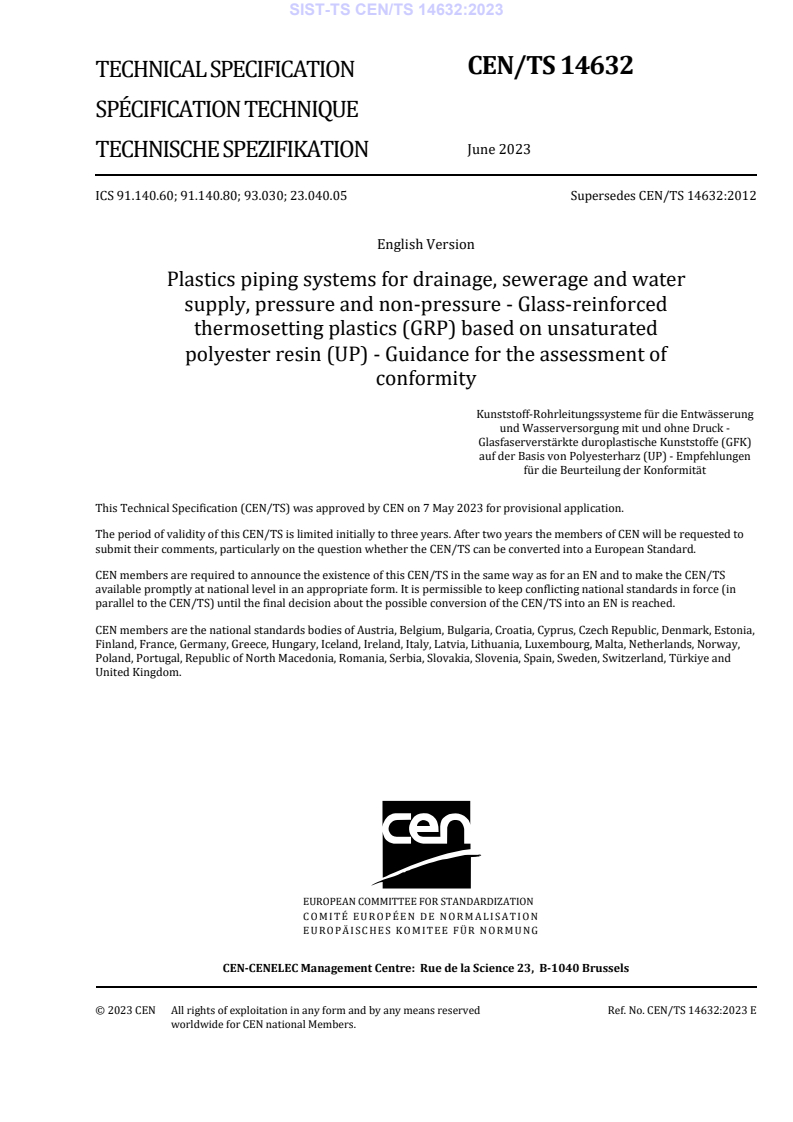
CEN/TS 14632
TECHNICAL SPECIFICATION
SPÉCIFICATION TECHNIQUE
June 2023
TECHNISCHE SPEZIFIKATION
ICS 91.140.60; 91.140.80; 93.030; 23.040.05 Supersedes CEN/TS 14632:2012
English Version
Plastics piping systems for drainage, sewerage and water
supply, pressure and non-pressure - Glass-reinforced
thermosetting plastics (GRP) based on unsaturated
polyester resin (UP) - Guidance for the assessment of
conformity
Kunststoff-Rohrleitungssysteme für die Entwässerung
und Wasserversorgung mit und ohne Druck -
Glasfaserverstärkte duroplastische Kunststoffe (GFK)
auf der Basis von Polyesterharz (UP) - Empfehlungen
für die Beurteilung der Konformität
This Technical Specification (CEN/TS) was approved by CEN on 7 May 2023 for provisional application.
The period of validity of this CEN/TS is limited initially to three years. After two years the members of CEN will be requested to
submit their comments, particularly on the question whether the CEN/TS can be converted into a European Standard.
CEN members are required to announce the existence of this CEN/TS in the same way as for an EN and to make the CEN/TS
available promptly at national level in an appropriate form. It is permissible to keep conflicting national standards in force (in
parallel to the CEN/TS) until the final decision about the possible conversion of the CEN/TS into an EN is reached.
CEN members are the national standards bodies of Austria, Belgium, Bulgaria, Croatia, Cyprus, Czech Republic, Denmark, Estonia,
Finland, France, Germany, Greece, Hungary, Iceland, Ireland, Italy, Latvia, Lithuania, Luxembourg, Malta, Netherlands, Norway,
Poland, Portugal, Republic of North Macedonia, Romania, Serbia, Slovakia, Slovenia, Spain, Sweden, Switzerland, Türkiye and
United Kingdom.
EUROPEAN COMMITTEE FOR STANDARDIZATION
COMITÉ EUROPÉEN DE NORMALISATION
EUROPÄISCHES KOMITEE FÜR NORMUNG
CEN-CENELEC Management Centre: Rue de la Science 23, B-1040 Brussels
© 2023 CEN All rights of exploitation in any form and by any means reserved Ref. No. CEN/TS 14632:2023 E
worldwide for CEN national Members.
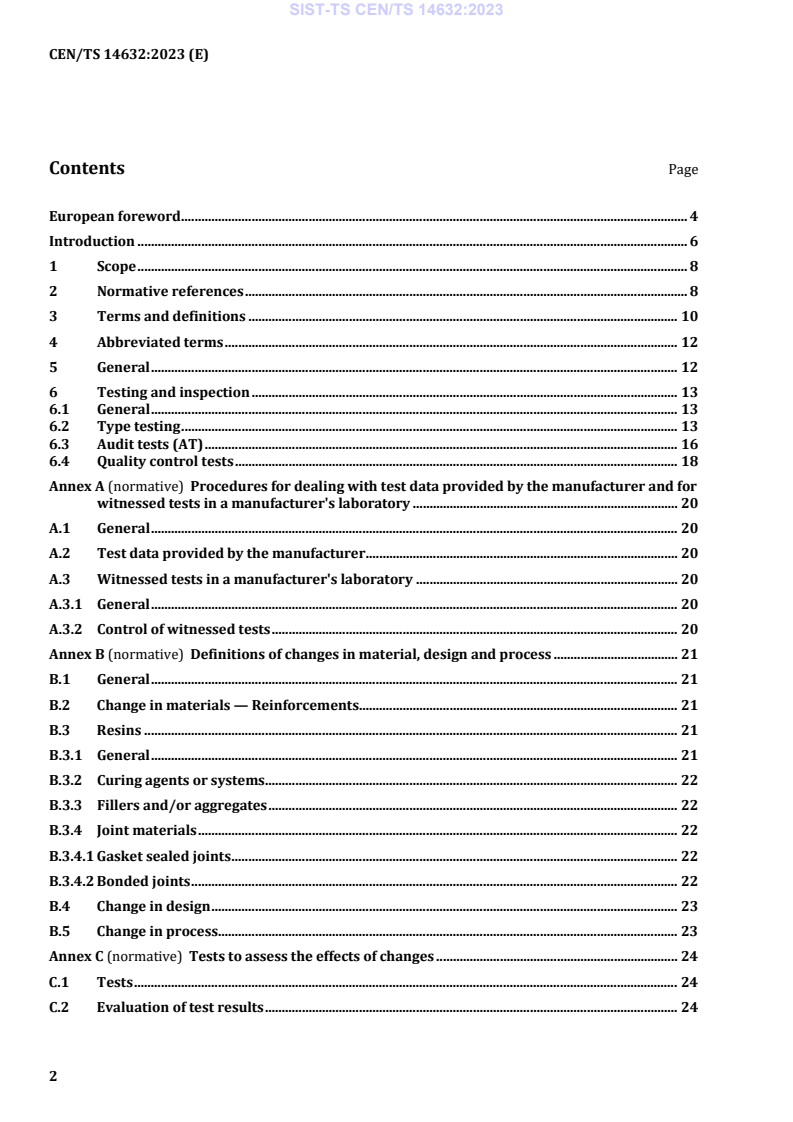
Contents Page
European foreword . 4
Introduction . 6
1 Scope . 8
2 Normative references . 8
3 Terms and definitions . 10
4 Abbreviated terms . 12
5 General . 12
6 Testing and inspection . 13
6.1 General . 13
6.2 Type testing . 13
6.3 Audit tests (AT) . 16
6.4 Quality control tests . 18
Annex A (normative) Procedures for dealing with test data provided by the manufacturer and for
witnessed tests in a manufacturer's laboratory . 20
A.1 General . 20
A.2 Test data provided by the manufacturer . 20
A.3 Witnessed tests in a manufacturer's laboratory . 20
A.3.1 General . 20
A.3.2 Control of witnessed tests . 20
Annex B (normative) Definitions of changes in material, design and process . 21
B.1 General . 21
B.2 Change in materials — Reinforcements . 21
B.3 Resins . 21
B.3.1 General . 21
B.3.2 Curing agents or systems . 22
B.3.3 Fillers and/or aggregates . 22
B.3.4 Joint materials . 22
B.3.4.1 Gasket sealed joints . 22
B.3.4.2 Bonded joints . 22
B.4 Change in design . 23
B.5 Change in process. 23
Annex C (normative) Tests to assess the effects of changes . 24
C.1 Tests . 24
C.2 Evaluation of test results . 24
C.2.1 Initial properties . 24
C.2.2 Reduced long-term tests . 24
Annex D (normative) Parameters and criteria for reduced long-term tests (RLTT) . 26
D.1 General . 26
D.2 Reduced long-term test parameters . 26
D.2.1 Reduced parameters for long-term failure pressure . 26
D.2.2 Reduced parameters for the resistance to strain corrosion . 26
D.2.2.1 General . 26
D.2.2.2 Procedure using failure points . 26
D.2.2.3 Procedure using specified levels . 27
D.2.2.3.1 . General
............................................................................................................................................................................. 27
D.2.2.3.2 . Using deflection
............................................................................................................................................................................. 27
D.2.2.3.3 . Using strain
............................................................................................................................................................................. 27
D.2.3 Reduced parameters for ultimate long-term resistance to failure in a deflected condition27
D.3 Evaluation of results of destructive RLTTs (see D.2.1, D.2.2 and D.2.3) . 28
D.3.1 General . 28
D.3.2 Example . 29
Annex E (normative) Reduced long-term testing (RLTT) of the determination of wet creep factor32
E.1 General . 32
E.2 Evaluation of results and criteria . 32
E.2.1 General . 32
E.2.2 Example . 33
Annex F (normative) Additional statements for manholes and inspection chambers . 36
F.1 General . 36
F.2 Tests specific to manholes and chambers . 36
F.2.1 Longitudinal compressive strength . 36
F.2.2 Determination of the resistance of installed steps to vertical and horizontal loading . 36
F.3 Type tests . 36
F.4 Audit tests . 36
F.5 Batch release tests . 36
Annex G (informative) Consequence Classes and Quality Levels . 37
G.1 General . 37
Bibliography . 39
European foreword
This document (CEN/TS 14632:2023) has been prepared by Technical Committee CEN/TC 155 “Plastics piping
systems and ducting systems”, the secretariat of which is held by NEN.
Attention is drawn to the possibility that some of the elements of this document may be the subject of patent
rights. CEN shall not be held responsible for identifying any or all such patent rights.
This document supersedes CEN/TS 14632:2012.
Compared with CEN/TS 14362:2012, the following changes have been made:
— In the scope references to ISO 25780 and ISO 16611 have been added and reference to EN ISO 23856
replaces reference to the previous product standards. References to appropriate accreditation standards
have also been corrected. This also applies in other parts of the document;
— In Clause 2 references to several standards have been added and updated;
— In Clause 3.6 on type testing the note has been removed;
— In Table 3, 4 and 5, the term “Long-term failure pressure” has been replaced with “Resistance to internal
pressure” and the term “strain corrosion” has been replaced with “chemical attack”. Also, the reference to
EN 1447 has been replaced with reference to ISO 7509;
— In Clause 6.2.3.4 a sentence has been added with reference to EN 681-1 and ISO 4633;
— Clause 6.2.5 has been rewritten;
— In Table 4 reference to ISO 7510 has been added. The notes to the table have been rewritten;
— In Clause 6.4.1.1 the words “the production” have been replaced with “each production batch”;
— Table 6 has been rewritten;
— First paragraph of Clause 6.4.2 has been reworded;
— In Clause B.1 the penultimate paragraph has been deleted;
— In Clause B.2 the items e), f), and g) have been deleted;
— Two items have been added to Clause B.3.4.1;
— Clause B.5 has been reworded and item b) deleted;
— Table C.1 has been completely reworked;
— Note a in Table C.2 has been removed and the table corrected accordingly, a column has been added, and
reference to α and β factors removed;
— In Clause D.2.2.3.2 the word “deflection” has been replaced with “initial ring stiffness”
— Throughout the document the words “specific ring stiffness” have been replaced with “ring stiffness”;
— Annex E has been completely rewritten;
— A new Annex G has been introduced;
— Typographical and grammatical errors have been corrected throughout the document.
This document can be used to support elaboration of national third-party certification procedures for GRP
products (glass-reinforced thermosetting plastics based on unsaturated polyester resin) to be used in piping
systems for the transport of water, drainage and sewage.
Any feedback and questions on this document should be directed to the users’ national standards body. A
complete listing of these bodies can be found on the CEN website.
According to the CEN/CENELEC Internal Regulations, the national standards organisations of the following
countries are bound to announce this Technical Specification: Austria, Belgium, Bulgaria, Croatia, Cyprus, Czech
Republic, Denmark, Estonia, Finland, France, Germany, Greece, Hungary, Iceland, Ireland, Italy, Latvia,
Lithuania, Luxembourg, Malta, Netherlands, Norway, Poland, Portugal, Republic of North Macedonia, Romania,
Serbia, Slovakia, Slovenia, Spain, Sweden, Switzerland, Türkiye and the United Kingdom.
Introduction
Figures 1 and 2 are intended to provide general information on the concept of testing and organization of those
tests used for the purpose of the assessment of conformity. For each type of test (i.e. type testing (TT), batch
release test (BRT), process verification test (PVT) and audit test (AT), this document details the applicable
characteristics to be assessed and the frequency and sampling of testing.
A typical scheme for the assessment of conformity of pipes, fittings and assemblies by manufacturers is given in
Figure 1.
Figure 1 —Typical scheme for the assessment of conformity by a manufacturer
A typical scheme for the assessment of conformity of pipes, fittings and assemblies by manufacturers, including
a third-party certification, is given in Figure 2.
Figure 2 — Typical scheme for the assessment of conformity by a manufacturer, including a third-party
certification
The quality management system conforms to or is no less stringent than the relevant requirements to
EN ISO 9001 [1].
1 Scope
This document gives guidance on the assessment of conformity of GRP-UP (glass-reinforced thermosetting
resins based on unsaturated polyesters) piping products and assemblies in accordance with EN ISO 23856.
ISO 25780 and ISO 16611 intended to be included in the manufacturer’s quality plan as part of the quality
management system and for the establishment of third-party certification procedures.
This document also gives guidance on the assessment of conformity of GRP-UP manholes and inspection
chambers (see EN 15383 for additional information). Pipes (see EN ISO 23856) are used for manufacturing the
shafts and chamber units. Additional statements as needed to assess the conformity of manholes and inspection
chambers are given in Annex F.
NOTE 1 For the purpose of this document, the term polyester resin (UP) also includes vinyl-ester resins (VE).
NOTE 2 If third-party certification is involved, the certification body is accredited to ISO/IEC 17065 or
EN ISO/IEC 17021 [3] as applicable.
2 Normative references
The following documents are referred to in the text in such a way that some or all of their content constitutes
requirements of this document. For dated references, only the edition cited applies. For undated references, the
latest edition of the referenced document (including any amendments) applies.
EN 681-1, Elastomeric seals - Materials requirements for pipe joint seals used in water and drainage applications -
Part 1: Vulcanized rubber
ISO 4633, Rubber seals – Joint rings for water supply, drainage and sewerage pipelines – Specifications for
materials
ISO 7509, Plastics piping systems — Glass-reinforced thermosetting plastics (GRP) pipes — Determination of time
to failure under sustained internal pressure
EN 1990, Eurocode - Basis of structural and geotechnical design
EN 15383, Plastics piping systems for drainage and sewerage — Glass-reinforced thermosetting plastics (GRP)
based on polyester resin (UP) — Manholes and inspection chambers
EN ISO 3126, Plastics piping systems - Plastics components - Determination of dimensions (ISO 3126)
EN ISO 23856, Plastics piping systems for pressure and non-pressure water supply, drainage or sewerage - Glass-
reinforced thermosetting plastics (GRP) systems based on unsaturated polyester (UP) resin (ISO 23856)
ISO 25780, Plastics piping systems for pressure and non-pressure water supply, irrigation, drainage or sewerage
— Glass-reinforced thermosetting plastics (GRP) systems based on unsaturated polyester (UP) resin — Pipes with
flexible joints intended to be installed using jacking techniques
ISO 16611, Plastics piping systems for drainage and sewerage without pressure — Non-circular pipes and joints
made of glass-reinforced thermosetting plastics (GRP) based on unsaturated polyester resins (UP) — Dimensions,
requirements and tests
ISO 7432, Glass-reinforced thermosetting plastics (GRP) pipes and fittings — Test methods to prove the design of
locked socket-and-spigot joints, including double-socket joints, with elastomeric seals
ISO 7510, Plastics piping systems — Glass-reinforced plastics (GRP) components — Determination of the amounts
of constituents
ISO 7685, Glass-reinforced thermosetting plastics (GRP) pipes — Determination of initial ring stiffness
ISO 8513, Plastics piping systems — Glass-reinforced thermosetting plastics (GRP) pipes — Determination of
longitudinal tensile properties
ISO 8521, Glass-reinforced thermosetting plastic (GRP) pipes — Test methods for the determination of the initial
circumferential tensile wall strength
ISO 8533, Glass-reinforced thermosetting plastics (GRP) pipes and fittings — Test methods to prove the design of
cemented or wrapped joints
ISO 8639, Glass-reinforced thermosetting plastics (GRP) pipes and fittings — Test methods for leaktightness and
proof of structural design of flexible joints
ISO 10466, Glass-reinforced thermosetting plastics (GRP) pipes — Test method to prove the resistance to initial
ring deflection
ISO 10468, Glass-reinforced thermosetting plastics (GRP) pipes — Determination of the creep properties under
wet or dry conditions
ISO 10471, Glass-reinforced thermosetting plastics (GRP) pipes — Determination of the long-term ultimate
bending strain and the long-term ultimate relative ring deflection under wet conditions
ISO 10928, Plastics piping systems — Glass-reinforced thermosetting plastics (GRP) pipes and fittings — Methods
for regression analysis and their use
ISO 10952, Glass-reinforced thermosetting plastics (GRP) pipes and fittings — Determination of the resistance to
chemical attack for the inside of a section in a deflected condition
ISO 18851, Plastics piping systems — Glass-reinforced thermosetting plastics (GRP) pipes and fittings — Test
method to prove the structural design of fittings
ISO/TS 20656-1, Plastics piping systems — General rules for structural design of glass-reinforced thermosetting
plastics (GRP) pipes — Part 1: Buried pipes
ISO 178, Plastics — Determination of flexural properties
3 Terms and definitions
For the purposes of this document, the terms and definitions given in EN ISO 23856, ISO 25780, ISO 16611 and
EN 15383 and the following apply.
3.1
certification body
impartial body, governmental or non-governmental, possessing the necessary competence and responsibility to
carry out certification of conformity according to given rules of procedure and management
Note 1 to entry: A certification body is preferably accredited to ISO/IEC 17065 [5].
3.2
inspection body
impartial organisation or company, approved by the certification body as possessing the necessary competence
to verify and/or to carry out initial type testing, audit testing and inspection of the manufacturer's factory
production control in accordance with the relevant standard
Note 1 to entry: An inspection body is preferably accredited to ISO/IEC 17020 [2].
3.3
testing laboratory
laboratory which measures, tests, calibrates or otherwise determines the characteristics of the performance of
materials and products
Note 1 to entry: In the context of this document, the materials and products can be subjected to type testing, batch release
testing, process verification testing, audit testing, and witness testing, as applicable.
Note 2 to entry: A testing laboratory is preferably accredited to ISO/IEC 17025 [4].
3.4
quality management system
management system to direct and control an organization with regard to quality
Note 1 to entry: Requirements for quality management systems are given in EN ISO 9001 [1].
3.5
quality plan
document setting out the specific quality practices, resources and sequence of activities relevant to a particular
product or range of products
3.6
type testing
TT
testing performed to prove that the material, product, joint or assembly is capable of conforming to the
requirements given in the relevant standard
3.7
batch release test
BRT
test performed by or on behalf of the manufacturer on a batch of products, which has to be satisfactorily
completed before the batch can be released
3.8
process verification test
PVT
test performed by or on behalf of the manufacturer on products at specific intervals to confirm that the process
continues to be capable of producing products which conform to the requirements given in the relevant
standard
Note 1 to entry: Such tests are not required to release batches of products and are carried out as a measure of process
control.
3.9
audit test
AT
test performed by a test laboratory on behalf of an inspection body or certification body to confirm that the
product continues to conform to the requirements given in the relevant standard and to provide information to
assess the effectiveness of the quality management system
3.10
indirect test
IT
test performed by or on behalf of the manufacturer, different from that specified test for that particular
characteristic, having previously verified its correlation with the specified test
3.11
witness test
WT
test accepted by an inspection or a certification body for type testing and/or audit testing, which is carried out
by or on behalf of the manufacturer and supervised by a representative of the inspection or certification body,
qualified in testing
3.12
product
pipe, fitting, manhole or inspection chamber of a clearly identified type intended to be a part of a piping system
which the manufacturer puts on the market
3.13
product batch
clearly identified collection of products, manufactured consecutively or continuously under the same
conditions, conforming to the same specification
Note 1 to entry: The production batch is defined and identified by the product manufacturer.
3.14
lot
clearly identifiable sub-division of a batch for inspection purposes
3.15
sample
one or more products drawn from the same production batch or lot, selected at random without regard to their
quality
Note 1 to entry: The number of products in the sample is the sample size.
3.16
group
collection of similar products from which samples are selected for testing purposes
3.17
reduced long-term test
RLTT
test using shorter time periods than those specified for the long-term test
Note 1 to entry: The RLTT results are to be compared to the results from the long-term test to verify that the current
performance of a product conforms to the initially established long-term performance.
3.18
uniaxial loading
loading condition where the pipe is pressurised, but not subjected to end-thrust
3.19
biaxial loading
loading condition where the pipe is pressurised and subjected to end-thrust
4 Abbreviated terms
To avoid misunderstanding, the abbreviations in this Clause are defined as being the same in each language.
For the same reason, the terms are given in the three languages, English, French and German.
EN FR DE
AT audit test essai d’audit Überwachungsprüfung
BRT batch release test essai de libération de campagne de Freigabeprüfung einer
fabrication Charge
IT indirect test essai indirect indirekte Prüfung
PVT process verification essai de vérification du procédé de Prozessüberprüfung
test fabrication
RLT reduced long-term essai à long-terme écourté verkürzte Langzeitprüfung
T test
TT type test essai de type Typprüfung
WT witness testing essai témoin Prüfung unter Aufsicht
5 General
5.1 The materials, pipes, fittings, joints, manholes and inspection chambers shall conform to the
requirements in EN ISO 23856 and EN 15383, as applicable.
5.2 Pipes, fittings, joints, manholes and inspection chambers shall be produced by the manufacturer under a
quality management system which includes a quality plan.
It is recommended that the quality management system conforms to or is no less stringent than the relevant
requirements of EN ISO 9001 [1].
5.3 For the effect on water quality, attention is drawn to the requirements of National regulations.
6 Testing and inspection
6.1 General
6.1.1 Records of inspection and test
Unless otherwise specified all records shall be maintained for a minimum of ten years.
6.1.2 Indirect tests
Generally, testing shall be performed according to the test method referred to EN ISO 23856, ISO 25780,
ISO 16611 and EN 15383, as applicable.
Indirect testing may be used for BRT and PVT characteristics as given in 6.4.1 and 6.4.2, respectively. Indirect
testing shall not be applied to type testing.
The correlation or safe relationship of the indirect testing to the specified testing shall be documented in the
manufacturer's quality plan. If a third-party certification is involved, the IT shall be accepted by the certification
body. The continuing validity of the indirect testing shall be checked at regular intervals. In cases of dispute, the
test methods referred to in EN ISO 23856, ISO 25780, ISO 16611 and EN 15383, as applicable, shall be used for
BRT or PVT, using RLTT, where applicable.
6.2 Type testing
6.2.1 General
Type tests shall be conducted in accordance with the requirements and rules given in Annex A and, the
requirements given in 6.2.2 to 6.2.4, as applicable.
6.2.2 Pipe type test group
A pipe type test group consists of a range or family of products made such that the results of the long-term type
tests are applicable to all products in the group. A pipe type test group shall be made of products:
a) manufactured by the same process;
b) with the same material specifications;
c) with the same pipe wall construction (i.e. the sequence of layers, layer compositions, material properties
and design method for using the results of the long-term type tests in determining the pipe wall for all
combinations of DN, PN and SN);
d) tested with the same loading condition (i.e. uniaxial or biaxial load).
The quality management system shall document all process details that could influence type test performance.
The quality management system shall document the complete product design method and demonstrate how
the results of the type tests are used to establish product designs.
Table 1 lists the constituents which are addressed by a certificate of conformity to the pipe-manufacturer's
specification from the material producer. Table 2 lists the characteristics declared by the manufacturer. Table 3
lists the long-term type teststo be conducted. In addition, all short-term properties listed in Table 6 for BRT
shall be tested and documented for the pipes used for the long-term type tests.
Table 1 — Characteristics for pipe type test (TT) — Constituents covered by a certificate of conformity
Constituents
Glass fibre reinforcements
Thermosetting polyester resins
Fillers
Aggregates
Thermoplastic liners
Elastomers
Metals
Table 2 — Characteristics for pipe type test (TT) — Characteristics declared by the manufacturers
a
Characteristic
Wall construction
Wall thickness
a
The wall construction (the sequence and composition of the
individual layers comprising the pipe wall) shall be documented by
the manufacturer. The manufacturer shall translate the product
design into detailed process specifications to control the amount and
placement of material components.
Table 3 — Characteristics for pipe long-term type test (TT) - Characteristics verified by testing
Characteristic Test method Minimum sampling frequency
Pipes
Creep factor under wet conditions ISO 10468 one DN per pipe type test group
Resistance to long-term ultimate ring ISO 10471 one DN per pipe type test group
deflection for water pipe only
Resistance to internal pressure ISO 7509 one DN per pipe type test group
Resistance to chemical attack for sewer ISO 10952 one DN per pipe type test group
pipe only
6.2.3 Joint type test group
6.2.3.1 General
A joint type test group is determined by the configuration of the joint and the loading condition. Joint type test
groups are the following:
a) flanged uniaxial loading;
b) flanged biaxial loading;
c) butt/wrap uniaxial loading;
d) butt/wrap biaxial loading;
e) cemented uniaxial loading;
f) cemented biaxial loading;
g) gasket sealed uniaxial loading;
h) gasket sealed biaxial loading.
NOTE The term “uniaxial loading” refers to pressurization where there is no pressure end thrust component (the
pressure end thrust is taken by the test fixture and not the pipe) and thus the pipe is loaded only in the circumferential
direction while “biaxial loading” refers to pressurization where the pressure end thrust component is carried by the pipe
and thus the pipe is loaded in both circumferential and longitudinal directions.
The joint testing methods give the performance requirements for the various configurations of joints but
recognizing the very wide range of diameters and pressures it is clearly impractical to test all combinations of
DN/PN. The quality management system shall document the procedures for designing and manufacturing the
joints and include the results of testing programs to verify performance and establish over what range the test
results are applicable and how the design procedures are established and how they apply across the product
range. It is likely that multiple tests will be required to qualify the full range of PN and DN for any given
combination of joint configuration and loading condition and these results shall be documented as part of the
quality management system.
6.2.3.2 Butt/wrap and cemented joints
For butt/wrap and cemented joints, the methodology for designing joints shall be established by conducting
type tests that can be used to establish the procedures for design of the complete range of joints. Butt/wrap
and cemented joints are evaluated according to ISO 8533. Whether method A or method B is used is by
agreement between manufacturer and purchaser.
6.2.3.3 Bolted flanged joints
For bolted flanged joints, the methodology for design shall be established by conducting type tests that can be
used to establish the procedures for the design of the complete range of joints. Testing of flanged joints shall
also consider the type of gasket (e.g flat face or O-ring) sealing systems. Flanged joints are evaluated according
to ISO 8483. Whether method A or method B is used is by agreement between manufacturer and purchaser.
6.2.3.4 Elastomeric sealed joints
Elastomeric sealed joints have a laminate design consideration (for example how to determine the thickness of
the bell or coupling and how to contain the gasket seal) as well as many dimensional aspects e.g. the gasket
configuration, gasket size, gasket hardness and spigot to socket gap. Elastomeric sealed joints are evaluated
according to ISO 8639 for uniaxial and ISO 7432 for biaxial joints. Whether method A or method B is used is by
agreement between manufacturer and purchaser. The elastomeric material of the seal shall comply to
appropriate type and hardness category as defined in EN 681-1 or ISO 4633 .
6.2.4 Fitting Type Test Groups
A fitting type test group is determined by production method (fabricated or moulded) and loading condition
(uniaxial or biaxial). Fitting groups are the following:
a) fabricated uniaxial loaded;
b) fabricated biaxial loaded;
c) moulded uniaxial loaded;
d) moulded biaxial loaded.
Because of the large range of fittings (bends, tees, reducers, etc) possible and the very wide diameter and
pressure range of GRP fittings, type testing of fabricated fittings shall be directed at evaluation of the validity of
the fitting design and construction procedures. The quality management system shall document the fabricated
fitting design procedures including materials, material properties, sequence of attaching and reinforcing
layups, the process for applying layups and quality control procedures during and after fabrication for the
entire range of fittings produced.
While typically moulded fittings are made over a smaller diameter range than fabricated fittings, the materials
and all process and design details shall be fully documented in the quality management system.
For either fitting production method, the quality management system shall also include the results of a
prototype testing and qualification program that demonstrates fitting performance over the range of available
fittings. The structural design of fittings is evaluated according to ISO 18851. The prototype test fittings and
fitting test program should be selected considering:
e) the range of DN and PN to which the design procedures apply;
f) fitting geometry – e.g. a tee is a far more complex design that say a reducer;
g) how the results of the testing are applied to the full fitting range;
h) influence of layup thickness and thickness/diameter ratio;
i) use of strain gauges and FEM/FEA to correlate the test results and provide data for designing the full
product range.
6.2.5 Permitted special procedure
The manufacturer shall submit the established long-term performance for each characteristic (see Table 3).
Where another factory of the same manufacturer uses the same manufacturing process, design, materials and
loading (see Clause 6.2.2), that factory may use the established long-term performance with the following
conditions:
a) each factory performs RLTT (see 6.3.2) to confirm that the product in the factory fulfils the requirement of
the long-term performance (see Annex D and Annex E),
b) the materials used in the products have been approved by RLTT in any of the factories of the manufacturer.
When the materials in the product have been approved for one factory, these materials can be used in all
factories of the manufacturer.
6.3 Audit tests (AT)
6.3.1 General
Those characteristics specified in the EN ISO 23856, ISO 25780 and ISO 16611 and listed in Table 4 are
intended to be audit tested at the minimum sampling frequency as given in Table 4.
Where possible the classes selected for tests should be primarily those which have not previously been subject
to audit testing.
When a manufacturer fabricates fittings using pipes of the same classification from which the fittings are to be
used, the audit test for the pipes covering mechanical and chemical characteristics cover these fittings. Where
tests have been witnessed during routine inspections additional tests for audit purposes will not be required.
Reduced long-term type tests (RLTT) as detailed in 6.3.2 may be used for satisfying the relevant audit test
requirements, as well as proving that products still conform to the original specifications. Reduced long-term
tests can thus be used as a comparison with existing long-term data, but not as a basis for a new design.
Table 4 — Characteristics and minimum sampling frequencies for AT
Minimum sampling
Characteristic Test method
frequency
General
ISO 7510 Once/year per pipe
The amounts of constituents
type test group.
Pipes
Creep under wet conditions ISO 10468 Once/ 5 years per
pipe type test group
Resistance to long-term ultimate ring deflection for ISO 10471 Once/5 years per
water pipe pipe type test group
Resistance to internal pressure ISO 7509 Once/5 years per
pipe type test group
Resistance to chemical attack for sewer pipe ISO 10952 Once/5 years per
pipe type test group
a
Joint performance
Flexible joints with elastomeric sealing
ISO 8639
components
Locked socket and spigot joints with elastomeric
Once/5 years. See
ISO 7432
sealing components
also Note 2
Wrapped and cemented joints ISO 8533
Bolted flange joints ISO 8483
For manufacturers with limited production and infrequent changes the frequency can be reconsidered.
Note 1 To reduce the number of long-term testing the following rule can be applied: if one pipe type test group
is chosen for testing then another pipe type test group need not to be tested, provided that the manufacturer
demonstrates a correlation between the two.
Note 2 For the resistance to long-term ultimate ring deflection for water pipe according to the referred
standard, there is an option to perform resistance to chemical attack instead
a
Only the joint types most commonly used by a manufacturer may be subject to audit testing. Audit tests
covering the joint profiles most commonly used shall be witnessed over a period of five years.
6.3.2 Reduced long-term tests (RLTT)
Those characteristics that may be subjected to reduced long-term tests to show conformance to the long-term
test requirements are detailed in Table 5.
The reduced long-term test procedures and parameters together with the applicable consequences are given in
Annex D.
Table 5 — Characteristics that may be subjected to RLTT
Characteristic
Pipes
Resistance to long-term ultimate ring deflection ISO 10471
Resistance to internal pressure ISO 7509
Resistance to chemical attack ISO 10952
Creep under wet conditions ISO 1046
...